Japan’s power system is operated area by area. The transmission lines and converter facilities that link one area with another are called cross-regional interconnection lines (interconnection lines for short). This article explains the configuration and role of the interconnection lines as of FY2026 (April 2026–March 2027), how ownership and operating rules are divided, and the planned reinforcements.
Interconnection Lines
The areas are linked by transmission lines, and a transmission line (or converter facility) that links areas is called an interconnection line. In other words, an interconnection line is a transmission facility that links one power system with another.
A transmission line inside an area links the generators and demand in that area. An interconnection line links one area with another. Through interconnection lines, electricity from generators in one area can be sent to demand in another area.
Japan’s Regional Service Areas and Frequencies
Japan has ten regional service areas: Hokkaido, Tohoku, Tokyo, Chubu, Hokuriku, Kansai, Chugoku, Shikoku, Kyushu and Okinawa. In each area, the transmission and distribution lines are owned and operated by that area’s general transmission and distribution company (GT&D company). A GT&D company is the company that operates the transmission and distribution network and is ultimately responsible for matching supply and demand in its area.
The Okinawa area is not linked to any other area by an interconnection line. The areas linked by interconnection lines are therefore the nine areas other than Okinawa.
The frequency of Japan’s electricity differs between east and west. The Hokkaido, Tohoku and Tokyo areas use 50 Hz, and the areas from Chubu westward use 60 Hz. Systems with different frequencies cannot be linked directly by AC transmission lines.
Coordination across areas is the job of the Organization for Cross-regional Coordination of Transmission Operators, JAPAN (OCCTO). OCCTO monitors supply and demand nationwide and calculates and publishes the total transfer capability (TTC) of the interconnection lines, among other tasks. Trades of electricity across areas are allocated to the interconnection lines based on the clearing results of the markets of the Japan Electric Power Exchange (JEPX), Japan’s only wholesale power exchange.
Japan’s Interconnection Lines (FY2026)
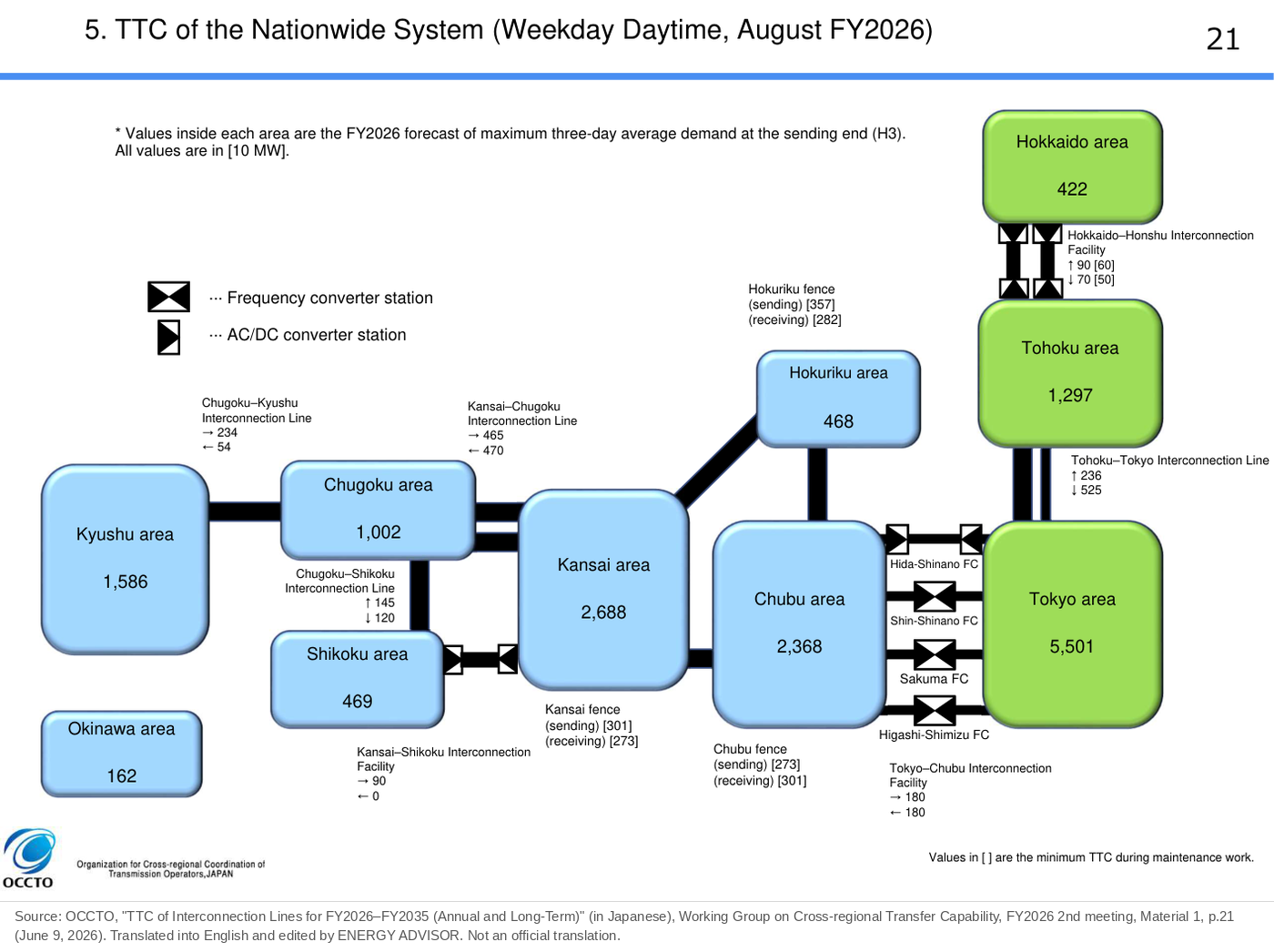
There are ten interconnection facilities in all. Their TTC (the upper limit of electricity that can flow on an interconnection line) for weekday daytime in August FY2026 is as follows.
| Interconnection facility | Areas linked | Type | TTC (MW, weekday daytime, August FY2026) |
|---|---|---|---|
| Hokkaido–Honshu Interconnection Facility | Hokkaido–Tohoku | DC (AC/DC converter stations). Two facilities: Kitahon and Shin-Kitahon | Toward Hokkaido 900 [600] / toward Tohoku 700 [500] |
| Tohoku–Tokyo Interconnection Line | Tohoku–Tokyo | AC | Toward Tohoku 2,360 / toward Tokyo 5,250 |
| Tokyo–Chubu Interconnection Facility | Tokyo–Chubu | Frequency converter stations (50 Hz ⇔ 60 Hz) | Toward Tokyo [1,800] / toward Chubu [1,800] |
| Chubu–Kansai Interconnection Line (Mie–Higashiomi Line) | Chubu–Kansai | AC | Managed by fence (see below) |
| Chubu–Hokuriku Interconnection Facility (Minami-Fukumitsu) | Chubu–Hokuriku | AC (from FY2026; until then, a DC back-to-back converter) | Managed by fence (see below) |
| Hokuriku–Kansai Interconnection Line (Echizen–Reinan Line) | Hokuriku–Kansai | AC | Managed by fence (see below) |
| Kansai–Chugoku Interconnection Line | Kansai–Chugoku | AC (two routes) | Toward Kansai 4,650 / toward Chugoku 4,700 |
| Kansai–Shikoku Interconnection Facility (Anan–Kihoku HVDC Link) | Kansai–Shikoku | DC (AC/DC converter stations) | Toward Kansai 900 / toward Shikoku 0 |
| Chugoku–Shikoku Interconnection Line | Chugoku–Shikoku | AC | Toward Chugoku 1,450 / toward Shikoku 1,200 |
| Chugoku–Kyushu Interconnection Line | Chugoku–Kyushu | AC | Toward Chugoku 2,340 / toward Kyushu 540 |
From FY2026, the TTC of the three interconnection facilities among Chubu, Hokuriku and Kansai is managed by the following three “fences.”
| Fence | TTC, weekday daytime, August FY2026 (MW) |
|---|---|
| Chubu fence | Toward Hokuriku and Kansai [2,730] / toward Chubu [3,010] |
| Hokuriku fence | Toward Hokuriku [2,820] / toward Chubu and Kansai [3,570] |
| Kansai fence | Toward Kansai [2,730] / toward Chubu and Hokuriku [3,010] |
(Values without square brackets are the TTC when no maintenance work is under way; values in [ ] are the minimum TTC during maintenance work. The minimum TTC during maintenance work is the smallest value while facilities such as transmission lines are taken out of service for work. Source: OCCTO, FY2026 2nd Working Group on Cross-regional Transfer Capability, Material 1, pp.3 and 21)
TTC changes with the month, the time of day and whether facilities are out of service for work. How TTC is determined is explained in “Total Transfer Capability (TTC) of Interconnection Lines” in this series.
AC/DC Converter Stations and Frequency Converter Stations
Besides AC transmission lines, some interconnection lines use facilities that convert between AC and DC. OCCTO’s nationwide map shows “frequency converter stations” and “AC/DC converter stations” separately.
Frequency converter stations (FC) link the 50 Hz Tokyo area with the 60 Hz Chubu area. They convert AC to DC and then back to AC at the other frequency. The Tokyo–Chubu Interconnection Facility consists of four FCs: Shin-Shinano, Sakuma, Higashi-Shimizu and Hida-Shinano.
AC/DC converter stations link areas with the same frequency by DC. The Hokkaido–Honshu Interconnection Facility and the Kansai–Shikoku Interconnection Facility are of this type. The Hokkaido–Honshu Interconnection Facility consists of two DC facilities, Kitahon and Shin-Kitahon. The Anan–Kihoku HVDC Link between Kansai and Shikoku is a DC transmission facility with a route length of 48.9 km, including submarine cables.
On a DC facility, the direction and amount of power flow can be controlled as set. On AC transmission lines, electricity splits across multiple routes according to how easily it flows on each. This difference also shows up in how TTC is managed.
The Central-Area AC Loop and “Fences”
The Chubu and Hokuriku areas used to be linked by the DC interconnection facility at the Minami-Fukumitsu interconnection station, a back-to-back (BTB) converter (a facility that converts AC to DC and immediately back to AC). In FY2026, this BTB was retired, and the three areas of Chubu, Hokuriku and Kansai moved to an AC loop, the “Central-Area AC Loop.”
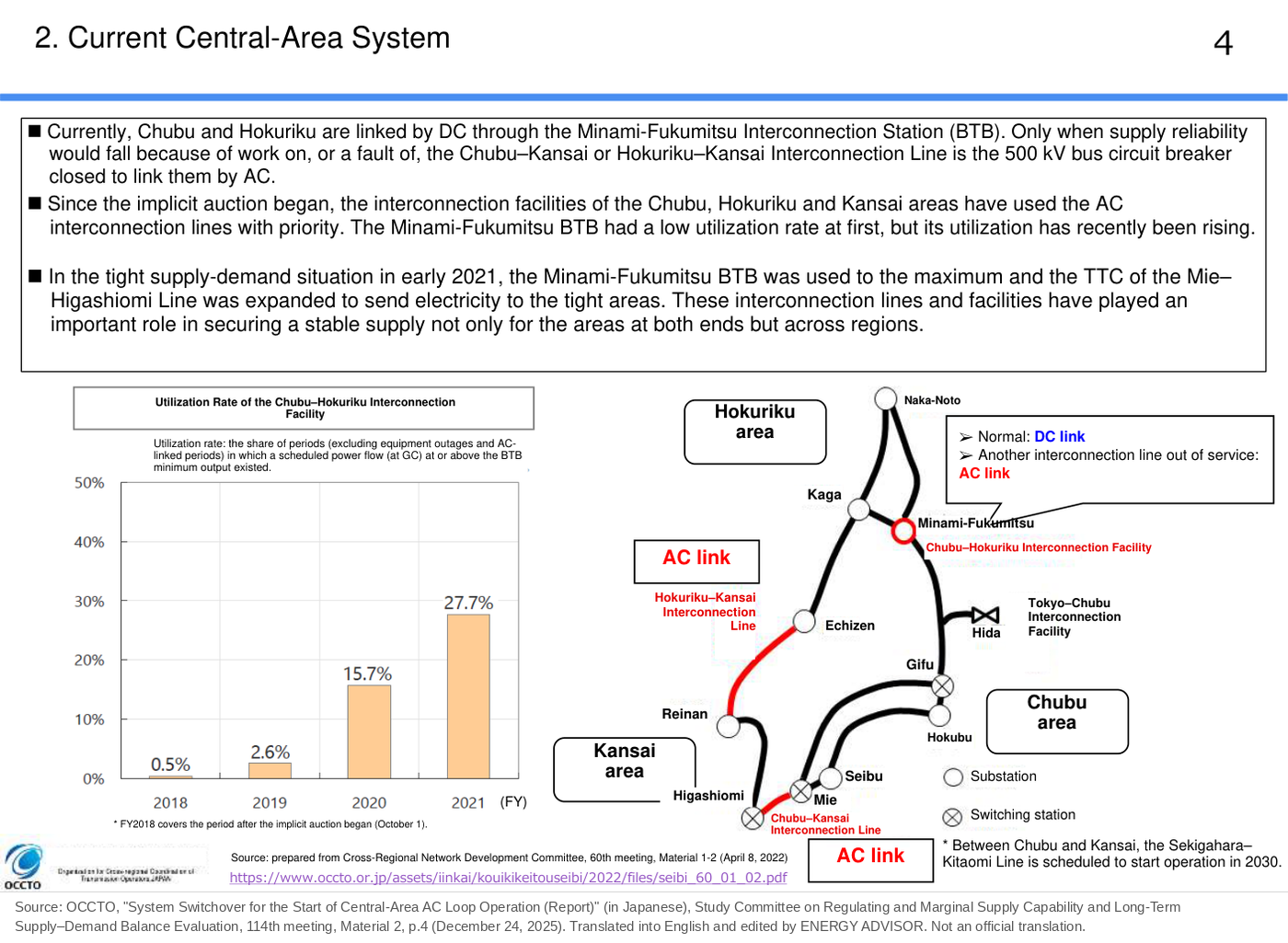
In an AC loop, when one route stops because of a fault, the electricity it carried flows around to the remaining routes. For this reason, TTC is managed not for each interconnection line but by “fences.” A fence is a cross-section that sums the power flows on the two interconnection facilities connected to an area. The Kansai–Chugoku Interconnection Line, which links the two areas by two routes, is likewise managed by a fence (the sum of its flows).
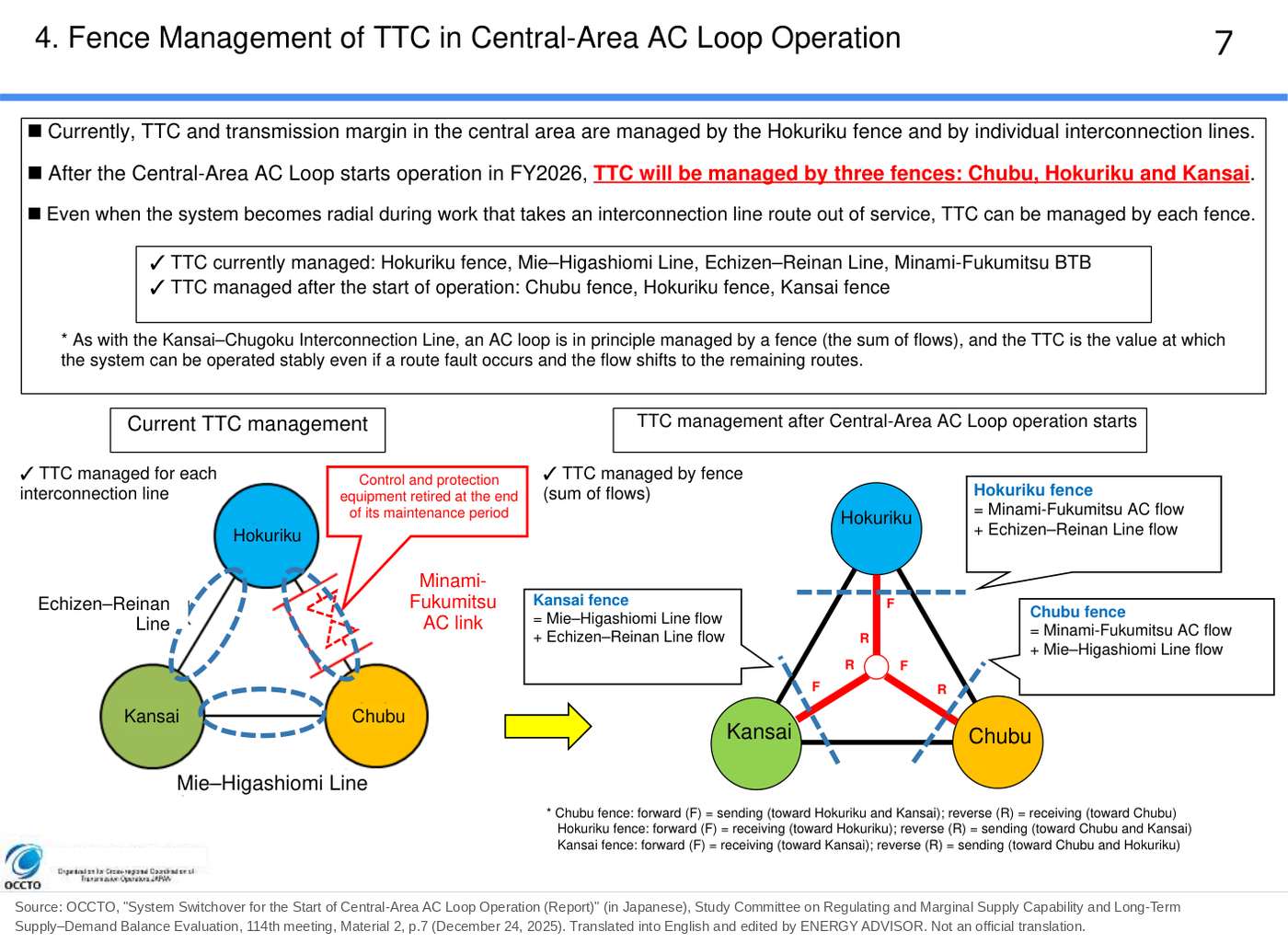
The background of the Central-Area AC Loop and how its TTC is determined are explained in detail in the case-study article in this series, “Start of the Central-Area AC Loop and Fence-Based Management.”
Role of Interconnection Lines
One role of interconnection lines is the exchange of power between areas. When one area runs short of power, sending power from an area with spare supply raises the reliability of supply as a whole. In practice, when supply capacity has fallen short, power has been exchanged between areas on OCCTO’s instructions.
Interconnection lines are also used when power is to be sent to a different area. For example, sending power from a generator in Kyushu to a customer in Tokyo uses the interconnection lines in between. Today, trades between areas are allocated to the interconnection lines through JEPX’s day-ahead market (spot market) (“Implicit Auction” in this series).
In addition, supply must always match demand. Balancing supply and demand is easier when the system is operated as one system that is as large as possible. For this reason, the areas are basically always operated while linked by interconnection lines. Electricity is exchanged between 50 Hz and 60 Hz through the frequency converter stations.
Division of Ownership and Operating Rules
The interconnection facilities are owned and operated day to day by each area’s GT&D company.
OCCTO operates the rules for using the interconnection lines fairly across the country. Specifically, it does the following:
- Calculates and publishes the TTC of the interconnection lines (the upper limit of flow) (Working Group on Cross-regional Transfer Capability)
- Calculates and publishes the transmission margin (capacity kept free in case of contingencies) (Working Group on Transmission Margin)
- Manages the use of the interconnection lines (scheduled power flow) based on market clearing results
The calculation conditions and results are published as materials of the Working Group on Cross-regional Transfer Capability and the Working Group on Transmission Margin. Daily values can be checked on OCCTO’s system information service.
Planned Reinforcements
Reinforcements of the interconnection lines are planned in stages. The schedule shown in OCCTO’s materials as of June 2026 is as follows.
| Interconnection facility | Reinforcement | Planned timing |
|---|---|---|
| Hokkaido–Honshu Interconnection Facility | Reinforcement of 300 MW | FY2027 |
| Tohoku–Tokyo Interconnection Line | Start of operation of the second interconnection line (500 kV Marumori–Iwaki Trunk Line, etc.) | November 2027 |
| Tokyo–Chubu Interconnection Facility | Completion, in stages, of reinforcement work of 900 MW | By FY2028 |
| Chubu–Kansai Interconnection Line | New Sekigahara–Kitaomi Line. The Chubu and Kansai fences are expected to expand to around 6,000 MW | FY2030 |
(Source: OCCTO, FY2026 2nd Working Group on Cross-regional Transfer Capability, Material 1, p.20, notes 1–3; FY2025 3rd Working Group on Cross-regional Transfer Capability, Material 3, slide 1)
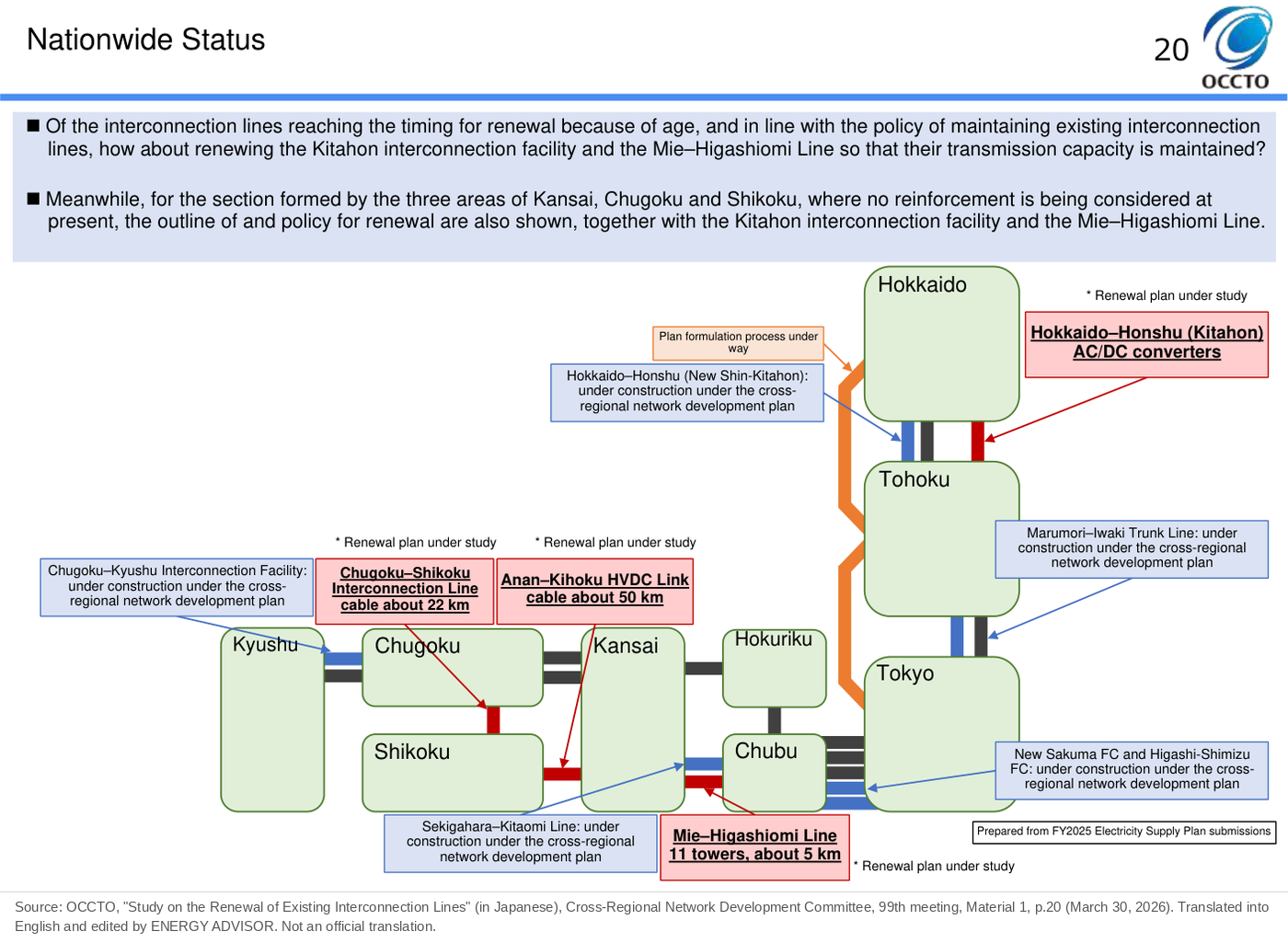
For the Tohoku–Tokyo line, OCCTO’s materials show that even after the reinforcement, TTC is not expected to reach the planned value right away. How this happens is explained in the case-study article in this series, “Tohoku–Tokyo Interconnection Line Falls Short of 10,280 MW Right After Reinforcement (November 2027).”
Summary
An interconnection line is a transmission facility that links the power systems of different areas. In Japan, the nine areas other than Okinawa are linked by ten interconnection facilities. Between 50 Hz and 60 Hz, the link is made by frequency converter stations; sections linked by DC even at the same frequency use AC/DC converter stations.
From FY2026, the links among Chubu, Hokuriku and Kansai form an AC loop, and TTC is managed by three fences. The facilities are owned by the GT&D companies, while OCCTO calculates and publishes TTC and the transmission margin and manages the use of the interconnection lines.
This series goes on to explain TTC and its four limiting factors, transient stability, the transmission margin and the implicit auction in turn, and then connects them to actual cases in 2026 (Kansai–Shikoku, Tohoku–Tokyo and the Central-Area AC Loop).
This article is based on published materials from the Ministry of Economy, Trade and Industry and its Agency for Natural Resources and Energy, the Electricity and Gas Market Surveillance Commission, the Organization for Cross-regional Coordination of Transmission Operators (OCCTO) and other sources. The English translations of figures are by ENERGY ADVISOR and are not official translations. When using this information for decisions, please check the original sources. When we find an error, we correct the article and note the date of the correction.
Sources
- OCCTO, FY2026 2nd Working Group on Cross-regional Transfer Capability, Material 1, “Total Transfer Capability of Interconnection Lines for FY2026–FY2035 (Annual and Long-Term)” (in Japanese), p.3 (annual TTC for FY2026, weekday daytime), p.20 (long-term TTC and notes 1–4), p.21 (TTC of the nationwide system, weekday daytime in August FY2026), June 9, 2026. https://www.occto.or.jp/assets/iinkai/unyouyouryou/26002/2026_2_1.pdf
- OCCTO, published version of “Total Transfer Capability of Interconnection Lines for FY2026–FY2035 (Annual and Long-Term)” (in Japanese), March 2026. https://www.occto.or.jp/assets/renkeisenriyou/oshirase/2025/files/oshirase_1_2026-2035_unyouyouryou.pdf
- OCCTO, Study Committee on Regulating and Marginal Supply Capability and Long-Term Supply–Demand Balance Evaluation, 114th meeting, Material 2, “System Switchover for the Start of Operation of the Central-Area AC Loop (Report)” (in Japanese), pp.5 and 7, December 24, 2025. https://www.occto.or.jp/assets/iinkai/chousei_jukyu/114/chousei_114_02.pdf
- OCCTO, Cross-Regional Network Development Committee, 99th meeting, Material 1, “Study on the Renewal of Existing Interconnection Lines” (in Japanese) (facility overview of the Anan–Kihoku HVDC Link). https://www.occto.or.jp/assets/iinkai/kouikikeitouseibi/99/seibi_99_01_01.pdf
- OCCTO, FY2025 3rd Working Group on Cross-regional Transfer Capability, Material 3, “Method for Calculating TTC After Reinforcement of the Tohoku–Tokyo Interconnection Line” (in Japanese), slide 1, December 15, 2025. https://www.occto.or.jp/assets/iinkai/unyouyouryou/25003/2025_3_3.pdf
- OCCTO, Working Group on Cross-regional Transfer Capability (purpose) (in Japanese). https://www.occto.or.jp/iinkai/unyouyouryou/index.html ; Working Group on Transmission Margin (purpose) (in Japanese). https://www.occto.or.jp/iinkai/margin_kentoukai/index.html
- OCCTO, Cross-Regional Network Development Committee, 99th meeting, Material 1, “Study on the Renewal of Existing Interconnection Lines” (in Japanese), p.20 (nationwide status; map of interconnection lines prepared from the FY2025 Electricity Supply Plan submissions), March 30, 2026. https://www.occto.or.jp/assets/iinkai/kouikikeitouseibi/99/seibi_99_01_01.pdf
- OCCTO, Study Committee on Regulating and Marginal Supply Capability and Long-Term Supply–Demand Balance Evaluation, 114th meeting, Material 2 (in Japanese), p.4 (current central-area system), December 24, 2025. https://www.occto.or.jp/assets/iinkai/chousei_jukyu/114/chousei_114_02.pdf