In Japan, who can use an interconnection line (a transmission facility linking areas) is decided by the results of wholesale electricity market trading. This mechanism is called the implicit auction. This article explains the purpose and mechanism of the implicit auction, market splitting and the risk of price spreads between areas, and the changes up to 2026.
Trading takes place on the day-ahead market (spot market) of the Japan Electric Power Exchange (JEPX), Japan’s only wholesale power exchange, where electricity for delivery the next day is traded in 48 periods of 30 minutes per day, and on the intraday market (where trading is possible after the day-ahead market until just before delivery). Market conditions are monitored by the Electricity and Gas Market Surveillance Commission (EGC) of the Ministry of Economy, Trade and Industry.
The First-Come, First-Served Rule and Its Problems
Until September 2018, the power flowing on interconnection lines was decided under the “first-come, first-served rule.”
First-come, first-served is a rule under which the right to use an interconnection line can be reserved in the order in which use is requested. However, on some interconnection lines, companies that had applied earlier had already left too little available transfer capability (ATC). As a result, even when new generators with low generation costs were built, they could not use the interconnection lines.
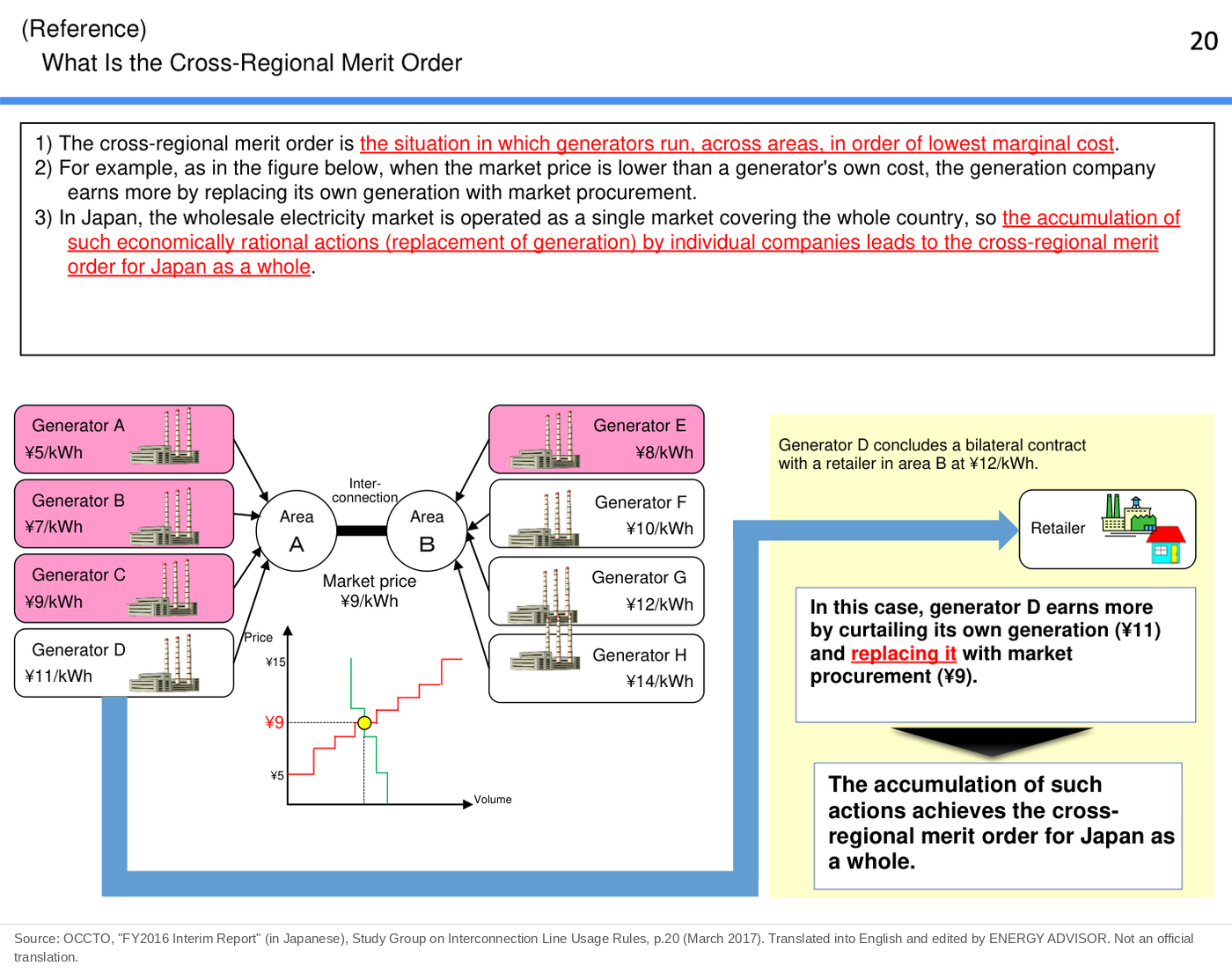
The basis of supply and demand is the “merit order,” running generators in order starting from those with the lowest generation costs. To achieve this nationwide, government councils studied changing the system so that interconnection lines could be used in order of lowest generation cost.
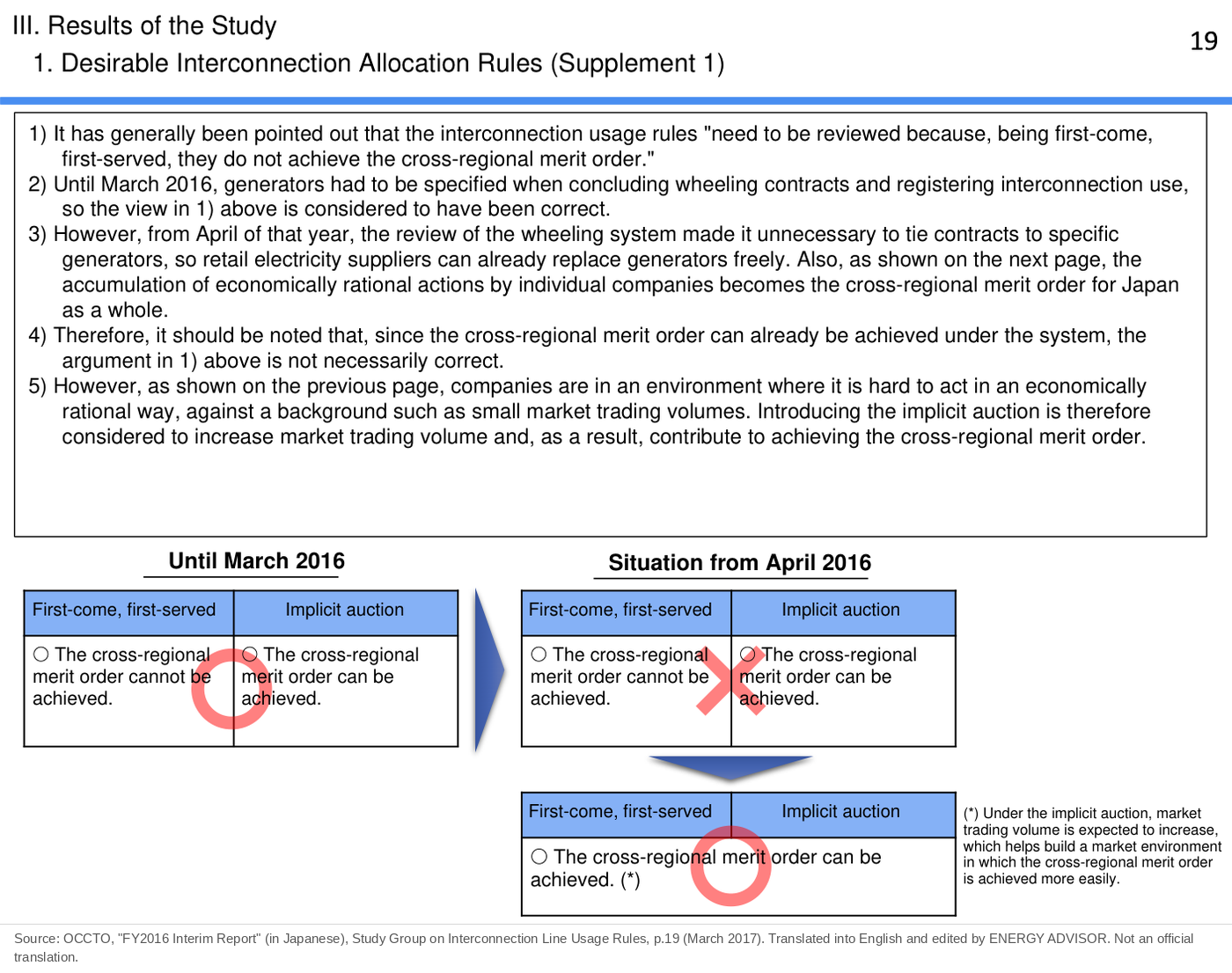
As a result, from October 2018, the “implicit auction” started, allowing interconnection lines to be used in order starting from the generators with the lowest bid prices, based on the clearing results of the day-ahead market.
Implicit Auction Mechanism (All Capacity to the Spot Market)
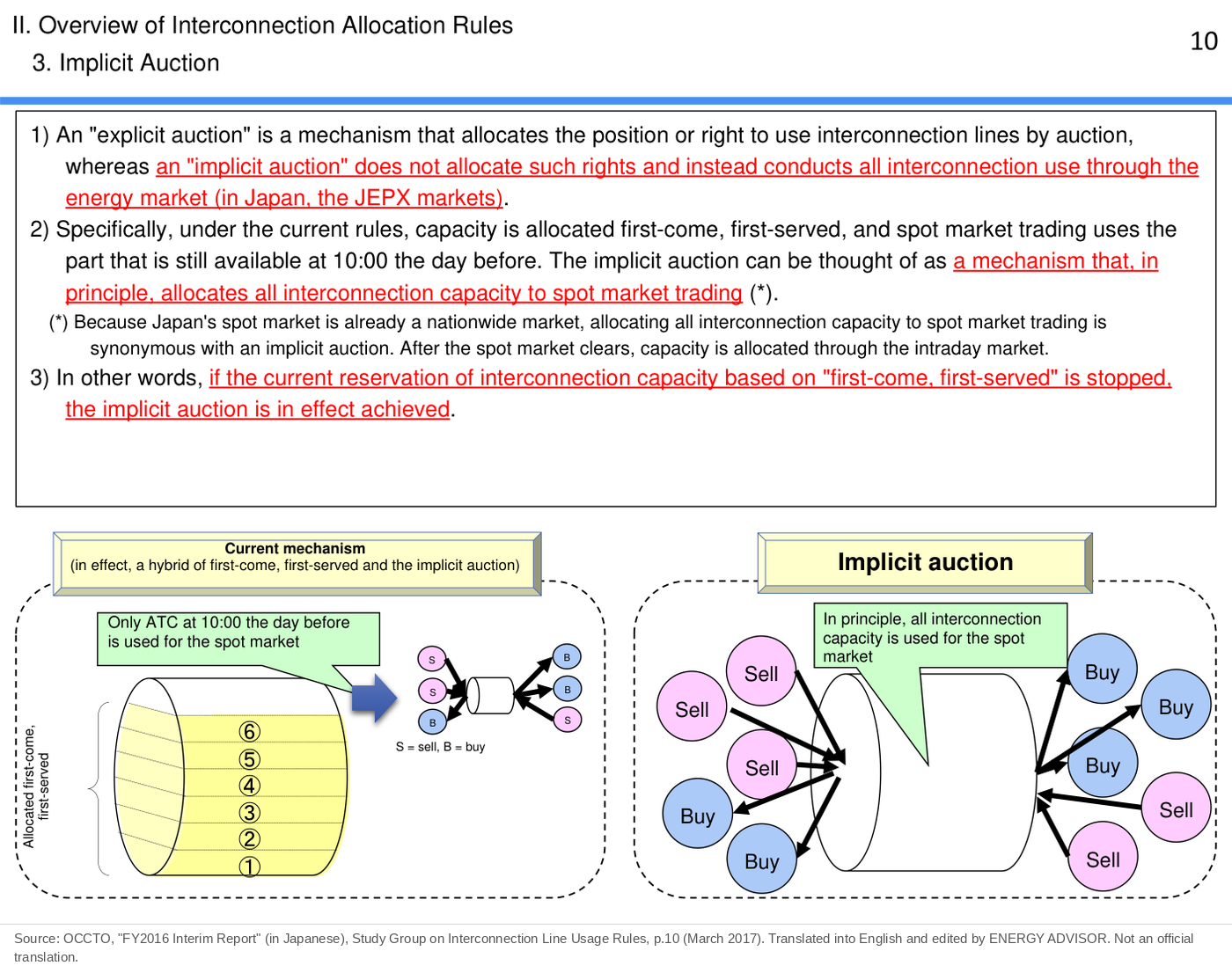
The purpose of the implicit auction is to use interconnection lines efficiently through the spot market and achieve the merit order over a wide area.
Under the first-come, first-served rule, transmission capacity was allocated in the order in which interconnection usage plans were submitted, and any capacity still free at 10:00 the day before was used for spot market trading. Since the implicit auction was introduced, the capacity of all interconnection lines has been allocated from the start to trading on JEPX’s day-ahead market. ATC left over from the day-ahead market is used afterward on the intraday market.
| Item | First-come, first-served rule (until September 2018) | Implicit auction (from October 2018) |
|---|---|---|
| Order of use of interconnection lines | Order in which use was requested | Order of lowest bid price in the spot market |
| Capacity going to the spot market | Capacity still free at 10:00 the day before | All interconnection capacity |
| Remaining capacity | – | Used on the intraday market |
A company wishing to send electricity across areas places a sell bid in the sending area and a buy bid of the same volume in the receiving area on the day-ahead market. This allows exchanges between areas similar to those before to be made through the market.
Market Splitting and Price-Spread Risk
In the day-ahead market clearing process, interconnection capacity is allocated in order starting from the lowest-cost generators. If there are many matches of sell and buy bids between areas and the resulting flow exceeds the ATC of the interconnection line (this is called congestion), matching moves to combinations within each area.
When bids are matched within an area, a difference (price spread) arises between that area’s spot market clearing price (the price for each area is called the area price) and the price in other areas. The shorter an area is of electricity, the higher its price. Congestion on an interconnection line that separates prices between areas is called market splitting.
When market splitting creates a price spread, a trade sending power to the higher-priced area loses the amount of the spread. Conversely, a trade sending power to the lower-priced area gains the amount of the spread. Under the implicit auction, exchanges between areas carry price risk from price spreads.
Indirect Transmission Rights to Hedge Price Spreads
As a mechanism to reduce price-spread risk, JEPX sells “indirect transmission rights” (a type of financial transmission right). JEPX’s explanatory material defines indirect transmission rights as follows.
- A right to receive, or an obligation to pay, the price spread between areas
- Sold by the exchange (for a fee). Holdings are managed by the exchange and cannot be resold
- Not a right to transmit electricity
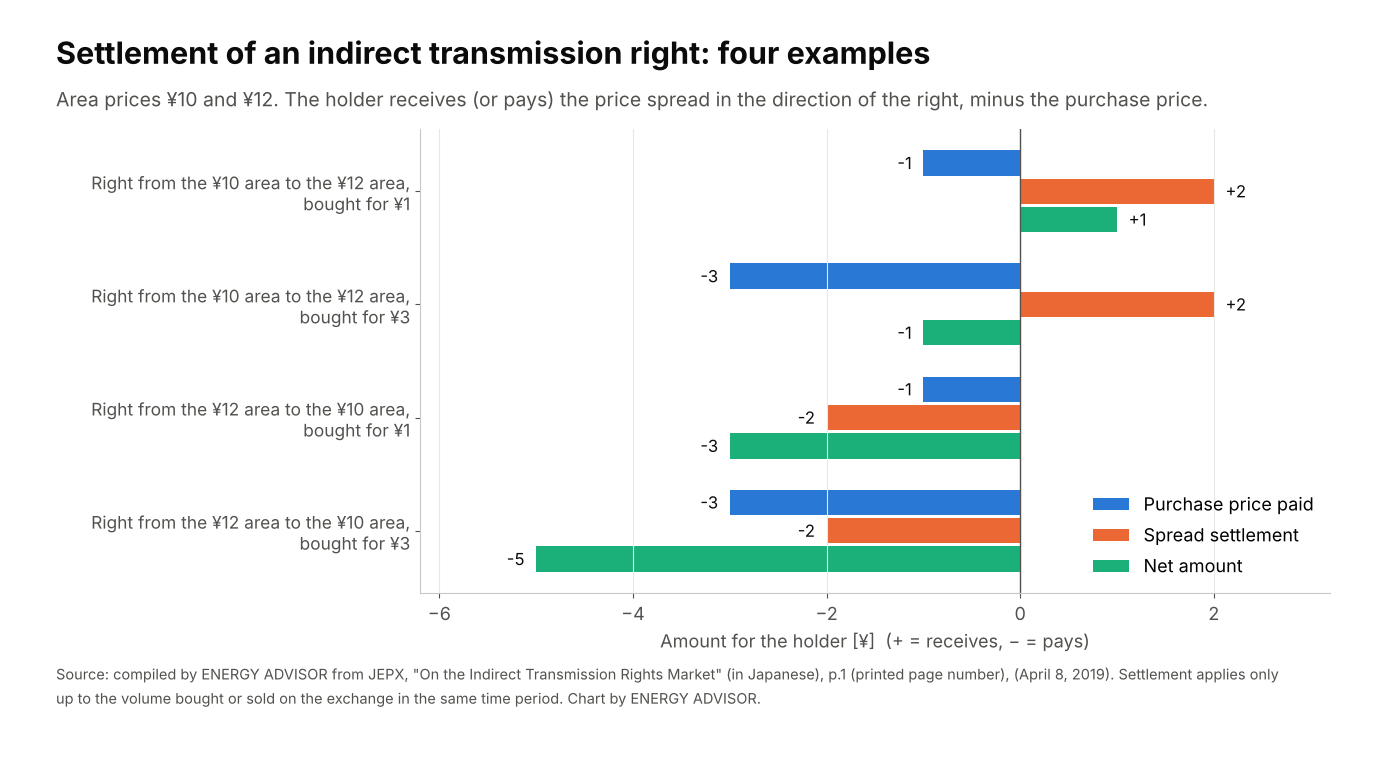
For example, suppose the price in the sending area is ¥10, the price in the receiving area is ¥12, and an indirect transmission right in this direction was bought for ¥1. The holder receives the spread of ¥2 and, after deducting the purchase cost of ¥1, receives ¥1. Settlement of the spread is made up to the volume of electricity bought and sold on the exchange in the same time period.
The following is the content of a JEPX material from April 2019. In that material, the products covered five interconnection lines and six products: Hokkaido–Honshu (Tohoku ⇒ Hokkaido), Tokyo–Chubu (both directions), Chugoku–Shikoku (Shikoku ⇒ Chugoku), Kansai–Shikoku (Shikoku ⇒ Kansai) and Chugoku–Kyushu (Kyushu ⇒ Chugoku). Each product covered one week, as a 24-hour product, in an auction format with the exchange as seller. The volume offered was set as the minimum of “TTC for the period − transmission margin − transitional plan volume.”
On JEPX’s market information page as of October 2026, the interconnection lines that can be selected for indirect transmission right data are Kitahon (both directions), Tohoku–Tokyo (forward), FC (both directions), Kanchu (counter), Anan–Kihoku (counter), Honshi (counter) and Kanmon (counter).
In a notice of April 17, 2026, JEPX set out its approach to sell volumes for the weekly and annual products of the indirect transmission rights market (applied from 2026 trading). The volume offered is determined based on the ATC of the interconnection line.
| Product | Sell volume |
|---|---|
| Weekly product | ATC of the interconnection line for the period, minus the volume cleared for annual products |
| Annual product (traded in September) | One-half of the minimum ATC of the interconnection line for the period, multiplied by one-quarter |
| Annual product (traded in February) | One-half of the minimum ATC of the interconnection line for the period, minus the volume cleared for the product traded in September |
(Source: JEPX, “Approach to Sell Volumes and Prices in the Indirect Transmission Rights Market,” April 17, 2026. This notice does not mention the treatment of the transitional plan volume.)
Transitional Measures at Introduction and Their End in March 2026
When the implicit auction was introduced in October 2018, transitional measures were put in place for companies that had registered use of interconnection lines under the first-come, first-served rule.
The supplementary provisions of the Operational Rules of the Organization for Cross-regional Coordination of Transmission Operators, JAPAN (OCCTO) stated that interconnection usage plans at the long-term stage for FY2016 would be managed as “transitional plans,” and that the companies holding such plans (eligible parties) would be notified of the values that form the basis for settling price spreads. As far as can be read from the supplementary provisions, this was a mechanism for settling price spreads from market splitting within the volume of the transitional plans. The transitional plan volume was also deducted from the volume of indirect transmission rights offered.
These transitional measures ended on March 31, 2026. OCCTO has deleted the related supplementary provisions from its Operational Rules and its Network Codes. The deletion takes effect on April 1, 2026, or on the date of approval by the Minister of Economy, Trade and Industry, whichever is later.
| Date | Event |
|---|---|
| October 2018 | Implicit auction starts. Transitional measures for registered interconnection use are put in place |
| April 2019 | JEPX publishes an explanatory material on the indirect transmission rights market |
| March 31, 2026 | Transitional measures end |
| April 1, 2026 (or the date of approval, whichever is later) | Related supplementary provisions of the Operational Rules and the Network Codes are deleted |
(Source: OCCTO, Board of Councilors, Agenda Items 1 and 2; JEPX, “On the Indirect Transmission Rights Market,” April 8, 2019. The deleted supplementary provisions include Articles 3, 5–7 and 9 of the supplementary provisions [September 6, 2017] of the Operational Rules, and Articles 2–5 of the supplementary provisions [September 6, 2017] of the Network Codes.)
Clearing Under Fence Management (from 2026)
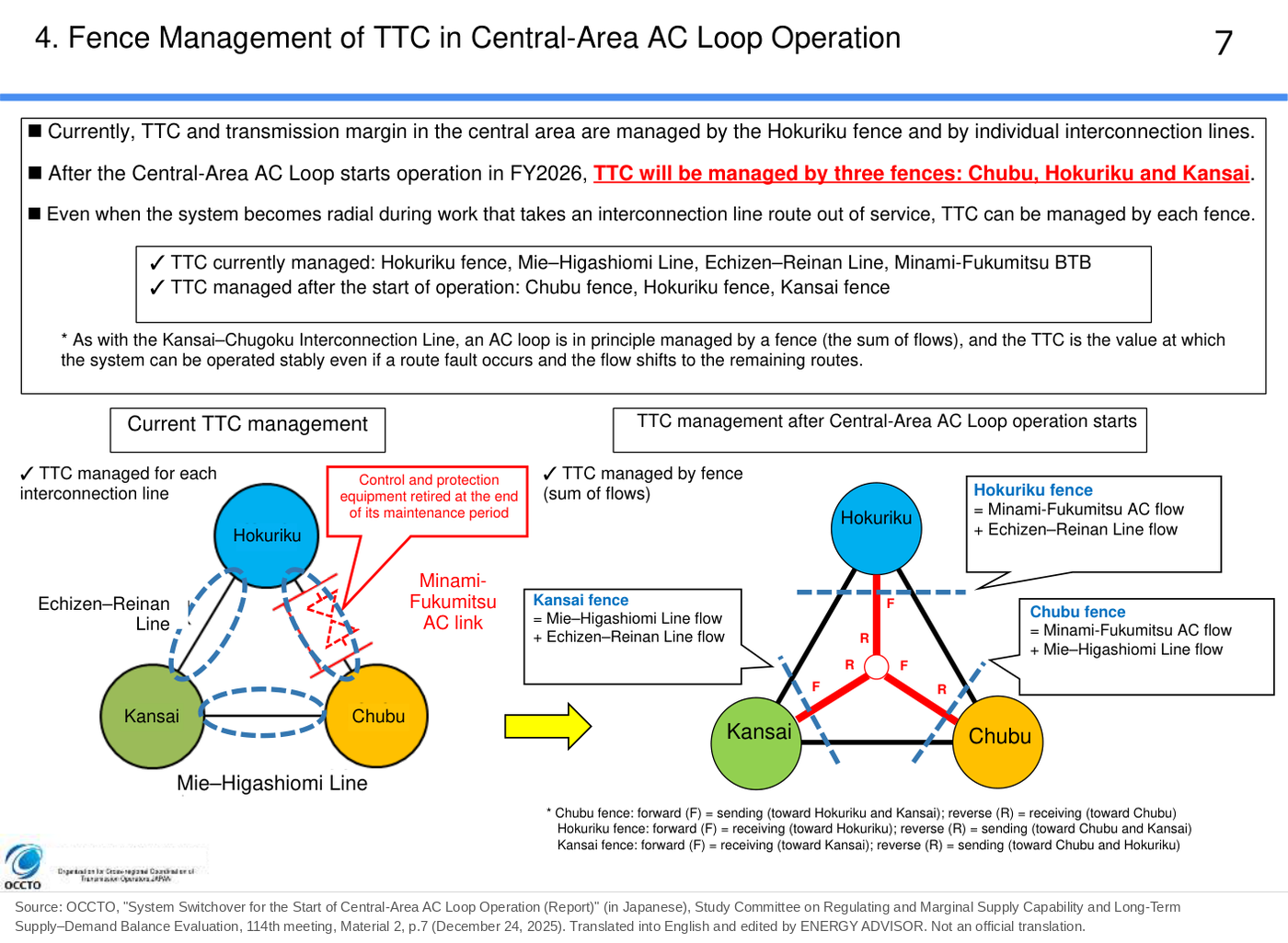
In March 2026, the interconnection lines among the three areas of Chubu, Hokuriku and Kansai were switched over to operate as an AC loop (the Central-Area AC Loop). Along with this, total transfer capability (TTC) management changed from each interconnection line to three “fences” for Chubu, Hokuriku and Kansai. A fence is a cross-section that sums the flows on the two interconnection facilities connected to an area.
The ATC of the three fences is also used in the clearing of JEPX’s spot and intraday markets and of the balancing market. How the Central-Area AC Loop works is explained in detail in the case-study article in this series, “Start of the Central-Area AC Loop and Fence-Based Management.”
Case: Market Splitting Between Chubu and Kansai in 2026
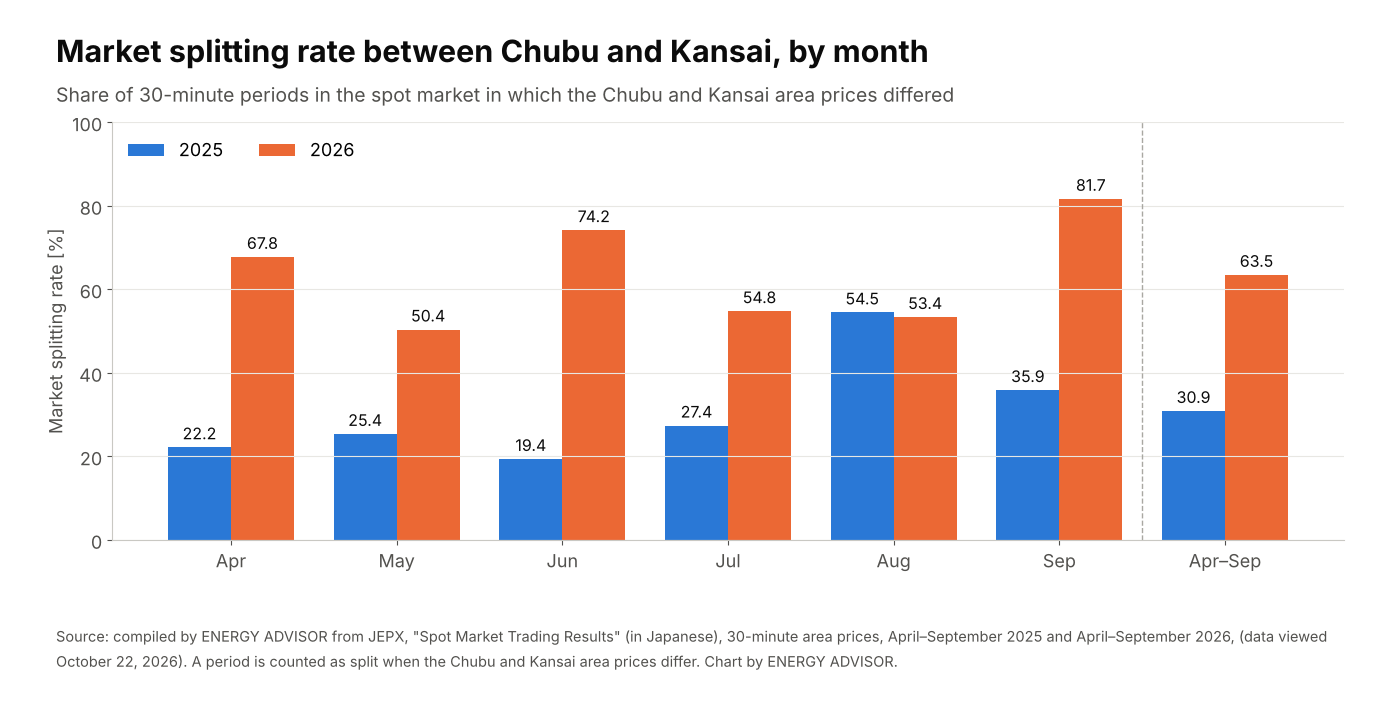
From April to September 2026, the spot market splitting rate between Chubu and Kansai was 63.5%, about double the 30.9% of the same period a year earlier (April–September 2025). The splitting rate is the share of 30-minute products in which the prices of the two areas differed (compiled from JEPX spot market trading results).
| Market splitting rate between Chubu and Kansai | April–September 2025 | April–September 2026 |
|---|---|---|
| All hours | 30.9% | 63.5% |
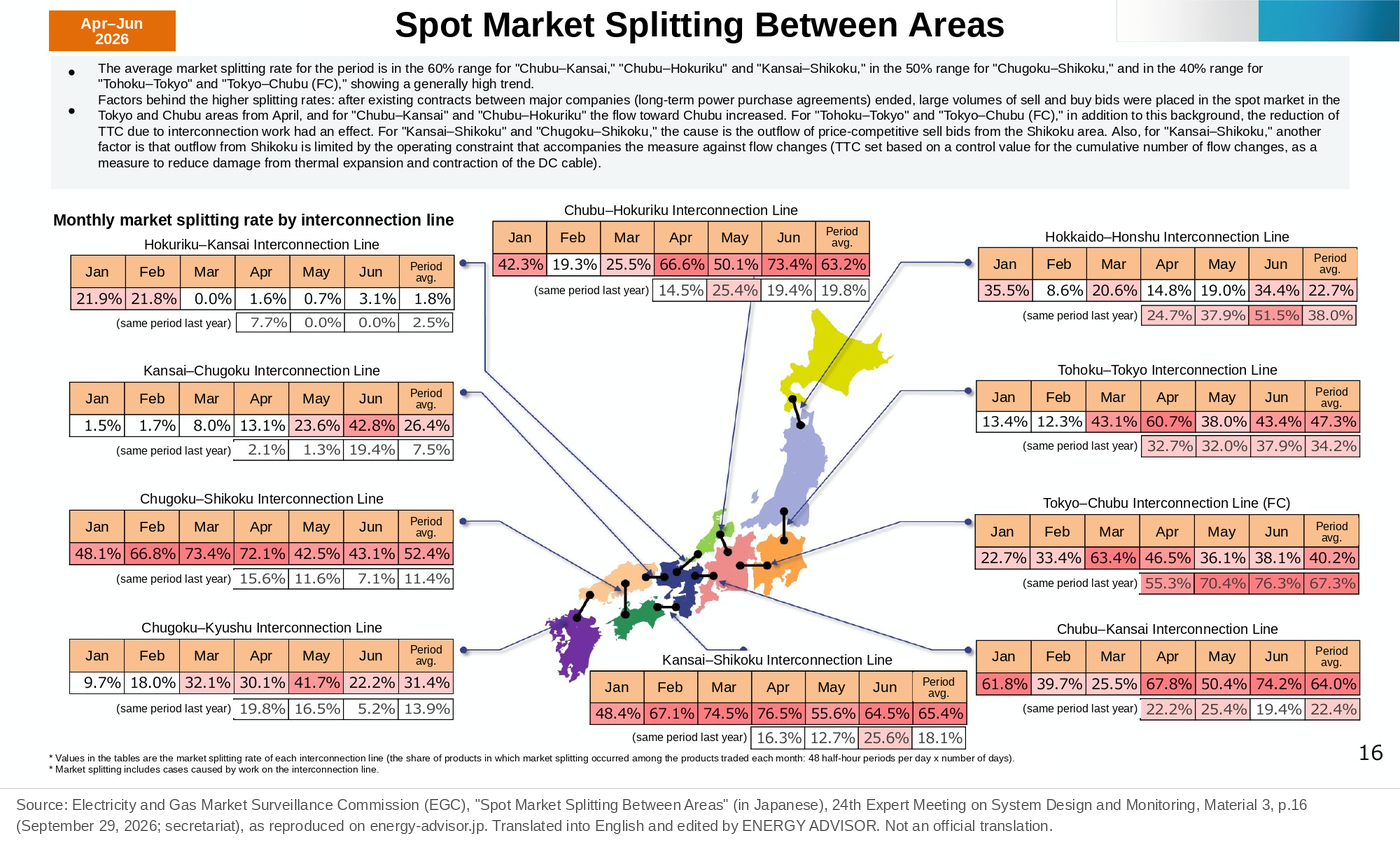
The EGC explains market splitting in April–June 2026 as follows.
“The factor behind the higher splitting rate was that, with the end of existing contracts (long-term power purchase agreements) between major companies, large volumes of buy and sell bids were placed on the spot market in the Tokyo and Chubu areas from April, and for ‘Chubu–Kansai’ and ‘Chubu–Hokuriku’ this increased the flow toward Chubu.”
The results checked against published data on TTC and flows are summarized in the case-study article in this series, “Increase in Chubu Market Splitting After the Central-Area AC Loop Started.”
Summary
Until September 2018, interconnection lines were used under the “first-come, first-served rule,” in the order in which use was requested. From October 2018, this changed to the “implicit auction,” in which the capacity of all interconnection lines is allocated to JEPX’s day-ahead market and interconnection lines are used in order starting from the generators with the lowest bid prices.
The implicit auction creates price-spread risk from market splitting. As a means to reduce this risk, JEPX sells indirect transmission rights. The transitional measures put in place at introduction ended on March 31, 2026, and since March 2026 the ATC of the fences has been used in clearing for the central area.
This article is based on published materials from the Ministry of Economy, Trade and Industry and its Agency for Natural Resources and Energy, the Electricity and Gas Market Surveillance Commission, the Organization for Cross-regional Coordination of Transmission Operators (OCCTO) and other sources. The English translations of figures are by ENERGY ADVISOR and are not official translations. When using this information for decisions, please check the original sources. When we find an error, we correct the article and note the date of the correction.
Sources
- OCCTO, Study Group on Interconnection Line Usage Rules, “FY2016 Interim Report” (in Japanese). https://www.occto.or.jp/iinkai/renkeisenriyou/files/renkeisen_2016chuukantorimatome.pdf.pdf
- OCCTO, Board of Councilors, Agenda Item 1, “Partial Amendment of the Operational Rules” (in Japanese) (amendment of provisions following the end of the transitional measures for registered interconnection use; comparison table of the supplementary provisions). https://www.occto.or.jp/assets/hyougiinkai/02042677/2025_3_1.pdf
- OCCTO, Board of Councilors, Agenda Item 2, “Partial Amendment of the Network Codes” (in Japanese). https://www.occto.or.jp/assets/hyougiinkai/02042677/2025_3_2.pdf
- JEPX, “On the Indirect Transmission Rights Market” (in Japanese), pp.1–5, April 8, 2019. https://www.jepx.jp/electricpower/news/pdf/jepx20190405.pdf
- JEPX, market information, “Indirect Transmission Rights Market” (in Japanese) (viewed October 22, 2026). https://www.jepx.jp/electricpower/market-data/transmission_rights/
- OCCTO, Study Committee on Regulating and Marginal Supply Capability and Long-Term Supply–Demand Balance Evaluation, 114th meeting, Material 2, “System Switchover for the Start of Operation of the Central-Area AC Loop (Report)” (in Japanese), December 24, 2025. https://www.occto.or.jp/assets/iinkai/chousei_jukyu/114/chousei_114_02.pdf
- EGC, 24th Expert Meeting on System Design and Monitoring, Material 3, “Monitoring Report on Voluntary Efforts and Competition (April–June 2026)” (in Japanese), p.16, September 29, 2026. https://www.egc.meti.go.jp/activity/emsc_systemsurveillance/pdf/024_03_00.pdf
- JEPX, spot market trading results (the market splitting rates are the values compiled in article 09 of this series).
- JEPX, “Approach to Sell Volumes and Prices in the Indirect Transmission Rights Market” (in Japanese), April 17, 2026. https://www.jepx.jp/electricpower/outline/pdf/jepx20260417.pdf
- OCCTO, Study Group on Interconnection Line Usage Rules, “FY2016 Interim Report” (in Japanese), p.10 (comparison of first-come, first-served and the implicit auction), pp.19–20 (cross-regional merit order), March 2017. https://www.occto.or.jp/iinkai/renkeisenriyou/files/renkeisen_2016chuukantorimatome.pdf.pdf