Part of the total transfer capability (TTC) of an interconnection line (the upper limit of electricity that can flow on it) is allocated to a block called the transmission margin. This article explains what the transmission margin is, why it is held, and where and how much is set in FY2026 (April 2026–March 2027). How TTC is determined is explained in “Total Transfer Capability (TTC) of Interconnection Lines” in this series.
Definition of Transmission Margin
The upper limit of electricity that can flow on an interconnection line is called TTC. TTC is divided into the following three parts.
| Part | Meaning |
|---|---|
| Scheduled power flow (SPF) | Flow (of electricity) already allocated to the interconnection line, based on market clearing results and other factors |
| Transmission margin | A block of TTC kept as a reserve in case of contingencies |
| Available transfer capability (ATC) | The amount still available: TTC minus the scheduled power flow and the transmission margin |
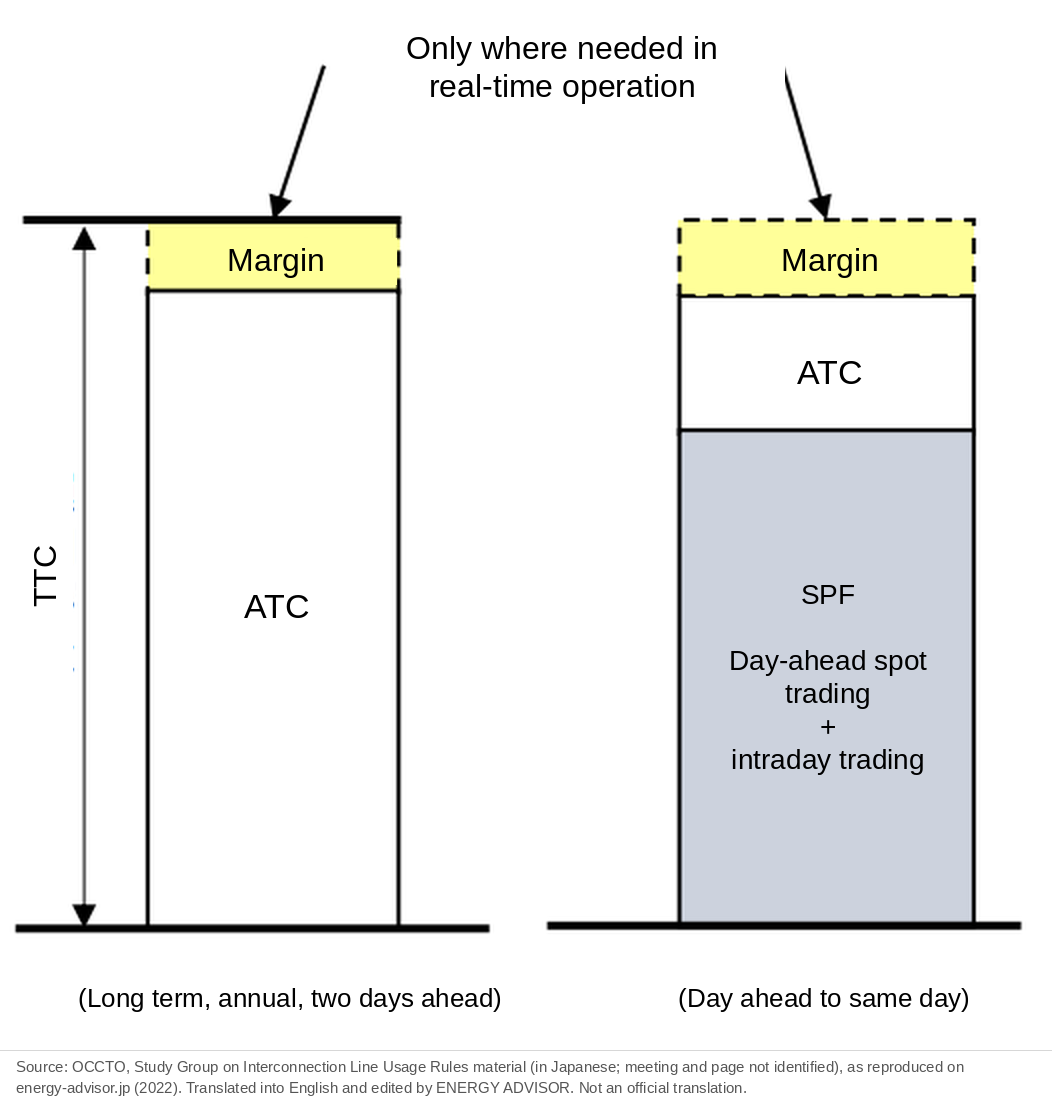
As its name suggests, the transmission margin is part of TTC kept as a reserve for contingencies. TTC minus the transmission margin is the interconnection capacity that retail electricity suppliers and others can use through the market.
Types of Transmission Margin (A, B and C, Plus A0 and B0 for the Balancing Market)
By purpose, the transmission margin is divided into the following three types.
- Margin for supply-demand balance (A)
- Margin for frequency control (B)
- Margin for limiting interconnection flow (C)
In addition, a distinction between “risks normally to be considered” and “rare but severe contingencies (risks that occur only rarely but have a large impact)” is added, giving the breakdown in the table below.
| Type | Risks normally to be considered: procured outside the area | Risks normally to be considered: expected from outside the area | Rare but severe contingencies: expected from outside the area |
|---|---|---|---|
| A Supply-demand balance | A0: tertiary balancing capacity (1) and (2) | A1: equivalent of the largest generating unit | A2: none |
| B Frequency control | B0: primary balancing capacity, secondary balancing capacity (1) (from FY2027) and secondary balancing capacity (2) | B1: Tokyo–Chubu (EPPS: Chubu ⇒ Tokyo), Hokkaido–Honshu (emergency AFC: Tohoku ⇒ Hokkaido) | B2: Tokyo–Chubu (EPPS: Tokyo ⇒ Chubu) |
| C Flow limitation | – | C1: Hokkaido–Honshu (flow limitation) | C2: Tohoku–Tokyo (flow limitation) |
(Source: Organization for Cross-regional Coordination of Transmission Operators, JAPAN [OCCTO], FY2025 4th Working Group on Transmission Margin, Material 2, p.7)
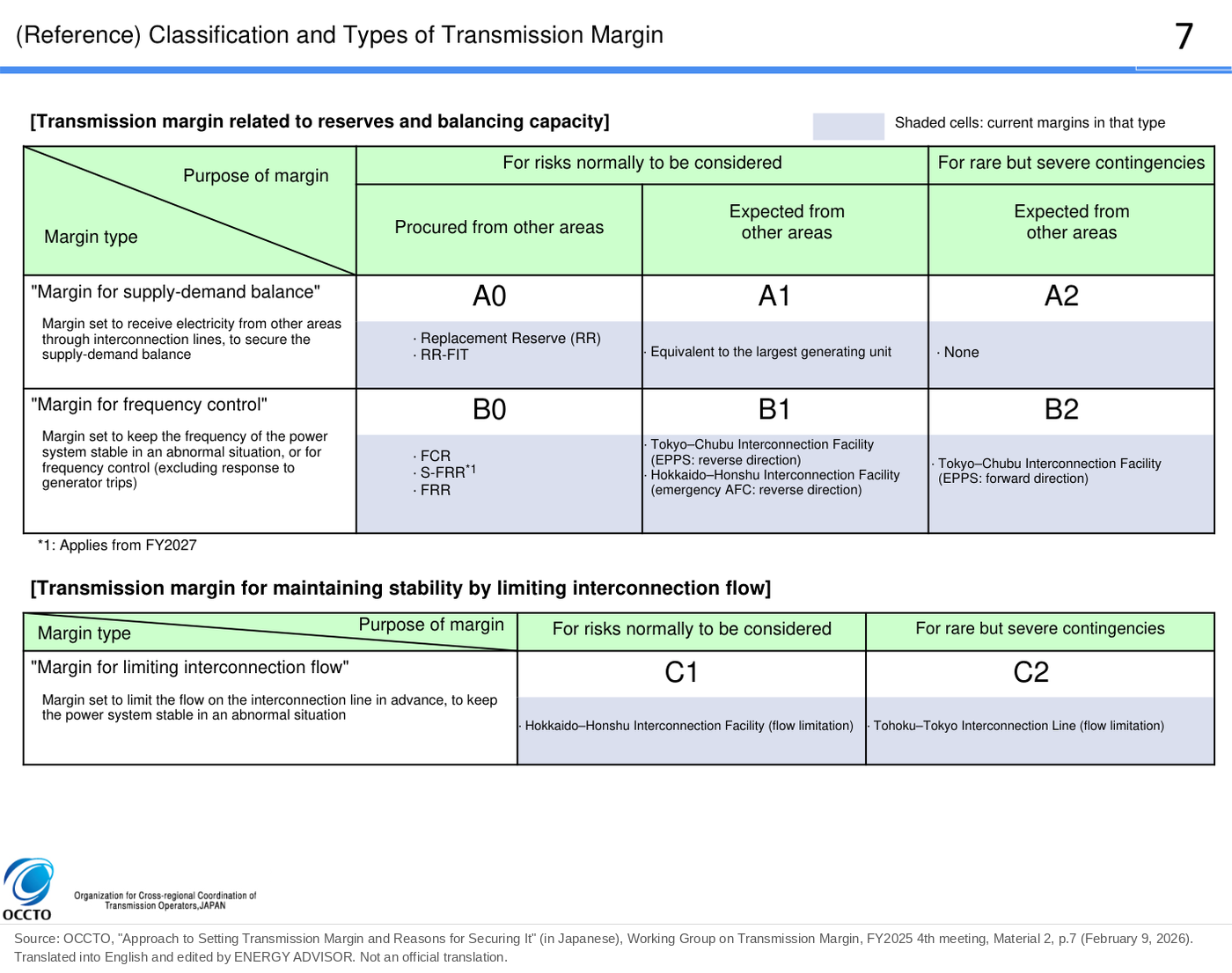
A0 and B0 are margins for using balancing capacity procured from other areas in the Supply and Demand Balancing Market (balancing market), the market in which general transmission and distribution companies (GT&D companies) procure the balancing capacity they use to match supply and demand. Primary, secondary and tertiary balancing capacity are types of balancing capacity divided by how quickly they respond after an instruction. A0 and B0 are included in the breakdown for all interconnection lines, but they are not set at the long-term or annual stage; they are set close to real time, according to the volume cleared outside the area.
The following sections explain the main reasons for holding a margin (A1, B1 and B2, C1 and C2).
Margin for Supply-Demand Balance (A1)
The materials of the Working Group on Transmission Margin describe this as “a margin set to receive electricity from other areas through an interconnection line for the purpose of securing the supply-demand balance.”
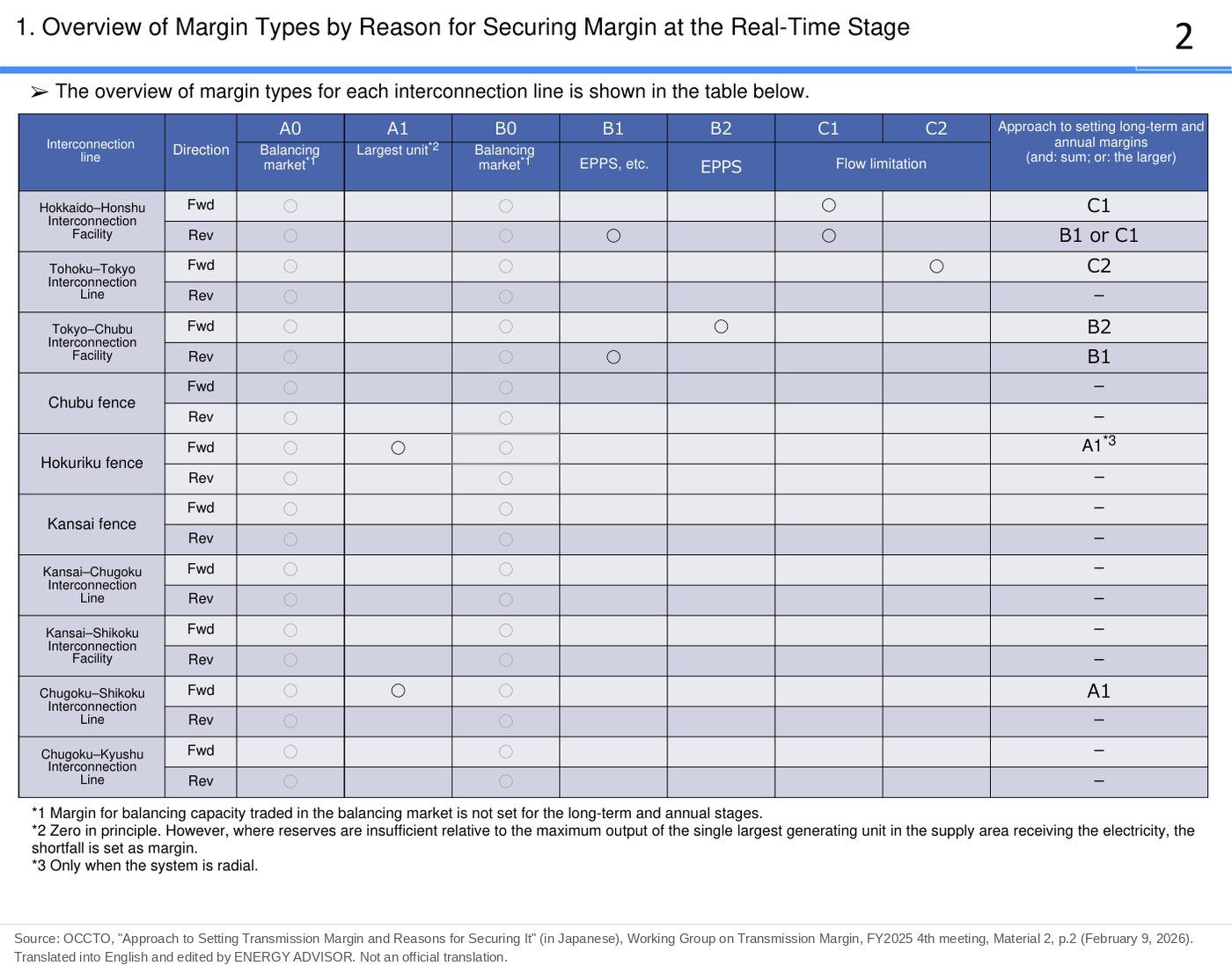
A1 is assigned to the direction of receiving power into relatively small areas at the edges of the system (the Hokuriku and Shikoku areas). In the FY2026 materials, it applies to the Hokuriku fence toward Hokuriku and to the Chugoku–Shikoku Interconnection Line from Chugoku to Shikoku.
The reason for holding it is as follows. If the largest generating unit in a small area stops because of a fault or other cause, the area’s reserve may become insufficient. A block of interconnection capacity is held in advance as a margin so that the shortfall can be received through the interconnection line.
If no margin were held and the interconnection line were fully used by flows into the Hokuriku or Shikoku area, no additional power could be received from other areas when the largest generating unit faulted. Because these areas have large generating units relative to the small size of their systems, the interconnection margin is used to secure supply reliability.
The approach for A1 is that it is zero in principle and that the shortfall is set as a margin only when reserves would become insufficient.
Margin for Frequency Control (B1 and B2)
The materials of the Working Group on Transmission Margin describe this as “a margin set to keep the frequency of the power system stable during abnormal conditions of the power system or for frequency control (excluding responses to generator trips).”
This margin is set on the interconnection facilities that use AC/DC converter stations or frequency converter stations (Hokkaido–Honshu and Tokyo–Chubu). These converter facilities can control the direction and amount of flow instantly. For this reason, they are given a function to send power instantly when the frequency of one area falls.
The frequency converter stations of the Tokyo–Chubu Interconnection Facility have a function called EPPS (Emergency Power Preset Switch). When the frequency of the Tokyo or Chubu area falls below a preset value, 600 MW plus some additional amount can be sent instantly from the healthy area. This can, to some extent, prevent frequency from falling when generation stops on a large scale, for example in an earthquake.
The same function is also provided on the Hokkaido–Honshu Interconnection Facility. As emergency AFC (automatic frequency control), power can be sent instantly from Honshu toward Hokkaido when frequency in the Hokkaido area falls.
Margin for Flow Limitation (C1 and C2)
The materials of the Working Group on Transmission Margin describe this as “a margin set to limit the flow on the interconnection line in advance for the purpose of keeping the power system stable during abnormal conditions of the power system.”
This margin is set on the Hokkaido–Honshu Interconnection Facility (Kitahon) and on the Tohoku–Tokyo Interconnection Line, each for its own purpose.
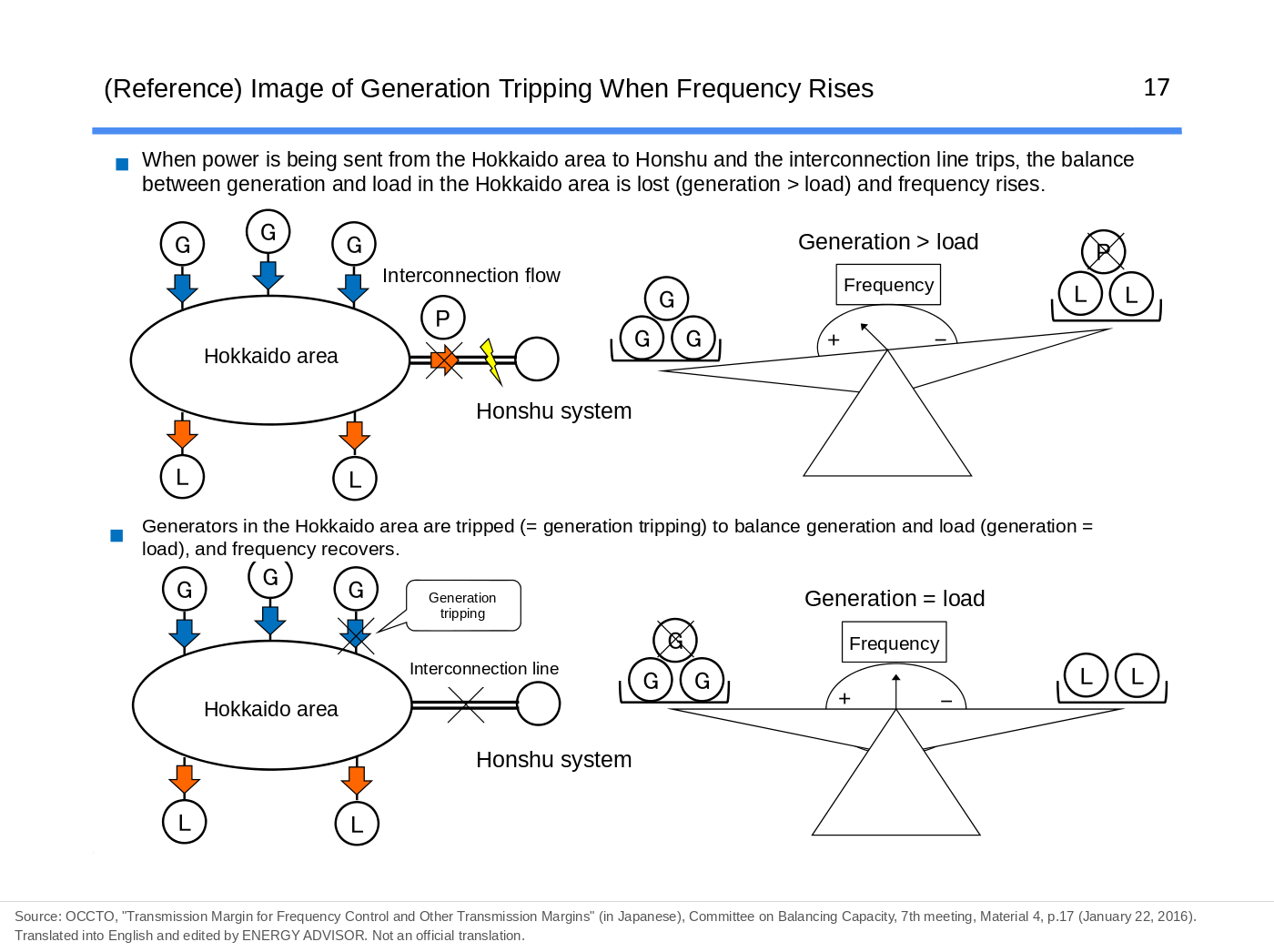
Kitahon (C1): If Kitahon stops in an emergency while flow is running from Hokkaido toward Honshu, the flow has nowhere to go, supply in the Hokkaido area is in surplus, and frequency rises. The larger the flow, the larger the frequency rise. To keep the frequency rise within a set value, the interconnection flow must be kept at or below a set value. Setting a margin keeps the interconnection flow at or below that value.
Tohoku–Tokyo (C2): If multiple power sources stop in the Tokyo area because of a transmission line fault, the power sent from Tohoku to Tokyo increases naturally, and the increase may push the flow above the TTC of the interconnection line. To avoid an interconnection fault while TTC is exceeded, a margin is set to prevent TTC from being exceeded in advance.
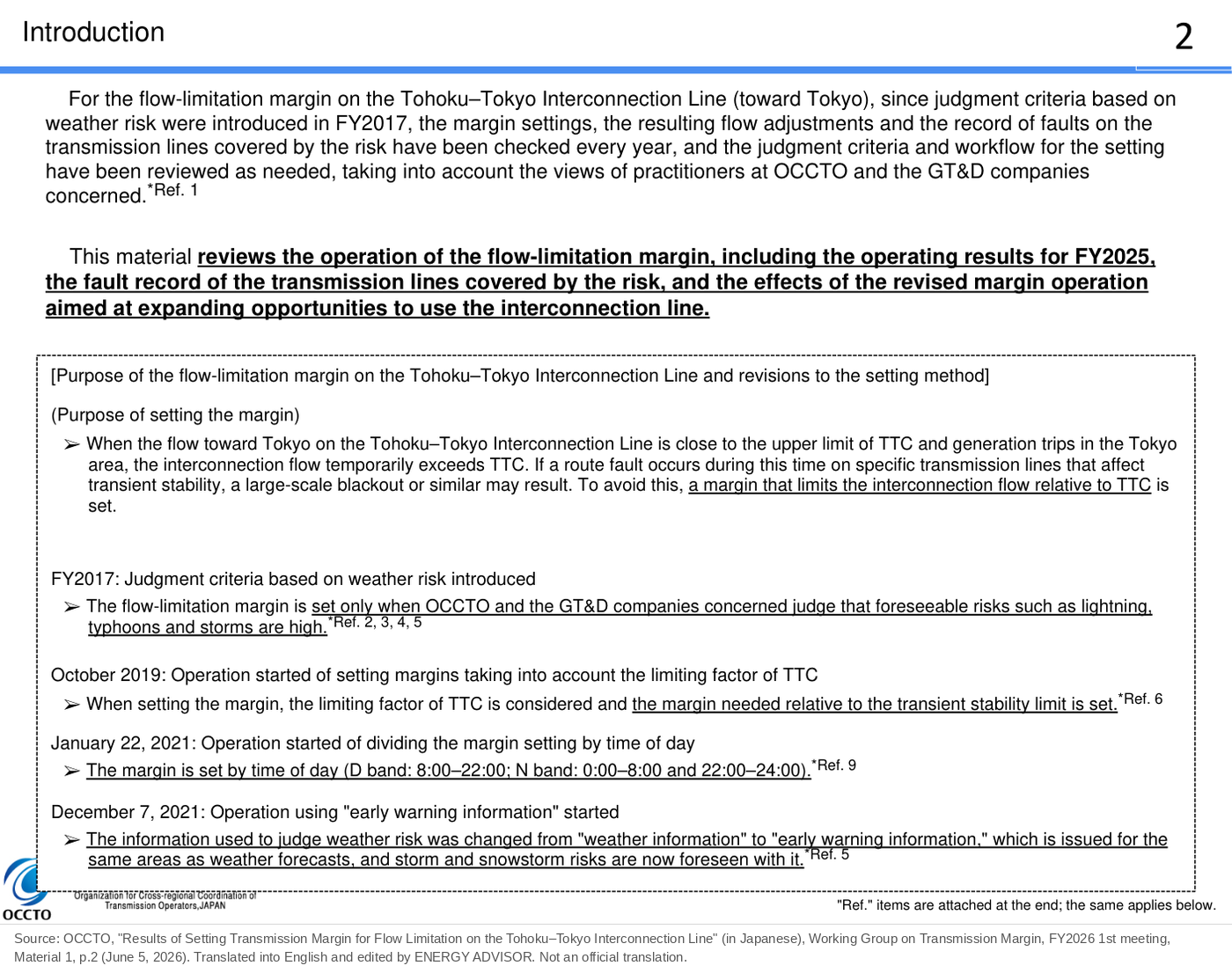
This margin addresses the concern of an interconnection fault while TTC is exceeded. For this reason, it is operated so that it is set when foreseeable risks such as lightning, typhoons or storms increase (since FY2017).
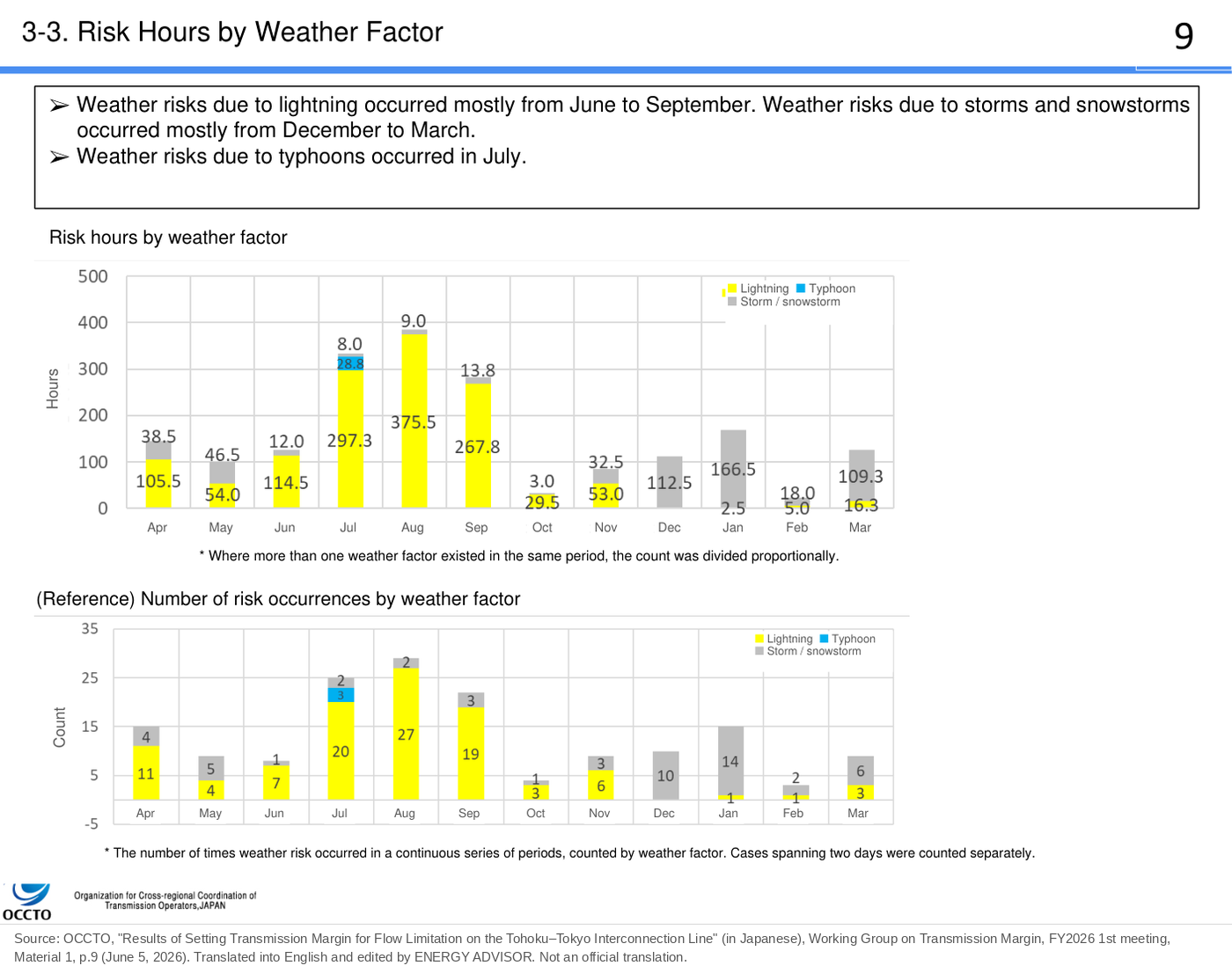
The results for FY2025 are as follows (OCCTO, FY2026 1st Working Group on Transmission Margin, Material 1, p.4).
| Weather risk | Hours with the margin set in real time | Number of times |
|---|---|---|
| Lightning | 1,230.0 hours | 95 |
| Typhoon | 28.8 hours | 3 |
| Storm / snowstorm | 460.3 hours | 47 |
| Total | 1,719.0 hours (19.6% of the 8,760 hours in a year) | – |
The same material reports that there were zero faults on the specified transmission lines during FY2025 (p.13).
Change to the Hokuriku Margin with the Central-Area AC Loop
In FY2026, the interconnection lines among the three areas of Chubu, Hokuriku and Kansai became an AC loop (the Central-Area AC Loop), and the treatment of the Hokuriku A1 margin changed. The reserve margin in the table is the ratio of spare supply capacity to demand.
| System configuration | Long-term to week-ahead stage | Two-days-ahead stage |
|---|---|---|
| Loop network (normal) | 0 | Set only when the reserve margin of the Hokuriku area (taking the ATC of the interconnection lines into account as far as possible) is expected to be below 3% |
| Radial network (either the Echizen–Reinan Line or the Minami-Fukumitsu AC interconnection line out of service) | Set as before | Set as before |
(Source: OCCTO, FY2025 3rd Working Group on Transmission Margin, Material 1, pp.5–6)
A radial network is a state in which the loop is broken and the area is connected in a dead-end shape. The amount set at the two-days-ahead stage is “equivalent of the largest generating unit + demand forecast for two days ahead × 3% − the required volume when primary to tertiary (1) balancing capacity are cleared together.”
With the loop, the Hokuriku area can receive power over two routes, and the amount it can receive also increases. The materials give as reasons that in most recent time periods the ATC of the Hokuriku fence was 700 MW or more, the equivalent of the largest unit, and that no outages of interconnection facilities were planned for the coming winter. They also state that the need for the margin will continue to be studied by looking at flow conditions after loop operation starts.
Settings in FY2026
The annual transmission margin for FY2026 (weekdays) is as follows. Margin values in OCCTO’s materials are given in MW.
| Interconnection line | Direction | FY2026 margin (MW, weekdays) | Type |
|---|---|---|---|
| Hokkaido–Honshu Interconnection Facility | Hokkaido ⇒ Tohoku | 260 for weekday daytime in August (160–320 on weekdays depending on month and time of day) | C1 |
| Hokkaido–Honshu Interconnection Facility | Tohoku ⇒ Hokkaido | 570 for weekday daytime in August (510–600 on weekdays depending on month and time of day) | The larger of B1 and C1 |
| Tohoku–Tokyo Interconnection Line | Tohoku ⇒ Tokyo | 0–370 (July and August), 0–380 (other months except March), 0–450 (March) | C2 |
| Tokyo–Chubu Interconnection Facility | Tokyo ⇒ Chubu / Chubu ⇒ Tokyo | 600 / 600 (all year) | B2 / B1 |
| Chubu, Hokuriku and Kansai fences | Both directions | 0 | – |
| Kansai–Chugoku, Kansai–Shikoku, Chugoku–Shikoku and Chugoku–Kyushu | Both directions | 0 | – |
(Source: OCCTO, FY2025 4th Working Group on Transmission Margin, Material 3, pp.2 and 4. The values for Hokkaido–Honshu during maintenance work are on p.5 onward of the same material. The breakdown of the type for Tohoku ⇒ Hokkaido is on p.11 of the same material; for example, for weekday daytime in April 2026, B1 is 570 and C1 is 400, so the margin is 570.)
The “0–370” for Tohoku–Tokyo means that the margin is normally 0 and is set up to this value at most when risks such as typhoons or snowstorms increase. The margins for the balancing market (A0 and B0) are not included in the annual values, because the volume procured outside the area has not been determined.
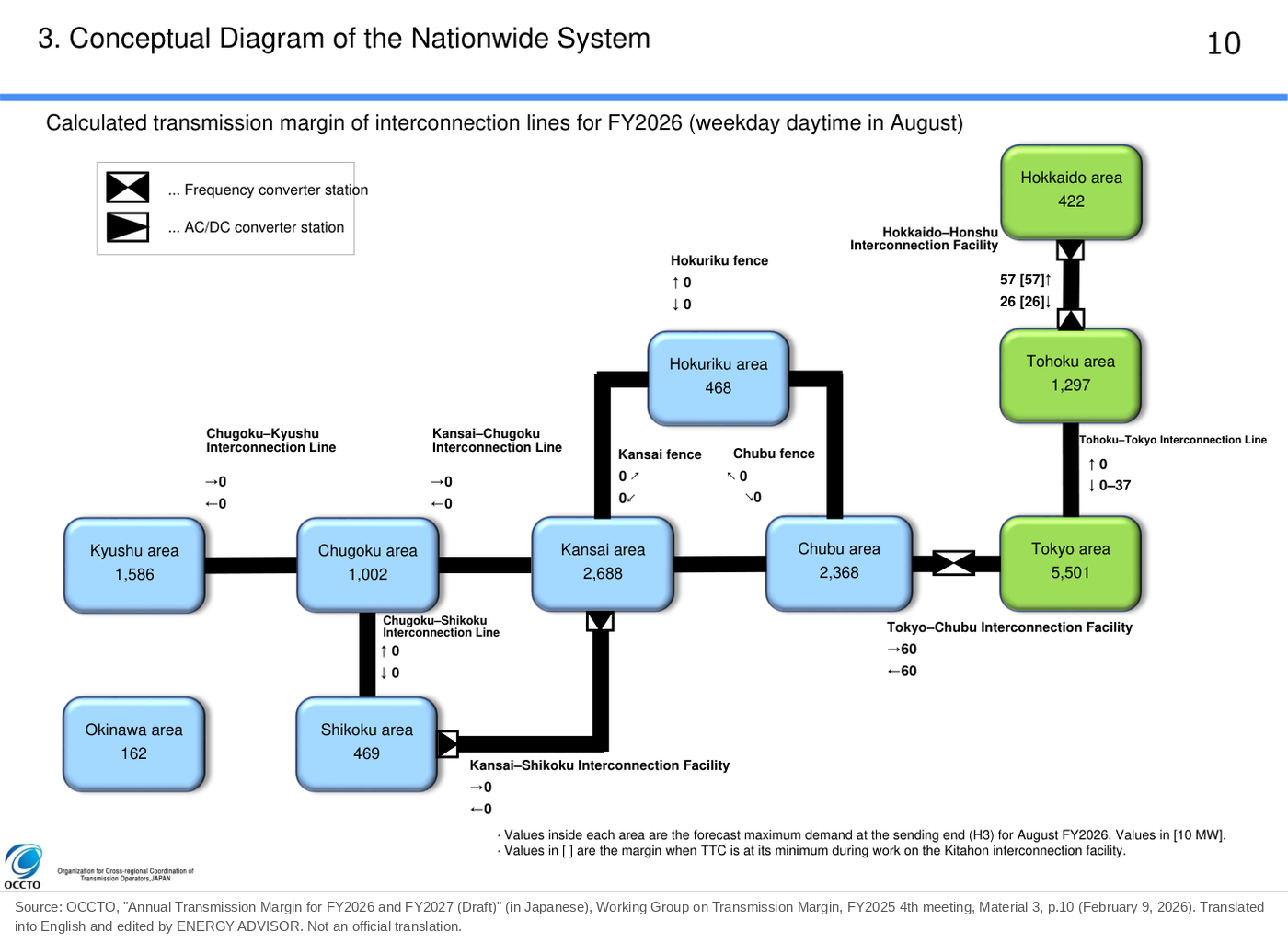
The values for weekday daytime in August are compared between FY2022 and FY2026 below (in MW. The FY2026 values in [ ] are the margin when TTC is at its minimum because of maintenance work on the Hokkaido–Honshu Interconnection Facility [note on p.10 of Material 3]. The FY2022 map also shows values in [ ] in the same positions, but there is no note within the part of the map shown in the original article).
| Interconnection line | Direction | FY2022 | FY2026 |
|---|---|---|---|
| Hokkaido–Honshu Interconnection Facility | Tohoku ⇒ Hokkaido | 570 [300] | 570 [570] |
| Hokkaido–Honshu Interconnection Facility | Hokkaido ⇒ Tohoku | 300 [30] | 260 [260] |
| Tohoku–Tokyo Interconnection Line | Tokyo ⇒ Tohoku | 30 | 0 |
| Tohoku–Tokyo Interconnection Line | Tohoku ⇒ Tokyo | 30–400 | 0–370 |
| Tokyo–Chubu Interconnection Facility | Both directions | 600 / 600 | 600 / 600 |
| Hokuriku fence | Toward Hokuriku | 0–510 | 0 |
| Other interconnection lines and fences | Both directions | 0 | 0 |
(Source: FY2022: OCCTO, Working Group on Transmission Margin, nationwide map in “Annual Transmission Margin for FY2022 and FY2023 (Draft)” [shown in the original article]; FY2026: FY2025 4th Working Group on Transmission Margin, Material 3, p.10)
With the start of the Central-Area AC Loop, the annual value for the Hokuriku fence became 0.
The published transmission margins can be checked in the materials of OCCTO’s Working Group on Transmission Margin (https://www.occto.or.jp/iinkai/margin_kentoukai/index.html) and on the system information service (https://occtonet3.occto.or.jp/public/dfw/RP11/OCCTO/SD/LOGIN_login#).
Calculation and Publication Schedule
The approach to setting the transmission margin is decided at OCCTO’s Working Group on Transmission Margin, and the margin is then calculated. The schedule is the same as for TTC and was brought forward starting with the FY2026 work. The study conditions are published at the end of May, the margin is calculated by the end of January each year, and annual values are published in mid-February and long-term values at the end of February (before the amendment, annual values were published on March 15 and long-term values on the last day of March; see article 02 of this series and OCCTO, FY2025 3rd Working Group on Transmission Margin, Material 2, pp.3–5).
Summary
The transmission margin on an interconnection line is a block of TTC kept as a reserve for contingencies. The reasons for holding it fall broadly into three: the “margin for supply-demand balance,” the “margin for frequency control” and the “margin for limiting interconnection flow.” The breakdown also includes margins for using balancing capacity procured from other areas in the balancing market (A0 and B0).
In FY2026, annual transmission margins are set on Hokkaido–Honshu, Tohoku–Tokyo (in severe weather) and Tokyo–Chubu. With the start of the Central-Area AC Loop, the Hokuriku A1 margin became 0 at the long-term to week-ahead stages when the system is in a loop configuration. The transmission margin is calculated by the end of January each year, and annual values are published in mid-February and long-term values at the end of February.
This article is based on published materials from the Ministry of Economy, Trade and Industry and its Agency for Natural Resources and Energy, the Electricity and Gas Market Surveillance Commission, the Organization for Cross-regional Coordination of Transmission Operators (OCCTO) and other sources. The English translations of figures are by ENERGY ADVISOR and are not official translations. When using this information for decisions, please check the original sources. When we find an error, we correct the article and note the date of the correction.
Sources
- OCCTO, FY2025 4th Working Group on Transmission Margin, Material 2, “Approach to Setting Transmission Margin and Reasons for Holding It” (in Japanese), pp.2–7, February 9, 2026. https://www.occto.or.jp/assets/margin_2025_4_2.pdf
- OCCTO, FY2025 4th Working Group on Transmission Margin, Material 3, “Annual Transmission Margin for FY2026 and FY2027 (Draft)” (in Japanese), pp.2, 4 and 5, February 9, 2026. https://www.occto.or.jp/assets/margin_2025_4_3.pdf
- OCCTO, FY2025 3rd Working Group on Transmission Margin, Material 1, “Treatment of the Hokuriku Margin After the Start of the Central-Area AC Loop” (in Japanese), pp.3–6, October 29, 2025. https://www.occto.or.jp/assets/iinkai/margin_kentoukai/25003/2025_3_1_margin_toriatukai.pdf
- OCCTO, FY2025 3rd Working Group on Transmission Margin, Material 2, “Amendment of OCCTO Rules to Align Maintenance Outage Plan Coordination with the Schedule for Calculating TTC and Transmission Margin” (in Japanese), pp.3–5, October 29, 2025. https://www.occto.or.jp/assets/iinkai/margin_kentoukai/25003/2025_3_2_margin_kaisei.pdf
- OCCTO, Board of Councilors, Agenda Item 1, “Partial Amendment of the Operational Rules” (in Japanese). https://www.occto.or.jp/assets/hyougiinkai/02042677/2025_3_1.pdf
- Transmission and Distribution Grid Council, “Toward Avoiding Large-Scale Blackouts: Efforts to Maintain System Frequency” (in Japanese). https://www.tdgc.jp/information/docs/367f2ce75b42f870fdb4fdf96001a02de8aa135c.pdf
- OCCTO, Committee on Balancing Capacity, Material 4, “Margin for Frequency Control and Other Margins” (in Japanese). https://www.occto.or.jp/iinkai/chouseiryoku/2015/files/chousei_07_04.pdf
- OCCTO, Working Group on Transmission Margin, “Results of Setting the Margin for Limiting Flow on the Tohoku–Tokyo Interconnection Line” (in Japanese). https://www.occto.or.jp/iinkai/margin/2021/files/2021_1_1_margin_jisseki.pdf
- OCCTO, Working Group on Transmission Margin (in Japanese). https://www.occto.or.jp/iinkai/margin_kentoukai/index.html
- OCCTO, FY2026 1st Working Group on Transmission Margin, Material 1, “Results of Setting the Margin for Limiting Flow on the Tohoku–Tokyo Interconnection Line” (in Japanese), pp.2, 4 and 13, June 5, 2026. https://www.occto.or.jp/assets/iinkai/margin/2026/files/2026_1_1_margin_jisseki.pdf
- OCCTO, FY2025 4th Working Group on Transmission Margin, Material 3, “Annual Transmission Margin for FY2026 and FY2027 (Draft)” (in Japanese), p.10 (conceptual diagram of the nationwide system), p.11 (breakdown for the Kitahon interconnection facility), February 9, 2026. https://www.occto.or.jp/assets/margin_2025_4_3.pdf
- OCCTO, 7th Committee on Balancing Capacity, Material 4, “Margin for Frequency Control and Other Margins” (in Japanese), p.17 (image of generation tripping when frequency rises), January 22, 2016 (committee secretariat). https://www.occto.or.jp/iinkai/chouseiryoku/2015/files/chousei_07_04.pdf