Grid Access Rules– category –
Rules for using the transmission and distribution grid, such as non-firm connection, redispatch, congestion management in local grids and the connection of grid-scale batteries.
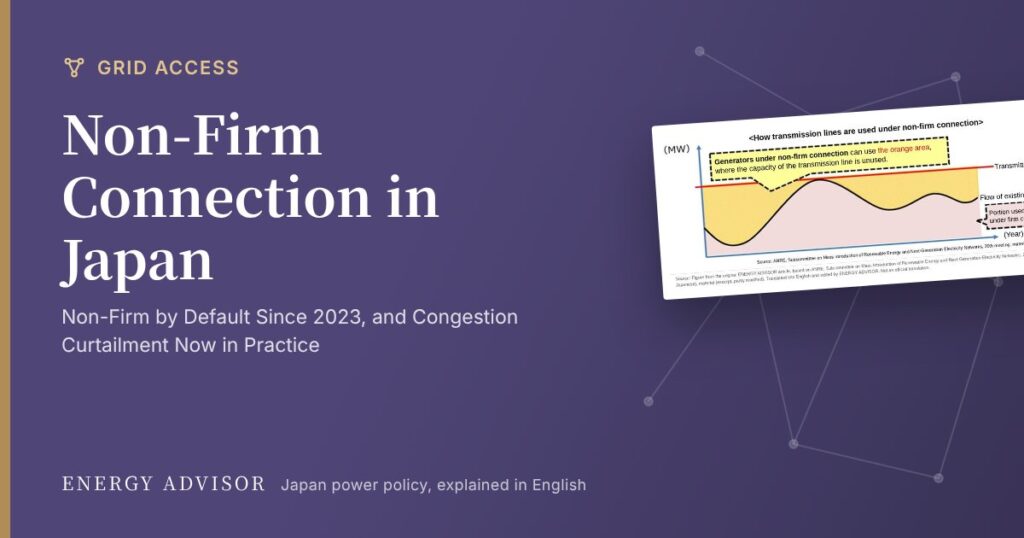
Non-Firm Connection in Japan: Non-Firm by Default Since 2023, and Congestion Curtailment Now in Practice
How non-firm connection works in Japan, its extension to nearly all generators from April 2023, the first congestion curtailments in 2025, and market rules.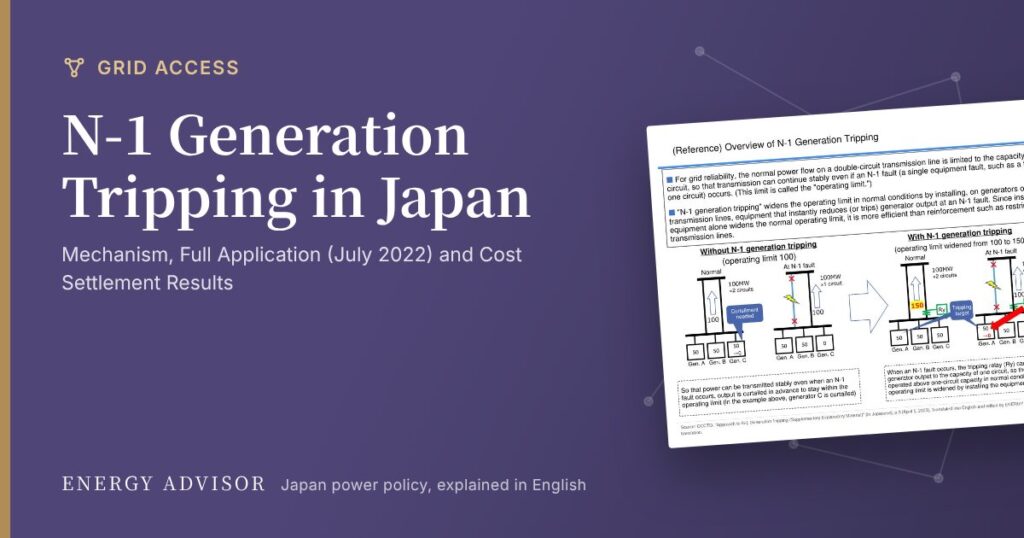
N-1 Generation Tripping in Japan: Mechanism, Full Application (July 2022) and Cost Settlement Results
How N-1 generation tripping widens transmission limits in Japan, early vs. full application (2022), generator selection and settlement of tripping costs.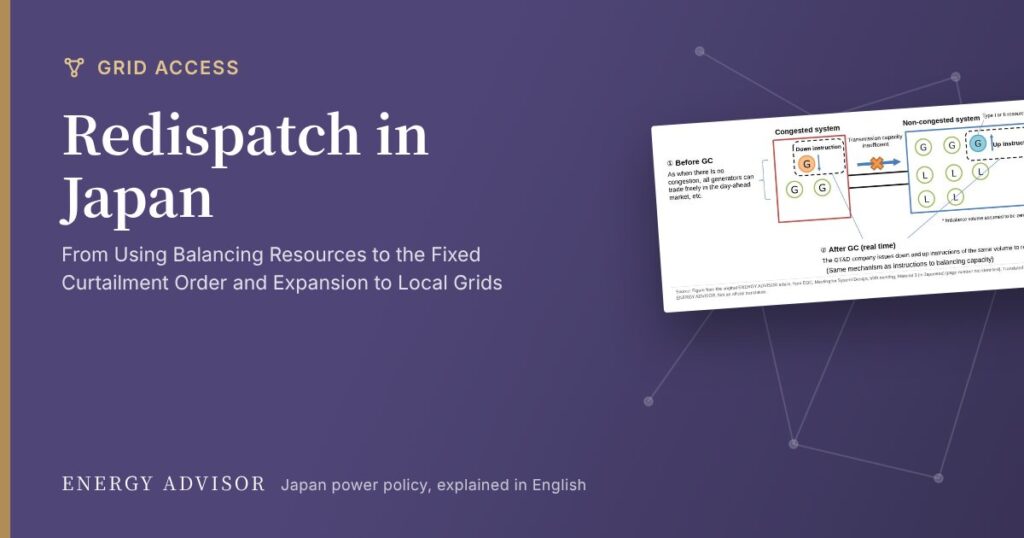
Redispatch in Japan: From Using Balancing Resources to the Fixed Curtailment Order and Expansion to Local Grids
Japan’s redispatch rules for grid congestion: the 2022 start, the 2023 fixed curtailment order, the curtailment sequence, settlement prices and a 2025 case.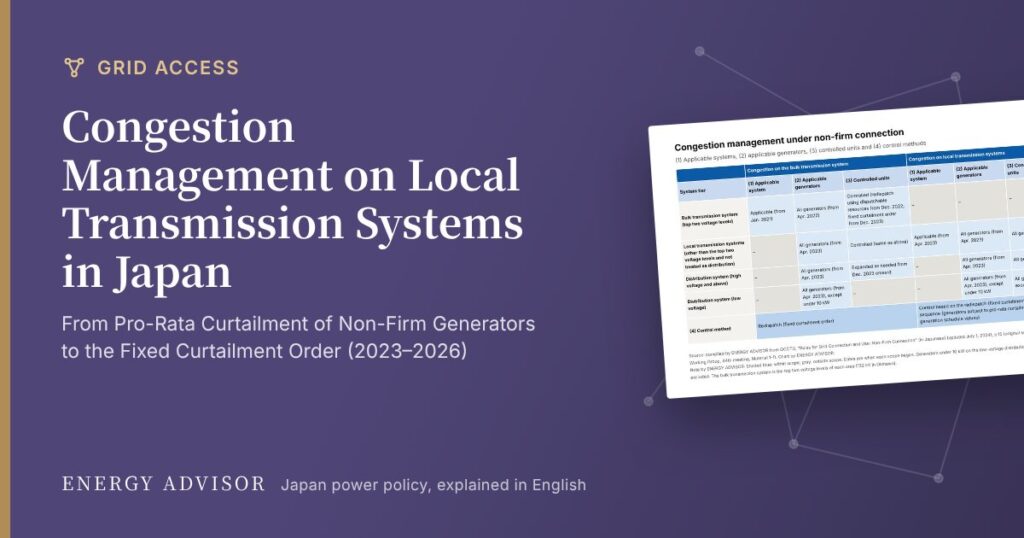
Congestion Management on Local Transmission Systems in Japan: From Pro-Rata Curtailment of Non-Firm Generators to the Fixed Curtailment Order (2023–2026)
Congestion management on Japan’s local grids: interim measures by area, the first renewable curtailment in 2025, Tokyo’s April 2026 shift, and settlement.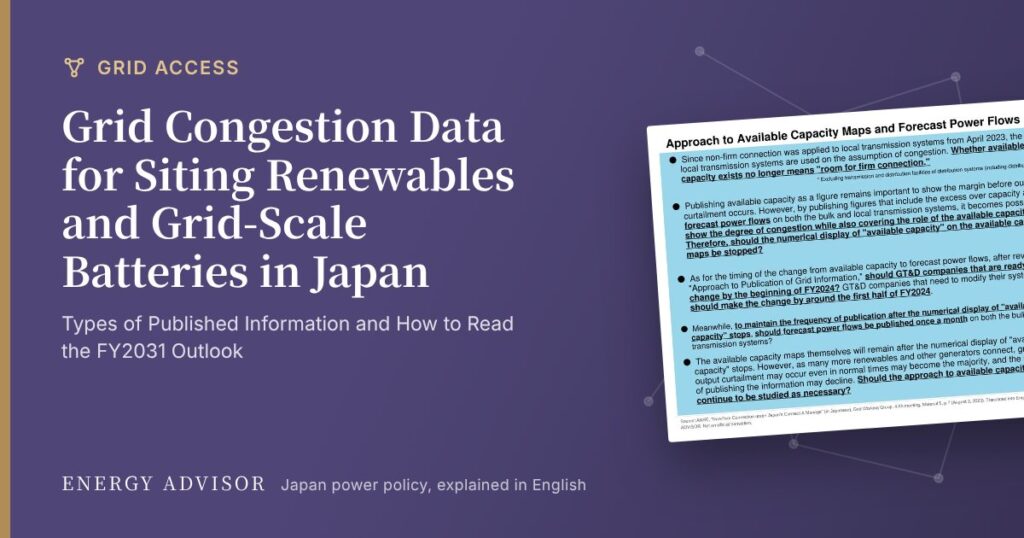
Grid Congestion Data for Siting Renewables and Grid-Scale Batteries in Japan: Types of Published Information and How to Read the FY2031 Outlook
Grid information and curtailment outlooks published in Japan for non-firm generators, their assumptions and limits, and key results of the FY2031 outlook.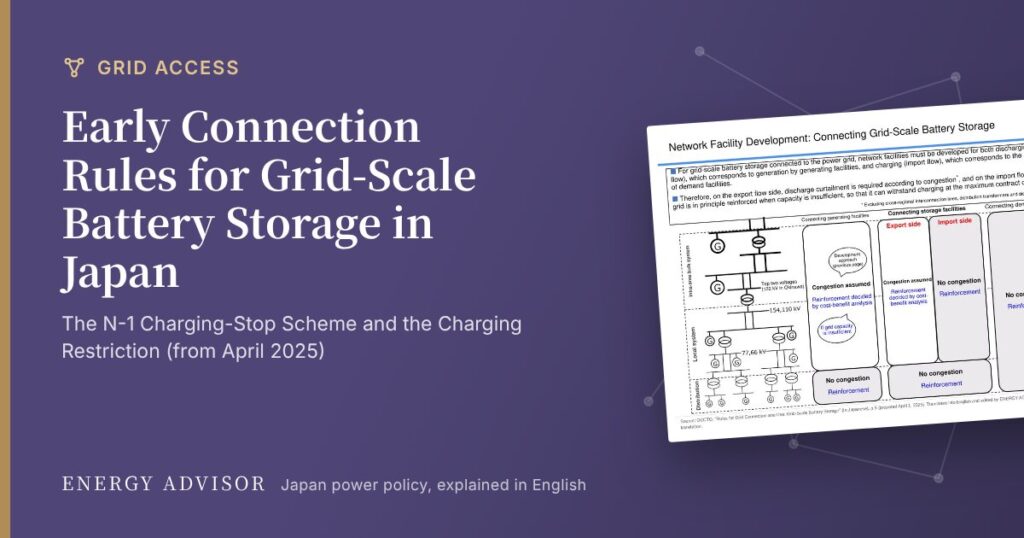
Early Connection Rules for Grid-Scale Battery Storage in Japan: The N-1 Charging-Stop Scheme and the Charging Restriction (from April 2025)
How grid-scale batteries in Japan can connect before charging-side reinforcement: the N-1 charging-stop scheme, the charging restriction and 2026 updates.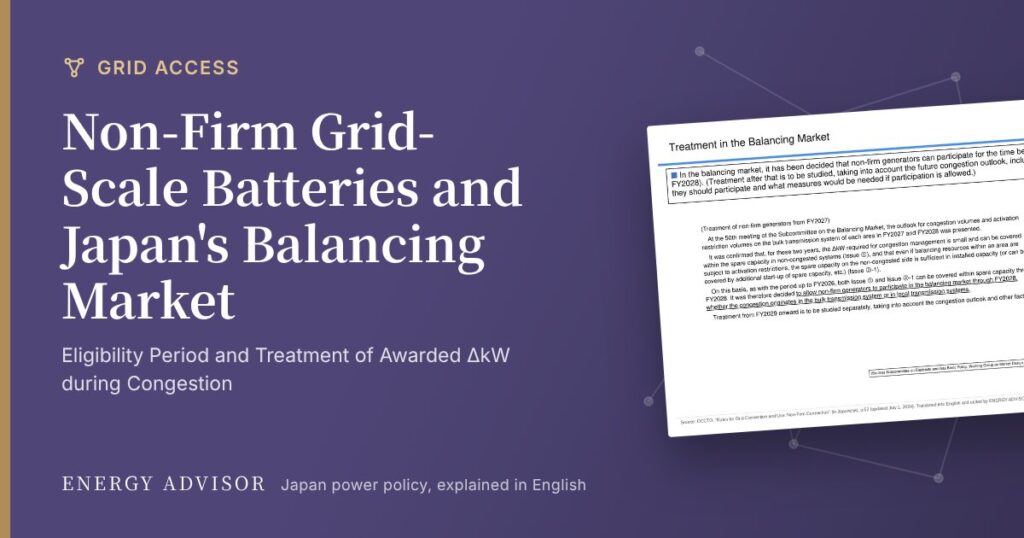
Non-Firm Grid-Scale Batteries and Japan’s Balancing Market: Eligibility Period and Treatment of Awarded ΔkW during Congestion
Until when non-firm batteries can join Japan’s balancing market, and how awarded ΔkW is released and replaced during congestion, with the cost allocation.