The Japan Electric Power Exchange (JEPX) runs a day-ahead market (spot market), where electricity for the next day is traded, and an intraday market, where trading continues until shortly before delivery. This article explains how the two markets differ and what changed when they moved to new trading systems in 2026.
Background: Japan’s Power Market
Japan has ten regional service areas: Hokkaido, Tohoku, Tokyo, Chubu, Hokuriku, Kansai, Chugoku, Shikoku, Kyushu and Okinawa. In each area, the grid is owned and operated by that area’s general transmission and distribution company (GT&D company). A GT&D company operates the grid and is ultimately responsible for matching supply and demand in its area.
The grid frequency differs between east and west. The Hokkaido, Tohoku and Tokyo areas run at 50 Hz, and the areas from Chubu westward run at 60 Hz. The nine areas other than Okinawa are linked by cross-regional interconnection lines (transmission facilities that connect one area to another).
Three main bodies are involved in the system:
| Body | Role |
|---|---|
| Agency for Natural Resources and Energy (ANRE) | An external agency of the Ministry of Economy, Trade and Industry (METI). Designs the electricity system |
| Electricity and Gas Market Surveillance Commission (EGC) | A regulator under the Minister of Economy, Trade and Industry. Monitors the markets and examines the details of pricing rules |
| Organization for Cross-regional Coordination of Transmission Operators, JAPAN (OCCTO) | Monitors supply and demand nationwide, receives market participants’ plans, manages the interconnection lines, and more |
JEPX: Members and Trading Volume
The Japan Electric Power Exchange (JEPX) is Japan’s only wholesale power exchange. Following the move toward electricity liberalization, it was established in November 2003 and began trading in April 2005.
To trade on JEPX, a company must become a trading member. Trading members must be companies that handle physical electricity. Specifically, they must have a generation balancing supply contract or a connection supply contract with a GT&D company. For this reason, ordinary consumers cannot buy electricity directly from JEPX; they always buy through a company.
JEPX’s company overview (the President’s message dated July 22, 2026) describes the number of trading members as “more than 300 companies.”
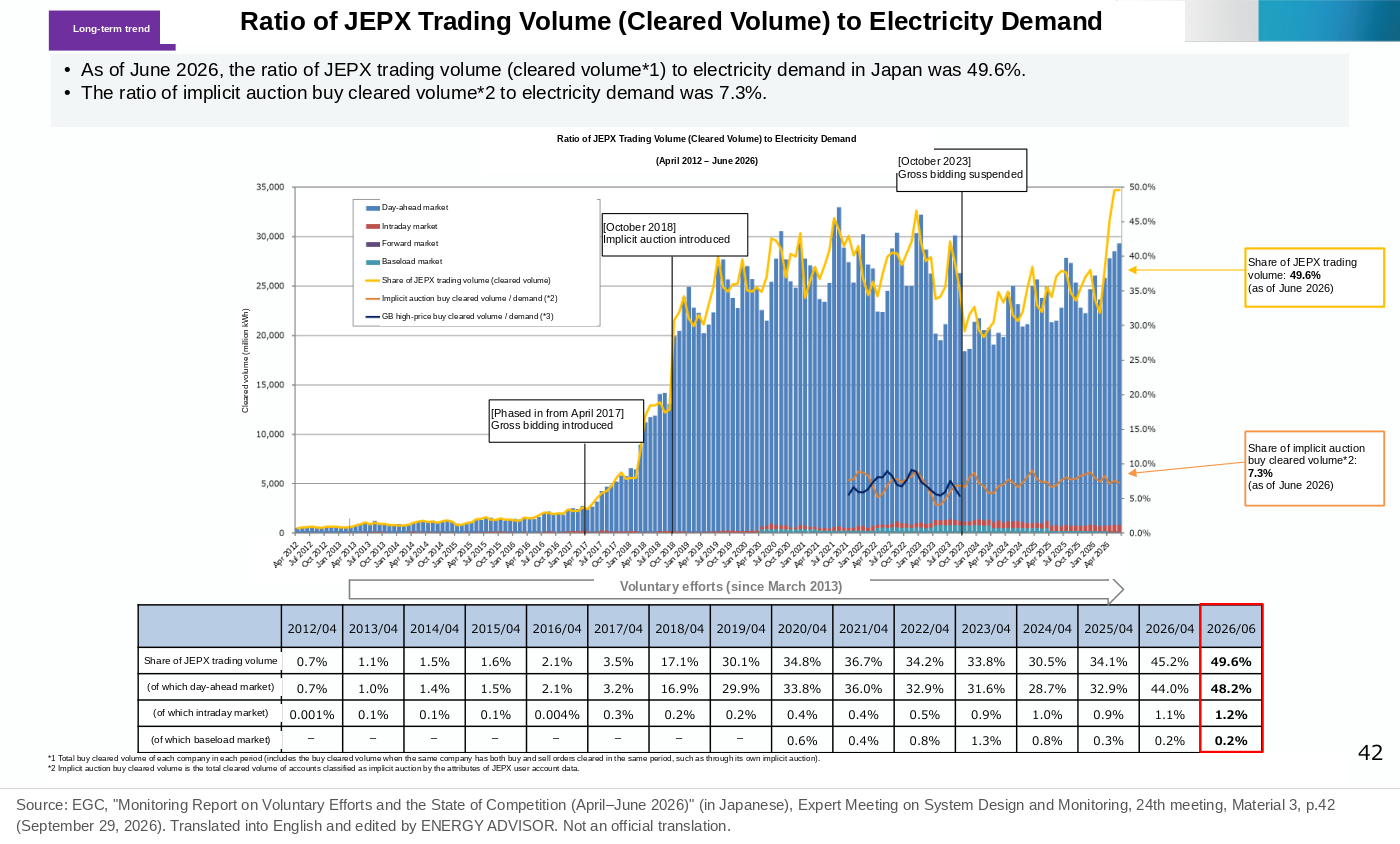
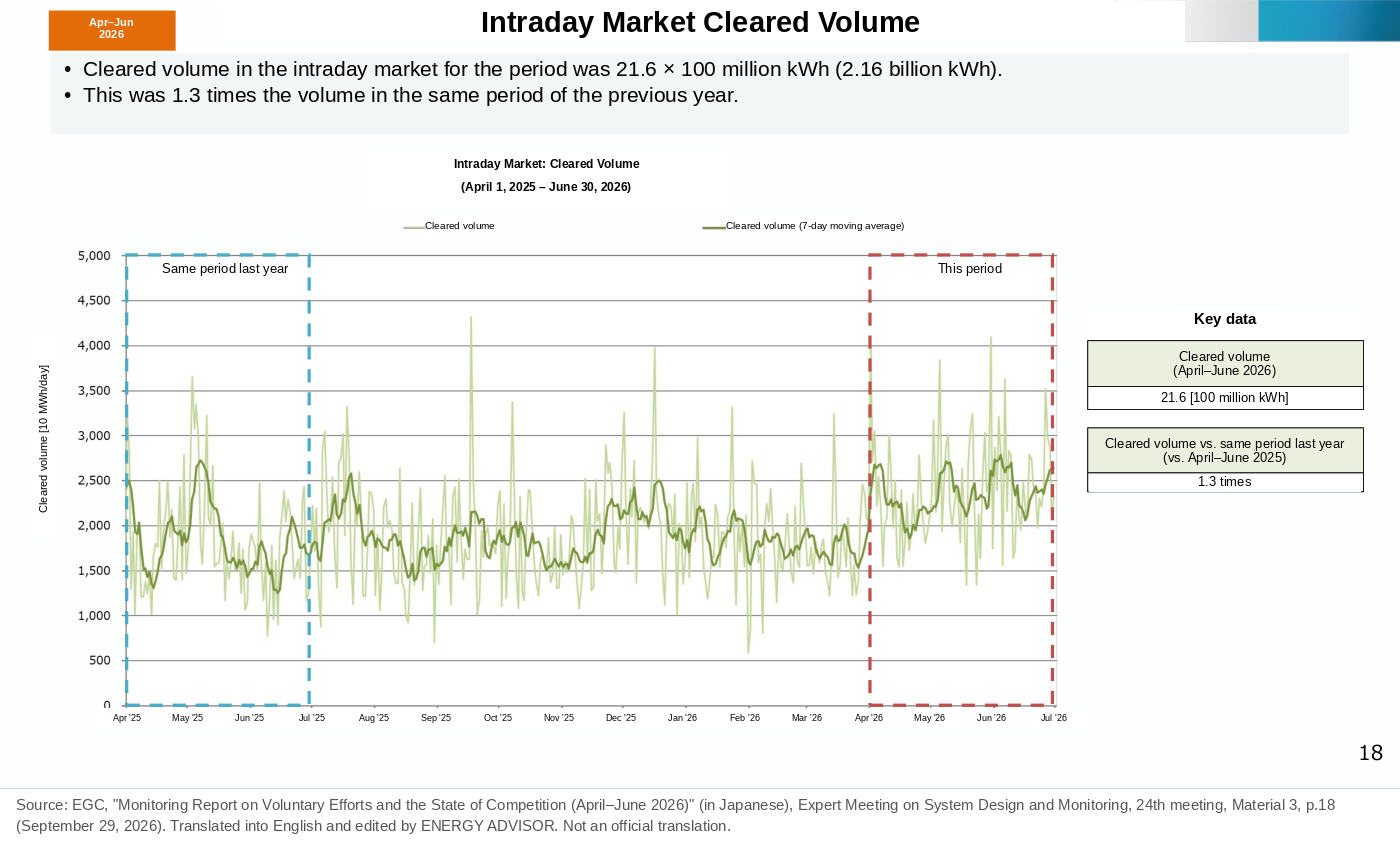
Trading volume has reached about half of electricity demand. According to an EGC report, the ratio of JEPX trading volume to electricity demand was 49.6% as of June 2026. Of this, the day-ahead market accounted for 48.2% and the intraday market for 1.2%.
Planned-Value Balancing and the Role of the Markets
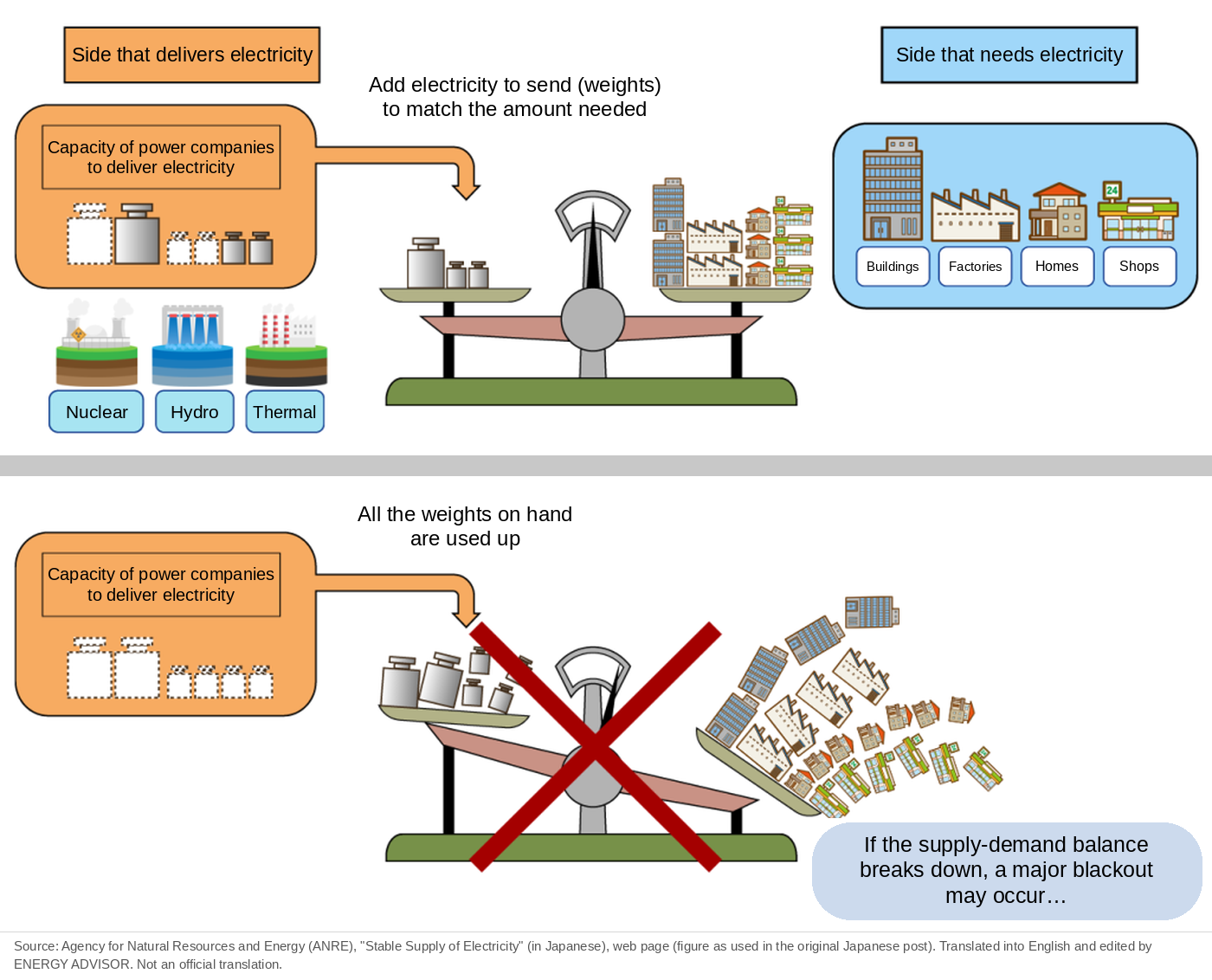
The amount of electricity produced (supply) and the amount used (demand) must always be equal at the same moment. This is called simultaneous balancing. If the two diverge, the frequency is disturbed and electricity can no longer be delivered normally.
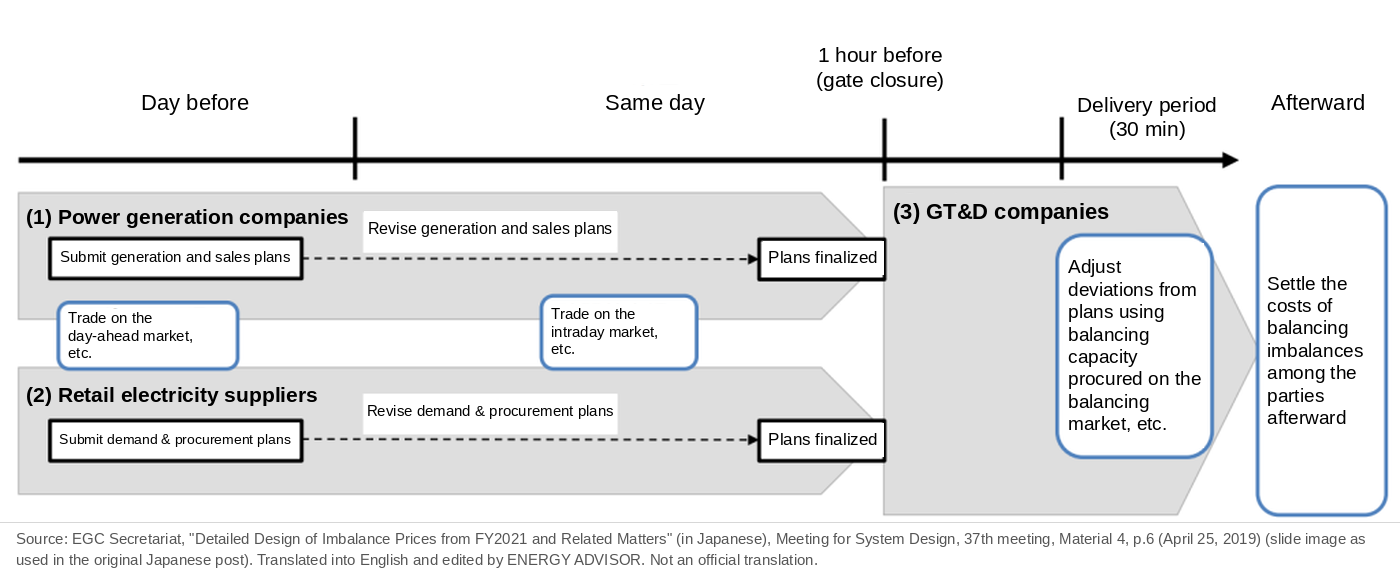
To maintain this balance, retail electricity suppliers and power generation companies follow a rule called planned-value balancing (30-minute balancing against plans). Under this rule, each day is divided into 48 periods of 30 minutes, and a plan is prepared for each period and submitted to OCCTO.
- Retail electricity suppliers forecast their customers’ demand for each 30-minute period, procure supply capacity to match it, and reflect this in their plans
- Power generation companies reflect in their plans how much they will generate in each 30-minute period and to whom they will sell it
- Plans are submitted by balancing group (BG), a unit in which several companies submit plans together, and are checked to confirm that demand and supply capacity match in each period
To match demand and supply capacity in each of the 48 periods, retail electricity suppliers use the day-ahead and intraday markets to cover shortfalls or sell surpluses of supply capacity. Power generation companies use the markets to sell their surplus supply capacity.
Day-Ahead Market: 48 Periods, 10:00 Deadline, Single Price
The day-ahead market trades electricity for delivery on the next day. It is also called the spot market.
- Each day is divided into 48 periods of 30 minutes, and each period is traded as a separate product
- Bids are accepted from 0:00 eleven days before the delivery date and close at 10:00 on the day before delivery (JEPX Trading Rules, Article 16). JEPX then calculates the clearing (the matching of buy and sell orders) for the next day and publishes the results on its website
- Instead of specifying a price, a bidder can choose a “market order,” which specifies no price and trades at whatever clearing price is set (same, Article 17)
- The market is divided into the nine areas other than Okinawa (Hokkaido, Tohoku, Tokyo, Chubu, Hokuriku, Kansai, Chugoku, Shikoku and Kyushu), and bidders choose how much to buy or sell in which area and which period
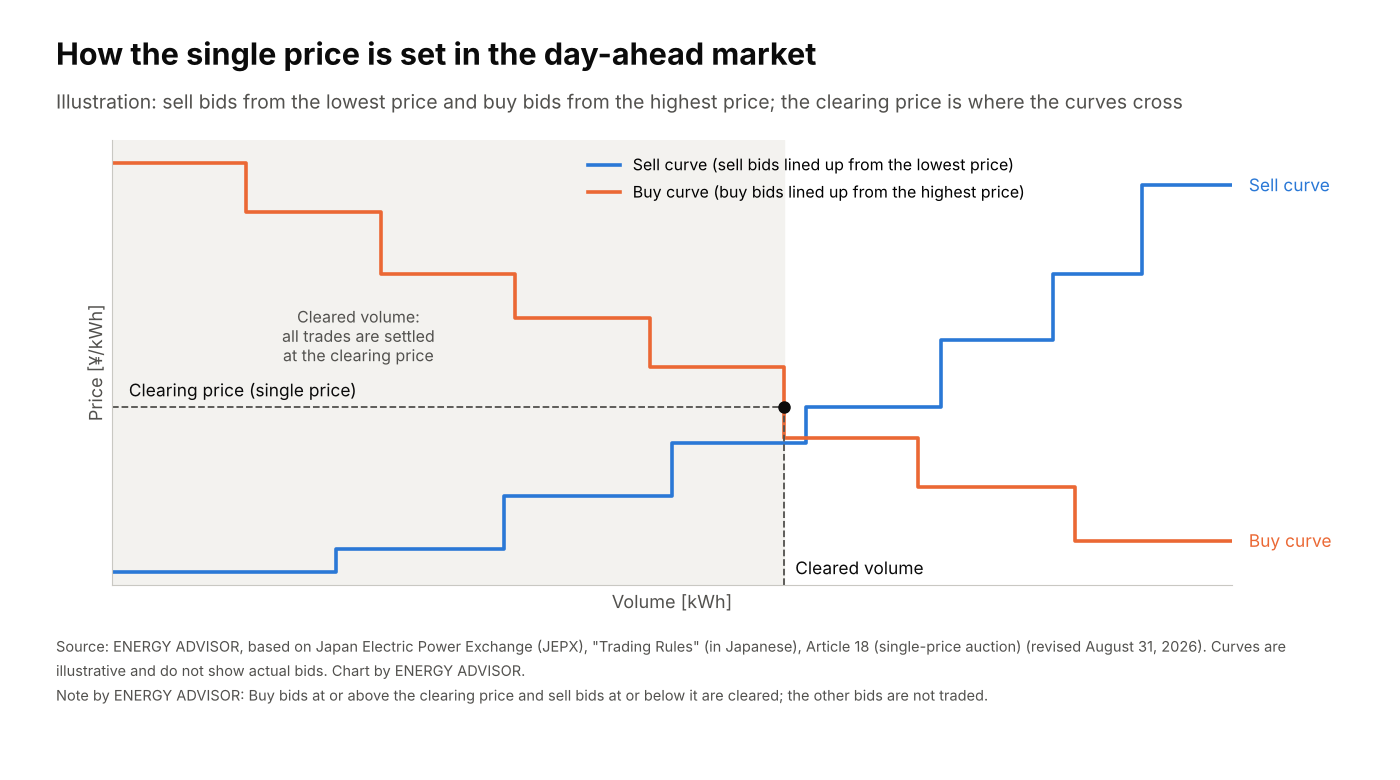
The clearing method is a blind single-price auction.
- Blind: When bidding, participants cannot see other participants’ bids
- Single price: All sell bids and buy bids are lined up, and the clearing price is set at the single point where the quantity and price of sell and buy bids meet. All cleared bids are traded at this clearing price, regardless of the price bid
For example, when the clearing price is ¥20/kWh, a buyer who bid ¥20 or more buys at ¥20. The reverse applies to sellers: a seller who bid ¥20 or less sells at ¥20. In many cases, the bid price and the clearing price differ.
Under this method, a buyer who wants to be sure of buying can bid a very high price and still actually buy at the clearing price. However, when supply capacity is short and high buy bids increase, the clearing price rises sharply once the sell bids are exhausted. In periods of high demand in summer and winter, such price spikes have occurred repeatedly. How prices are set and how to read spikes are explained in the next article (bid curves).
There is an upper limit on how much power can flow over the interconnection lines between areas. When that limit is reached, the clearing price splits by area. This is called market splitting. The price in each area is called the area price, and the single nationwide price is called the system price.
Intraday Market: Continuous Trading and Gate Closure
Even after next-day trading in the day-ahead market is finished, generator problems or sudden increases in demand can occur before actual delivery. The intraday market is a market for adjusting supply-demand deviations that arise after the next day’s plans have been made.
- It opens at 17:00 on the day before delivery (JEPX Trading Rules, Article 63) and, like the day-ahead market, trades 48 products of 30 minutes each
- Trading is possible until one hour before the period in question. For example, the 12:00–12:30 period can be traded until 11:00
- The deadline one hour before real time is called gate closure (GC). At this point, generation plans and sales plans become final
The clearing method is continuous trading. Bidders submit orders specifying price, volume and area, and each time the conditions of a sell order and a buy order match, those orders are cleared. Unlike the day-ahead market, there is no single price; the price differs from trade to trade.
The intraday market is used mainly to adjust deviations that arise after the day-ahead market. When supply capacity becomes short or surplus because demand forecasts miss or generators have problems, companies buy or sell in the intraday market.
Intraday Order Book Shown in Five Zones (from October 2026)
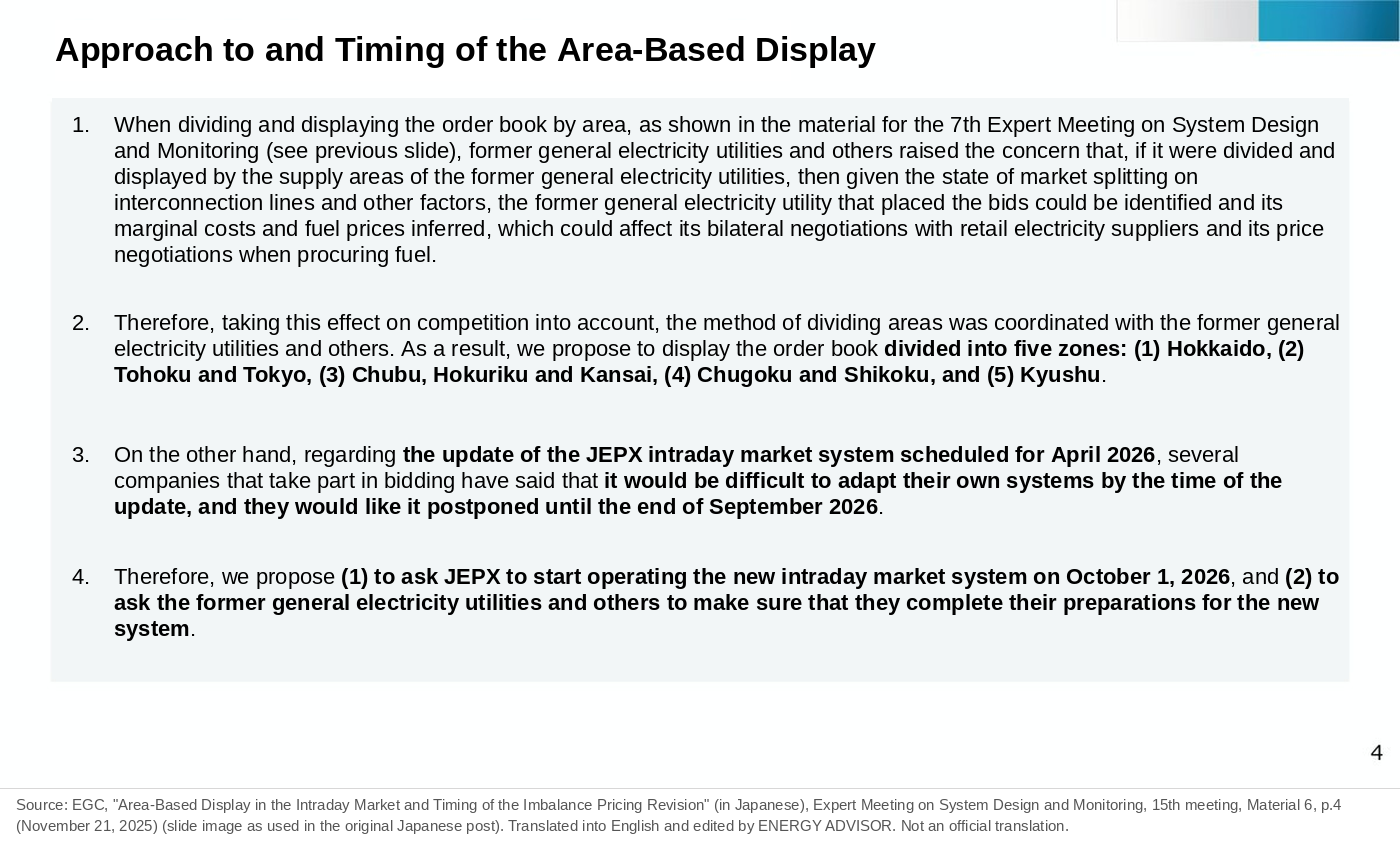
In the intraday market, until September 2026, information on sell and buy orders (the order book) was not separated by area. Orders from Hokkaido to Kyushu were shown in a single order book, so when an interconnection line was split, a sell order visible in the order book sometimes could not be cleared in the bidder’s own area.
From deliveries on October 1, 2026, the intraday market moved to a new system, and order information is now shown in the following five zones.
| Zone | Areas |
|---|---|
| 1 | Hokkaido |
| 2 | Tohoku and Tokyo |
| 3 | Chubu, Hokuriku and Kansai |
| 4 | Chugoku and Shikoku |
| 5 | Kyushu |
The display was not split into all nine areas because the former general electricity utilities (incumbent regional utilities) raised concerns. These are the ten regional utilities that handled everything from generation to retail in their areas until full retail market liberalization in 2016. Their concern was that splitting the display by service area could reveal which former general electricity utility had placed an order and allow others to infer its marginal cost and fuel prices. The EGC states that it adjusted the zoning with the effect on competition in mind.
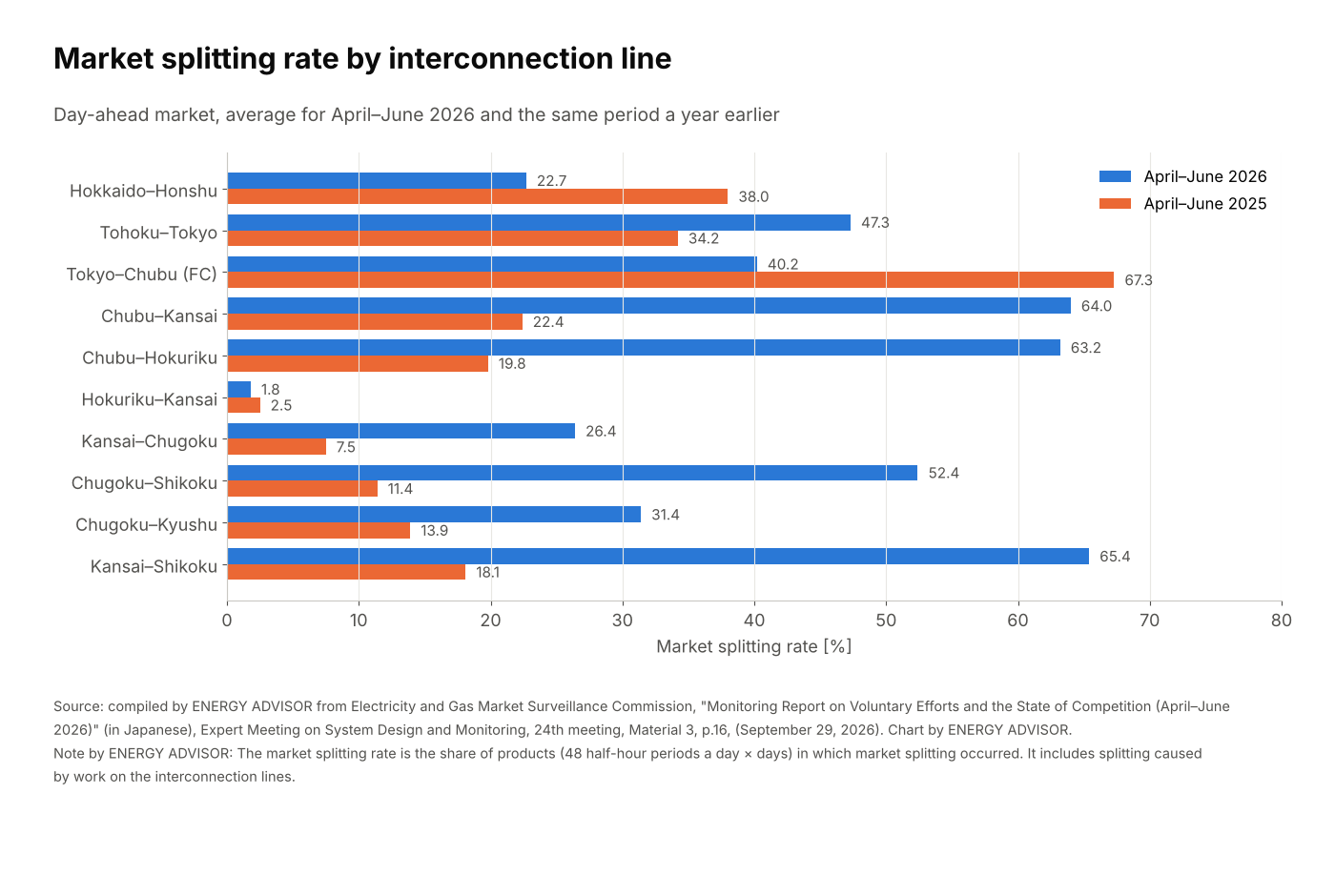
On the other hand, interconnection lines can split even within the same zone. In April–June 2026, the market splitting rate in the day-ahead market was 64.0% between Chubu and Kansai and 63.2% between Chubu and Hokuriku. Even within Zone 3, an order visible in the order book may not be cleared between Chubu and Hokuriku or Kansai.
Move to the 2026 New Systems
| Timing | Change |
|---|---|
| Deliveries from April 1, 2026 | The day-ahead market moved to JEPX’s new in-house trading system. Bidding methods and other features changed |
| Deliveries from October 1, 2026 | The intraday market moved to the new system. Order information began to be shown in five zones |
The move of the day-ahead market to the new system was reviewed by the EGC in March 2026 as a change to JEPX’s operational rules. Under the current Trading Rules (revised August 31, 2026), day-ahead bids are accepted from eleven days before the delivery date, and market orders are allowed (see the section above).
In the day-ahead market, the old system is running in parallel with the new one. According to JEPX, the old system can be used for deliveries up to March 31, 2027. The five-zone display in the intraday market is as explained in the section above.
Gross bidding, under which the former general electricity utilities passed part of their internal transactions through the day-ahead market, was suspended in October 2023, and its abolition was decided in June 2025. This is explained in detail in Article 02.
What the Markets Do Not Cover: Imbalances
If a company does not use the intraday market, or uses it but its orders are not cleared, a surplus or shortfall of supply capacity remains. The GT&D company fills this remaining gap with balancing capacity (the capability of power plants and other resources secured in advance to match supply and demand). This gap is called an imbalance, and the cost of the adjustment is settled later as the imbalance price.
The imbalance price changes with supply-demand conditions. From October 2026, the cap when the supply-demand balance is tight became ¥300/kWh. Retail electricity suppliers are obliged to follow planned-value balancing. An imbalance is the result of not procuring enough in the markets. Even when intraday prices are high, a company that holds back from procuring on the assumption that imbalances will fill the gap will pay a high price when the supply-demand balance becomes tight. How imbalances work is explained in “Imbalance Settlement in Japan” in this series.
Summary
| Item | Day-ahead market | Intraday market |
|---|---|---|
| What is traded | Electricity for delivery the next day | Electricity for the same day (from 17:00 the day before) |
| Products | 48 periods of 30 minutes | 48 periods of 30 minutes |
| Deadline | 10:00 every day | One hour before each period (gate closure) |
| Clearing method | Blind single-price auction | Continuous trading (orders cleared individually when conditions match) |
| Changes in 2026 | Moved to the new trading system in April | Moved to the new system in October; order information shown in five zones |
| Trading volume as a share of demand (June 2026) | 48.2% | 1.2% |
This article is based on published materials from the Ministry of Economy, Trade and Industry and its Agency for Natural Resources and Energy, the Electricity and Gas Market Surveillance Commission, the Organization for Cross-regional Coordination of Transmission Operators (OCCTO) and other sources. The English translations of figures are by ENERGY ADVISOR and are not official translations. When using this information for decisions, please check the original sources. When we find an error, we correct the article and note the date of the correction.
Sources
- Japan Electric Power Exchange, “Company Overview” (President’s message, July 22, 2026; basic information) (in Japanese). https://www.jepx.jp/company/overview/
- Japan Electric Power Exchange, “History” (corporate registration November 28, 2003; start of power trading April 1, 2005; spot bidding deadline changed from 9:30 to 10:00 on July 1, 2016) (in Japanese). https://www.jepx.jp/company/history/
- Japan Electric Power Exchange, “Trading Rules” (revised August 31, 2026), Article 16 (bid acceptance hours for next-day trading), Article 17 (bidding method, market orders), Article 18 (single-price auction), Article 63 (trading period for intraday trading), Article 68 (continuous trading) (in Japanese). https://www.jepx.jp/electricpower/outline/pdf/tr_rules.pdf
- Japan Electric Power Exchange, “Trading Overview” (in Japanese). https://www.jepx.jp/electricpower/outline/
- Japan Electric Power Exchange, “On the System Upgrade Schedule and Other Matters” (November 26, 2025) (in Japanese). https://www.jepx.jp/system/news/pdf/jepx20251126.pdf
- Japan Electric Power Exchange, “On the Upgrade of the Trading System” (September 8, 2026) (in Japanese). https://www.jepx.jp/electricpower/news/pdf/jepx20260908.pdf
- Electricity and Gas Market Surveillance Commission, “Approval of Changes to the Operational Rules of the Wholesale Electricity Exchange” (March 23, 2026) (in Japanese). https://www.egc.meti.go.jp/info/public/pdf/20260323003a.pdf
- Electricity and Gas Market Surveillance Commission, Expert Meeting on System Design and Monitoring, 15th meeting, Material 6, “Area-Based Display in the Intraday Market and Timing of the Imbalance Pricing Revision,” pp.4–5 (November 21, 2025) (in Japanese). https://www.egc.meti.go.jp/activity/emsc_systemsurveillance/pdf/015_06_00.pdf
- Electricity and Gas Market Surveillance Commission, Expert Meeting on System Design and Monitoring, 10th meeting, Material 9, “On Gross Bidding,” pp.2 and 4 (June 27, 2025) (in Japanese). https://www.egc.meti.go.jp/activity/emsc_systemsurveillance/pdf/010_09_00.pdf
- Electricity and Gas Market Surveillance Commission, Expert Meeting on System Design and Monitoring, 24th meeting, Material 3, “Monitoring Report on Voluntary Efforts and the State of Competition (April–June 2026),” p.16 (market splitting rates) and p.42 (ratio of trading volume) (September 29, 2026) (in Japanese). https://www.egc.meti.go.jp/activity/emsc_systemsurveillance/pdf/024_03_00.pdf
- Electricity and Gas Market Surveillance Commission, Meeting for System Design, 37th meeting, Material 4, “Detailed Design of Imbalance Pricing from FY2021,” p.6 (flow of planned-value balancing) (April 25, 2019, Secretariat) (in Japanese). https://www.egc.meti.go.jp/activity/emsc_system/pdf/037_04_00.pdf
- Agency for Natural Resources and Energy, “Stable Supply of Electricity” (in Japanese). https://www.enecho.meti.go.jp/about/special/johoteikyo/balance_game.html