Grid-scale battery storage is storage that charges from the power grid and discharges to the grid. On the discharging side, non-firm connection (a method of connecting without waiting for reinforcement, on the condition of output curtailment during congestion) applies. On the charging side, by contrast, the basic rule is that if grid capacity is insufficient, the grid is reinforced before connection.
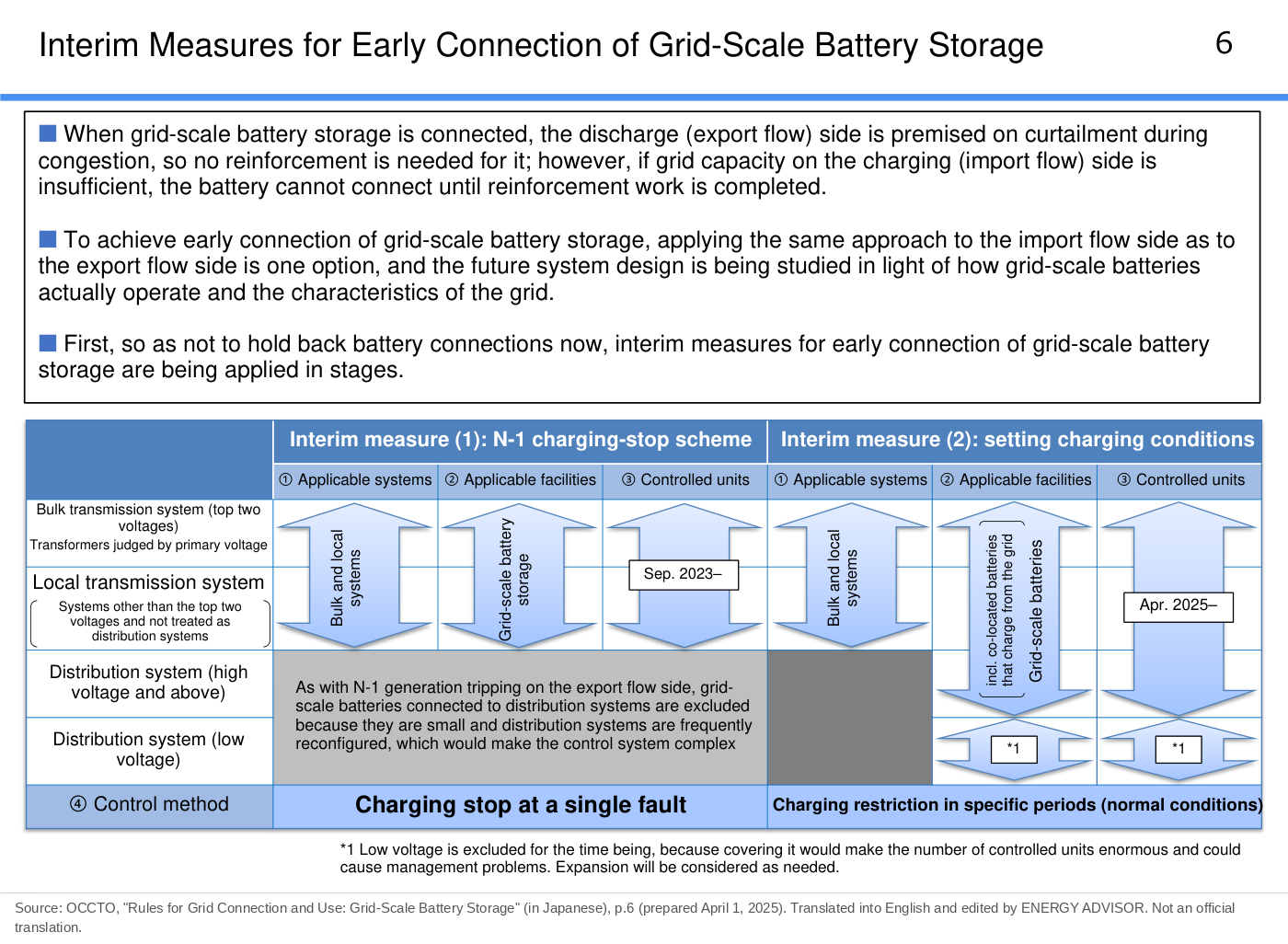
Reinforcement takes time and money. For this reason, two interim measures have been introduced for earlier connection: the N-1 charging-stop scheme (from September 2023) and the charging restriction (from April 2025). This article explains how these two measures work and their conditions.
Non-firm connection, the tiers of Japan’s grid and the key organizations are explained in the first article of this series, and N-1 generation tripping in the second.
Connection Issues for Grid-Scale Battery Storage
Discharging Side and Charging Side
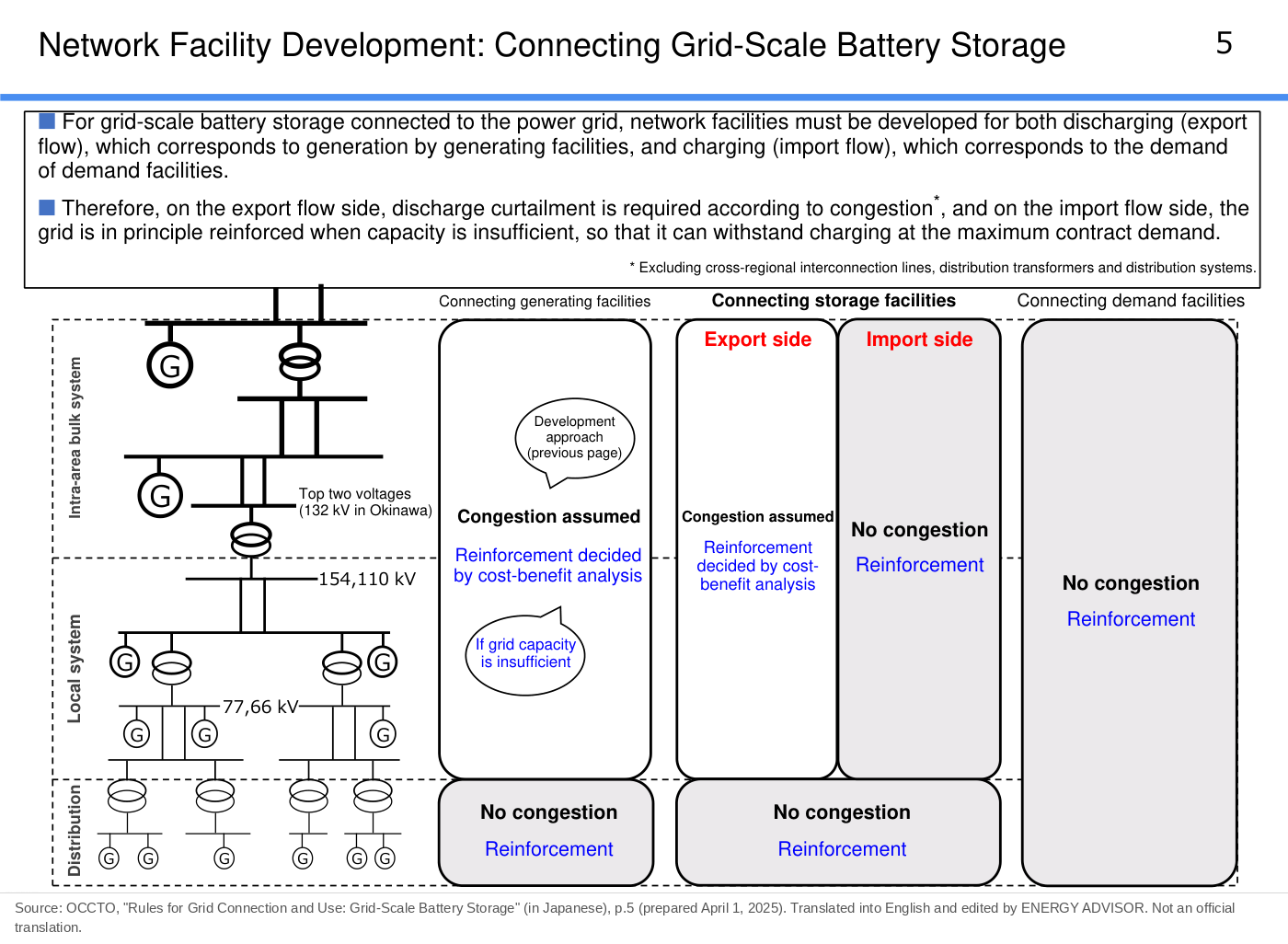
How grid facilities are developed depends on the direction in which electricity flows (OCCTO, “Rules for Grid Connection and Use: Grid-Scale Battery Storage,” pp.4–5, prepared April 1, 2025).
| Direction | Example | Approach to development |
|---|---|---|
| Export flow (from the receiving point to the grid) | Generation by generating facilities, battery discharging | If capacity is exceeded, connect on the premise of reducing output (non-firm connection) |
| Import flow (from the grid to the supply point) | Demand of demand facilities, battery charging | If capacity is exceeded, reinforce the facilities before connection, and capacity remains secured afterward |
For demand, there is currently no mechanism to reduce demand during congestion in normal conditions, so the most severe conditions are assumed. Charging of grid-scale battery storage is treated in the same way as demand. The basic rule is to reinforce when capacity is insufficient, so that the grid can withstand charging at the maximum contract demand.
Therefore, even when no reinforcement is needed on the discharging side, if capacity on the charging side is insufficient, the battery cannot connect until the reinforcement work is finished (same, p.6).
Surge in Connection Applications
Applications for grid connection studies (the procedure in which a general transmission and distribution company (GT&D company) examines whether a facility can connect) for grid-scale battery storage are surging.
| As of | Connected | Grid connection studies accepted | Connection contracts (contract applications) accepted | Source |
|---|---|---|---|---|
| End of September 2024 | About 100 MW | About 88 GW | About 6.2 GW | Grid WG, 53rd meeting, Material 2, pp.2 and 4 |
| End of December 2024 | About 170 MW | About 95 GW | About 8 GW | Next-Generation Power System Working Group, 2nd meeting, Material 2, pp.2–3 |
| End of March 2025 | About 230 MW | About 113 GW | About 12 GW | Next-Generation Power System Working Group, 3rd meeting, Material 4, p.12 |
| End of December 2025 | – | – | 28,688 MW (3,759 applications; Chubu and Chugoku as of end of November 2025) | Next-Generation Power System Working Group, 7th meeting, Material 1-1, p.11 |
| End of March 2026 | About 840 MW | About 191 GW | About 35 GW | Next-Generation Power System Working Group, 12th meeting, Material 2, p.4 |
| End of June 2026 | 1,280 MW | About 211 GW | About 41 GW | Next-Generation Power System Working Group, 13th meeting, Material 2, p.3 |
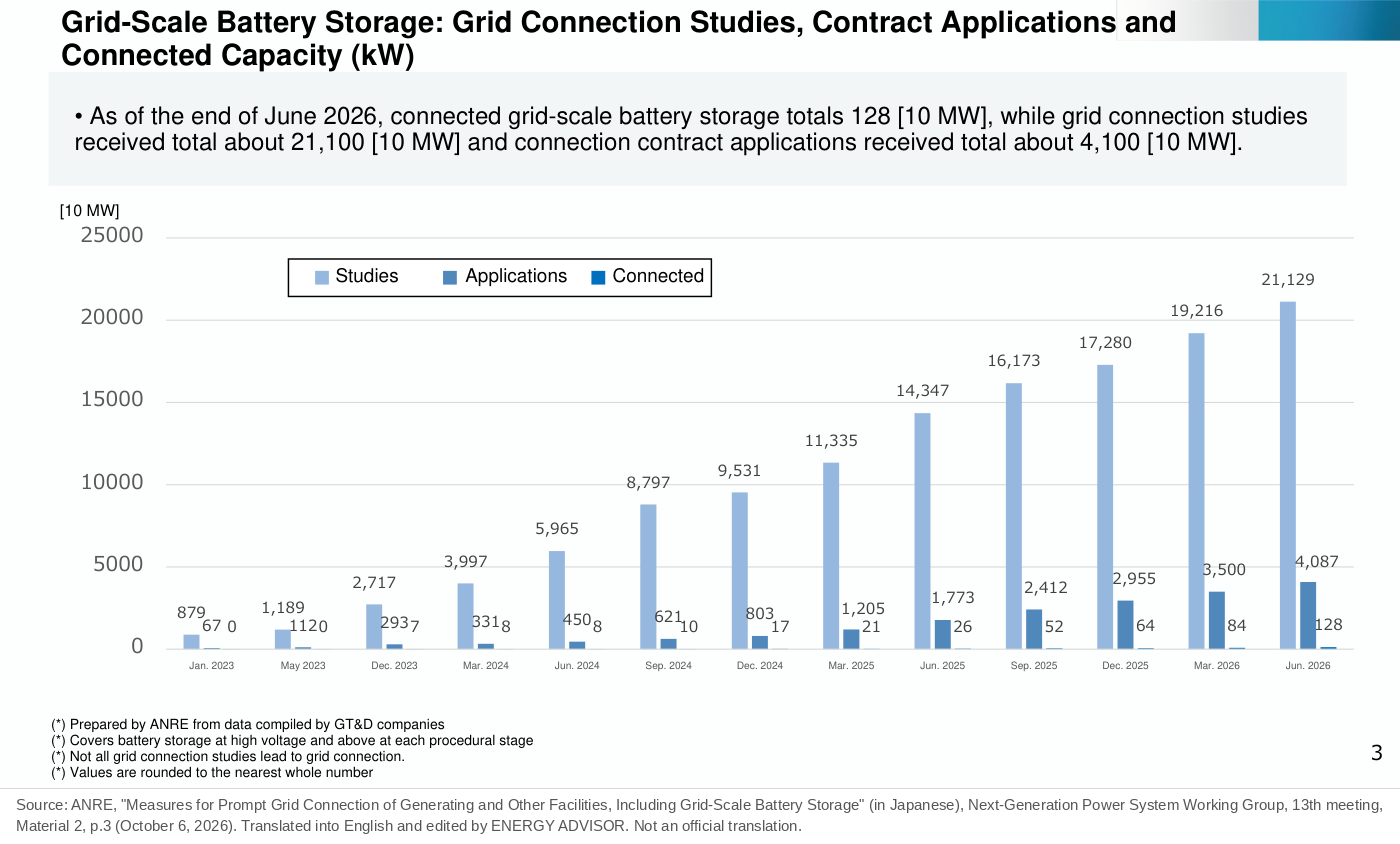
The growth multiples given in the materials are measured against different base dates in each material. For the end of September and the end of December 2024, the multiples are relative to the end of December 2023: about 3.2 and 3.5 times for grid connection studies, and about 2.1 and 2.7 times for connection contracts. For the end of March 2025, the multiples are relative to the end of March 2024: about 2.8 times for grid connection studies and about 3.7 times for connection contracts. Values from the end of December 2025 onward are shown in the materials as volumes of “contract applications.”
The Agency for Natural Resources and Energy (ANRE) expects grid connection studies to keep increasing. This reflects the effects of subsidies and the Long-Term Decarbonized Capacity Auction (an auction that guarantees long-term revenue for new decarbonized power sources and similar projects). Even with the N-1 charging-stop scheme, there were cases on some systems where the operating limit of a transmission line or transformer (unyo yoryo in Japanese) on the charging side was exceeded (Grid WG, 53rd meeting, Material 2, pp.2 and 5).
N-1 Charging-Stop Scheme (from September 2023)
Mechanism
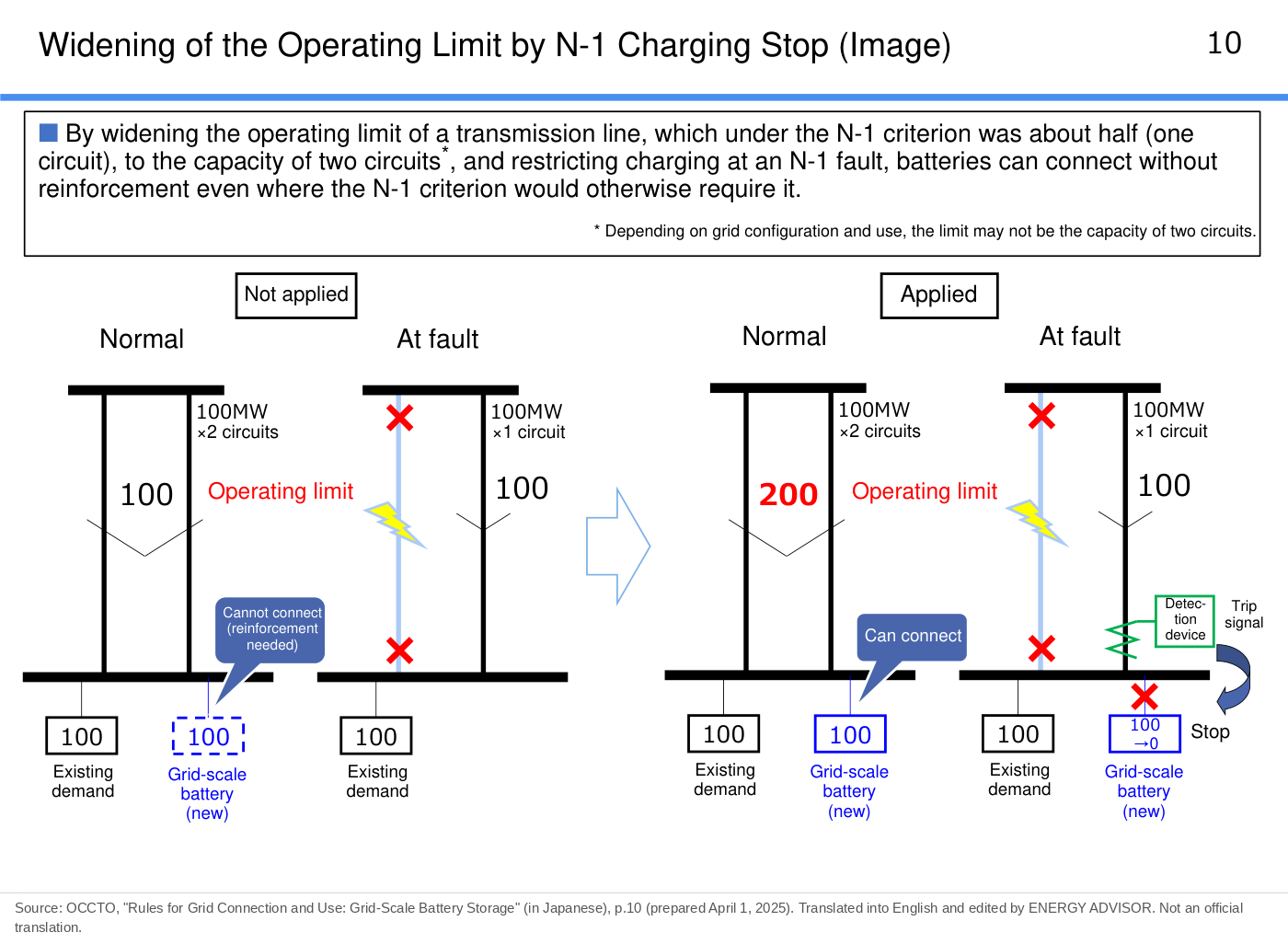
Transmission lines are operated with roughly one of their two circuits kept free for emergencies, so that transmission can continue even if one facility fails (an N-1 contingency). If grid facilities can be stopped instantly during a fault, the emergency capacity can also be used in normal conditions.
N-1 generation tripping is a mechanism that stops generators during a fault to widen the operating limit on the export flow side. Applying this idea, the method of stopping battery charging during a fault to widen the operating limit on the import flow side is called the “N-1 charging stop” (“Grid-Scale Battery Storage,” pp.9–10).
The operating limit, which under the N-1 criterion was set at about half (one circuit), can in some cases be widened to the capacity of two circuits. This allows projects that would otherwise require reinforcement to connect without it (depending on the grid configuration and usage, the capacity may not reach two circuits).
Conditions
| Item | Content |
|---|---|
| Start of application | September 2023 |
| Applicable systems | Bulk transmission system and local transmission systems (for loop systems, decided for each system because the scheme becomes complex) |
| Eligible facilities | Extra-high-voltage grid-scale battery storage newly seeking connection |
| Position | Applied as an alternative to reinforcement where reinforcement can be avoided |
| Cost | Borne by the battery operator: the costs of installing, renewing, maintaining, operating and decommissioning the device, and the opportunity cost of charging stops |
The source is “Grid-Scale Battery Storage,” pp.6 and 11. The basic system configuration is the same as in the guidelines for N-1 generation tripping (same, p.12).
Early Connection through the Charging Restriction (from April 2025)
Mechanism
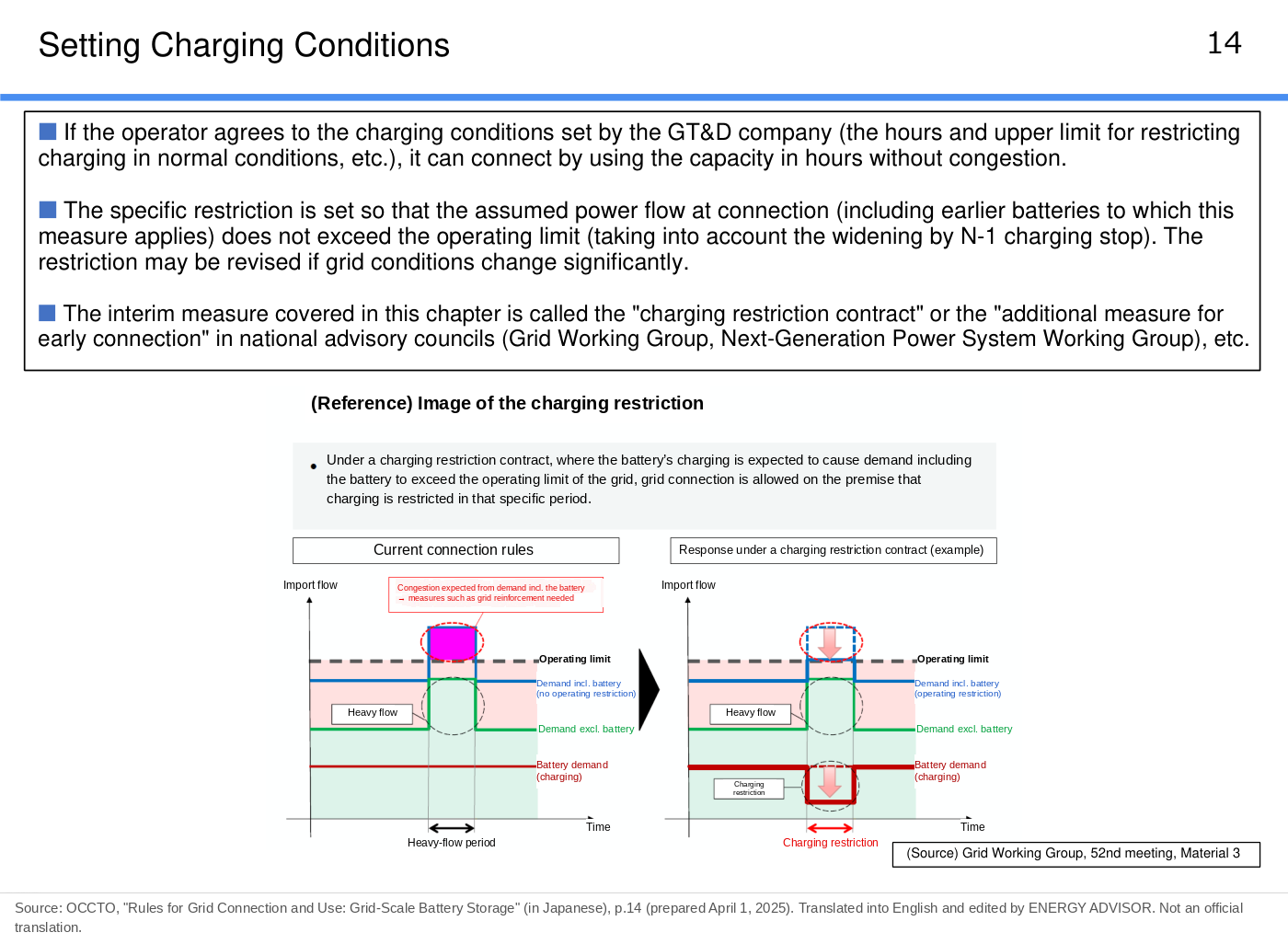
The charging conditions are the hours in which charging is restricted in normal conditions and the upper limit value, set by the GT&D company. If the operator agrees to the conditions, it can connect without reinforcement by using capacity in hours without congestion (“Grid-Scale Battery Storage,” p.14).
The content of the restriction is set so that the assumed power flow at the time of connection does not exceed the operating limit. The assumed power flow includes batteries to which this measure was applied earlier. The operating limit includes the amount widened by the N-1 charging stop. In government councils, it is also called a “charging restriction contract” or the “additional measure for early connection.”
Conditions
| Item | Content | Source |
|---|---|---|
| Start of application | Applies to grid connection studies from April 2025. For projects already applied for, answers with this premise can be given once the GT&D company is ready | Next-Generation Power System Working Group, 2nd meeting, Material 2, p.26 |
| Applicable systems | Bulk transmission system and local transmission systems (excluding distribution transformers). The GT&D company judges technical applicability in light of the system’s characteristics | “Grid-Scale Battery Storage,” p.17 |
| Eligible facilities | Grid-scale battery storage at high voltage or above newly seeking connection (including co-located batteries that charge from the grid). Low voltage is excluded for the time being because the number of facilities would be enormous and hard to manage | Same, pp.6 and 17 |
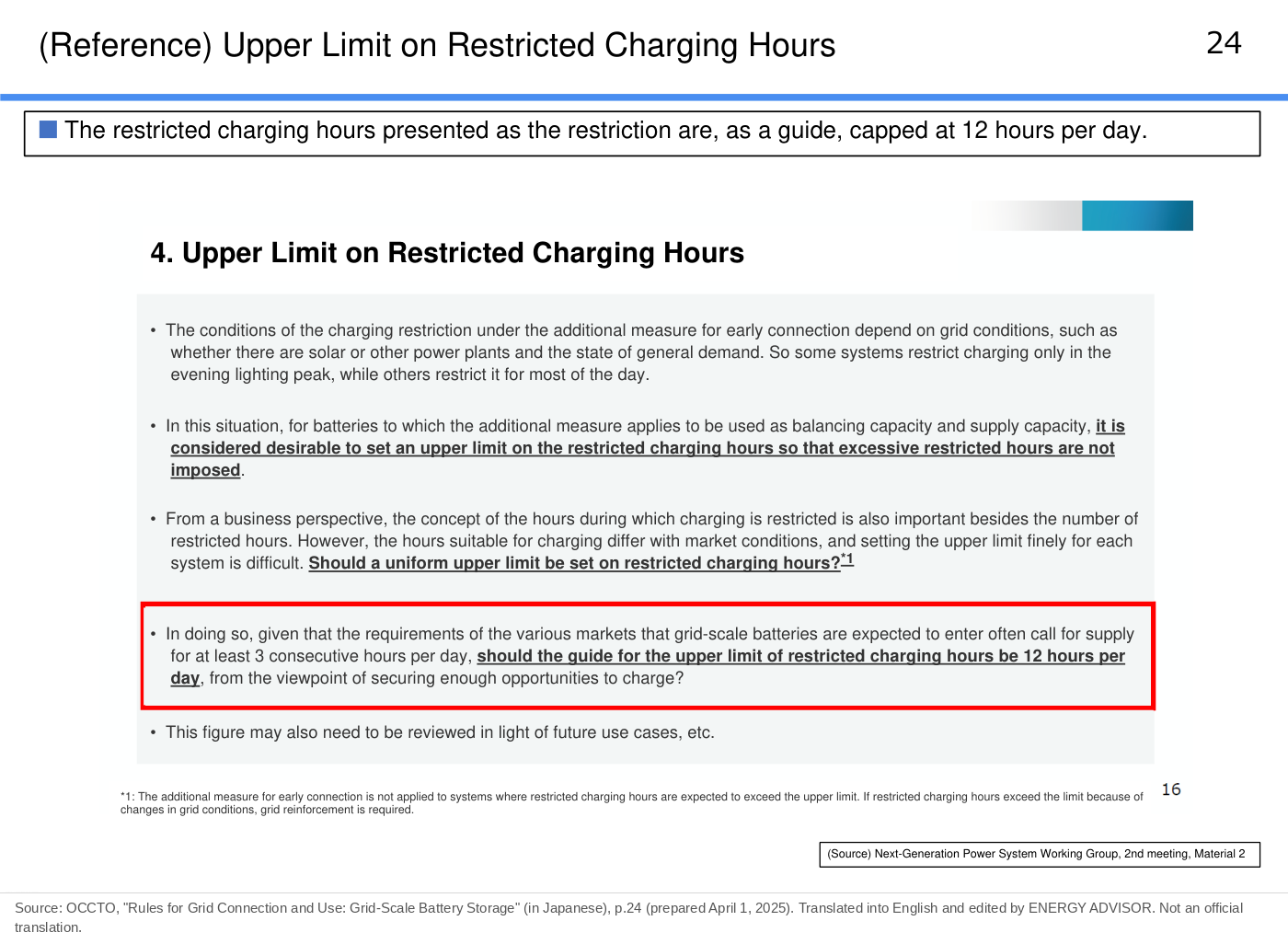
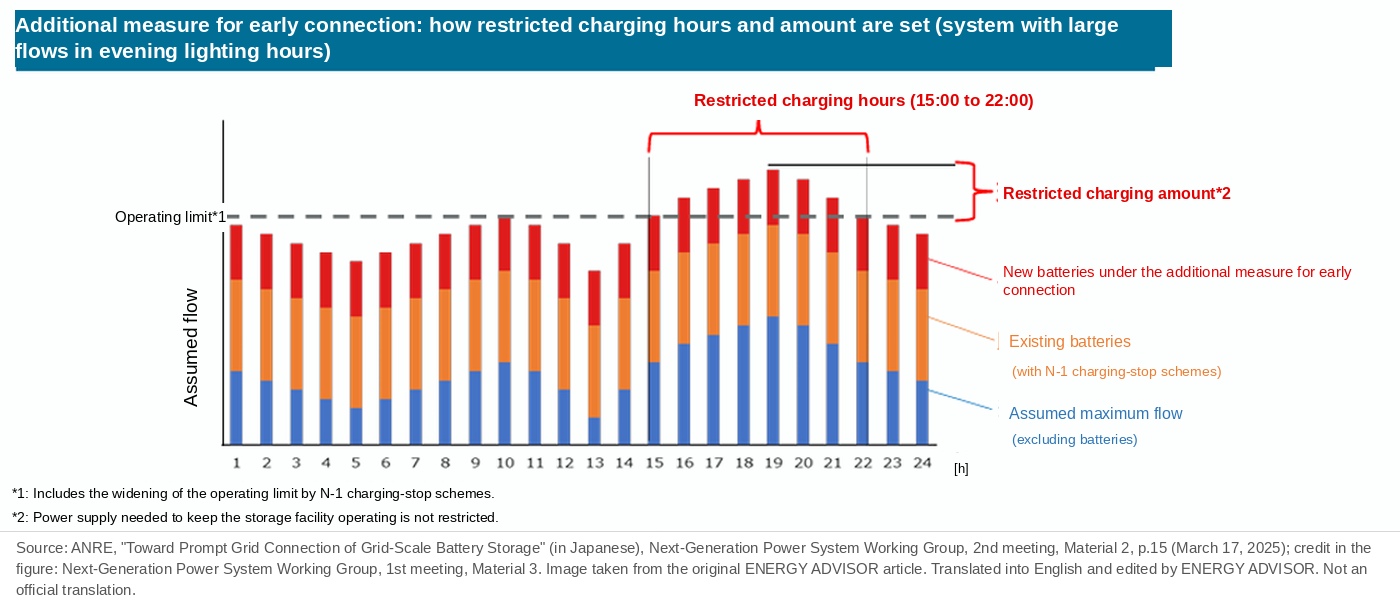
| Restricted hours | Basically the hours in which the assumed power flow exceeds the operating limit. The guide for the upper limit is 12 hours per day, and the measure is not applied to systems expected to exceed this | Same, p.24; 2nd meeting, Material 2, pp.15–17 |
| Method of restriction | The GT&D company sets the restricted hours in advance, and the battery operator stops charging during those hours with its own system (offline) | 2nd meeting, Material 2, pp.8–12 |
| Presentation and review of conditions | In principle, the specific content of the restriction is presented by the time the operational agreement with the GT&D company is signed. After connection, it is reviewed in principle once a year. It is also reviewed if grid conditions change significantly | “Grid-Scale Battery Storage,” p.19 |
| Cost | Borne by the battery operator: opportunity cost of the charging restriction; the costs of installing, renewing, maintaining, operating and decommissioning safety equipment; restoration costs if facilities are damaged by equipment malfunction; damages; and so on | Same, p.17 |
Required Equipment
Equipment is needed to operate in line with the restriction specified by the GT&D company: a schedule operation function and a safety function for when communication is lost (“Grid-Scale Battery Storage,” p.18). The consent form requires a function for cases where remote monitoring and control become impossible (same, p.21): either automatic transfer to autonomous control or automatic stopping of charging from the grid.
To measure the amount charged, separate metering is also needed, with meters that measure battery charging and discharging separately from ordinary demand and generator output (Next-Generation Power System Working Group, 2nd meeting, Material 2, pp.6–7).
Main Conditions of the Consent Form
A consent form is submitted when connecting under this measure. The main conditions are as follows (“Grid-Scale Battery Storage,” pp.21–22).
- Prepare demand schedules based on the restriction specified by the GT&D company (restricted hours, restricted amount, etc.) and limit charging from the grid
- Stop charging on request during faults or outage work on network facilities
- When notified of a review of the restriction due to future demand growth or similar reasons, reset the system by the specified date
- Because the contract is signed before the rules for battery connection are decided, accept any disadvantage arising from later changes to conditions or rules
- If the conditions are not followed, network service (the service of delivering electricity over the transmission and distribution network) may be suspended or the contract terminated
Order of Application and Cost Allocation
The interim measures for early grid connection are basically applied in the following order (“Grid-Scale Battery Storage,” p.15).
| Order | Grid situation | Connection method |
|---|---|---|
| (1) | Available capacity exists | No reinforcement (work other than reinforcement is needed) |
| (2) | No available capacity; the N-1 charging-stop scheme or similar can be used | Connect by installing the N-1 charging-stop scheme or similar |
| (3) | No available capacity; the N-1 charging-stop scheme or similar cannot be used, or the limit of application is exceeded | Connect after reinforcement. However, if both the applicant and the GT&D company can accept charging conditions, connect without reinforcement by agreement |
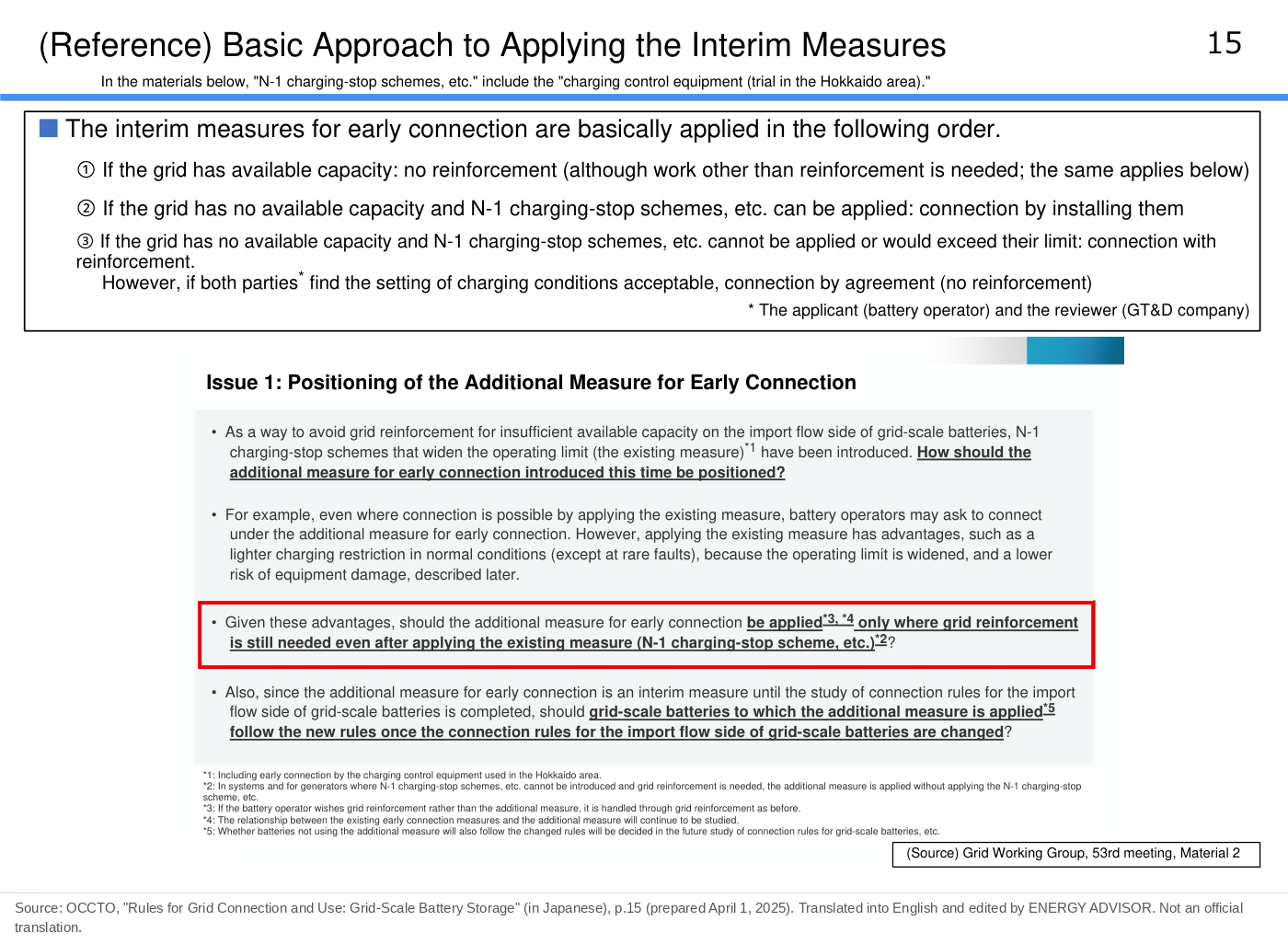
Where the N-1 charging-stop scheme allows connection, its use is given priority. The charging restriction is limited to cases where reinforcement is needed even with existing measures. The two measures can be combined in a single application (Next-Generation Power System Working Group, 2nd meeting, Material 2, pp.8–14).
In principle, the charging restriction conditions of a battery connected earlier are not changed even if another battery connects later. If a later operator chooses reinforcement, the grid is reinforced by the later operator’s capacity so that the earlier operator’s restriction does not widen (same, pp.13–14).
When reinforcement is needed, a connection cost contribution arises. This is the part of the cost of connection work borne by the connecting operator. The calculation method is the same as on the export flow side (“Grid-Scale Battery Storage,” p.29).
Separately, on some systems in the Hokkaido area, a trial approach using charging control devices is applied (same, pp.26–27). Hokkaido Electric Power Network states that available capacity on the import flow side is insufficient at some transmission and transformation facilities. The method allows early connection on the condition of installing a charging control device that limits charging, and acceptance began on January 20, 2023.
Effects on Market Participation
Batteries under the charging restriction face no restriction on market participation and are treated in the same way as other batteries (“Grid-Scale Battery Storage,” p.23). This covers the day-ahead market (spot market), the intraday market, the capacity market and the Supply and Demand Balancing Market (balancing market).
However, they participate in each market within the constraints, with priority given to the requirements for connecting to the grid. If market requirements cannot be met because of the charging restriction, there is in principle no exemption, except where the operator is not responsible (Next-Generation Power System Working Group, 2nd meeting, Material 2, pp.23–25).
Because the discharging side is under non-firm connection, it is subject to output curtailment when the grid is congested. The treatment of the discharging side in the balancing market is explained in the next article.
A Remaining Issue: Full Rules for the Import Flow Side
Both the N-1 charging-stop scheme and the charging restriction are “interim measures.” OCCTO states that the future design for the charging (import flow) side is being studied (“Grid-Scale Battery Storage,” p.6). Applying the same approach as on the discharging (export flow) side is one option.
If connection rules are developed in the future, it is considered desirable for batteries connected under the interim measures to follow the new rules as well (same, p.7). ANRE lists the following as future issues (Next-Generation Power System Working Group, 2nd meeting, Material 2, pp.28–34).
- Study of flexible connection rules such as non-firm connection
- Measures against capacity hoarding (holding secured capacity without using it)
- Measures against competition with ordinary demand
- Discipline in grid access
- Review of rules for network development (reviewing inefficient reinforcement, for example where batteries do not charge during heavy-flow hours)
Developments in 2026 (Next-Generation Power System Working Group, 6th–13th Meetings)
At the 7th meeting on February 9, 2026, ANRE presented three policies for the full rules on the charging side. At the center is schedule-based control. Schedule-based control is a control method under which congestion is known before real time. The material states that, compared with real-time control, it has a smaller effect on battery business plans and a smaller volume of imbalances (deviations between plan and actual results) (7th meeting, Material 1-1, p.10). The material for the 12th meeting (August 6, 2026) states that the three policies were endorsed at the 7th meeting (12th meeting, Material 2, p.15).
| Policy | Content | Source |
|---|---|---|
| (1) Schedule-based control | Study aiming at non-firm connection on the charging side through schedule-based control, with reference to the mechanism on the generation side | 7th meeting, Material 1-1, p.9 |
| (2) Interim measures until introduction | Study measures such as making the hours of the charging restriction more flexible | 7th meeting, Material 1-1, p.10 |
| (3) Approach to grid reinforcement | Study the approach to grid reinforcement on the premise of introducing non-firm connection | 12th meeting, Material 2, p.15 |
Introducing non-firm connection through schedule-based control is said to take a long time, five to seven years (7th meeting, Material 1-1, p.10; 12th meeting, Material 2, p.17). No year of introduction is given.
As for use of the charging restriction, there were contract applications for 189 projects totaling 913 MW (approximate) as of the end of January 2026. This is about 3% of the total by capacity (7th meeting, Material 1-1, pp.10–11).
For the interim measures in (2), the 12th meeting presented the following proposal (12th meeting, Material 2, p.19). It would build on the current additional measure for early connection (the charging restriction) and widen its scope. It is at the proposal stage.
- Further widen the voltage levels eligible for application
- Study the treatment of discharging
- Make it a uniform rule rather than a scheme that operators choose
Material 2 of the 13th meeting on October 6, 2026 contained no mention of schedule-based control or interim measures for the charging side.
Low-Voltage Grid-Scale Battery Storage
Applications are also increasing for low-voltage grid-scale battery storage, which is outside the scope of the charging restriction. As of the end of August 2026, there were contract applications for about 130 MW in about 2,800 cases (13th meeting, Material 2, p.13). The 13th meeting presented a proposal that the following three measures need to be worked out in detail for the time being (same, p.17). It is at the proposal stage.
- Measures against splitting sites, for example to avoid stepping up the voltage (the subject of discussion at the 13th meeting)
- Response to large numbers of applications by a single operator
- Clarifying the relationship between landowners and the parties carrying out the business
Discipline Already Introduced
Discipline has been introduced into application procedures. Raising the application deposit and revising installment payments were decided at the 6th meeting on December 24, 2025 (7th meeting, Material 1-1, p.5). The material for the 12th meeting lists the following measures as “introduced” (12th meeting, Material 2, p.7).
| Procedure | Measure | Start | Scope |
|---|---|---|---|
| Grid connection study | Require submission of a document summarizing information on the land where connection is sought | January 2026 | All generating and similar facilities |
| Grid connection study | Cap the number of grid connection study applications per operator | August 2026 | Grid-scale battery storage only |
| Grid connection study | Give an early answer once it is clear that construction costs or other terms do not meet the operator’s wishes | April 2026 | All generating and similar facilities |
| Connection contract application | Require submission of land-use rights (the right to use the land) for the land where connection is sought | October 2026 | All generating and similar facilities |
| Connection contract application | Raise the application deposit at the time of contract application and set a minimum first payment for installment payment of construction costs | April 2026 | Grid-scale battery storage only |
The material for the 7th meeting describes the measures applied only to grid-scale battery storage as interim, until the review of connection rules is complete (7th meeting, Material 1-1, pp.5–6).
Summary
Grid-scale battery storage can connect on the discharging side under non-firm connection, but on the charging side the basic rule is to reinforce before connection if capacity is insufficient. As interim measures for earlier connection, the N-1 charging-stop scheme has applied since September 2023 and the charging restriction since April 2025.
The charging restriction is a mechanism for connecting without reinforcement on the condition of stopping charging during hours set by the GT&D company, with 12 hours per day as the guide for the upper limit. The costs are borne by the operator, and participation in the various markets is not restricted. Full rules for the charging side are still being studied, aiming at non-firm connection through schedule-based control. Introduction is said to take five to seven years, and in the meantime interim measures based on the charging restriction and discipline in applications are used.
This article is based on published materials from the Ministry of Economy, Trade and Industry and its Agency for Natural Resources and Energy, the Electricity and Gas Market Surveillance Commission, the Organization for Cross-regional Coordination of Transmission Operators (OCCTO) and other sources. The English translations of figures are by ENERGY ADVISOR and are not official translations. When using this information for decisions, please check the original sources. When we find an error, we correct the article and note the date of the correction.
Sources
- OCCTO, “Rules for Grid Connection and Use: Grid-Scale Battery Storage” (in Japanese) (prepared April 1, 2025), pp.4–7, 9–12, 14–24 and 26–29. https://www.occto.or.jp/grid/business/documents/chikudenchi_20250901.pdf
- ANRE, “Toward Rapid Grid Connection of Grid-Scale Battery Storage” (in Japanese), Grid Working Group, 53rd meeting, Material 2 (December 2, 2024), pp.2, 4, 5 and 15. https://www.meti.go.jp/shingikai/enecho/shoene_shinene/shin_energy/keito_wg/pdf/053_02_00.pdf
- ANRE, “Toward Rapid Grid Connection of Grid-Scale Battery Storage” (in Japanese), Next-Generation Power System Working Group, 2nd meeting, Material 2 (March 17, 2025), pp.2–3, 6–17, 23–26 and 28–34. https://www.meti.go.jp/shingikai/enecho/denryoku_gas/saisei_kano/smart_power_grid_wg/pdf/002_02_00.pdf
- ANRE, “Toward Rapid Grid Connection of Grid-Scale Battery Storage” (in Japanese), Next-Generation Power System Working Group, 3rd meeting, Material 4 (June 27, 2025), pp.12, 17 and 22–23. https://www.meti.go.jp/shingikai/enecho/denryoku_gas/saisei_kano/smart_power_grid_wg/pdf/003_04_00.pdf
- ANRE, “Response toward Rapid Grid Connection of Generating and Similar Facilities, Including Grid-Scale Battery Storage” (in Japanese), Next-Generation Power System Working Group, 7th meeting, Material 1-1 (February 9, 2026), pp.5, 6 and 9–11. https://www.meti.go.jp/shingikai/enecho/denryoku_gas/saisei_kano/smart_power_grid_wg/pdf/007_01_01.pdf
- ANRE, “Response toward Rapid Grid Connection of Generating and Similar Facilities, Including Grid-Scale Battery Storage” (in Japanese), Next-Generation Power System Working Group, 12th meeting, Material 2 (August 6, 2026), pp.4, 7, 15, 17 and 19. https://www.meti.go.jp/shingikai/enecho/denryoku_gas/saisei_kano/smart_power_grid_wg/pdf/012_02_00.pdf
- ANRE, “Response toward Rapid Grid Connection of Generating and Similar Facilities, Including Grid-Scale Battery Storage” (in Japanese), Next-Generation Power System Working Group, 13th meeting, Material 2 (October 6, 2026), pp.3, 13 and 17. https://www.meti.go.jp/shingikai/enecho/denryoku_gas/saisei_kano/smart_power_grid_wg/pdf/013_02_00.pdf
- Same working group, 10th meeting, Material 2 (April 16, 2026), https://www.meti.go.jp/shingikai/enecho/denryoku_gas/saisei_kano/smart_power_grid_wg/pdf/010_02_00.pdf; 11th meeting, Material 2 (June 10, 2026), https://www.meti.go.jp/shingikai/enecho/denryoku_gas/saisei_kano/smart_power_grid_wg/pdf/011_02_00.pdf (in Japanese) (used to confirm there is no contradiction with this article)
- METI, Next-Generation Power System Working Group (list of meetings) (in Japanese). https://www.meti.go.jp/shingikai/enecho/denryoku_gas/saisei_kano/smart_power_grid_wg/index.html
- Hokkaido Electric Power Network, “Grid Access” (connection of grid-scale battery storage using charging control devices) (in Japanese). https://www.hepco.co.jp/network/con_service/sys_access/index.html#BATTERIES