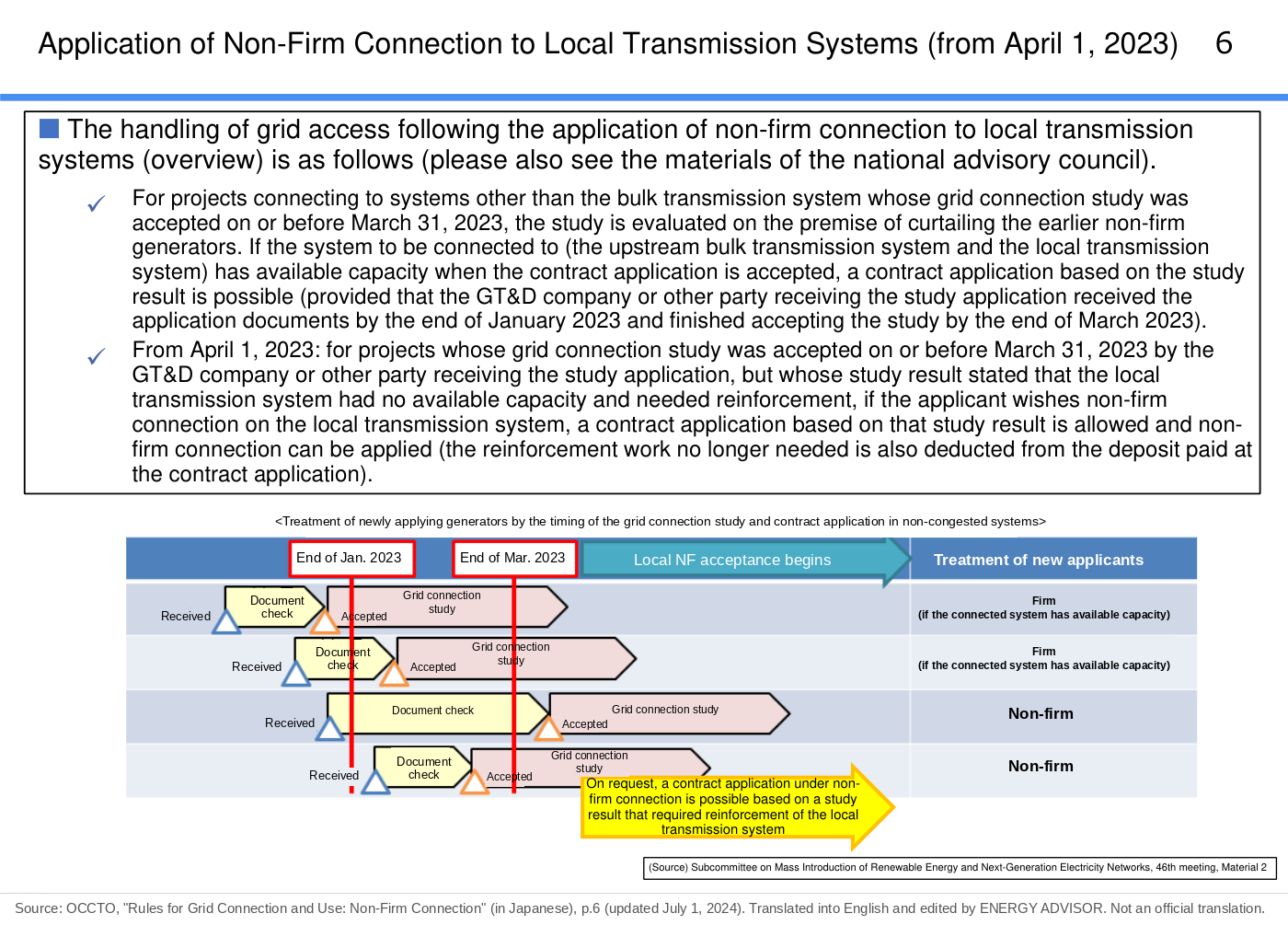
Since April 1, 2023, non-firm connection has applied in principle to generating facilities whose grid connection study (explained below) was accepted on or after that date. This applies regardless of the voltage of the connection point or whether there is available capacity. Non-firm connection is a method of connecting new generators without waiting for grid reinforcement, on the condition that their output is reduced when transmission lines or other facilities are congested.
In 2025, output curtailment under this condition was actually carried out. This article explains how non-firm connection works, its scope, actual cases of curtailment, and how non-firm generators are treated in the markets.
Basics of Japan’s Power Grid and Key Organizations
Japan’s power grid is divided into ten regional service areas: Hokkaido, Tohoku, Tokyo, Chubu, Hokuriku, Kansai, Chugoku, Shikoku, Kyushu and Okinawa. The frequency is 50 Hz in eastern Japan (Hokkaido, Tohoku and Tokyo) and 60 Hz in western Japan. The nine areas other than Okinawa are linked by transmission lines called cross-regional interconnection lines.
The main organizations that appear in this series are as follows.
| Name | Role |
|---|---|
| General transmission and distribution companies (GT&D companies) | The companies (ten in total) that own and operate the transmission and distribution lines in each area. They accept grid connection applications and curtail output during congestion. In the Tokyo area, this is TEPCO Power Grid |
| Organization for Cross-regional Coordination of Transmission Operators, JAPAN (OCCTO) | The body that coordinates supply-demand and grid operation nationwide. It operates the cross-regional interconnection lines and sets the rules for grid connection and use |
| Agency for Natural Resources and Energy (ANRE) | The bureau of the Ministry of Economy, Trade and Industry (METI) in charge of energy policy. It discusses the direction of policy in advisory councils (meetings of experts) |
| Electricity and Gas Market Surveillance Commission (EGC) | The regulator that monitors electricity trading and tariffs |
| Japan Electric Power Exchange (JEPX) | The wholesale electricity exchange. It runs markets such as the day-ahead market (spot market), where electricity for the next day is traded the day before |
The grid is divided into three tiers by voltage.
| Tier | Scope | Example (Tokyo area) |
|---|---|---|
| Bulk transmission system | The top two voltage levels of each area’s grid (132 kV in Okinawa) | 500 kV and 275 kV |
| Local transmission system | Extra-high-voltage systems below the bulk transmission system, excluding the distribution system | 154 kV and 66 kV |
| Distribution system | High voltage (6.6 kV) and low voltage | 6.6 kV and 100 V/200 V |
The voltages of the bulk transmission system differ by area.
Series Timeline
| Date | Event |
|---|---|
| April 2018 | Rationalization of assumed power flows (revised calculation of available capacity) |
| October 2018 | Early application of N-1 generation tripping |
| January 2021 | Non-firm connection applied to bulk transmission systems with no available capacity |
| April 2022 | Applied to generators whose receiving voltage is that of the bulk transmission system, regardless of available capacity |
| July 2022 | Full application of N-1 generation tripping |
| December 2022 | Redispatch on the bulk transmission system (redispatch using balancing resources) begins |
| April 2023 | Non-firm connection applied in principle regardless of connection voltage or available capacity (including local transmission systems) |
| September 2023 | N-1 charging-stop scheme applied to grid-scale battery storage |
| December 2023 | Redispatch on the bulk transmission system (fixed curtailment order) begins |
| April 2024 | Interim pro-rata curtailment of non-firm generators begins on local transmission systems in the Tokyo area |
| July 2024 | OCCTO’s rules add the treatment of batteries (energy storage systems) in output curtailment |
| January 2025 | Output curtailment of thermal plants under redispatch on the bulk transmission system in the Tokyo area |
| March 2025 | Japan’s first grid-constrained curtailment of solar and wind, on a local transmission system in the Chubu area |
| April 2025 | Charging restriction for grid-scale battery storage (interim measures for early grid connection) applied |
| April 2026 | Curtailment based on the redispatch (fixed curtailment order) sequence begins on local transmission systems in the Tokyo area |
Firm and Non-Firm Connection
To deliver electricity from a generating facility to customers, the facility must be connected to the power grid. Connecting to the grid is called “grid access,” and the GT&D company’s examination of whether a facility can connect is called a “grid connection study.”
One item in the grid connection study is securing the capacity of transmission lines and transformers. Because transmission lines have an upper limit on the power they can carry, the study checks whether there is enough available capacity to carry the power from the new generating facility.
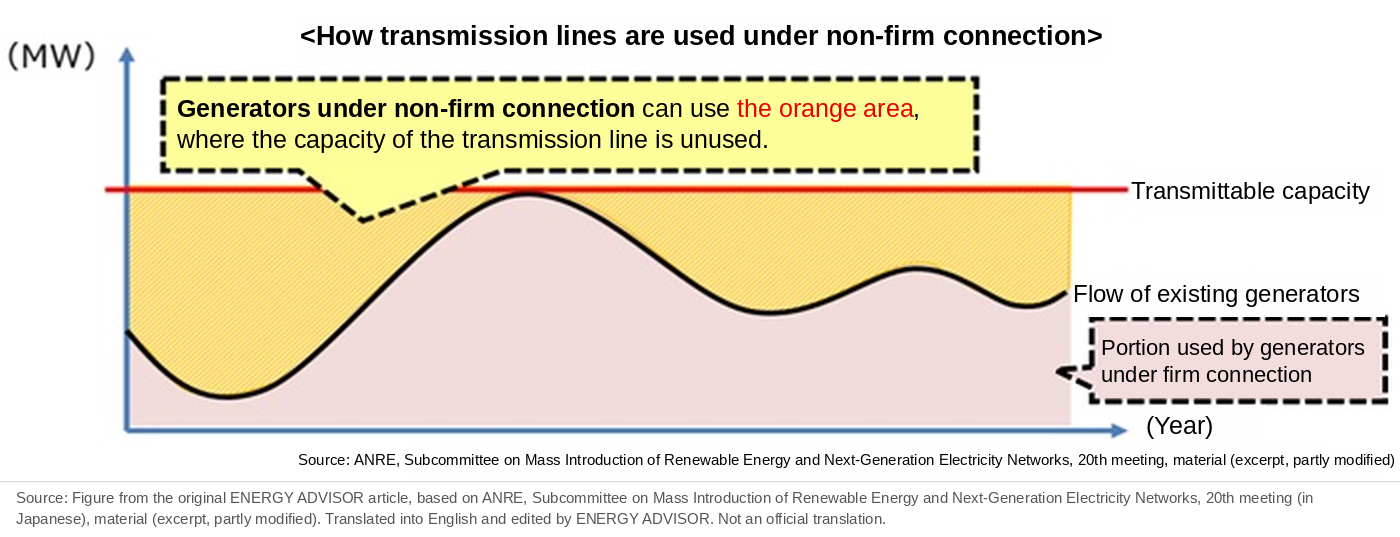
Generating facilities connected to the grid operate according to demand and weather (sunshine and wind). They therefore do not always use up the capacity of transmission and transformation facilities.
Connecting new generators by using this unused capacity is called non-firm connection. Because it uses spare capacity, output is curtailed to fit the available capacity even in normal conditions, when there is no fault or failure of facilities.
The conventional connection method, in which the capacity needed to generate in normal conditions is secured (“firm”), is called firm connection. A connection method in which the necessary capacity is not secured (“non-firm”) is non-firm connection.
Congestion is a situation in which the power flowing through a transmission line or transformer exceeds, or may exceed, its operating limit (unyo yoryo in Japanese). Under non-firm connection, generators can connect quickly on the premise of output curtailment (reducing a generator’s output) during congestion. The operating limit here is the upper limit of power that may flow in normal conditions, after excluding the margin kept for facility faults.
Three Measures of the Japanese Version of Connect & Manage
Non-firm connection is one of the measures of the “Japanese version of Connect & Manage.” This is an initiative to expand renewable energy by making maximum use of the existing transmission network. There are three measures.
| Measure | Content | Start |
|---|---|---|
| Rationalization of assumed power flows | Stop assuming that all generators reach maximum output at the same time, and recalculate available capacity based on actual results | April 2018 |
| N-1 generation tripping | Widen the operating limit in normal conditions, on the condition of devices that instantly stop generators when a single facility fails | Early application October 2018; full application July 2022 |
| Non-firm connection | Connect using spare capacity, on the condition of output curtailment during congestion | In stages from January 2021 |
N-1 generation tripping is explained in a separate article in this series.
Expansion of Scope
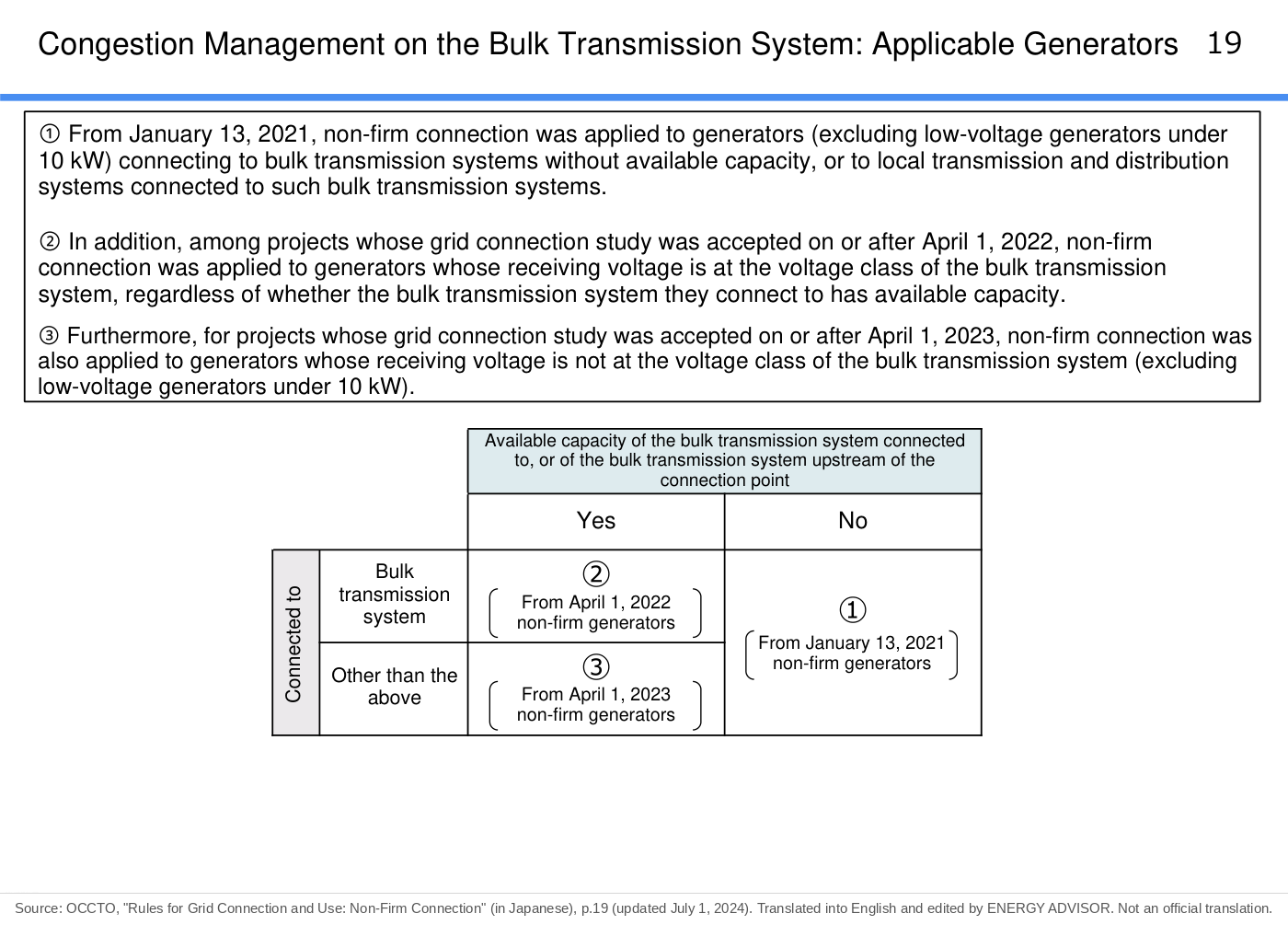
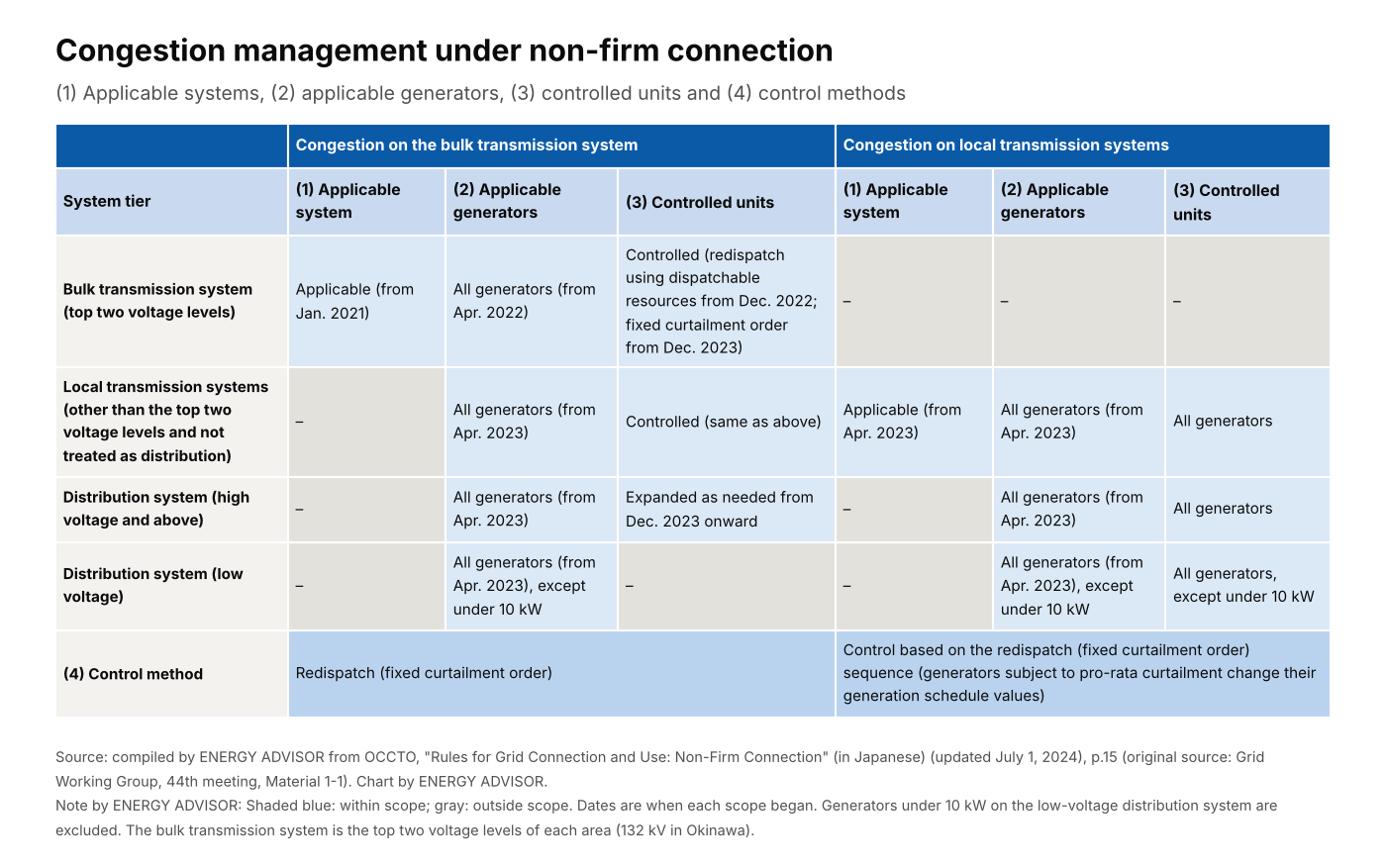
The scope of non-firm connection expanded in the following order (OCCTO, “Rules for Grid Connection and Use: Non-Firm Connection,” pp.5 and 19, version updated July 1, 2024).
| Start of application | Scope |
|---|---|
| January 13, 2021 | Generators connecting to, or below, a bulk transmission system with no available capacity |
| April 1, 2022 (date the grid connection study was accepted) | Generators whose receiving voltage is that of the bulk transmission system. Applies regardless of whether the bulk transmission system has available capacity |
| April 1, 2023 (date the grid connection study was accepted) | In principle, all generators, regardless of the connection voltage or whether there is available capacity. Extended to local transmission systems |
However, low-voltage generators under 10 kW are excluded. Because they are affected by fluctuations in demand, their output is hard to forecast and control. TEPCO Power Grid states that it has applied non-firm connection to local transmission systems since April 3, 2023.
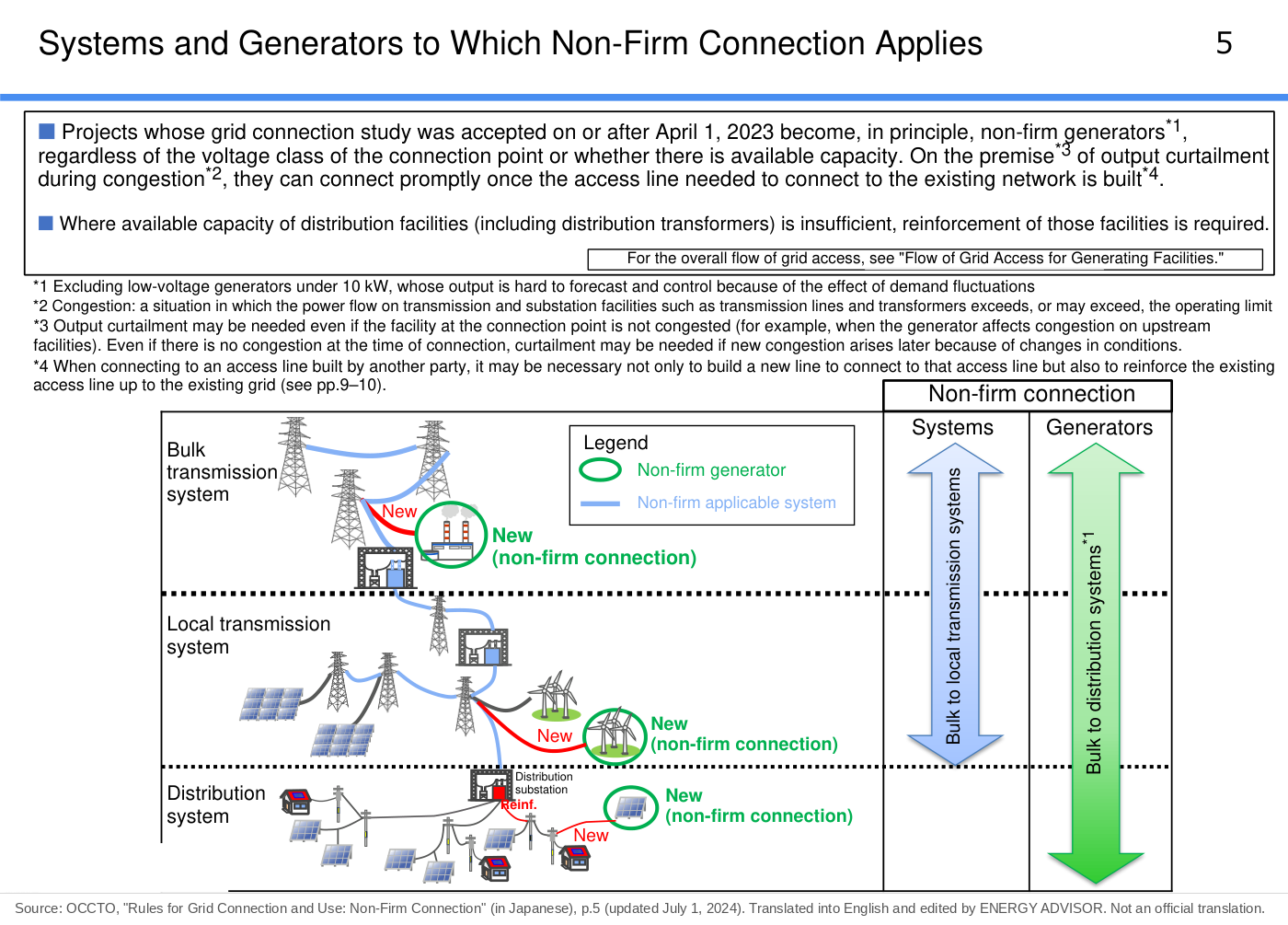
Even under “non-firm by default,” reinforcement has not become unnecessary for all facilities. If the available capacity of distribution system facilities (including distribution transformers) is insufficient, reinforcement work on those facilities is required (same material, p.5).
As of the end of October 2024, applications for non-firm connection contracts totaled about 26 GW nationwide (ANRE, “Non-Firm Connection Initiatives under the Japanese Version of Connect & Manage,” Next-Generation Power System Working Group, 1st meeting, Material 4, p.2, January 23, 2025).
Output Control Equipment Required for Non-Firm Generators
When connecting a generator under non-firm connection, a device that receives the output curtailment schedule is required. The GT&D company sends the schedule online.
When applying to a GT&D company for connection, the generator submits a “consent form for non-firm connection.” The consent form includes conditions such as the following (same material, pp.12–13).
- On the premise of output curtailment without compensation during grid congestion (online control), install the equipment needed for output curtailment before grid connection begins
- Comply with the GT&D company’s requests regarding the installation of output control equipment and output curtailment
At voltages of 66 kV or higher, the output curtailment schedule must be received over a dedicated line. On that basis, the generator builds a system that controls the generator’s output automatically.
On systems below 66 kV, a device that receives the output curtailment schedule is also required. However, the conditions allow the generator to be controlled manually (Transmission and Distribution Grid Council, “Specifications of Output Control Equipment for Non-Firm Connection,” Grid Working Group, 44th meeting, Material 1-2).
Congestion Curtailment Actually Carried Out in 2025
The original article (2022) stated, as a forecast, that output would need to be curtailed if generators on the same system sent power at maximum output at the same time. In 2025, this actually happened.
| Date | Location | Content |
|---|---|---|
| January 6, 2025 | Bulk transmission system in the Tokyo area (one 500/275 kV transformer at Boso Substation) | Output of dispatchable resources (thermal plants) curtailed under redispatch (fixed curtailment order). About 150 MWh (preliminary value) |
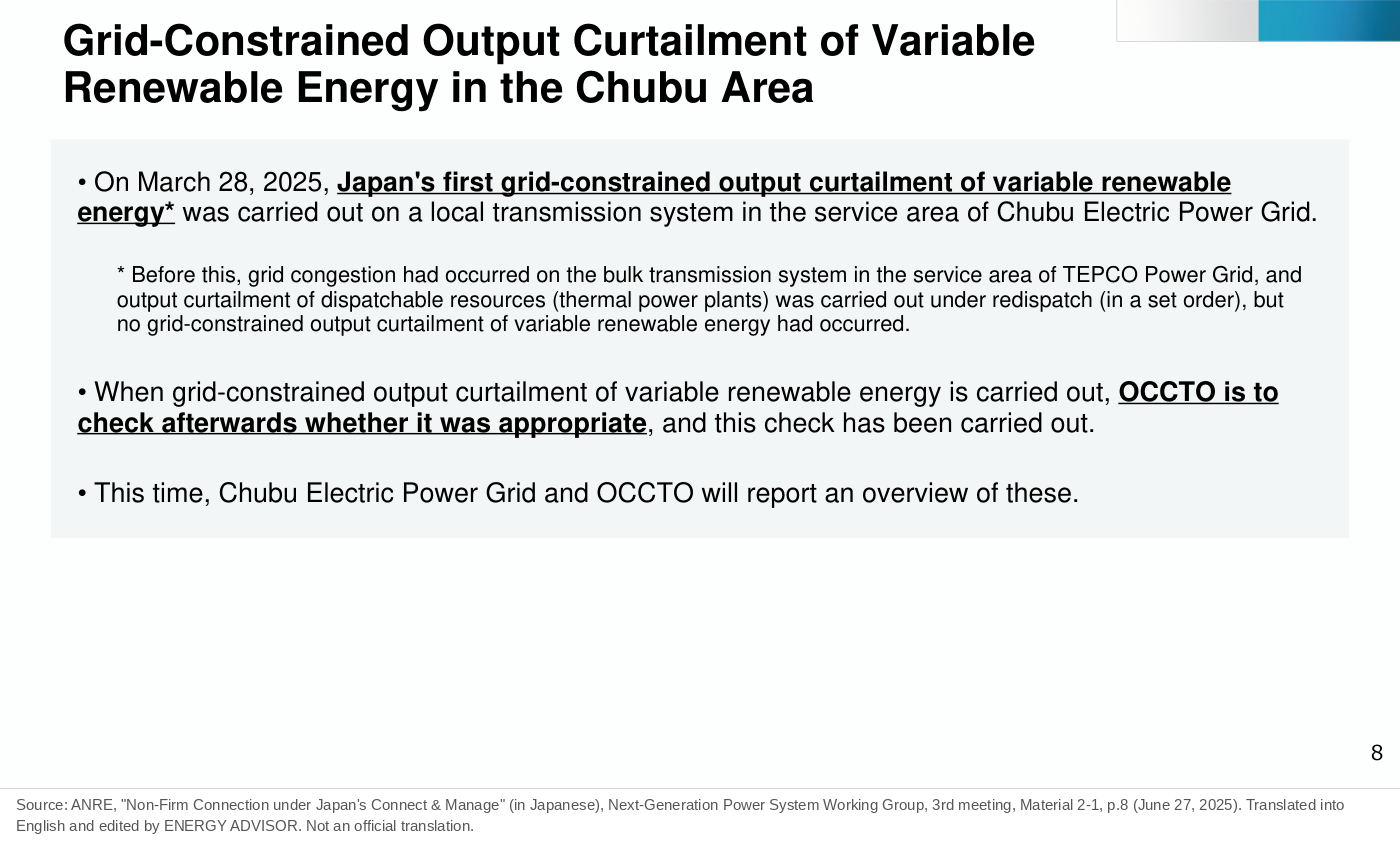
| March 28, 2025 | Local transmission system in the Chubu area | Japan’s first grid-constrained output curtailment of variable renewable energy (solar and wind) |
The sources are Next-Generation Power System Working Group, 1st meeting, Material 4, pp.2–3 (January 23, 2025), and the same working group, 3rd meeting, Material 2-1, pp.5 and 8 (June 27, 2025).
In the Chubu case, curtailment instructions were issued on 15 days between March 28 and April 28, 2025. The targets were ten non-firm solar operators connected to the 77 kV Seino-Ibi Line, and the maximum daily curtailment was 0.9–2.3 MW (Chubu Electric Power Grid, “Status of Renewable Energy Output Curtailment due to Grid Congestion,” Next-Generation Power System Working Group, 3rd meeting, Material 2-3, pp.3, 6 and 8).
ANRE expects that if the volume of non-firm connections grows further, congestion will also occur in other areas and systems (1st meeting, Material 4, p.2).
Congestion management on the bulk transmission system (redispatch) and on local transmission systems is explained in separate articles in this series.
Market Participation
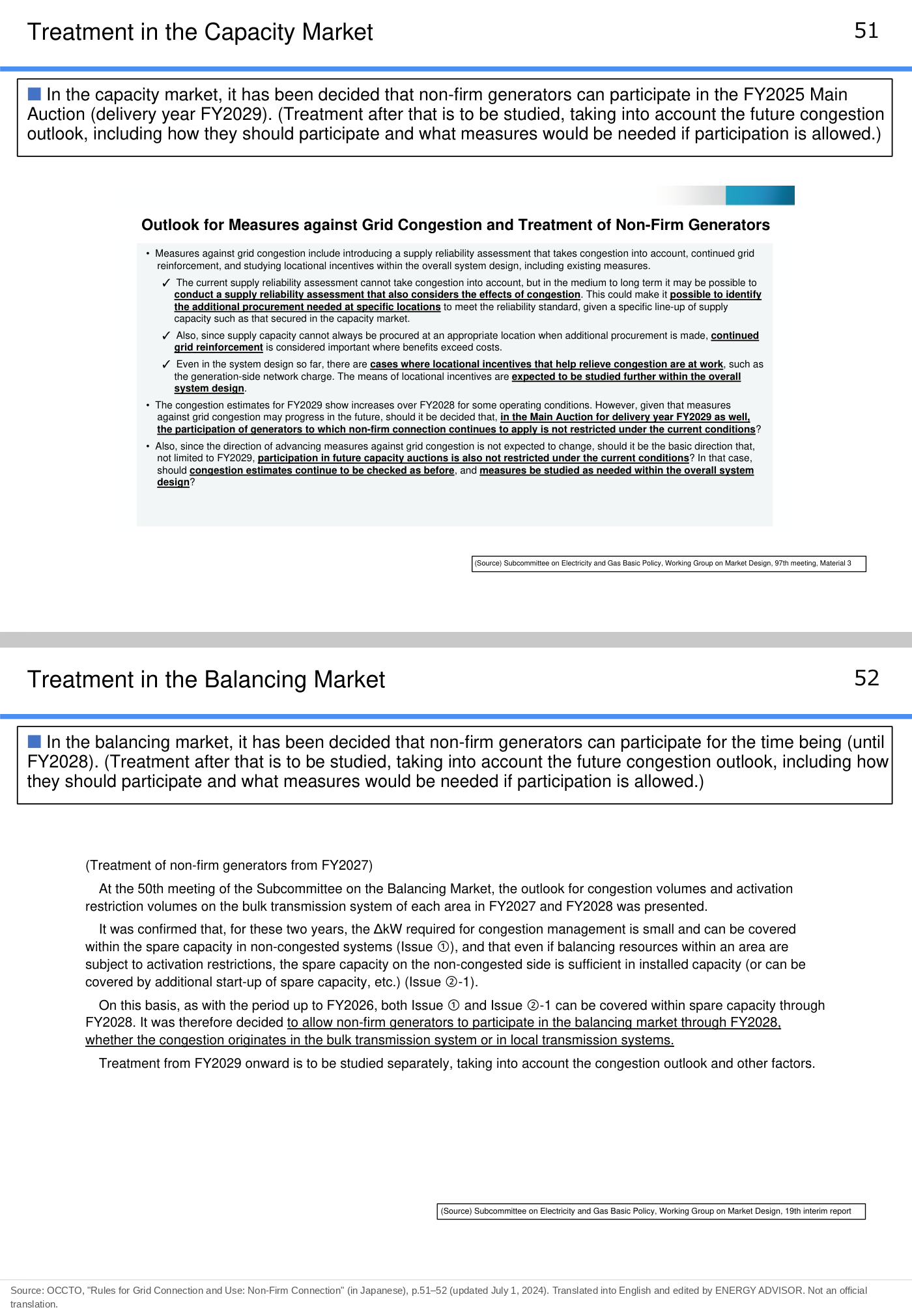
Non-firm generators may be subject to output curtailment. For this reason, there has been discussion of whether they can take part in two markets: the capacity market, which trades future supply capacity, and the Supply and Demand Balancing Market (balancing market), which trades the power used to balance supply and demand (balancing capacity). The current arrangement is as follows (OCCTO, “Non-Firm Connection,” pp.51–52).
| Market | Treatment of non-firm generators |
|---|---|
| Capacity market | May participate in the FY2025 Main Auction (delivery year FY2029). After that, to be considered in light of the congestion outlook |
| Balancing market | May participate for the time being (until FY2028). After that, to be considered in light of the congestion outlook |
Japan’s fiscal year (FY) runs from April to March; for example, FY2029 is April 2029–March 2030.
The consent form also includes the condition that the generator “accepts that it may be unable to participate in the capacity market and the balancing market” (same material, p.12). The treatment in the balancing market is explained in detail in the article on grid-scale battery storage.
Charging Side of Grid-Scale Battery Storage (Overview)
Grid-scale battery storage is storage that charges from the power grid and discharges to the grid. Discharging, like generation, is an export flow (electricity flowing from the customer side to the grid). Charging, like demand, is an import flow (electricity flowing from the grid to the customer side).
Non-firm connection applies to the discharging (export flow) side. For the charging (import flow) side, as with demand, the basic rule is that if capacity is insufficient, the grid is reinforced before connection. On that basis, interim measures have been introduced for earlier connection: the N-1 charging-stop scheme (from September 2023) and the charging restriction (from April 2025) (OCCTO, “Rules for Grid Connection and Use: Grid-Scale Battery Storage,” pp.5–7, prepared April 1, 2025). Details are explained in the article on early connection rules for grid-scale battery storage.
Advantages and Disadvantages
Advantages
When connecting a generating facility to the grid, if capacity is insufficient, the generator must bear the cost of reinforcing the facilities. That cost could be high and was an obstacle to building new generating facilities.
Non-firm connection has made it possible to connect without waiting for reinforcement, even to systems with no available capacity. The burden of reinforcement costs has also fallen greatly.
Disadvantages
Non-firm connection uses the times when the grid has spare capacity. When generators on the same system send power at the same time, the capacity of transmission lines and transformers becomes insufficient, and generation must be curtailed. In 2025, curtailment was actually carried out, as shown in the table above.
Because a generator may be unable to send the amount of energy assumed when it was built, investment decisions become harder.
Information Developers Should Watch
OCCTO publishes a medium- to long-term outlook of output curtailment due to grid congestion every year. The latest covers FY2031 (Cross-Regional Network Development Committee, 103rd meeting, Material 3, September 1, 2026). GT&D companies also publish information on systems where congestion is expected and on the status of output curtailment.
How to read this information is explained in the article on reading grid congestion data.
Summary
Non-firm connection is a mechanism for making effective use of the unused capacity of transmission and distribution facilities. Generators whose grid connection study was accepted on or after April 2023 are, in principle, connected on a non-firm basis, except for low-voltage generators under 10 kW.
At the same time, congestion curtailment was actually carried out in 2025 on both the bulk transmission system and a local transmission system. When building a generating facility under non-firm connection, developers should estimate output curtailment based on the published congestion outlook, and then assess the project’s economics.
This article is based on published materials from the Ministry of Economy, Trade and Industry and its Agency for Natural Resources and Energy, the Electricity and Gas Market Surveillance Commission, the Organization for Cross-regional Coordination of Transmission Operators (OCCTO) and other sources. The English translations of figures are by ENERGY ADVISOR and are not official translations. When using this information for decisions, please check the original sources. When we find an error, we correct the article and note the date of the correction.
Sources
- OCCTO, “Rules for Grid Connection and Use: Non-Firm Connection” (in Japanese) (prepared December 25, 2020; updated July 1, 2024), pp.5 and 19 (scope), pp.12–13 (consent form), p.51 (capacity market), p.52 (balancing market). https://www.occto.or.jp/grid/assets/NF_setuzokuriyou_20260710.pdf
- OCCTO, “Rules for Grid Connection and Use: Grid-Scale Battery Storage” (in Japanese) (prepared April 1, 2025), pp.5–7. https://www.occto.or.jp/grid/business/documents/chikudenchi_20250901.pdf
- ANRE, “Non-Firm Connection Initiatives under the Japanese Version of Connect & Manage” (in Japanese), Next-Generation Power System Working Group, 1st meeting, Material 4 (January 23, 2025), pp.2–3. https://www.meti.go.jp/shingikai/enecho/denryoku_gas/saisei_kano/smart_power_grid_wg/pdf/001_04_00.pdf
- ANRE, “Non-Firm Connection Initiatives under the Japanese Version of Connect & Manage” (in Japanese), Next-Generation Power System Working Group, 3rd meeting, Material 2-1 (June 27, 2025), pp.5 and 8. https://www.meti.go.jp/shingikai/enecho/denryoku_gas/saisei_kano/smart_power_grid_wg/pdf/003_02_01.pdf
- Chubu Electric Power Grid, “Status of Renewable Energy Output Curtailment due to Grid Congestion” (in Japanese), Next-Generation Power System Working Group, 3rd meeting, Material 2-3 (June 27, 2025), pp.3, 6 and 8. https://www.meti.go.jp/shingikai/enecho/denryoku_gas/saisei_kano/smart_power_grid_wg/pdf/003_02_03.pdf
- METI, Next-Generation Power System Working Group (list of meetings) (in Japanese). https://www.meti.go.jp/shingikai/enecho/denryoku_gas/saisei_kano/smart_power_grid_wg/index.html
- Transmission and Distribution Grid Council, “Specifications of Output Control Equipment for Non-Firm Connection” (in Japanese), Grid Working Group, 44th meeting, Material 1-2. https://www.meti.go.jp/shingikai/enecho/shoene_shinene/shin_energy/keito_wg/pdf/044_01_02.pdf
- TEPCO Power Grid, “Non-Firm Connection and Redispatch” (in Japanese). https://www.tepco.co.jp/pg/consignment/access/nonfarm.html
- OCCTO, “Medium- to Long-Term Grid Congestion Outlook for FY2031 (Report)” (in Japanese), Cross-Regional Network Development Committee, 103rd meeting, Material 3 (September 1, 2026). https://www.occto.or.jp/assets/iinkai/kouikikeitouseibi/103/seibi_103_03_01.pdf