Power facilities such as transmission lines and transformers have an upper limit on the power they can carry. General transmission and distribution companies (GT&D companies) are the companies that operate the transmission and distribution network in each area. When there is a risk of exceeding the limit, the GT&D company adjusts the output of generators to stay within it.
Redispatch is the set of rules for adjusting generator output in such cases. In Japan, it began in December 2022 as “redispatch using balancing resources” and was extended to the “fixed curtailment order” in December 2023. This article explains how redispatch works, the order of output curtailment, the approach to settlement, and an actual case of activation.
The grid tiers (bulk transmission system and local transmission system) and the key organizations are explained in the first article of this series, on non-firm connection.
Basics of Grid Congestion and Redispatch
Power facilities have a set upper limit on the electricity they can carry: the operating limit of a transmission line or transformer (unyo yoryo in Japanese). A situation in which this value may be exceeded is called “grid congestion.”
To relieve grid congestion, the output of generators within the congested system is reduced. However, to maintain frequency, demand and generation must always match. For this reason, the output of generators in a system that is not congested is raised by the same amount that was reduced.
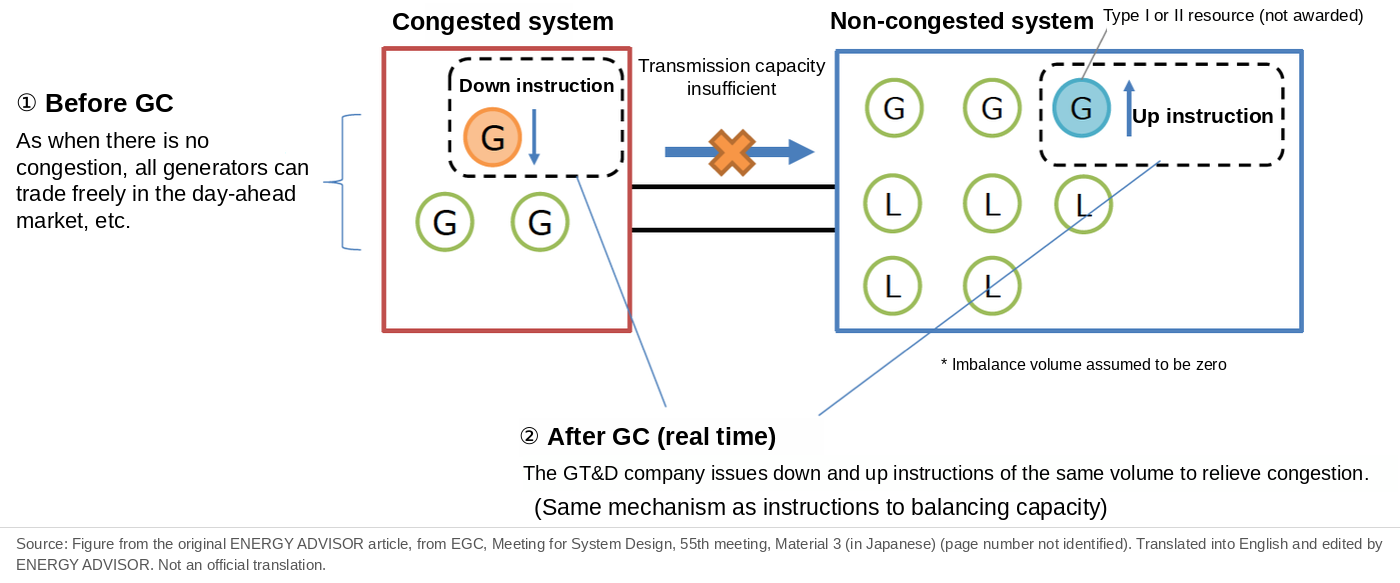
Concept of redispatch (Source: Electricity and Gas Market Surveillance Commission (EGC), Meeting for System Design, 55th meeting, Material 3)
For example, suppose grid congestion occurs near bulk substation B. To relieve it, the output of dispatchable resources connected to bulk substation B is reduced, and at the same time the output of dispatchable resources connected to another bulk substation, A, is raised.
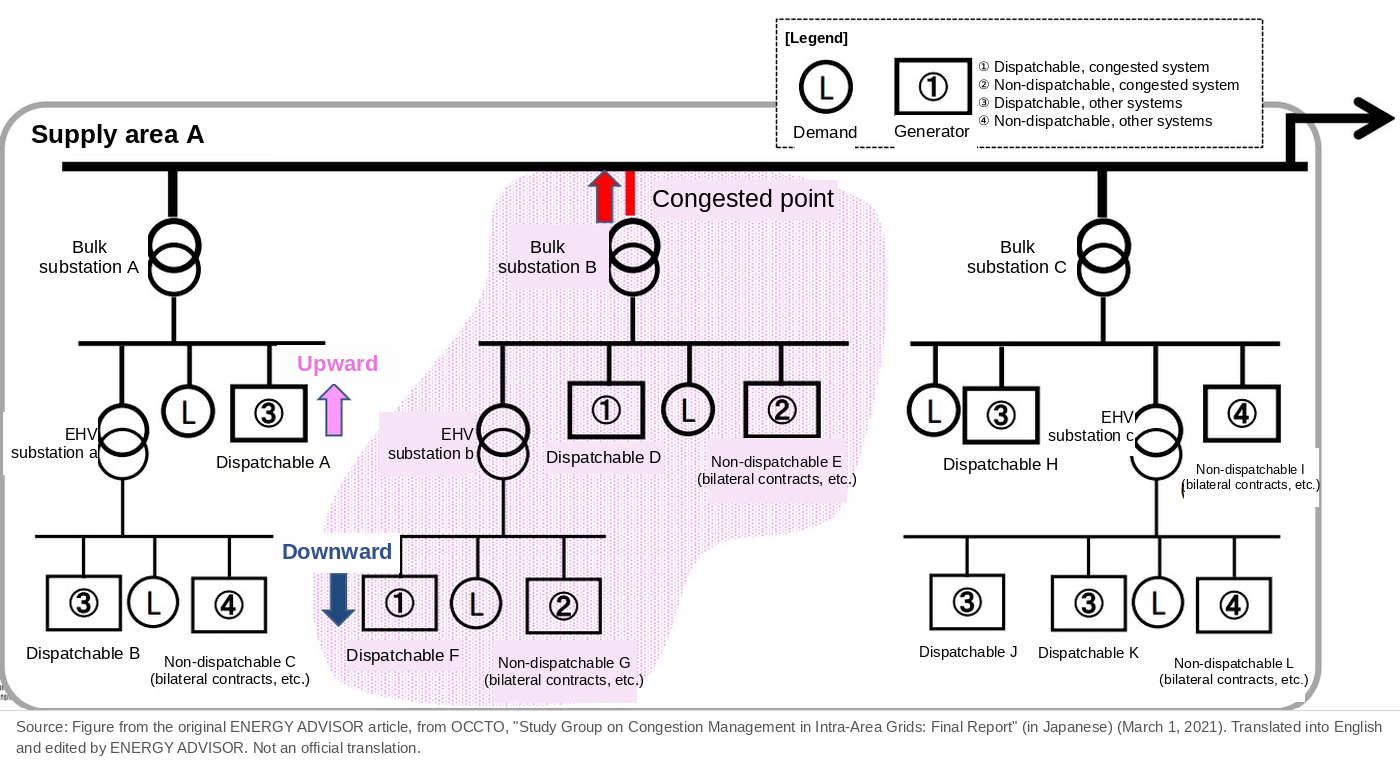
Example of congestion management (Source: Study Group on Congestion Management in Intra-Area Grids, Final Report, March 1, 2021)
The method in which the GT&D company issues “down” and “up” instructions at the same time to relieve congestion is called redispatch.
Non-firm connection is a “connection” concept: connecting to the grid without reinforcement, on the premise of output curtailment during congestion. Redispatch is an “operation (congestion management)” concept that presupposes such connections.
Three Stages
| Stage | Start | Target system | Generators whose output is curtailed |
|---|---|---|---|
| Stage 1: Redispatch using balancing resources | December 21, 2022 | Bulk transmission system | Dispatchable resources only |
| Stage 2: Fixed curtailment order | December 28, 2023 | Bulk transmission system | In addition to dispatchable resources, non-dispatchable resources are also curtailed in a fixed order |
| Stage 3: Expansion to local transmission systems | Tokyo area: April 1, 2026 | Local transmission systems | Control based on the fixed curtailment order sequence |
The sources are OCCTO, “Rules for Grid Connection and Use: Non-Firm Connection,” p.15 (updated July 1, 2024), and TEPCO Power Grid, “Non-Firm Connection and Redispatch.”
Stage 1: Redispatch Using Balancing Resources (from December 2022)
Dispatchable Resources
Dispatchable resources are generators whose output the GT&D company can control. From FY2024 (April 2024–March 2025), balancing capacity tenders were abolished (except in Okinawa), and GT&D companies procure upward balancing capacity from the Supply and Demand Balancing Market (balancing market). Gate closure (GC) is the time, one hour before real time, at which plans are fixed. Congestion management uses balancing capacity secured in the market and the spare capacity of generators after gate closure (“Non-Firm Connection,” p.53). Spare capacity is used from generators that have signed a “spare-capacity utilization contract.” This contract allows the GT&D company to use, for balancing, the upward and downward headroom left on a generator after gate closure.
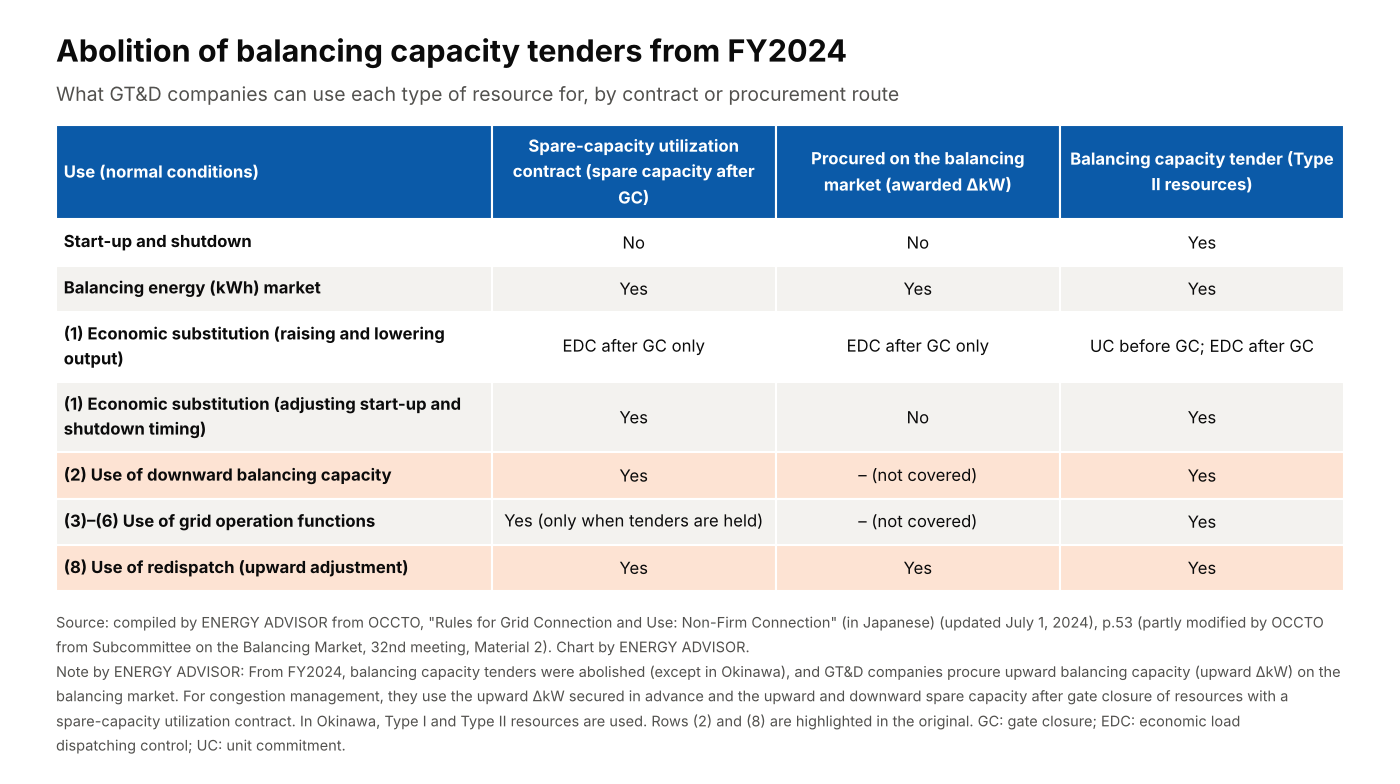
The balancing market is the market in which GT&D companies procure balancing capacity (ΔkW) to fill the gap between demand and supply.
Control by Merit Order
In redispatch, the output of the generator with the highest cost (incremental price) within the congested system is reduced, and the output of the generator with the lowest cost in another system is raised. This keeps the impact on the cost of supply and demand to a minimum.
The approach of running generators in order from the lowest operating cost (fuel cost, start-up cost and so on) to minimize total operating cost is called the merit order.
How It Started
At a government advisory council on November 30, 2021 (Subcommittee on Mass Introduction of Renewable Energy and Next-Generation Electricity Networks, 37th meeting), it was agreed to start redispatch (redispatch using balancing resources). It is a method that uses dispatchable resources, for which the control environment is already in place, and controls their output according to the merit order. Operation began on December 21, 2022.
The council material explains the reason for introduction as follows (37th meeting, Material 2, pp.22 and 24). Market-based mechanisms take a certain amount of time for system development and other work. Therefore, to reduce renewable output curtailment quickly, it was decided to start redispatch using dispatchable resources within 2022. If congestion can be handled with dispatchable resources, the existing systems can be used, and dispatchable resources can respond before renewables are curtailed. For this reason, the material stated that the physical connection of non-firm generators should also be brought forward as much as possible.
Stage 2: Fixed Curtailment Order (from December 2023)
When Dispatchable Resources Are Not Enough
Relieving congestion with dispatchable resources requires enough dispatchable resources within the congested system. If there are no dispatchable resources in the system, or not enough, congestion cannot be relieved.
A method was therefore created to curtail output in a fixed order, including generators other than dispatchable resources. This is “redispatch (fixed curtailment order).” The change from Stage 1 is that generators other than dispatchable resources (non-dispatchable resources) are also subject to output curtailment. Operation began on December 28, 2023.
Generators Subject to Output Curtailment
As of the start on December 28, 2023, generators connected to the bulk transmission system and local transmission systems are, in principle, subject to output curtailment. For generators on the distribution system (high voltage and above), it was decided to expand coverage as needed from December 2023 onward (“Non-Firm Connection,” pp.17 and 20).
| Type of generator | Firm connection | Non-firm connection |
|---|---|---|
| Dispatchable resources | Subject | Subject |
| Non-dispatchable resources: thermal and similar generators, energy storage systems (batteries, etc.) | Subject | Subject |
| Non-dispatchable resources: variable renewable energy (solar and wind), long-term fixed generators (hydro, nuclear and geothermal), biomass generators (dedicated, local resources) | No output curtailment in principle | Subject |
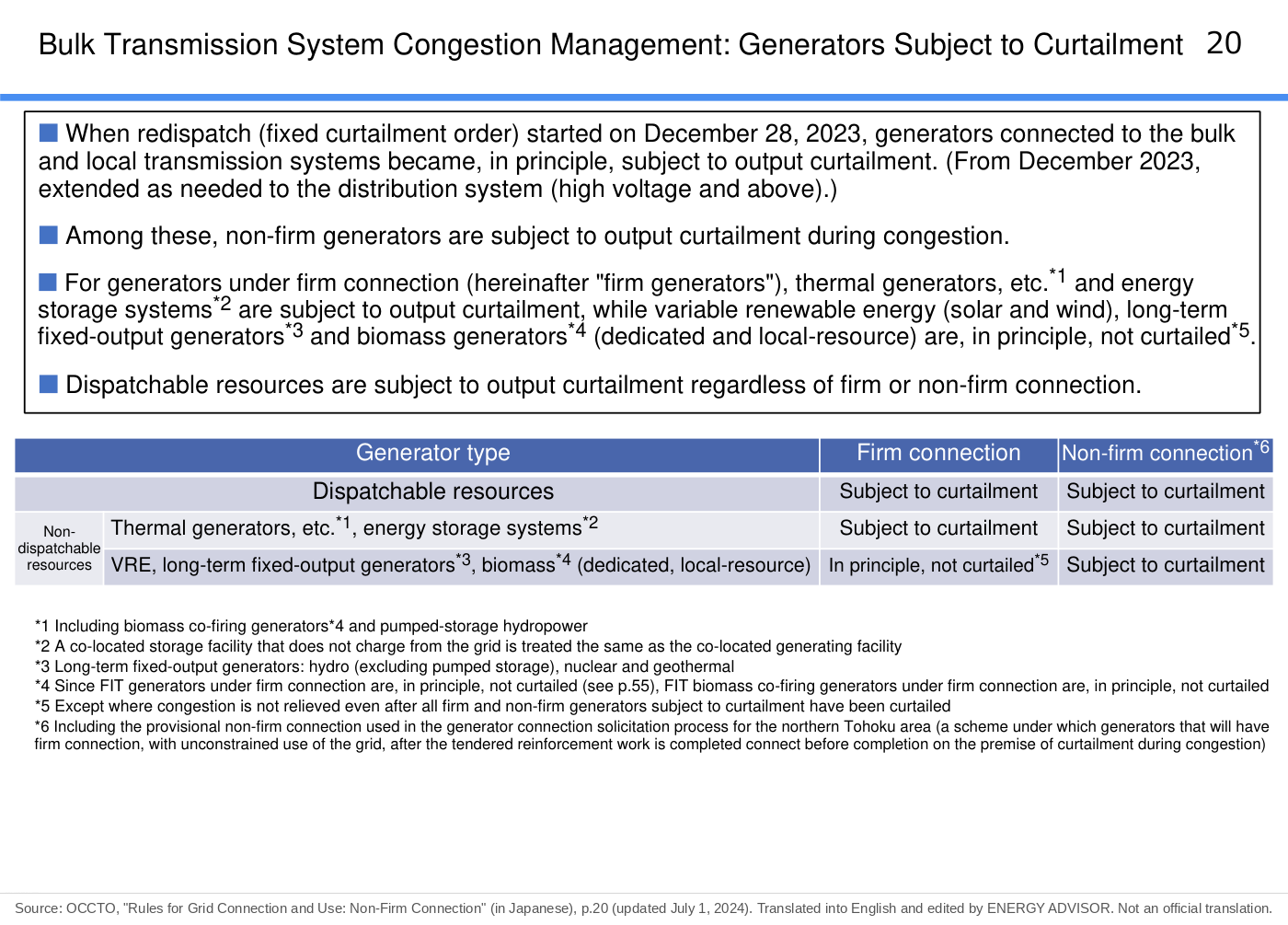
The source is “Non-Firm Connection,” p.20. Thermal and similar generators include co-fired biomass and pumped-storage units. Batteries co-located at a power plant that do not charge from the grid are treated in the same way as the co-located generating facility.
Order of Output Curtailment (July 2024 Version)
The July 2024 revision listed energy storage systems (batteries, etc.) separately from thermal and similar generators. The current order of output curtailment is as follows (“Non-Firm Connection,” pp.21–22).
| Order | Target | Control method |
|---|---|---|
| (1) | Dispatchable resources (including pumping operation of pumped storage, charging of storage facilities for improving the supply-demand balance, and discharge limitation of energy storage systems with a spare-capacity utilization contract) | Merit order |
| (2) | Among non-firm non-dispatchable resources, thermal and similar generators | Pro-rata |
| (3) | Among non-firm non-dispatchable resources, energy storage systems (discharge limitation only) | Pro-rata |
| (4) | Among firm non-dispatchable resources, thermal and similar generators | Merit order |
| (5) | Among firm non-dispatchable resources, energy storage systems (discharge limitation only) | Merit order |
| (6) | Non-firm biomass generators (dedicated; local resources excluding those whose output is difficult to control) | Pro-rata |
| (7) | Non-firm variable renewable energy (solar and wind) | Pro-rata |
| (8) | Non-firm biomass generators (local resources whose output is difficult to control) and long-term fixed generators | Pro-rata |
| (9)–(11) | Generators under provisional non-firm connection (in the same order as (6)–(8)) | Pro-rata |
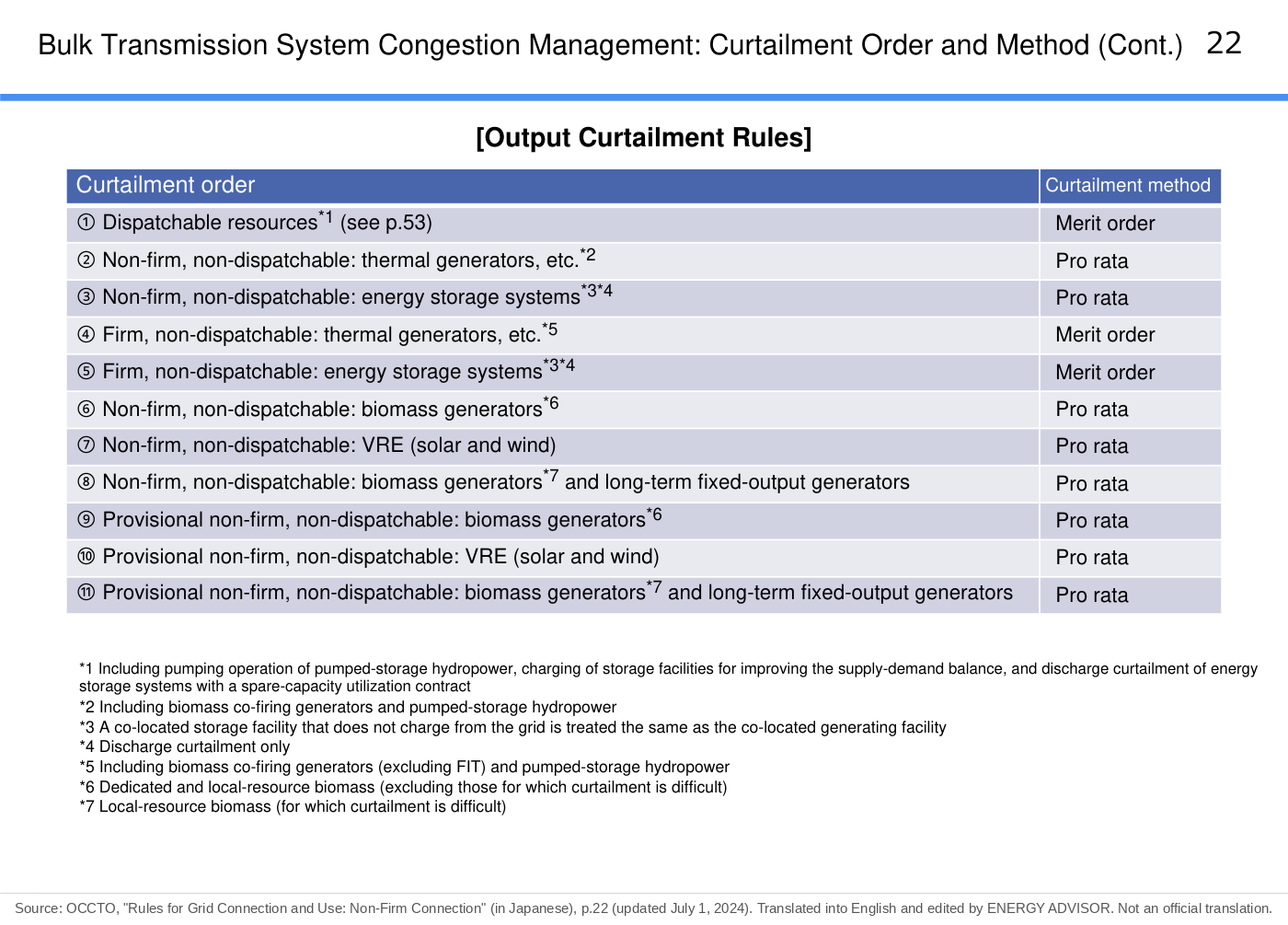
“Pro-rata” is a control method that equalizes the ratio of curtailment to each generator’s generation schedule.
First, (1) dispatchable resources are curtailed by merit order. If congestion is still not relieved, (2) and (3) non-firm thermal and similar generators and batteries are curtailed pro-rata. Next, (4) and (5) firm thermal and similar generators and batteries are curtailed by merit order. If congestion is still not relieved, non-firm biomass, solar and wind, and long-term fixed generators in (6)–(8) are curtailed pro-rata in that order.
In the original article (the December 2023 version of the table), batteries were included in the same category as thermal and similar generators.
“Provisional non-firm connection,” at the end of the order, is a method used in the generator connection solicitation process in the northern Tohoku area. That process is a procedure in which applicants share the cost of reinforcement work to develop the grid. It applies to generators that will have firm connection, able to use the grid without constraint once reinforcement is complete, and that connected before reinforcement was completed on the premise of output curtailment during congestion.
Operation on the Bulk Transmission System (Why Generation Schedules Need Not Change)
Under redispatch (fixed curtailment order), congestion is in principle relieved after gate closure. The GT&D company curtails output in the congested system according to the “fixed order.”
The power lost through curtailment is made up by raising dispatchable resources in the non-congested system by merit order, so that demand and supply match.
Generation balancing group contractors are the entities that submit generation schedules to the GT&D company. For congestion on the bulk transmission system, the GT&D company relieves congestion through output curtailment. Generation balancing group contractors therefore do not need to change their generation schedules.
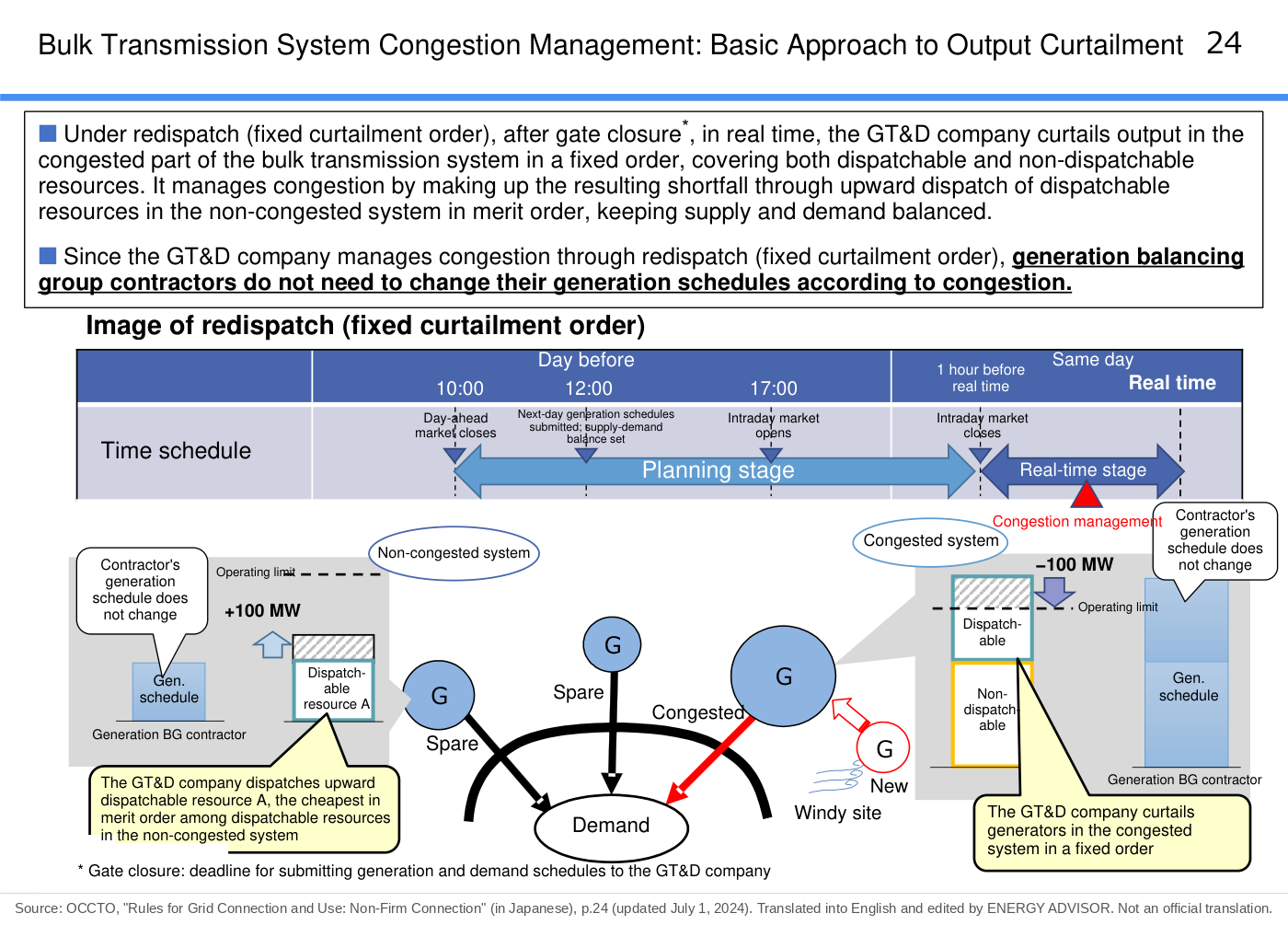
Image of redispatch (fixed curtailment order) (Source: OCCTO, “Rules for Grid Connection and Use: Non-Firm Connection,” p.24)
For correct settlement, generation balancing group contractors must submit generation schedules per receiving point (“Non-Firm Connection,” p.57).
Approach to Settlement Prices
Even when a generator’s output is curtailed under redispatch, the generation balancing group contractor does not change its generation schedule. The electricity is therefore treated as delivered to the counterparty (JEPX, bilateral contracts, etc.) according to the schedule. JEPX is the Japan Electric Power Exchange.
Because output has actually fallen due to curtailment, the shortfall is supplied by the GT&D company. The generation balancing group contractor pays the GT&D company for the supply it received.
| Type of generator | Firm connection | Non-firm connection |
|---|---|---|
| Dispatchable resources | Balancing price (marginal-cost based) | Balancing price (marginal-cost based) |
| Non-dispatchable resources: thermal and similar generators, energy storage systems | Settlement price for supply under dispatch instruction (marginal-cost based) | Settlement price for supply under dispatch instruction (day-ahead market price) |
| Non-dispatchable resources: variable renewable energy, long-term fixed generators, biomass generators | – (no output curtailment in principle) | Settlement price for supply under dispatch instruction (day-ahead market price) |
The source is “Non-Firm Connection,” p.25. Marginal cost is the cost of increasing output by one unit (mainly fuel cost).
Firm non-dispatchable resources sign a contract with the GT&D company on settlement during output curtailment, based on the formula in the Balancing Market Guidelines.
- Settlement price during output curtailment ≥ marginal cost of the generator − fixed amount
- Fixed amount = marginal cost × fixed percentage
Non-firm generators are, as a rule, settled at the day-ahead market (spot market) price. Generators subject to output curtailment must register their settlement prices with the GT&D company (not required for dispatchable resources, which have balancing capacity contracts).
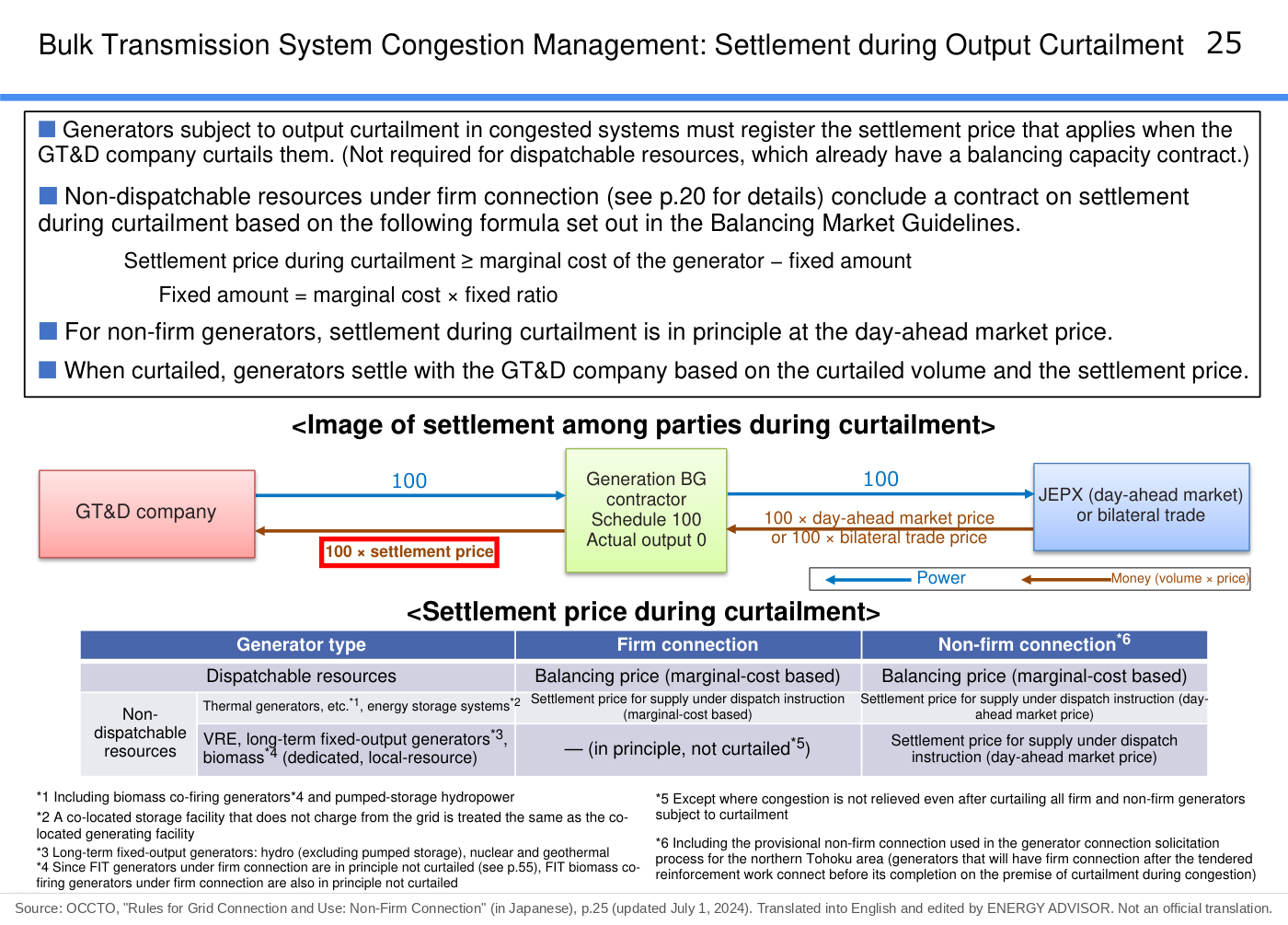
Settlement during output curtailment (Source: OCCTO, “Rules for Grid Connection and Use: Non-Firm Connection,” p.25. The same content appears in Subcommittee on Mass Introduction of Renewable Energy and Next-Generation Electricity Networks, 43rd meeting, Material 2, pp.41–42)
Actual Activation (January 2025, Tokyo Area)
On January 6, 2025, congestion occurred on the bulk transmission system in TEPCO Power Grid’s service area. Under redispatch (fixed curtailment order), the output of dispatchable resources (thermal plants) was curtailed (Next-Generation Power System Working Group, 1st meeting, Material 4, pp.2–3).
| Item | Content |
|---|---|
| Facility | 500/275 kV transformer at Boso Substation (one unit) |
| Time periods | 12:00–12:30, 13:30–14:00, 14:00–14:30 |
| Generators curtailed | Dispatchable resources (thermal plants) |
| Volume | About 150 MWh (preliminary value) |
In this case, congestion was relieved at (1) (dispatchable resources) in the curtailment order. The Agency for Natural Resources and Energy (ANRE) expects that if the volume of non-firm connections grows further, congestion will also occur in other areas and systems (same, p.2).
TEPCO Power Grid states that when it carries out congestion management by redispatch, it publishes information on the congestion management on its website.
Expansion to Local Transmission Systems, and Market-Based Congestion Management Beyond
The curtailment order of redispatch (fixed curtailment order) is also used for congestion management on local transmission systems. However, on local transmission systems, non-firm generators must change their own generation schedules, so operation differs from the bulk transmission system (“Non-Firm Connection,” p.39). In the Tokyo area, control based on the fixed curtailment order sequence began on local transmission systems on April 1, 2026. Details are explained in the article on congestion management on local transmission systems.
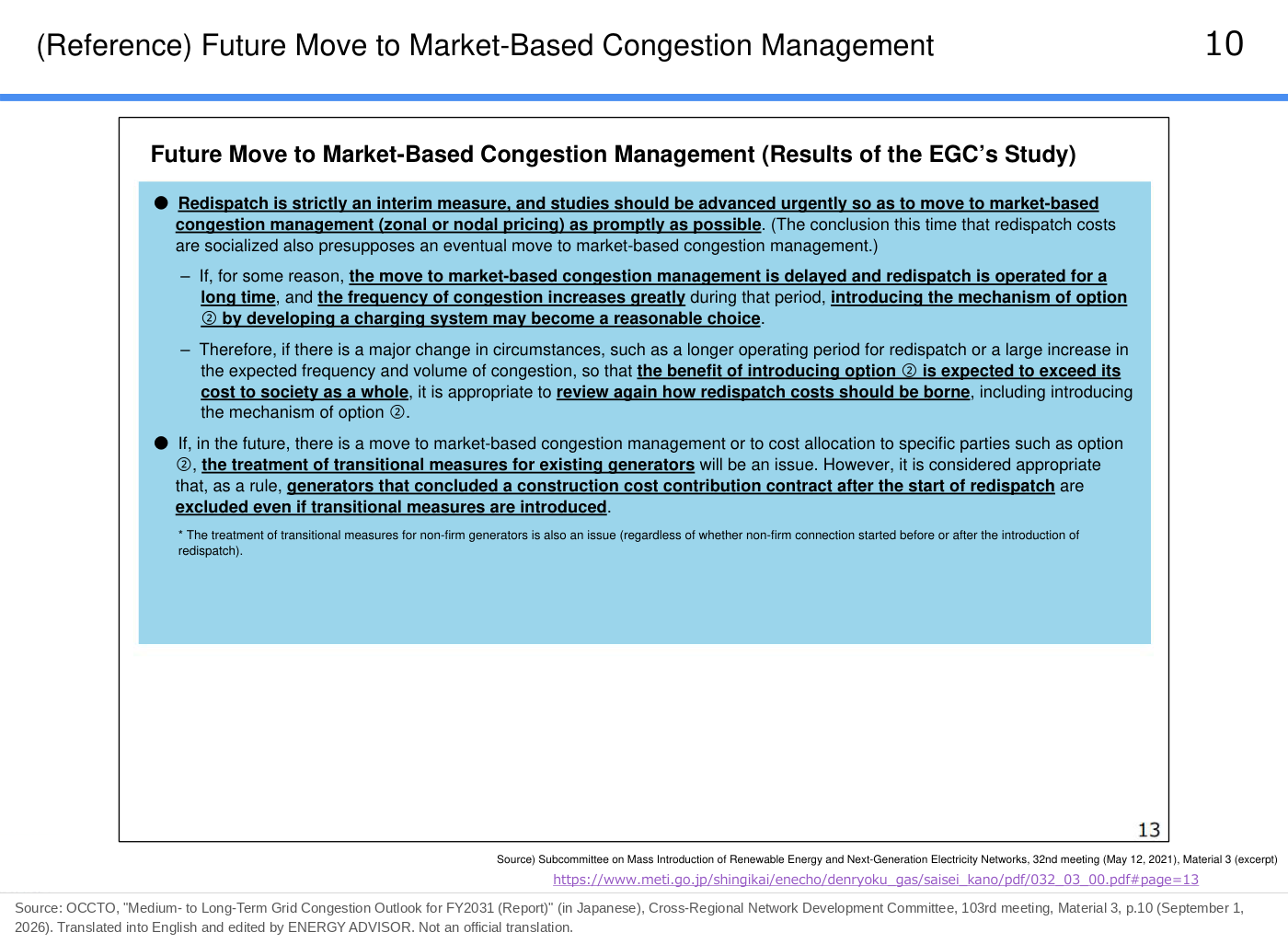
OCCTO describes redispatch as “strictly an interim measure” (Cross-Regional Network Development Committee, 103rd meeting, Material 3, p.49). It considers it important to proceed with studies so as to move to market-based congestion management as quickly as possible. Market-based congestion management is a method in which generation companies adjust their own output in response to market prices. Market-based methods (zonal pricing and nodal pricing) and the co-optimization market (simultaneous market for energy and balancing capacity), which is the forum where they are being studied, are explained in the article on the co-optimization market.
Summary
Redispatch is the set of rules for relieving grid congestion. It relieves congestion by reducing the output of generators in the congested system and raising the output of dispatchable resources in another system.
On December 21, 2022, “redispatch using balancing resources,” which uses only dispatchable resources, began. On December 28, 2023, it was extended to the “fixed curtailment order,” which also curtails non-dispatchable resources in a fixed order. In July 2024, a category for batteries was added to the order of output curtailment. In January 2025, redispatch was actually activated on the bulk transmission system in the Tokyo area.
This article is based on published materials from the Ministry of Economy, Trade and Industry and its Agency for Natural Resources and Energy, the Electricity and Gas Market Surveillance Commission, the Organization for Cross-regional Coordination of Transmission Operators (OCCTO) and other sources. The English translations of figures are by ENERGY ADVISOR and are not official translations. When using this information for decisions, please check the original sources. When we find an error, we correct the article and note the date of the correction.
Sources
- OCCTO, “Rules for Grid Connection and Use: Non-Firm Connection” (in Japanese) (updated July 1, 2024), pp.15, 17, 20–22, 25, 39, 53 and 57. https://www.occto.or.jp/grid/assets/NF_setuzokuriyou_20260710.pdf
- EGC, Meeting for System Design, 55th meeting, Material 3 (in Japanese). https://www.emsc.meti.go.jp/activity/emsc_system/pdf/055_03_01.pdf
- OCCTO, “Study Group on Congestion Management in Intra-Area Grids: Final Report” (in Japanese) (March 1, 2021). https://www.occto.or.jp/iinkai/masutapuran/2020/konzatsu_torimatome.html
- ANRE, “Next-Generation Electricity Networks” (in Japanese), Subcommittee on Mass Introduction of Renewable Energy and Next-Generation Electricity Networks, 37th meeting, Material 2 (November 30, 2021), pp.17, 22 and 24. https://www.meti.go.jp/shingikai/enecho/denryoku_gas/saisei_kano/pdf/037_02_00.pdf
- ANRE, “Next-Generation Electricity Networks” (in Japanese), Subcommittee on Mass Introduction of Renewable Energy and Next-Generation Electricity Networks, 43rd meeting, Material 2 (July 13, 2022), pp.41 and 42. https://www.meti.go.jp/shingikai/enecho/denryoku_gas/saisei_kano/pdf/043_02_00.pdf
- OCCTO, “Introduction of Redispatch (Fixed Curtailment Order) in December 2023” (in Japanese). https://www.occto.or.jp/access/oshirase/220729_saikyuden_donyu.html
- Transmission and Distribution Grid Council, “Start of Redispatch (Fixed Curtailment Order) on the Bulk Transmission System” (in Japanese) (July 31, 2023). https://www.tdgc.jp/information/2023/07/31_1530.html
- ANRE, “Non-Firm Connection Initiatives under the Japanese Version of Connect & Manage” (in Japanese), Next-Generation Power System Working Group, 1st meeting, Material 4 (January 23, 2025), pp.2–3. https://www.meti.go.jp/shingikai/enecho/denryoku_gas/saisei_kano/smart_power_grid_wg/pdf/001_04_00.pdf
- TEPCO Power Grid, “Non-Firm Connection and Redispatch” (in Japanese). https://www.tepco.co.jp/pg/consignment/access/nonfarm.html
- OCCTO, “Medium- to Long-Term Grid Congestion Outlook for FY2031 (Report)” (in Japanese), Cross-Regional Network Development Committee, 103rd meeting, Material 3 (September 1, 2026), p.49. https://www.occto.or.jp/assets/iinkai/kouikikeitouseibi/103/seibi_103_03_01.pdf