Grid-scale battery storage connecting from now on is subject to non-firm connection (a method of connecting without waiting for reinforcement, on the condition of output curtailment during congestion) on its discharging side. The Supply and Demand Balancing Market (balancing market) is expected to be an important source of revenue for grid-scale battery storage.
The balancing market is the market in which general transmission and distribution companies (GT&D companies) procure balancing capacity to fill the gap between demand and supply. Balancing capacity is traded as the ability to raise and lower output (ΔkW, “delta kilowatt”).
This article explains the period during which non-firm generators can take part in the balancing market, and how awarded ΔkW is treated when the grid is congested. Non-firm connection, Japan’s grid and the key organizations are explained in the first article of this series, and the connection rules for the charging side of batteries in the previous article.
Basics of Non-Firm Generators and Market Participation
Non-firm generators are subject to output curtailment when the grid is congested. The balancing capacity of a generator inside a congested system may be unusable, because an upward instruction would make the congestion worse. For this reason, whether non-firm generators can take part in markets has been decided year by year while checking the congestion outlook. The markets concerned are the capacity market (a market that trades future supply capacity) and the balancing market.
The consent form for non-firm connection also includes the condition that the generator “accepts that it may be unable to participate in the capacity market and the balancing market” (OCCTO, “Rules for Grid Connection and Use: Non-Firm Connection,” p.12, updated July 1, 2024).
Balancing Market Participation until FY2028 (Later Years under Study)
Decisions So Far
| Date | Meeting | Decision |
|---|---|---|
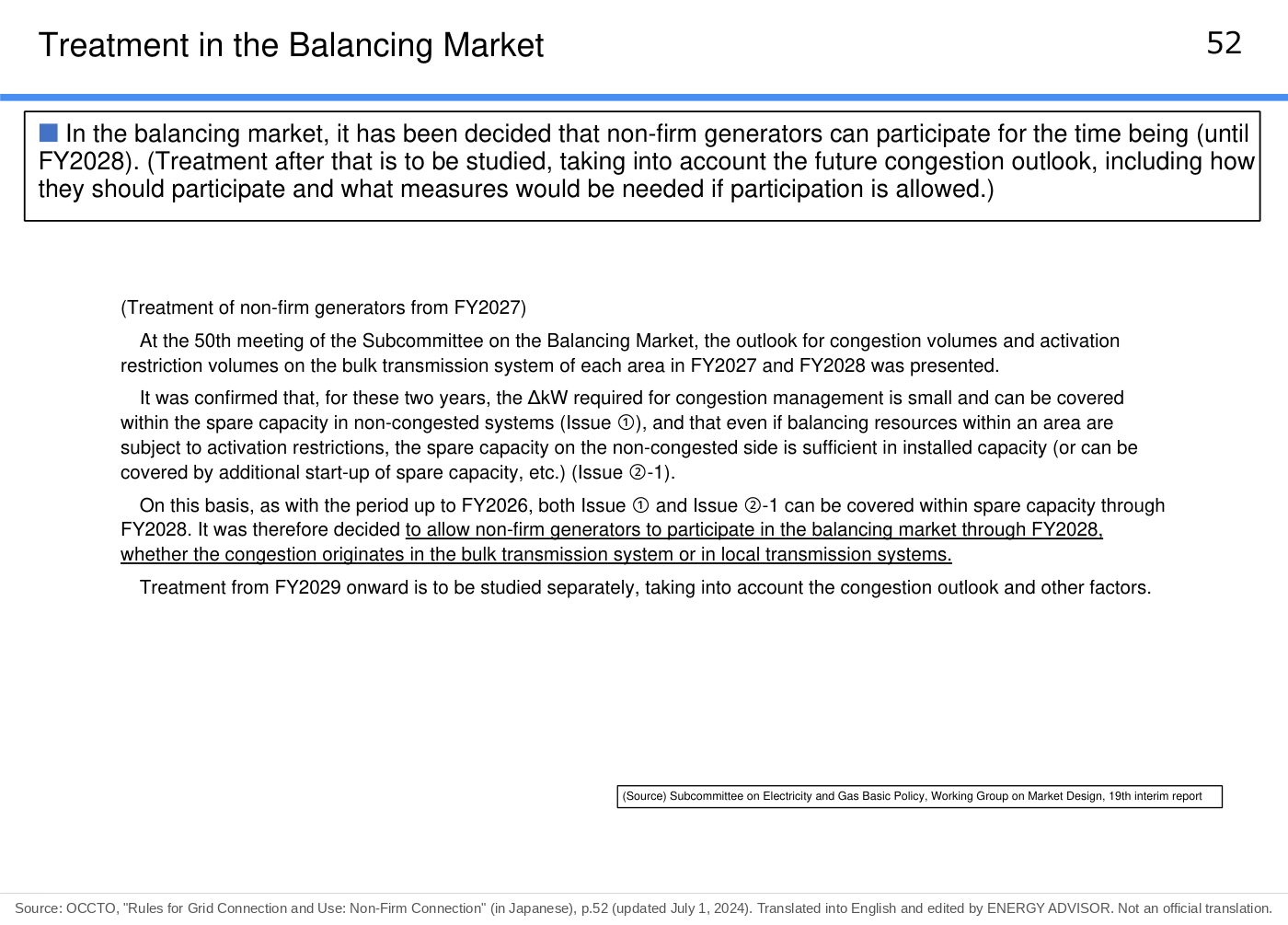
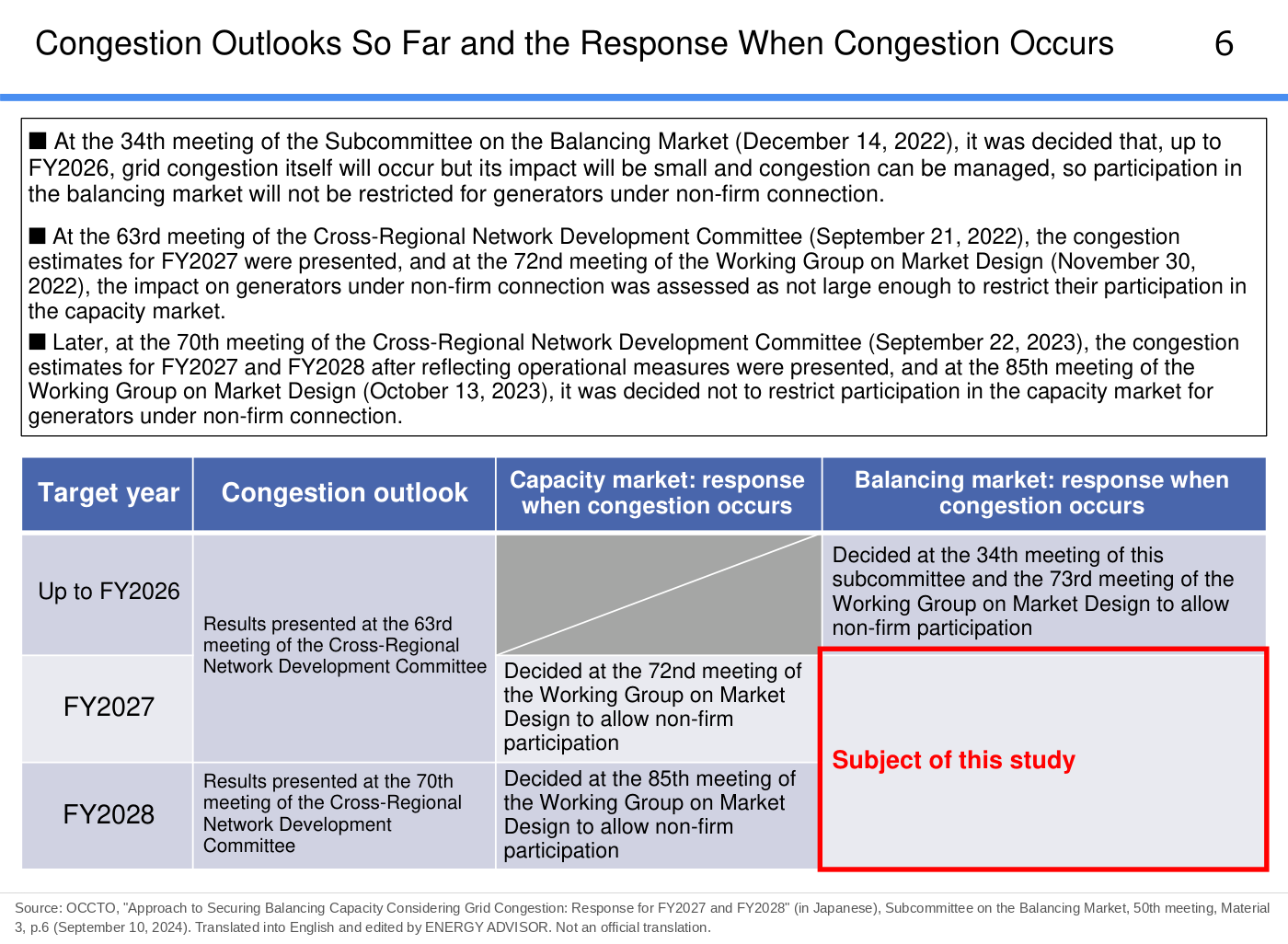
| December 14, 2022 | Subcommittee on the Balancing Market, 34th meeting | Up to FY2026, congestion will occur but its impact will be small and manageable. Participation of non-firm generators, regardless of bulk or local transmission system, allowed from FY2024 for the time being (until about FY2026) |
| September 10, 2024 | Subcommittee on the Balancing Market, 50th meeting | Congestion assumptions for FY2027 and FY2028 checked; still expected to be manageable within spare capacity. Decided that participation is possible in FY2027 and FY2028 as well, if product requirements are met |
The source is Subcommittee on the Balancing Market, 50th meeting, Material 3, pp.2, 6, 25 and 29. The Subcommittee on the Balancing Market is a meeting under an OCCTO committee. Japan’s fiscal year (FY) runs from April to March; FY2028 is April 2028–March 2029.
Reasons for Allowing Participation
At the 50th meeting, the issues that arise in the balancing market during congestion were checked as follows (50th meeting, Material 3, pp.13–25).
| Issue | Content | Outlook for FY2027 and FY2028 |
|---|---|---|
| Securing ΔkW for congestion management | Whether balancing capacity can be secured to raise output in non-congested systems by the amount reduced in congested systems | The amount of congestion is small and can be handled with spare capacity in non-congested systems |
| Shortage of ΔkW for supply-demand balancing | Whether the balancing capacity that becomes unusable in congested systems can be secured instead in non-congested systems | The amount that becomes unusable is large in some areas, but because congestion occurs in low-demand periods, replacements can be secured from spare capacity |
| Participation of non-firm generators | Whether to allow participation | Participation is possible if product requirements are met |
FY2029 and Later
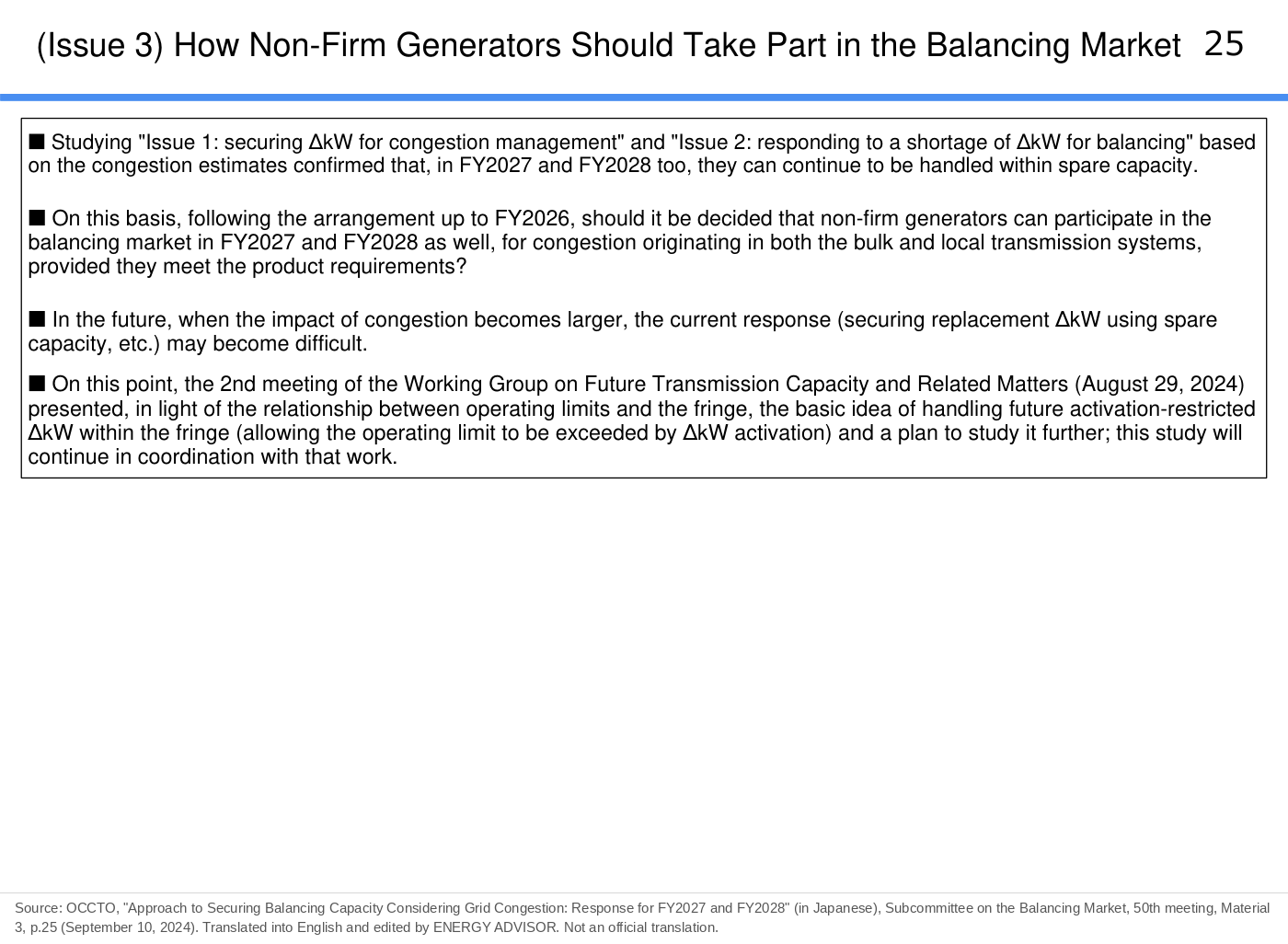
The treatment from FY2029 onward has not been decided. OCCTO considers that in the future, when the impact of congestion grows, the current approach is likely to become difficult. The current approach means securing replacement ΔkW from spare capacity and similar measures. OCCTO states that it will study how ΔkW should be secured in the future, with a stage in mind in which congestion occurs at many unspecified locations (50th meeting, Material 3, p.25; Cross-Regional Network Development Committee, 92nd meeting, Material 2, p.7; 103rd meeting, Material 3, p.7).
Treatment in the Capacity Market
In the capacity market, it has been decided that non-firm generators can take part in the FY2025 Main Auction (delivery year FY2029). For later auctions, the approach to participation and the necessary measures are to be studied in light of the congestion outlook (“Non-Firm Connection,” p.51).
OCCTO states that, according to the FY2029 outlook, the impact of congestion on supply reliability is limited. On that basis, it has decided that the participation of non-firm generators in the Main Auction for FY2029 is not restricted (103rd meeting, Material 3, p.6).
Treatment of Awarded ΔkW during Grid Congestion
Resources (generators and batteries) awarded in the balancing market become units whose output the GT&D company adjusts (dispatchable resources) within the range of their awarded ΔkW (“Non-Firm Connection,” p.54). The treatment when the grid is congested was set out at the 38th meeting of the Subcommittee on the Balancing Market (April 26, 2023).
Process
| Time | What the GT&D company does |
|---|---|
| 12:00 the day before | Generation companies and others submit generation schedules for the next day |
| Around 17:00 the day before | From the scheduled values and the awarded ΔkW, the occurrence of congestion and the activation restriction on ΔkW in congested systems (its becoming unusable) can be foreseen |
| As soon as possible after 17:00 the day before | Set output caps on generators in congested systems. Release the ΔkW in congested systems (cancel the award) and secure replacement ΔkW in non-congested systems |
| By gate closure (one hour before real time) | Finish securing replacement ΔkW |
| Real time | Issue “down” instructions in congested systems and “up” instructions in non-congested systems (redispatch) |
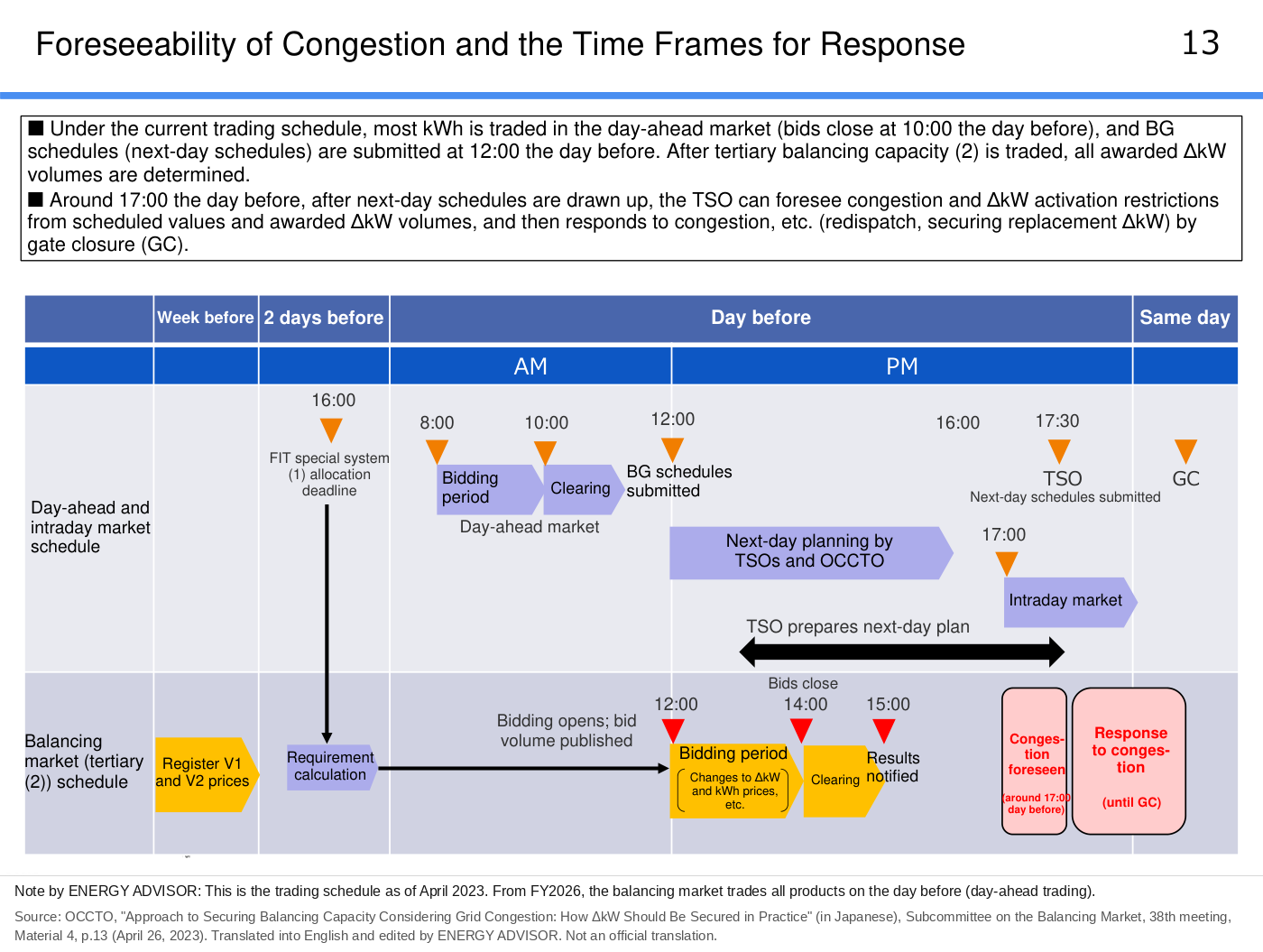
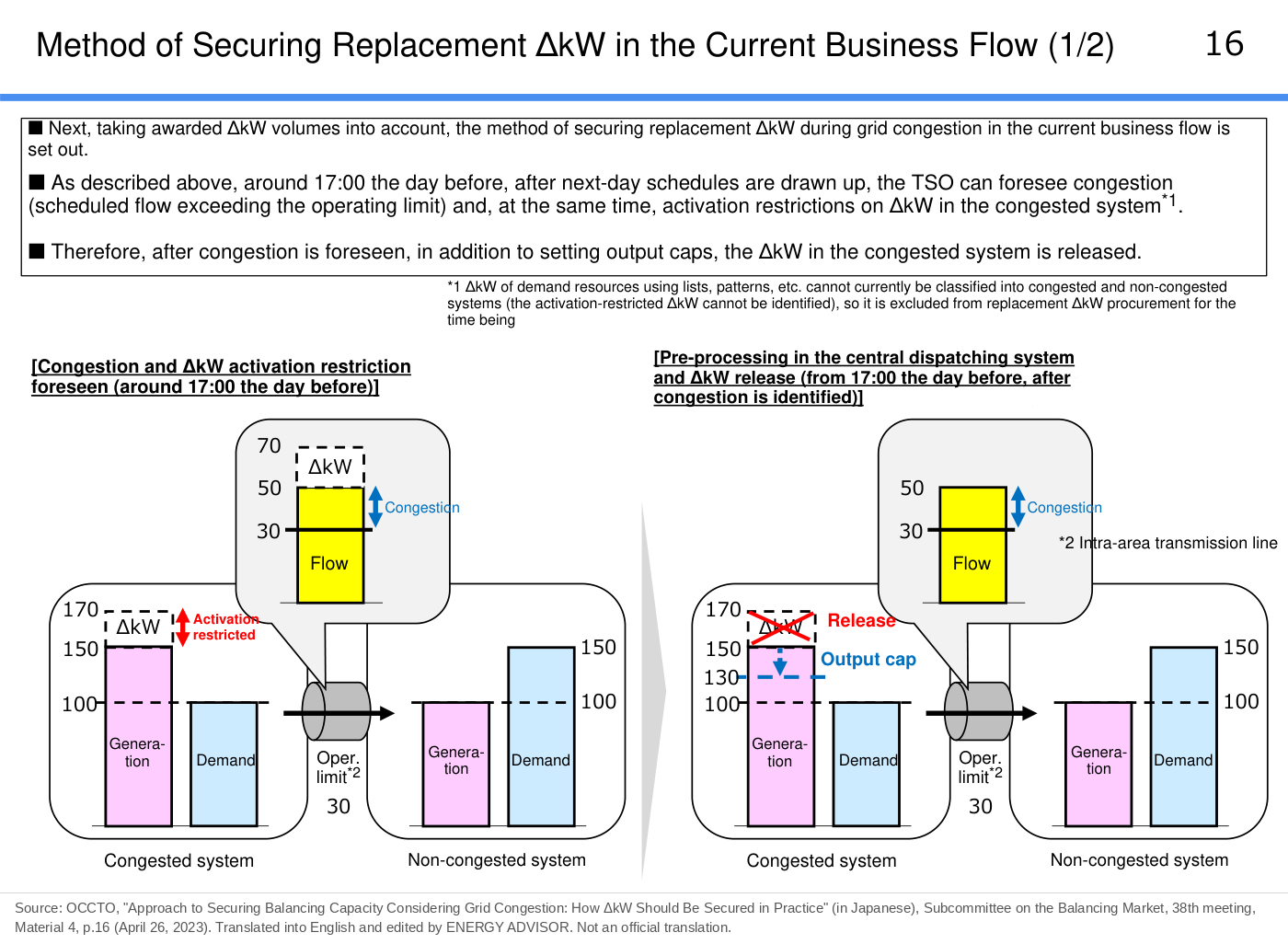
The source is Subcommittee on the Balancing Market, 38th meeting, Material 4, pp.13–18 and 38.
In some cases the scheduled flow stays within the operating limit of the congested transmission line or transformer (unyo yoryo in Japanese). Even then, if the scheduled flow plus the ΔkW in the congested system exceeds the operating limit, part of the ΔkW is subject to an activation restriction. In this case, the ΔkW in the congested system is released in merit order, and replacements are secured in non-congested systems for the excess amount only (same, p.19).
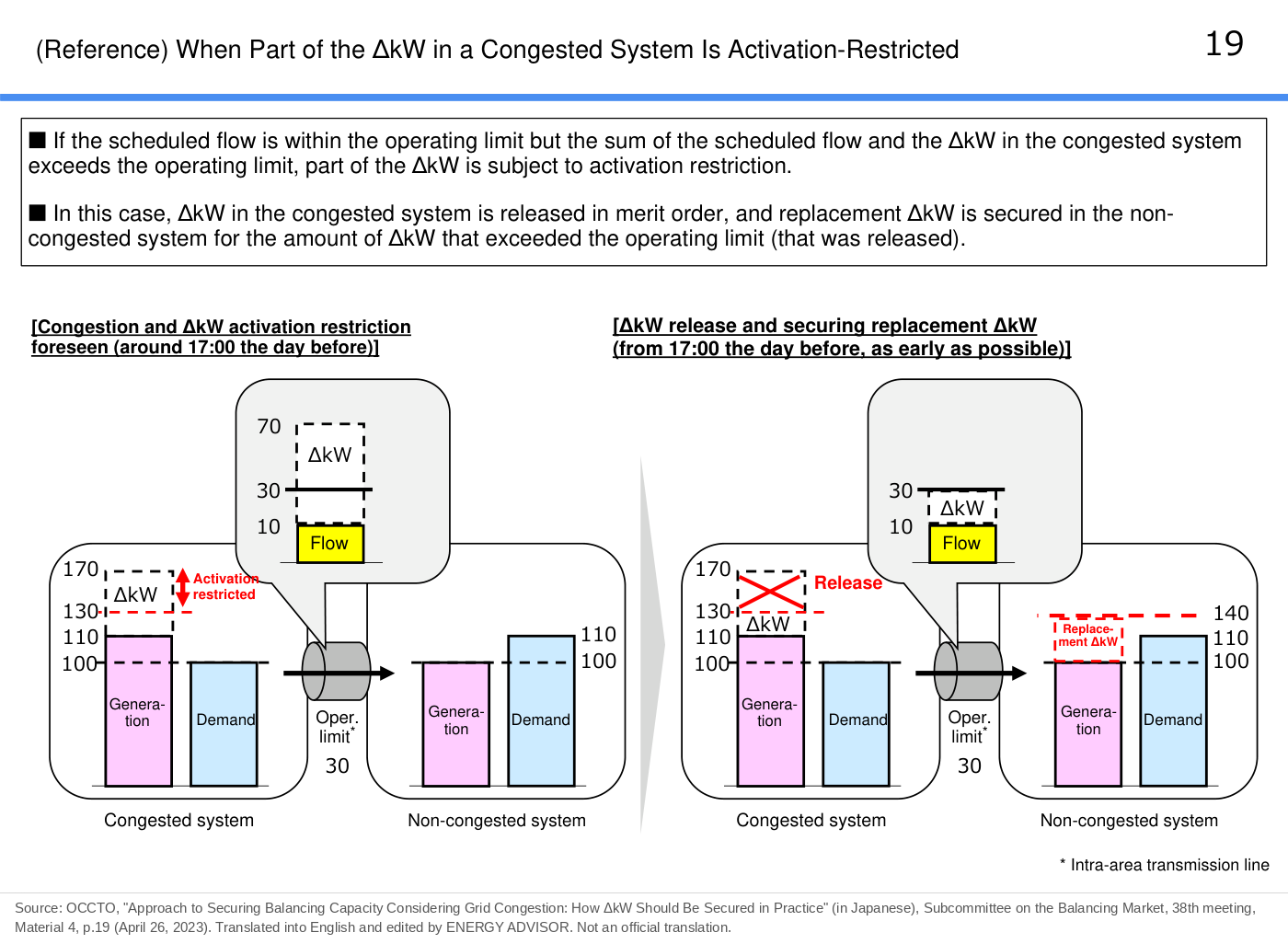
This means that if non-firm grid-scale battery storage is in a congested system, all or part of its awarded ΔkW may be released.
Why Activation Restrictions Cannot Be Avoided at the Award Stage
The GT&D company can foresee congestion only around 17:00 the day before, after the next day’s schedules are submitted. For this reason, under the current trading schedule of the balancing market, ΔkW cannot be awarded with congestion taken into account (38th meeting, Material 4, pp.26 and 38).
Bidding Released ΔkW into the Intraday Market
Whether released ΔkW may be offered on the intraday market, which trades from 17:00 the day before, became an issue. Bidding into the intraday market while knowing that the resource is in a congested system increases congestion and the cost of managing it. OCCTO judged this to be a form of arbitrage (gaming) and undesirable.
On the other hand, simple regulation would make it more rational to offer into the intraday market without bidding into the balancing market. As a result, the incentive to bid into the balancing market could fall further. For this reason, the issue is to be studied further in cooperation with the government (38th meeting, Material 4, pp.20–22 and 38).
Cost Allocation and Effects on Siting
The allocation of the cost of securing replacement ΔkW because of congestion has also been set out. At the 75th meeting of the Working Group on Market Design on January 27, 2023, the following option (Option C) was considered desirable (38th meeting, Material 4, pp.6–8; 50th meeting, Material 3, p.13).
| Cost | Who bears it |
|---|---|
| Payment for released awarded ΔkW | Not paid (cost borne by the operator that provided the balancing capacity) |
| Cost of securing replacement ΔkW | Borne by the GT&D company (socialized cost) |
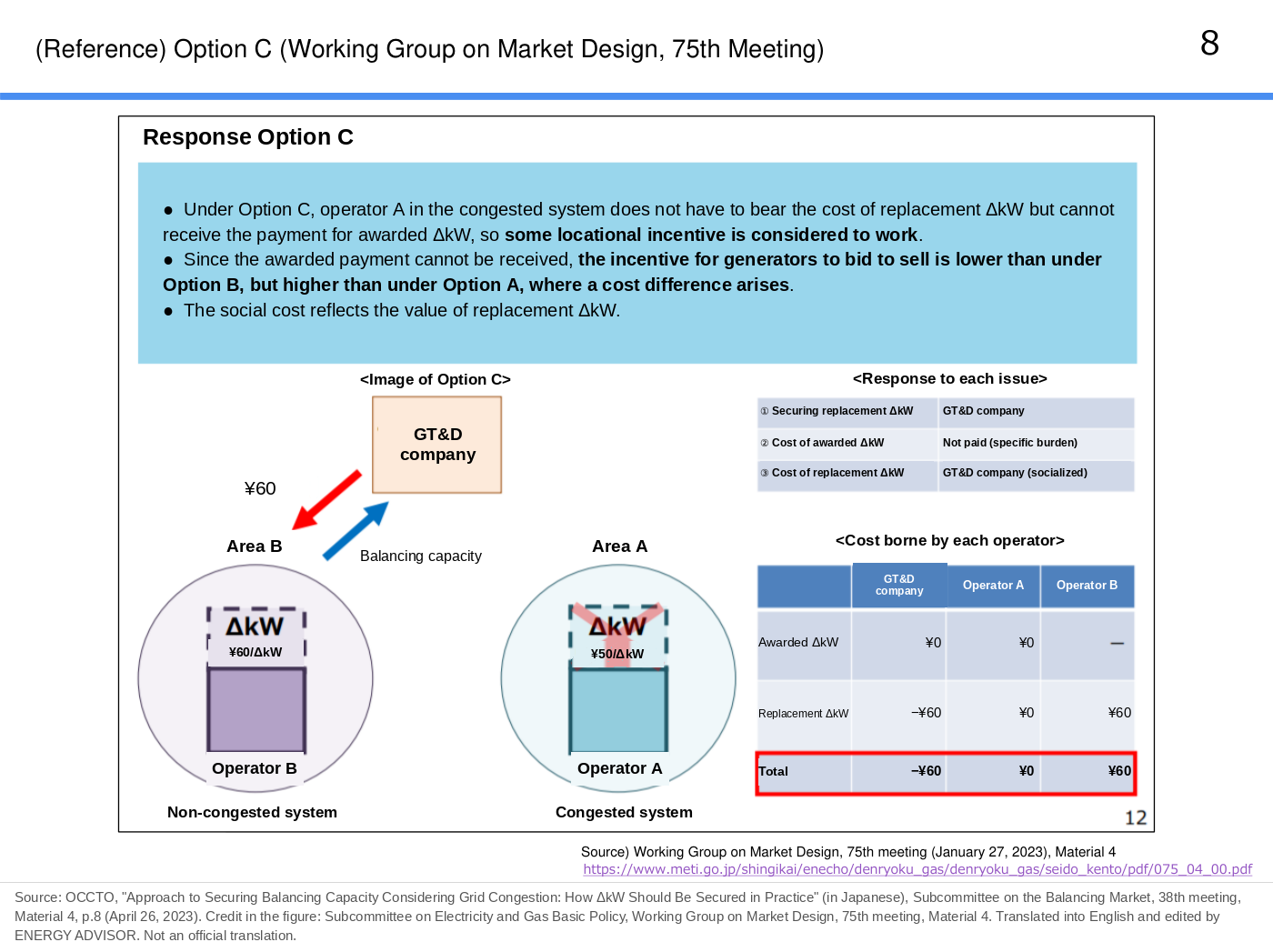
OCCTO states that under this arrangement, a certain locational signal (a pull toward siting in places without congestion) works on generators bidding in congested systems (103rd meeting, Material 3, p.11). A battery in a congested system cannot receive payment for its ΔkW if the ΔkW is released, even after being awarded.
Move to Day-Ahead Trading in FY2026 and Future Issues
Move to Day-Ahead Trading
From FY2026, the balancing market began trading on the day before even the products that had been traded weekly (day-ahead trading of all products). At the same time, trading in 30-minute units began (OCCTO, Study Committee on Regulating and Marginal Supply Capability and Long-Term Supply–Demand Balance Evaluation, 117th meeting, Material 4, pp.7 and 49–50, March 16, 2026). That this has been in place since FY2026 can be confirmed in Subcommittee on the Balancing Market, 62nd meeting, Material 2, p.2 (July 31, 2026).
How the treatment of activation restrictions and releases of ΔkW in congested systems changed after the move to day-ahead trading has not been confirmed. The materials checked were 117th meeting Material 4 (March 16, 2026) and Subcommittee on the Balancing Market 62nd meeting Material 2 (July 31, 2026). Neither mentions this treatment.
Future Issues
| Issue | Content | Source |
|---|---|---|
| Allowing activation beyond the operating limit | For future activation-restricted ΔkW, deepen the basic idea of allowing ΔkW activation to exceed the operating limit (handling it within the fringe) | 50th meeting, Material 3, pp.25 and 29 |
| Subdividing areas where ΔkW is secured | Divide the areas where ΔkW is secured along transmission lines prone to congestion. There is an example in PJM in the United States | 38th meeting, Material 4, pp.31 and 33 |
| Congestion management that also considers ΔkW | Include not only kWh but also ΔkW in transmission capacity constraints. There are no examples of adoption overseas, and the reasons need to be examined further | 38th meeting, Material 4, pp.32–33 |
| Co-optimization market | Study of a market that clears electricity (kWh) and balancing capacity (ΔkW) together | See the article on the co-optimization market |
The fringe is the fluctuation, with periods from a few seconds to a little over ten minutes, that occurs in transmission line flows as a result of controls that maintain frequency (governor-free operation (GF), load frequency control (LFC) and economic load dispatching control (EDC)). The operating limit is originally set with a margin for this fluctuation. For this reason, it is considered that exceeding the operating limit because of fluctuations from activating balancing capacity is already taken into account to some extent (OCCTO, “Direction of Study on the Fringe in Response to Grid Congestion,” Working Group on Future Transmission Capacity and Related Matters, 2nd meeting, Material 4, pp.10–11, August 29, 2024).
Summary
Non-firm grid-scale battery storage can take part in the balancing market until FY2028 if it meets the product requirements. The treatment from FY2029 onward has not been decided. In the capacity market, participation in the Main Auction for delivery year FY2029 is allowed.
When the grid is congested, awarded ΔkW in the congested system is released from around 17:00 the day before, and replacements are secured in non-congested systems. No payment is made for released ΔkW. Batteries sited in congested systems need to allow for the possibility that their balancing market revenue will fall because of congestion.
This article is based on published materials from the Ministry of Economy, Trade and Industry and its Agency for Natural Resources and Energy, the Electricity and Gas Market Surveillance Commission, the Organization for Cross-regional Coordination of Transmission Operators (OCCTO) and other sources. The English translations of figures are by ENERGY ADVISOR and are not official translations. When using this information for decisions, please check the original sources. When we find an error, we correct the article and note the date of the correction.
Sources
- OCCTO, “Rules for Grid Connection and Use: Non-Firm Connection” (in Japanese) (updated July 1, 2024), pp.12, 51–52 and 54. https://www.occto.or.jp/grid/assets/NF_setuzokuriyou_20260710.pdf
- OCCTO, “Approach to Securing Balancing Capacity Considering Grid Congestion: How ΔkW Should Be Secured in Practice” (in Japanese), Subcommittee on the Balancing Market, 38th meeting, Material 4 (April 26, 2023), pp.6–8, 13–22, 26, 31–33 and 38. https://www.occto.or.jp/iinkai/chouseiryoku/jukyuchousei/2023/files/jukyu_shijyo_38_04.pdf
- OCCTO, “Approach to Securing Balancing Capacity Considering Grid Congestion: Response for FY2027 and FY2028” (in Japanese), Subcommittee on the Balancing Market, 50th meeting, Material 3 (September 10, 2024), pp.2, 6, 13–25 and 29. https://www.occto.or.jp/iinkai/chouseiryoku/jukyuchousei/2024/files/jukyu_shijyo_50_03.pdf
- OCCTO, “Medium- to Long-Term Grid Congestion Outlook for FY2030 (Report)” (in Japanese), Cross-Regional Network Development Committee, 92nd meeting, Material 2 (September 2, 2025), p.7. https://www.occto.or.jp/iinkai/kouikikeitouseibi/2025/files/seibi_92_02_01.pdf
- OCCTO, “Medium- to Long-Term Grid Congestion Outlook for FY2031 (Report)” (in Japanese), Cross-Regional Network Development Committee, 103rd meeting, Material 3 (September 1, 2026), pp.6, 7 and 11. https://www.occto.or.jp/assets/iinkai/kouikikeitouseibi/103/seibi_103_03_01.pdf
- OCCTO, “Direction of Study on the Fringe in Response to Grid Congestion” (in Japanese), Working Group on Future Transmission Capacity and Related Matters, 2nd meeting, Material 4 (August 29, 2024), pp.10–11. https://www.occto.or.jp/assets/iinkai/chouseiryoku/jukyuchousei/2024/files/unyouyouryousagyoukai_2_04.pdf
- OCCTO, “Results of the Survey on Actual Conditions of the Balancing Market, etc.” (in Japanese), Subcommittee on the Balancing Market, 62nd meeting, Material 2 (July 31, 2026), p.2. https://www.occto.or.jp/assets/iinkai/jukyuchousei/62/jukyu_shijyo_62_02.pdf
- OCCTO, “Status of Studies at the Subcommittee on the Balancing Market (FY2025 Report)” (in Japanese), Study Committee on Regulating and Marginal Supply Capability and Long-Term Supply–Demand Balance Evaluation, 117th meeting, Material 4 (March 16, 2026), pp.7 and 49–50. https://www.occto.or.jp/assets/chousei_117_04.pdf