From April 2023, non-firm connection also began to be accepted on systems at voltages below the bulk transmission system (local transmission systems). Interim congestion management was then carried out in each area, and in March 2025, grid-constrained output curtailment of solar and wind took place for the first time in Japan. In the Tokyo area, control based on the redispatch (fixed curtailment order) sequence has been in place since April 1, 2026.
This article explains how congestion management on local transmission systems works and how it developed from 2023 to 2026. The basics of non-firm connection, the tiers of Japan’s grid and the key organizations are explained in the first article of this series.
Bulk, Local and Distribution Systems
| Tier | Scope | Example (Tokyo area) | Non-firm connection |
|---|---|---|---|
| Bulk transmission system | The top two voltage levels of each area (132 kV in Okinawa) | 500 kV and 275 kV | Applied |
| Local transmission system | Extra-high-voltage systems other than the top two voltage levels and the distribution system | 154 kV and 66 kV | Applied (from April 2023) |
| Distribution system | High voltage (6.6 kV) and low voltage | 6.6 kV and 100 V/200 V | If distribution system facilities (including distribution transformers) are congested, reinforcement is required. However, for congestion on local transmission systems and the bulk transmission system, generators connected to the distribution system (10 kW or more) are also subject to output curtailment |
The rules for non-firm connection are organized around the following four concepts. The source is OCCTO, “Rules for Grid Connection and Use: Non-Firm Connection,” p.15 (updated July 1, 2024).
| Item | Meaning | Congestion on the bulk transmission system | Congestion on local transmission systems |
|---|---|---|---|
| (1) Applicable system | Which system’s congestion is handled | Bulk transmission system | Local transmission systems |
| (2) Applicable generators | Generators to which non-firm connection applies | All generators on the bulk transmission system and below (excluding low voltage under 10 kW) | All generators on local transmission systems and below (excluding low voltage under 10 kW) |
| (3) Controlled units | Generators subject to output curtailment | Generators on the bulk and local transmission systems (expanded to high voltage and above on the distribution system as needed) | Generators on local transmission systems and the distribution system (10 kW or more) |
| (4) Control method | Which rule is used for control | Redispatch (fixed curtailment order) | Control based on the redispatch (fixed curtailment order) sequence. Generators subject to pro-rata curtailment change their generation schedule values |
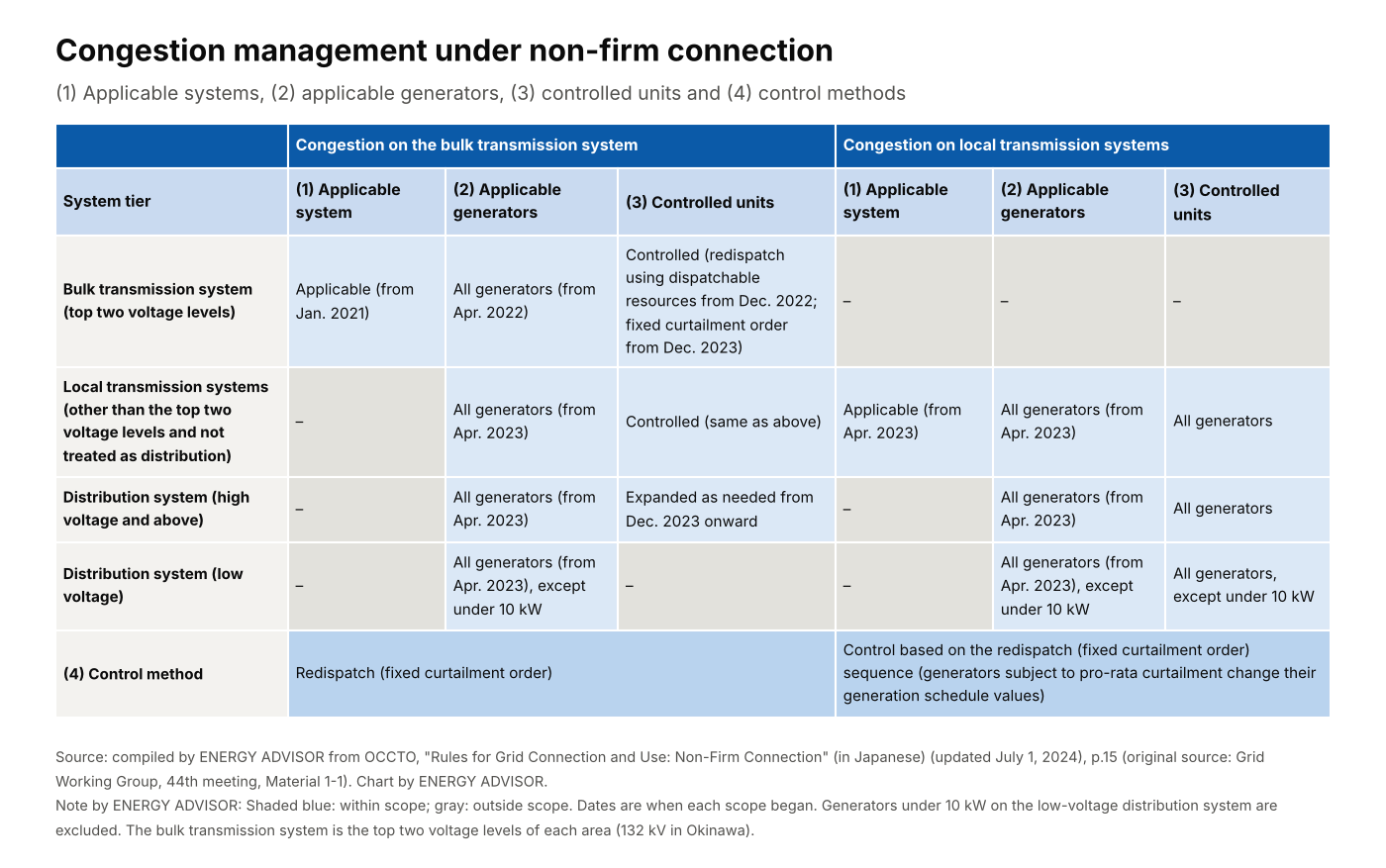
Applicable systems, applicable generators, controlled units and control methods for non-firm connection (Source: OCCTO, “Rules for Grid Connection and Use: Non-Firm Connection,” p.15)
Application of Non-Firm Connection to Local Transmission Systems (April 2023) and Interim Measures
A grid connection study is the procedure in which a general transmission and distribution company (GT&D company) examines whether a generator can connect. Generators whose grid connection study was accepted on or after April 1, 2023 are, in principle, connected on a non-firm basis, regardless of the connection voltage or available capacity. Non-firm connection was thus extended to local transmission systems. TEPCO Power Grid has applied it to local transmission systems since April 3, 2023.
The Agency for Natural Resources and Energy (ANRE) describes acceptance on local transmission systems as having started on the premise of “interim measures and the like until full operation of congestion management.” Actual congestion management began with interim methods in each area. As of June 2025, the expectations in each area were as follows (Next-Generation Power System Working Group, 3rd meeting, Material 2-1, pp.4–5).
| Area | Expected timing of congestion | Interim period | Controlled units | Timing of notice | Control method |
|---|---|---|---|---|---|
| (Full operation) | – | – | All non-firm generators, firm thermal plants, dispatchable resources | Day before; 1+α hours before real time; 1 hour before | Online |
| Hokkaido | Around autumn 2025 | Within FY2026 | Non-firm generators at high voltage and above, dispatchable resources | Around the 20th of the previous month | Offline |
| Tohoku | FY2026 or later | Within FY2026 | All non-firm generators, firm thermal plants, dispatchable resources | 17:00 the day before | Online (partly offline) |
| Tokyo | FY2027 or later | Within FY2026 | All non-firm generators | Day before; 5 hours before; 1 hour before | Online |
| Chubu | Occurred on March 28, 2025 | Until June 30, 2025 | All non-firm generators | 17:00 the day before | Offline |
| Chugoku | Autumn 2025 or later | Within FY2028 | All non-firm generators, firm thermal plants, dispatchable resources | 17:00 the day before | Online (partly offline) |
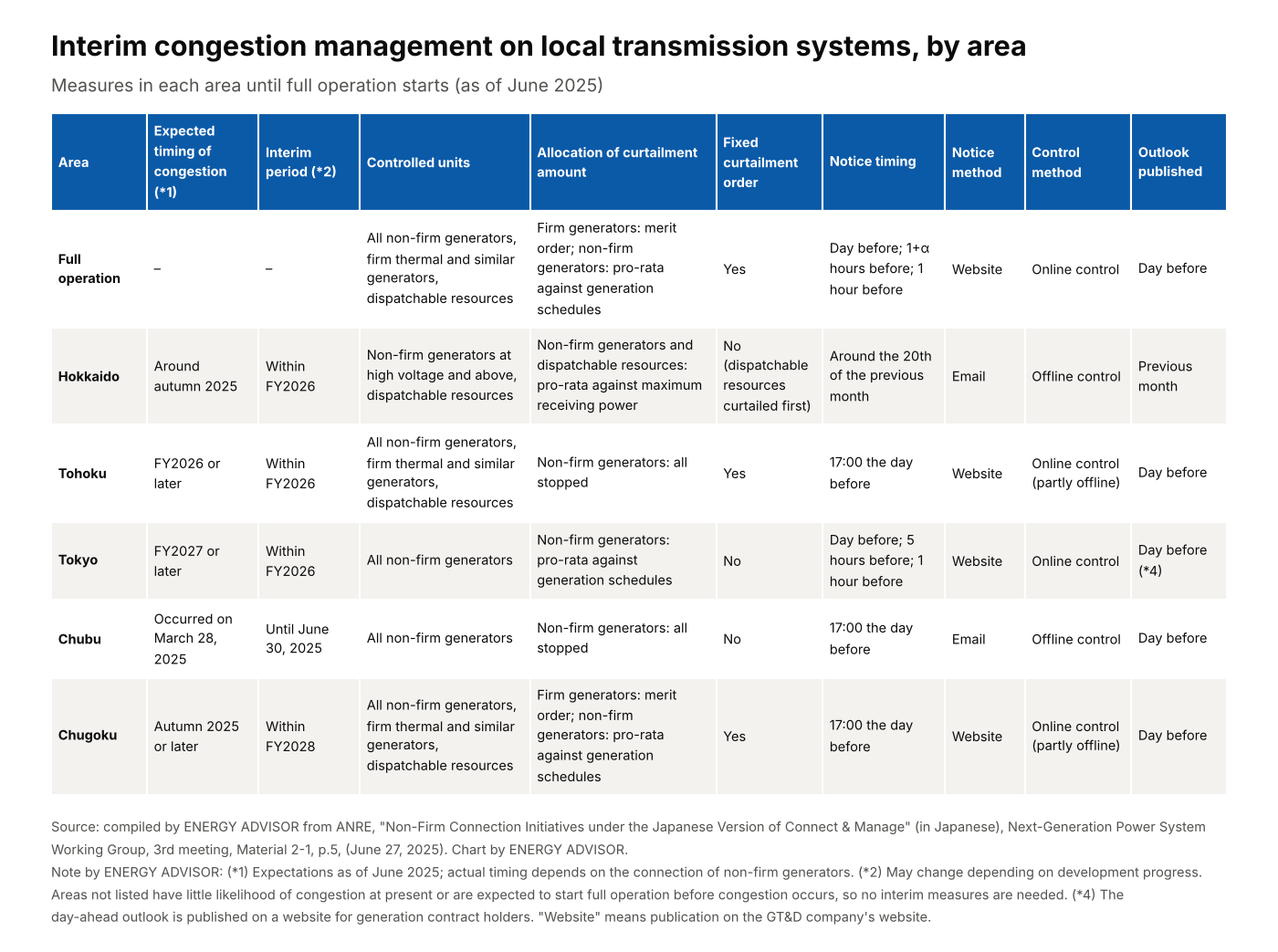
Areas not in the table are expected either to have little likelihood of congestion or to be able to move to full operation before congestion occurs. The timings are expectations as of 2025 and may change depending on the connection of non-firm generators. Offline control is a method in which the operator reduces its own output after receiving a notice from the GT&D company. Japan’s fiscal year (FY) runs from April to March; FY2026 is April 2026–March 2027.
First Renewable Output Curtailment (March 2025, Chubu Area)
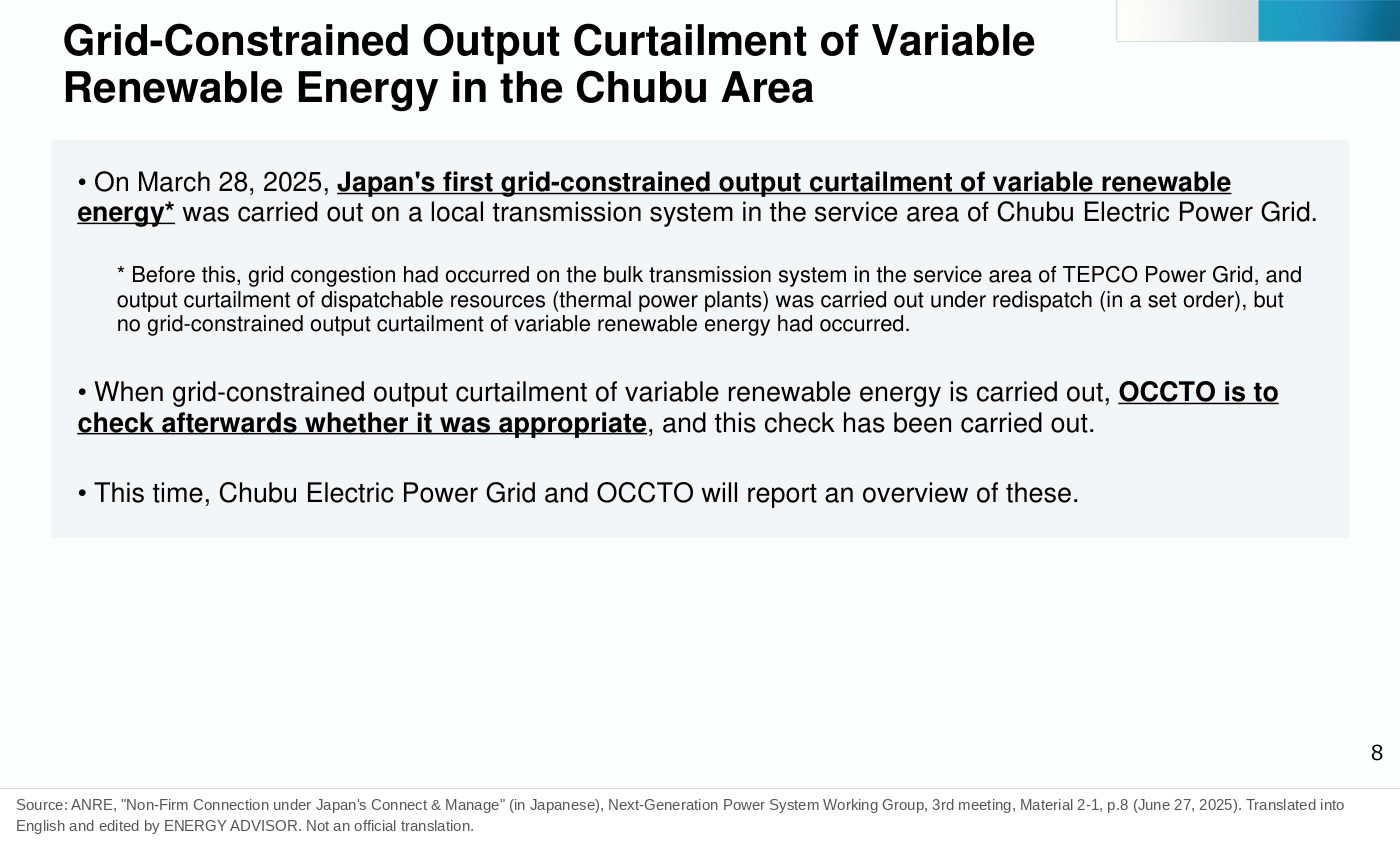
On March 28, 2025, output curtailment was carried out on a local transmission system in Chubu Electric Power Grid’s service area. It was the first grid-constrained output curtailment of variable renewable energy (solar and wind) in Japan (Next-Generation Power System Working Group, 3rd meeting, Material 2-1, p.8).
Under interim operation, output was stopped for all non-firm generators. The method was notice by email at 17:00 the day before, with offline control (same, p.5).
According to Chubu Electric Power Grid’s report, curtailment instructions were issued on 15 days between March 28 and April 28, 2025. The congested facility was the 77 kV Seino-Ibi Line, and the targets were ten non-firm solar operators. The maximum daily curtailment was 0.9–2.3 MW (same working group, 3rd meeting, Material 2-3, pp.3, 6 and 8). The company also reported that on April 14 and 15 it mistakenly instructed curtailment for longer than necessary (same, p.9).
Transition in the Tokyo Area: From Pro-Rata Curtailment of Non-Firm Generators (April 2024) to the Fixed Curtailment Order (April 2026)
TEPCO Power Grid proceeded with congestion management on local transmission systems as follows (TEPCO Power Grid, “Congestion Management on Local Transmission Systems,” October 8, 2025, revised October 31, 2025; and its FAQ, February 2026).
| Timing | Content |
|---|---|
| End of December 2023 (original plan) | Planned to introduce control based on the fixed curtailment order sequence |
| April 1, 2024 | Because developing and modifying the related systems took time, “pro-rata curtailment of non-firm generators” began as an interim measure. Targets were non-firm generators connected from local transmission systems down to low voltage of 10 kW or more |
| April 1, 2026 | Control based on the redispatch (fixed curtailment order) sequence began. Dispatchable resources and firm thermal and similar generators and batteries were added as targets |
From April 2026, (1) dispatchable resources in the curtailment order and firm non-dispatchable resources (thermal and similar generators and batteries) are also curtailed. Control is by merit order (the approach of reducing generators in order from the highest cost). Non-firm generators continue to be curtailed pro-rata.
When other areas such as Tohoku and Chugoku moved to full operation has not been confirmed.
Curtailment Order and the Flow of Generation Schedule Revisions
Curtailment Order
Congestion management on local transmission systems uses the same curtailment order as redispatch (fixed curtailment order) (“Non-Firm Connection,” p.32). The July 2024 revision listed batteries (energy storage systems) separately from thermal and similar generators.
| Order | Target | Control method |
|---|---|---|
| (1) | Dispatchable resources | Merit order |
| (2) | Non-firm thermal and similar generators | Pro-rata |
| (3) | Non-firm energy storage systems (discharge limitation only) | Pro-rata |
| (4) | Firm thermal and similar generators | Merit order |
| (5) | Firm energy storage systems (discharge limitation only) | Merit order |
| (6) | Non-firm biomass generators (dedicated; local resources excluding those whose output is difficult to control) | Pro-rata |
| (7) | Non-firm variable renewable energy (solar and wind) | Pro-rata |
| (8) | Non-firm biomass generators (local resources whose output is difficult to control) and long-term fixed generators (hydro, nuclear and geothermal) | Pro-rata |
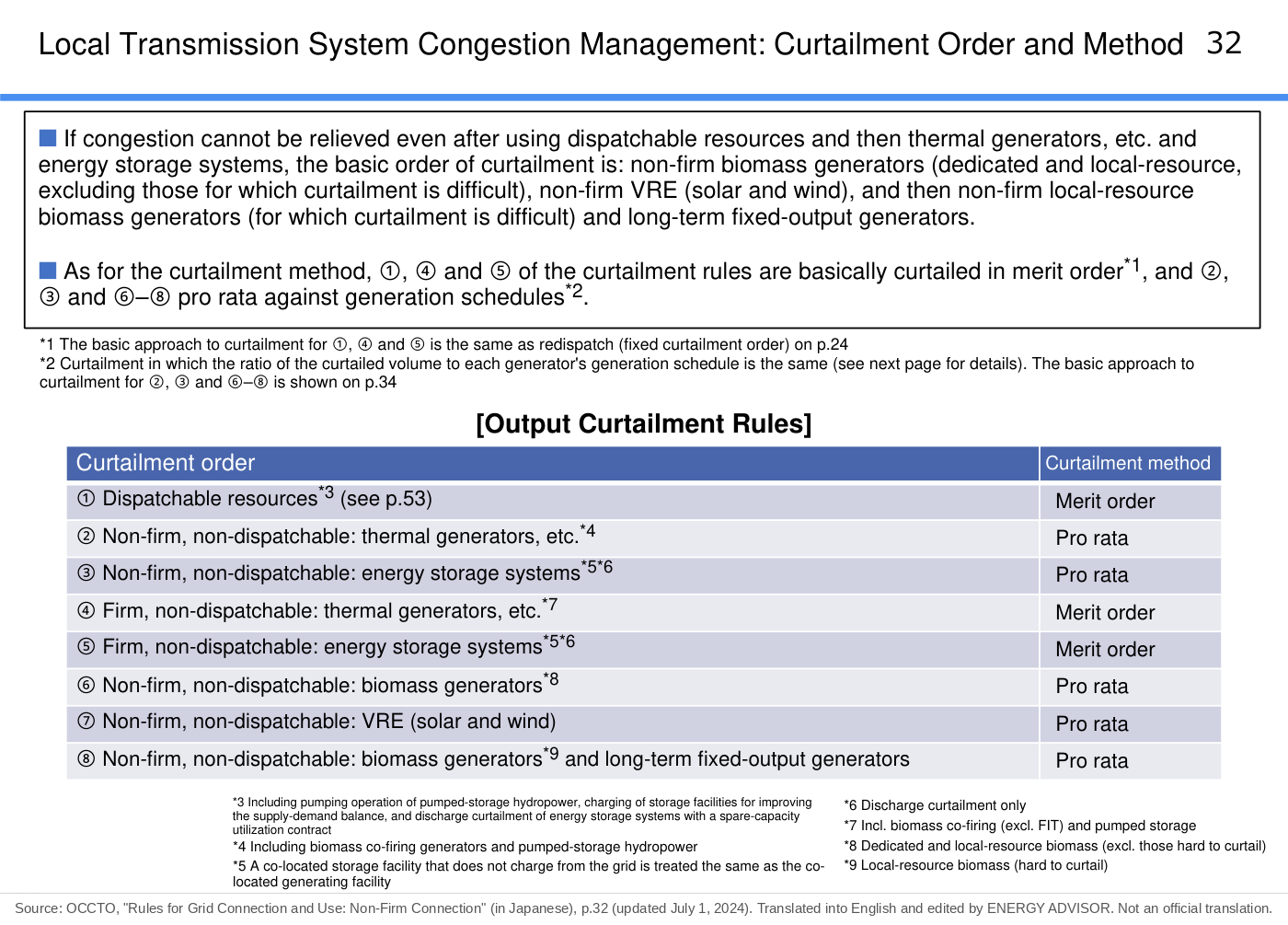
Firm solar, wind, long-term fixed generators and biomass generators are, in principle, not curtailed (same, p.31).
Non-firm thermal plants are curtailed first even if non-firm solar or wind connects later ((2) comes before (7)). Congestion on local transmission systems changes greatly with the connection of new generators. Anyone connecting thermal plants or batteries under non-firm connection also needs to take this into account.
Differences from the Bulk Transmission System
| Item | Congestion on the bulk transmission system | Congestion on local transmission systems |
|---|---|---|
| Control of non-firm generators ((2), (3), (6)–(8)) | Redispatch. The GT&D company curtails at the real-time stage, and generation schedules are not changed | The generation balancing group contractor changes its generation schedule values |
| Control of dispatchable resources and firm generators ((1), (4), (5)) | Redispatch | Redispatch |
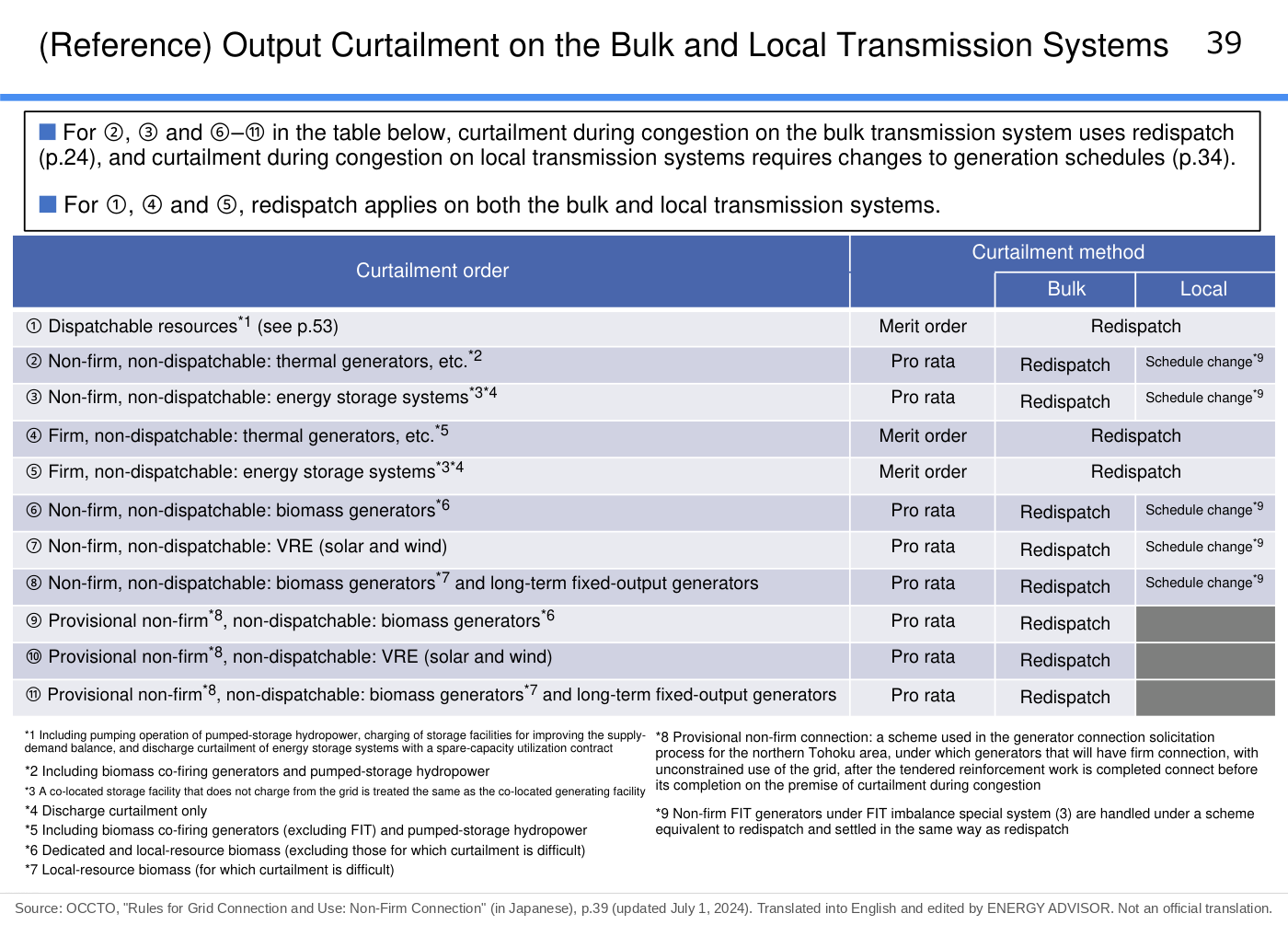
The source is “Non-Firm Connection,” p.39. When the bulk transmission system and a local transmission system are congested at the same time, the rule is that congestion on the local transmission system is handled first. This is so that output curtailment can be carried out efficiently according to congestion on the local transmission system, regardless of the congestion situation on the bulk transmission system (Subcommittee on Mass Introduction of Renewable Energy and Next-Generation Electricity Networks, 48th meeting, Material 1, p.11).
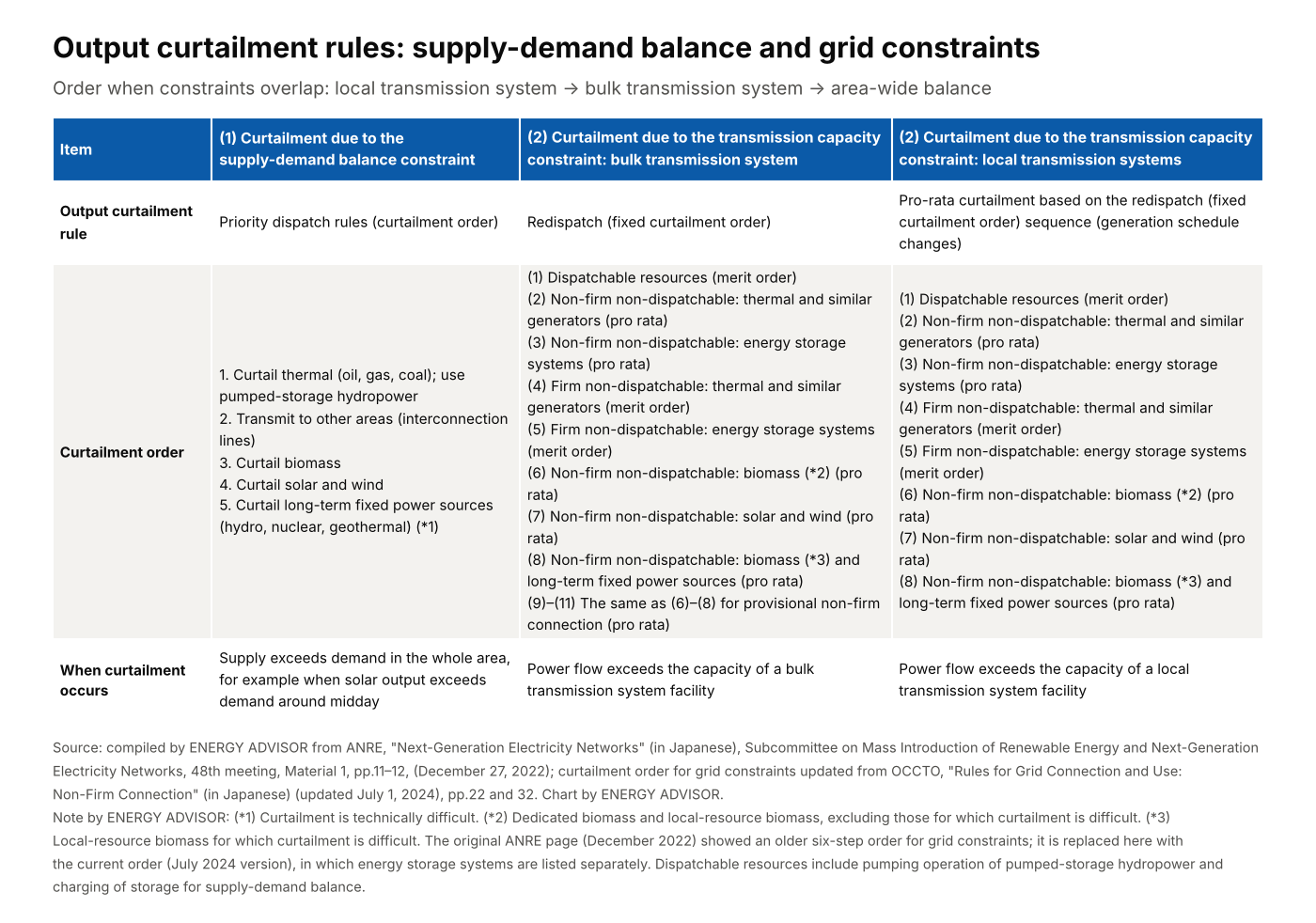
Relationship among output curtailment rules for supply-demand balance constraints, the bulk transmission system and local transmission systems (Source: Subcommittee on Mass Introduction of Renewable Energy and Next-Generation Electricity Networks, 48th meeting, Material 1, p.12)
Control from the Planning Stage
Output curtailment for congestion on local transmission systems is carried out from a stage before the final schedule submission (one hour before real time), that is, from the planning stage. The GT&D company forecasts congestion at the following three points (“Non-Firm Connection,” p.34).
- After submission of the next day’s generation schedules
- 1+α hours before real time (α is set by the GT&D company, taking into account system processing time and the time operators need to procure replacement power)
- One hour before real time (immediately after generation schedules are fixed)
In the Tokyo area, point 2 is set at five hours before real time. Congestion forecasts are issued three times, both by notice to generating facilities and by publication on the company’s website (TEPCO Power Grid FAQ, Q30 and Q31). Congestion forecasts are shown as a “ratio to maximum receiving power.” OCCTO’s material defines the upper limit of output of a non-firm generator that does not cause congestion as the “output control value,” and the output control value with maximum receiving power taken as 100% as the “output cap as a ratio to maximum receiving power (%)” (“Non-Firm Connection,” p.36). GT&D companies publish this value on their websites for each receiving point identification number (same, p.35). TEPCO Power Grid’s material states that the output cap posted on its website is shown every 30 minutes as a “percentage of simultaneous maximum receiving power” (“Congestion Management on Local Transmission Systems,” p.40).
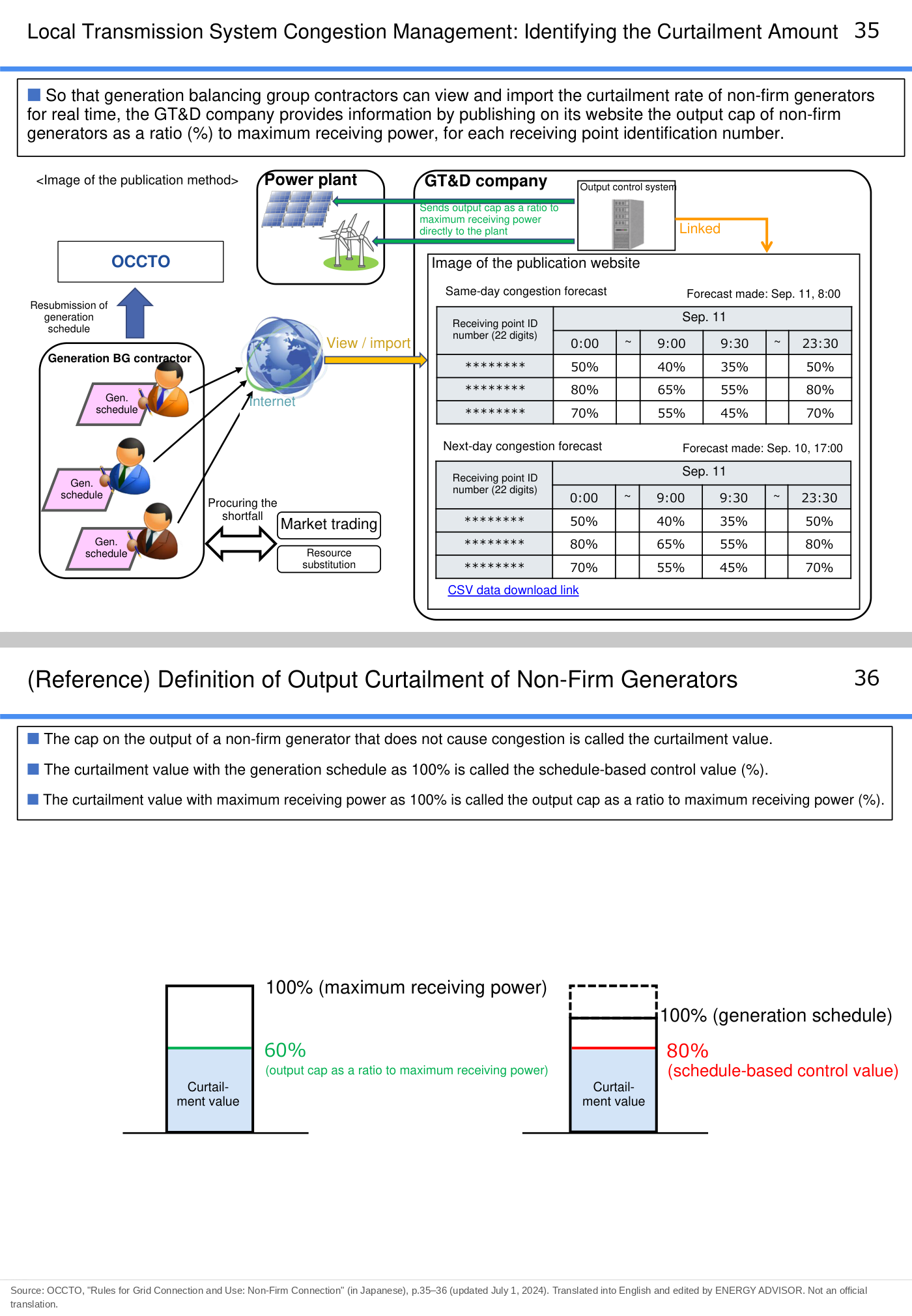
The GT&D company estimates power flows based on the latest generation schedules at that time, forecasts of solar and wind output, and the demand forecast. On that basis, it forecasts congestion for non-firm generators. An output curtailment schedule is sent to non-firm generators, and the operating schedule of the PCS (power conditioner, the device that controls the output of solar and other generators) is rewritten.
Generation balancing group contractors are the entities that submit generation schedules to the GT&D company. They determine the curtailment amount from the first and second congestion forecasts. They then procure replacement power and, as needed, resubmit generation schedules.
The final curtailment amount is set at the third point, based on the final generation schedule. Any difference may be settled as an imbalance. An imbalance is a deviation between plan and actual results, and the imbalance price is the price for settling that deviation.
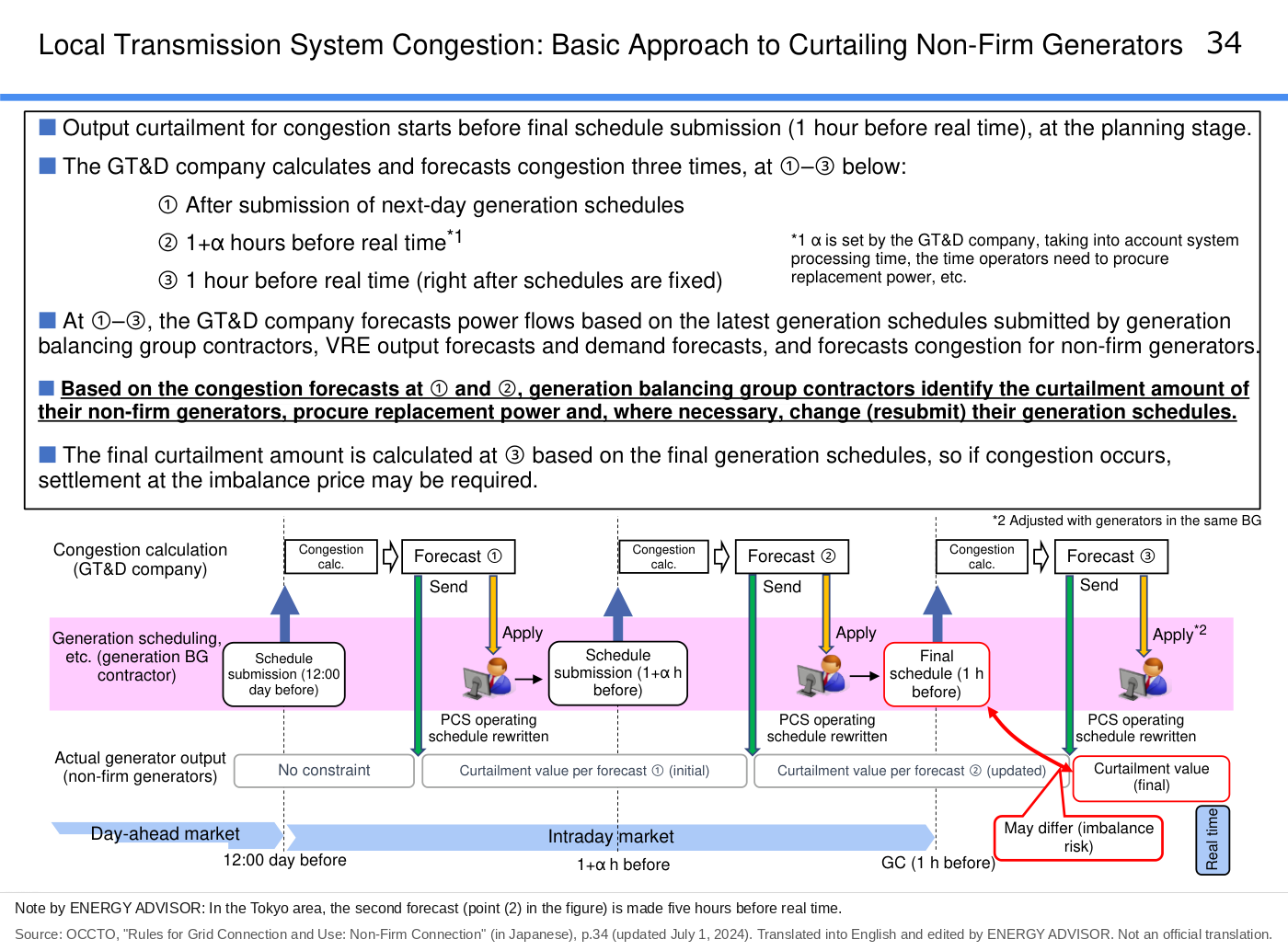
Flow of output curtailment of non-firm generators (Source: OCCTO, “Rules for Grid Connection and Use: Non-Firm Connection,” p.34)
Schedule Values for Low-Voltage Generators (Tokyo Area)
Low-voltage generators (10 kW or more) are also connected below local transmission systems where congestion is expected. These generators must submit generation schedule values for each distribution substation and each generator type (TEPCO Power Grid, “Congestion Management on Local Transmission Systems,” p.22). Low-voltage non-firm generators of 10 kW or more that do not belong to the congested transmission network can continue to submit schedule values as a low-voltage group, as before (same FAQ, Q42).
Approach to Settlement (Tokyo Area Example)
| Generator | Settlement method | Source |
|---|---|---|
| Non-firm generators | Accepting output curtailment without compensation during grid congestion is a condition of connection | FAQ Q44 |
| Amounts that deviated from actual results because the schedule revision was not made in time | Settled at the imbalance price. Low voltage (10 kW or more) is settled as an imbalance | FAQ Q45 |
| Firm non-dispatchable resources (curtailed by merit order) | The marginal-cost price submitted in advance is settled as the settlement price for supply under dispatch instruction | “Congestion Management on Local Transmission Systems,” p.30 |
TEPCO Power Grid explains that the imbalance price has no penalty element and is close to actual cost (FAQ Q47). This is because, since FY2022, it has been calculated based on the marginal cost of balancing capacity.
Firm non-dispatchable resources submit their marginal-cost prices every week (by 14:00 on the Tuesday of the week before the week of application). If no price is submitted, the average imbalance price for the same period of the previous year is used as a substitute price (“Congestion Management on Local Transmission Systems,” pp.28–29).
How Differences in Settlement Affect Siting
OCCTO considers that differences in how the costs of congestion management are borne affect the locational signal for generators (Cross-Regional Network Development Committee, 103rd meeting, Material 3, pp.8–9).
| System | Cost of congestion management | Locational signal |
|---|---|---|
| Bulk transmission system | Socialized cost (borne broadly through network charges) | Basically weak (for non-firm FIP generators, there is a signal equal to the premium they can no longer earn) |
| Local transmission systems | Curtailment of non-firm generators is without compensation and borne by the specific operators | A certain signal works on non-firm generators other than dispatchable resources |
Congestion Outlook and Published Information
Generators connecting under non-firm connection need to assess project economics with output curtailment taken into account. The following information is published for this purpose.
| Information | Published by | Content |
|---|---|---|
| Medium- to long-term grid congestion outlook | OCCTO (every year) | The FY2029 outlook on September 10, 2024 (83rd meeting of the Cross-Regional Network Development Committee); the FY2031 outlook on September 1, 2026 (103rd meeting) |
| Outlook and grid maps for each congested facility | Each GT&D company | Facility-level results of the medium- to long-term outlook |
| Congestion forecast (ratio to maximum receiving power) | TEPCO Power Grid | Three times: after next-day schedule submission, five hours before, and one hour before |
| Receiving point identification numbers of non-firm generators and output curtailment information | TEPCO Power Grid | Operators are asked to submit consent forms ahead of publication (“Congestion Management on Local Transmission Systems,” pp.24–25) |
How to read the outlook is explained in the article on reading grid congestion data.
Summary
Acceptance of non-firm connection on local transmission systems began in April 2023. Congestion management began with interim measures in each area, and on March 28, 2025, Japan’s first grid-constrained output curtailment of solar and wind took place in the Chubu area. In the Tokyo area, interim pro-rata curtailment of non-firm generators was carried out from April 1, 2024. On April 1, 2026, the area moved to control based on the fixed curtailment order sequence.
For congestion on local transmission systems, unlike the bulk transmission system, non-firm generators must rewrite their own generation schedules. Curtailment is without compensation, and amounts for which the schedule was not revised in time are settled as imbalances.
This article is based on published materials from the Ministry of Economy, Trade and Industry and its Agency for Natural Resources and Energy, the Electricity and Gas Market Surveillance Commission, the Organization for Cross-regional Coordination of Transmission Operators (OCCTO) and other sources. The English translations of figures are by ENERGY ADVISOR and are not official translations. When using this information for decisions, please check the original sources. When we find an error, we correct the article and note the date of the correction.
Sources
- OCCTO, “Rules for Grid Connection and Use: Non-Firm Connection” (in Japanese) (updated July 1, 2024), pp.15, 27, 31–32 and 34–39. https://www.occto.or.jp/grid/assets/NF_setuzokuriyou_20260710.pdf
- ANRE, “Non-Firm Connection Initiatives under the Japanese Version of Connect & Manage” (in Japanese), Next-Generation Power System Working Group, 3rd meeting, Material 2-1 (June 27, 2025), pp.4–5 and 8. https://www.meti.go.jp/shingikai/enecho/denryoku_gas/saisei_kano/smart_power_grid_wg/pdf/003_02_01.pdf
- Chubu Electric Power Grid, “Status of Renewable Energy Output Curtailment due to Grid Congestion” (in Japanese), Next-Generation Power System Working Group, 3rd meeting, Material 2-3 (June 27, 2025), pp.3, 6, 8 and 9. https://www.meti.go.jp/shingikai/enecho/denryoku_gas/saisei_kano/smart_power_grid_wg/pdf/003_02_03.pdf
- TEPCO Power Grid, “Congestion Management on Local Transmission Systems (Output Curtailment Based on the Redispatch (Fixed Curtailment Order) Sequence)” (in Japanese) (October 8, 2025; revised October 31, 2025), pp.1, 9–16, 22–30 and 40. https://www.tepco.co.jp/pg/consignment/retailservice/pdf/local_repowering_method.pdf
- TEPCO Power Grid, “Congestion Management on Local Transmission Systems: FAQ” (in Japanese) (February 2026), Q2, Q3, Q30, Q31, Q42, Q44, Q45 and Q47. https://www.tepco.co.jp/pg/consignment/retailservice/pdf/local_repowering_method_FAQ.pdf
- TEPCO Power Grid, “Non-Firm Connection and Redispatch” (in Japanese). https://www.tepco.co.jp/pg/consignment/access/nonfarm.html
- TEPCO Power Grid, “Introduction of Redispatch on Local Transmission Systems” (in Japanese) (October 8, 2025). https://www.tepco.co.jp/pg/consignment/workshop/information/renewable/fit/20251008.html
- ANRE, “Next-Generation Electricity Networks” (in Japanese), Subcommittee on Mass Introduction of Renewable Energy and Next-Generation Electricity Networks, 48th meeting, Material 1, pp.9, 11, 12 and 16. https://www.meti.go.jp/shingikai/enecho/denryoku_gas/saisei_kano/pdf/048_01_00.pdf
- OCCTO, “Medium- to Long-Term Grid Congestion Outlook for FY2031 (Report)” (in Japanese), Cross-Regional Network Development Committee, 103rd meeting, Material 3 (September 1, 2026), pp.8–9. https://www.occto.or.jp/assets/iinkai/kouikikeitouseibi/103/seibi_103_03_01.pdf
- OCCTO, Cross-Regional Network Development Committee, 83rd meeting, Material 3 (in Japanese) (September 10, 2024). https://www.occto.or.jp/iinkai/kouikikeitouseibi/2024/files/seibi_83_03_01.pdf