N-1 generation tripping is a measure that widens the operating limit of transmission lines and transformers (unyo yoryo in Japanese: the upper limit of power that may flow) in normal conditions. It is conditional on instantly stopping generators when one facility among transmission lines and transformers fails. The generators are stopped by a relay system that detects the fault and sends a signal.
After early application in October 2018, full application began in July 2022. Under full application, eligible generators expanded from new generators to existing ones, and a cost settlement system was also put in place.
This article explains the basic mechanism of N-1 generation tripping, the difference between early and full application, and the cost settlement mechanism and its results. The tiers of Japan’s power grid (bulk transmission system and local transmission system) and the key organizations are explained in the first article of this series, on non-firm connection.
Key points
- 1N-1 generation tripping instantly limits generation in preparation for an N-1 contingency on a transmission line, and in this way widens the operating limit
- 2With full application in July 2022, existing generators also became eligible, and cost settlement began in April 2023
- 3As one of the three measures of the Japanese version of Connect & Manage, it supports the expansion of renewable energy
Operating Limits and N-1 Contingencies
An N-1 contingency is the failure of a single facility, such as a fault on one circuit of a transmission line. The normal power flow on a two-circuit transmission line is kept to an amount that allows transmission to continue even if an N-1 contingency occurs. Specifically, it is operated with the equipment capacity of one circuit as the upper limit.
This upper limit is called the operating limit (unyo yoryo).
Transmission lines are normally built as a pair of two circuits, but only the capacity of one circuit can be used in normal conditions. The capacity of the other circuit is kept free in case of a fault.
Mechanism of N-1 Generation Tripping
The devices installed for N-1 generation tripping instantly reduce generator output or stop generators during an N-1 contingency. The devices are installed at generators, transmission lines and other facilities.
N-1 generation tripping can be applied just by installing devices. It widens the operating limit more efficiently than reinforcement work such as restringing transmission lines (OCCTO, “Approach to N-1 Generation Tripping (Supplementary Explanatory Material),” p.3).
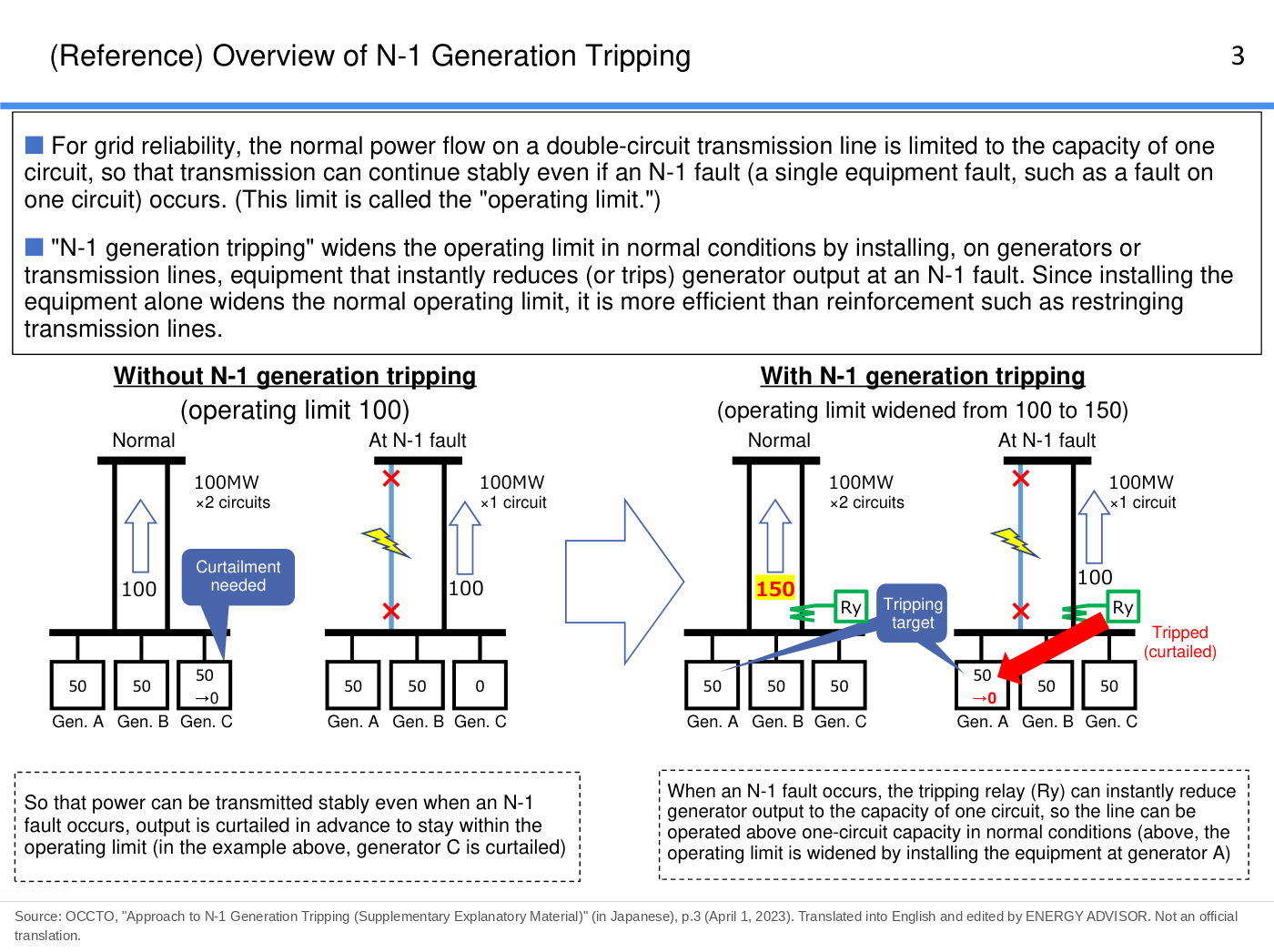
Overview of N-1 generation tripping (Source: OCCTO, “Approach to N-1 Generation Tripping (Supplementary Explanatory Material),” p.3)
ANRE’s Energy White Paper 2021 puts the national connectable capacity enabled by N-1 generation tripping at about 40.4 GW. This is a value confirmed by OCCTO. The value also appears in council material dated November 30, 2021 (Subcommittee on Mass Introduction of Renewable Energy and Next-Generation Electricity Networks, 37th meeting, Material 2; excerpted on p.2 of OCCTO’s supplementary material). The same table states that, as of November 2021, about 6.5 GW nationwide had been connected using N-1 generation tripping. These are values from the early application period, not current values.
Example of N-1 Generation Tripping
Using a two-circuit transmission line as an example, here is how the operating limit changes when N-1 generation tripping is applied.
Under conventional operation, even with a two-circuit transmission line, only the capacity of one circuit (for example, 100 MW) could be used, in preparation for an N-1 contingency. When N-1 generation tripping is applied, power can be sent in normal conditions at more than the capacity of one circuit.
If an N-1 contingency actually occurs, the relay system instantly stops the target generators and reduces the flow to a level that can be sent safely on the remaining circuit.
Position in the Japanese Version of Connect & Manage
N-1 generation tripping is one of the three measures that make up the “Japanese version of Connect & Manage.” The Japanese version of Connect & Manage is the collective name for initiatives to expand renewable energy by making maximum use of existing transmission and transformation facilities.
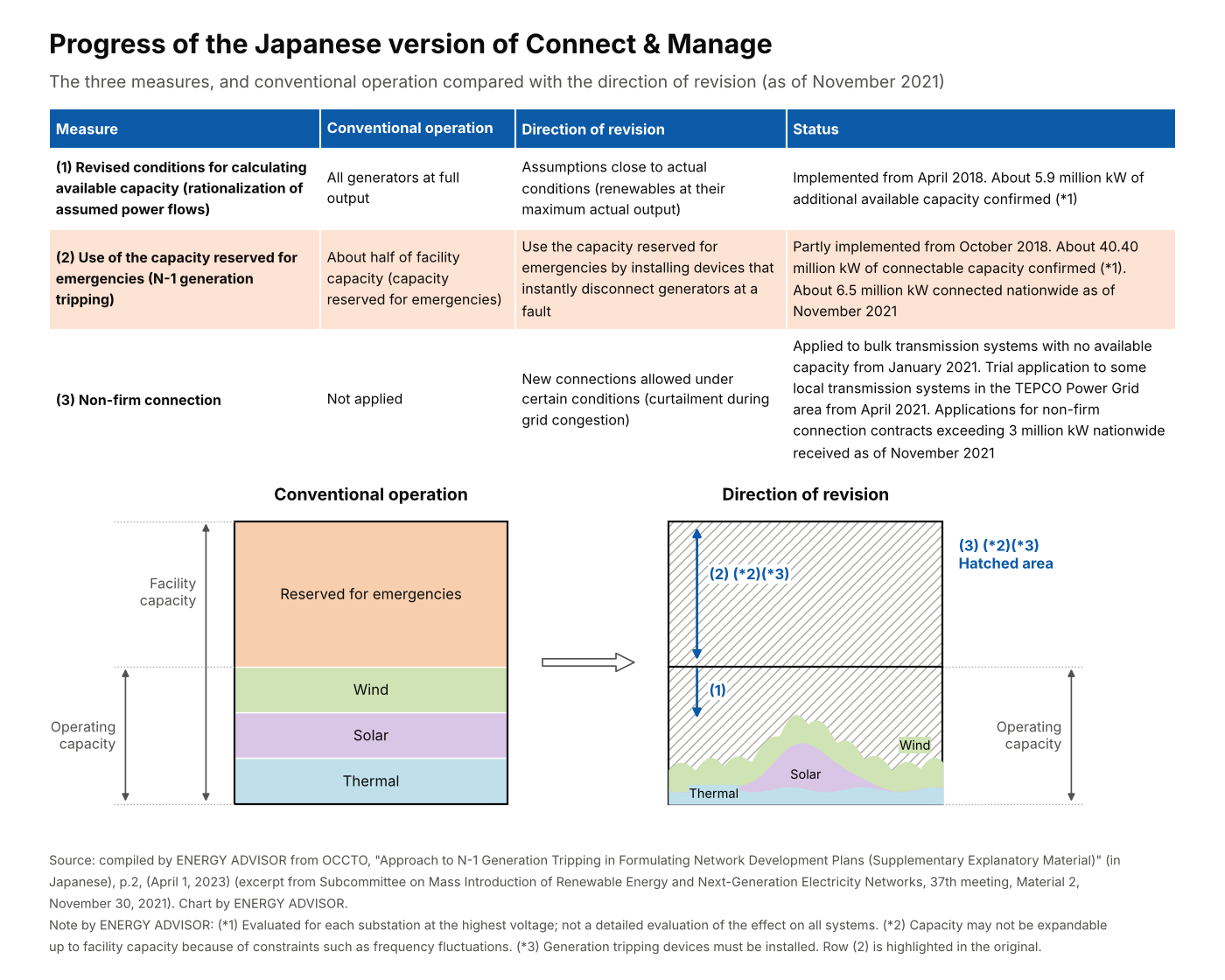
| Measure | Content | Start |
|---|---|---|
| Rationalization of assumed power flows | Stop assuming that all generators reach maximum output at the same time, and recalculate available capacity based on operating results | April 2018 |
| N-1 generation tripping | Widen the operating limit in normal conditions on the premise of instantly limiting generation during an N-1 contingency (this article) | Early application October 2018; full application July 2022 |
| Non-firm connection | Connect using capacity in hours when it is unused, on the condition of output curtailment during congestion | Bulk transmission system January 2021; local transmission systems April 2023 |
As of the end of October 2024, applications for non-firm connection contracts totaled about 26 GW nationwide (Next-Generation Power System Working Group, 1st meeting, Material 4, p.2).
The three measures are used in combination. Rationalization of assumed power flows re-evaluates available capacity, and N-1 generation tripping widens the operating limit. On that basis, non-firm connection uses the hours when capacity is unused.
Early Application and Full Application
N-1 generation tripping has two stages: “early application” and “full application.”
| Item | Early application (from October 2018) | Full application (from July 2022) |
|---|---|---|
| Purpose | Connection of new generators (carried out as part of grid access) | Effective use of the grid by widening the operating limit (carried out by GT&D companies based on cost-benefit analysis) |
| Eligible generators | New extra-high-voltage generators connecting to the grid | All generators connected at extra-high voltage, including existing ones |
| Installation cost of tripping devices | Borne by the connecting generation company (cost borne by the connecting party) | Socialized cost (borne broadly through network charges). Operation and maintenance of control devices within the power plant site are borne by the generation company |
| Operation costs when tripping is activated | Not settled (borne by the generation company) | Settled from April 2023. Socialized cost for the time being |
The sources are OCCTO, “Approach to N-1 Generation Tripping (Supplementary Explanatory Material),” pp.1, 4, 8 and 12 (April 1, 2023), and Cross-Regional Network Development Committee, 86th meeting, Material 1, p.4 (January 15, 2025).
Early Application (from October 2018)
Under early application, generators eligible for N-1 generation tripping were limited to those newly connecting to the grid. This covers cases where a power plant about to connect to a transmission line (mainly renewable generators such as solar and wind) becomes subject to N-1 generation tripping in the course of the grid connection study. The new generator connects to emergency capacity that is not used in normal conditions, on the condition that it can itself be stopped during a fault.
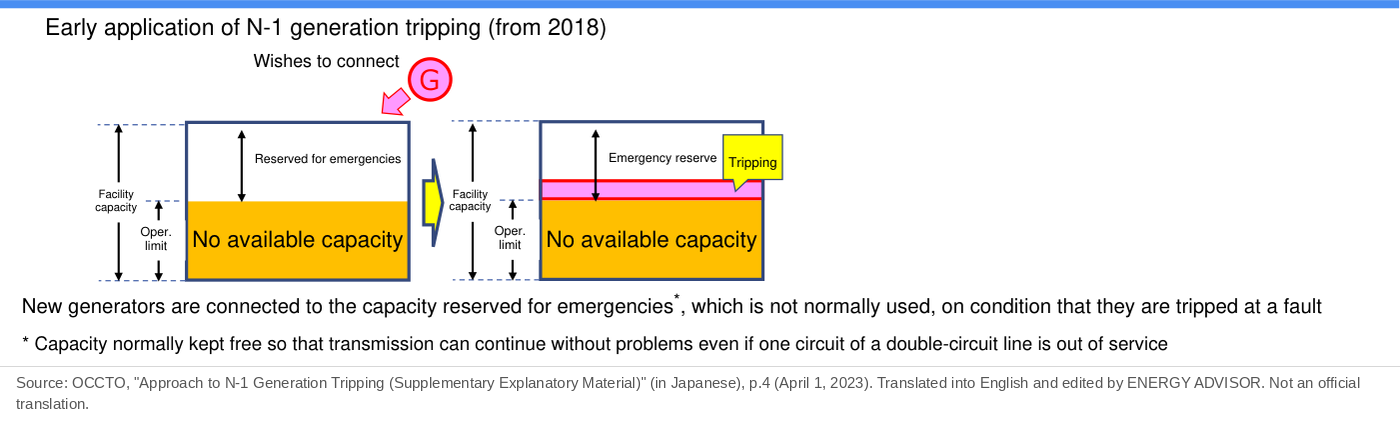
Image of early application of N-1 generation tripping (Source: OCCTO, “Approach to N-1 Generation Tripping (Supplementary Explanatory Material),” p.4)
Full Application (from July 2022)
In July 2022, OCCTO changed its Operational Rules and its Network Codes for full application (supplementary material, p.1). TEPCO Power Grid began accepting grid connection studies premised on full application from July 5, 2022 (TEPCO Power Grid, “Start of Full Application of N-1 Generation Tripping”). Under full application, eligible generators expanded greatly, regardless of whether a generator is new or existing. N-1 generation tripping devices are installed at generators that the GT&D company judges reasonable, and the capacity of those generators is placed on the emergency capacity side. This widens the operating limit of facilities, which is used to relieve congestion and to connect new generators.
Full application also put in place a system to settle operation costs when N-1 generation tripping is activated, and settlement has been carried out since April 2023.
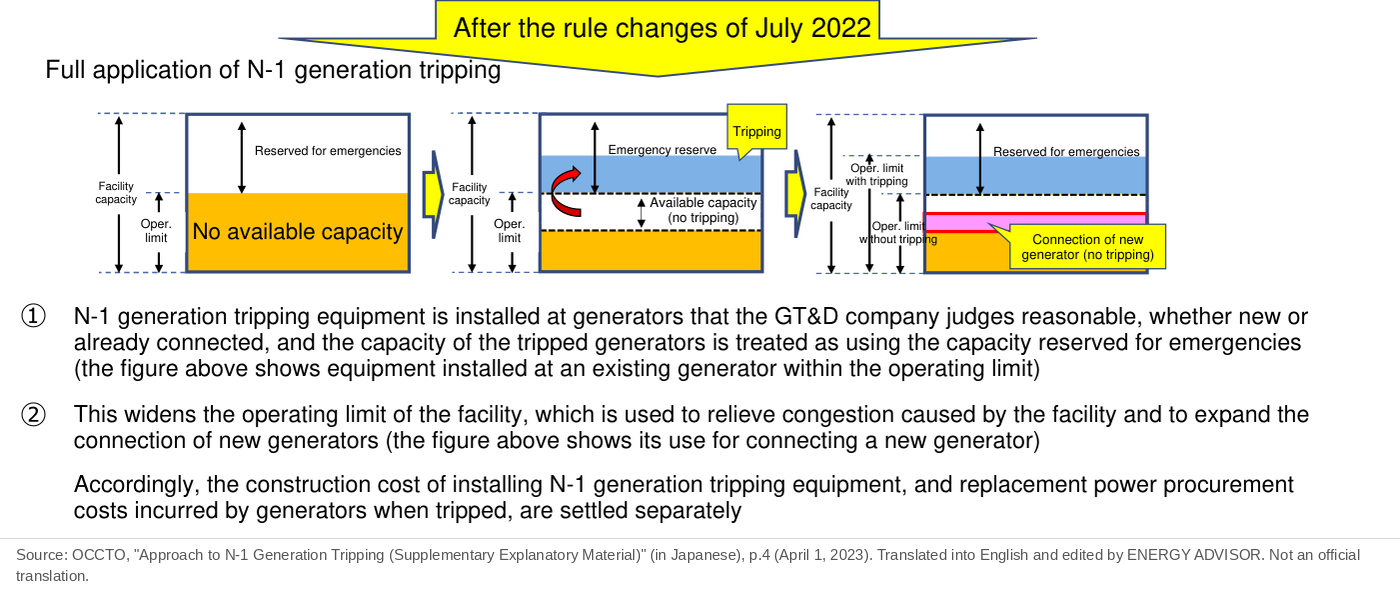
Image of full application of N-1 generation tripping (Source: OCCTO, “Approach to N-1 Generation Tripping (Supplementary Explanatory Material),” p.4)
There are two major differences between early and full application: “existing generators became eligible” and “a cost settlement system was put in place.” Under early application, only newly connecting generators were eligible, and existing power plants were not subject to N-1 generation tripping. Under full application, all generators connected at extra-high voltage became candidates for N-1 generation tripping, so the effect of widening the operating limit across the grid as a whole has become larger.
Selection of Target Generators
Under full application, all generators connected at extra-high voltage are candidates for N-1 generation tripping. Which generators are actually targeted is designated by the GT&D company based on the priorities in the guidelines. OCCTO’s guidelines state that target generators are selected with the effect of reducing the flow as the first consideration (supplementary material, p.8).
Selection Priorities
The guidelines state that target generators are selected in the following four priorities (guidelines §1.6; supplementary material, p.10).
- Whether the effect of reducing the flow is large, for example, by reducing the number of units tripped or making the reduction amount appropriate
- Whether the restart time after tripping is short
- Whether the opportunity cost is low, for example, a high generation cost or a low start-up cost
- Whether the installation cost of the tripping device is low, for example, a low cost for communication lines
Tripping occurs quite rarely. For this reason, the effect of widening the operating limit by installing devices is given more weight than the cost at the time of tripping. The basic approach is to put the reduction effect first and to choose using the remaining three items when there are several candidates. The reduction effect is evaluated from three viewpoints: the generator’s “location,” “size” and “congestion outlook at times of congestion” (guidelines §1.6).
Obligation to Accept Installation
The guidelines state that generation companies must accept the installation of N-1 generation tripping devices unless there is a justifiable reason (note to guidelines §1.6). Justifiable reasons are limited to extremely special circumstances, such as when the generator’s retirement is scheduled in the near future. Concerns about equipment damage from tripping and effects on other businesses are stated not to be justifiable reasons. These are considered as needed under “opportunity cost” in the priorities.
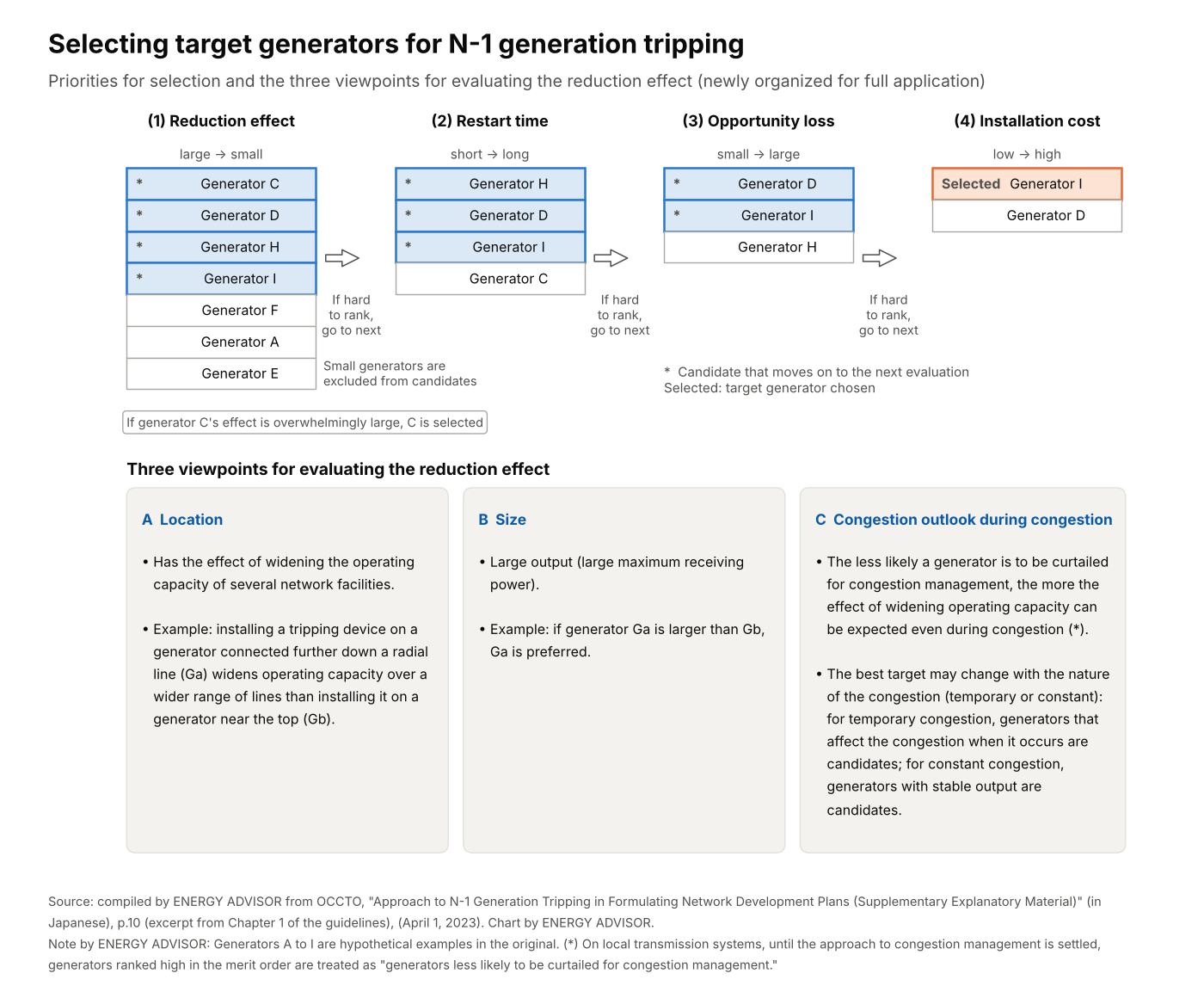
Selection of target generators for N-1 generation tripping (Source: OCCTO, “Approach to N-1 Generation Tripping (Supplementary Explanatory Material),” p.10)
Systems Where N-1 Generation Tripping Applies
How N-1 generation tripping applies is organized by the shape of the system. OCCTO’s guidelines set it out as follows (supplementary material, p.8).
| System | Approach to application |
|---|---|
| Radial bulk transmission system (a single path for power flow) | Applied in principle |
| Local transmission systems at extra-high voltage or above | Applied in principle |
| Loop bulk transmission system (power can flow over multiple paths) | Decided for each system |
A local transmission system is a system at a voltage below the bulk transmission system. In the Tokyo area, for example, the 154 kV and 66 kV systems fall into this category. Local transmission systems are often radial.
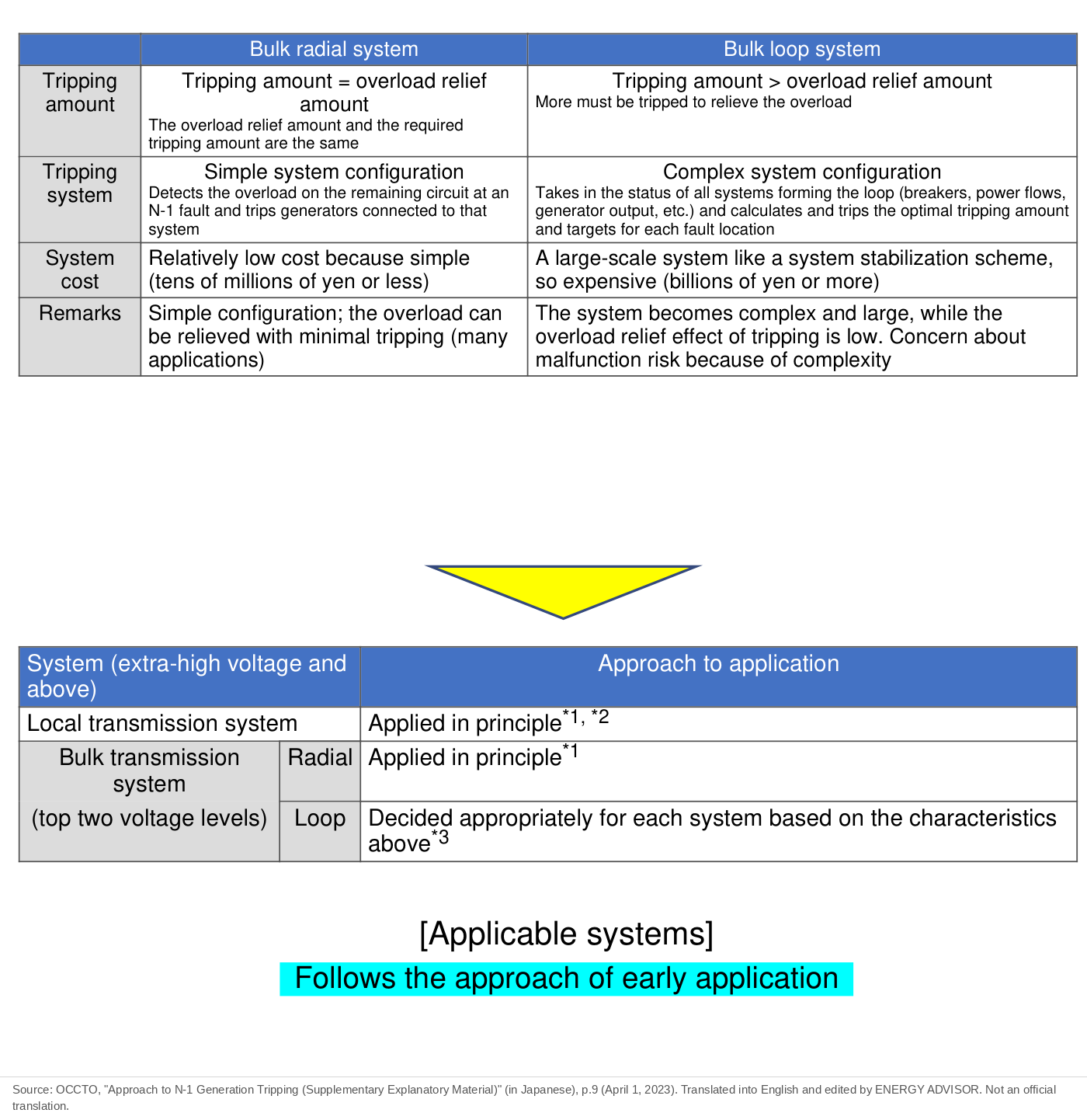
Approach to systems where N-1 generation tripping applies (Source: OCCTO, “Approach to N-1 Generation Tripping (Supplementary Explanatory Material),” p.9)
The guidelines also set a guide for the permissible amount of tripping. The guide is the smaller of “the amount of tripping that stays within normal frequency fluctuations” and “the amount of tripping that takes into account each area’s reserves” (supplementary material, p.8).
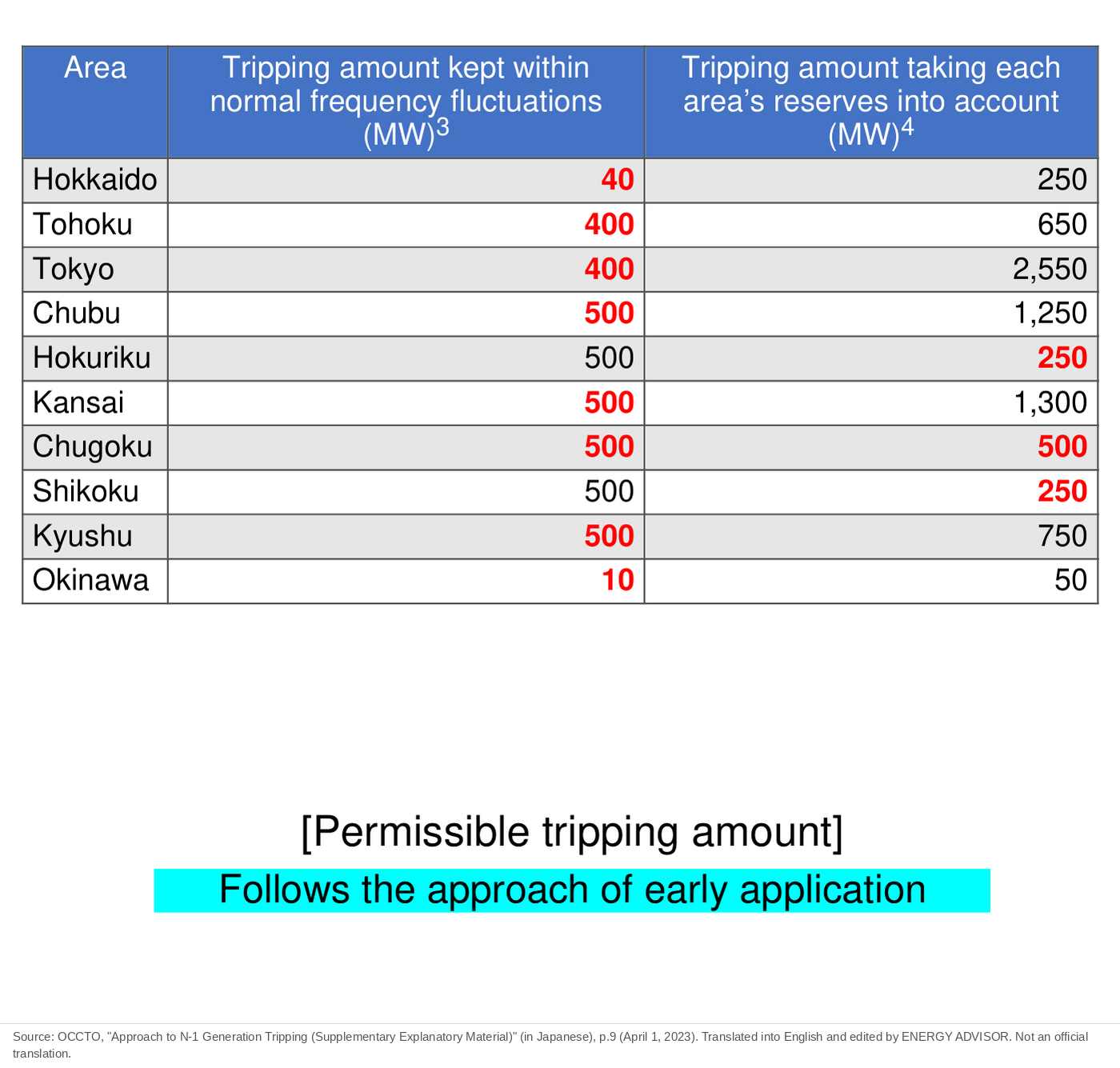
Cost Settlement When N-1 Generation Tripping Is Activated
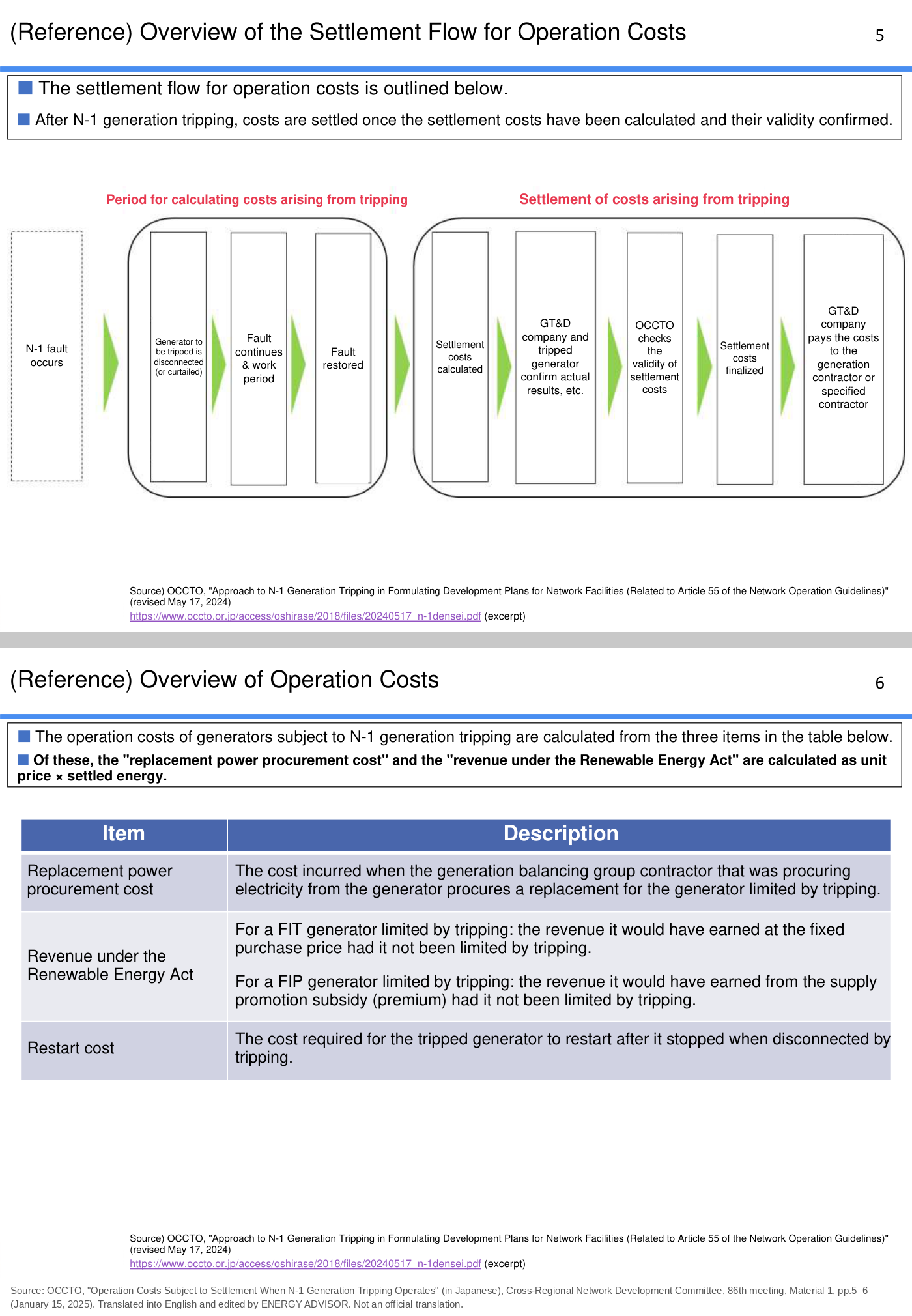
Together with full application, a system was put in place to settle the operation costs incurred when N-1 generation tripping is actually activated. Settlement has been carried out since April 2023.
Why Cost Settlement Is Needed
When N-1 generation tripping is activated, the target generators stop instantly. Because a stopped generator cannot generate during that time, replacement power must be procured. The cost settlement system sets out who bears this cost and how.
Costs Subject to Settlement
What is settled is the “operation costs” incurred when N-1 generation tripping is activated, which consist of the following three items (supplementary material, p.17; Cross-Regional Network Development Committee, 86th meeting, Material 1, p.6).
| Item | Content |
|---|---|
| Replacement power procurement cost | The cost incurred by the generation balancing group contractor, which had procured electricity from the tripped generator, to procure a replacement source |
| Revenue under the Renewable Energy Special Measures Act | The revenue a FIT generator (a renewable generator whose output is purchased at a fixed price) would have earned had it not been tripped. For a FIP generator (a renewable generator that receives a premium on top of the market price), the premium it would have earned |
| Restart cost | The cost incurred by the tripped generator from stopping until restarting |
The energy subject to settlement is calculated as the difference between the generation schedule submitted by the generation balancing group contractor when N-1 generation tripping was activated and the actual output of the tripped generator (86th meeting, Material 1, p.8).
Settlement Process
When an N-1 contingency occurs, the relay system instantly trips the target generators. The GT&D company then calculates the operation costs, and OCCTO checks that they are reasonable. After this check, the GT&D company settles the costs with the generation company. For the time being, operation costs are borne by the GT&D company (socialized cost) and recovered through network charges (supplementary material, p.8; 99th meeting, Material 3, p.5).
Under early application there was no such settlement system, so even if a generator was tripped by N-1 generation tripping, the loss was borne by the generation company. Now that full application has put the settlement system in place, operators of existing generators find it easier to cooperate with N-1 generation tripping.
Developments after Full Application (2025–2026)
Revised Method for Estimating Generation Schedules of FIT Generators (January 2025)
Among FIT generators, for solar and wind plants that have chosen FIT special system (1) or (3), the generation balancing group contractor does not prepare a generation schedule. FIT special systems (1) and (3) are arrangements (the FIT imbalance special system) under which the generation schedules of FIT generators are prepared not by the generation company but by the GT&D company or others. For this reason, the generation schedule value must be estimated at settlement.
For power plants without a pyranometer or anemometer, the value had been estimated by allocating the forecast FIT generation for the whole service area to each plant in proportion to its output. OCCTO confirmed in actual cases that the error can be large compared with the actual conditions at individual sites.
In response, the 86th meeting of the Cross-Regional Network Development Committee on January 15, 2025 presented a policy to revise the estimation method. The method uses generation forecast by the GT&D company in mesh units (units that divide a region into small cells) or similar. The guidelines were to be revised promptly (86th meeting, Material 1, pp.2 and 11–15).
Disclosure of Settlement Information (March 2026)
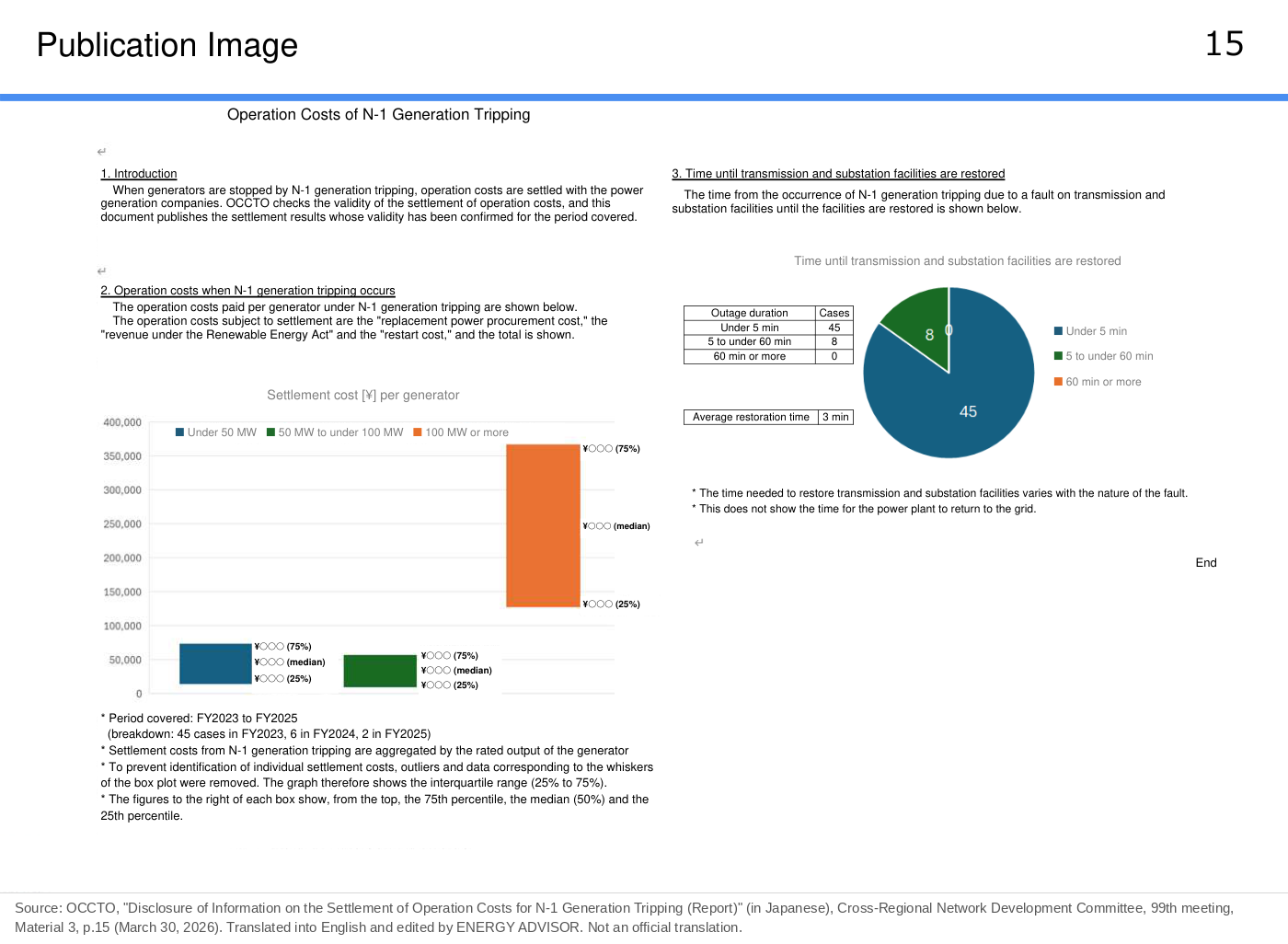
At the 99th meeting of the Cross-Regional Network Development Committee on March 30, 2026, a policy to disclose information on the settlement of operation costs was reported (99th meeting, Material 3).
| Item | Content |
|---|---|
| Settlement results | From April 2023 to the end of February 2026, the reasonableness of settlement was checked for 25 faults involving a total of 53 generating units |
| Form of disclosure | So that individual generating units cannot be identified, settlement costs per unit are published in statistical form (box plots), in three categories by rated output (under 50 MW, 50 MW to under 100 MW, and 100 MW or more) |
| Restoration time | The number of cases is published in three categories of time to restore transmission and transformation facilities: under 5 minutes, under 60 minutes, and 60 minutes or more |
| Where published and updates | The “Rules for Grid Connection and Use” page on OCCTO’s website. Updated once a year, around April, including the previous fiscal year’s results |
Redispatch on Local Transmission Systems (April 2026)
In the Tokyo area, a new output curtailment practice began on April 1, 2026 on local transmission systems where congestion is expected. It is control based on the redispatch (fixed curtailment order) sequence (TEPCO Power Grid, “Non-Firm Connection and Redispatch”). The start dates in other areas are covered in this series’ article on local transmission systems.
The three systems have different roles. N-1 generation tripping is a mechanism that widens the operating limit in normal conditions. Non-firm connection is a mechanism for connecting using unused capacity, and redispatch is the rule for output curtailment during congestion.
Related Mechanisms Using the N-1 Approach
The approach of N-1 generation tripping is also used outside generation.
| Mechanism | Content | Status |
|---|---|---|
| N-1 charging-stop scheme for grid-scale battery storage | Widens the operating limit on the charging (import flow) side by stopping battery charging during an N-1 contingency | Applied from September 2023 (OCCTO, “Grid-Scale Battery Storage,” pp.9–11) |
| Demand curtailment under an N-1 contingency for large demand | Customers such as data centers connect earlier on the condition that they accept limits on receiving power during an N-1 contingency | At the stage where deeper study began at the 13th meeting of the Next-Generation Power System Working Group in October 2026 |
Each is explained in detail in the articles on grid-scale battery storage and on data centers.
Summary
N-1 generation tripping is a measure that can widen the operating limit in normal conditions just by installing devices. It widens the operating limit more efficiently than transmission line reinforcement work.
Under early application in October 2018, eligibility was limited to newly connecting generators. With full application in July 2022, all extra-high-voltage generators, including existing ones, became candidates, and cost settlement began in April 2023. By the end of February 2026, the reasonableness of settlement had been confirmed for 25 faults involving a total of 53 units.
OCCTO publishes the approach to and specific methods of N-1 generation tripping on its website.
This article is based on published materials from the Ministry of Economy, Trade and Industry and its Agency for Natural Resources and Energy, the Electricity and Gas Market Surveillance Commission, the Organization for Cross-regional Coordination of Transmission Operators (OCCTO) and other sources. The English translations of figures are by ENERGY ADVISOR and are not official translations. When using this information for decisions, please check the original sources. When we find an error, we correct the article and note the date of the correction.
Sources
- OCCTO, “Approach to N-1 Generation Tripping in Formulating Network Development Plans (Related to Article 55 of the Network Codes) (Supplementary Explanatory Material)” (in Japanese) (April 1, 2023), pp.1, 3, 4, 8, 12 and 17. https://www.occto.or.jp/access/oshirase/2018/files/20230401_n-1densei_hosoku.pdf
- OCCTO, “Operation Costs Subject to Settlement When N-1 Generation Tripping Is Activated” (in Japanese), Cross-Regional Network Development Committee, 86th meeting, Material 1 (January 15, 2025), pp.2, 4, 6, 8 and 11–15. https://www.occto.or.jp/iinkai/kouikikeitouseibi/2024/files/seibi_86_01_01.pdf
- OCCTO, “Disclosure of Information on Settlement of Operation Costs for N-1 Generation Tripping (Report)” (in Japanese), Cross-Regional Network Development Committee, 99th meeting, Material 3 (March 30, 2026), pp.5, 10, 12–14 and 17. https://www.occto.or.jp/assets/iinkai/kouikikeitouseibi/99/seibi_99_03_01.pdf
- OCCTO, “Approach to N-1 Generation Tripping in Formulating Network Development Plans (Related to Article 55 of the Network Codes) (Draft)” (in Japanese) (guideline text at the time of public consultation, May 18, 2022), §1.6, pp.9–10. https://www.occto.or.jp/iken/2022/files/ikenboshuu_glhonbun_220518.pdf (According to the source field of 86th meeting Material 1, the guidelines were also changed on May 17, 2024.)
- TEPCO Power Grid, “Start of Full Application of N-1 Generation Tripping” (in Japanese) (July 5, 2022). https://www.tepco.co.jp/pg/consignment/access/pdf/n-1_electrical_system0705.pdf
- ANRE, “Energy White Paper 2021” (in Japanese), Part 3, Chapter 3, Section 3. https://www.enecho.meti.go.jp/about/whitepaper/2021/html/3-3-3.html
- ANRE, “Non-Firm Connection Initiatives under the Japanese Version of Connect & Manage” (in Japanese), Next-Generation Power System Working Group, 1st meeting, Material 4 (January 23, 2025), p.2. https://www.meti.go.jp/shingikai/enecho/denryoku_gas/saisei_kano/smart_power_grid_wg/pdf/001_04_00.pdf
- OCCTO, “Rules for Grid Connection and Use: Grid-Scale Battery Storage” (in Japanese) (prepared April 1, 2025), pp.9–11. https://www.occto.or.jp/grid/business/documents/chikudenchi_20250901.pdf
- TEPCO Power Grid, “Non-Firm Connection and Redispatch” (in Japanese). https://www.tepco.co.jp/pg/consignment/access/nonfarm.html
- ANRE, “Ensuring Discipline for Large Demand and Next Steps” (in Japanese), Next-Generation Power System Working Group, 13th meeting, Material 1 (October 6, 2026). https://www.meti.go.jp/shingikai/enecho/denryoku_gas/saisei_kano/smart_power_grid_wg/pdf/013_01_00.pdf