The money paid to power generation companies and others in the capacity market is funded by “capacity contributions” paid by retail electricity suppliers and others. For retail electricity suppliers, the capacity market is also positioned as a means of meeting their obligation to secure supply capability under the Electricity Business Act. This article explains how capacity contributions are calculated, how the actual totals have changed, the add-on for the Long-Term Decarbonized Capacity Auction, and the relationship with the obligation to secure supply capability.
How Capacity Contributions Work
Capacity contributions are paid to OCCTO by retail electricity suppliers, general transmission and distribution companies (GT&D companies) and licensed distribution companies. They are the cost of securing supply capacity through the capacity market. The legal basis is Article 55-2 of OCCTO’s Articles of Incorporation (OCCTO’s basic rules) (Overview of the Long-Term Decarbonized Capacity Auction (Bidding Year FY2026), PDF p.35). A licensed distribution company is a company that operates the distribution network in a specific district.
Funded by capacity contributions, OCCTO pays capacity payments to the capacity providers that provide supply capacity. The flow of money is as follows.
| Payer | Recipient | Name of the money |
|---|---|---|
| Retail electricity suppliers, GT&D companies and licensed distribution companies | OCCTO | Capacity contribution |
| OCCTO | Capacity providers (winning power generation companies and others) | Capacity payment |
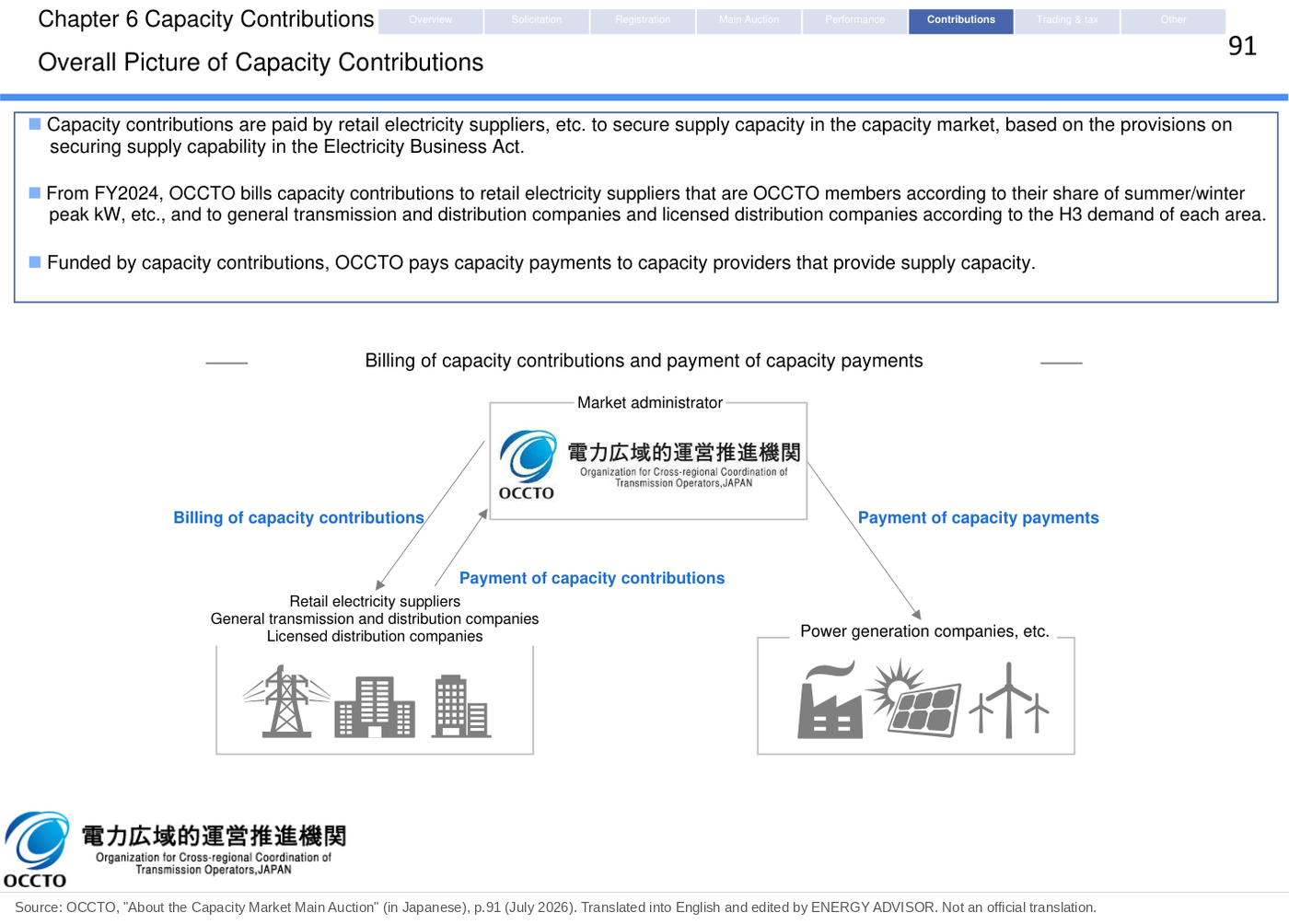
Retail electricity suppliers recover this cost from customers through their electricity rates.
Timing of billing and settlement
Billing of capacity contributions began in July 2024 for delivery year FY2024 (April 2024–March 2025) (OCCTO, capacity contribution briefing, September 2023, PDF p.19). The invoice for a given month (month N) is issued by the 10th of month N+3. Payment is due within one month of issue (Capacity Market Operations Manual: Capacity Contributions (Delivery Year FY2026) (Draft)).
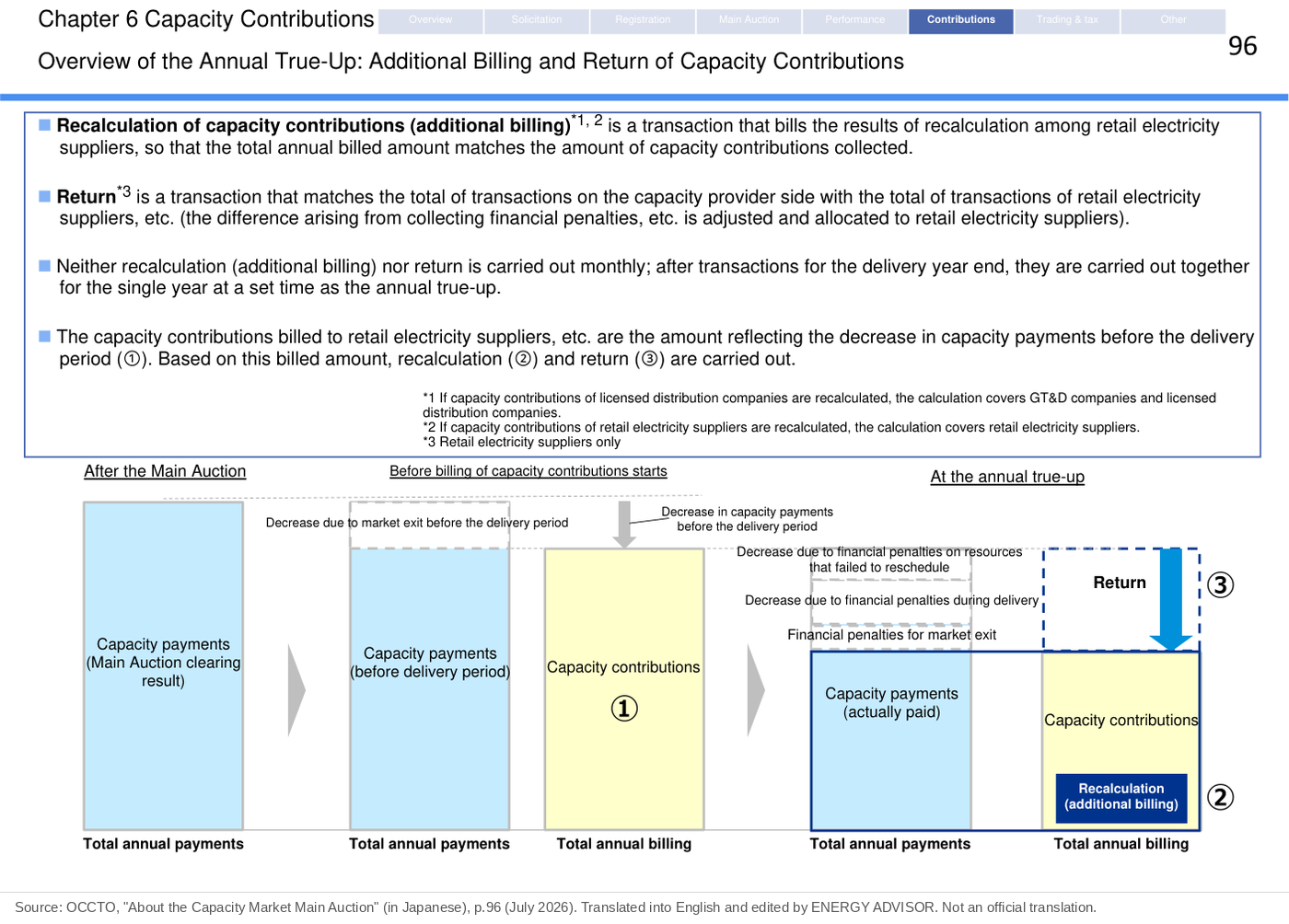
The capacity contributions billed to retail electricity suppliers and others reflect decreases in capacity payments that occurred before delivery (decreases due to market exit and similar causes). During the delivery period, amounts may change because of generators’ penalties and market exits. Some amounts may also not be collected. An annual true-up, held once a year, therefore matches the total capacity payments for the fiscal year with the total capacity contributions. The September 2023 briefing material stated that the annual true-up for delivery year FY2024 was scheduled for October–November 2025 (capacity contribution briefing, September 2023, PDF p.15). An invoice is sent if an additional payment is due, and a payment notice if a refund is due. For the annual true-up for delivery year FY2024, OCCTO published explanatory material on the calculation method and results on November 28, 2025 (results in the next section).
Allocation by Area and by Company
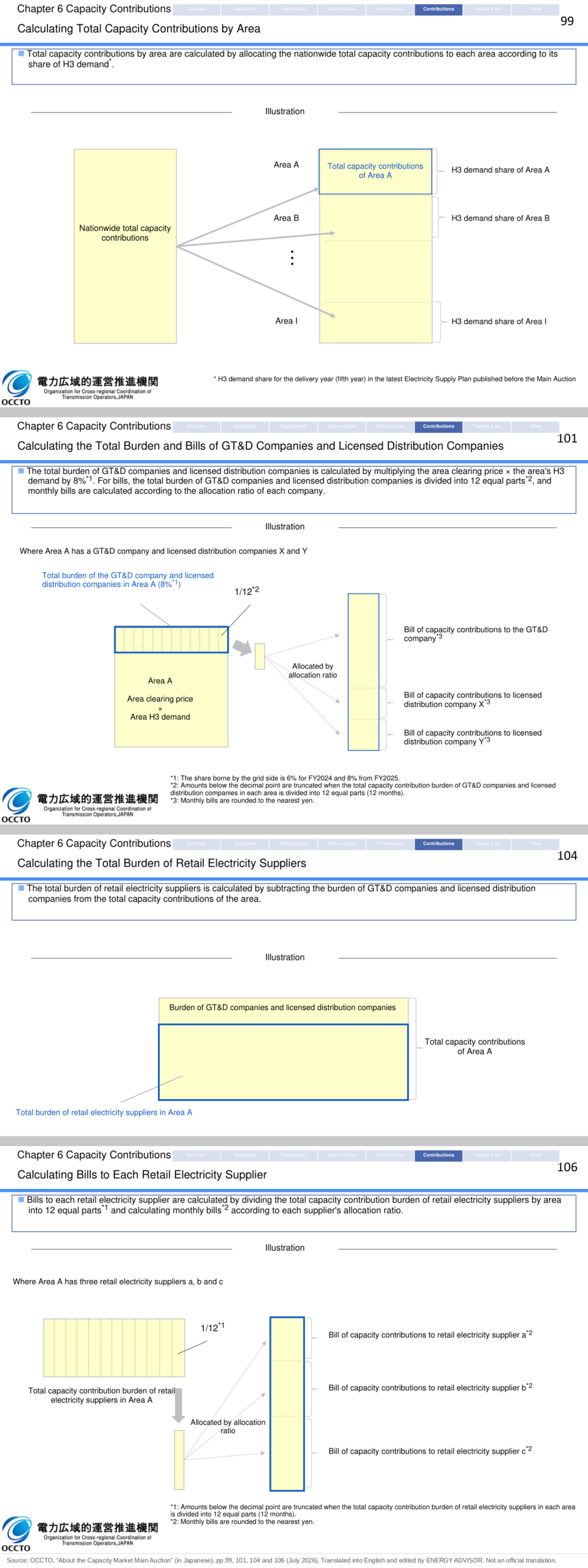
The burden of capacity contributions is allocated based on demand ratios.
(1) Total capacity contributions by area
The nationwide total of capacity contributions is allocated to each area by the ratio of H3 demand by area (see the third article of this series). The ratio uses the H3 demand for the delivery year (the fifth year) in the latest Electricity Supply Plan published before the Main Auction.
(2) Total burden of GT&D companies and licensed distribution companies
The total burden of GT&D companies and licensed distribution companies is calculated as “area clearing price × area H3 demand × a set ratio.” The set ratio is 6% for FY2024 and 8% from FY2025 onward (capacity contribution briefing, September 2023, PDF p.33). In the 2021 revision, this ratio was organized to change from 6% to 7% (Study Committee on the Capacity Market, 35th meeting, Material 3-2, PDF p.5). It was later set at 8% in the 13th interim report of the Working Group on Market Design (August 2023) (clearing results for FY2029, PDF p.11). The total burden is divided into 12 equal parts, and each company’s monthly bill is set by its allocation ratio.
(3) Total burden of retail electricity suppliers
The total burden of retail electricity suppliers is the area’s total capacity contributions minus “the total burden of GT&D companies and licensed distribution companies” and “the deduction under the transitional measures.”
The transitional measures reduce the capacity payments for older plants and others for a certain period, to soften the effect on retail electricity suppliers’ competitive environment right after the capacity market was introduced. The burden on retail electricity suppliers is reduced by the amount of the reduction.
(4) Bill for each retail electricity supplier
The total burden of retail electricity suppliers in each area is divided into 12 equal parts, and each company’s monthly bill is set by its allocation ratio. The allocation ratio is based on actual peak-time demand (kW) in the summer (July–September) and winter (December–February) of the previous fiscal year. It is then adjusted for changes in share using the change in network service contract demand in the billing month. Network service contract demand is the kW in the contract for use of the transmission and distribution network that a retail electricity supplier concludes with the GT&D company. Actual peak-time demand is calculated from the balancing monitoring data. These are data on actual demand and supply for every 30 minutes that each GT&D company submits to OCCTO.
Totals for Delivery Years FY2024–FY2029
Main Auction and Incremental Auction
The basis of the total capacity contributions is the total clearing amount of the auctions (after transitional measures).
| Delivery year | Main Auction total clearing amount | Incremental Auction total clearing amount |
|---|---|---|
| FY2024 | ¥1,598.7 billion | Not held |
| FY2025 | ¥514.0 billion | ¥10.5 billion (held only in Hokkaido, Tokyo and Kyushu) |
| FY2026 | ¥842.5 billion | ¥58.2 billion |
| FY2027 | ¥1,314.0 billion | ¥42.5 billion |
| FY2028 | ¥1,850.6 billion | (to be decided in FY2027) |
| FY2029 | ¥2,209.4 billion | (to be decided in FY2028) |
(Sources: for the Main Auction, the same as the table in the third article of this series. The FY2027 amount is the value in the clearing results (January 24, 2024), PDF p.9, and is the same as the total contracted amount at the time of the review report. For the Incremental Auction, FY2025 from Board of Directors, 466th meeting, Agenda Item 5, PDF p.13; FY2026 from the 67th meeting of the study committee, Material 3, PDF p.12; FY2027 from the 76th meeting of the study committee, Material 3, PDF p.12.)
The actual amounts billed do not match these total clearing amounts because of market exits and the annual true-up. This article has not confirmed the final billed amounts for delivery year FY2025 onward.
Results of the annual true-up for delivery year FY2024
For delivery year FY2024, the results of the annual true-up have been published (OCCTO, “Capacity Contributions (Delivery Year FY2024) Annual True-Up: Calculation Method and Explanatory Material for Companies”, PDF pp.2–3, November 28, 2025).
| Item | Amount |
|---|---|
| Capacity payments at the time of Main Auction clearing | ¥1,598.7 billion |
| Decrease before delivery (market exit, etc.) | −¥44.6 billion |
| Total capacity contributions billed | ¥1,554.1 billion (retail electricity suppliers ¥1,420.5 billion; GT&D companies ¥133.7 billion) |
| Uncollected capacity contributions | About ¥1.07 million (retail electricity suppliers only) |
| Financial penalties, etc. during the delivery period | ¥48.0 billion (about 3% of capacity payments) |
| Total returned in the annual true-up (including ¥0.69 billion in penalties at market exit) | ¥48.4 billion |
(Rounded to the nearest ¥0.1 billion in the original. Only retail electricity suppliers receive the returns; GT&D companies do not.)
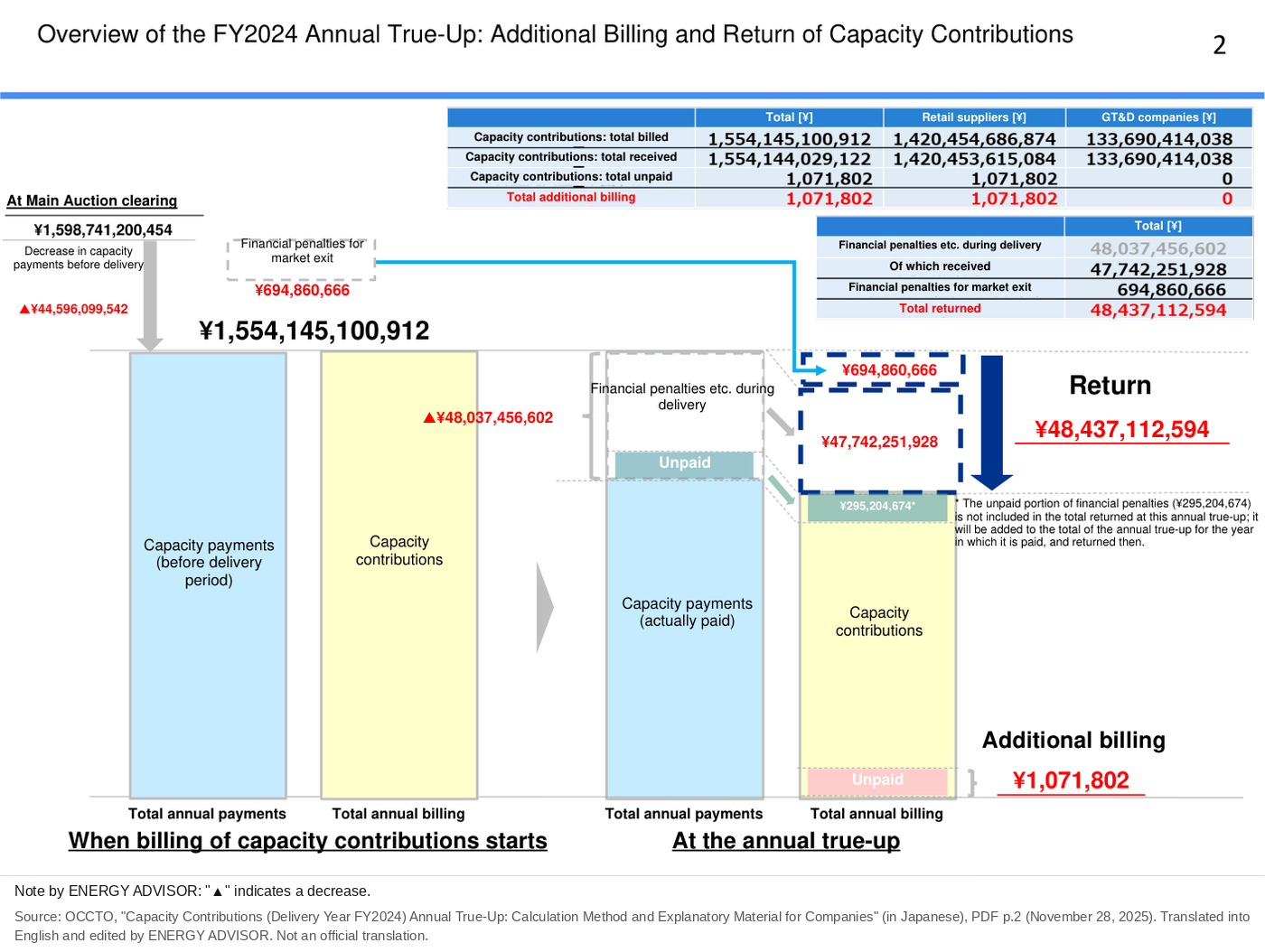
Almost all capacity contributions were collected. The uncollected amount (about ¥1.07 million) will be billed additionally to retail electricity suppliers. The amount by which capacity payments decreased because of penalties and similar causes (¥48.4 billion) is returned to retail electricity suppliers.
Estimate by area for delivery year FY2029
The estimated capacity contributions by area for delivery year FY2029 (for the Main Auction and for the Long-Term Decarbonized Capacity Auction) are as follows. The Long-Term Decarbonized Capacity Auction portion includes the three auctions of bidding years FY2023–FY2025 and is the amount after deducting the estimated refund of other-market revenue.
| Area | GT&D companies (Main) | GT&D companies (Long-Term) | Retail electricity suppliers (Main) | Retail electricity suppliers (Long-Term) | Assumed H3 demand |
|---|---|---|---|---|---|
| Hokkaido | ¥6.33 billion | ¥0.28 billion | ¥71.41 billion | ¥3.34 billion | 5.281 GW |
| Tohoku | ¥16.54 billion | ¥0.74 billion | ¥184.73 billion | ¥8.69 billion | 13.678 GW |
| Tokyo | ¥68.94 billion | ¥3.07 billion | ¥770.19 billion | ¥36.02 billion | 57.028 GW |
| Chubu | ¥22.78 billion | ¥1.23 billion | ¥256.73 billion | ¥14.53 billion | 22.983 GW |
| Hokuriku | ¥4.86 billion | ¥0.26 billion | ¥54.74 billion | ¥3.10 billion | 4.900 GW |
| Kansai | ¥26.71 billion | ¥1.44 billion | ¥301.06 billion | ¥17.03 billion | 26.951 GW |
| Chugoku | ¥10.40 billion | ¥0.56 billion | ¥117.28 billion | ¥6.64 billion | 10.499 GW |
| Shikoku | ¥4.55 billion | ¥0.25 billion | ¥51.27 billion | ¥2.90 billion | 4.590 GW |
| Kyushu | ¥19.19 billion | ¥0.83 billion | ¥221.66 billion | ¥10.05 billion | 15.876 GW |
| Total | ¥180.29 billion | ¥8.66 billion | ¥2,029.07 billion | ¥102.25 billion | 161.786 GW |
(Source: Study Committee on the Capacity Market, 73rd meeting, Material 3, PDF p.25, May 27, 2026. The Main Auction values are the same as in the clearing results for FY2029, PDF p.11.)
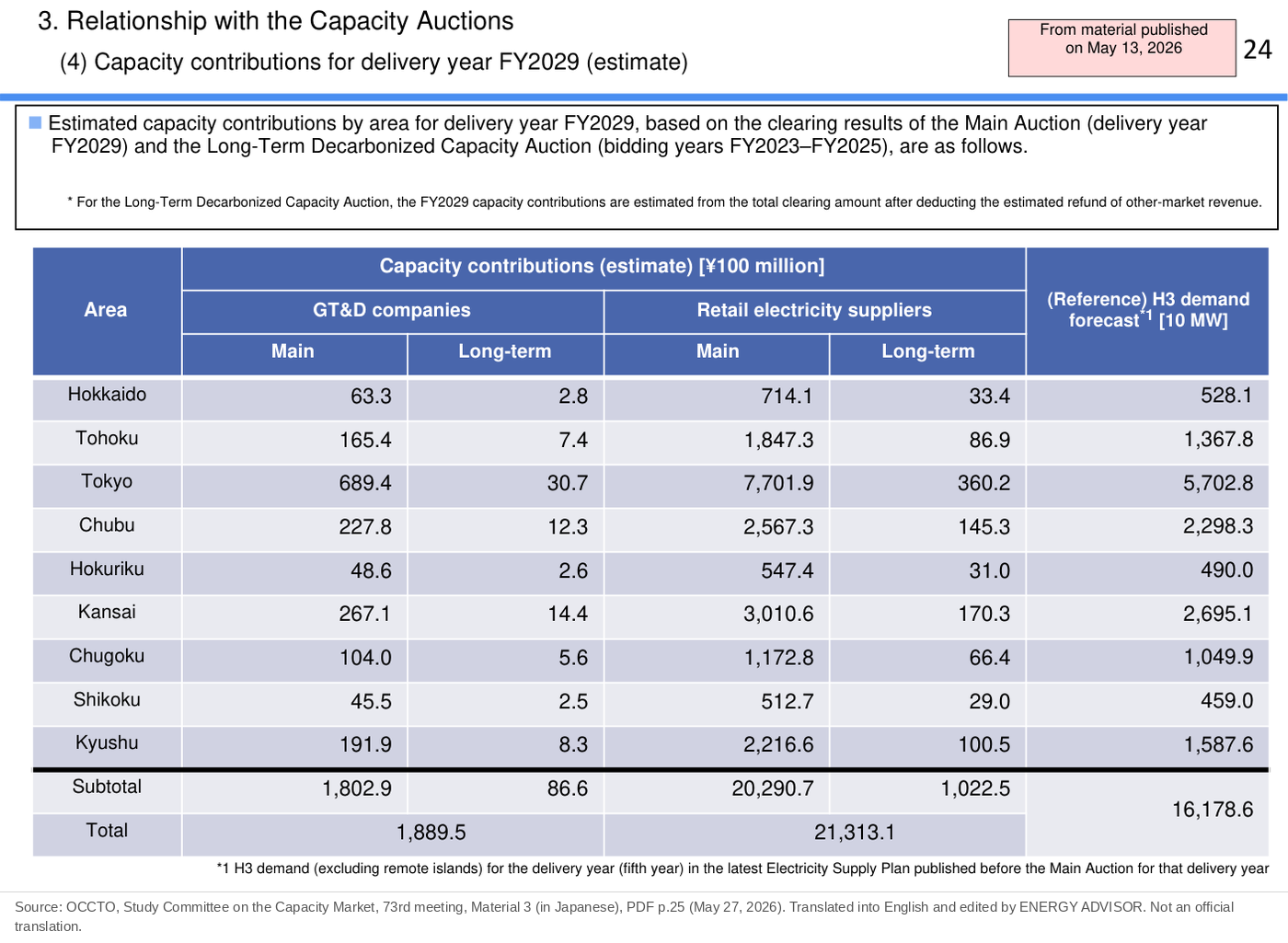
Because clearing prices differ by area, the burden differs by area even for the same H3 demand.
Transitional Measures and Their Phase-Down
The transitional measures have shrunk year by year. For delivery year FY2024, a 42% deduction rate was applied to the capacity payments for resources built by the end of FY2010. From FY2025, the mechanism changed. The deduction rate by age is 6.0% for FY2026, 4.5% for FY2027, 3.0% for FY2028 and 1.5% for FY2029 (details in the third article of this series).
As the transitional measures shrink, the amount deducted from retail electricity suppliers’ burden falls. The burden on retail electricity suppliers therefore approaches the total clearing amount.
For contracts for delivery year FY2030 onward, the transitional measures are abolished (Study Committee on the Capacity Market, 74th meeting, Material 3, PDF p.7; the chapter on transitional measures is “deleted” in the Main Auction Guidelines (Delivery Year FY2030), PDF p.38). From FY2030, retail electricity suppliers’ burden will be the total clearing amount minus the burden of GT&D companies and others.
Contributions for the Long-Term Decarbonized Capacity Auction
Who pays and from when
Capacity contributions for the Long-Term Decarbonized Capacity Auction are borne by the same companies as for the Main Auction. All retail electricity suppliers, GT&D companies and licensed distribution companies bear them, regardless of whether they have bilateral contracts or other arrangements.
Payments start from FY2027, when the support period (the period of receiving capacity revenue) for resources from the Long-Term Decarbonized Capacity Auction begins. The first auction (bidding year FY2023) covers supply capacity from delivery year FY2027 onward (Long-Term Decarbonized Capacity Auction Clearing Results (Bidding Year FY2024), PDF p.19).
Calculation method
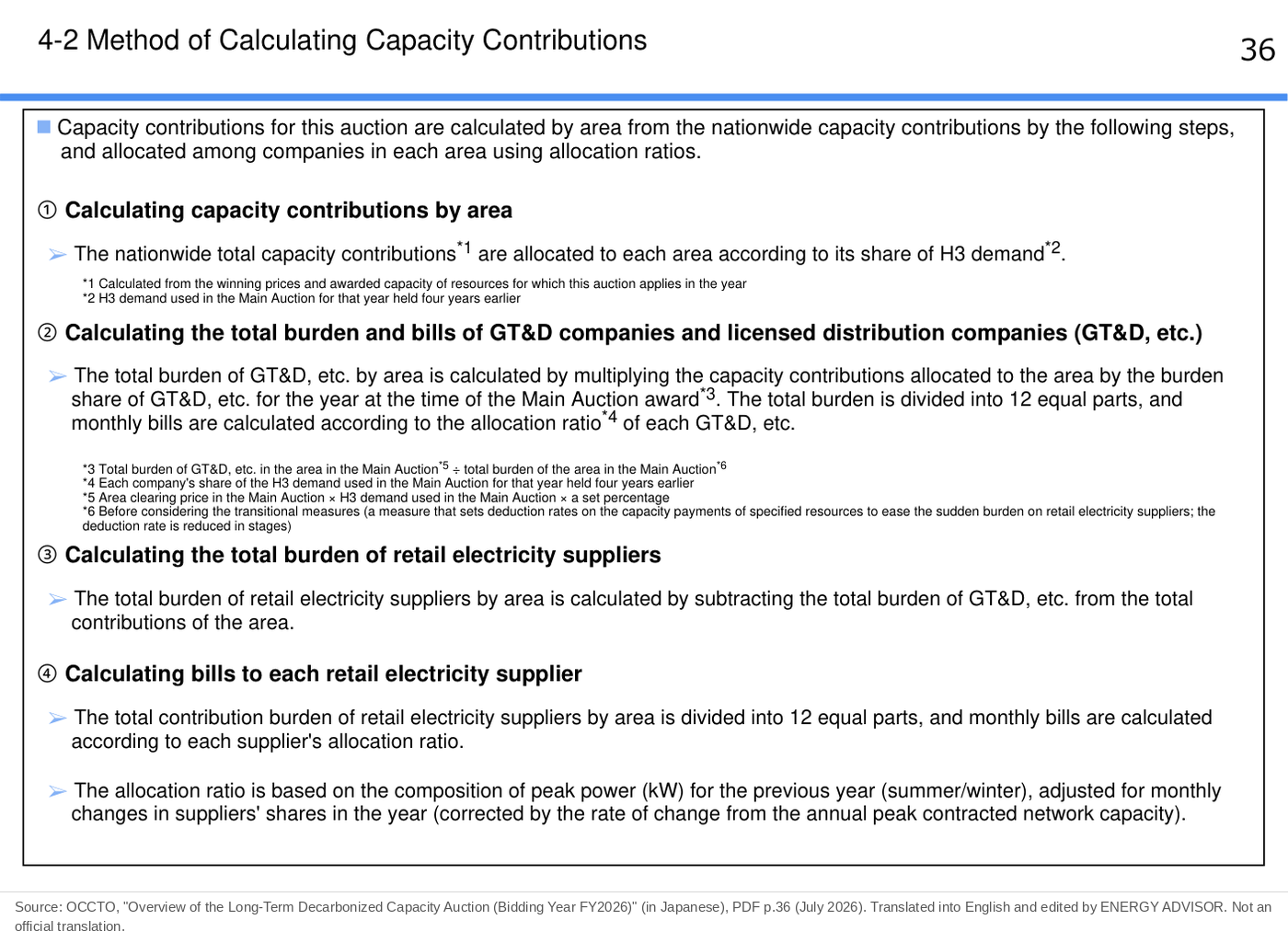
The calculation steps are almost the same as for the Main Auction (Overview of the Long-Term Decarbonized Capacity Auction (Bidding Year FY2026), PDF p.36).
- From the winning prices and winning capacities of the resources whose support period has started in that fiscal year, the nationwide total capacity contributions are calculated and allocated to each area by the ratio of H3 demand by area. The H3 demand is the value used in the Main Auction for that fiscal year.
- The burden of GT&D companies and licensed distribution companies is calculated by multiplying the area’s contributions by “the share borne by GT&D companies and others in the Main Auction.”
- Retail electricity suppliers bear the rest. The calculation steps do not include a deduction under the transitional measures.
- Allocation to each retail electricity supplier uses the same allocation ratios as for the Main Auction. Bills are issued monthly together with those for the Main Auction.
Refund of other-market revenue and return of penalties
In the Long-Term Decarbonized Capacity Auction, winning companies refund about 90% of the revenue they earn in wholesale and other markets (other-market revenue) to OCCTO (ninth article of this series). The refunded amount is returned to retail electricity suppliers and others once in the following fiscal year (same, PDF pp.37–38).
- The part of the refund up to the capacity payment is returned to retail electricity suppliers, GT&D companies and licensed distribution companies.
- The part above the capacity payment is returned only to retail electricity suppliers.
- Financial penalties paid by capacity providers are returned only to retail electricity suppliers.
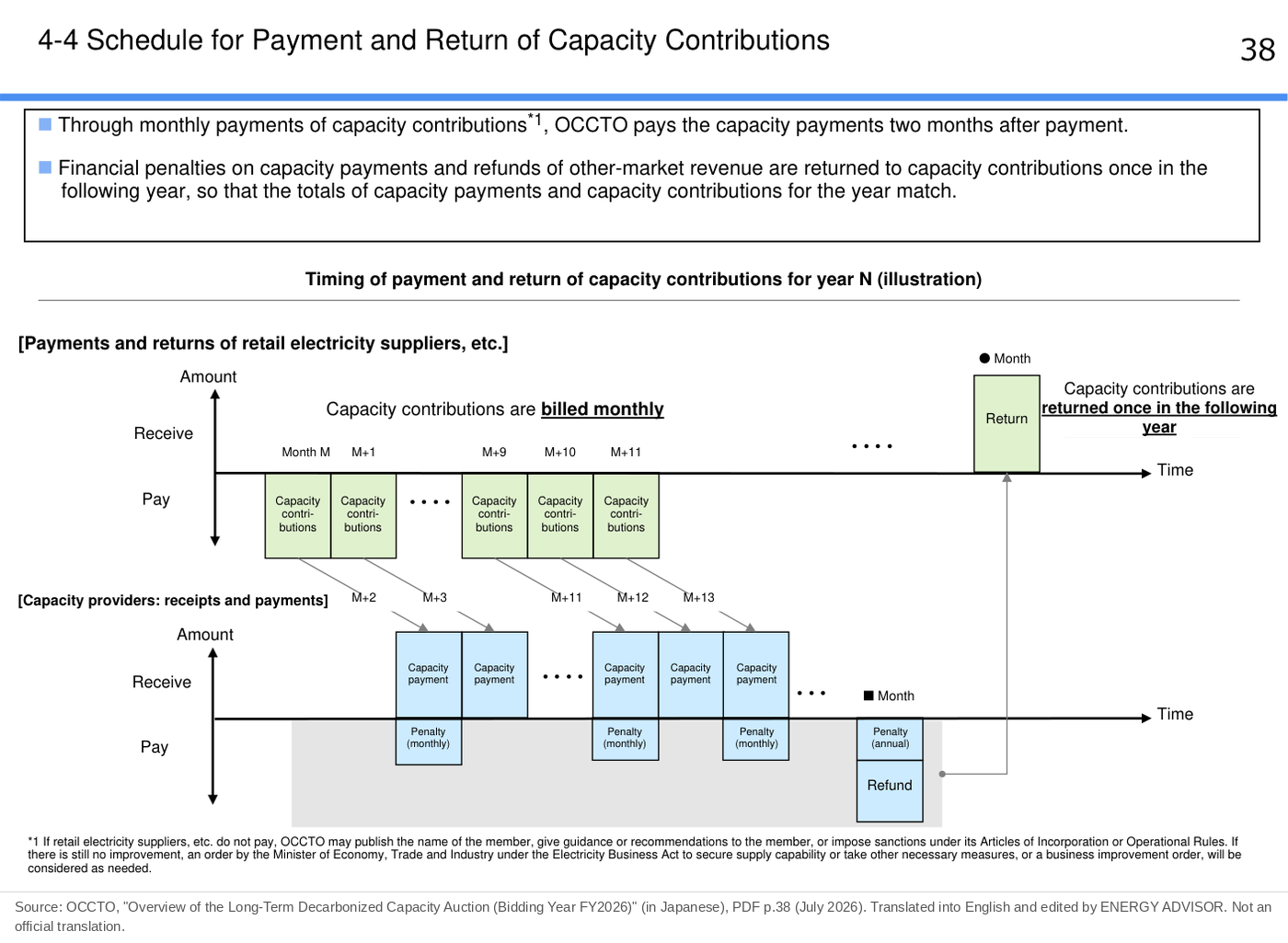
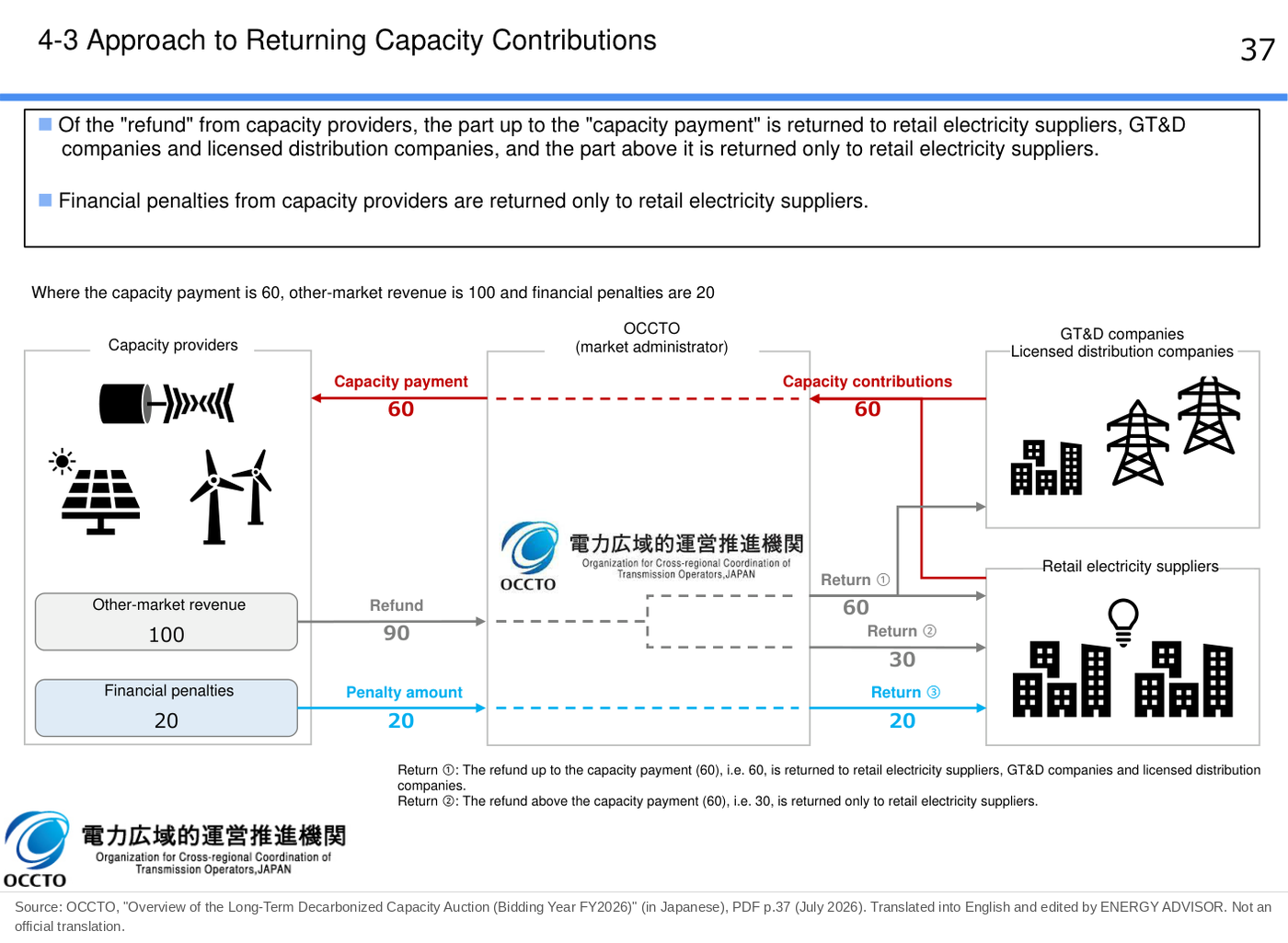
For this reason, the amount that retail electricity suppliers actually bear is close to the contract amount minus the refund.
Estimated amounts
OCCTO has published estimates of capacity contributions after deducting the estimated refund of other-market revenue. The estimates based on the results of the three auctions of bidding years FY2023–FY2025 are as follows.
| Delivery year | GT&D companies (Long-Term) | Retail electricity suppliers (Long-Term) | Total |
|---|---|---|---|
| FY2027 | ¥4.03 billion | ¥48.59 billion | ¥52.62 billion |
| FY2028 | ¥7.82 billion | ¥93.22 billion | ¥101.04 billion |
| FY2029 | ¥8.66 billion | ¥102.25 billion | ¥110.91 billion |
(Source: 73rd meeting of the study committee, Material 3, PDF pp.23–25. The total is the sum of the two values in the table.)
The estimated refund was calculated from prices in the day-ahead market (spot market) and the non-fossil value trading market over the past three years and similar data, and differs from the method of calculating, and the amount of, actual refunds. In addition, battery storage, pumped storage and long-duration energy storage are not included in the refund estimate, because their variable costs and capacity factors are not published (same, PDF p.14).
Relationship with Retail Electricity Suppliers’ Obligation to Secure Supply Capability
The legal obligation
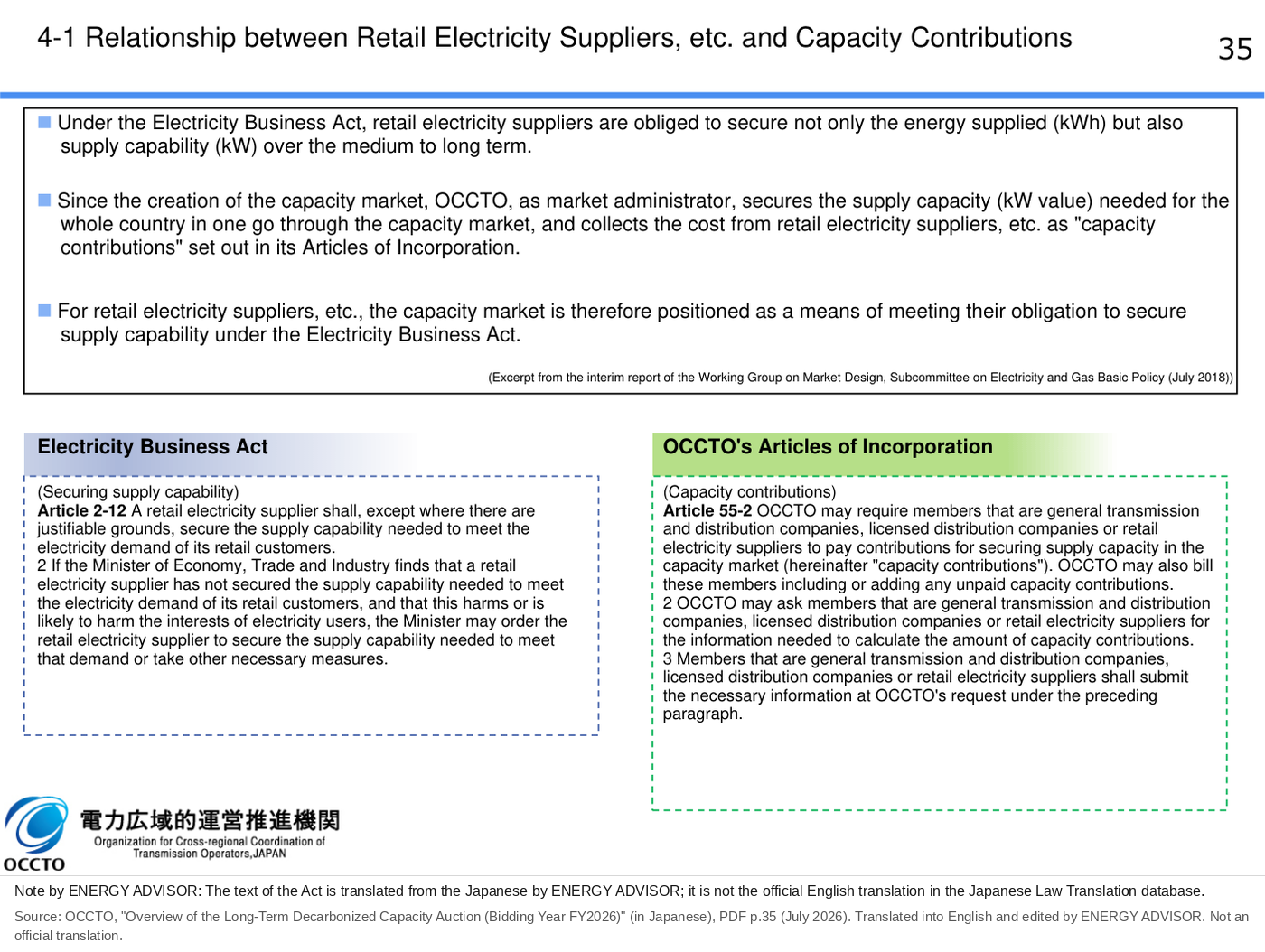
Article 2-12, paragraph 1 of the Electricity Business Act requires retail electricity suppliers to secure supply capability. This is the supply capability needed to meet the demand of their own retail customers. Cases with justifiable grounds are excepted. If the obligation is not met, the Minister of Economy, Trade and Industry can order the supplier to secure supply capability or take other action (paragraph 2 of the same article). This obligation covers not only energy (kWh) but also securing medium- to long-term supply capability (kW).
Since the capacity market was created, OCCTO, as the market administrator, secures the supply capacity (kW) needed nationwide all at once through the capacity market. OCCTO collects the cost from retail electricity suppliers and others as capacity contributions. For retail electricity suppliers, the capacity market is therefore positioned as a means of meeting their obligation to secure supply capability.
Before and after the capacity market
The role of retail electricity suppliers in securing supply capacity before and after the introduction of the capacity market was organized as follows. This was set out in the Subcommittee on Electricity and Gas Basic Policy’s “New Challenges for the Future Electricity System: Interim Report” (February 2022).
| Item | Through FY2023 (FY2021–FY2023) | From FY2024 |
|---|---|---|
| Content of the obligation to secure supply capability | In principle, the retail electricity supplier meets the obligation by securing kWh itself | The obligation to pay capacity contributions to the capacity market (a monetary payment obligation) |
| Cases treated as “justifiable grounds” | When all four conditions below are met (safe harbor) | ― |
| Obligation of planned-value balancing | Same as the four conditions to the left | Same, but without the condition “when the cross-regional reserve margin exceeds 3%” |
(Source: same interim report, pp.13 and 17)
The four conditions through FY2023 are as follows.
- The supply-demand balance is not tight (the cross-regional reserve margin exceeds 3%)
- An imbalance (difference between schedule and actual) occurred because sell bids were exhausted even though the supplier bid on the day-ahead market
- No trade was concluded even though the supplier tried to procure reasonably on the day-ahead and intraday markets
- The retail electricity supplier pays the imbalance price after the fact
The original article raised the following points as the author’s view. They are not supported by primary sources.
- Through FY2023, even when the day-ahead market was close to sell bids being exhausted, retail electricity suppliers had to place buy bids at high prices to meet the obligation. This was one of the factors that pushed market prices even higher.
- “Justifiable grounds” required accurately predicting when sell bids would be exhausted, and there was no concrete benchmark for a “remarkably low price,” so in practice it was hard to use.
- Now that the content of the obligation has changed to paying capacity contributions, buy-bid prices are less likely to be driven up when sell bids are exhausted.
The planned-value balancing obligation that remains from FY2024
Even after the capacity market was introduced, under the planned-value balancing system based on the network service terms and conditions, retail electricity suppliers continue to be obliged to secure supply capacity matching a reasonably forecast demand schedule. Planned-value balancing is the system in which, in every 30-minute period, the demand schedule and the procurement schedule must match, and the difference from actual results is settled as an imbalance.
The network service terms and conditions include provisions on cancellation of the connection supply contract. They provide that the GT&D company may cancel the contract if large imbalances occur frequently (for example, TEPCO Power Grid, Network Service Terms and Conditions, 54 Cancellation, etc.). Article 179 of OCCTO’s Operational Rules (the rules that set out how OCCTO carries out its work) also has a provision. If a retail electricity supplier is not expected to secure adequate supply capacity in light of past results and other factors, OCCTO gives guidance and recommendations. In that case, it publishes the company’s name and the reasons.
If a retail electricity supplier does not pay its capacity contributions, OCCTO publishes its name and gives guidance, recommendations and sanctions under its Articles of Incorporation and Operational Rules. If the situation still does not improve, an order from the Minister of Economy, Trade and Industry under the Electricity Business Act or other action is considered (Overview of the Long-Term Decarbonized Capacity Auction (Bidding Year FY2026), PDF p.38).
Summary
- Capacity contributions are paid to OCCTO by retail electricity suppliers, GT&D companies and licensed distribution companies, and fund capacity payments. Billing began in July 2024.
- The total for each area is allocated by the ratio of H3 demand. The burden of GT&D companies and others is “clearing price × H3 demand × 6% (FY2024) or 8% (FY2025 onward).” Retail electricity suppliers bear the rest minus the deduction under the transitional measures.
- The total clearing amount of the Main Auction, which is the basis of the totals, has grown from ¥514.0 billion for delivery year FY2025 to ¥2.2094 trillion for FY2029. The transitional measures shrink year by year and are abolished from delivery year FY2030.
- Contributions for the Long-Term Decarbonized Capacity Auction are added from FY2027. Estimates after deducting the estimated refund of other-market revenue are ¥52.62 billion for FY2027 and ¥110.91 billion for FY2029.
- From FY2024, retail electricity suppliers’ obligation to secure supply capability has become an obligation to pay capacity contributions. The planned-value balancing obligation continues.
This article is based on published materials from the Ministry of Economy, Trade and Industry and its Agency for Natural Resources and Energy, the Electricity and Gas Market Surveillance Commission, the Organization for Cross-regional Coordination of Transmission Operators (OCCTO) and other sources. The English translations of figures are by ENERGY ADVISOR and are not official translations. When using this information for decisions, please check the original sources. When we find an error, we correct the article and note the date of the correction.
Sources
- OCCTO, “Capacity Contribution Briefing” (briefing material) (in Japanese), PDF p.15 (timing of the annual true-up), p.19 (start of billing in July 2024), p.33 (6% and 8%), September 2023. https://www.occto.or.jp/assets/market-board/market/oshirase/2023/files/231010_setsumeikai2_youryoukyoshutsukin.pdf
- OCCTO, “Capacity Market Operations Manual: Capacity Contributions (Delivery Year FY2026) (Draft)” (in Japanese), October 2025 (public consultation version). https://www.occto.or.jp/assets/iken/2025/files/251008_youryou_gyoumumanual_youryoukyoshutsukin.pdf
- OCCTO, “Capacity Market Main Auction Clearing Results (Delivery Year FY2029)” (in Japanese), PDF p.11 (estimated capacity contributions and basis for 8%), January 20, 2026. https://www.occto.or.jp/assets/news/capacity-market/260120_mainauction_youryouyakujokekka_kouhyou_jitsujukyu2029.pdf
- OCCTO Board of Directors, 466th meeting, Agenda Item 5, “Publication of the Capacity Market Incremental Auction Clearing Results (Delivery Year FY2025)” (in Japanese), PDF p.13, July 10, 2024. https://www.occto.or.jp/assets/soukaihoka/rijikai/2024/files/rijikai_466_gian5.pdf
- Study Committee on the Capacity Market, 35th meeting, Material 3-2, “About the Capacity Market” (in Japanese), PDF p.5 (revision of the GT&D companies’ share from 6% to 7%), December 22, 2021. https://www.occto.or.jp/assets/iinkai/youryou/kentoukai/2021/files/youryou_kentoukai_35_03_2.pdf
- Study Committee on the Capacity Market, 74th meeting, Material 3 (in Japanese), PDF p.7 (abolition of the transitional measures), June 30, 2026. https://www.occto.or.jp/assets/iinkai/youryou_kentoukai/74/youryou_kentoukai_74_03.pdf
- OCCTO, “Capacity Market Main Auction Guidelines (Delivery Year FY2030)” (in Japanese), PDF p.38, July 30, 2026. https://www.occto.or.jp/assets/market-board/market/jitsujukyukanren/260730_mainauction_boshuyoukou_jitsujukyu2030.pdf
- Study Committee on the Capacity Market, 73rd meeting, Material 3, “Long-Term Decarbonized Capacity Auction Clearing Results (Bidding Year FY2025) and Toward the Next Auction” (in Japanese), PDF p.14, pp.23–25, May 27, 2026. https://www.occto.or.jp/assets/iinkai/youryou_kentoukai/73/youryou_kentoukai_73_03.pdf
- OCCTO, “Capacity Market Long-Term Decarbonized Capacity Auction Clearing Results (Bidding Year FY2024)” (Board of Directors, 509th meeting, Agenda Item 5) (in Japanese), PDF p.19, April 28, 2025. https://www.occto.or.jp/assets/soukaihoka/rijikai/2025/files/rijikai_509_gian5.pdf
- OCCTO, “Overview of the Long-Term Decarbonized Capacity Auction (Bidding Year FY2026)” (in Japanese), PDF pp.35–38, July 2026. https://www.occto.or.jp/assets/various/capacity-market/youryou_setsumeikai/202607_youryou_gaiyousetsumei_long-r.pdf
- Advisory Committee for Natural Resources and Energy, Electricity and Gas Industry Committee, Subcommittee on Electricity and Gas Basic Policy, “New Challenges for the Future Electricity System: Interim Report” (in Japanese), pp.13 and 17, February 2022. https://www.meti.go.jp/shingikai/enecho/denryoku_gas/denryoku_gas/pdf/045_s01_00.pdf (the draft is Material 5-2 of the 43rd meeting of the same subcommittee (December 27, 2021): https://www.meti.go.jp/shingikai/enecho/denryoku_gas/denryoku_gas/pdf/043_05_02.pdf)
- Sources of the third article of this series (clearing results for each year)
- OCCTO, “Details of the Long-Term Decarbonized Capacity Auction (Bidding Year FY2023)” (in Japanese), September 2023 (source of figures in original article 964). https://www.occto.or.jp/assets/market-board/market/files/202309_youryou_syousaisetsumei_long.pdf
- OCCTO, “Capacity Contributions (Delivery Year FY2024) Annual True-Up: Calculation Method and Explanatory Material for Companies” (in Japanese), PDF pp.2–3, November 28, 2025. https://www.occto.or.jp/assets/20251128_2024nenjiseisan_setsumeishiryou.pdf
- OCCTO, “About the Capacity Market Main Auction” (briefing material) (in Japanese), PDF p.91 (overall picture of capacity contributions), pp.94–96 (billing, payment and annual true-up), pp.99–107 (method of calculating billed amounts), July 2026. https://www.occto.or.jp/www.occto.or.jp/news/20260708_youryou_seidosetsumei.pdf
- OCCTO, “Capacity Contribution Briefing” (briefing material) (in Japanese), PDF p.8, p.12, pp.33–37, December 2023 (source of figures in original article 850). https://www.occto.or.jp/assets/market-board/market/oshirase/2023/files/202318_youryou_jitsujukyu_setsumeikai_youryoukyoshutsukin.pdf
- OCCTO, “Details of the Long-Term Decarbonized Capacity Auction (Bidding Year FY2023)” (briefing material) (in Japanese), PDF pp.88–89, p.91, p.97, p.103, September 2023 (source of figures in original article 964). https://www.occto.or.jp/assets/market-board/market/files/202309_youryou_syousaisetsumei_long.pdf