The Long-Term Decarbonized Capacity Auction is one of the auctions that make up the capacity market. For new investment in decarbonized power sources and similar resources, it promises capacity revenue at the level of fixed costs, in principle for 20 years. This article explains how it differs from the Main Auction, which resources are eligible and on what conditions, and how procurement targets are set, and summarizes the results of the three rounds so far and the changes for FY2026 (April 2026–March 2027; the fourth round). The background of the scheme is explained in the seventh article of this series, and prices and revenue in the ninth.
Position of the Long-Term Decarbonized Capacity Auction
Composition of the capacity market
The capacity market is a scheme in which OCCTO holds auctions to secure, all at once, the supply capacity that will be needed nationwide in the future. The capacity market consists of the following auctions (Overview of the Long-Term Decarbonized Capacity Auction (Bidding Year FY2026), PDF p.10).
| Auction | Description |
|---|---|
| Main Auction | Secures supply capacity for one year, four years before the delivery year |
| Incremental Auction | Held one year before the delivery year if judged necessary after the Main Auction |
| Long-Term Decarbonized Capacity Auction (created in FY2023) | Promises long-term fixed revenue for huge generation investments for decarbonization, such as new build and repowering |
| Special auction | Held when it has become clear that maintaining stable supply will be difficult, and in similar cases |
Single-year auctions alone do not give a long-term revenue outlook. Because of concern that generation investment would fall, the Long-Term Decarbonized Capacity Auction was newly created in FY2023.
Differences from the Main Auction
| Item | Main Auction | Long-Term Decarbonized Capacity Auction |
|---|---|---|
| Purpose | Secure the supply capacity needed for one future year | Encourage new generation investment (including repowering and retrofits) and secure supply capacity from decarbonized power sources over the long term |
| Eligibility for participation registration | Electricity suppliers that intend to bid using their own or others’ resources | Domestic corporations that intend to bid using resources they themselves maintain and operate |
| Eligible resources | Resources that can provide supply capacity in the delivery year, etc. | New build and repowering of decarbonized power sources, retrofits of existing thermal plants for decarbonization, and new build and repowering of LNG-only thermal plants |
| Eligible capacity | 1,000 kW or more (expected capacity) | 30–100 MW or more depending on the resource type (installed capacity at the sending end) |
| Clearing method | Single price | Pay-as-bid (multi-price) |
| Period of providing supply capacity | Single year | In principle 20 years (up to 40 years depending on the resource type) |
| Company revenue | Capacity payment | Capacity payment − refund after the fact |
| Subject of monitoring | Withholding and price manipulation by companies with market power | Bid prices and other-market revenue |
(Source: same, PDF p.48)
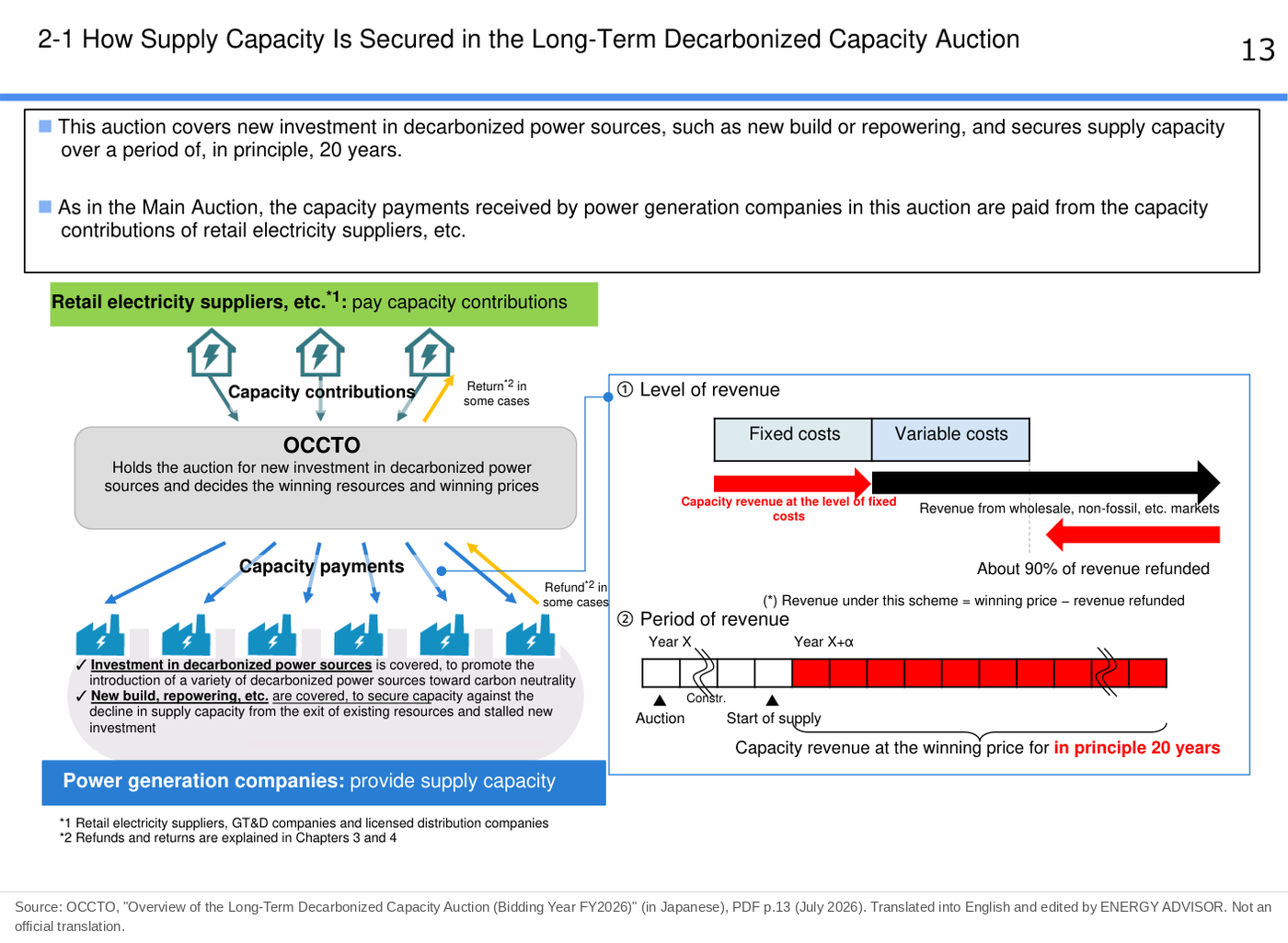
The Long-Term Decarbonized Capacity Auction has its own requirements not found in the Main Auction (such as meeting the commissioning deadline and the co-firing ratio of decarbonized fuel). Winners must also refund to OCCTO about 90% of the revenue they earn in wholesale and other markets (same, PDF pp.28 and 30).
Flow of money
The capacity payments received by winning power generation companies are funded by capacity contributions paid by retail electricity suppliers and others. The mechanism is explained in the sixth article of this series.
Why pay-as-bid pricing is used
In the Long-Term Decarbonized Capacity Auction, power generation companies and others bid, for each bidding unit, a bid volume and a bid price (¥/kW-year). In principle, mixed resource types are awarded in order of lowest bid price, and resources up to the point where the procurement target is met are the winners. Under pay-as-bid (multi-price) pricing, the bid price of each winning resource becomes its clearing price (same, PDF p.14).
For a resource that straddles the procurement target: if the amount by which an award would exceed the target is no more than 10 times the shortfall that would result from not awarding it, it is awarded; if more than 10 times, it is not awarded.
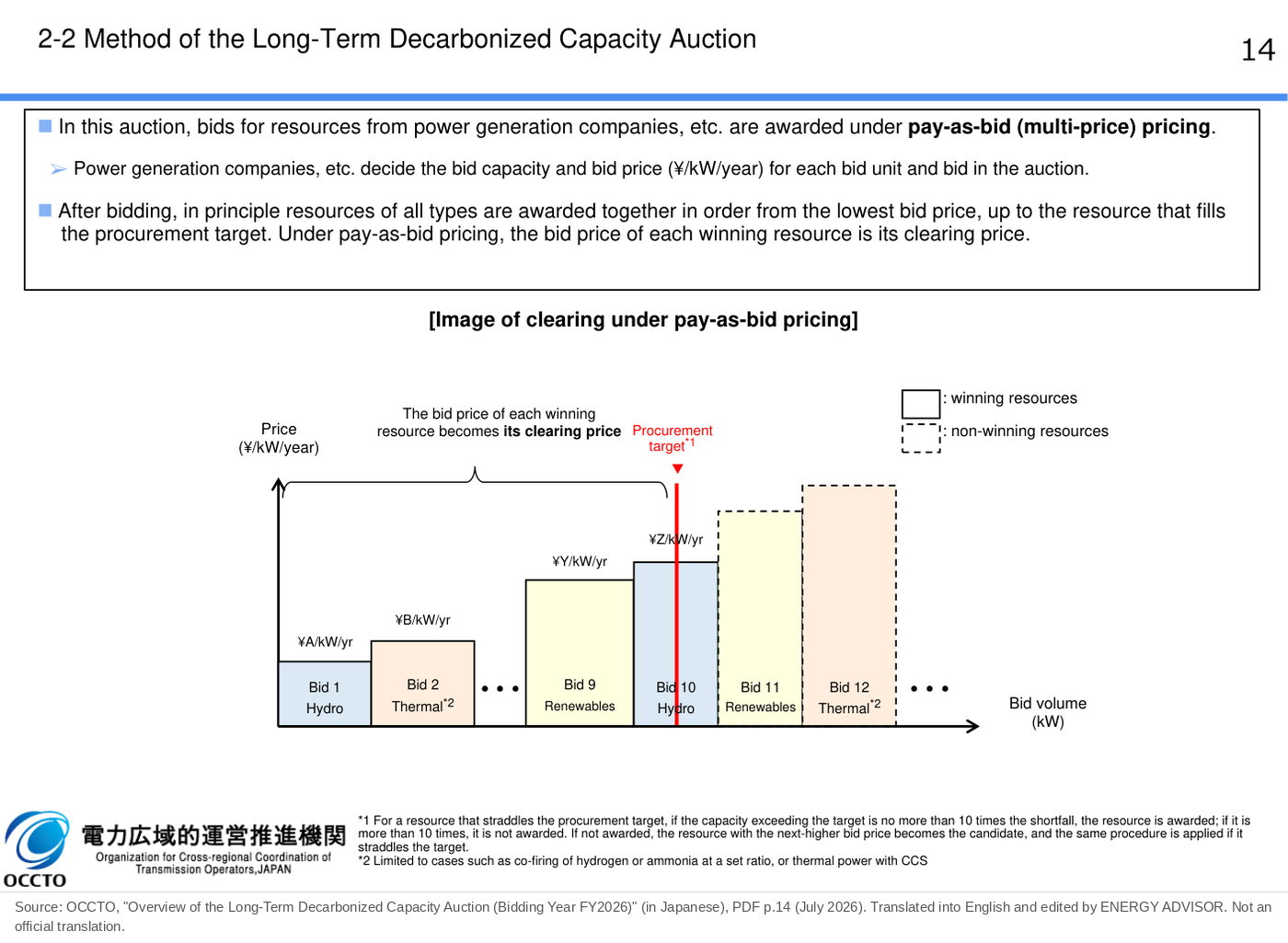
Many resource types bid in this auction. Its purpose is to give a long-term revenue outlook for initial investment. Pay-as-bid pricing, in which companies bid at the price needed to recover their investment and that price becomes the winning price, was therefore judged appropriate (as organized in original article 958).
Delivery period of supply capacity
The Main Auction covers a single year four years ahead, and the Incremental Auction a single year one year ahead, as the delivery period.
Because the Long-Term Decarbonized Capacity Auction covers new build, repowering and retrofits, a commissioning deadline is set for each resource type, reflecting the time needed for construction. The fiscal year in which supply begins differs by winning project. From the fiscal year after the one in which supply begins, the support period (the period of receiving capacity revenue), in principle 20 years, begins (Long-Term Decarbonized Capacity Auction Guidelines (Bidding Year FY2026), PDF p.10).
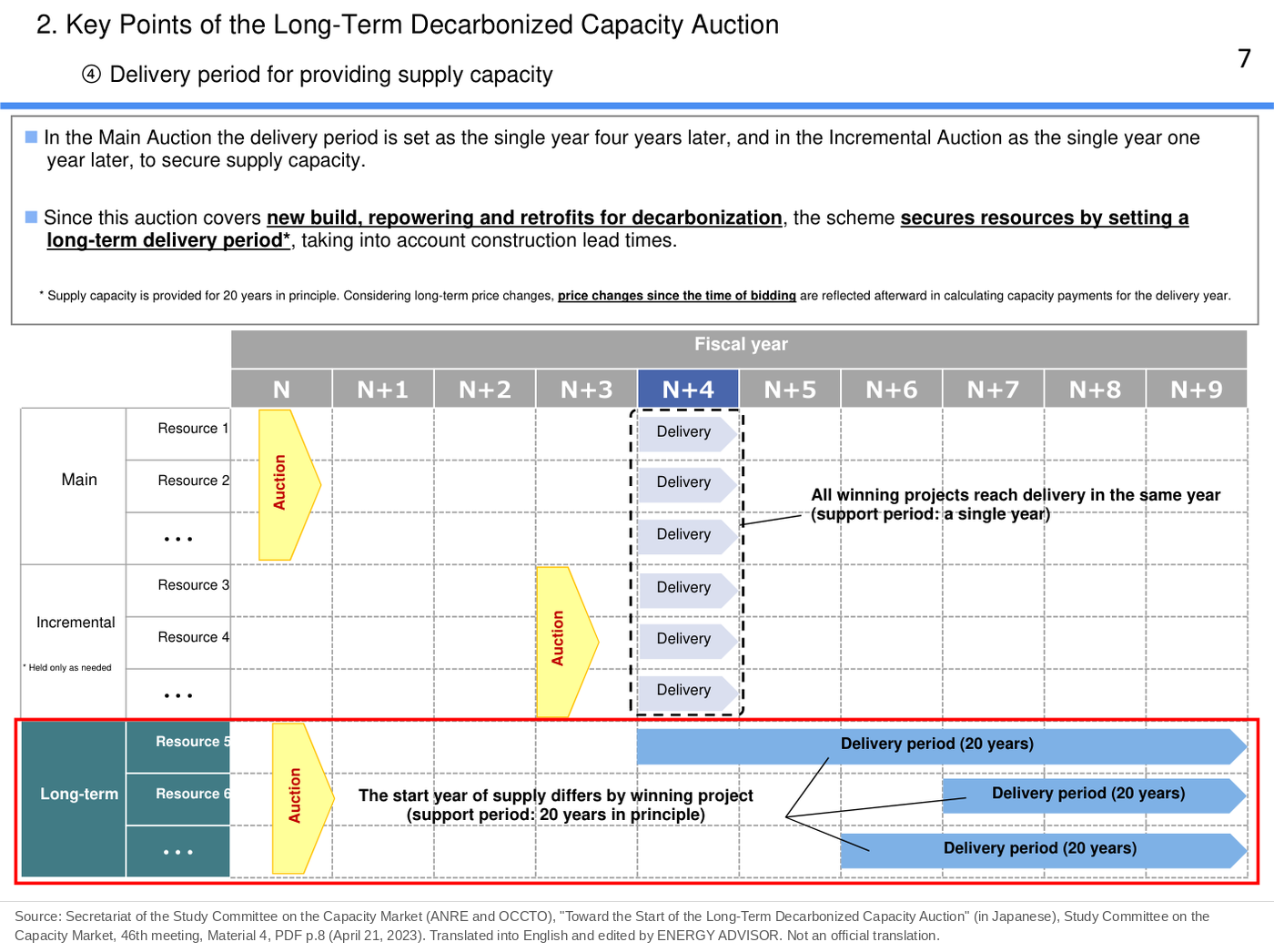
When the procurement volume needed four years ahead is set in the Main Auction, resources already secured in the Long-Term Decarbonized Capacity Auction are deducted. In the Main Auction for delivery year FY2029, about 3,430 MW was deducted (Capacity Market Main Auction Clearing Results (Delivery Year FY2029), PDF p.41).
Eligible Resources and Conditions (FY2026)
Eligible resources
The following three types of new investment are eligible (Overview of the Long-Term Decarbonized Capacity Auction (Bidding Year FY2026), PDF p.20).
- New build and repowering of decarbonized power sources: all power plants, including solar and wind, and battery storage are eligible. Thermal plants (coal, LNG, oil) without measures to prevent CO2 emissions are excluded. Resources receiving support under the FIT or FIP scheme are also excluded. FIP (the Feed-in Premium (FIP) scheme) is a support scheme for renewables that pays a set premium on top of the market price.
- Retrofits of existing thermal plants that contribute to decarbonization: the newly decarbonized kW are eligible. For co-firing, the whole plant must be decarbonized in the future.
- New build and repowering of LNG-only thermal plants on the premise of future decarbonization: the condition is that measures toward decarbonization begin within 10 years after supply begins. Decarbonization by 2050 is also a condition.
Minimum capacity by resource type (FY2026)
This and the next section refer to procedures under two laws. The Act on Promoting the Utilization of Sea Areas for the Development of Marine Renewable Energy Power Generation Facilities (the “Marine Renewable Energy Act”) is the law for selecting offshore wind developers through public tenders in general sea areas designated by the government. An environmental impact assessment is the procedure for examining and publishing the environmental impact before building a large power plant. Long-duration energy storage (LDES) in the table refers to facilities, other than battery storage and pumped storage, that store electricity from the grid and return it.
| Resource type | Eligible | Eligible installed capacity (sending end) | Category |
|---|---|---|---|
| Solar | New build and repowering | 100 MW or more | Variable resources |
| Wind (onshore and offshore) | New build and repowering | 100 MW or more | Variable resources |
| Battery storage | New build and repowering | 30 MW or more (able to operate at least once a day for 6 hours or more continuously) | Stable resources |
| Long-duration energy storage | New build and repowering | 30 MW or more (same as above) | Stable resources |
| Pumped storage | New build, repowering and major refurbishment of existing plants | 30 MW or more (same as above) | Stable resources |
| Conventional hydropower (reservoir and regulating pondage types) | New build and repowering | 30 MW or more | Stable resources |
| Conventional hydropower (run-of-river) | New build and repowering | 30 MW or more | Variable resources |
| Geothermal | New build and repowering | 100 MW or more | Stable resources |
| Nuclear | New build, repowering and safety upgrades of existing plants | 100 MW or more | Stable resources |
| Hydrogen (dedicated and co-firing) | New build and repowering / retrofit | 100 MW or more (new build and repowering), 50 MW or more (retrofit) | Stable resources |
| Ammonia (dedicated and co-firing) | New build and repowering (dedicated) / retrofit | 100 MW or more (new build and repowering), 50 MW or more (retrofit) | Stable resources |
| Thermal power with CCS | Retrofit | 50 MW or more | Stable resources |
| Dedicated biomass | New build and repowering / retrofit | 100 MW or more | Stable resources |
| LNG-only thermal plants | New build and repowering | 100 MW or more | Stable resources |
(Sources: same, PDF p.21; Long-Term Decarbonized Capacity Auction Guidelines (Bidding Year FY2026), PDF pp.11–13, September 2, 2026)
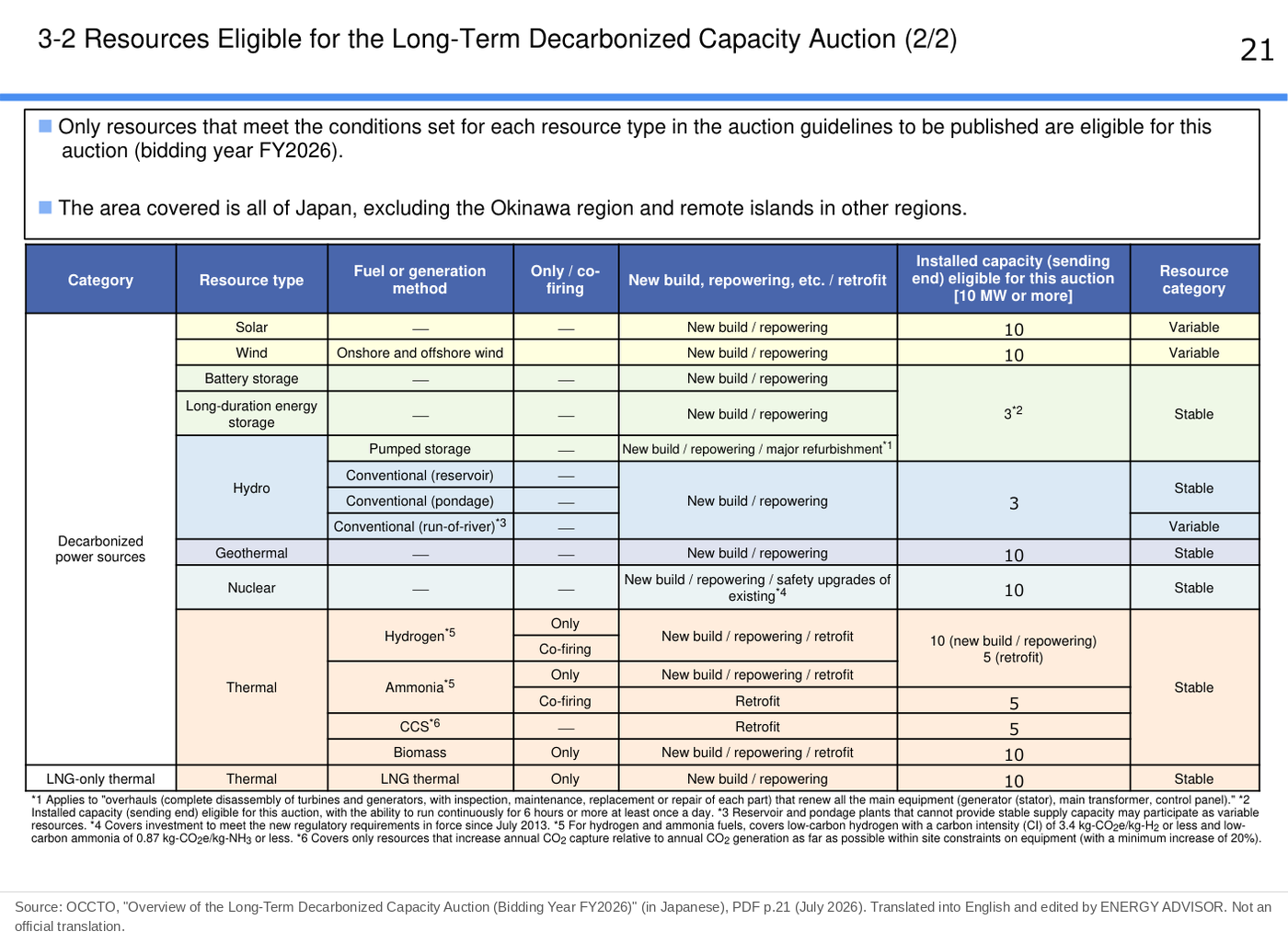
The main conditions are as follows.
- Long-duration energy storage (LDES) is a facility that receives electricity from the grid, stores the energy and sends it back to the grid. Battery storage and pumped storage are excluded; mechanical, thermal and chemical types qualify.
- The condition is co-firing of 10% or more hydrogen, or 20% or more ammonia, with LNG on a heat basis. From FY2026, eligibility is limited to fuels whose CO2 emissions during production are below a set level: “low-carbon hydrogen” at 3.4 kg-CO2e/kg-H2 or less and “low-carbon ammonia” at 0.87 kg-CO2e/kg-NH3 or less.
- For retrofits to thermal power with CCS (thermal plants fitted with facilities that capture CO2 and store it underground), conditions include increasing the annual CO2 capture rate by 20% or more. The following resources are covered by the scheme but not eligible in the FY2026 auction: new build and repowering of thermal power with CCS, new build of LNG-fired plants premised on ammonia co-firing, and power plants using synthetic methane as fuel.
- Offshore wind is now eligible, but only for “zero-premium offshore wind projects.” These are projects from the second and third rounds of public tenders under the Marine Renewable Energy Act that have changed their supply price to ¥0/kWh and do not receive the FIP premium.
- New thermal plants, pumped storage, battery storage and LDES must have balancing functions (GF, LFC and EDC: functions that respond automatically to frequency changes and functions that change output on instructions from the general transmission and distribution company) and maintain them throughout the support period. The control line must, in principle, be a dedicated communication line.
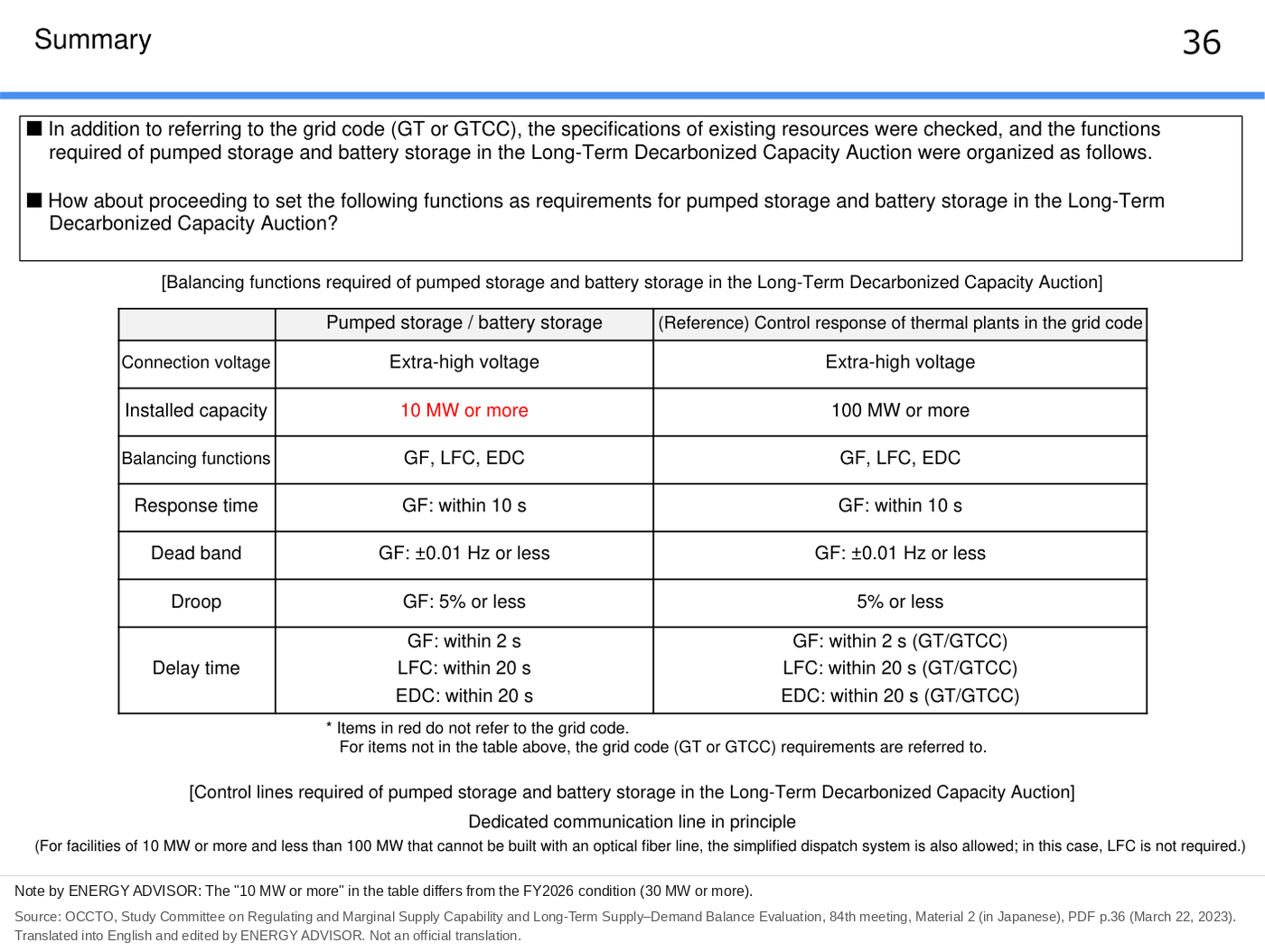
In the original article (FY2023), the condition for battery storage and pumped storage was “installed capacity of 10 MW or more, able to operate at least once a day for 3 hours or more.” For FY2026, it has changed to “30 MW or more, 6 hours or more continuously.”
Commissioning deadlines
For each resource type, there is a commissioning deadline counted from the date of contract conclusion (Overview of the Long-Term Decarbonized Capacity Auction (Bidding Year FY2026), PDF p.29).
| Resource type | Commissioning deadline (if the environmental impact assessment has been completed) |
|---|---|
| Solar | End of the fiscal year 5 years later (3 years) |
| Wind and geothermal | End of the fiscal year 8 years later (4 years) |
| Hydropower (including pumped storage) | End of the fiscal year 12 years later (8 years) |
| Thermal power using hydrogen, ammonia, biomass or CCS (including retrofits) | End of the fiscal year 11 years later (7 years) |
| Nuclear | End of the fiscal year 17 years later (12 years) |
| Battery storage | End of the fiscal year 4 years later |
| Long-duration energy storage | End of the fiscal year 7 years later (4 years in FY2025) |
| LNG-only thermal plants | End of the fiscal year 11 years later (7 years) (8 years in FY2024–FY2025; 6 years in FY2023) |
Approach to Procurement Targets and Changes by Round
Approach to procurement targets
The approach to procurement targets was set out in the Working Group on Market Design’s 8th Interim Report (October 2022).
Achieving carbon neutrality in 2050 requires replacing about 70% of fossil-fuel power sources with decarbonized power sources (this depends on the results of energy saving and electrification). Existing decarbonized power sources also need to be repowered. Because building power plants takes a certain amount of time, about 20 years remain for investment decisions. If about 120 GW of fossil-fuel power sources were all replaced with decarbonized power sources, an average of about 6,000 MW would need to be introduced each year.
However, it was decided that procurement targets in the early stage would basically follow a “small start.” There were three reasons. This scheme is not the only means of introducing decarbonized power sources. Innovation may allow more efficient introduction. And soliciting the average volume from the start could weaken competition and increase the burden on the public (Overview of the Long-Term Decarbonized Capacity Auction (Bidding Year FY2026), PDF p.15).
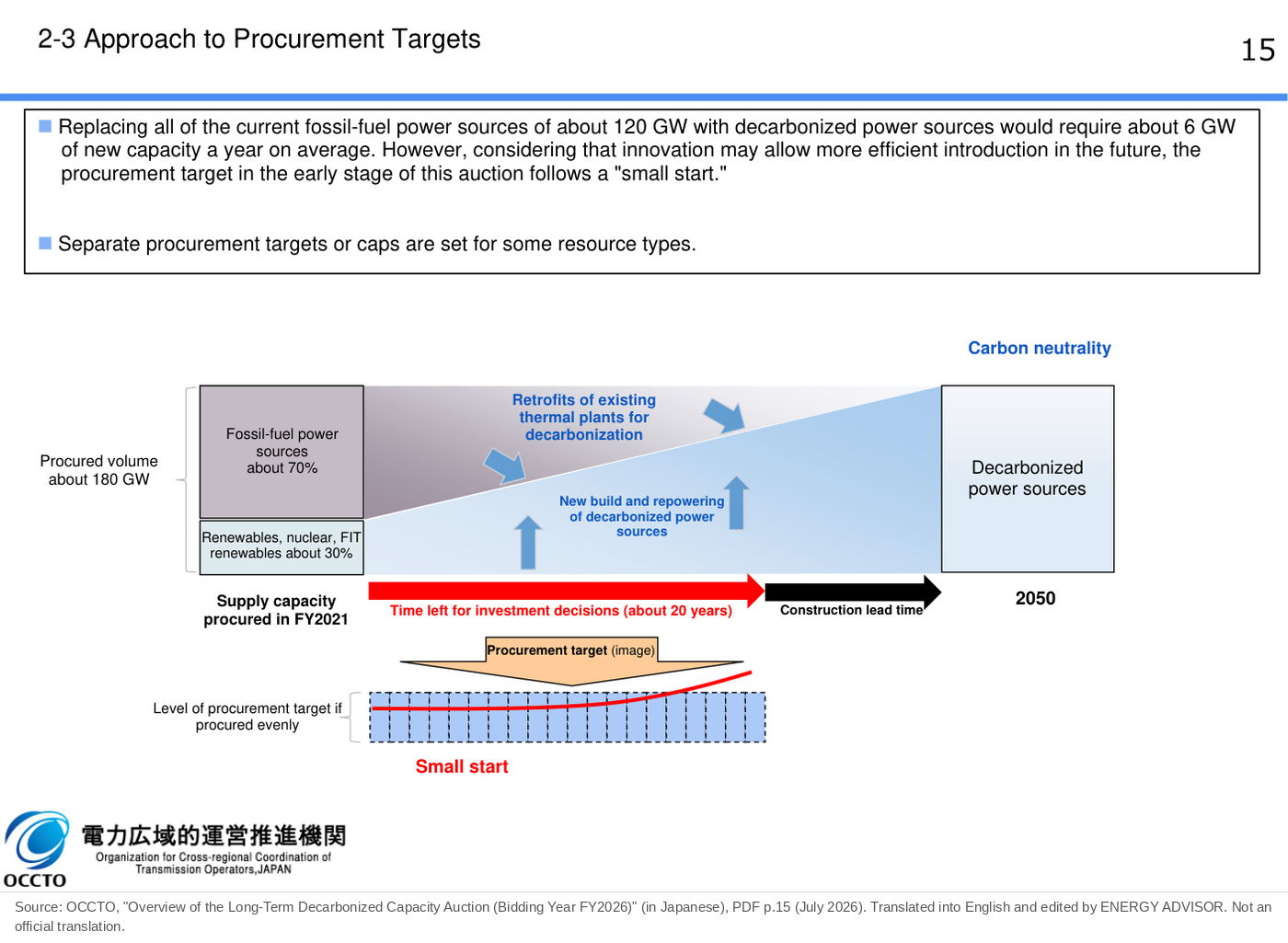
The procurement target for new build and repowering of LNG-only thermal plants was set at 6,000 MW in total over the three years of FY2023–FY2025. This value took into account the possibility that the supply capacity of thermal power would fall by about 9,000 MW by 2030 (Working Group on Market Design, 93rd meeting, Material 3, “About the Long-Term Decarbonized Capacity Auction”, pp.12–13, May 27, 2024; ANRE).
Procurement targets by round
| Round (bidding year) | Procurement target for decarbonized power sources | Main category caps | Procurement target for LNG-only thermal plants |
|---|---|---|---|
| 1st (FY2023) | 4,000 MW | Battery storage and pumped storage 1,000 MW; retrofits of existing thermal plants 1,000 MW | 6,000 MW (total for the three years FY2023–FY2025) |
| 2nd (FY2024) | 5,000 MW | Retrofits of existing thermal plants 1,000 MW; pumped storage and battery storage (3–6 hours of continuous operation) 750 MW; pumped storage and battery storage (6 hours or more) 750 MW; safety upgrades of existing nuclear plants 2,000 MW | About 2,244 MW |
| 3rd (FY2025) | 5,000 MW | Decarbonized thermal power 500 MW; pumped storage (other than new build) and lithium-ion battery storage 400 MW; pumped storage (new build), other battery storage and LDES 400 MW; safety upgrades of existing nuclear plants 1,500 MW | About 2,929 MW |
| 4th (FY2026) | 5,000 MW | Decarbonized thermal power 500 MW; lithium-ion battery storage 400 MW; other battery storage 400 MW; pumped storage and LDES combined 400 MW; safety upgrades of existing nuclear plants 1,500 MW; offshore wind 500 MW | 6,000 MW |
(Sources: 1st round clearing results, PDF p.10; 2nd round clearing results, PDF pp.11–12; 73rd meeting of the study committee, Material 3, PDF pp.13–14; FY2026 overview, PDF p.23. The 2nd-round caps are from the Long-Term Decarbonized Capacity Auction Guidelines (Bidding Year FY2024) (OCCTO Board of Directors, 474th meeting, Agenda Item 4, September 4, 2024), PDF p.11, and the 3rd-round caps from the same (Bidding Year FY2025) (Board of Directors, 528th meeting, Agenda Item 2, September 3, 2025), PDF p.11.)
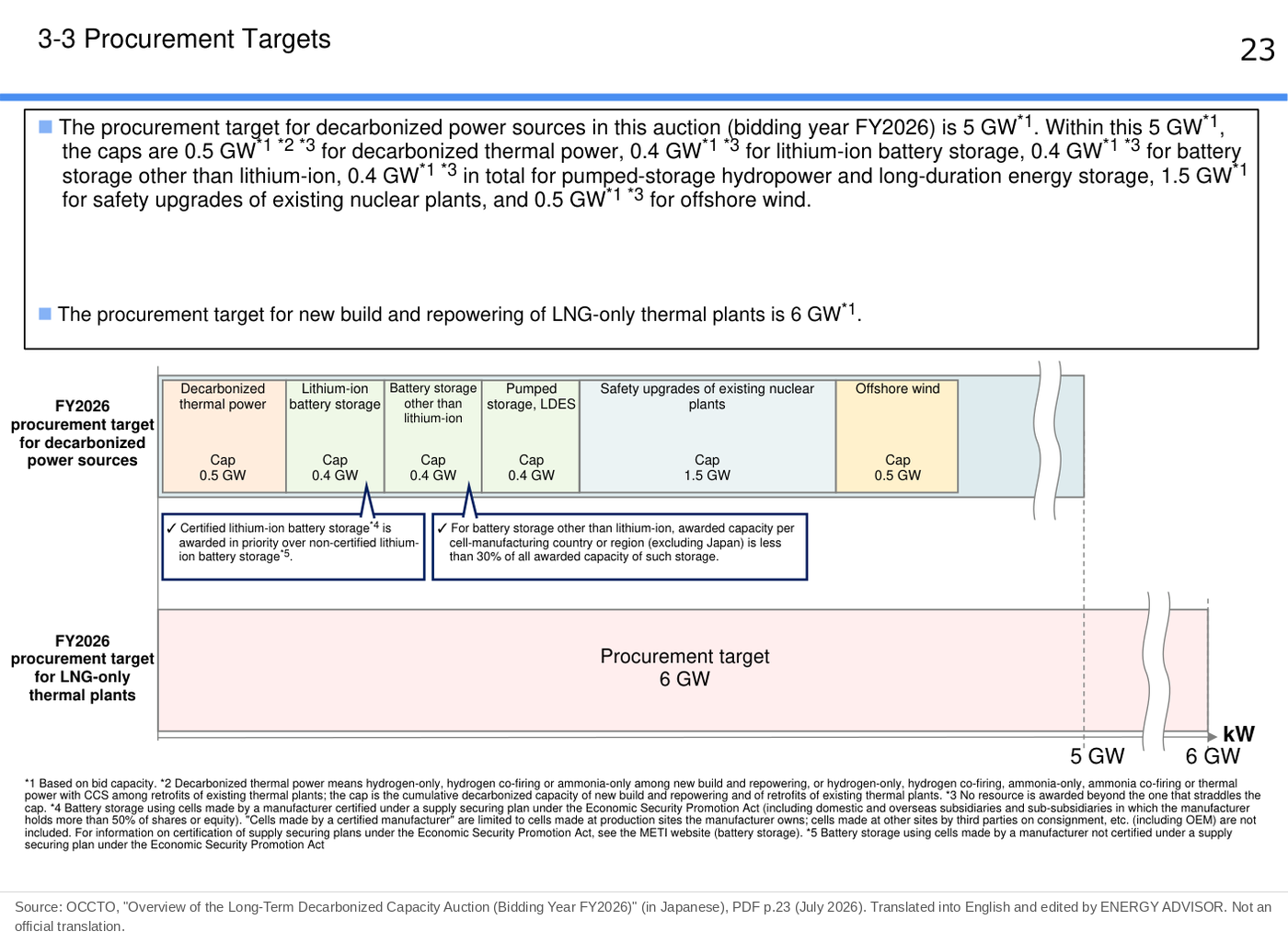
The second round’s procurement target of about 2,244 MW for LNG-only thermal plants is the policy of soliciting an additional 2,000 MW in each of FY2024 and FY2025, plus about 240 MW left over from the first round (Working Group on Market Design, 94th meeting, Material 4-1, p.8, June 28, 2024).
For category caps, in principle, awards stop at the resource that straddles the cap. However, if the total awarded falls short of the procurement target for decarbonized power sources, awards can exceptionally exceed the cap (except for decarbonized thermal power). Battery storage, pumped storage and LDES must charge or pump up before discharging or generating. Because their value as supply capacity is therefore considered limited, awards above the cap are allowed only up to twice the cap (73rd meeting of the study committee, Material 3, PDF p.15). In FY2026, for decarbonized thermal power, lithium-ion battery storage, other battery storage, pumped storage, LDES and offshore wind, awards are limited to the resource that straddles each category cap. Safety upgrades of existing nuclear plants may be awarded above the cap to meet the procurement target for decarbonized power sources (Long-Term Decarbonized Capacity Auction Guidelines (Bidding Year FY2026), PDF pp.35–36).
Results of the First to Third Rounds
Overall
| Round (bidding year) | Results published | Total bid capacity | Total awarded capacity | Decarbonized power sources: awarded (total clearing amount) | LNG-only thermal plants: awarded (total clearing amount) |
|---|---|---|---|---|---|
| 1st (FY2023) | April 26, 2024 | 13,562 MW | 9,766 MW | 4,010 MW (¥233.6 billion per year) | 5,756 MW (¥176.6 billion per year) |
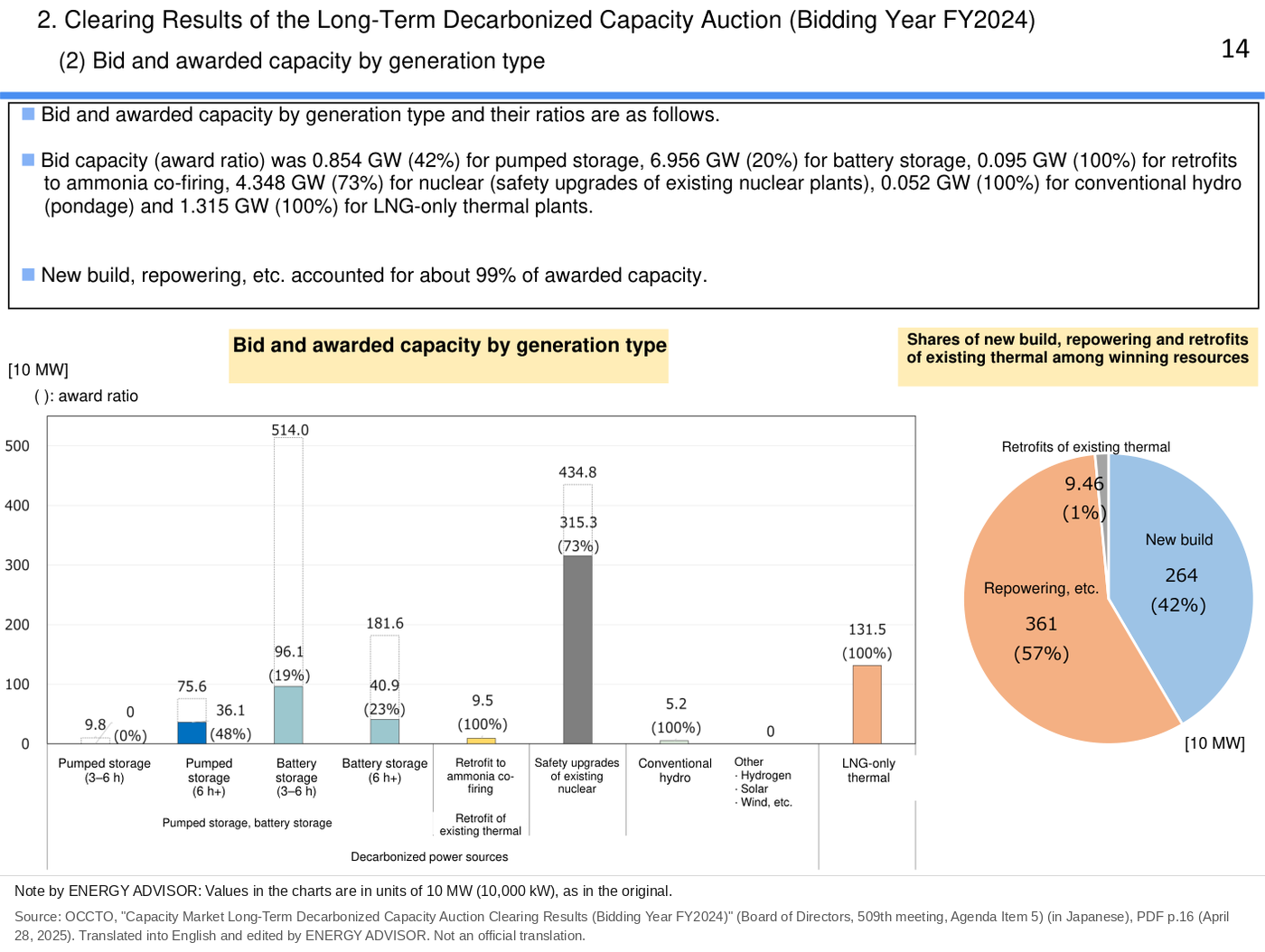
| 2nd (FY2024) | April 28, 2025 | 13,619 MW | 6,345 MW | 5,030 MW (¥346.4 billion per year) | 1,315 MW (¥45.6 billion per year) |
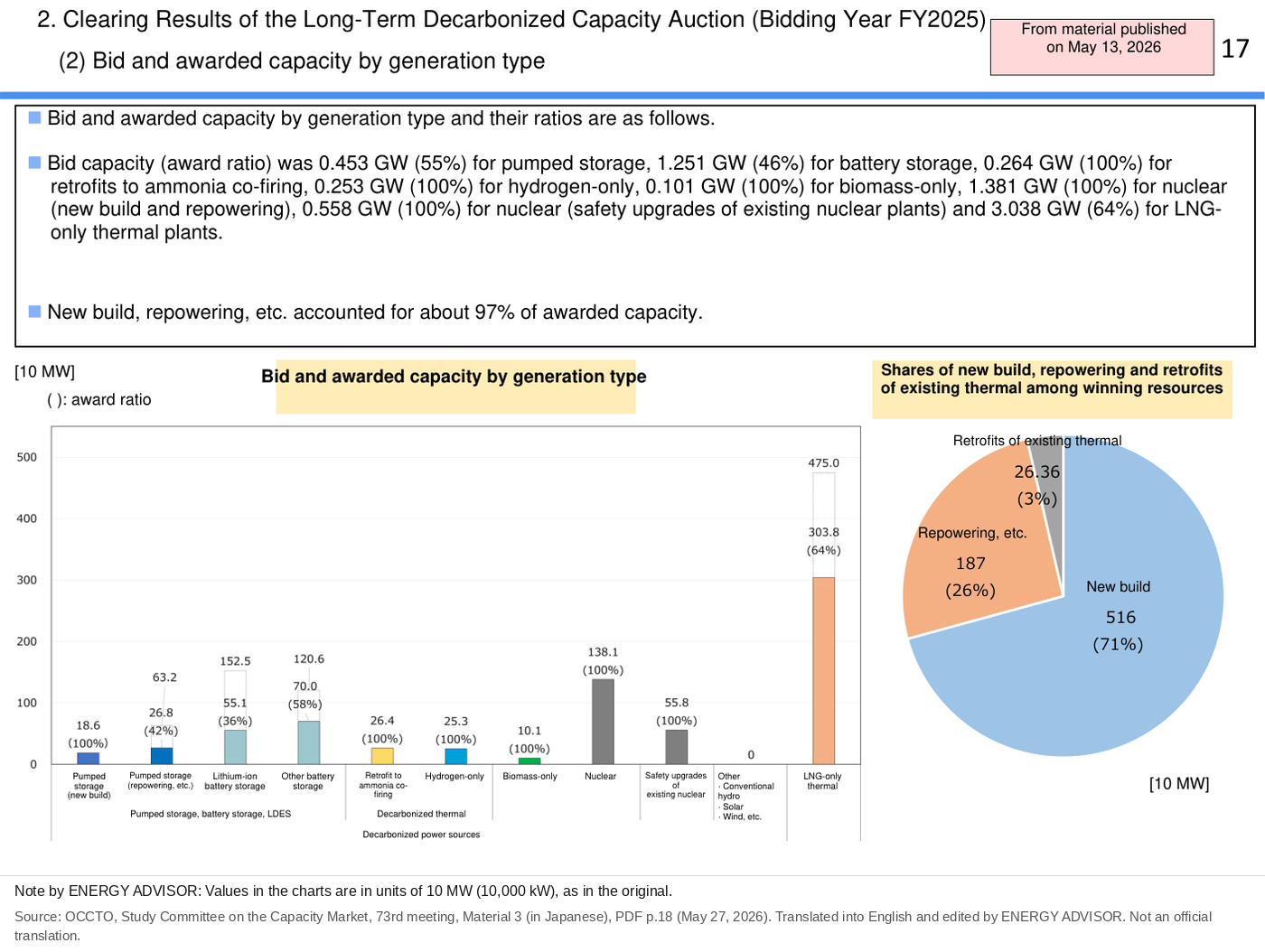
| 3rd (FY2025) | May 13, 2026 | 10,856 MW | 7,299 MW | 4,261 MW (¥474.8 billion per year) | 3,038 MW (¥144.4 billion per year) |
(Sources: 1st round clearing results, PDF pp.10 and 15; 2nd round clearing results, PDF pp.12 and 17; 73rd meeting of the study committee, Material 3, PDF pp.14 and 19. The total clearing amount is the sum for resources with different delivery years and is not a constant value over the support period.)
In the first round, the weighted average clearing price was ¥58,000/kW-year for decarbonized power sources and ¥30,000/kW-year for LNG-only thermal plants (Working Group on Market Design, 92nd meeting, Material 3-3 (ANRE), May 10, 2024).
Awards by resource type
| Resource type | 1st round (FY2023) awarded (award ratio) | 2nd round (FY2024) awarded (award ratio) | 3rd round (FY2025) awarded (award ratio) |
|---|---|---|---|
| Battery storage | 1,092 MW (24%; bids 4,559 MW) | 1,370 MW (20%; bids 6,956 MW) | 1,251 MW (46%) |
| Pumped storage | 577 MW (69%; bids 838 MW) | 361 MW (42%; bids 854 MW) | 453 MW (55%) |
| Battery storage and pumped storage, total | 1,669 MW | 1,730 MW (3–6 hours of continuous operation 961; 6 hours or more 769) | 1,704 MW |
| Nuclear (new build and repowering) | 1,316 MW (100%) | ― | 1,381 MW (100%) |
| Safety upgrades of existing nuclear plants | ― | 3,153 MW (73%; bids 4,348 MW) | 558 MW (100%) |
| Retrofit for ammonia co-firing | 770 MW (100%) | 95 MW (100%) | 264 MW (100%) |
| Retrofit for hydrogen co-firing | 55 MW (100%) | ― | ― |
| Dedicated hydrogen | ― | ― | 253 MW (100%) |
| LNG with 10% hydrogen co-firing (repowering) | 0 MW (0%; bids 68 MW) | ― | ― |
| Dedicated biomass | 199 MW (100%) | ― | 101 MW (100%) |
| Conventional hydropower (regulating type) | ― | 52 MW (100%) | ― |
| LNG-only thermal plants | 5,756 MW (100%) | 1,315 MW (100%) | 3,038 MW (64%) |
(Sources: 1st round clearing results, PDF p.14; 2nd round clearing results, PDF pp.12 and 16; 73rd meeting of the study committee, Material 3, PDF pp.14 and 18. The 2nd-round awards for battery storage and pumped storage are the sums of the values by duration of continuous operation in the graph in the clearing results, PDF p.16 (battery storage 961 MW + 409 MW; pumped storage 0 MW + 361 MW). “―” means no award in that round or no entry in the material.)
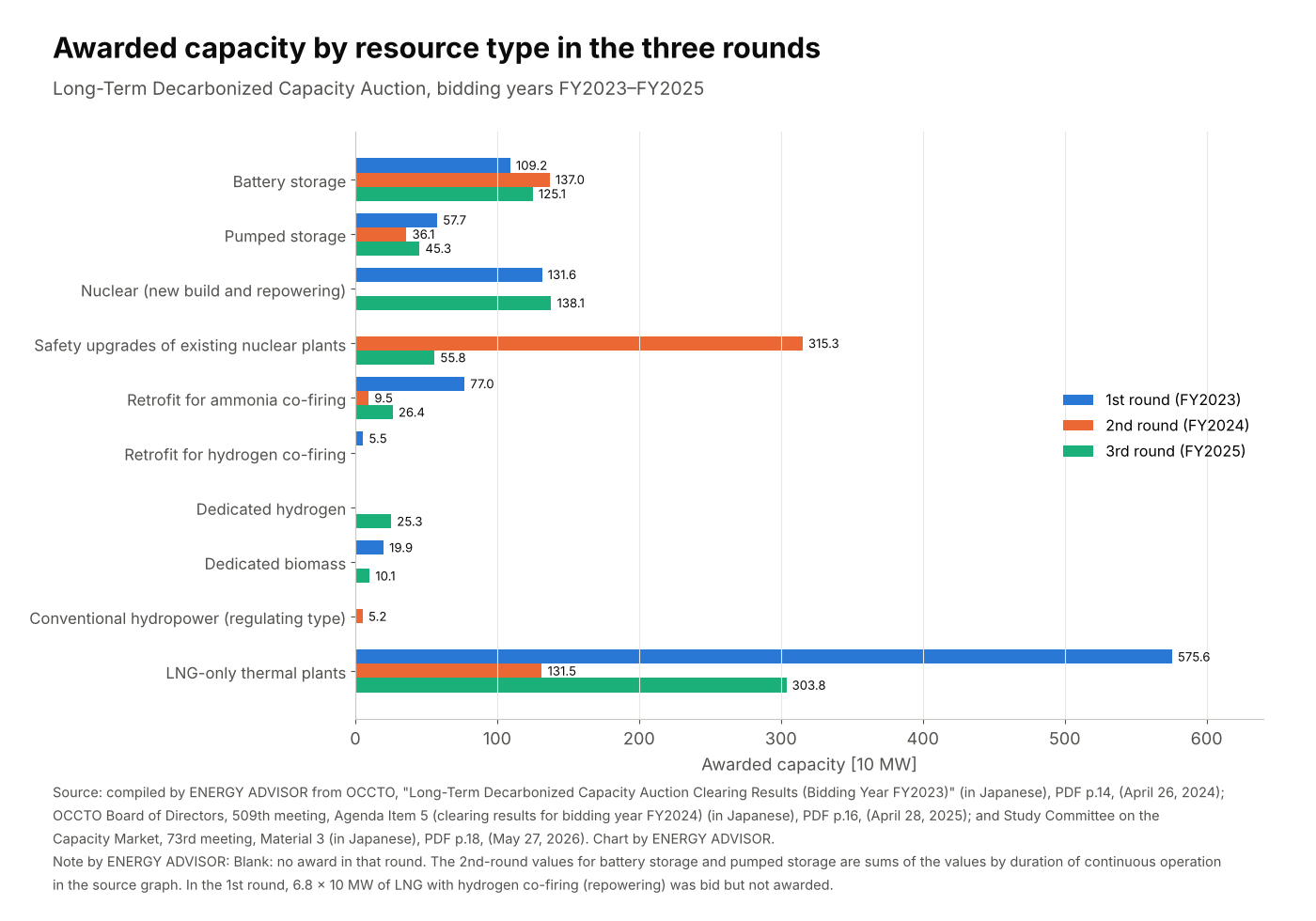
Results for Battery Storage, Pumped Storage, Nuclear and LNG
- Battery storage: in all three rounds, bids far exceeded the category cap, and the award ratio was 24% in the first round, 20% in the second and 46% in the third. In the first round, awards for decarbonized power sources did not reach the procurement target of 4,000 MW. As a result, under the rules, 1,669 MW of battery storage and pumped storage was awarded, above the cap of 1,000 MW (Working Group on Market Design, 92nd meeting, Material 3-3, PDF p.7).
- Nuclear: in the first round, 1,316 MW of new build, and in the second round, 3,153 MW of safety upgrades of existing nuclear plants (investment to meet the new regulatory requirements that took effect in July 2013), were the largest awards among decarbonized power sources. In the third round, there were 1,381 MW of new build and repowering and 558 MW of safety upgrades.
- Decarbonized thermal power: retrofits for ammonia co-firing were awarded in all three rounds, and in the third round dedicated hydrogen (253 MW) was awarded for the first time.
- LNG-only thermal plants: in the first round, all 5,756 MW were awarded. In the second round, 1,315 MW was awarded against a procurement target of about 2,244 MW, and in the third round, 3,038 MW was awarded against a procurement target of about 2,929 MW (award ratio of 64%).
- In the third round, awards for decarbonized power sources were 4,261 MW, short of the procurement target of 5,000 MW.
Changes for FY2026 (the Fourth Round)
The main changes for the FY2026 (bidding year) auction are as follows (Overview of the Long-Term Decarbonized Capacity Auction (Bidding Year FY2026), PDF pp.42–44). The final guidelines were published on September 2, 2026. Comparing the final version with the draft put out for public consultation, the contents of the table below are unchanged, except for the level of the fixed refund for LNG-only thermal plants.
| Item | Change |
|---|---|
| Procurement targets and category caps | Decarbonized power sources 5,000 MW; LNG-only thermal plants 6,000 MW. Category caps as in the table in the previous section. Except for safety upgrades of existing nuclear plants, no awards beyond the resource that straddles the cap (guidelines, PDF p.36) |
| Procurement of battery storage | Priority award to lithium-ion battery storage using cells from manufacturers whose supply assurance plans are certified under the Act on the Promotion of Ensuring National Security through Integrated Implementation of Economic Measures (the Economic Security Promotion Act). For battery storage other than lithium-ion, awarded capacity using cells made in any one country or region (excluding Japan) must be less than 30% of the total |
| Eligible resources | Zero-premium offshore wind projects added. Hydrogen and ammonia limited to low-carbon hydrogen and low-carbon ammonia |
| Support period | In principle 20 years. Hydropower (excluding pumped storage), pumped storage (new build), LDES, nuclear and LNG-only thermal plants can request up to 30 years; thermal power and retrofits of existing thermal plants (excluding dedicated biomass), pumped storage (other than new build) and battery storage up to 40 years. Solar, wind, geothermal and biomass are limited to 20 years |
| Commissioning deadline | Changed to the end of the fiscal year 7 years later for LDES, and 11 years later (7 years if the environmental impact assessment has been completed) for LNG-only thermal plants |
| Price cap | For LNG-only thermal plants, separate price caps depending on whether development of an LNG terminal is needed. For LDES, conventional hydropower, pumped storage (new build) and nuclear, the price cap changed from 1.5 times to 2 times the cost parameters |
| Cost of capital | The WACC (cost of funding) changed to 4.5% for resources with a commissioning deadline of less than 5 years, 5.5% for 5 years to less than 10 years, and 6.5% for 10 years or more |
| Refund of other-market revenue | LNG-only thermal plants can choose between refunding about 90% of actual results and refunding a fixed amount. The level of the fixed amount was ¥8,000/kW-year in the draft, but the final version calls it the “refund level amount,” and the level and how it is set are still being studied at the government advisory council |
| Penalty for failed rescheduling | The reduction for resources that could not accept coordination of capacity outage plans is treated as a financial penalty |
| Market exit | For decarbonized thermal power, market exit is allowed without a financial penalty if, within 8 months after winning, a hydrogen or ammonia supply business or a CO2 transport and storage business is canceled for reasons attributable to others |
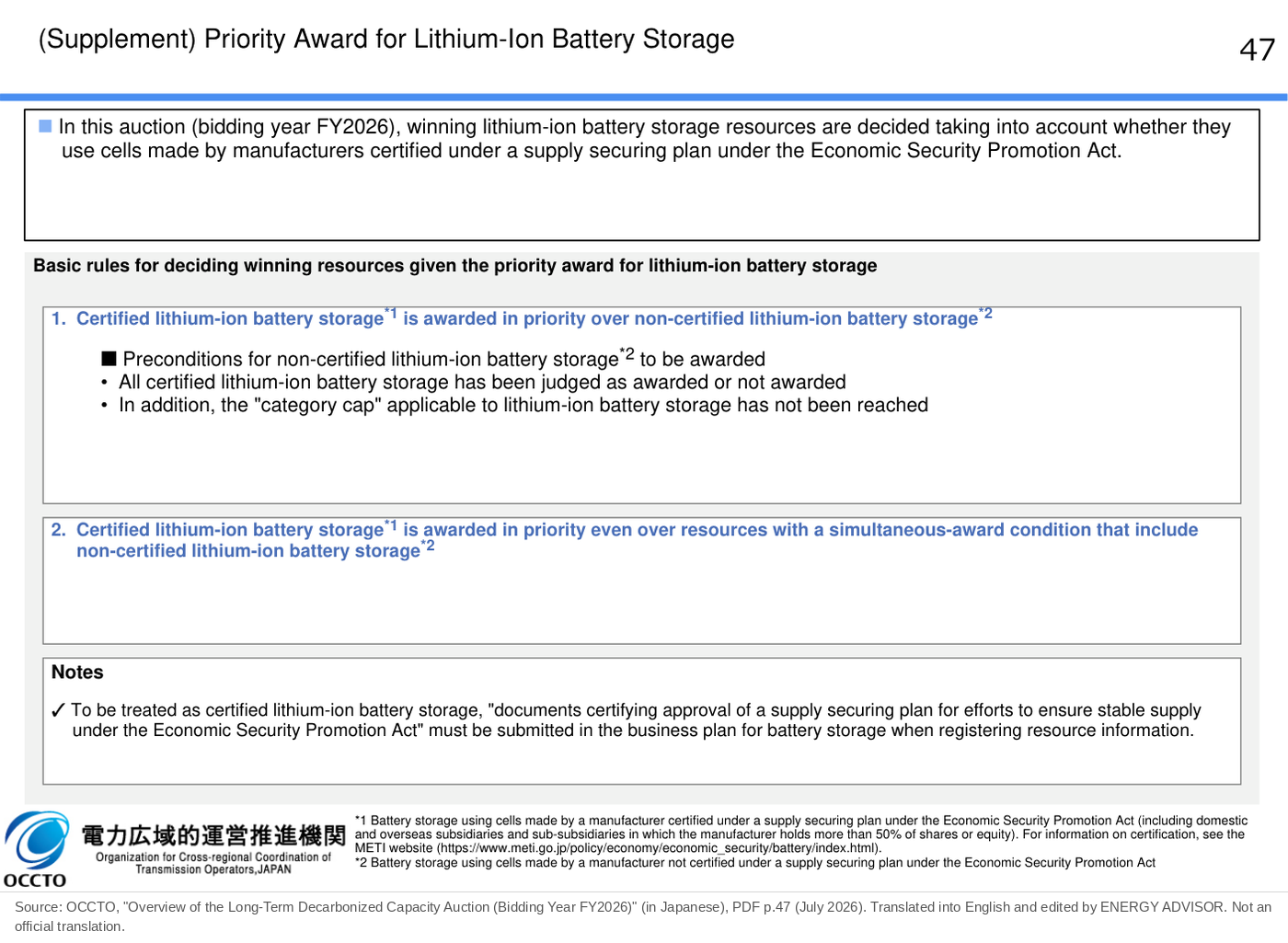
Bids will be accepted from January 19 to 26, 2027, and the clearing results are scheduled to be published about three months after bidding closes (Long-Term Decarbonized Capacity Auction Guidelines (Bidding Year FY2026), PDF p.9, September 2, 2026).
Summary
- The Long-Term Decarbonized Capacity Auction is part of the capacity market. For new investment in decarbonized power sources and similar resources, it promises capacity revenue for, in principle, 20 years (up to 40 years depending on the resource type), using pay-as-bid pricing.
- Eligible are new build and repowering of decarbonized power sources, retrofits of existing thermal plants for decarbonization, and new build and repowering of LNG-only thermal plants. In FY2026, battery storage, pumped storage and LDES must meet “30 MW or more, 6 hours or more continuously.”
- Procurement targets follow a “small start”: for decarbonized power sources, 4,000 MW in the first round and 5,000 MW from the second round.
- The main winners in the three rounds were nuclear (new build and safety upgrades of existing plants), battery storage and pumped storage, and LNG-only thermal plants. Battery storage received many bids, with award ratios of 20–46%.
- For the fourth round (FY2026), changes include category caps, priority award to lithium-ion battery storage, eligibility of offshore wind and LDES, and longer support periods. Bidding is scheduled for January 2027.
This article is based on published materials from the Ministry of Economy, Trade and Industry and its Agency for Natural Resources and Energy, the Electricity and Gas Market Surveillance Commission, the Organization for Cross-regional Coordination of Transmission Operators (OCCTO) and other sources. The English translations of figures are by ENERGY ADVISOR and are not official translations. When using this information for decisions, please check the original sources. When we find an error, we correct the article and note the date of the correction.
Sources
- OCCTO, “Overview of the Long-Term Decarbonized Capacity Auction (Bidding Year FY2026)” (in Japanese), PDF p.10, pp.14–15, pp.20–23, pp.28–30, pp.42–44, p.48, July 2026. https://www.occto.or.jp/assets/various/capacity-market/youryou_setsumeikai/202607_youryou_gaiyousetsumei_long-r.pdf
- OCCTO, “Capacity Market Long-Term Decarbonized Capacity Auction Guidelines (Bidding Year FY2026)” (in Japanese), PDF pp.9–13, p.28, pp.35–36, September 2, 2026. https://www.occto.or.jp/assets/260902_boshuyoukou_long_2026.pdf
- Same guidelines, draft (in Japanese) (public consultation period July 21–August 3, 2026; used for comparison with the final version). https://www.occto.or.jp/assets/2026_tyouki_bosyuyoko.pdf
- OCCTO, “Capacity Market Long-Term Decarbonized Capacity Auction Clearing Results (Bidding Year FY2023)” (in Japanese), PDF p.10, pp.14–15, April 26, 2024. https://www.occto.or.jp/assets/market-board/market/oshirase/2024/files/240426_longauction_youryouyakujokekka_kouhyou_ousatsu2023.pdf
- Advisory Committee for Natural Resources and Energy, Subcommittee on Electricity and Gas Basic Policy, Working Group on Market Design, 92nd meeting, Material 3-3, “About the Long-Term Decarbonized Capacity Auction” (ANRE) (in Japanese), PDF pp.4–7, May 10, 2024. https://www.meti.go.jp/shingikai/enecho/denryoku_gas/denryoku_gas/seido_kento/pdf/092_03_03.pdf
- OCCTO, “Capacity Market Long-Term Decarbonized Capacity Auction Clearing Results (Bidding Year FY2024)” (Board of Directors, 509th meeting, Agenda Item 5) (in Japanese), PDF pp.11–13, pp.16–17, April 28, 2025. https://www.occto.or.jp/assets/soukaihoka/rijikai/2025/files/rijikai_509_gian5.pdf
- Study Committee on the Capacity Market, 73rd meeting, Material 3, “Long-Term Decarbonized Capacity Auction Clearing Results (Bidding Year FY2025) and Toward the Next Auction” (in Japanese), PDF pp.13–14, pp.18–19, May 27, 2026. https://www.occto.or.jp/assets/iinkai/youryou_kentoukai/73/youryou_kentoukai_73_03.pdf
- OCCTO, “Capacity Market Main Auction Clearing Results (Delivery Year FY2029)” (in Japanese), PDF p.41, January 20, 2026. https://www.occto.or.jp/assets/news/capacity-market/260120_mainauction_youryouyakujokekka_kouhyou_jitsujukyu2029.pdf
- Working Group on Market Design, 8th Interim Report (in Japanese). https://www.meti.go.jp/shingikai/enecho/denryoku_gas/denryoku_gas/seido_kento/pdf/20221003_1.pdf
- OCCTO, “Details of the Long-Term Decarbonized Capacity Auction”, September 2023, and “Overview of the Long-Term Decarbonized Capacity Auction”, June 2023 (in Japanese) (sources of figures in the original articles). https://www.occto.or.jp/assets/market-board/market/files/202309_youryou_syousaisetsumei_long.pdf / https://www.occto.or.jp/assets/market-board/market/files/202306_youryou_gaiyousetsumei_long.pdf
- Study Committee on the Capacity Market, 46th meeting, Material 4 (in Japanese) (source of a figure in the original articles). https://www.occto.or.jp/assets/iinkai/youryou/kentoukai/2023/files/youryou_kentoukai_46_04.pdf
- Study Committee on Regulating and Marginal Supply Capability and Long-Term Supply–Demand Balance Evaluation, 84th meeting, Material 2, “Balancing Functions of Pumped Storage and Battery Storage in the Long-Term Decarbonized Capacity Auction” (in Japanese) (source of a figure in the original article). https://www.occto.or.jp/assets/iinkai/chouseiryoku/2022/files/chousei_84_02.pdf
- Long-Term Decarbonized Capacity Auction Guidelines (Bidding Year FY2024) (OCCTO Board of Directors, 474th meeting, Agenda Item 4) (in Japanese), PDF p.11 (procurement targets and category caps), September 4, 2024. https://www.occto.or.jp/soukaihoka/rijikai/2024/files/rijikai_474_gian4.pdf
- Long-Term Decarbonized Capacity Auction Guidelines (Bidding Year FY2025) (OCCTO Board of Directors, 528th meeting, Agenda Item 2) (in Japanese), PDF p.11 (procurement targets and category caps), September 3, 2025. https://www.occto.or.jp/soukaihoka/rijikai/2025/files/rijikai_528_gian2.pdf
- Working Group on Market Design, 93rd meeting, Material 3, “About the Long-Term Decarbonized Capacity Auction” (ANRE) (in Japanese), pp.12–13 (possible fall of about 9,000 MW in thermal supply capacity by 2030), May 27, 2024. https://www.meti.go.jp/shingikai/enecho/denryoku_gas/denryoku_gas/seido_kento/pdf/093_03_00.pdf
- Working Group on Market Design, 94th meeting, Material 4-1, “About the Long-Term Decarbonized Capacity Auction” (ANRE) (in Japanese), p.8 (additional solicitation of LNG-only thermal plants in FY2024 and FY2025), June 28, 2024. https://www.meti.go.jp/shingikai/enecho/denryoku_gas/denryoku_gas/seido_kento/pdf/094_04_01.pdf