Through the capacity market, OCCTO secures the supply capacity needed nationwide all at once, four years before the delivery period. This article explains, party by party, the flow from the auction four years ahead to delivery and payment. The basics of Japan’s electricity system (regional service areas, general transmission and distribution companies, OCCTO and so on) are explained in the first article of this series.
Overall Picture
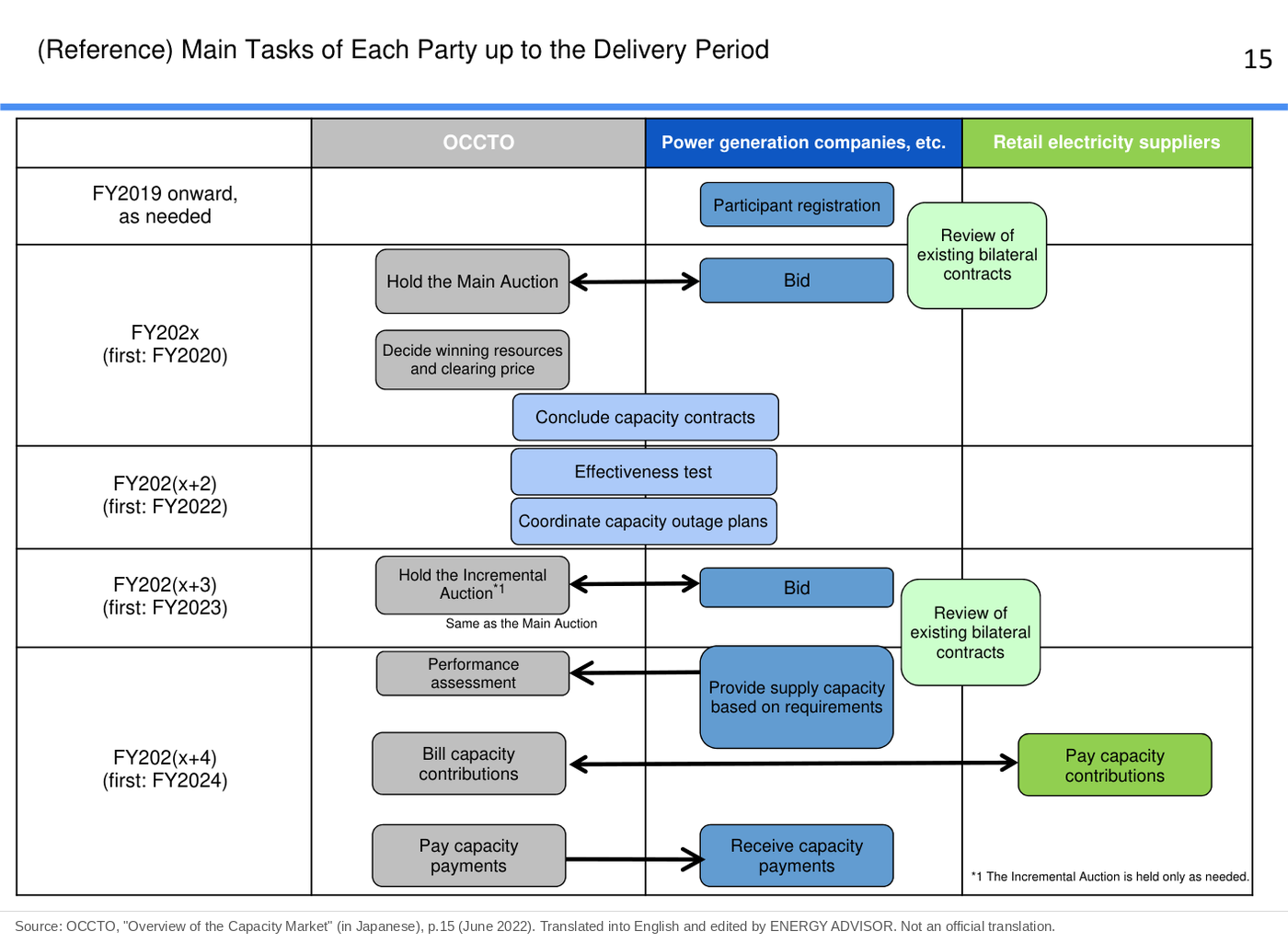
There are three parties in the capacity market: OCCTO, “power generation companies, etc.” and “retail electricity suppliers, etc.” Retail electricity suppliers, etc. means retail electricity suppliers, general transmission and distribution companies (GT&D companies) and licensed distribution companies. Measured from the delivery year, the flow is divided into four stages.
| Stage | Main procedures | Main parties |
|---|---|---|
| Four years before | Main Auction; conclusion of capacity contracts | OCCTO; power generation companies, etc. |
| Two years before | Effectiveness test (dispatch-on-command resources); coordination of capacity outage plans | OCCTO; GT&D companies; power generation companies, etc. |
| One year before | Incremental Auction (if judged necessary) | OCCTO; power generation companies, etc. |
| Delivery year | Provision of supply capacity under the requirements; performance assessment; payment of capacity contributions; receipt of capacity payments | All three parties |
As a concrete example, the actual dates for delivery year FY2029 (April 2029–March 2030) are as follows.
| Stage | Example: delivery year FY2029 |
|---|---|
| Four years before (FY2025) | Participation registration August–September 2025; bidding October 14–24, 2025; publication of clearing results January 20, 2026; conclusion of capacity contracts from the publication date to around April 2026 |
| Two years before (FY2027) | Effectiveness tests (summer and winter); coordination of capacity outage plans (planned) |
| One year before (FY2028) | Decision on whether to hold an Incremental Auction (planned) |
| Delivery (FY2029) | April 2029–March 2030 |
(Source: Capacity Market Main Auction Clearing Results (Delivery Year FY2029), PDF p.5)
Four Years Before: The Main Auction
Holding the Main Auction
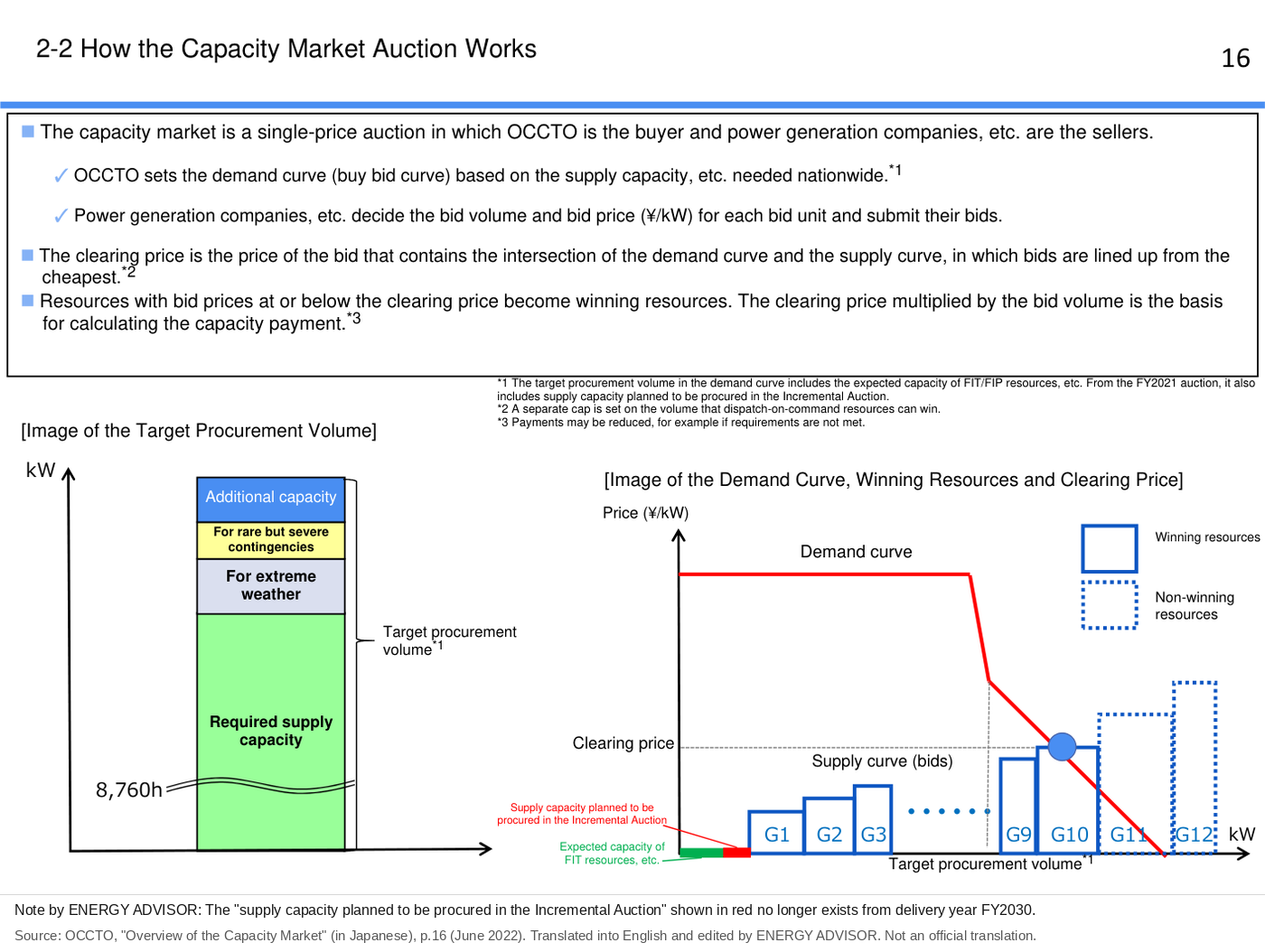
The capacity market is an auction in which OCCTO is the buyer and power generation companies and others are the sellers.
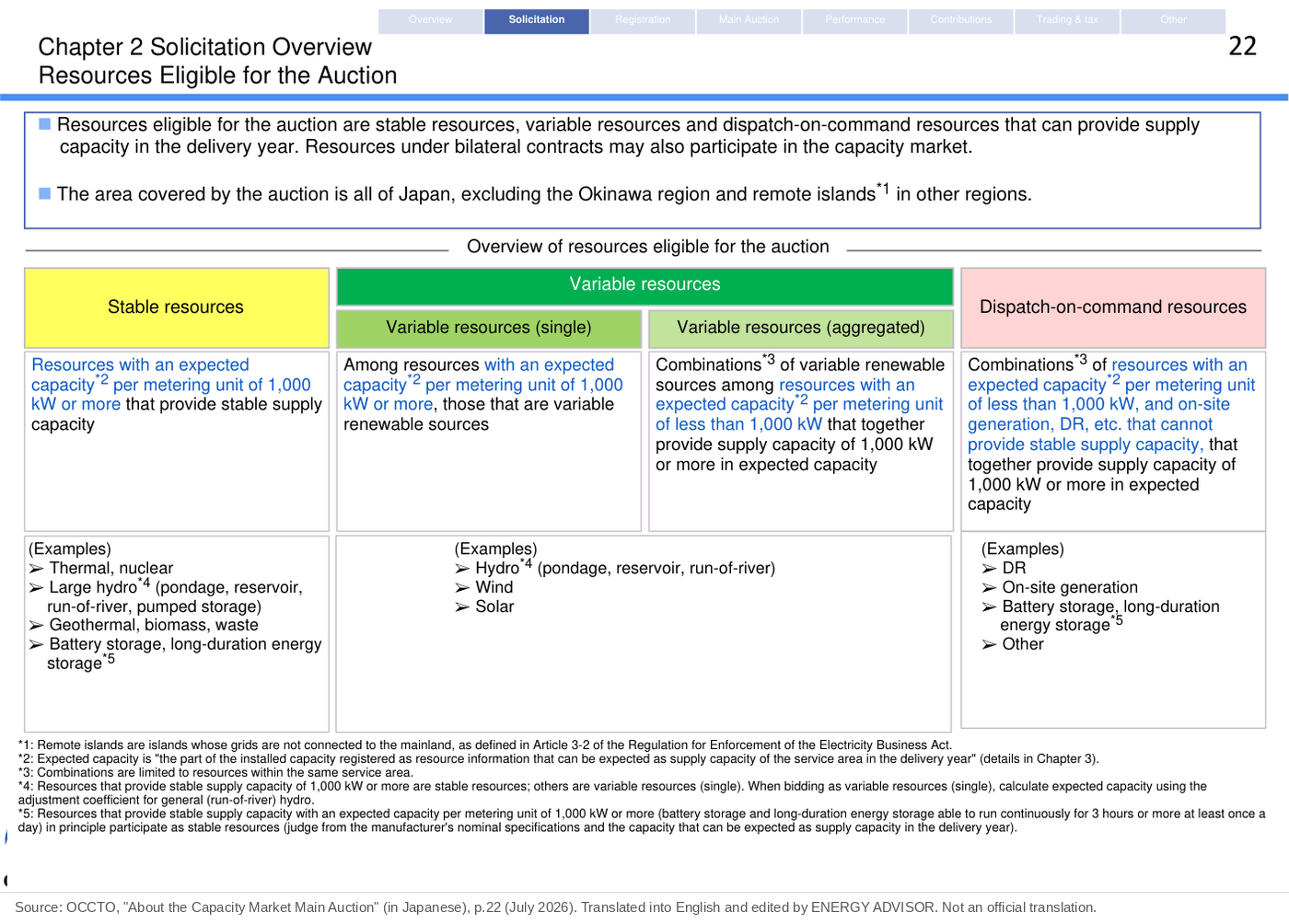
Resources eligible for the auction are divided into “stable resources,” “variable resources (single),” “variable resources (aggregated)” and “dispatch-on-command resources,” each with its own requirements. Stable resources are those that can provide supply capacity steadily, such as thermal, nuclear and large hydropower. Variable resources are those whose output varies with the weather, such as solar and wind. Dispatch-on-command resources include demand response (DR, a mechanism in which customers reduce their electricity use as a substitute for supply capacity). The categories are explained in detail in the third article of this series.
Based on the supply capacity needed nationwide and other factors, OCCTO sets the target procurement volume and the demand curve (the buy-bid curve).
In response, power generation companies and others bid, for each bidding unit, a bid volume (kW) and a bid price (¥/kW).
The clearing price is the intersection of the demand curve and the supply curve, in which the offered resources are ranked from cheapest. Resources at or below the clearing price are the winning resources.
The Main Auction uses single pricing in principle, so winning resources receive the clearing price of their area (the area price) regardless of their bid price. However, for delivery years FY2026–FY2029, there was a mechanism that applied pay-as-bid (multi-price) pricing. It applied, in areas where competition might be limited, to the portion above 1.5 times the price of the adjacent area. This mechanism has been removed for delivery year FY2030 (third article of this series).
The latest auction is for delivery year FY2029 (held in FY2025). Bids were accepted from October 14 to 24, 2025, and clearing results were published on January 20, 2026.
Concluding the capacity contract
After the clearing results are published, a company whose resource wins concludes a “capacity contract” with OCCTO.
The capacity contract sets out the specific ways in which supply capacity is to be provided during the delivery period (hereafter, the requirements).
Two Years Before: Effectiveness Tests and Coordination of Capacity Outage Plans
Effectiveness test
During the delivery period, dispatch-on-command resources must respond to dispatch calls up to 12 times a year (each lasting 3 hours).
Before that, an “effectiveness test” is held in the summer (July–September) or winter (December–February) two fiscal years before the delivery year. In this test, a dispatch-on-command resource must prove that it can provide supply capacity at or above its contracted capacity. For example, the effectiveness tests for delivery year FY2028 are held in the summer and winter of FY2026 (OCCTO, “About Effectiveness Tests (Delivery Year FY2028)”, February 2026).
In areas where the volume of dispatch-on-command resources exceeds a certain level, an “adjustment coefficient” is applied that lowers the share counted as supply capacity. In the Incremental Auction for delivery year FY2027, it was about 56.6% in Hokkaido, about 92.8% in Kyushu and 100% in the other areas (Study Committee on the Capacity Market, 76th meeting, Material 3, PDF p.17). This is explained in detail in the fifth article of this series.
Coordination of capacity outage plans
Capacity providers (companies that won and concluded contracts) submit capacity outage plans to OCCTO two years before the delivery year. Each company submits a plan for each resource by the end of October, and in November–December OCCTO publishes an assessment of supply reliability based on the collected plans. Resources that will be taken offline to match construction work on the GT&D company’s transmission and distribution facilities submit their plans in July (Study Committee on the Capacity Market, 72nd meeting, Attachment 1, “Capacity Market FY2025 Comprehensive Review: Review Report (Draft)”, PDF p.41, March 27, 2026).
A capacity outage plan is a plan for “work needed to maintain and operate resources” and “outages or output reductions of resources due to other factors.”
Based on the submitted capacity outage plans, OCCTO assesses supply reliability month by month. Supply reliability is the expected value of annual unserved energy per 1 kW of demand; the smaller it is, the higher the reliability (clearing results for FY2029, PDF p.7). Based on the assessment, the timing of resource outages is coordinated.
Capacity providers that have submitted capacity outage plans for the areas and months designated by OCCTO are asked to move them to other months.
If they cannot accept the request, a financial penalty may be imposed.
By coordinating capacity outage plans, such as moving outages from months with little supply capacity to other months, the mechanism ensures that the supply capacity needed each month is secured. This is explained in detail in the fourth article of this series.
One Year Before: The Incremental Auction
Types of Incremental Auction and the decision to hold one
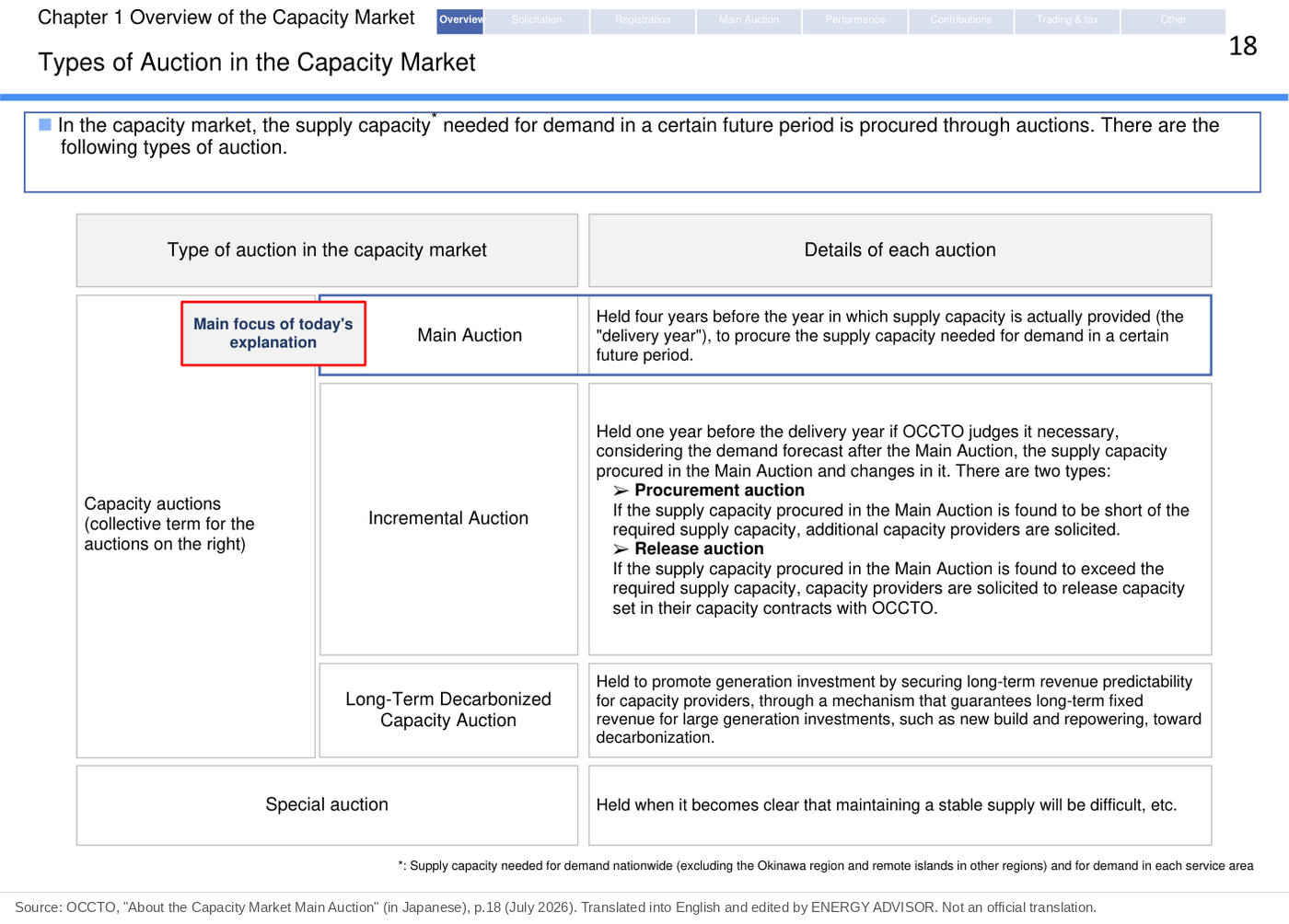
Whether to hold an Incremental Auction is decided in light of changes in demand and supply capacity after the Main Auction. The decision uses the supply-demand balance assessment for the second year of the Electricity Supply Plan (the ten-year plans that compile companies’ plans). A supply-demand balance assessment checks whether supply capacity is sufficient for the forecast demand. There are two types of Incremental Auction: a “procurement auction,” which solicits additional capacity when supply capacity is short, and a “release auction,” which solicits companies willing to give up contracted capacity when supply capacity is in surplus (Overview of the Long-Term Decarbonized Capacity Auction (Bidding Year FY2026), PDF p.10).
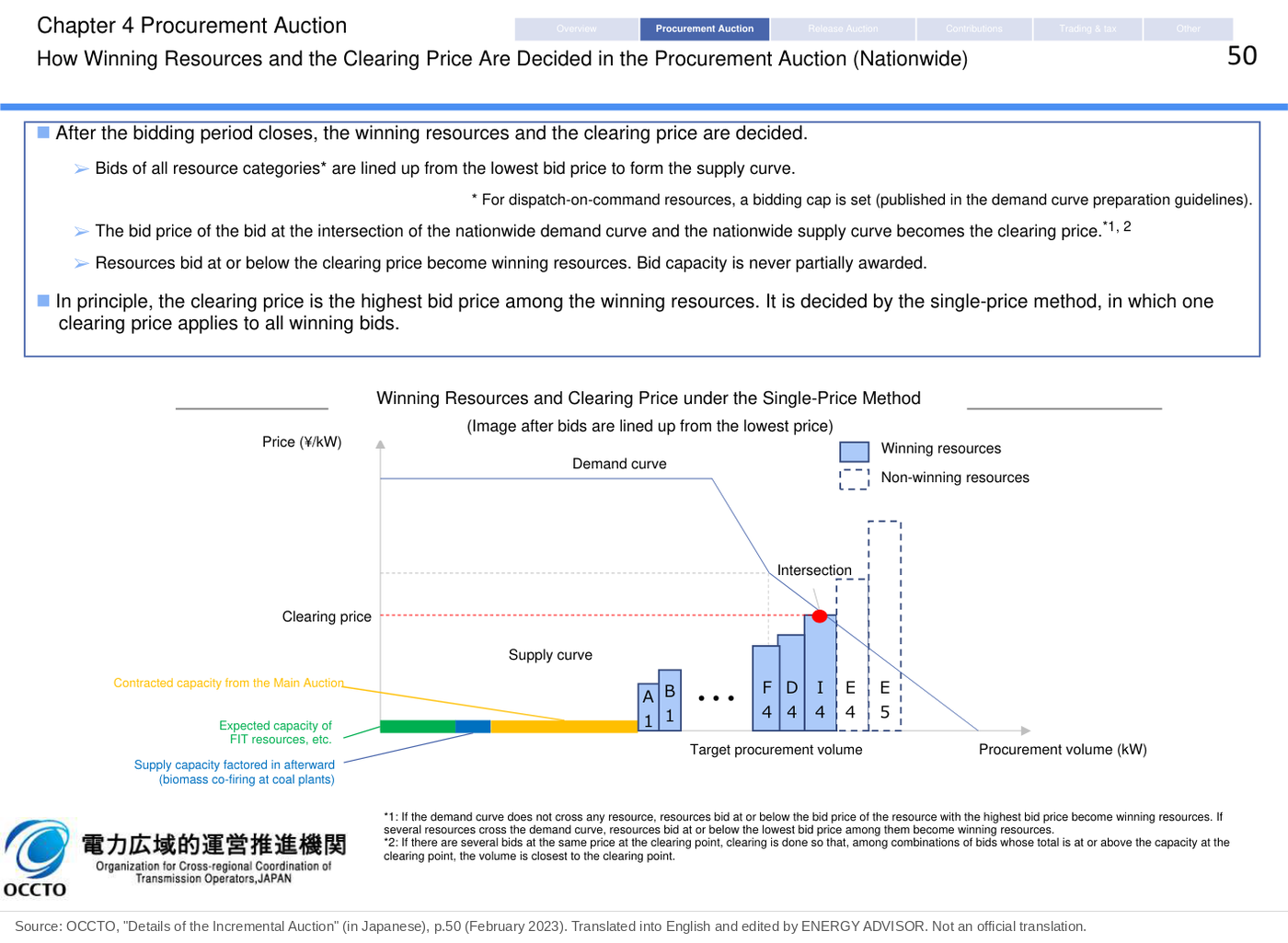
Like the Main Auction, the Incremental Auction finds the clearing price at the intersection of the supply and demand curves.
Auctions held so far
Procurement auctions have been held three times so far. None was held for delivery year FY2024 (Table 22 in the review report for delivery year FY2027, PDF p.31).
| Delivery year (year held) | Total cleared capacity | Clearing price (area price) | Total clearing amount (after transitional measures) |
|---|---|---|---|
| FY2025 (FY2024) | About 1.33 GW (held separately in the Hokkaido, Tokyo and Kyushu areas) | Hokkaido ¥13,761/kW; Tokyo ¥3,495/kW; Kyushu ¥5,029/kW | ¥10.5 billion |
| FY2026 (FY2025) | About 8.3 GW | Hokkaido, Tohoku, Tokyo and Chubu ¥8,749/kW; Hokuriku, Kansai, Chugoku and Shikoku ¥8,213/kW; Kyushu ¥8,591/kW | ¥58.2 billion |
| FY2027 (FY2026) | About 4.58 GW | All areas ¥10,361/kW | ¥42.5 billion |
(Sources: for FY2025, OCCTO Board of Directors, 466th meeting, Agenda Item 5, PDF p.13 (July 10, 2024); for FY2026, Study Committee on the Capacity Market, 67th meeting, Material 3, PDF p.12; for FY2027, 76th meeting of the same committee, Material 3, PDF p.12)
For delivery year FY2025, supply capacity was sufficient nationwide. A nationwide procurement auction was therefore not held. Procurement auctions were held only in the three areas of Hokkaido, Tokyo and Kyushu, where supply reliability fell short of the target (OCCTO Board of Directors, 452nd meeting, Agenda Item 8, PDF p.5, April 24, 2024). Of these, Tokyo and Kyushu still did not reach the target supply reliability after the Incremental Auction (Board of Directors, 466th meeting, Agenda Item 5, PDF p.13).
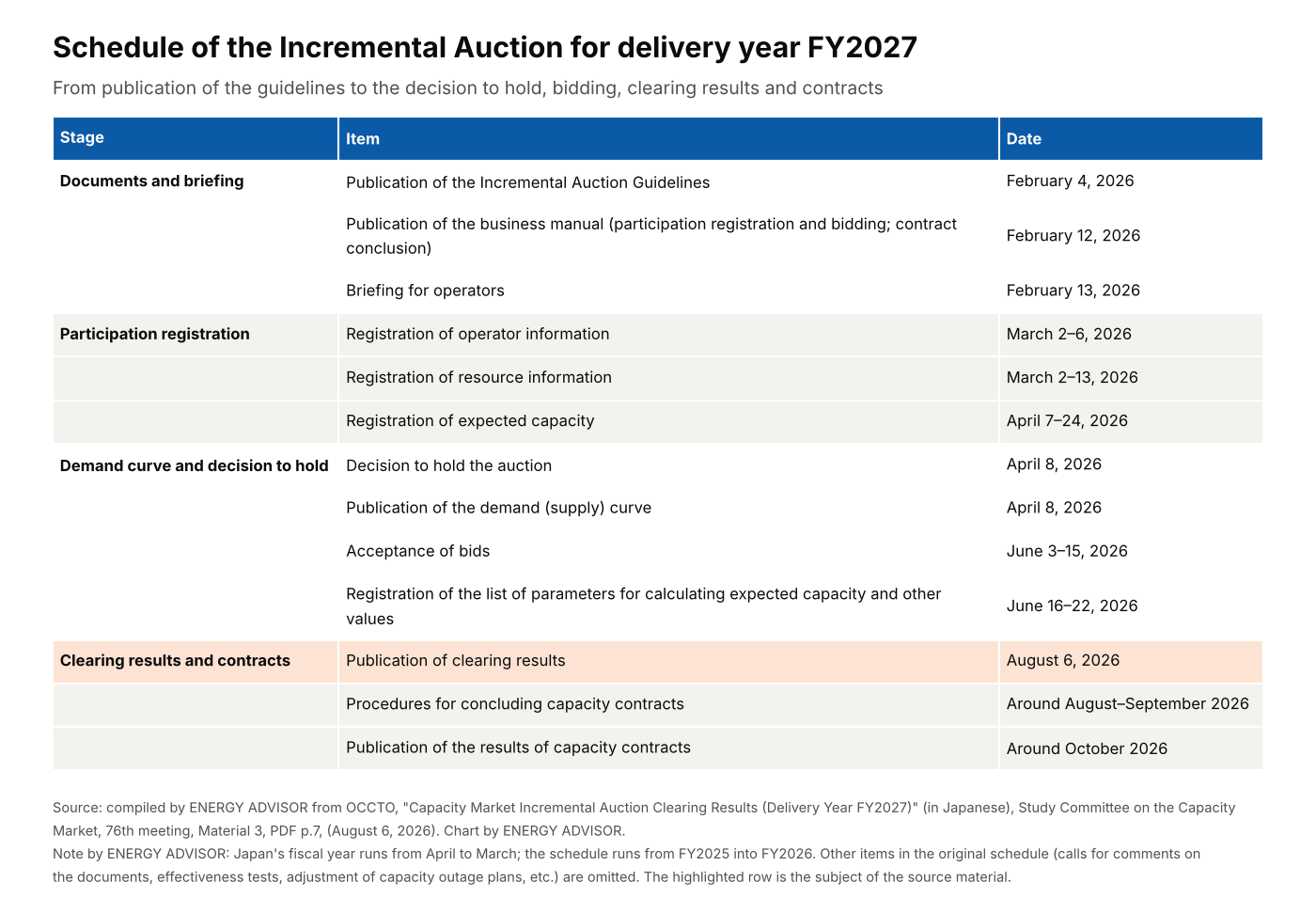
For delivery year FY2027, the decision to hold the auction was made on April 8, 2026, bids were accepted from June 3 to 15, 2026, and clearing results were published on August 6, 2026 (76th meeting, Material 3, PDF p.7).
Changes from delivery year FY2030
From delivery year FY2025 through FY2029, 2% of H3 demand was left unpurchased in the Main Auction (Study Committee on the Capacity Market, 35th meeting, Material 3-2, PDF p.5). H3 demand is the average of the three highest daily peak demands in a month. The 2% left over was to be procured in the Incremental Auction.
From delivery year FY2030, this 2% is no longer left over and is procured in the Main Auction. In the demand curve published on July 30, 2026, “supply capacity planned to be procured in the Incremental Auction” disappeared from the supply capacity added in the clearing process (FY2026 Main Auction Demand Curve, PDF p.3). The policy was set out in Study Committee on the Capacity Market, 74th meeting, Material 3, PDF p.6 (June 30, 2026).
At the same time, a policy was set out to raise the bidding cap for dispatch-on-command resources in the Main Auction from 4% to 5% of H3 demand (same). In the final Main Auction Guidelines, the value of the cap is “to be announced separately” (Guidelines (Delivery Year FY2030), PDF p.31). OCCTO’s July 2026 briefing material explains that the cap was to be revised to “5% of H3 demand” (OCCTO, “About the Capacity Market Main Auction”, briefing material, PDF p.6, July 2026).
Delivery Year: Requirements and Performance Assessment
Providing supply capacity under the requirements
During the delivery period, each resource must provide supply capacity under the requirements set for it.
Examples of the main requirements for stable resources and others are as follows.
- Maintaining supply capacity: keep the resource able to provide supply capacity in the delivery year.
- Bidding spare capacity into the wholesale electricity exchange, etc.: in periods with no capacity outage plan, bid the spare capacity not used by retail electricity suppliers and others into the wholesale electricity exchange or other markets.
- Responding to supply instructions: this applies when an assessment from the day before onward judges that the supply-demand balance may become tight. Following the instructions of the GT&D company in that area, provide the spare capacity remaining after gate closure (GC; the deadline for schedules one hour before delivery) as supply capacity.
Performance assessment (checking compliance with the requirements)
A performance assessment checks whether each resource has met its requirements. If the conditions are not met, a financial penalty is imposed.
In FY2024, periods close to a tight supply-demand balance occurred far more often than assumed in the design, and the value that sets the strength of the penalty (Z hours) was revised from 30 hours to 90 hours. The background is explained in the fourth article of this series.
Flow of Money: Capacity Contributions and Capacity Payments
Capacity contributions are paid to OCCTO by retail electricity suppliers, GT&D companies and licensed distribution companies to secure supply capacity through the capacity market.
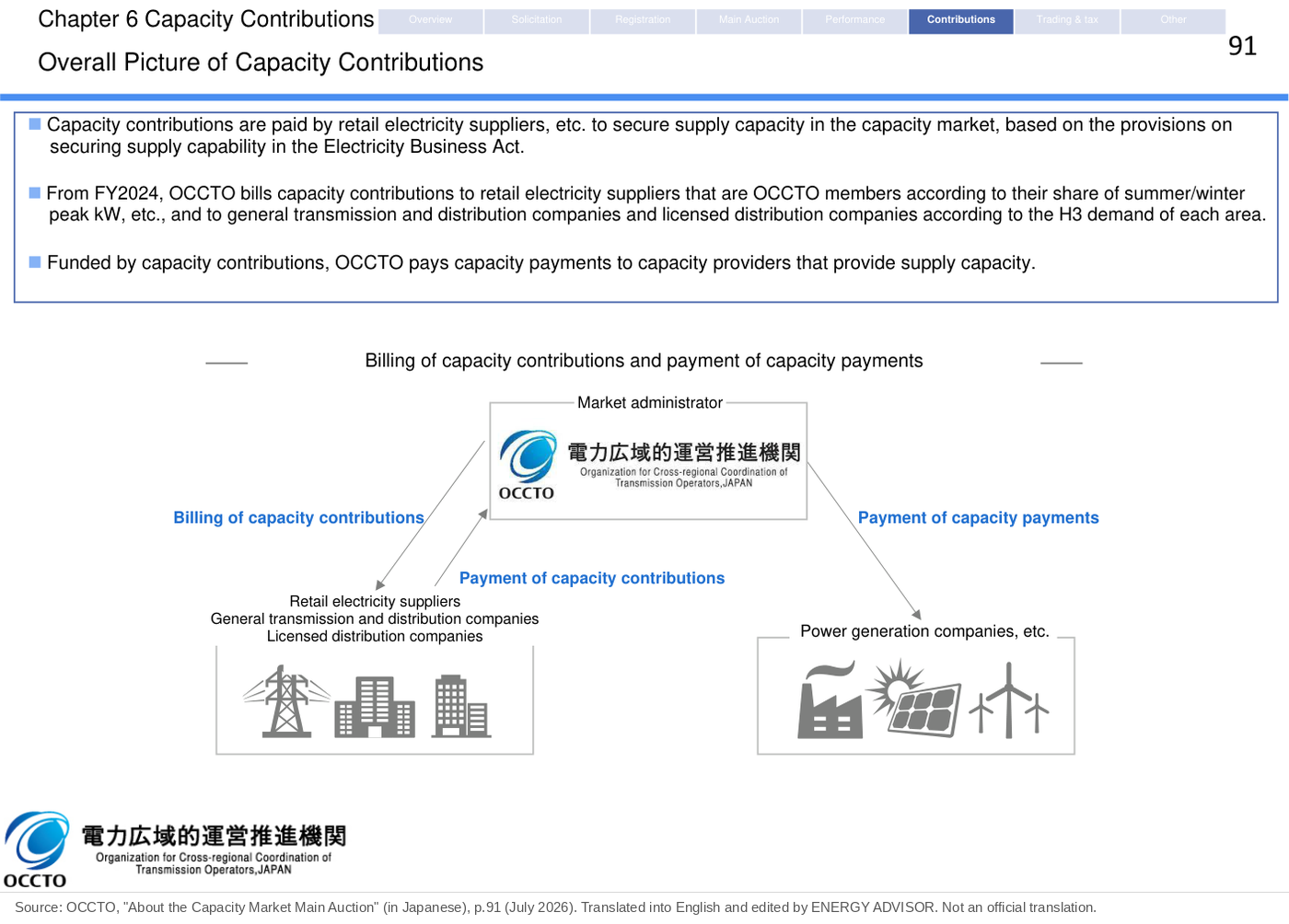
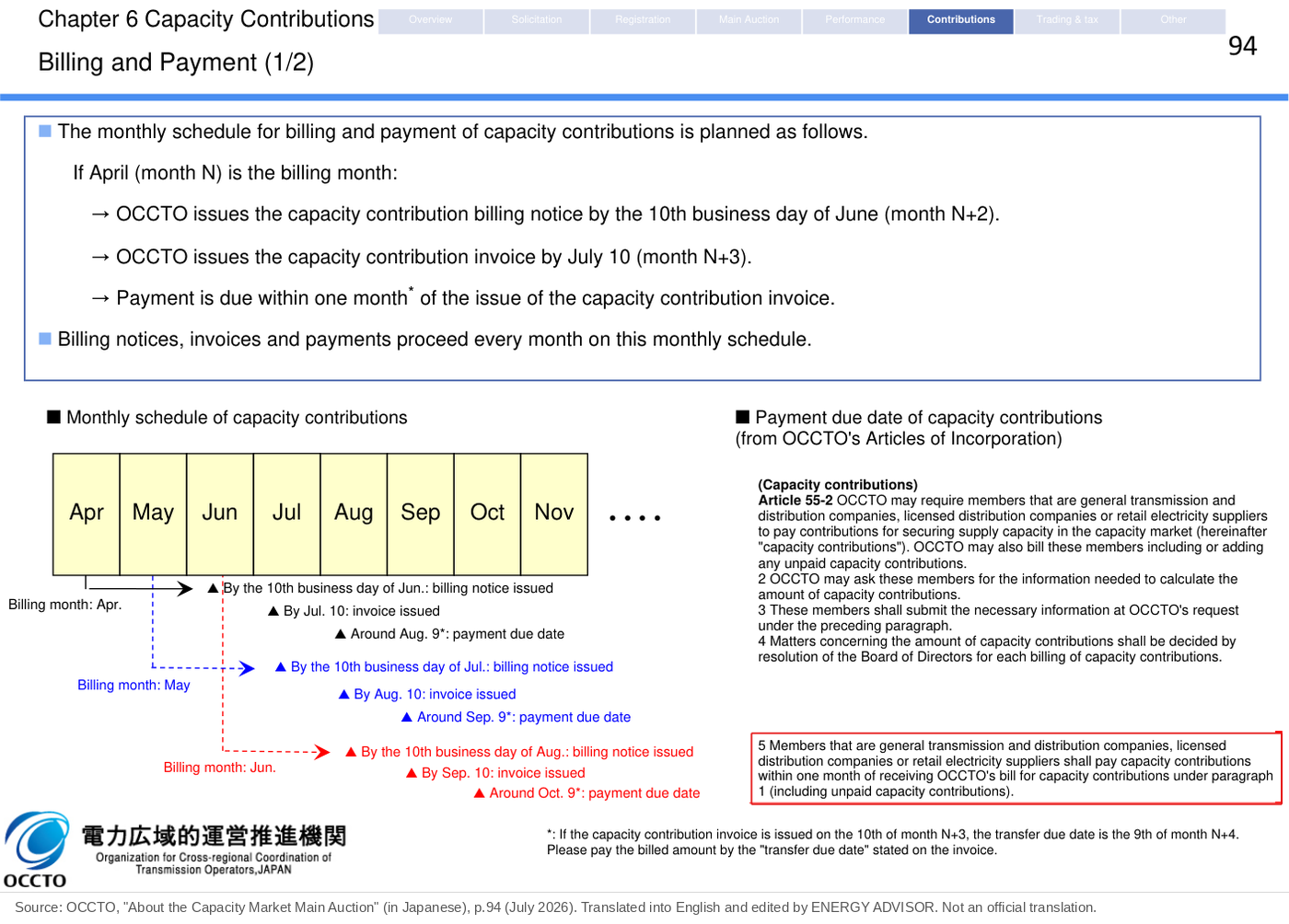
Billing of capacity contributions began in July 2024 for delivery year FY2024 (OCCTO, capacity contribution briefing material, September 2023, PDF p.19). Since then, they have been billed every month. The invoice for a given month is issued by the 10th of the third month after it (Capacity Market Operations Manual: Capacity Contributions (Delivery Year FY2026) (Draft), October 2025).
Funded by capacity contributions, OCCTO pays capacity payments to the capacity providers that provide supply capacity. How the amounts are calculated and how the totals have changed is explained in the sixth article of this series.
Relationship with the Long-Term Decarbonized Capacity Auction
The Long-Term Decarbonized Capacity Auction is one of the auctions that make up the capacity market. The Main Auction covers one year, four years ahead. The Long-Term Decarbonized Capacity Auction promises capacity revenue to new decarbonized power sources and others, in principle for 20 years. The fiscal year in which a project starts providing supply capacity differs by winning project, reflecting the time needed for construction.
Capacity secured in the Long-Term Decarbonized Capacity Auction is deducted in the Main Auctions for delivery year FY2028 onward. It is deducted from the required procurement volume (Long-Term Decarbonized Capacity Auction Clearing Results (Bidding Year FY2024), PDF p.19). For delivery year FY2029, about 3.43 GW was deducted (clearing results for FY2029, PDF p.41). Capacity contributions for the Long-Term Decarbonized Capacity Auction are also borne by retail electricity suppliers and others under the same mechanism as those for the Main Auction.
Summary
- The capacity market flow has four stages: the Main Auction four years before; effectiveness tests and coordination of capacity outage plans two years before; the Incremental Auction one year before; and provision of supply capacity and payments in the delivery year.
- The latest Main Auction with published results is for delivery year FY2029; results were published on January 20, 2026. For delivery year FY2030, bids are being accepted from October 13 to 23, 2026.
- Incremental Auctions (procurement auctions) have been held three times: for delivery year FY2025 (about 1.33 GW, three areas), FY2026 (about 8.3 GW) and FY2027 (about 4.58 GW). From delivery year FY2030, the 2% left for the Incremental Auction is also procured in the Main Auction.
- Billing of capacity contributions began in July 2024 and is carried out every month.
- Capacity secured in the Long-Term Decarbonized Capacity Auction is deducted from the procurement volume of the Main Auction.
This article is based on published materials from the Ministry of Economy, Trade and Industry and its Agency for Natural Resources and Energy, the Electricity and Gas Market Surveillance Commission, the Organization for Cross-regional Coordination of Transmission Operators (OCCTO) and other sources. The English translations of figures are by ENERGY ADVISOR and are not official translations. When using this information for decisions, please check the original sources. When we find an error, we correct the article and note the date of the correction.
Sources
- OCCTO, “Capacity Market Main Auction Clearing Results (Delivery Year FY2029)” (in Japanese), PDF p.5 (schedule), p.7 (definition of supply reliability), p.41 (contracted capacity of the Long-Term Decarbonized Capacity Auction), January 20, 2026. https://www.occto.or.jp/assets/news/capacity-market/260120_mainauction_youryouyakujokekka_kouhyou_jitsujukyu2029.pdf
- OCCTO, “About Effectiveness Tests (Delivery Year FY2028)”, capacity market practical briefing material (in Japanese), February 2026. https://www.occto.or.jp/assets/various/capacity-market/260206_youryou_jikkouseitestsetsumei.pdf
- OCCTO, “Review Report on the Capacity Market Main Auction Clearing Results (Delivery Year FY2027)” (in Japanese), PDF p.31 (Table 22), June 12, 2024. https://www.occto.or.jp/assets/market-board/market/oshirase/2024/files/240612_mainauction_kensyoreport_jitsujukyu2027.pdf
- OCCTO Board of Directors, 452nd meeting, Agenda Item 8, “Holding of the Capacity Market FY2024 Incremental Auction (Delivery Year FY2025)” (in Japanese), PDF p.5, April 24, 2024. https://www.occto.or.jp/assets/soukaihoka/rijikai/2024/files/rijikai_452_gijiroku8.pdf
- OCCTO Board of Directors, 466th meeting, Agenda Item 5, “Publication of the Capacity Market Incremental Auction Clearing Results (Delivery Year FY2025)” (in Japanese), PDF p.13, July 10, 2024. https://www.occto.or.jp/assets/soukaihoka/rijikai/2024/files/rijikai_466_gian5.pdf
- Study Committee on the Capacity Market, 67th meeting, Material 3, “Capacity Market Incremental Auction Clearing Results (Delivery Year FY2026)” (in Japanese), PDF p.12, July 28, 2025. https://www.occto.or.jp/assets/iinkai/youryou/kentoukai/2025/files/youryou_kentoukai_67_03.pdf
- Study Committee on the Capacity Market, 76th meeting, Material 3, “Capacity Market Incremental Auction Clearing Results (Delivery Year FY2027)” (in Japanese), PDF p.7 (schedule), p.12 (overview), p.17 (adjustment coefficients), August 6, 2026. https://www.occto.or.jp/assets/iinkai/youryou_kentoukai/76/youryou_kentoukai_76_03.pdf
- OCCTO, “Capacity Market Main Auction Guidelines (Delivery Year FY2030)” (in Japanese), PDF p.9 (schedule), p.31 (bidding cap for dispatch-on-command resources), July 30, 2026. https://www.occto.or.jp/assets/market-board/market/jitsujukyukanren/260730_mainauction_boshuyoukou_jitsujukyu2030.pdf
- OCCTO, “FY2026 Main Auction Demand Curve (Delivery Year FY2030)” (in Japanese), PDF p.3, July 30, 2026. https://www.occto.or.jp/assets/market-board/market/jitsujukyukanren/260730_mainauction_jyuyoukyokusen_jitsujukyu2030.pdf
- Study Committee on the Capacity Market, 35th meeting, Material 3-2, “About the Capacity Market” (in Japanese), PDF p.5 (two-stage auctions), December 22, 2021. https://www.occto.or.jp/assets/iinkai/youryou/kentoukai/2021/files/youryou_kentoukai_35_03_2.pdf
- Study Committee on the Capacity Market, 74th meeting, Material 3, “Start of Public Consultation on the Draft FY2026 Main Auction Guidelines (Delivery Year FY2030)” (in Japanese), PDF p.6, June 30, 2026. https://www.occto.or.jp/assets/iinkai/youryou_kentoukai/74/youryou_kentoukai_74_03.pdf
- OCCTO, “Capacity Contribution Briefing” (briefing material) (in Japanese), PDF p.19, September 2023. https://www.occto.or.jp/assets/market-board/market/oshirase/2023/files/231010_setsumeikai2_youryoukyoshutsukin.pdf
- OCCTO, “Capacity Market Operations Manual: Capacity Contributions (Delivery Year FY2026) (Draft)” (in Japanese), October 2025 (public consultation version). https://www.occto.or.jp/assets/iken/2025/files/251008_youryou_gyoumumanual_youryoukyoshutsukin.pdf
- OCCTO, “Overview of the Long-Term Decarbonized Capacity Auction (Bidding Year FY2026)” (in Japanese), PDF p.10, July 2026. https://www.occto.or.jp/assets/various/capacity-market/youryou_setsumeikai/202607_youryou_gaiyousetsumei_long-r.pdf
- OCCTO, “Capacity Market Long-Term Decarbonized Capacity Auction Clearing Results (Bidding Year FY2024)” (Board of Directors, 509th meeting, Agenda Item 5) (in Japanese), PDF p.19, April 28, 2025. https://www.occto.or.jp/assets/soukaihoka/rijikai/2025/files/rijikai_509_gian5.pdf
- OCCTO, capacity market briefing material (in Japanese), June 2022 (source of a figure in the original article). https://www.occto.or.jp/assets/market-board/market/files/202206_youryou_gaiyousetsumei.pdf
- OCCTO, “About the Capacity Market Main Auction” (briefing material) (in Japanese), PDF p.6 (main changes for FY2030), pp.17–18 (mechanism and types of auction), p.20 (overall schedule), p.94 (monthly schedule for capacity contributions), July 2026. https://www.occto.or.jp/www.occto.or.jp/news/20260708_youryou_seidosetsumei.pdf
- Study Committee on the Capacity Market, 72nd meeting, Attachment 1, “Capacity Market FY2025 Comprehensive Review: Review Report (Draft)” (in Japanese), PDF p.41 (timing of submission and coordination of capacity outage plans), March 27, 2026. https://www.occto.or.jp/assets/iinkai/youryou_kentoukai/72/youryou_kentoukai_72_besshi01.pdf
- OCCTO, “Details of the Incremental Auction” (briefing material) (in Japanese), PDF p.50, p.96, February 2023 (source of figures in the original article). https://www.occto.or.jp/assets/market-board/market/oshirase/2022/files/202302_youryou_tuika_seidosyousaisetsumei.pdf
- OCCTO, “Details of the Capacity Market” (briefing material) (in Japanese), PDF p.18, July 2022 (source of a figure in the original article). https://www.occto.or.jp/assets/market-board/market/files/202207_youryou_seidosyousaisetsumei.pdf