Dispatch-on-command resources are resources that normally do not provide supply capacity but provide it when the supply-demand balance becomes tight, on receiving an instruction (a dispatch call) from the general transmission and distribution company (GT&D company). They include demand response (DR, a mechanism in which customers reduce their electricity use as a substitute for supply capacity) and on-site generation at factories. This article explains the requirements for dispatch-on-command resources: the “effectiveness test” and “responding to dispatch calls.” The full list of requirements is explained in the fourth article of this series.
Definition of Dispatch-on-Command Resources
Dispatch-on-command resources are DR, resources with expected capacity of 1,000 kW or more that cannot provide supply capacity steadily, and combinations of resources under 1,000 kW that reach expected capacity of 1,000 kW or more (Capacity Market Main Auction Clearing Results (Delivery Year FY2029), PDF p.6).
The difference from stable resources is the scope of the obligations required during tight supply-demand conditions. Stable resources must offer their spare capacity to the market almost all year round. The only exception is the period covered by a capacity outage plan (planned outages without penalty are allowed up to 180 days a year). Dispatch-on-command resources provide supply capacity in response to dispatch calls when the cross-regional reserve margin falls below 5%. This happens up to 12 times a year, 3 hours each time (Study Committee on the Capacity Market, 76th meeting, Material 5, PDF p.34, September 1, 2026).
Replacing Type I’ resources
Until FY2023 (April 2023–March 2024), “Type I’ resources” were dispatched when the cross-regional reserve margin fell below 8%, to restore the cross-regional reserve margin. Type I’ resources were reserves procured by GT&D companies through tenders for extreme weather.
From FY2024, dispatch-on-command resources secured all at once nationwide through the capacity market have taken over this role from Type I’ resources.
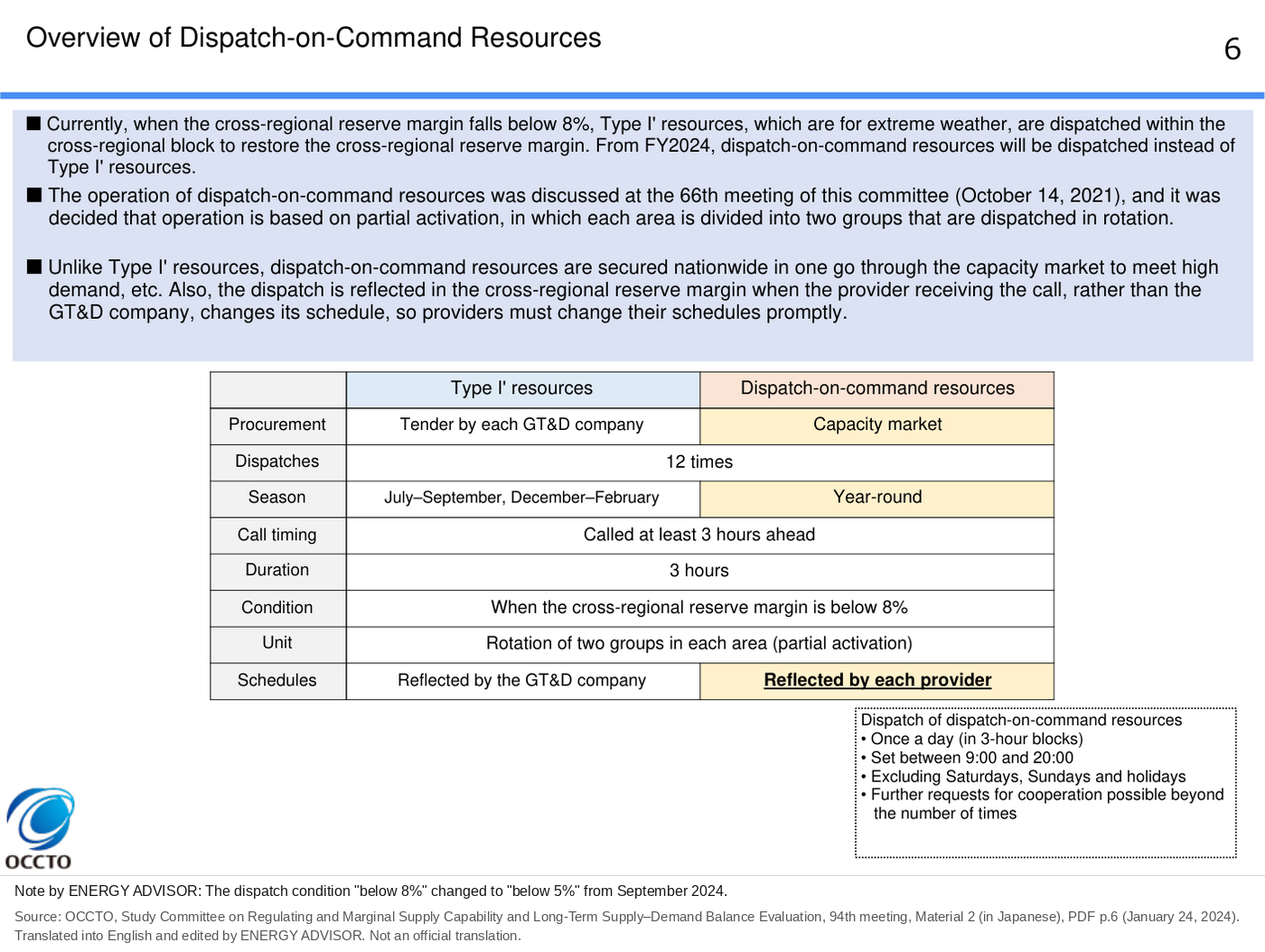
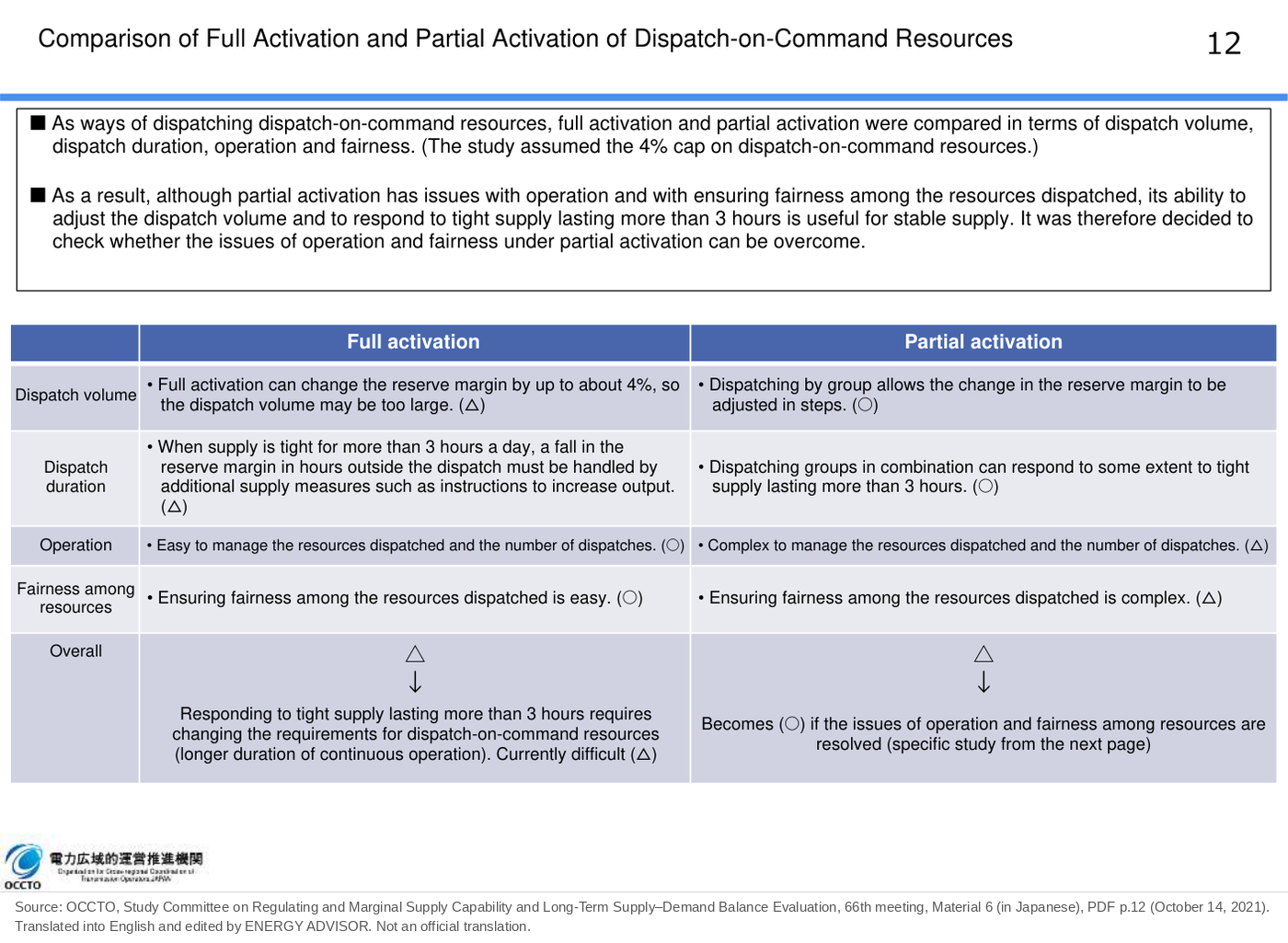
How dispatch-on-command resources are operated was discussed in OCCTO’s Study Committee on Regulating and Marginal Supply Capability and Long-Term Supply–Demand Balance Evaluation, 66th meeting, Material 6 (October 14, 2021). In each area, dispatch-on-command resources are divided into two groups, and each group is dispatched in turn. This is called “partial activation” and is the basic mode of operation. If the full volume is dispatched at once, the cross-regional reserve margin can jump by up to about 4%, and the volume dispatched may be excessive. The reasons given are that dividing them into groups allows the reserve margin to be adjusted step by step, and that combining groups allows some response to tight periods lasting more than 3 hours (same, Material 6, PDF pp.10–12).
With Type I’ resources, the GT&D company tracked the supply capacity and reflected it in the cross-regional reserve margin. With dispatch-on-command resources, the supply capacity is reflected in the cross-regional reserve margin when the company receiving the call changes its schedule. Companies are therefore required to change their schedules promptly.
How the Effectiveness Test Works
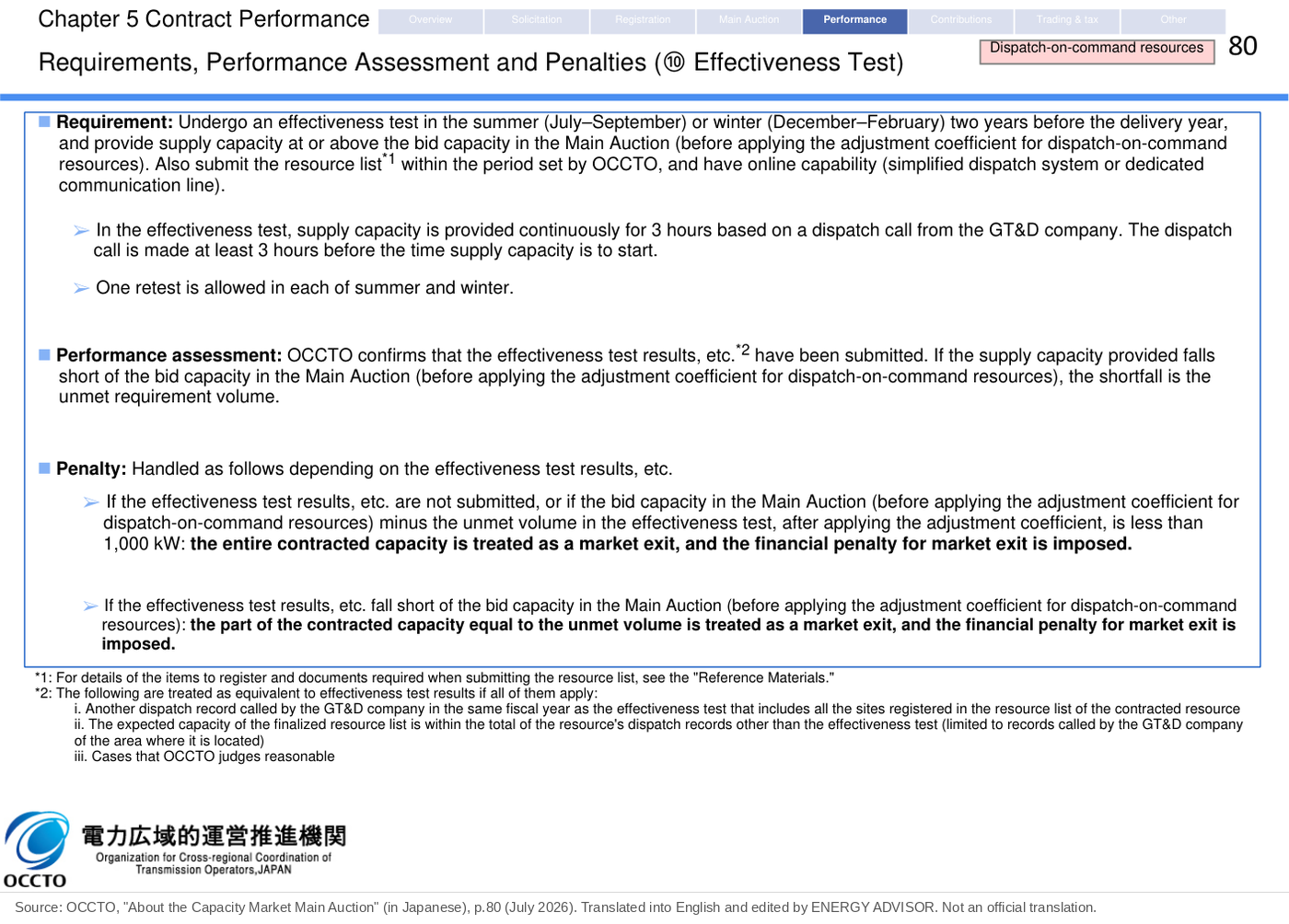
The effectiveness test requirement is “to provide supply capacity at or above the contracted capacity in the effectiveness test.”
Capacity providers take the effectiveness test in the summer (July–September) or winter (December–February) two years before the delivery year. In this test, they must show that they can provide supply capacity at or above their contracted capacity. For example, the effectiveness tests for delivery year FY2028 are held in the summer and winter of FY2026 (OCCTO, “About Effectiveness Tests (Delivery Year FY2028)”, February 2026).
- To take the effectiveness test, a resource list (a list of the bundled resources) must be submitted in advance. The resource must also have the ability to receive instructions online (including a simplified dispatch system).
- In the effectiveness test, the resource provides supply capacity continuously for 3 hours based on a dispatch call from the GT&D company. The dispatch call is issued at least 3 hours before supply begins, and the company cannot choose the date and time.
- A retest may be taken only once each in summer and winter.
- If the test is held on two consecutive days, the company can choose to submit the first day, the second day or the two-day average.
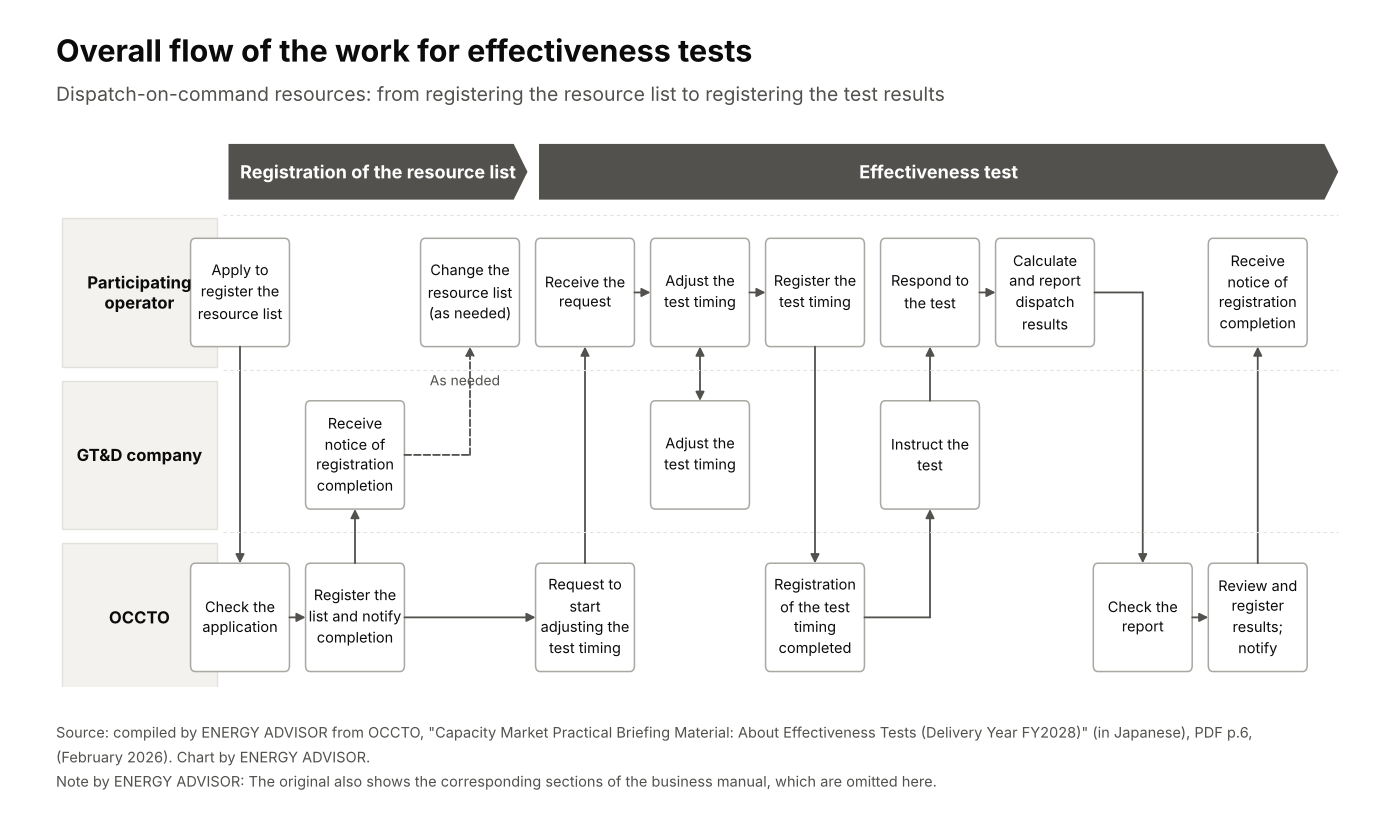
For the effectiveness tests for delivery year FY2028, the following points changed from the previous year’s operations manual (same, PDF p.7).
- Clarified the treatment of resources with multiple bids at one site
- Clarified the treatment when the resource list is updated or the number identifying a site changes
- Unified, without exception, the settlement of energy produced in the effectiveness test into imbalance settlement (the mechanism that settles the difference between schedule and actual)
- Made more flexible the deadlines for correcting deficiencies after reporting dispatch results and for market exit
Performance Assessment and Penalty for the Effectiveness Test
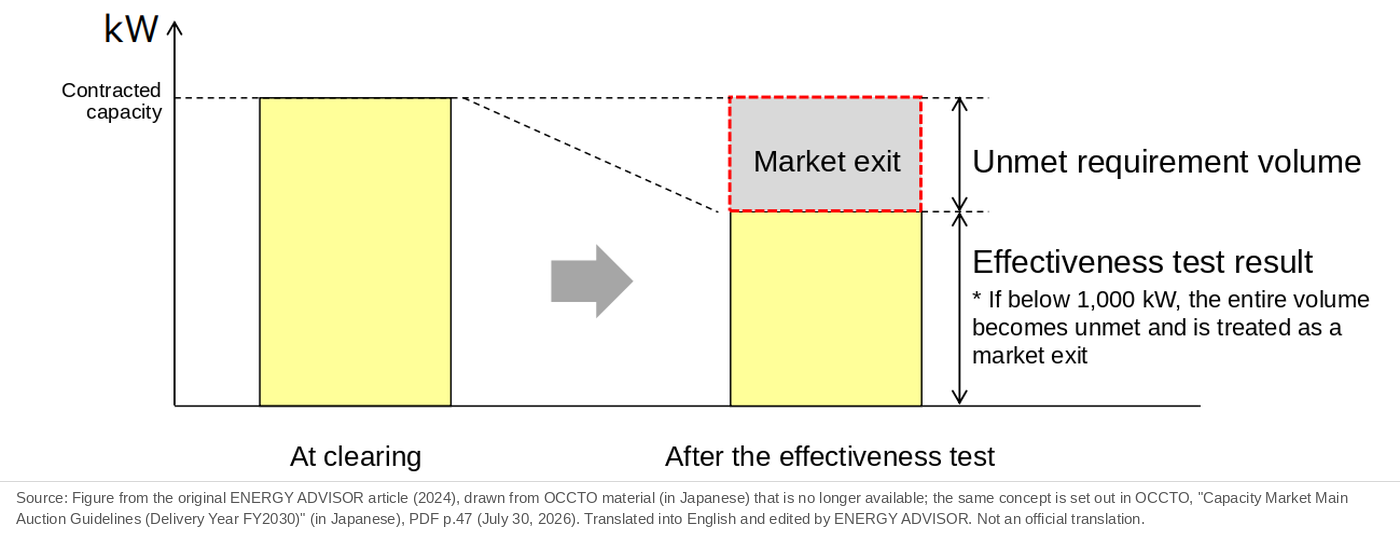
Performance is assessed for each 30-minute period. If the expected capacity in the effectiveness test is less than the contracted capacity, the shortfall is the “effectiveness test unmet volume.”
However, in the following cases, the full contracted capacity is treated as the unmet volume.
- If the effectiveness test results or other required information were not submitted
- If the value obtained by subtracting the effectiveness test unmet volume from the bid volume (before applying the adjustment coefficient) and then applying the adjustment coefficient is less than 1,000 kW (Guidelines (Delivery Year FY2030), PDF p.47)
The effectiveness test unmet volume is treated as part of the contracted capacity having exited the market. In this case, the financial penalty for market exit is imposed (Main Auction Guidelines (Delivery Year FY2030), PDF pp.47–48).
Financial penalty (¥) = capacity payment (¥) × 5% × exited capacity (kW) ÷ contracted capacity (kW)
The capacity payment divided by the contracted capacity is the contract unit price, so this is roughly the same as 5% of the clearing price multiplied by the exited capacity. The 5% is the rate for exit before the end of the confirmation period for contract changes and cancellations. For exit after the confirmation period, it is 10% (same, PDF p.38).
To actually take part, there are also procedures such as providing online functions and obtaining a company code and a grid code, so sufficient preparation time is needed.
Responding to Dispatch Calls (12 Times a Year, 3 Hours Each)
The requirement
The requirement for responding to dispatch calls is “to respond appropriately when the GT&D company issues a dispatch call.”
In response to dispatch calls, a capacity provider must provide supply capacity at or above its contracted capacity, up to 12 times a year, continuously for 3 hours each time. When a dispatch call is issued, the provider supplies capacity through supply to retail electricity suppliers under bilateral contracts, offers to the wholesale electricity market and similar means.
Under the Main Auction Guidelines for delivery year FY2030, the conditions for dispatch calls are as follows (same, PDF p.50).
- 12 dispatches per year, with a limit of one per day
- The dispatch call is issued at least 3 hours before supply capacity is provided
- Duration of 3 hours (between 9:00 and 20:00, excluding Saturdays, Sundays and holidays)
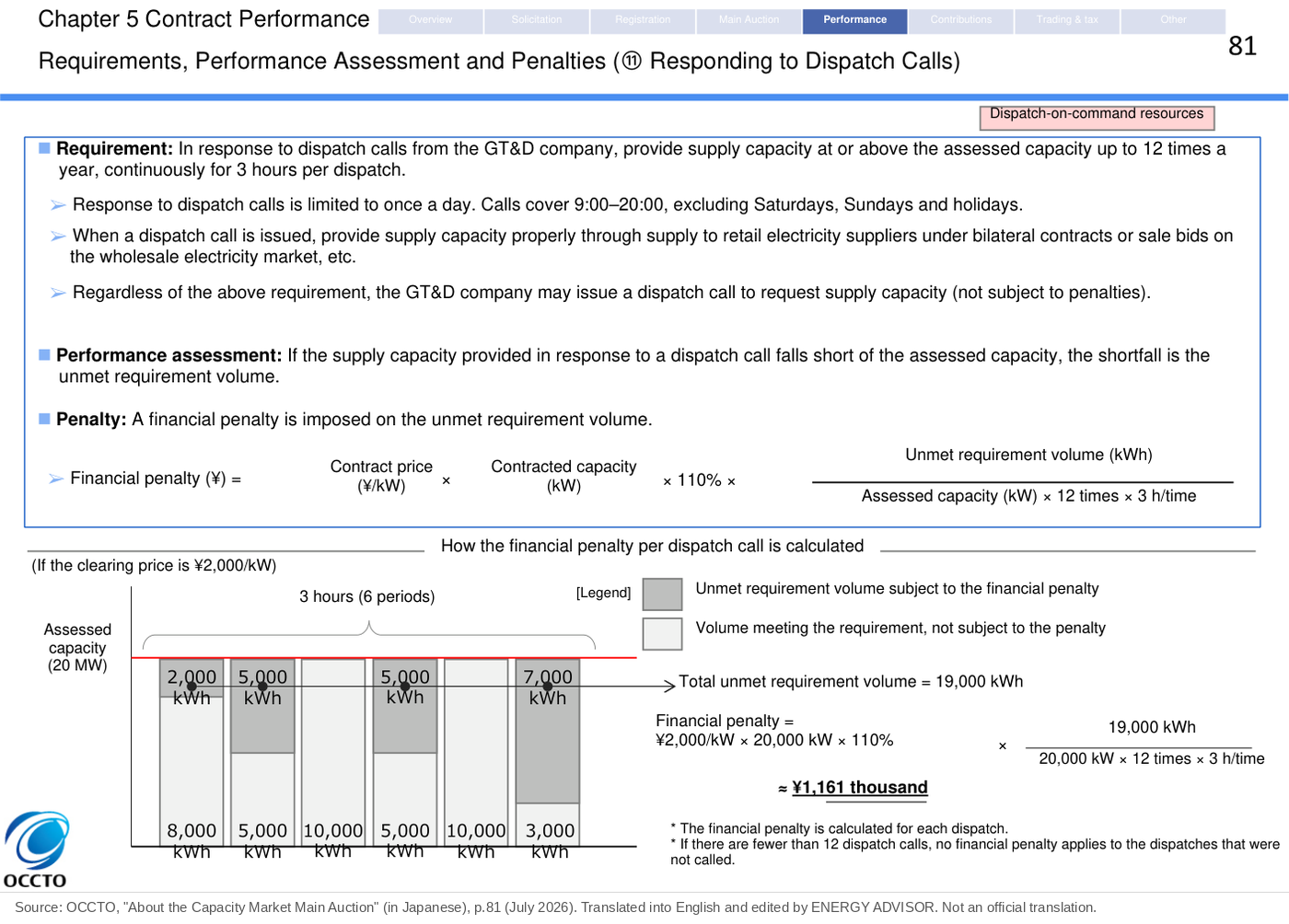
The GT&D company may issue dispatch calls beyond these conditions, but in that case no financial penalty applies.
Timing of dispatch
Dispatch-on-command resources are positioned as the first measure used among the additional supply measures during tight supply-demand conditions (Study Committee on Regulating and Marginal Supply Capability and Long-Term Supply–Demand Balance Evaluation, 94th meeting, Material 2).
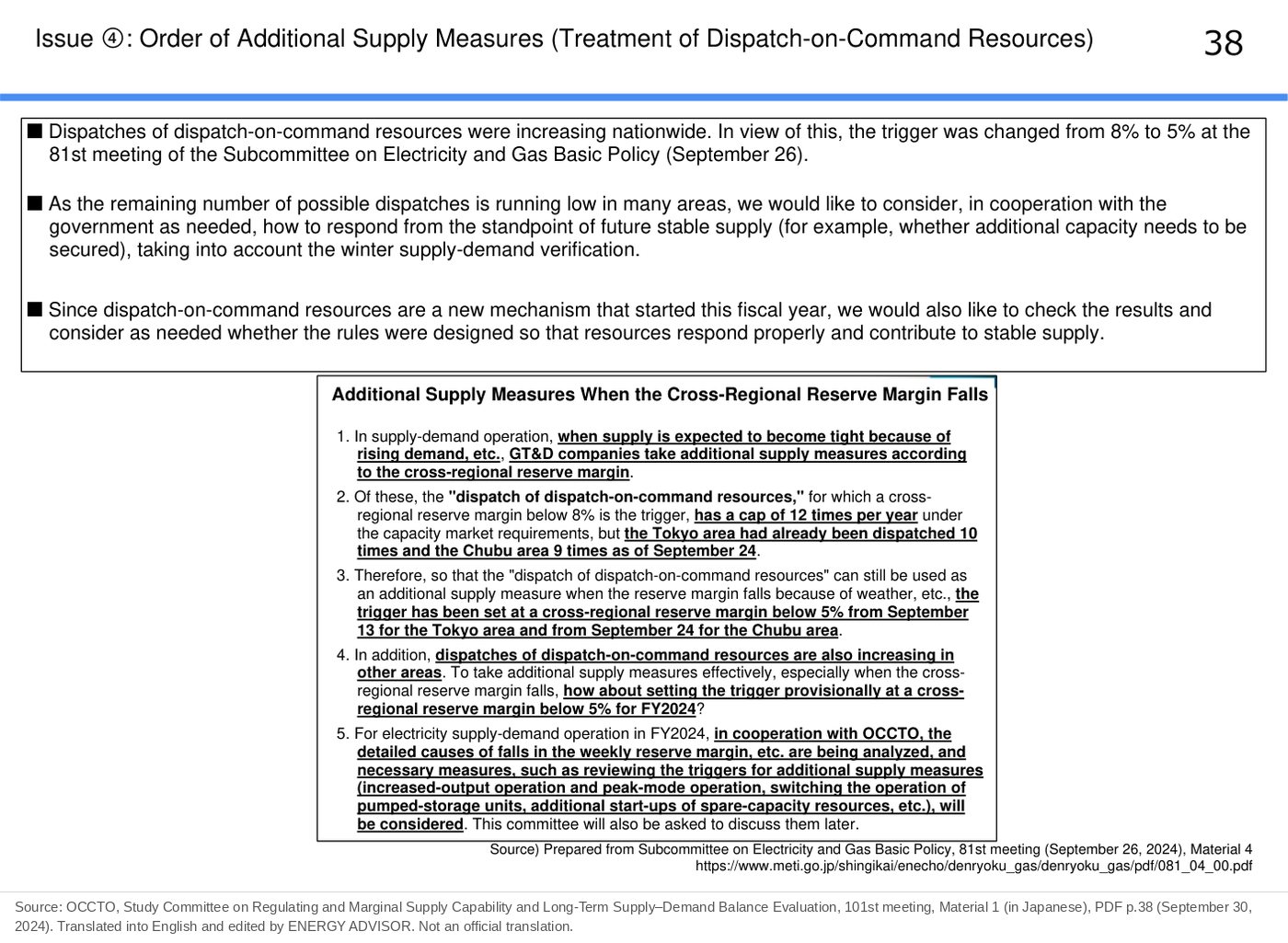
At the start of the system, the dispatch threshold was “when the cross-regional reserve margin is expected to fall below 8%.” In FY2024, the number of dispatches rose nationwide, and the Tokyo area reached 10 (of the limit of 12) by September 20. The Tokyo area from September 13 and the Chubu area from September 24 had used a cross-regional reserve margin below 5% as their criterion. Then, at the 81st meeting of the Subcommittee on Electricity and Gas Basic Policy (an ANRE advisory council) on September 26, 2024, a proposal was presented to use below 5% provisionally for the rest of FY2024, and the threshold changed from 8% to 5% (Subcommittee on Electricity and Gas Basic Policy, 81st meeting, Material 4, p.1, September 26, 2024; Study Committee on Regulating and Marginal Supply Capability and Long-Term Supply–Demand Balance Evaluation, 101st meeting, Material 1, PDF pp.15 and 38, September 30, 2024). This provisional practice is to continue for the time being from FY2025 onward (107th meeting of the same committee, Material 3, PDF pp.4 and 11, March 19, 2025; Study Committee on the Capacity Market, 76th meeting, Material 5, PDF p.17).
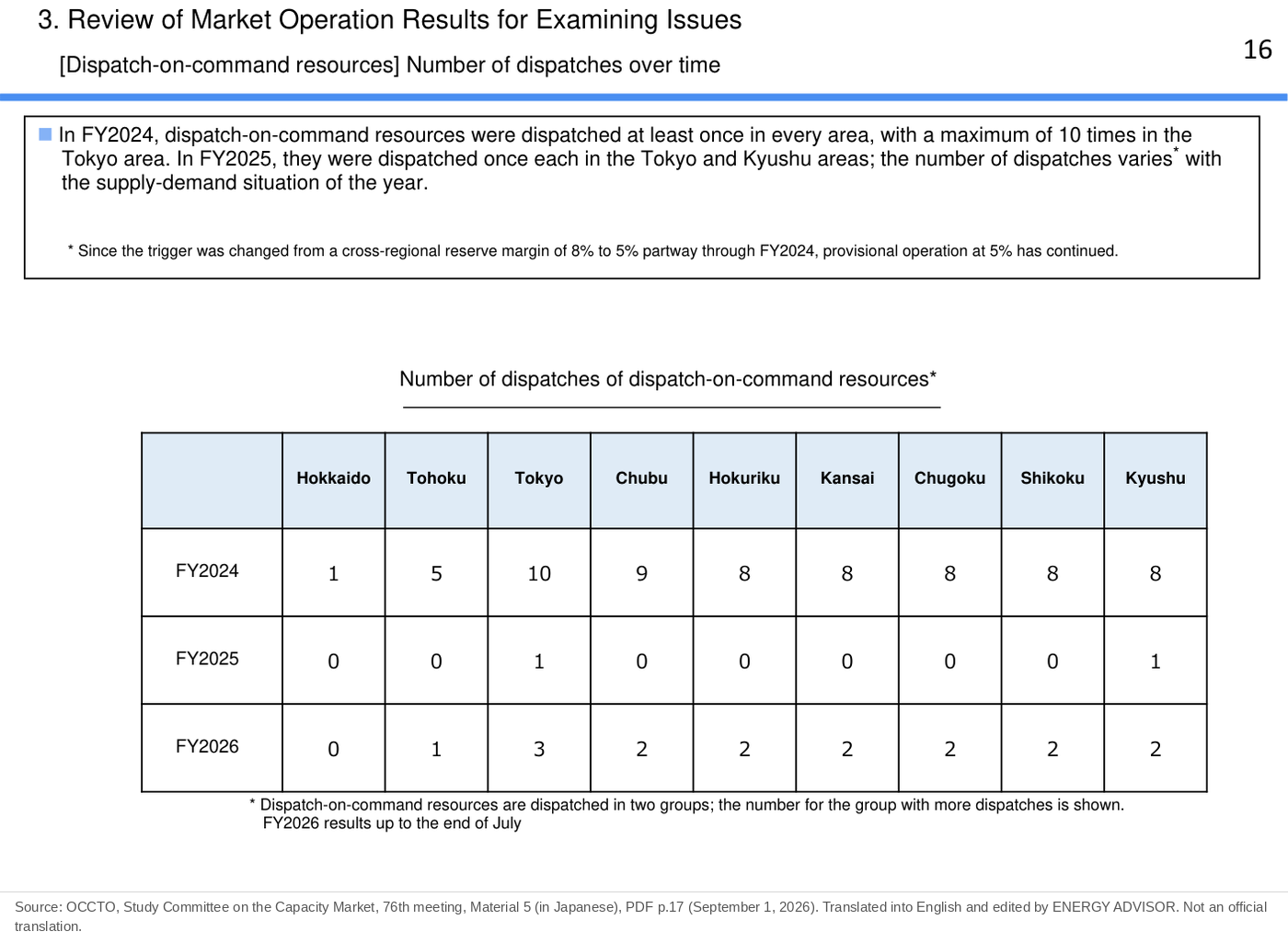
Dispatches so far
| Area | Hokkaido | Tohoku | Tokyo | Chubu | Hokuriku | Kansai | Chugoku | Shikoku | Kyushu |
|---|---|---|---|---|---|---|---|---|---|
| FY2024 | 1 | 5 | 10 | 9 | 8 | 8 | 8 | 8 | 8 |
| FY2025 | 0 | 0 | 1 | 0 | 0 | 0 | 0 | 0 | 1 |
| FY2026 (through end of July) | 0 | 1 | 3 | 2 | 2 | 2 | 2 | 2 | 2 |
(Unit: times. The number for whichever of the two groups was dispatched more often. Source: 76th meeting, Material 5, PDF p.17)
Performance assessment and penalty
If the supply capacity provided in response to a dispatch call is less than the contracted capacity, the shortfall becomes the unmet requirement volume, and the following financial penalty is imposed (Study Committee on the Capacity Market, 71st meeting, Material 4, PDF p.10).
Financial penalty = capacity payment × 110% × unmet volume ÷ (assessment capacity × 3 hours × 12 times)
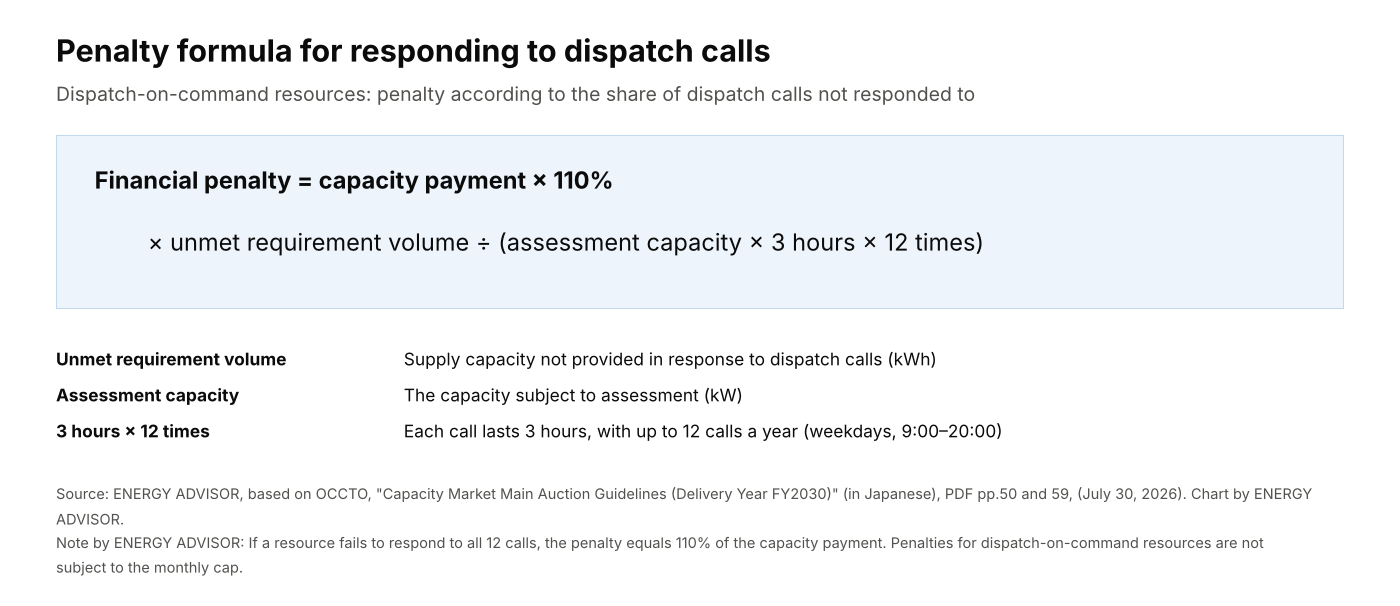
If a resource fails to respond to all 12 calls of 3 hours each in a year, the penalty equals 110% of the capacity payment. It can be seen as a penalty with a 10% surcharge.
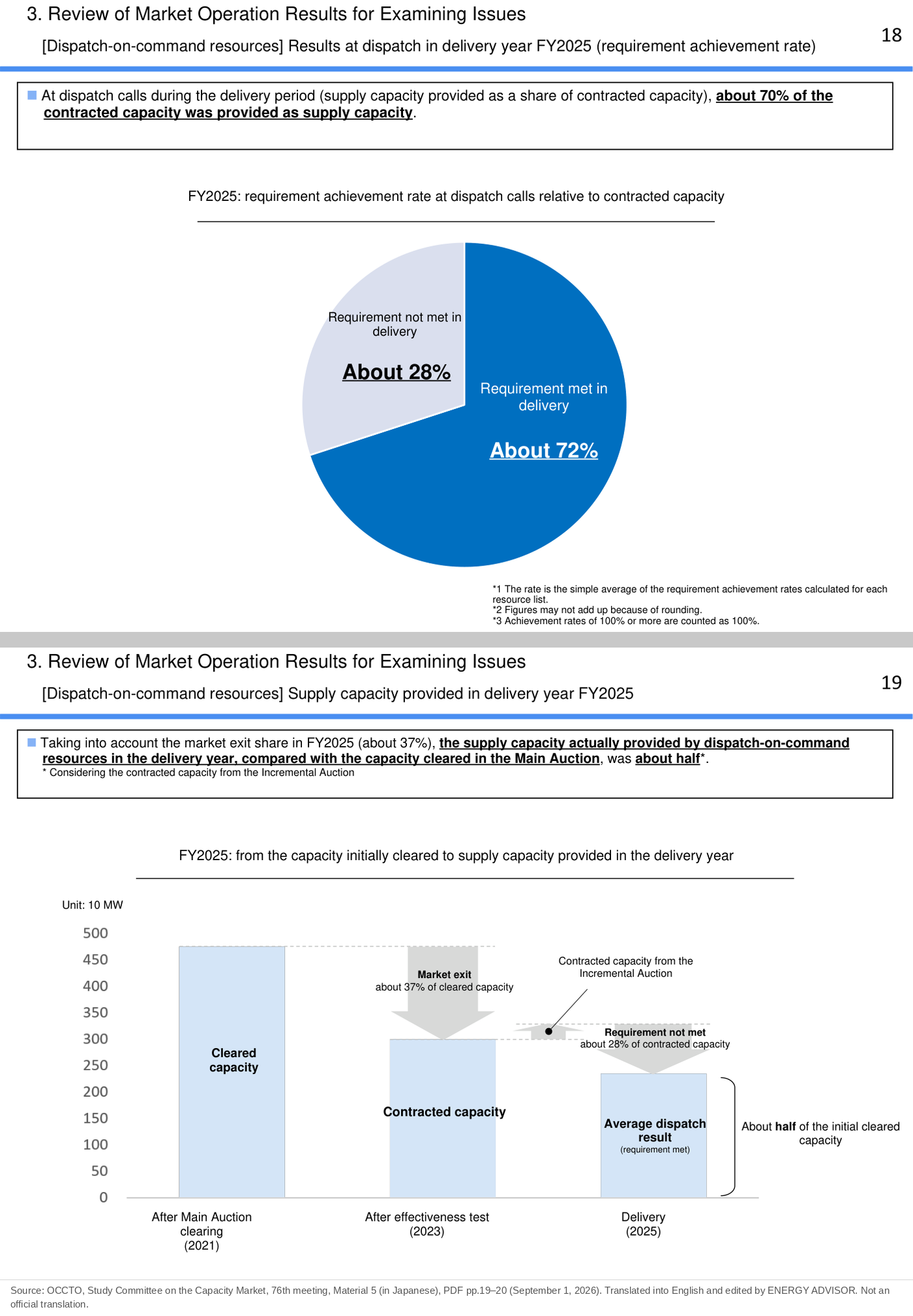
At dispatches in FY2025, about 72% of the contracted capacity was provided. This is called the requirement achievement rate. In addition, in FY2025, about 37% of the cleared capacity had exited the market after the effectiveness test. Taking both into account, the supply capacity actually provided was about half of the originally cleared capacity (76th meeting, Material 5, PDF pp.19–20).
The share of penalties in capacity payments excluding market exit was 13.2% in FY2024 and 1.0% in FY2025 for dispatch-on-command resources. FY2025 was lower because there were few dispatches (same, PDF p.22).
Adjustment Coefficient and Bidding Cap
Adjustment coefficient
When the volume of dispatch-on-command resources in an area exceeds a certain level, an “adjustment coefficient” is applied that lowers the share counted as supply capacity, from the standpoint of securing supply reliability. The adjustment coefficient is calculated after the fact from the bidding results.
In the Incremental Auction for delivery year FY2027, the adjustment coefficients calculated at the Main Auction were used. They were about 56.6% in Hokkaido, about 92.8% in Kyushu and 100% in the other areas (Study Committee on the Capacity Market, 76th meeting, Material 3, PDF p.17).
Even when an adjustment coefficient applies, a resource responding to a dispatch call must provide supply capacity for 3 hours at its capacity before the adjustment coefficient (76th meeting, Material 3, PDF p.23).
Bidding cap
There is a cap on the bid volume of dispatch-on-command resources. It is 4% of nationwide H3 demand (the average of the three highest daily peak demands in a month) in the Main Auction and 1% of each area’s H3 demand in the Incremental Auction (76th meeting, Material 3, PDF p.12; clearing results for FY2028, PDF p.9).
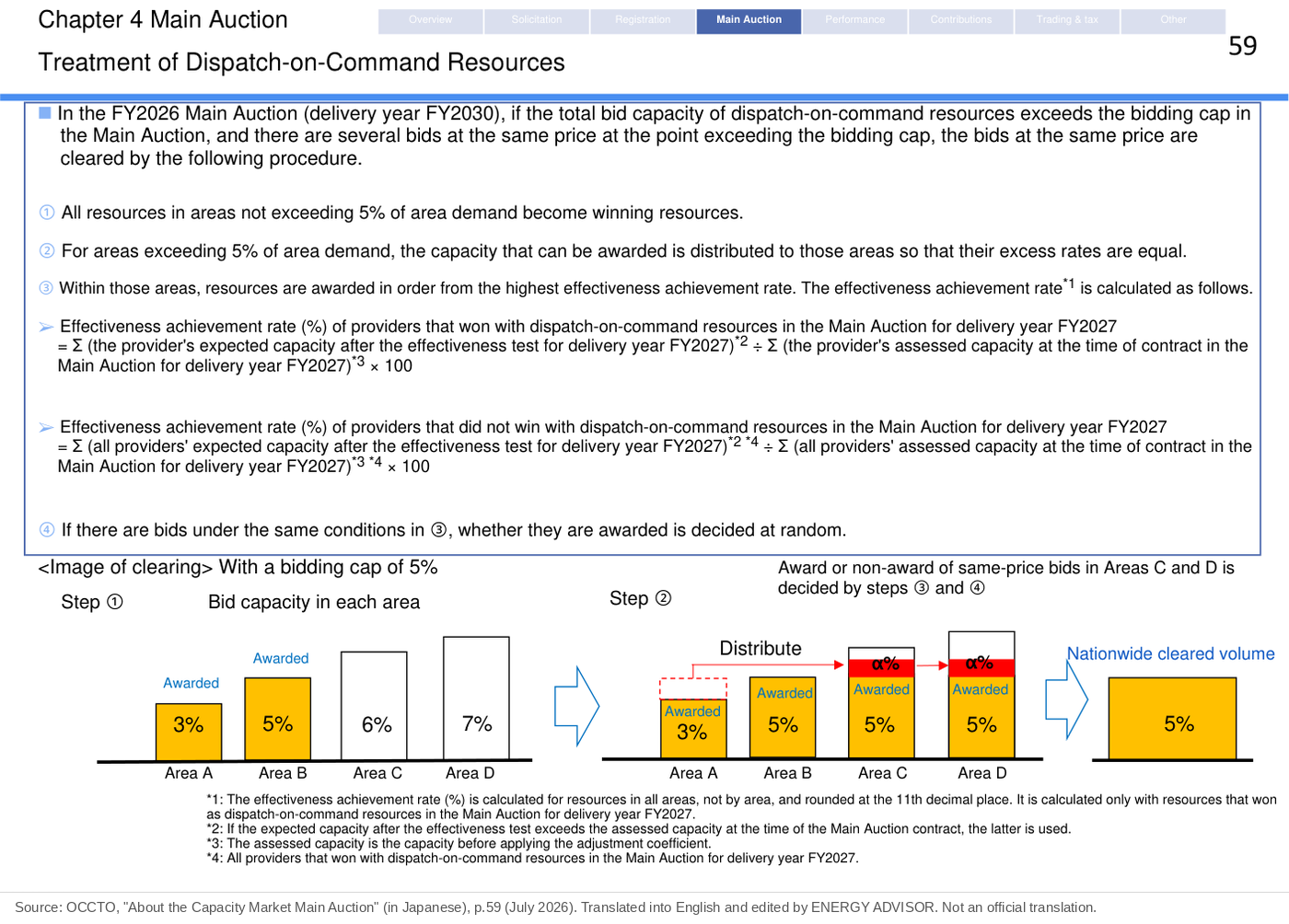
In the Main Auction for delivery year FY2029, the bid volume after applying the adjustment coefficients exceeded the cap. At the point where the cap was crossed, there were several bids at the same price. Winning and losing bids were therefore decided in order of effectiveness test achievement rate. Bids with the same achievement rate were decided at random (clearing results for FY2029, PDF p.9).
From delivery year FY2030, the Main Auction cap is to be raised from 4% to 5% of H3 demand (Study Committee on the Capacity Market, 74th meeting, Material 3, PDF p.6; OCCTO, “About the Capacity Market Main Auction”, briefing material, PDF p.6, July 2026). In the final Main Auction Guidelines, the value of the cap is “to be announced separately.” The procedure for handling bids at the same price uses 5% of area demand as its basis (Guidelines (Delivery Year FY2030), PDF pp.31–32).
What Has Been Decided, What Values Have Not Been Published, and What Is Under Study
The situation as of October 2026 is organized into the following three groups.
What has been decided
In the Main Auction for delivery year FY2030 (bidding in October 2026), the supply capacity previously left for the Incremental Auction (2% of H3 demand) is procured in the Main Auction. In the demand curve published on July 30, 2026, the item “supply capacity planned to be procured in the Incremental Auction” has been removed (FY2026 Main Auction Demand Curve, PDF p.3).
What values have not been published
The bidding cap for dispatch-on-command resources in the Main Auction is to be raised from 4% to 5% of H3 demand (OCCTO, “About the Capacity Market Main Auction”, briefing material, PDF p.6, July 2026). In the final Main Auction Guidelines, the value of the cap (kW) is “to be announced separately” (Guidelines (Delivery Year FY2030), PDF p.31). This article has not confirmed the value in kW.
What is under study
Following the FY2025 comprehensive review, the following directions were presented at the study committee on September 1, 2026 (76th meeting, Material 5).
- Clarifying the category criteria: for battery storage and on-site generation, whether to bid as stable resources or as dispatch-on-command resources may depend on the company’s judgment. The requirements for each category will therefore be organized. The proposal is to revise resource substitution (replacing a winning resource with another) so that it is allowed only within the same category (same, PDF pp.37–49).
- Measures to make up for exited capacity: in years when no Incremental Auction is held, capacity that has exited the market would be replaced. The replacements would be resources that did not win in the Main Auction and the portion by which effectiveness test results exceeded contracted capacity (same, PDF pp.65–69).
In addition, in the call for comments for the comprehensive review, companies commented that “the bidding timing for dispatch-on-command resources should be brought closer to the delivery year” (Study Committee on the Capacity Market, 71st meeting, Material 4, PDF p.29). This is at the stage of companies’ comments and is not a policy of the study committee.
Summary
- Dispatch-on-command resources, such as DR and on-site generation, provide supply capacity during tight supply-demand conditions in response to dispatch calls from the GT&D company. From FY2024, they have taken over this role from Type I’ resources.
- Two years before delivery, they take an effectiveness test and show that they can provide supply capacity at or above their contracted capacity for 3 hours. Any shortfall is treated as market exit, with a penalty of 5% of the contract unit price (10% after the confirmation period).
- In the delivery year, they respond to dispatch calls up to 12 times a year, 3 hours each time. Since partway through FY2024, the dispatch threshold has been a cross-regional reserve margin of 5% on a provisional basis.
- In areas with large volumes, an adjustment coefficient applies, and bid volumes are capped at 4% (Main Auction) and 1% (Incremental Auction) of H3 demand. From delivery year FY2030, the Main Auction cap will be raised to 5%.
- In FY2025, the achievement rate at dispatch was about 72% and market exit about 37%, so the supply capacity actually provided was about half of the originally cleared capacity. Clarifying the categories and measures to make up for exited capacity are under study.
This article is based on published materials from the Ministry of Economy, Trade and Industry and its Agency for Natural Resources and Energy, the Electricity and Gas Market Surveillance Commission, the Organization for Cross-regional Coordination of Transmission Operators (OCCTO) and other sources. The English translations of figures are by ENERGY ADVISOR and are not official translations. When using this information for decisions, please check the original sources. When we find an error, we correct the article and note the date of the correction.
Sources
- OCCTO, “About Effectiveness Tests (Delivery Year FY2028)”, capacity market practical briefing material (in Japanese), PDF p.7, February 2026. https://www.occto.or.jp/assets/various/capacity-market/260206_youryou_jikkouseitestsetsumei.pdf
- Study Committee on the Capacity Market, 76th meeting, Material 5, “Actions After the FY2025 Comprehensive Review and Direction for Each Issue (Resource Categories and Requirements and Penalties for Tight Supply-Demand Conditions)” (in Japanese), PDF p.17, pp.19–20, p.22, p.34, pp.37–49, pp.65–69, September 1, 2026. https://www.occto.or.jp/assets/iinkai/youryou_kentoukai/76/youryou_kentoukai_76_05.pdf
- Study Committee on the Capacity Market, 76th meeting, Material 3, “Capacity Market Incremental Auction Clearing Results (Delivery Year FY2027)” (in Japanese), PDF p.12, p.17, p.23, August 6, 2026. https://www.occto.or.jp/assets/iinkai/youryou_kentoukai/76/youryou_kentoukai_76_03.pdf
- Study Committee on the Capacity Market, 71st meeting, Material 4, “FY2025 Comprehensive Review of the Capacity Market (Call for Evidence Results, Part 2)” (in Japanese), PDF p.10, p.29, January 30, 2026. https://www.occto.or.jp/assets/iinkai/youryou_kentoukai/71/youryou_kentoukai_71_04.pdf
- Study Committee on the Capacity Market, 74th meeting, Material 3, “Start of Public Consultation on the Draft FY2026 Main Auction Guidelines (Delivery Year FY2030)” (in Japanese), PDF p.6, June 30, 2026. https://www.occto.or.jp/assets/iinkai/youryou_kentoukai/74/youryou_kentoukai_74_03.pdf
- OCCTO, “Capacity Market Main Auction Clearing Results (Delivery Year FY2028)” (in Japanese), PDF p.9, January 29, 2025. https://www.occto.or.jp/assets/market-board/market/oshirase/2024/files/250129_mainauction_youryouyakujokekka_kouhyou_jitsujukyu2028.pdf
- OCCTO, “Capacity Market Main Auction Clearing Results (Delivery Year FY2029)” (in Japanese), PDF p.6, p.9, January 20, 2026. https://www.occto.or.jp/assets/news/capacity-market/260120_mainauction_youryouyakujokekka_kouhyou_jitsujukyu2029.pdf
- OCCTO, “Capacity Market Main Auction Guidelines (Delivery Year FY2030)” (in Japanese), PDF pp.31–32 (bidding cap and clearing for dispatch-on-command resources), p.38 (market exit penalty), pp.47–48 (effectiveness test), p.50 (conditions for dispatch calls), July 30, 2026. https://www.occto.or.jp/assets/market-board/market/jitsujukyukanren/260730_mainauction_boshuyoukou_jitsujukyu2030.pdf
- OCCTO, “FY2026 Main Auction Demand Curve (Delivery Year FY2030)” (in Japanese), PDF p.3, July 30, 2026. https://www.occto.or.jp/assets/market-board/market/jitsujukyukanren/260730_mainauction_jyuyoukyokusen_jitsujukyu2030.pdf
- OCCTO, “Overview of Requirements, Performance Assessment and Penalties in the Capacity Market” (in Japanese), February 2021 (link broken as of October 2026). https://www.occto.or.jp/market-board/market/files/210224_requirement_gaiyo.pdf
- OCCTO, “Details of the Capacity Market Main Auction” (in Japanese), July 2023. https://www.occto.or.jp/assets/market-board/market/files/20230718_youryou_shousaisetsumei.pdf
- Study Committee on Regulating and Marginal Supply Capability and Long-Term Supply–Demand Balance Evaluation, 66th meeting, Material 6, “Partial Activation of Dispatch-on-Command Resources and Type I’ Resources” (in Japanese), PDF pp.10–12, October 14, 2021. https://www.occto.or.jp/assets/iinkai/chouseiryoku/2021/files/chousei_66_06.pdf
- Study Committee on Regulating and Marginal Supply Capability and Long-Term Supply–Demand Balance Evaluation, 94th meeting, Material 2 (in Japanese). https://www.occto.or.jp/assets/iinkai/chouseiryoku/2023/files/chousei_94_02.pdf
- Study Committee on Regulating and Marginal Supply Capability and Long-Term Supply–Demand Balance Evaluation, 101st meeting, Material 1, “Issues in Supply-Demand Operation Based on the FY2024 Cross-Regional Reserve Margin” (in Japanese), PDF p.15 (number of dispatches in FY2024), p.38 (change of the dispatch threshold from 8% to 5%; prepared from Subcommittee on Electricity and Gas Basic Policy, 81st meeting (September 26, 2024), Material 4), September 30, 2024. https://www.occto.or.jp/iinkai/chouseiryoku/2024/files/chousei_101_01.pdf
- Study Committee on Regulating and Marginal Supply Capability and Long-Term Supply–Demand Balance Evaluation, 107th meeting, Material 3, “Supply-Demand Operation Based on the Cross-Regional Reserve Margin from FY2025” (in Japanese), PDF p.4, p.11, March 19, 2025. https://www.occto.or.jp/iinkai/chouseiryoku/2024/files/chousei_107_03.pdf
- OCCTO, “About the Capacity Market Main Auction” (briefing material) (in Japanese), PDF p.6 (revision of the bidding cap to 5%), p.59 (treatment of dispatch-on-command resources), pp.80–81 (effectiveness test and responding to dispatch calls), July 2026. https://www.occto.or.jp/www.occto.or.jp/news/20260708_youryou_seidosetsumei.pdf
- Advisory Committee for Natural Resources and Energy, Electricity and Gas Industry Committee, Subcommittee on Electricity and Gas Basic Policy, 81st meeting, Material 4, “Electricity Supply-Demand Measures (Additional Supply Measures When the Cross-Regional Reserve Margin Falls)” (ANRE) (in Japanese), p.1, September 26, 2024. https://www.meti.go.jp/shingikai/enecho/denryoku_gas/denryoku_gas/pdf/081_04_00.pdf