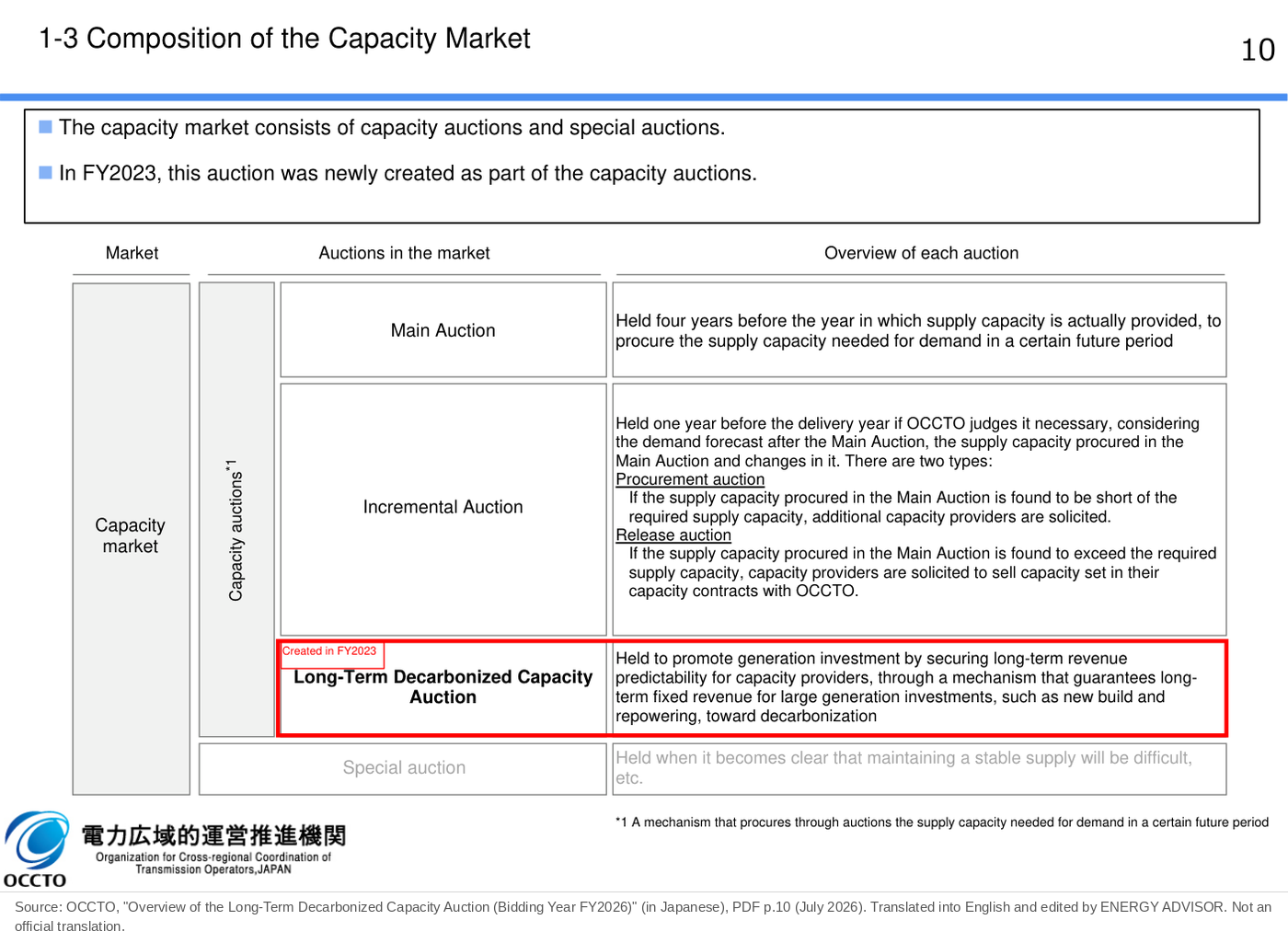
In the current Main Auction of the capacity market, most winning resources are existing plants. A bidding scheme separate from the Main Auction was therefore created to encourage new investment in power plants. It covers decarbonized power sources, and the period over which capacity revenue can be earned is “multiple years” rather than “one year.” This is the Long-Term Decarbonized Capacity Auction, which started in FY2023 (April 2023–March 2024). This article explains the background and purpose of the scheme and briefly summarizes the results of the three rounds so far. The basics of Japan’s electricity system and how the capacity market works are explained in the first to third articles of this series.
Background
Stalled investment in new power plants
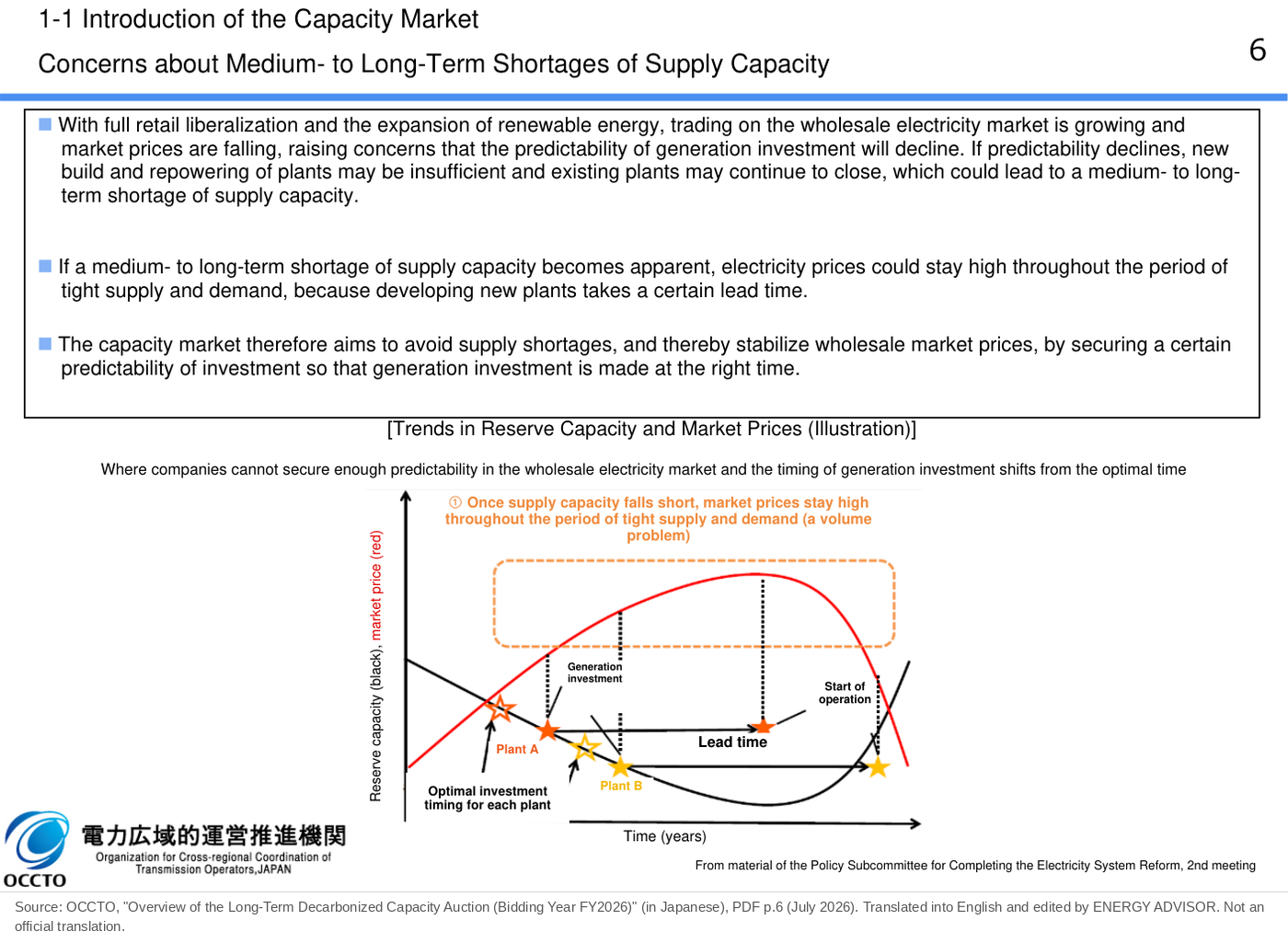
Before full retail liberalization (April 1, 2016), generation investment was recovered through stable electricity rates. Rates were set under cost-of-service regulation (a method of setting regulated tariffs by adding a reasonable profit to costs). Because there was a prospect of recovering investment over the long term, new power plants were developed in a planned way based on demand forecasts.
Since liberalization, generation investment has had to be recovered from market revenue. The markets include wholesale electricity markets such as the day-ahead market (spot market), the capacity market and the Supply and Demand Balancing Market (balancing market). Long-term price outlooks for these markets therefore became important.
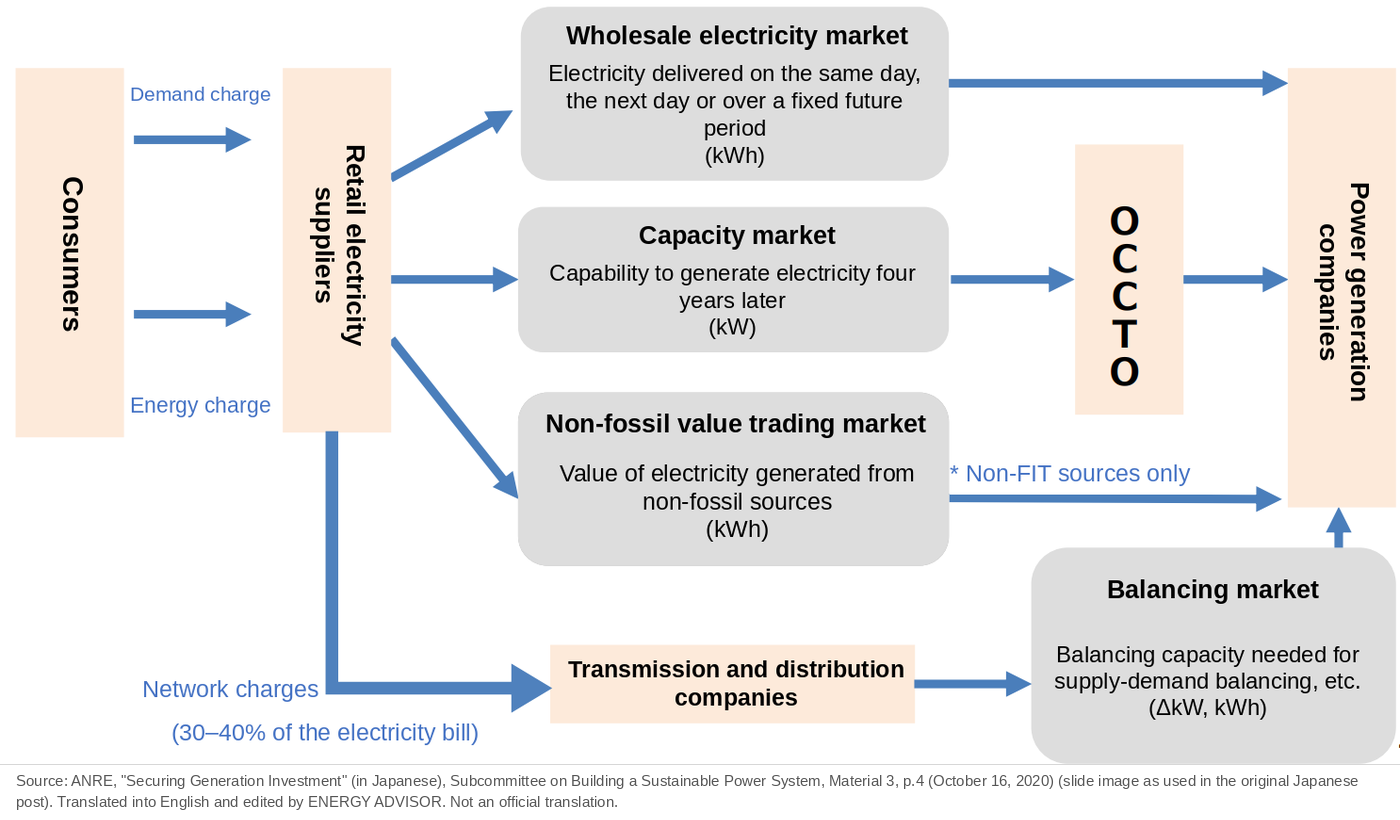
However, the Japan Electric Power Exchange (JEPX) day-ahead market has large price swings (see the graph of fiscal-year averages in Study Committee on the Capacity Market, 73rd meeting, Material 3, PDF p.17). Long-term prices are hard to foresee.
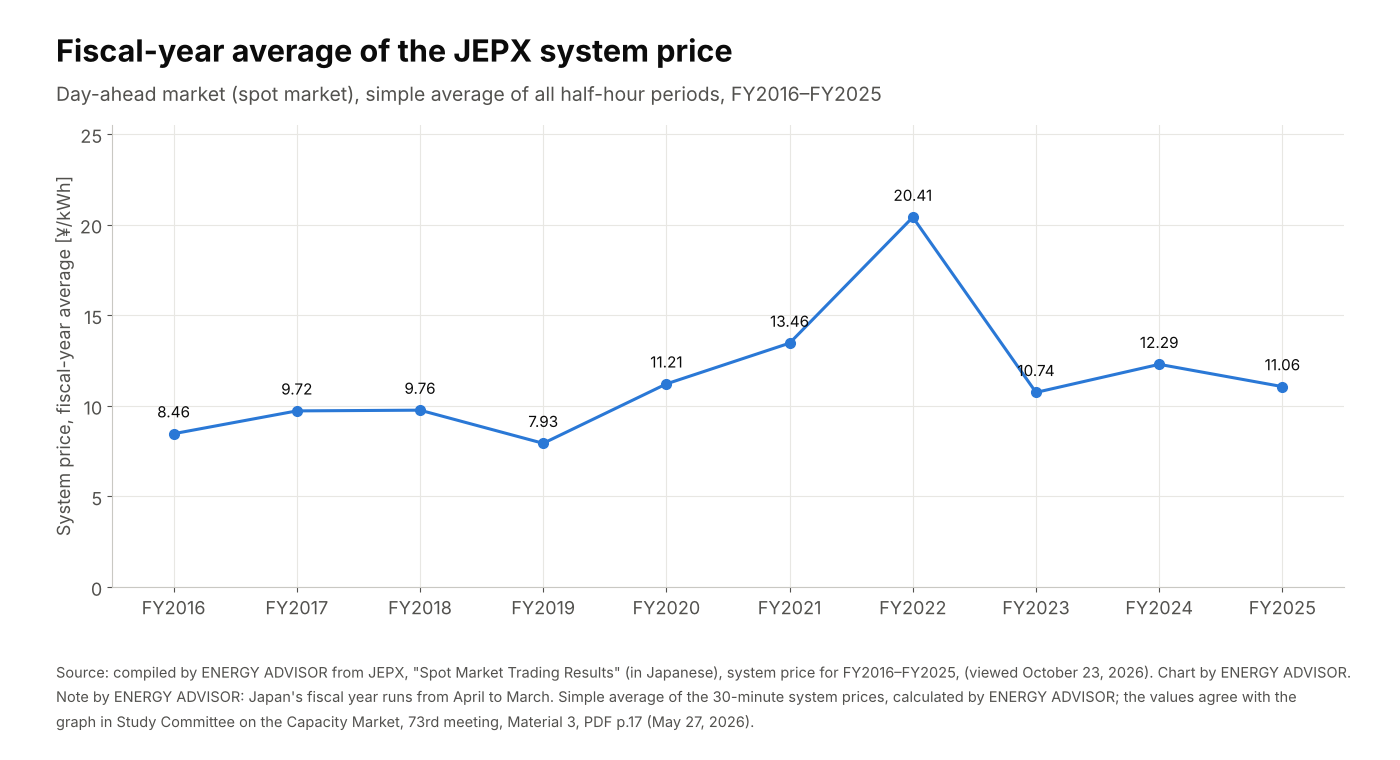
In addition, the capacity market, which began in FY2020 (for delivery year FY2024), is a mechanism for earning capacity revenue for “one year,” four years ahead. Clearing prices vary greatly from year to year (third article of this series), so long-term revenue is again hard to foresee.
In the balancing market (the market in which general transmission and distribution companies buy balancing capacity used to maintain frequency and for similar purposes), trading of all products began in April 2024 (timeline in Study Committee on the Capacity Market, 60th meeting, Material 5, PDF p.6).
Large market price swings reduce the prospect of recovering generation investment over the long term. As a result, there was concern that new investment in power plants requiring large amounts of capital would stop.
At the same time, there was concern that suspensions and retirements of existing plants due to aging would accelerate, further reducing supply capacity.
To secure a stable electricity supply over the medium to long term, a study of mechanisms to encourage new investment in power plants therefore began.
How the scheme was developed
The study took place within the Advisory Committee for Natural Resources and Energy, an advisory council of the Agency for Natural Resources and Energy (ANRE). Under the council are committees (such as the Strategic Policy Committee and the Electricity and Gas Industry Committee). Under them are subcommittees, and under those, working groups.
Up to its 102nd meeting (April 23, 2025), the Working Group on Market Design met under the Subcommittee on Electricity and Gas Basic Policy of the Electricity and Gas Industry Committee. From its 103rd meeting (May 28, 2025), it has met under the Subcommittee on the Next-Generation Electricity and Gas Business Base of the same committee (METI meeting pages for the 102nd and 103rd meetings).
The early study was led by the Subcommittee on Building a Sustainable Power System under the Strategic Policy Committee. Its “Second Interim Report” (August 10, 2021) presented a new scheme. It proposed bidding open to mixed resource types, limited to new investment that helps achieve both carbon neutrality and a stable supply. Winning projects would earn capacity revenue over multiple years. This proposal became the basis of the Long-Term Decarbonized Capacity Auction.
This proposal is closely related to the capacity market. At the 13th meeting of the Subcommittee on Building a Sustainable Power System (December 3, 2021) and the 42nd meeting of the Subcommittee on Electricity and Gas Basic Policy (December 14, 2021), it was therefore decided to move the study to the “Working Group on Market Design.” The Working Group on Market Design had been the forum for studying the capacity market. The specific scheme was studied with a view to introduction in FY2023.
Later, the “Working Group on Market Design 8th Interim Report” (October 2022) positioned the Long-Term Decarbonized Capacity Auction as part of the capacity market. The Organization for Cross-regional Coordination of Transmission Operators, JAPAN (OCCTO) was designated as the operator.
Finally, OCCTO compiled the details of the Long-Term Decarbonized Capacity Auction, and the first bidding was held in FY2023.
Purpose of the Scheme
The Long-Term Decarbonized Capacity Auction gives power generation companies a prospect of recovering their investment, in particular a prospect of recovering fixed costs including the initial investment. In this way, it aims to encourage new investment in decarbonized power sources and to achieve the following two goals at the same time (Overview of the Long-Term Decarbonized Capacity Auction (Bidding Year FY2026), PDF p.11).
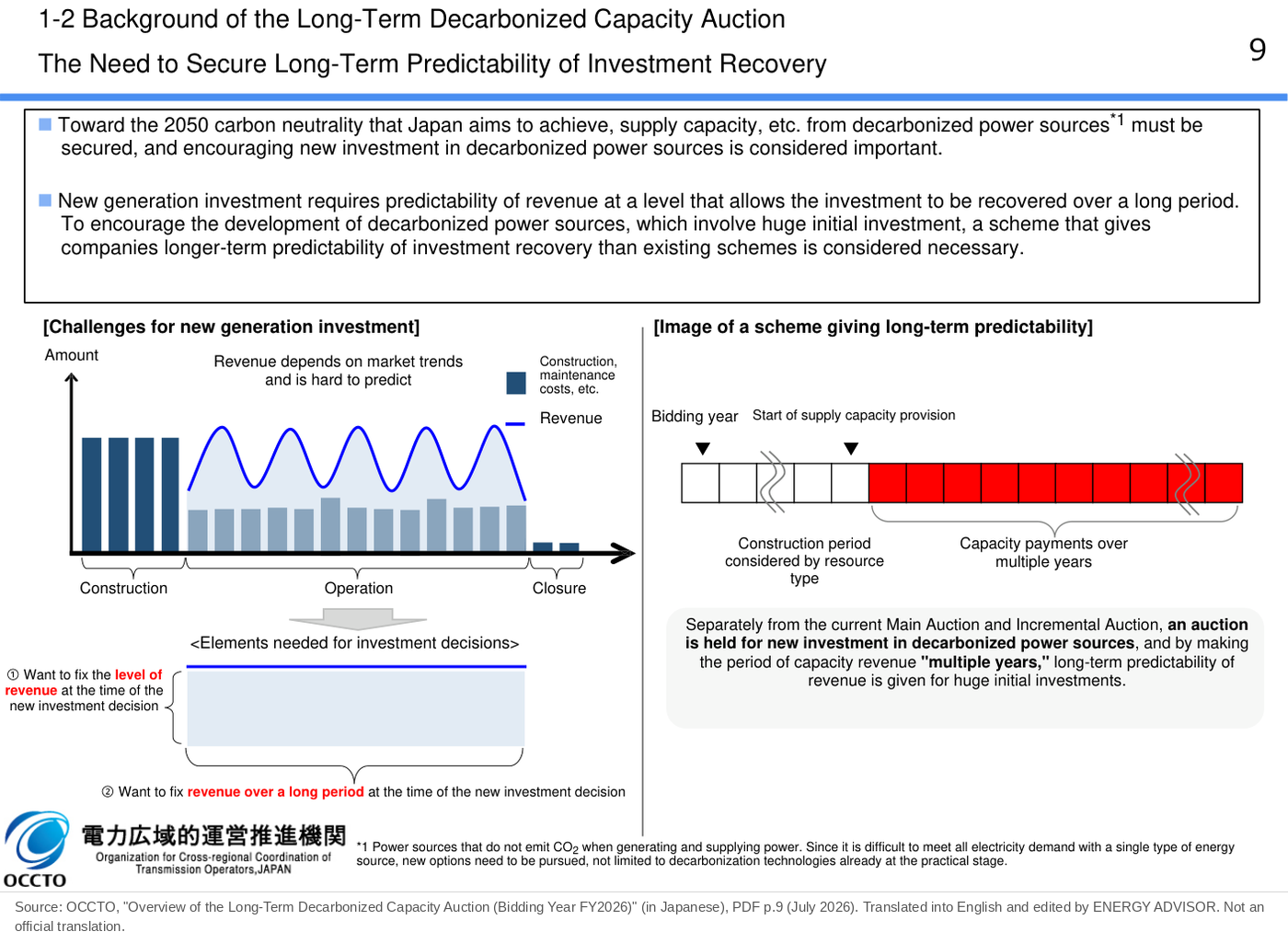
- To curb risks to stable supply and risks of price spikes from a medium- to long-term perspective
- To provide customers with the value of supply capacity from decarbonized power sources, toward carbon neutrality in 2050
Medium- to long-term stable supply and curbing price spikes
Most winning resources in the Main Auction are existing plants. As aging existing thermal plants are suspended and retired, investment in new power plants is essential. By encouraging the introduction of new power plants through the Long-Term Decarbonized Capacity Auction, the scheme aims to maintain a stable supply over the medium to long term.
It is also expected that securing sufficient supply capacity will curb price spikes on the day-ahead market.
Providing decarbonized power sources
As its name suggests, the Long-Term Decarbonized Capacity Auction is limited to decarbonized power sources. Resources introduced through the auction provide customers with the value of supply capacity from decarbonized power sources, toward carbon neutrality in 2050.
However, new build and repowering of LNG-only thermal plants are also eligible. This is because the future supply-demand balance and the progress of decarbonization technologies are uncertain. Achieving carbon neutrality in 2050 is a precondition. At the start of the scheme, this was limited to the three years of FY2023–FY2025. The FY2026 material states that “solicitation will continue for the time being,” and the procurement target for FY2026 is 6,000 MW (same, PDF pp.11 and 23).
Results of the Three Auctions
The results of the three rounds so far are as follows.
| Round (bidding year) | Results published | Decarbonized power sources: target → awarded | LNG-only thermal plants: target → awarded | Main awards (MW) |
|---|---|---|---|---|
| 1st (FY2023) | April 26, 2024 | 4,000 MW → 4,010 MW | 6,000 MW (three years’ worth, FY2023–FY2025) → 5,756 MW | Nuclear (new build) 1,316; battery storage 1,092; retrofit for ammonia co-firing 770; pumped storage 577; dedicated biomass 199; retrofit for hydrogen co-firing 55 |
| 2nd (FY2024) | April 28, 2025 | 5,000 MW → 5,030 MW | About 2,244 MW → 1,315 MW | Safety upgrades of existing nuclear plants 3,153; battery storage and pumped storage 1,730; retrofit for ammonia co-firing 95; conventional hydropower 52 |
| 3rd (FY2025) | May 13, 2026 | 5,000 MW → 4,261 MW | About 2,929 MW → 3,038 MW | Nuclear (new build and repowering) 1,381; battery storage 1,251; safety upgrades of existing nuclear plants 558; pumped storage 453; retrofit for ammonia co-firing 264; dedicated hydrogen 253; dedicated biomass 101 |
(Sources: OCCTO, Long-Term Decarbonized Capacity Auction Clearing Results (Bidding Year FY2023), PDF pp.10 and 14; same (Bidding Year FY2024), PDF pp.12 and 16; Study Committee on the Capacity Market, 73rd meeting, Material 3, PDF pp.14 and 18. Details in the eighth article of this series.)
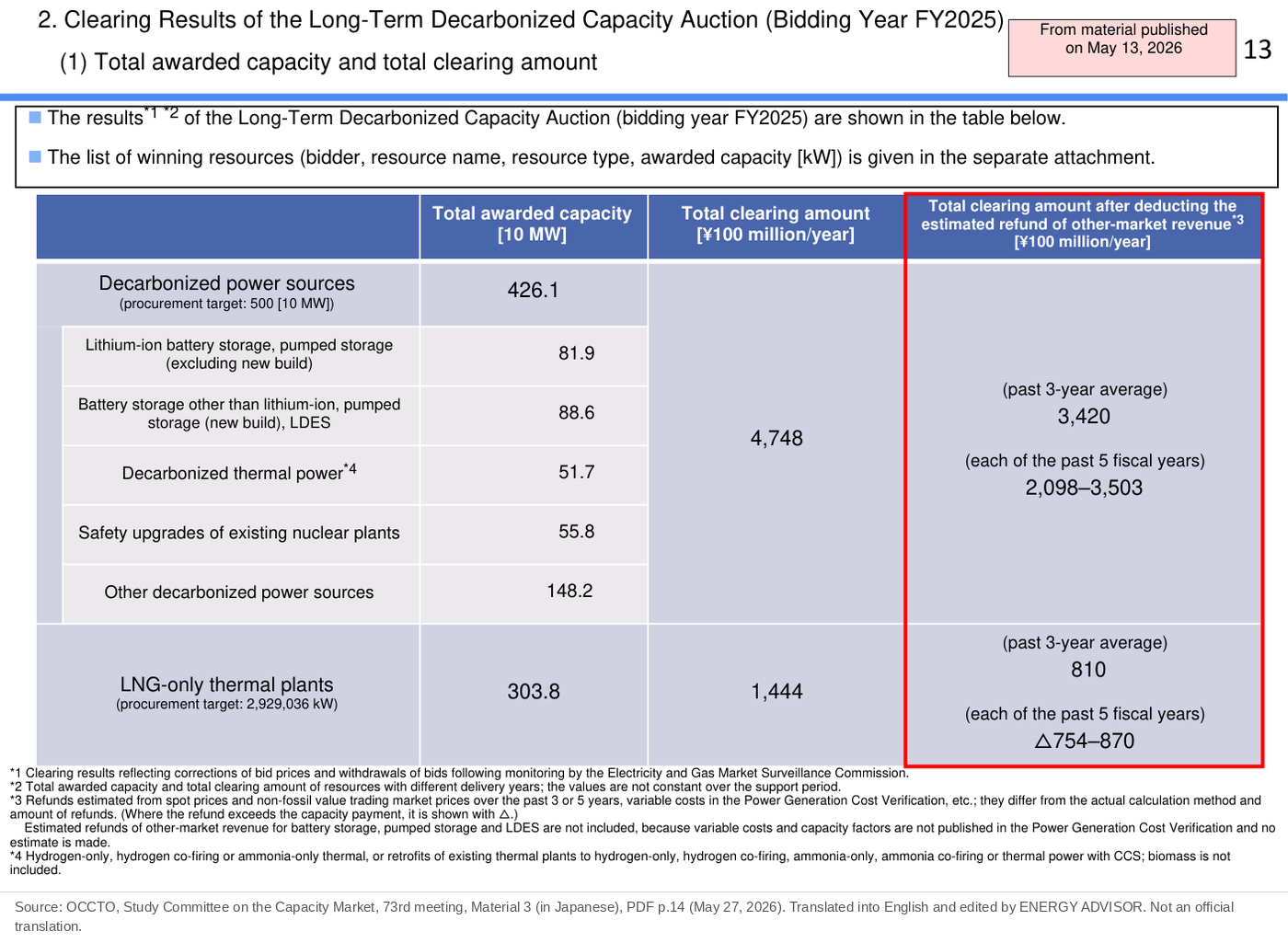
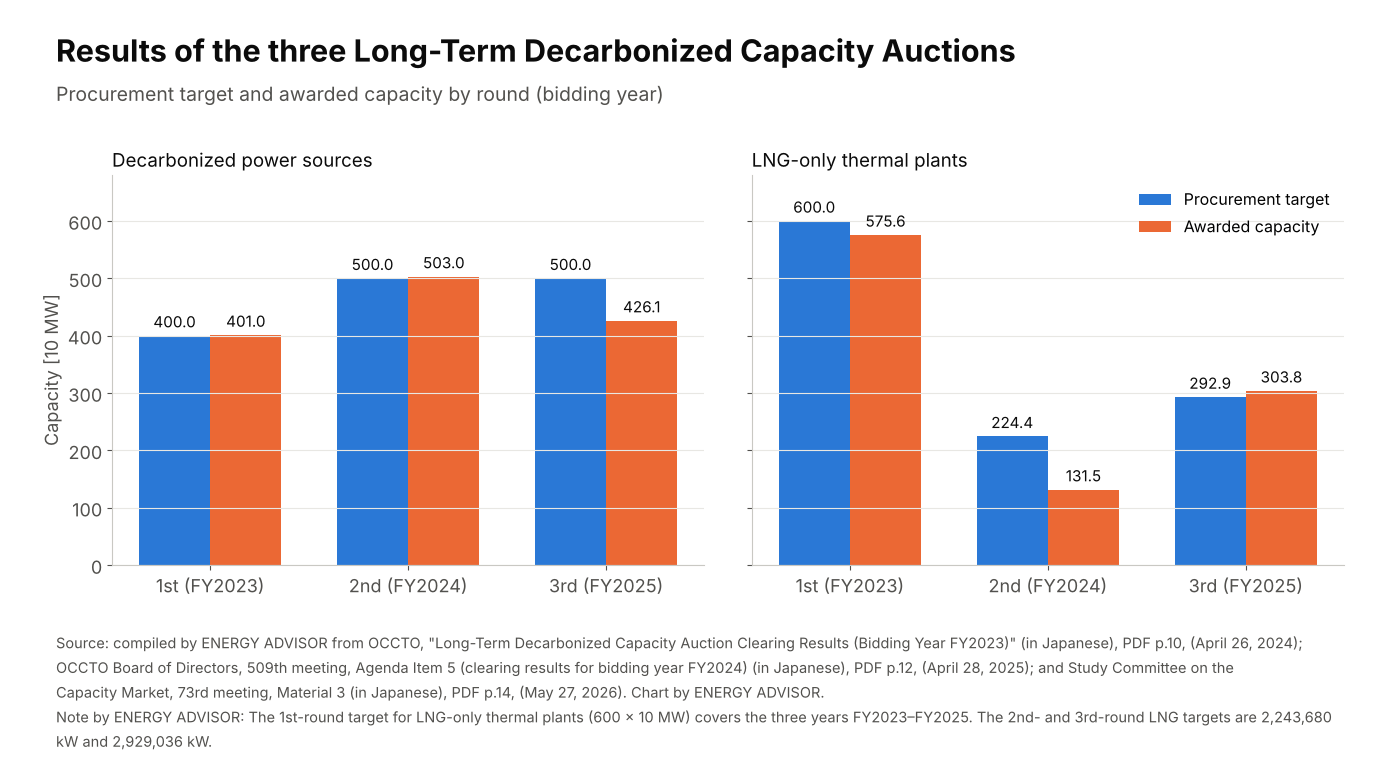
In the first round, the procurement target for LNG-only thermal plants was set at “6,000 MW over the three years FY2023–FY2025.” In light of the first-round results and the outlook for rising demand from data centers, semiconductor factories and the like, it was decided to solicit an additional 2,000 MW in each of FY2024 and FY2025 (4,000 MW in total). The second round’s target of about 2,244 MW is this 2,000 MW plus about 240 MW left over from the first round (Working Group on Market Design, 94th meeting, Material 4-1, p.8, June 28, 2024; ANRE).
The original article said, “Grid-scale battery storage is also eligible, so the introduction of facilities using the scheme seems likely to accelerate.” In fact, battery storage received many bids in all three rounds; in the first round, 1,092 MW was awarded against bids of 4,559 MW. Battery storage awards were 1,092 MW in the first round, 1,370 MW in the second and 1,251 MW in the third (the second-round figure is the sum of the values in the graph in the clearing results (Bidding Year FY2024), PDF p.16).
Summary
- Since liberalization, generation investment has had to be recovered from market revenue. However, prices on the day-ahead market and in the capacity market swing widely, and there was concern that investment in new power plants would stall.
- As part of the capacity market, the Long-Term Decarbonized Capacity Auction therefore began in FY2023. For new investment in decarbonized power sources, it promises capacity revenue at the level of fixed costs, in principle for 20 years.
- Its purposes are medium- to long-term stable supply, curbing price spikes, and providing supply capacity from decarbonized power sources toward carbon neutrality in 2050. LNG-only thermal plants are also eligible for the time being, on condition of future decarbonization.
- In the results of the three rounds, the main winners are nuclear (new build and safety upgrades of existing plants), battery storage and pumped storage, and LNG-only thermal plants.
This article is based on published materials from the Ministry of Economy, Trade and Industry and its Agency for Natural Resources and Energy, the Electricity and Gas Market Surveillance Commission, the Organization for Cross-regional Coordination of Transmission Operators (OCCTO) and other sources. The English translations of figures are by ENERGY ADVISOR and are not official translations. When using this information for decisions, please check the original sources. When we find an error, we correct the article and note the date of the correction.
Sources
- OCCTO, “Overview of the Long-Term Decarbonized Capacity Auction (Bidding Year FY2026)” (in Japanese), PDF pp.9–11, p.23, July 2026. https://www.occto.or.jp/assets/various/capacity-market/youryou_setsumeikai/202607_youryou_gaiyousetsumei_long-r.pdf
- OCCTO, “Capacity Market Long-Term Decarbonized Capacity Auction Clearing Results (Bidding Year FY2023)” (in Japanese), PDF p.10, p.14, April 26, 2024. https://www.occto.or.jp/assets/market-board/market/oshirase/2024/files/240426_longauction_youryouyakujokekka_kouhyou_ousatsu2023.pdf
- OCCTO, “Capacity Market Long-Term Decarbonized Capacity Auction Clearing Results (Bidding Year FY2024)” (Board of Directors, 509th meeting, Agenda Item 5) (in Japanese), PDF p.12, p.16, April 28, 2025. https://www.occto.or.jp/assets/soukaihoka/rijikai/2025/files/rijikai_509_gian5.pdf
- Study Committee on the Capacity Market, 73rd meeting, Material 3, “Long-Term Decarbonized Capacity Auction Clearing Results (Bidding Year FY2025) and Toward the Next Auction” (in Japanese), PDF p.14, p.18, May 27, 2026 (clearing results published May 13, 2026). https://www.occto.or.jp/assets/iinkai/youryou_kentoukai/73/youryou_kentoukai_73_03.pdf
- Study Committee on the Capacity Market, 60th meeting, Material 5 (in Japanese), PDF p.6, January 21, 2025. https://www.occto.or.jp/assets/iinkai/youryou/kentoukai/2024/files/youryou_kentoukai_60_05.pdf
- Subcommittee on Building a Sustainable Power System (7th meeting), material (in Japanese) (source of a figure in the original article). https://www.enecho.meti.go.jp/committee/council/basic_policy_subcommittee/system_kouchiku/007/007_08.pdf
- Subcommittee on Building a Sustainable Power System, Second Interim Report (in Japanese), August 10, 2021. https://www.enecho.meti.go.jp/committee/council/basic_policy_subcommittee/system_kouchiku/pdf/t62022100902.pdf
- Subcommittee on Building a Sustainable Power System, 13th meeting (in Japanese), December 3, 2021. https://www.enecho.meti.go.jp/committee/council/basic_policy_subcommittee/system_kouchiku/013/
- Subcommittee on Electricity and Gas Basic Policy, 42nd meeting (in Japanese), December 14, 2021. https://www.meti.go.jp/shingikai/enecho/denryoku_gas/denryoku_gas/042.html
- Advisory Committee for Natural Resources and Energy, Electricity and Gas Industry Committee, Subcommittee on Electricity and Gas Basic Policy, Working Group on Market Design, “8th Interim Report” (in Japanese), October 2022. https://www.meti.go.jp/shingikai/enecho/denryoku_gas/denryoku_gas/seido_kento/pdf/20221003_1.pdf
- Study Committee on the Capacity Market, 73rd meeting, Material 3 (in Japanese), PDF p.17 (graph of fiscal-year average JEPX spot prices), May 27, 2026. https://www.occto.or.jp/assets/iinkai/youryou_kentoukai/73/youryou_kentoukai_73_03.pdf
- Working Group on Market Design, 102nd meeting (April 23, 2025), meeting page (in Japanese). https://www.meti.go.jp/shingikai/enecho/denryoku_gas/denryoku_gas/seido_kento/102.html
- Working Group on Market Design, 103rd meeting (May 28, 2025), meeting page (in Japanese). https://www.meti.go.jp/shingikai/enecho/denryoku_gas/jisedai_kiban/system_review/103.html
- OCCTO, capacity market explainer site (in Japanese) (source of a figure in the original article; link broken as of October 2026). https://www.occto.or.jp/capacity-market/shikumi/auction-data
- Working Group on Market Design, 94th meeting, Material 4-1, “About the Long-Term Decarbonized Capacity Auction” (ANRE) (in Japanese), p.8, June 28, 2024. https://www.meti.go.jp/shingikai/enecho/denryoku_gas/denryoku_gas/seido_kento/pdf/094_04_01.pdf
- Subcommittee on Building a Sustainable Power System, Material 3, “Securing Generation Investment” (ANRE) (in Japanese), p.4, “Cash flows in the electricity market”, October 16, 2020 (source of a figure in the original article; posted as material of the 7th meeting of the subcommittee). https://www.enecho.meti.go.jp/committee/council/basic_policy_subcommittee/system_kouchiku/007/007_08.pdf