What a Negotiated Contract for Pumped Storage Is
Pumped-storage hydropower pumps water from a lower reservoir to an upper reservoir when electricity is in surplus (pumping), and releases water from the upper reservoir to generate when electricity is needed. Its output rises quickly after it starts generating, and it has long been used as balancing capacity.
A negotiated contract for pumped storage is a balancing capacity contract that a general transmission and distribution company (GT&D company; the company that operates each area’s grid) concludes directly with an owner of pumped-storage hydropower, without competitive bidding. It is a means of procurement separate from the Supply and Demand Balancing Market (balancing market; article 1), and is sometimes called “out-of-market procurement.”
In the balancing market, the GT&D company solicits volumes, and sellers bid delivery periods, volumes and prices, which are then cleared. A negotiated contract does not go through this process. Instead, the GT&D company negotiates individually with a specific pumped-storage plant and concludes a contract. The volume secured through the contract is deducted from the procurement volume of the balancing market’s combined-market products (FCR to RR and the combined product).
Because it does not go through market price formation, its appropriateness is reviewed area by area at the Expert Meeting on System Design and Monitoring of the Electricity and Gas Market Surveillance Commission (EGC; the body that monitors electricity markets). The preconditions for approval are ensuring cost transparency and keeping the impact on the market small.
Background: The Synchronization Requirement and Pumping Energy
From FY2024 (April 2024–March 2025), trading of Frequency Containment Reserve (FCR; primary), Synchronized Frequency Restoration Reserve (S-FRR; secondary (1)) and Frequency Restoration Reserve (FRR; secondary (2)) began in the balancing market, and participation by pumped-storage hydropower, with its strong balancing capability, was expected. In Japan, the fiscal year runs from April to March. However, pumped-storage hydropower faced structural barriers to participating in the market in a form operated by the generation company itself (BG operation; a balancing group, or BG, is a group of companies responsible for matching actual results to plans) (Organization for Cross-regional Coordination of Transmission Operators, JAPAN (OCCTO), Subcommittee on the Balancing Market, 47th meeting, Material 4, “Issues and Direction of Measures for Expanding Bids from Pumped Storage,” May 15, 2024).
FCR and S-FRR have a requirement that the resource must be synchronized: the generator must be connected to the grid throughout the time slots in which it provides balancing capacity. Pumped-storage hydropower is operated by connecting to the grid when electricity is needed, in line with demand. OCCTO organized the issues into two. One is how to secure pumping energy (the energy used for pumping) to provide balancing capacity. The other is “unit substitution,” which comes with connecting pumped storage to the grid at minimum output when offering a product that must be synchronized (47th meeting, Material 4, p.30). OCCTO then states that the problem is not the synchronization requirement itself; the real issue is that substitution cannot be guaranteed at the week-ahead stage, so the plant cannot bid if doing so means taking on the risk of performance assessment violations or mismatches with its plan (same, p.35).
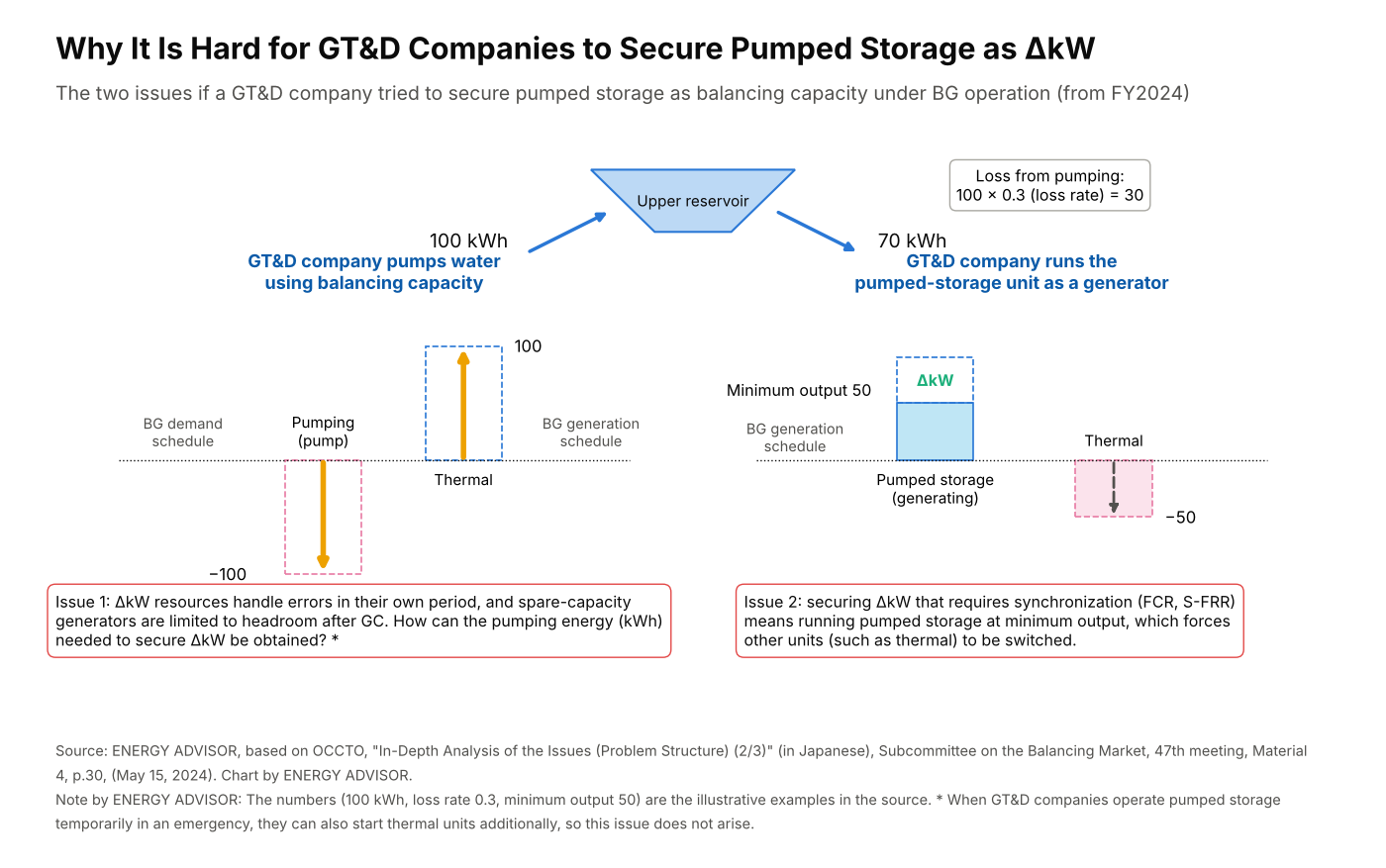
Unit substitution means balancing the plan by, for example, lowering the output of other resources by the amount of pumped storage connected to the grid. OCCTO’s analysis states that companies that also own thermal and other plants can substitute with their own resources and find it relatively easy, while companies with no resources other than pumped storage find it harder (same, p.31 and p.35).
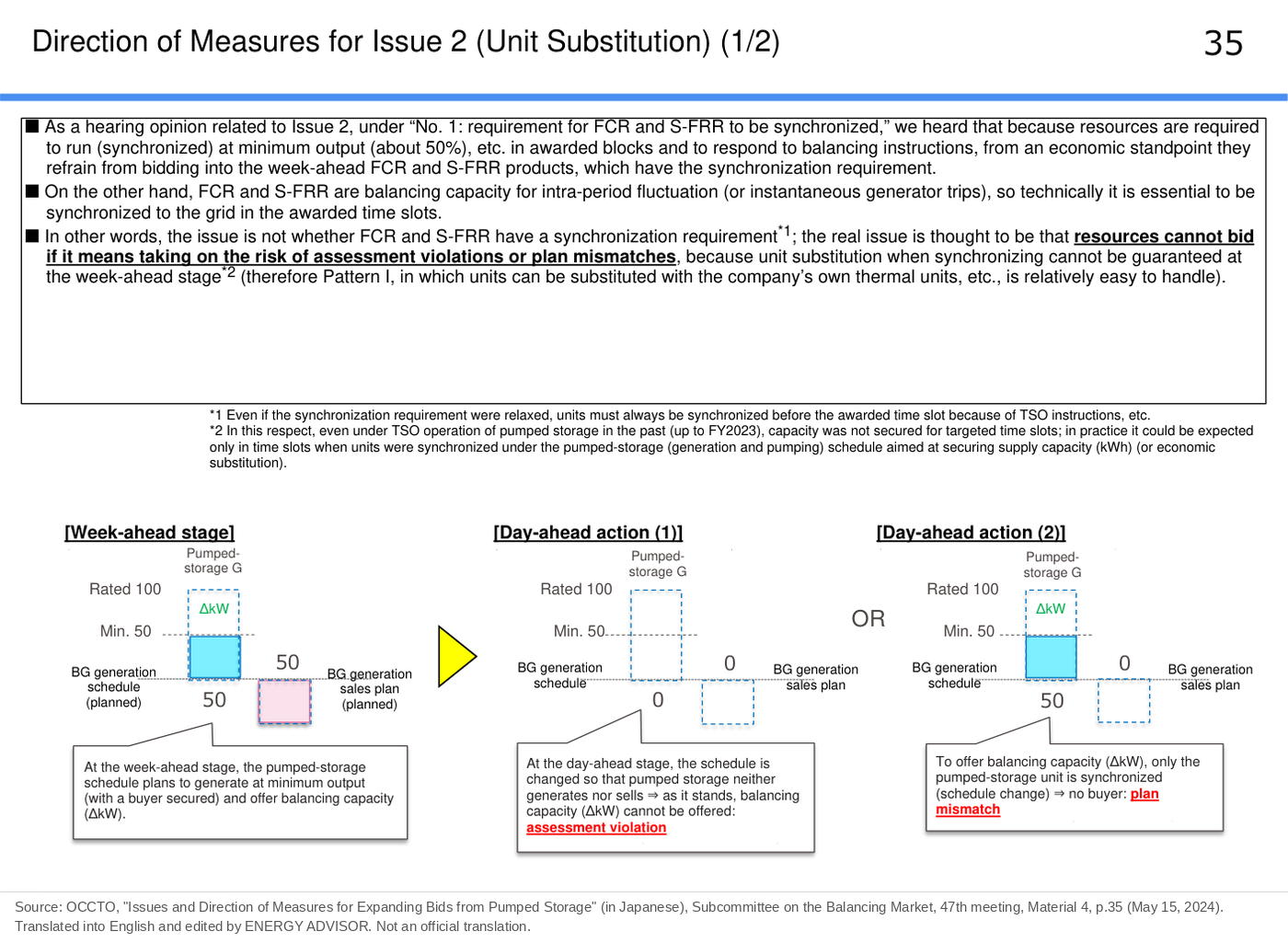
Measures were also studied, such as the GT&D company preparing replacement ΔkW, or the GT&D company connecting the minimum-output portion to the grid and also securing the substitute. However, these were options that could not originally be taken within market trading, and it was concluded that, as they stood, they could not be in place by the move to day-ahead trading (FY2026) (same, p.36). As an emergency measure, negotiated contracts for pumped storage, under which pumped storage is separated from the BG and operated directly by the GT&D company, were therefore introduced.
Later, the Working Group on Market Design of the Agency for Natural Resources and Energy (ANRE) (103rd meeting, May 28, 2025) set out the direction for procurement: while considering the introduction of a co-optimization market in the future, for the time being, procurement means other than the balancing market (resources under spare-capacity utilization contracts and negotiated contracts for pumped storage and similar resources) would also be used, from the standpoint of minimizing the cost of balancing capacity (OCCTO, Study Committee on Regulating and Marginal Supply Capability and Long-Term Supply–Demand Balance Evaluation, 117th meeting, Material 4, p.71).
Why Pumped Storage Suits Negotiated Contracts
Fast Response
Pumped-storage hydropower takes only a short time from starting generation to reaching a given output, and is well suited to products that require a fast response, such as FCR and secondary balancing capacity. Many units support governor-free operation (GF; operation that automatically changes output in response to frequency changes) and load frequency control (LFC; control that changes output based on signals from the central load dispatching center), and they have long been used as the main balancing capacity in grid operation.
BG Operation Compared with Operation by the GT&D Company
When pumped storage participates in the market under BG operation, the uncertainty of pumping energy, the cost of meeting the synchronization requirement, and the risk of unit substitution are added directly to the bid price. If it bids allowing for these risks, it has to set a high price, and in some cases it cannot bid at all.
Under a negotiated contract, the GT&D company becomes the party operating the kWh, and it handles both management of grid connection and provision of pumping energy. Because the risks the BG had carried move to the GT&D company, from the resource’s point of view it becomes a contract that provides stable income even at a low price. Pumped storage can be connected to the grid at times matched to demand and used as balancing capacity from the moment it is connected.
Cost Comparison
In a material for the 18th Expert Meeting on System Design and Monitoring (February 20, 2026), GT&D companies reported as follows (Material 4, pp.5–6).
| Area | Before the negotiated contract (unit price of pumped storage in the market) | Negotiated contract |
|---|---|---|
| Chubu | About ¥3–6/ΔkW·h | From several tens of sen (1 sen = ¥0.01) to ¥3/ΔkW·h |
| Tohoku | Estimated at the same level as the day-ahead market (spot market) price | Understood to lower the unit price greatly (no figures given) |
This shows that even for the same pumped-storage plant, the cost of providing balancing capacity changes greatly depending on who operates it and how.
Spread to Each Area (FY2024–FY2025)
Negotiated contracts for pumped storage have been reviewed and approved area by area at the Expert Meeting on System Design and Monitoring (OCCTO, 117th meeting, Material 4, p.65).
| Area | Meeting that approved it | Start |
|---|---|---|
| Chubu | After discussion at the 98th Meeting for System Design (June 25, 2024) | For delivery from July 20, 2024 |
| Tohoku | 7th Expert Meeting on System Design and Monitoring (March 31, 2025) | FY2025 |
| Hokkaido and Kansai | 10th Expert Meeting on System Design and Monitoring (June 27, 2025) | FY2025 |
| Tokyo | 12th Expert Meeting on System Design and Monitoring (August 29, 2025) | FY2025 |
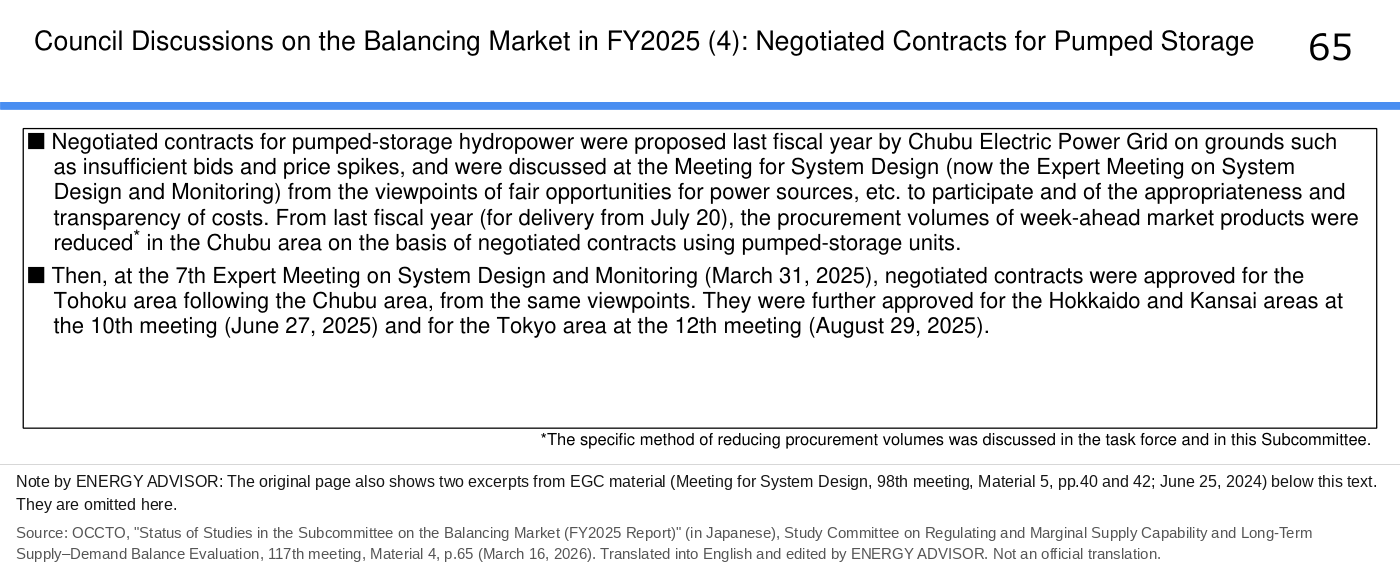
For the Chubu area, which started first, operating results and settlement amounts with the provider were checked after the fact, and it was assessed that there were no particular problems (same, p.66).
Status in FY2026
The treatment for FY2026 (April 2026–March 2027) was decided area by area. At the 17th meeting (January 30, 2026), each GT&D company reported on its FY2025 operations, and at the 18th meeting (February 20, 2026), the views of balancing capacity providers were heard (same, p.68).
| Area | Status in FY2026 | Start of revised procurement volume |
|---|---|---|
| Tohoku | Approved at the 19th Expert Meeting (March 30, 2026); negotiated contract concluded | For delivery from April 1, 2026 |
| Chubu | Same as above | For delivery from April 1, 2026 |
| Kansai | Same as above | For delivery from April 4, 2026 |
| Tokyo | Same as above | For delivery from May 26, 2026 |
| Chugoku | New consultation in FY2026. Reviewed at the 20th Expert Meeting (May 29, 2026) | For delivery from June 10, 2026 |
| Hokkaido | Implemented in FY2025. For FY2026, not continued from the start of the year; it said it would analyze market trends for one to two months before deciding again, and no conclusion had been reached as of the 20th meeting | — |
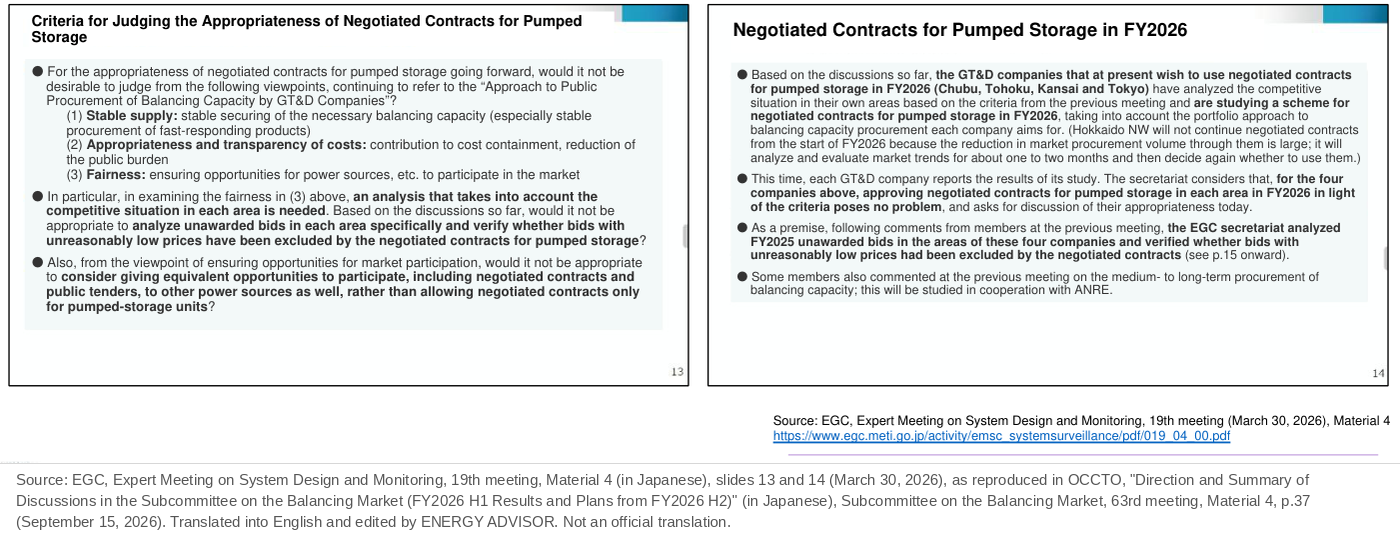
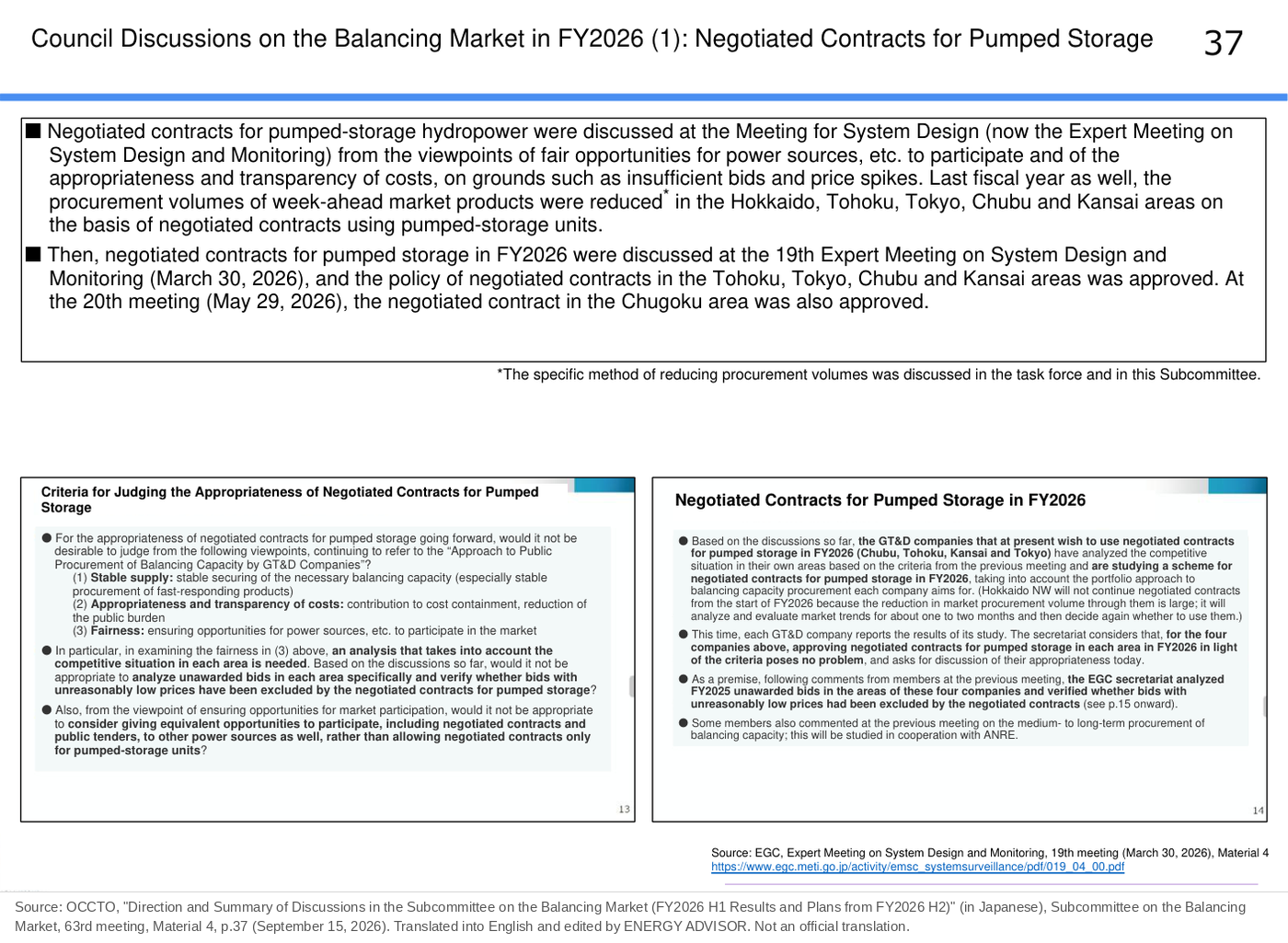
The start dates for each area are based on EPRX notices (partly updated on September 29 and 30, 2026). For Hokkaido, it was reported as of the 20th meeting that FCR procurement volumes were met by bids from thermal plants and batteries, while under-procurement of Replacement Reserve (RR; tertiary (1)) was increasing. If a negotiated contract were concluded as in other areas, RR could be secured, but low-priced resources bidding into FCR might no longer be awarded. Careful consideration was therefore said to be needed (EGC, 20th Expert Meeting on System Design and Monitoring, Material 4, pp.2–3).
The Debate over Negotiated Contracts
Why GT&D Companies Want to Continue
In the material for the 18th meeting, GT&D companies gave the following points (Material 4, p.2 and pp.5–6).
- Negotiated contracts for pumped storage help secure balancing capacity stably.
- “Portfolio procurement,” which combines the market and negotiated contracts, keeps overall procurement costs low.
- Procuring through a negotiated contract lowers costs for society as a whole compared with procuring in the market (Tohoku).
Concerns from Committee Members
Members of the Expert Meeting raised the following concerns (18th meeting, Material 4, pp.3–4).
- Shrinking procurement volume: Negotiated contracts concluded for a full year constrain the market’s procurement volume.
- Shrinking market and investment incentives: Negotiated contracts for pumped storage shrink the market and also undermine incentives for new investment. They may hold back participation of pumped storage in the market.
- Offering to the market: If negotiated contracts for pumped storage are this cheap, could they not be put into the market?
- Eligible resources: If batteries can provide balancing capacity as cheaply as pumped storage, negotiated contracts should not be limited to pumped storage.
Issues After the Move to Day-Ahead Trading
From delivery on March 14, 2026, combined-market products moved to day-ahead trading (article 1). Under day-ahead trading, bidding in the balancing market comes after the day-ahead market (spot market). The Tohoku area GT&D company was concerned that after the move to day-ahead trading, pumped storage would also be offered into the spot market and could not be used as balancing capacity when supply and demand are tight (18th meeting, Material 4, p.5).
After the move to day-ahead trading, the following has been reported (20th Expert Meeting, Material 4, p.1 and pp.4–5).
- The move to day-ahead trading has led to resources being taken first in the spot market, affecting bid volumes in the balancing market and whether procurement volumes are met.
- In the Chugoku area, after the move to day-ahead trading, resources being taken first in the spot market and other factors led to lower bid volumes in the balancing market, more under-procurement, and higher procurement prices. This is the background to the new consultation on a negotiated contract in FY2026.
- In the Tokyo and Chubu areas and others, cleared volumes in the combined market in April were larger than in the previous year. Increased bids through “offering reserve by derating committed units,” in which running resources lower their output to offer balancing capacity, are thought to have contributed.
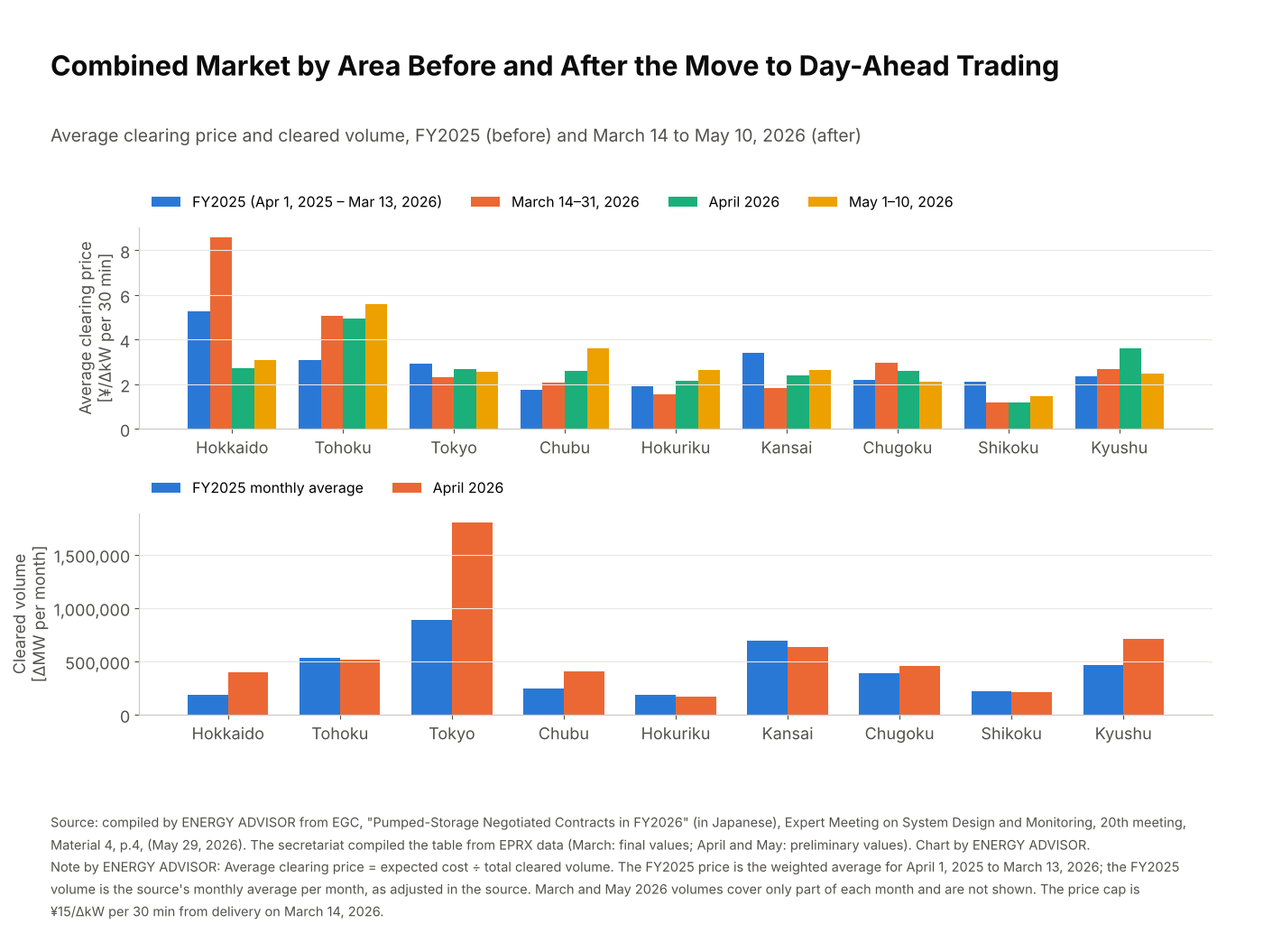
Hokkaido Electric Power Network said it would analyze market trends for about one to two months and decide again after quantitatively evaluating the usefulness of bilateral procurement and its impact on the market (20th meeting, Material 4, p.2). The secretariat stated that there was no problem in approving the Chugoku area’s negotiated contract for FY2026 (same, p.1).
Summary
The negotiated contract for pumped storage is an out-of-market procurement mechanism approved as a measure against procurement difficulties and rising costs in the balancing market. The background is that pumped storage under BG operation found it hard to bid into the market because of the synchronization requirement and the problem of pumping energy.
Starting in the Chubu area in July 2024, contracts were concluded in five areas in FY2025, and in FY2026 in five areas: Tohoku, Chubu, Kansai and Tokyo, plus Chugoku. Hokkaido had not decided its FY2026 treatment as of the 20th Expert Meeting on May 29, 2026.
GT&D companies point to cost reductions and the effect on stable procurement, while committee members have raised concerns about shrinking the market, effects on investment incentives, and limiting eligibility to pumped storage. After the move to day-ahead trading, resources being taken first in the spot market have been added as a new factor, and decisions differ by area.
This article is based on published materials from the Ministry of Economy, Trade and Industry and its Agency for Natural Resources and Energy, the Electricity and Gas Market Surveillance Commission, the Organization for Cross-regional Coordination of Transmission Operators (OCCTO) and other sources. The English translations of figures are by ENERGY ADVISOR and are not official translations. When using this information for decisions, please check the original sources. When we find an error, we correct the article and note the date of the correction.
Sources
- OCCTO, Subcommittee on the Balancing Market, 47th meeting, Material 4, “Issues and Direction of Measures for Expanding Bids from Pumped Storage” (in Japanese), p.30, p.31, p.35 and p.36, May 15, 2024. https://www.occto.or.jp/assets/iinkai/chouseiryoku/jukyuchousei/2024/files/jukyu_shijyo_47_04.pdf
- EGC, Expert Meeting on System Design and Monitoring, 19th meeting, Material 4, “Negotiated Contracts for Pumped Storage in FY2026” (in Japanese), pp.12–13, March 30, 2026. https://www.egc.meti.go.jp/activity/emsc_systemsurveillance/pdf/019_04_00.pdf
- OCCTO, Subcommittee on the Balancing Market, 63rd meeting, Material 4 (in Japanese), p.37, September 15, 2026. https://www.occto.or.jp/assets/iinkai/jukyuchousei/63/jukyu_shijyo_63_04.pdf
- OCCTO, Study Committee on Regulating and Marginal Supply Capability and Long-Term Supply–Demand Balance Evaluation, 117th meeting, Material 4, “Status of Discussions in the Subcommittee on the Balancing Market (FY2025 Report)” (in Japanese), pp.65–68 and pp.70–72, March 16, 2026. https://www.occto.or.jp/assets/chousei_117_04.pdf
- EGC, Expert Meeting on System Design and Monitoring, 18th meeting, Material 4, “Operation of Negotiated Contracts for Pumped Storage in FY2025 (2)” (in Japanese), pp.2–6, February 20, 2026. https://www.egc.meti.go.jp/activity/emsc_systemsurveillance/pdf/018_04_00.pdf
- EGC, Expert Meeting on System Design and Monitoring, 20th meeting, Material 4, “Negotiated Contracts for Pumped Storage in FY2026” (in Japanese), pp.1–5, May 29, 2026. https://www.egc.meti.go.jp/activity/emsc_systemsurveillance/pdf/020_04_00.pdf
- Electric Power Reserve eXchange (EPRX), “Notice of Revised Procurement Volumes for Combined-Market Products Following Negotiated Contracts with Pumped-Storage Generators in the Chubu and Tohoku Areas” (in Japanese), March 31, 2026 (partly updated September 30, 2026). https://www.eprx.or.jp/j_information/docs/news_202609301100.pdf
- EPRX, “Notice of Revised Procurement Volumes for Combined-Market Products Following a Negotiated Contract with Pumped-Storage Generators in the Kansai Area” (in Japanese), April 1, 2026 (partly updated September 29, 2026). https://www.eprx.or.jp/j_information/docs/news_202609291000.pdf
- EPRX, “Notice of Revised Procurement Volumes for Combined-Market Products Following a Negotiated Contract with Pumped-Storage Generators in the Tokyo Area” (in Japanese), May 22, 2026 (partly updated September 30, 2026). https://www.eprx.or.jp/j_information/docs/news_202609301110.pdf
- EPRX, “Notice of Revised Procurement Volumes for Combined-Market Products Following a Negotiated Contract with Pumped-Storage Generators in the Chugoku Area” (in Japanese), June 8, 2026 (partly updated September 29, 2026). https://www.eprx.or.jp/j_information/docs/news_202609291500.pdf
- OCCTO, Subcommittee on the Balancing Market, 61st meeting, Material 2, “Trading Status of the Balancing Market” (in Japanese), p.8, June 9, 2026. https://www.occto.or.jp/assets/iinkai/jukyuchousei/61/jukyu_shijyo_61_02.pdf