Electricity demand and supply must always be equal. The capability needed to match supply and demand as demand changes is called “balancing capacity.” This article explains supply-demand balancing (resolving imbalances), one of the system stabilization duties that general transmission and distribution companies carry out using balancing capacity. Frequency control is explained in the next article, Article 10.
Balancing Capacity
“Balancing capacity” is defined as follows in the Operational Rules of the Organization for Cross-regional Coordination of Transmission Operators, JAPAN (OCCTO). OCCTO is the body that monitors supply and demand nationwide and receives companies’ plans, among other tasks.
“Balancing capacity” means the capability of generation facilities (including pumped-storage hydropower facilities), electricity storage facilities, demand response and other systems that control electricity supply and demand, and anything equivalent to them (excluding transmission and distribution facilities), that is needed for system stabilization duties such as frequency control and supply-demand balancing.
Source: OCCTO Operational Rules, Article 2, paragraph 2, item 6 (version amended August 1, 2026)
Balancing capacity can also be described as the capability to adjust supply capacity that a general transmission and distribution company (GT&D company) needs to carry out system stabilization duties such as frequency control and supply-demand balancing. A GT&D company operates the grid in each area and is ultimately responsible for matching supply and demand in its area.
The role of balancing capacity is explained in Material 6 of the 6th meeting of OCCTO’s Committee on Balancing Capacity. The material is titled “Definition of Balancing Capacity and Scope of the Balancing Capacity Procurement Plan.”
Supply-Demand Balancing: GT&D Companies Fill Imbalances
The GT&D company is responsible for matching supply and demand in its area.
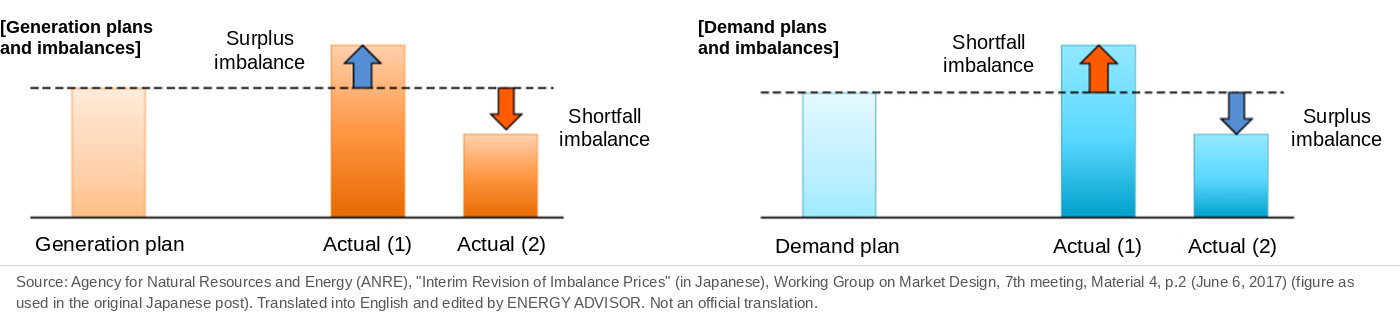
Under the rule of planned-value balancing (30-minute balancing against plans), power generation companies and retail electricity suppliers submit generation plans and demand plans in advance. However, differences inevitably arise between the “generation and demand plans” and “actual generation and demand.” These differences are called imbalances, and the GT&D company is responsible for resolving them (how imbalances work is explained in Article 04).
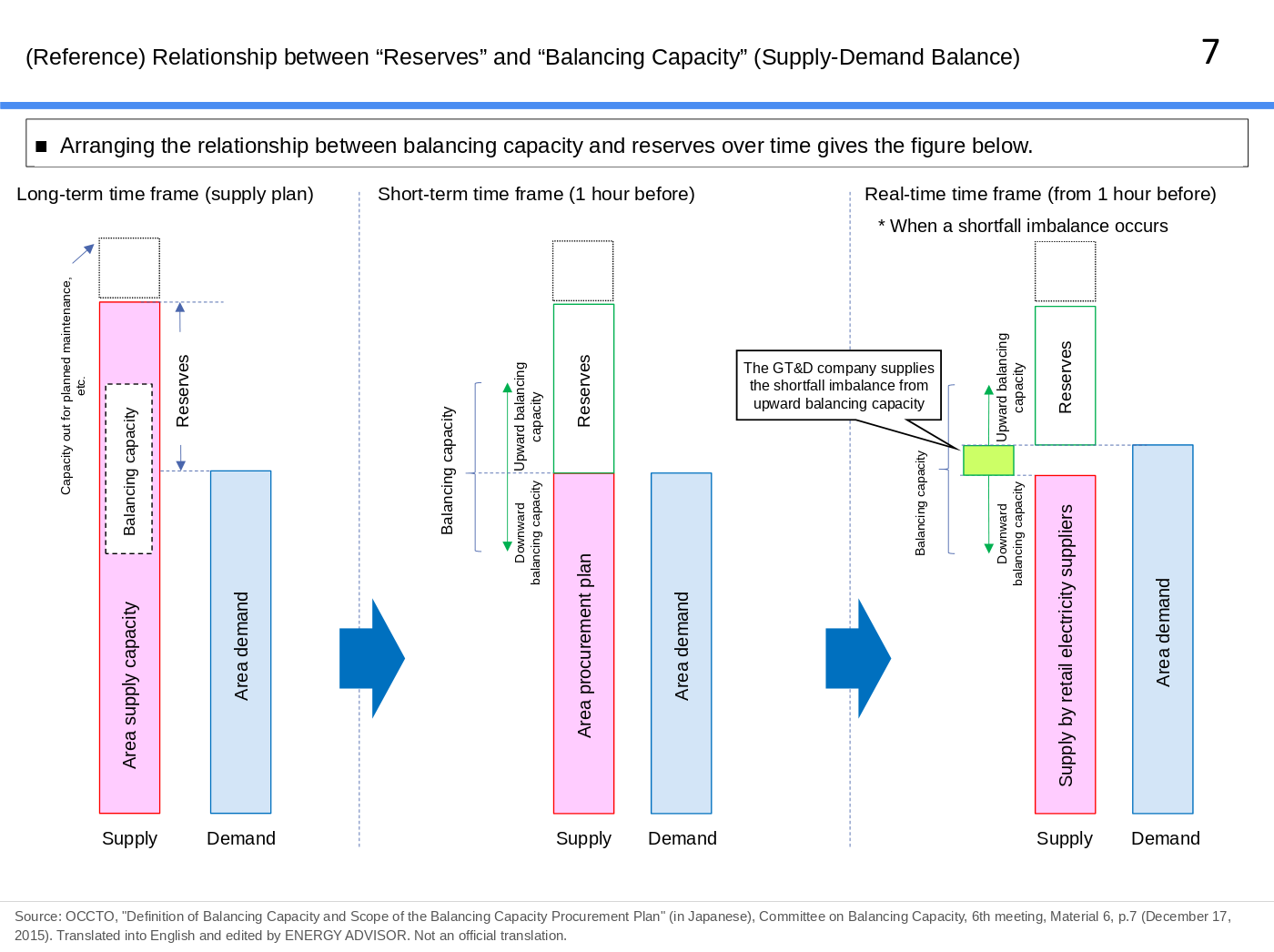
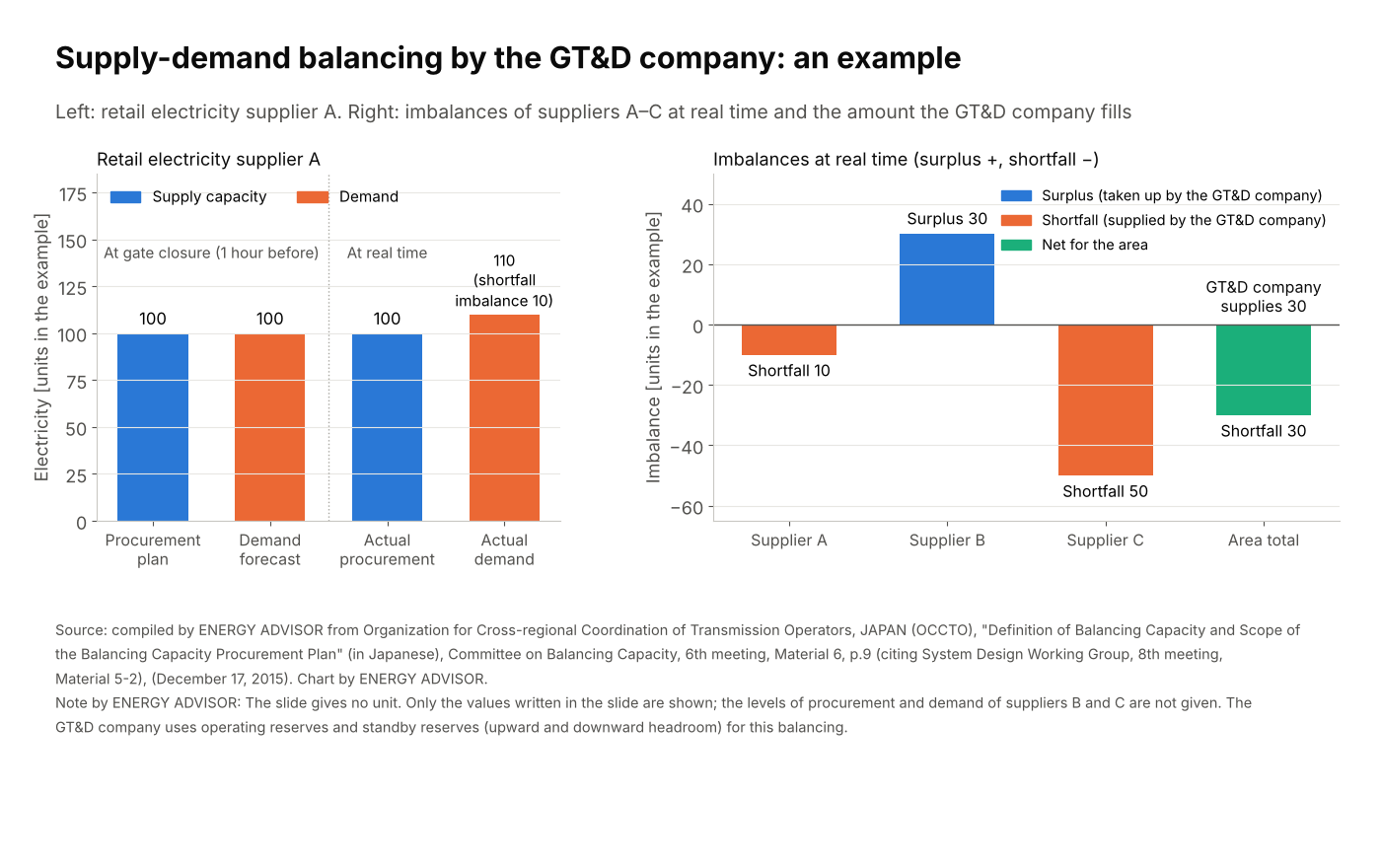
The GT&D company matches supply and demand by supplying additional capacity for shortfall imbalances and taking up capacity for surplus imbalances. This adjustment of supply capacity for imbalances is “supply-demand balancing” (Figure 1), and it is essential for stable operation of the power system.
The imbalances the GT&D company adjusts are the differences in the real-time time frame. The real-time time frame means from gate closure (one hour before real time) onward. The difference at that point between “supply by retail electricity suppliers” and “demand in the area” is what is adjusted.
In Figure 2, supply by retail electricity suppliers is lower than actual demand in the area, so supply capacity is short; in other words, a shortfall imbalance is occurring. In this case, the GT&D company supplies additional capacity using upward balancing capacity secured in advance, and matches demand and generation.
The central load dispatching center of the GT&D company constantly monitors the balance of demand and generation and keeps adjusting supply capacity for imbalances 24 hours a day, 365 days a year. The central load dispatching center is the control center that issues output instructions to power plants in the area.
What Upward and Downward Balancing Capacity Consist Of
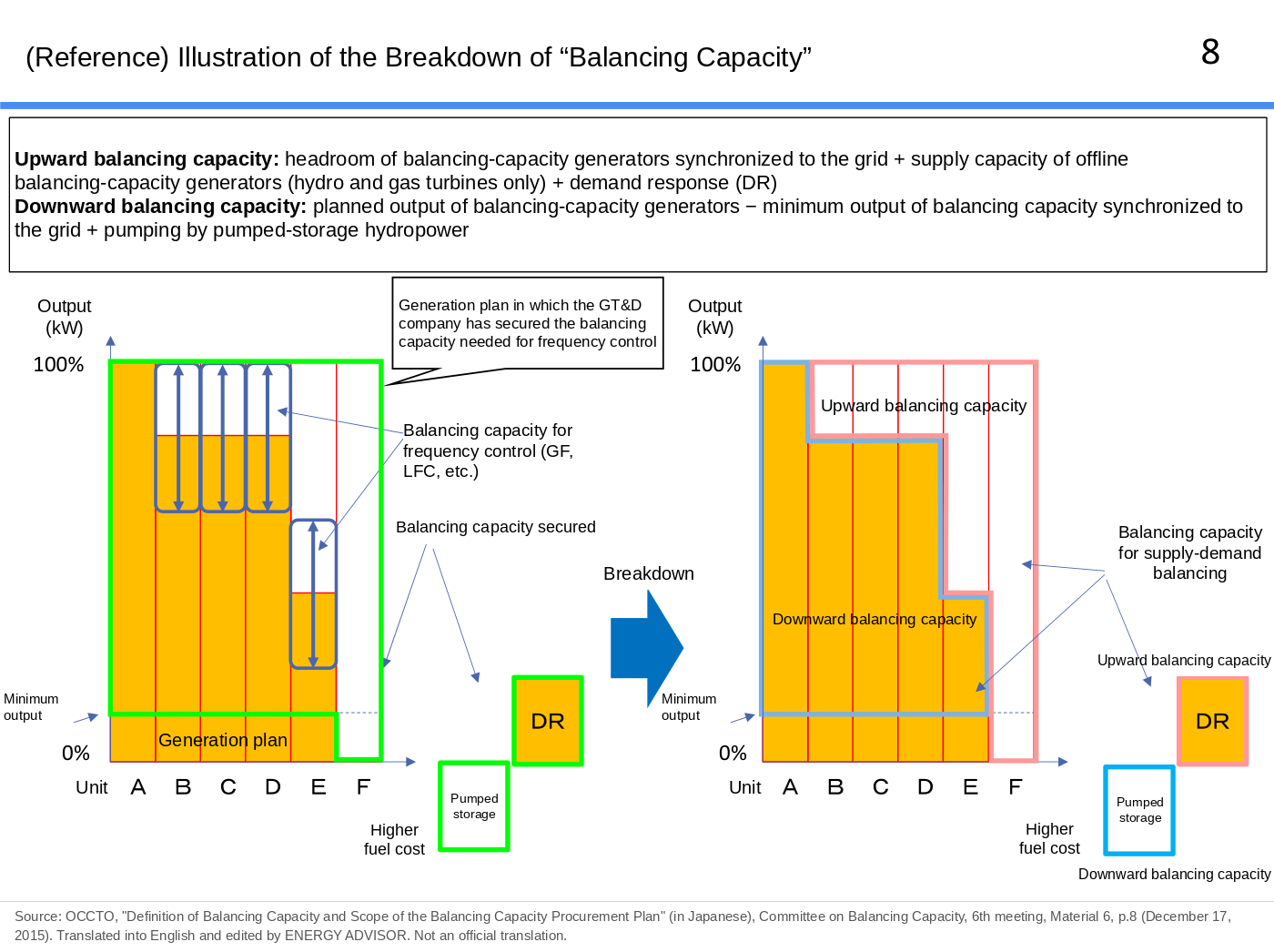
Balancing capacity is divided into upward balancing capacity and downward balancing capacity. Resources secured as balancing capacity can increase or decrease their output relative to their planned generation values, and that amount is used as balancing capacity. The amount by which output can be increased is called “upward balancing capacity,” and the amount by which it can be decreased is called “downward balancing capacity.” The speed and range of change, among other things, are set in detail as conditions of procurement.
Upward balancing capacity
Upward balancing capacity is produced by increasing output using the generation headroom of thermal generators and other units (the headroom from planned output up to 100% output) and pumped-storage hydropower units (whether running or stopped). Pumped-storage hydropower is hydropower that pumps water up to an upper reservoir when electricity is in surplus and releases it to generate when electricity is short. When the supply-demand balance is tight, demand response (DR: customers reducing their electricity use) may also be used.
Downward balancing capacity
Downward balancing capacity is produced by reducing the output of thermal and pumped-storage generators, or by increasing load through pumping (the operation that pumps water up) at pumped-storage plants.
An illustration of the breakdown of balancing capacity
Figure 4 is an illustration of how resources hold balancing capacity.
- Resource B has both upward and downward balancing capacity relative to its current output
- Resource A, at 100% output, cannot raise its output further, so it has no upward balancing capacity
- A stopped generator also has no upward balancing capacity
A certain amount of upward balancing capacity must be secured to prepare for demand changes and generator problems, and the allocation of output among generators is adjusted with this in mind. As the share of solar grows, a shortage of downward balancing capacity also becomes an issue.
| Type | What it consists of |
|---|---|
| Upward balancing capacity | Generation headroom of synchronized balancing resources + stopped balancing resources (limited to hydro and gas turbines) + DR |
| Downward balancing capacity | Planned generation of balancing resources minus their minimum output + pumping (load) at pumped-storage plants |
Change in Procurement: From Balancing Capacity Tenders to the Balancing Market (FY2024)
Until FY2023: Balancing capacity tenders (Type I, II and I’)
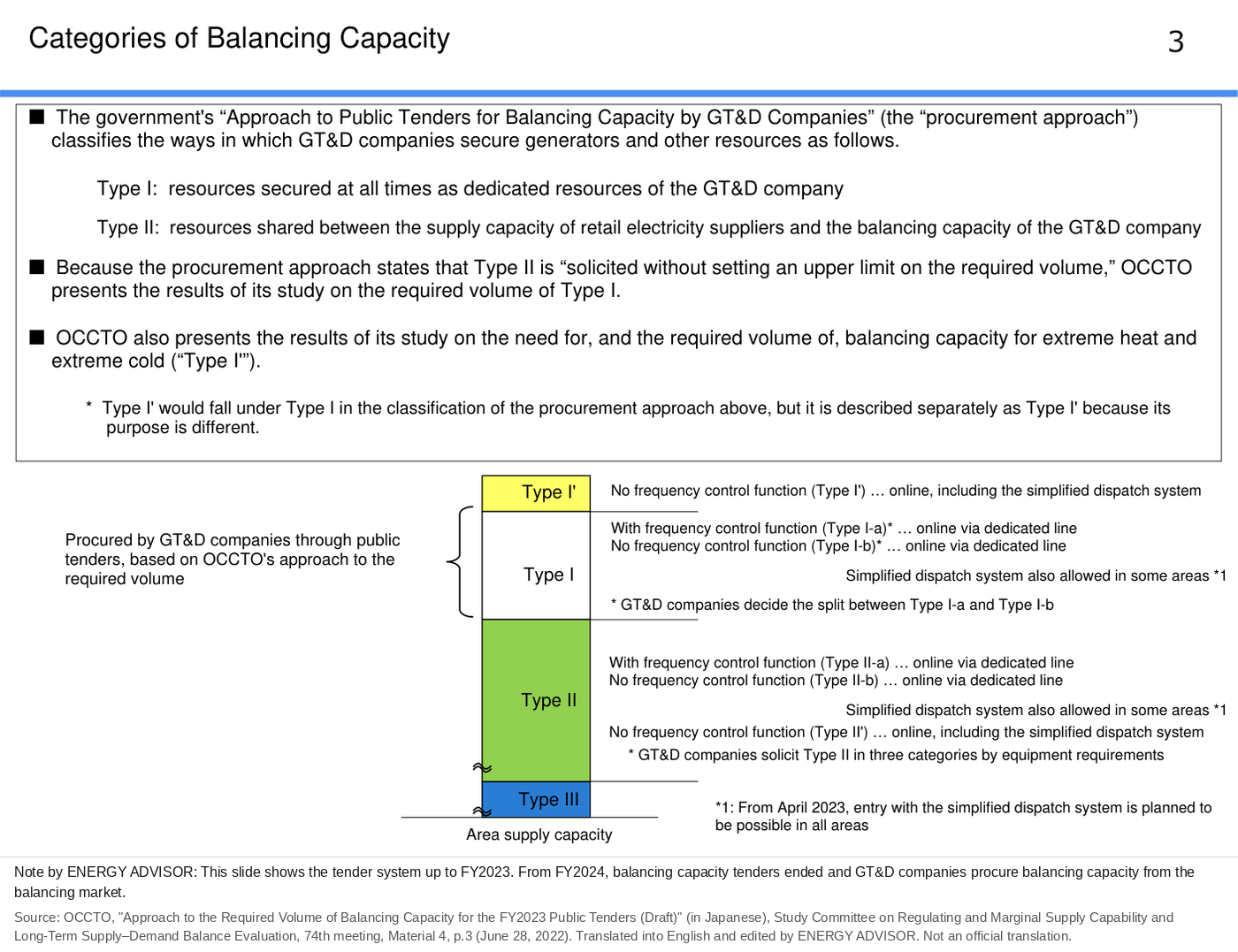
Until FY2023 (April 2023–March 2024), GT&D companies procured balancing capacity through tenders. The procured resources were classified mainly into three types, Type I, II and I’, each with a different role.
| Category | Role (until FY2023) |
|---|---|
| Type I resources | Resources secured at all times as dedicated resources of the GT&D company, and similar |
| Type II resources | Resources used both as supply capacity for retail electricity suppliers and others and as balancing capacity for the GT&D company, and similar |
| Type I’ resources | Balancing capacity secured to prepare for extreme heat and extreme cold |
Source: OCCTO, Study Committee on Regulating and Marginal Supply Capability and Long-Term Supply–Demand Balance Evaluation, 74th meeting, Material 4, p.3
For Type I and Type II resources, the GT&D company had the authority to start and stop them.
For supply-demand balancing, the supply capacity used to resolve imbalances was provided mainly by Type I and II resources procured through balancing capacity tenders. For downward balancing capacity, resources with Type II contracts were used.
From FY2024: The balancing market and spare-capacity utilization contracts
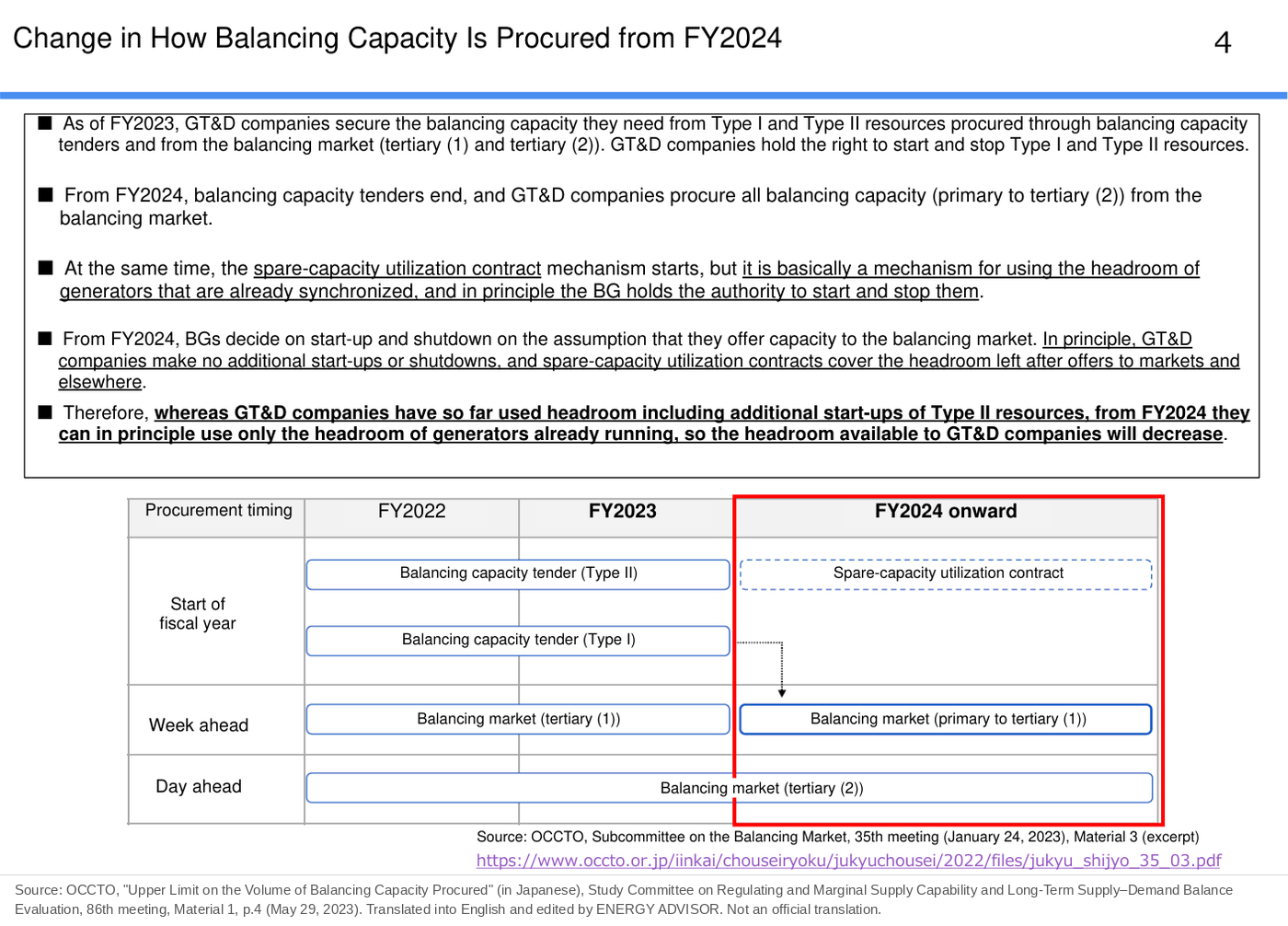
From FY2024, trading of all products (primary to tertiary (2)) began in the Supply and Demand Balancing Market (balancing market). Except in the Okinawa area, balancing capacity tenders ended, and the Type I and Type II system ceased to exist. The balancing market is the market in which GT&D companies buy balancing capacity (ΔkW: the capability to change output within a set time).
Balancing capacity is traded as five products (primary to tertiary (2)), based on the frequency control functions of generators (Figure 6). The relationship between the products and frequency control functions is explained in Article 10.
In the product requirements, each product has an “upward” and a “downward” category. However, currently only the upward category is procured (Electric Power Reserve eXchange, “Product Requirements and Trading Schedule of the Balancing Market,” 6th edition, p.2). The Electric Power Reserve eXchange (EPRX) is the organization where balancing market trading takes place.
In addition, the “spare-capacity utilization contract” system started in FY2024. A spare-capacity utilization contract is a contract that a resource registered as having a balancing function “available” under the capacity market requirements (the conditions that contracted resources must meet) concludes with the GT&D company. The capacity market is a market that contracts with resources to secure future supply capacity. A balancing function means a function that meets the requirements of the balancing market products. Spare-capacity utilization contracts cover the capacity left over after offering to markets and elsewhere.
The balancing capacity that GT&D companies use from gate closure onward includes balancing capacity procured in the balancing market and balancing capacity secured through spare-capacity utilization contracts (Imbalance Price Information Website, FAQ 1-3).
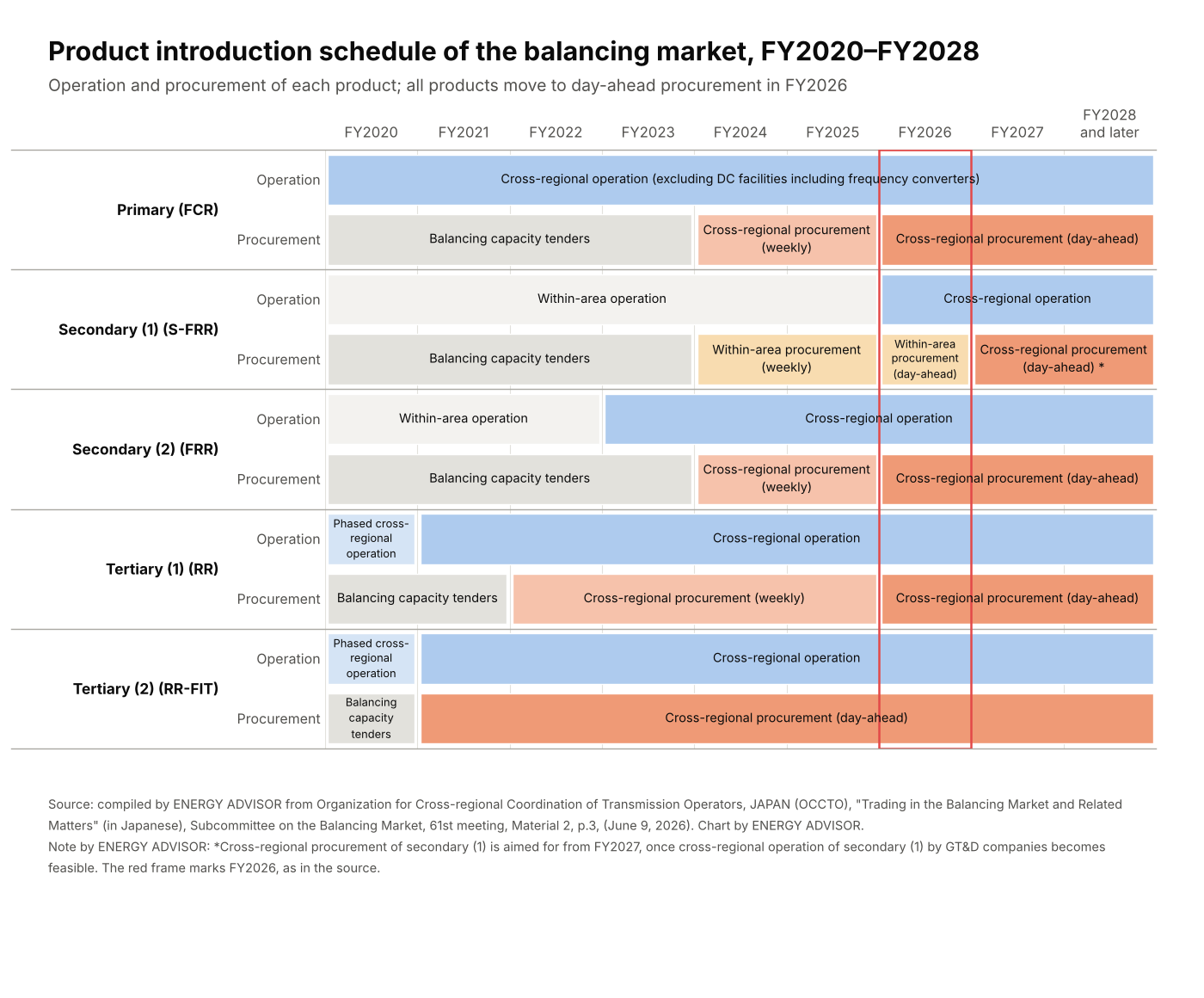
Current State of the Balancing Market: Undersubscription and the Move to Day-Ahead Trading in FY2026
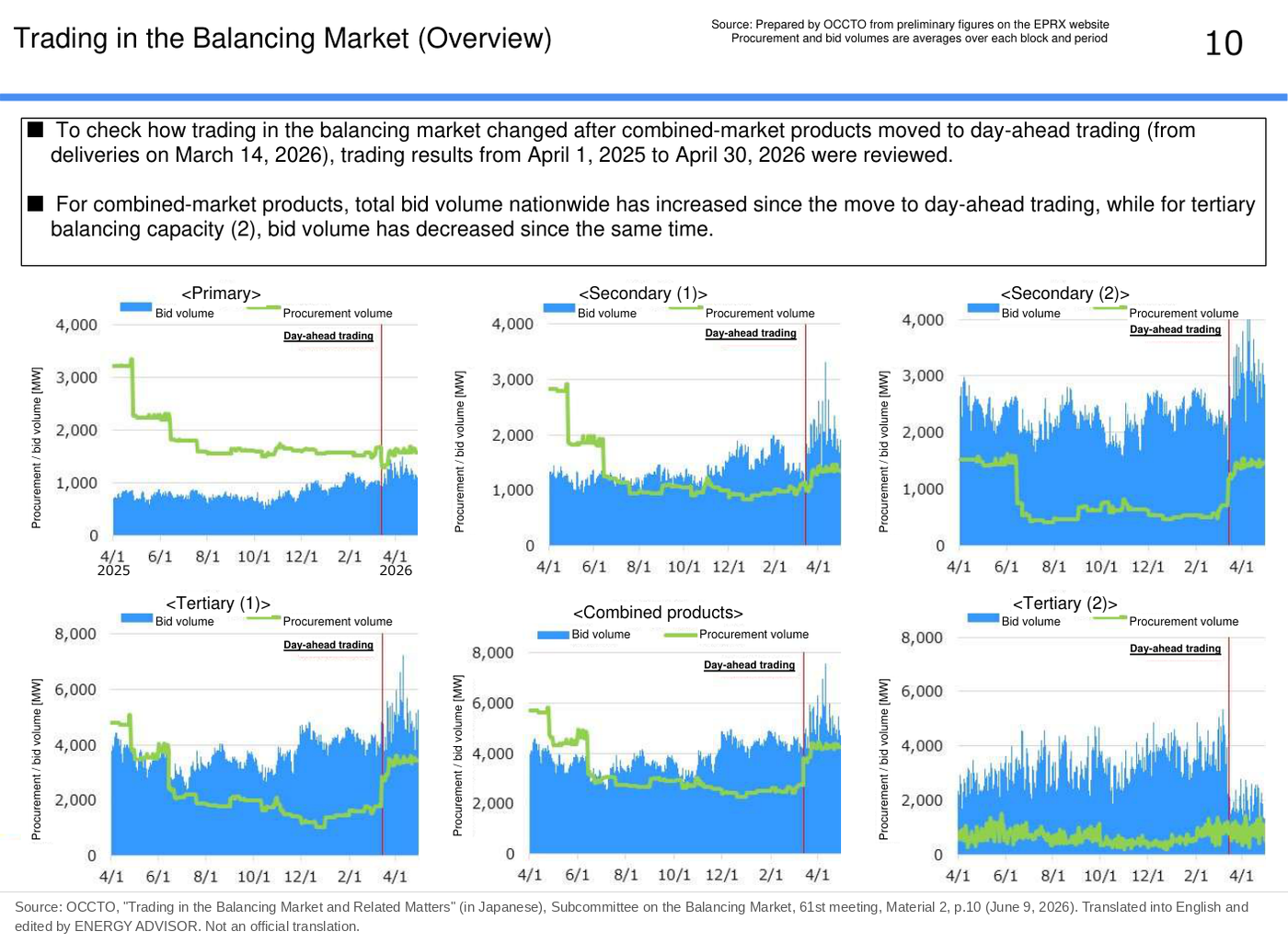
Trading of all products in the balancing market began in FY2024. However, bids fall short and do not reach the procurement volume, so there is no price competition, and the cost of procuring balancing capacity is high.
The combined market (products cleared together) is the market in which primary to tertiary (1) and combined products are cleared together. To improve the situation, from the FY2026 products, combined market trading was brought forward from week-ahead to day-ahead (from deliveries on March 14, 2026). At the same time, the time unit for bids was changed from 3 hours to 30 minutes. Most of the resources that bid are resources with spare-capacity utilization contracts. Because the resources operating in the previous period were considered to be usable for a certain time in a row, the time unit could be shortened.
According to OCCTO’s report in June 2026, bid volumes increased for many products and areas with the move to day-ahead trading. On the other hand, a certain shortfall continues for primary balancing capacity and secondary balancing capacity (1). On trading at the start of FY2026, OCCTO stated that “the fundamental undersubscription has not been resolved, and issues such as high-priced resources being cleared because of under-procurement continue.”
Summary
- Under the rule of planned-value balancing, power generation companies and retail electricity suppliers submit plans in advance, but differences inevitably arise between plans and actual results. These differences are imbalances
- The GT&D company matches supply and demand by supplying additional capacity for shortfall imbalances and taking up capacity for surplus imbalances. This is “supply-demand balancing”
- Balancing capacity is divided into upward and downward balancing capacity
- The balancing capacity that GT&D companies use for supply-demand balancing was secured through balancing capacity tenders until FY2023 and, from FY2024, through the balancing market and spare-capacity utilization contracts
- Undersubscription continues in the balancing market, and from the FY2026 products, combined market trading was moved to day-ahead and the bid unit to 30 minutes
This article is based on published materials from the Ministry of Economy, Trade and Industry and its Agency for Natural Resources and Energy, the Electricity and Gas Market Surveillance Commission, the Organization for Cross-regional Coordination of Transmission Operators (OCCTO) and other sources. The English translations of figures are by ENERGY ADVISOR and are not official translations. When using this information for decisions, please check the original sources. When we find an error, we correct the article and note the date of the correction.
Sources
- OCCTO, Operational Rules, Article 2, paragraph 2, item 6 (version amended August 1, 2026) (in Japanese). https://www.occto.or.jp/assets/occto/article/index/gyoumukitei2608.pdf
- OCCTO, Committee on Balancing Capacity, 6th meeting, Material 6, “Definition of Balancing Capacity and Scope of the Balancing Capacity Procurement Plan” (in Japanese). https://www.occto.or.jp/iinkai/chouseiryoku/2015/files/chousei_06_06.pdf
- OCCTO, Study Committee on Regulating and Marginal Supply Capability and Long-Term Supply–Demand Balance Evaluation, 86th meeting, Material 1, “Upper Limit of Balancing Capacity Procurement Volume,” pp.2–3 (May 29, 2023) (in Japanese). https://www.occto.or.jp/iinkai/chouseiryoku/2023/files/chousei_86_01.pdf
- OCCTO, Subcommittee on the Balancing Market, 61st meeting, Material 2, “Trading in the Balancing Market,” pp.2–3 (trading of all products from FY2024 and the product introduction schedule), p.5, p.6, p.10 and p.35 (June 9, 2026) (in Japanese). https://www.occto.or.jp/assets/iinkai/jukyuchousei/61/jukyu_shijyo_61_02.pdf
- OCCTO, Study Committee on Regulating and Marginal Supply Capability and Long-Term Supply–Demand Balance Evaluation, 74th meeting, Material 4, “Approach to the Required Volume for Balancing Capacity Tenders for FY2023 (Draft),” p.3 (categories of balancing capacity; source of a figure in the original post) (in Japanese). https://www.occto.or.jp/iinkai/chouseiryoku/2022/files/chousei_74_04.pdf
- Electric Power Reserve eXchange, “Product Requirements and Trading Schedule of the Balancing Market,” 6th edition, p.2 (note that “currently only the upward category is procured”) (March 13, 2026) (in Japanese). https://www.eprx.or.jp/outline/docs/shouhin_ver.6_20260313.pdf
- Agency for Natural Resources and Energy, “Interim Revision of Imbalance Prices” (Subcommittee on Electricity and Gas Basic Policy, Working Group on Market Design, 7th meeting, Material 4, June 6, 2017), p.2 (source of Figure 1 in the original post) (in Japanese). https://www.meti.go.jp/shingikai/enecho/denryoku_gas/denryoku_gas/seido_kento/pdf/007_04_00.pdf
- OCCTO, Subcommittee on the Balancing Market, 14th meeting, Material 2 (source of a figure in the original post) (in Japanese). https://www.occto.or.jp/iinkai/chouseiryoku/jukyuchousei/2019/files/jukyu_shijyo_14_02r.pdf
- Agency for Natural Resources and Energy, “Developing the Institutional Environment to Secure an Efficient and Stable Electricity Supply-Demand Balance” (Subcommittee on Electricity and Gas Basic Policy, 9th meeting, Material 6, May 18, 2018; the material the original post cited as the source of Figure 1; the same figure was not found when read via WebFetch) (in Japanese). https://www.meti.go.jp/shingikai/enecho/denryoku_gas/denryoku_gas/pdf/009_06_00.pdf
- Imbalance Price Information Website, “Frequently Asked Questions,” 1-3 (updated October 1, 2026) (in Japanese). https://www.imbalanceprices-cs.jp/show/faq/faqInquiry.pdf