An imbalance is the deviation between the plan a company submits in advance and its actual generation or demand. The general transmission and distribution company fills this deviation and settles it afterward through the imbalance price. This article explains the overall imbalance system and how it changed from 2000 to 2026. It is the entry point for the imbalance articles (05–08) and the balancing capacity articles (09–10) in this series.
Imbalances: Planned-Value Balancing and the Role of the GT&D Companies
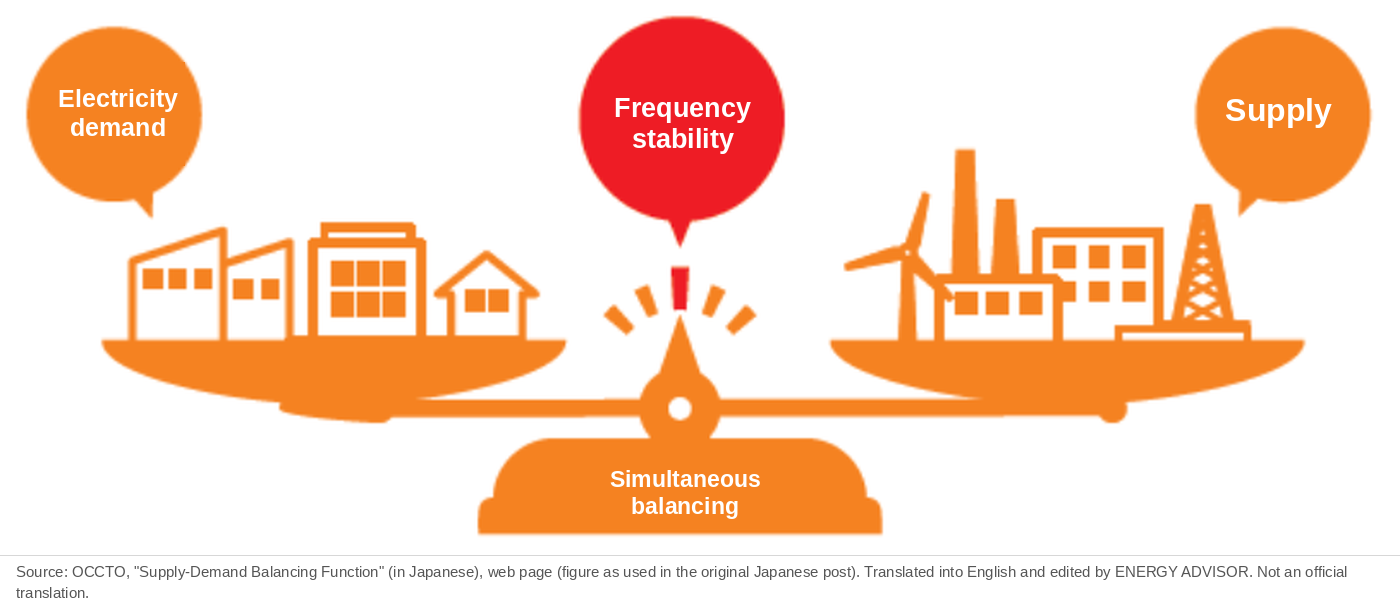
Electricity demand and supply capacity must be almost equal at every moment. When supply capacity is short, the frequency falls; when supply capacity is in surplus, the frequency rises. Japan’s frequency is 50 Hz in eastern Japan (Hokkaido, Tohoku and Tokyo) and 60 Hz in western Japan (from Chubu westward). To keep the frequency constant, supply capacity is adjusted to changes in demand continuously, 24 hours a day, 365 days a year.
Japan has ten regional service areas, and the grid in each area is operated by a general transmission and distribution company (GT&D company). The GT&D company is ultimately responsible for matching supply and demand in its area.
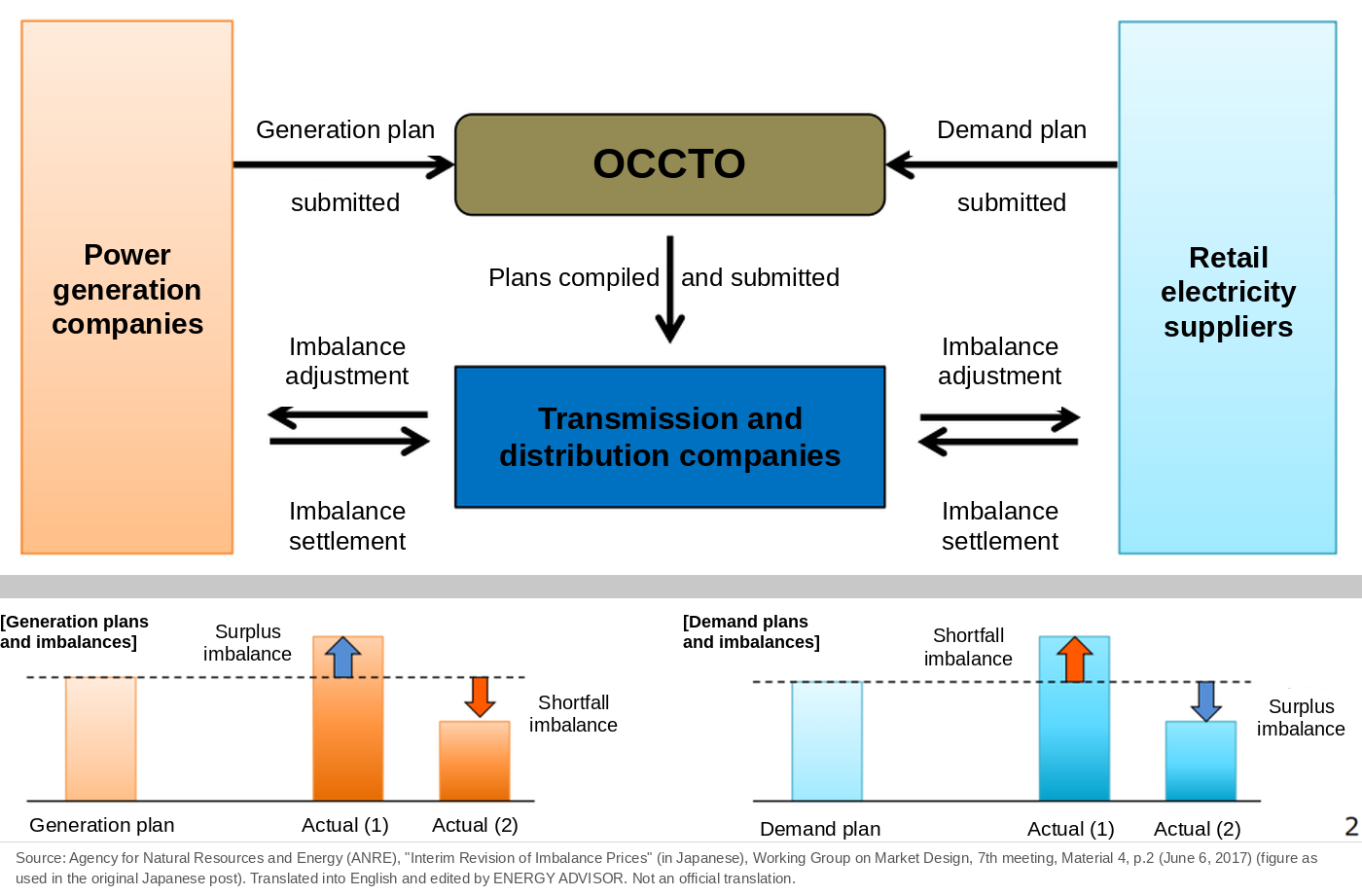
Since full retail market liberalization in 2016, power generation companies and retail electricity suppliers have prepared planned values for generation and demand for every 30 minutes. The planned values are submitted to the Organization for Cross-regional Coordination of Transmission Operators, JAPAN (OCCTO). This rule is called planned-value balancing (30-minute balancing against plans). OCCTO is the body that monitors supply and demand nationwide and receives companies’ plans.
However, differences always arise between planned values and actual generation and demand. The GT&D company therefore uses supply capacity secured in advance (balancing capacity) to adjust so that the shortfall or surplus becomes zero.
- A deviation from the plan is called an “imbalance”
- When actual demand is higher than planned, or generation is lower than planned, this is called a “shortfall imbalance”
- When actual demand is lower than planned, or generation is higher than planned, this is called a “surplus imbalance”
- The energy (kWh) the GT&D company used for the adjustment is settled with the power generation company or retail electricity supplier that caused the imbalance, at the imbalance price (¥/kWh)
The imbalance price is set for each 30-minute period and each area. A company with a shortfall imbalance pays the price, and a company with a surplus imbalance receives it.
Imbalances Versus Penalties
Imbalances are sometimes seen as a kind of penalty. In practice, they are a mechanism in which the GT&D company adjusts supply capacity for the difference from the planned values. Rather than a penalty, an imbalance can be described as a mechanism, alongside the day-ahead and intraday markets, for filling surpluses and shortfalls of supply capacity.
However, companies are obliged to follow planned-value balancing. In addition, the imbalance price is designed to rise when the supply-demand balance is tight. From October 2026, the cap became ¥300/kWh.
History of the Imbalance System
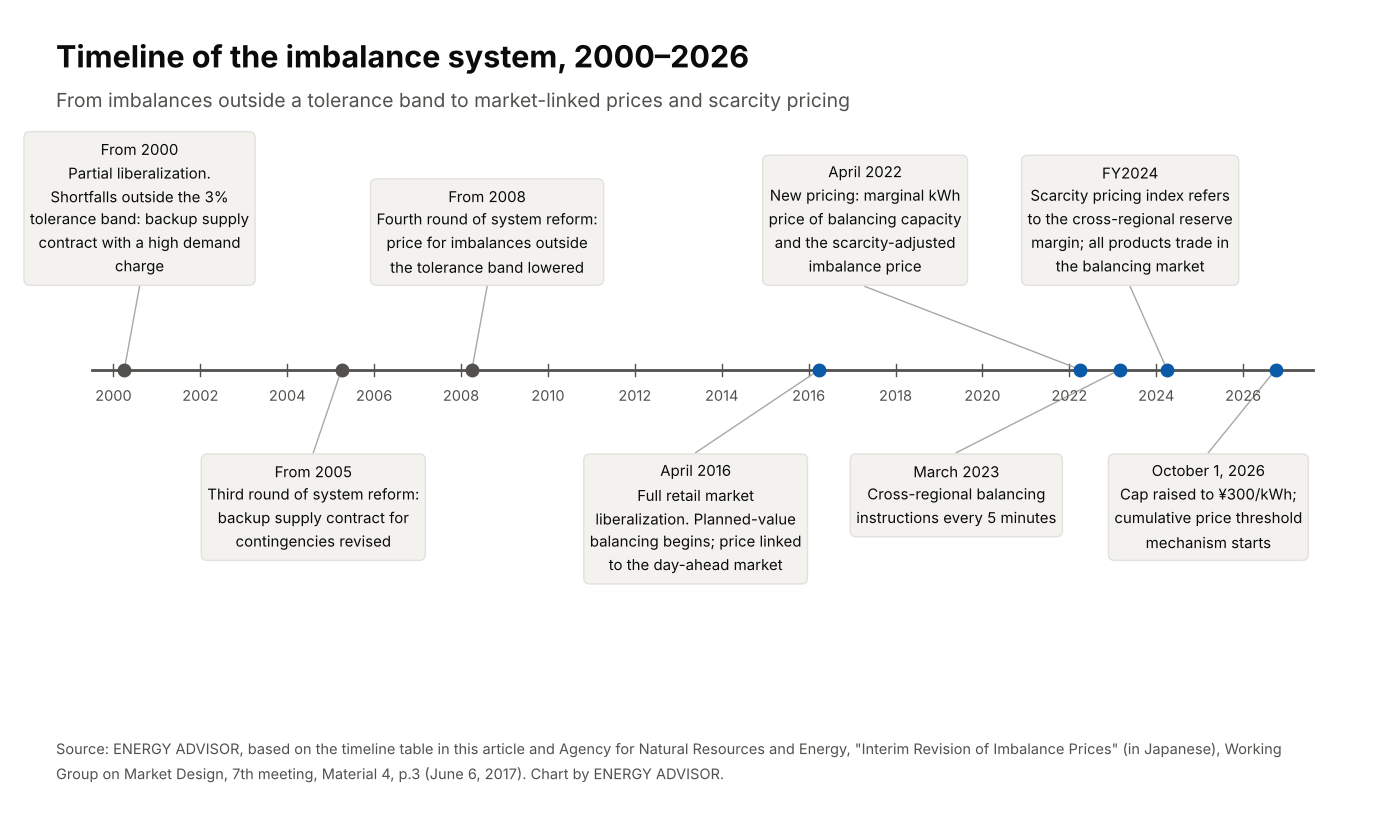
The imbalance system has changed many times since 2000, when partial liberalization of electricity retail began.
| Period | Main change |
|---|---|
| From 2000 | Partial liberalization. Shortfalls of more than 3% (outside the tolerance band) were charged a high demand charge under a backup supply contract for contingencies |
| From April 2016 | Full retail market liberalization. Planned-value balancing begins. The price is linked to the day-ahead market (spot market) price |
| From April 2022 | New imbalance pricing system: the marginal kWh price of balancing capacity and the scarcity-adjusted imbalance price |
| From March 2023 | Cross-regional balancing instructions issued every 5 minutes; 5-minute prices combined into the price for each 30-minute period |
| From FY2024 (April 2024–March 2025) | The scarcity pricing index refers to the cross-regional reserve margin. All products start trading in the Supply and Demand Balancing Market (balancing market) |
| From October 1, 2026 | Cap on the scarcity-adjusted imbalance price raised to ¥300/kWh. Cumulative price threshold mechanism starts |
History (1): From 2000, Imbalances Outside the Tolerance Band
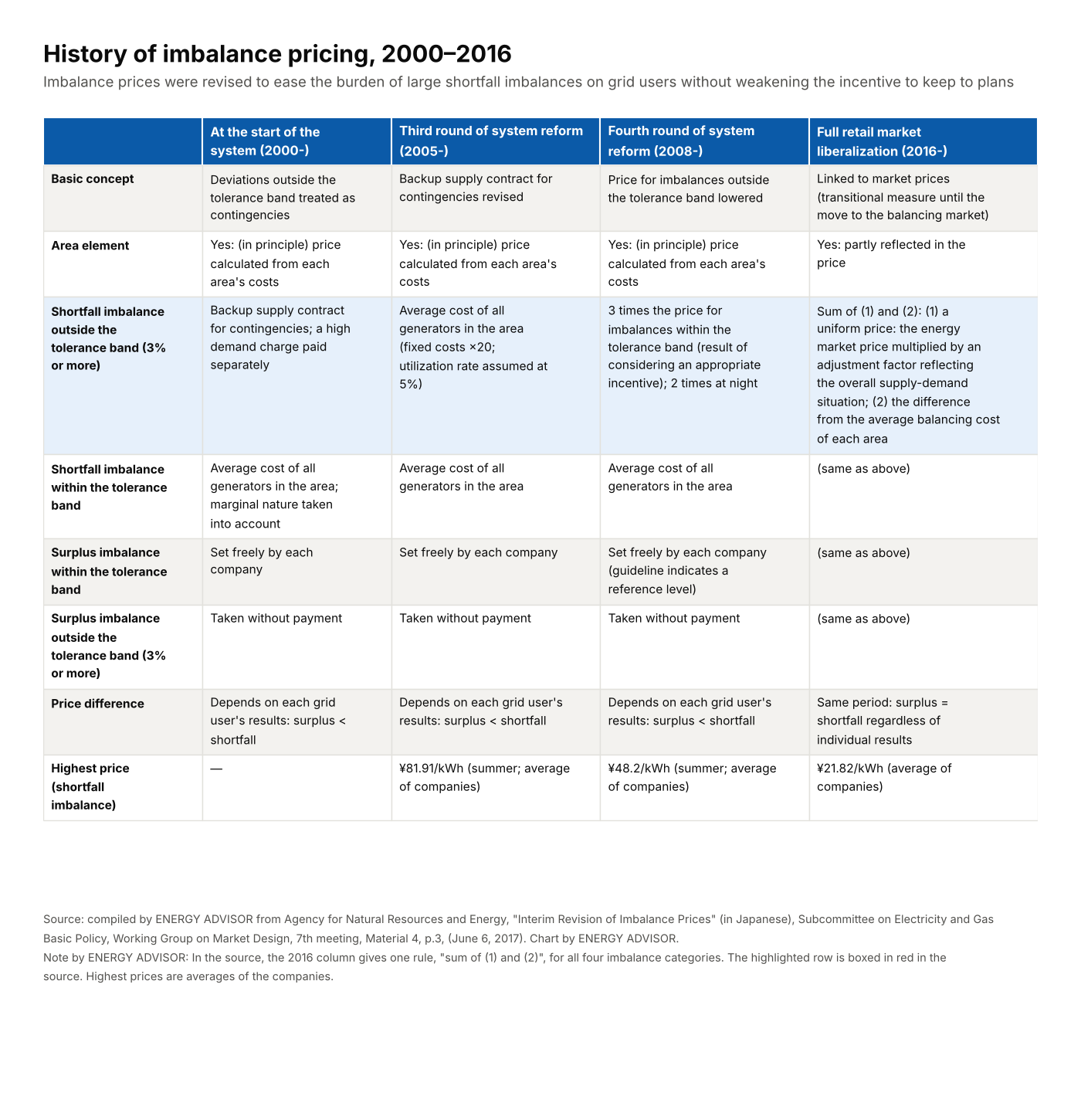
At the start of the system, the part of a deviation from the plan that exceeded 3% was treated as “outside the tolerance band.” For shortfall imbalances outside the tolerance band, companies concluded a backup supply contract for contingencies and paid a separate, high demand charge. Surplus imbalances outside the tolerance band were taken without payment. Later, in the third round of system reform from 2005 and the fourth round from 2008, the way the price for shortfall imbalances outside the tolerance band was set was revised (ANRE, “Interim Revision of Imbalance Prices,” p.3). For small new entrant retailers (retailers that entered the market after liberalization), high imbalance prices were a major risk, and the level and transparency of the prices were debated.
History (2): From 2016, Linked to the Market Price
After full retail market liberalization in 2016, the imbalance price came to be calculated from market prices. It was linked to the system price, the nationwide price in the day-ahead market.
However, this price differed from the cost of the resources the GT&D companies actually used to adjust imbalances. There was an issue that the price should reflect the cost of the resources actually used.
History (3): From April 2022, the Marginal kWh Price of Balancing Capacity and the Scarcity Adjustment
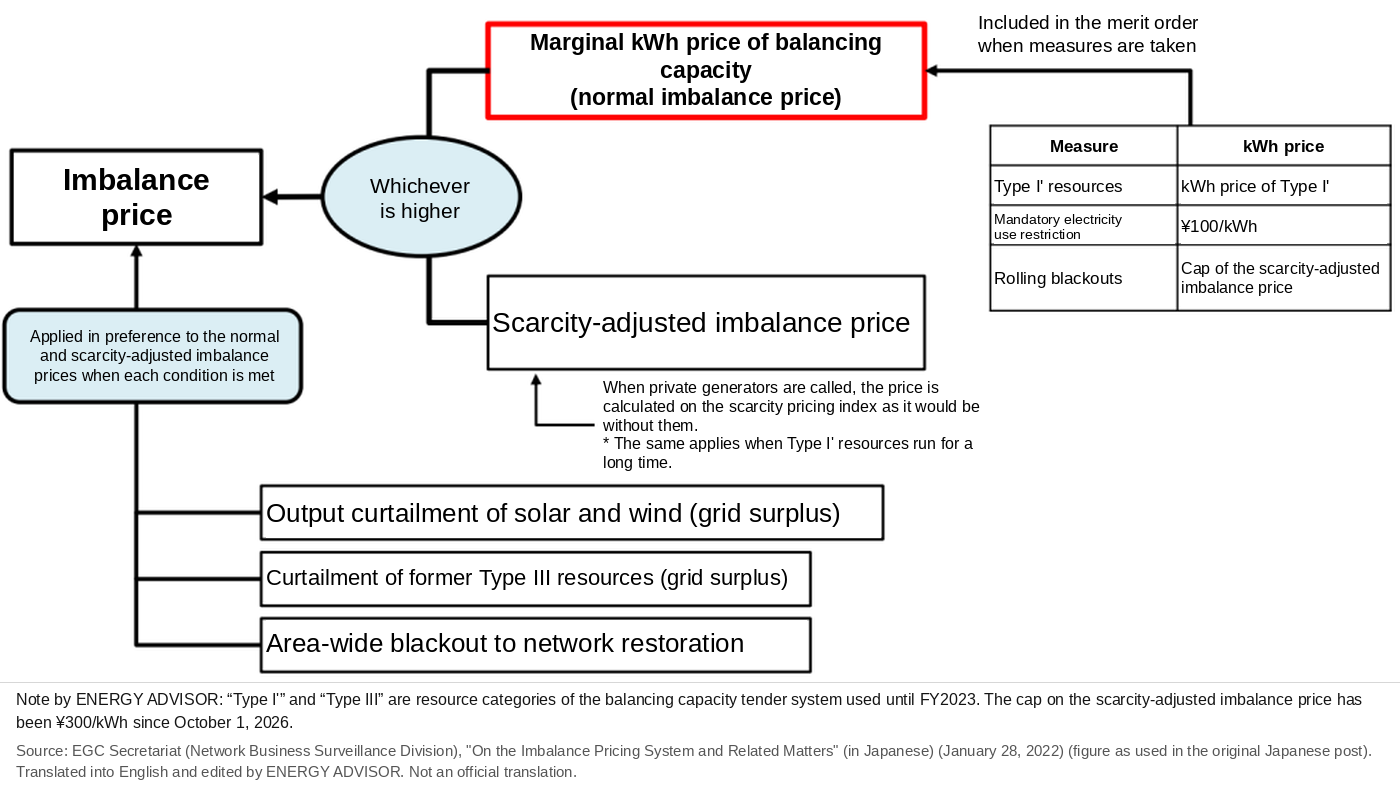
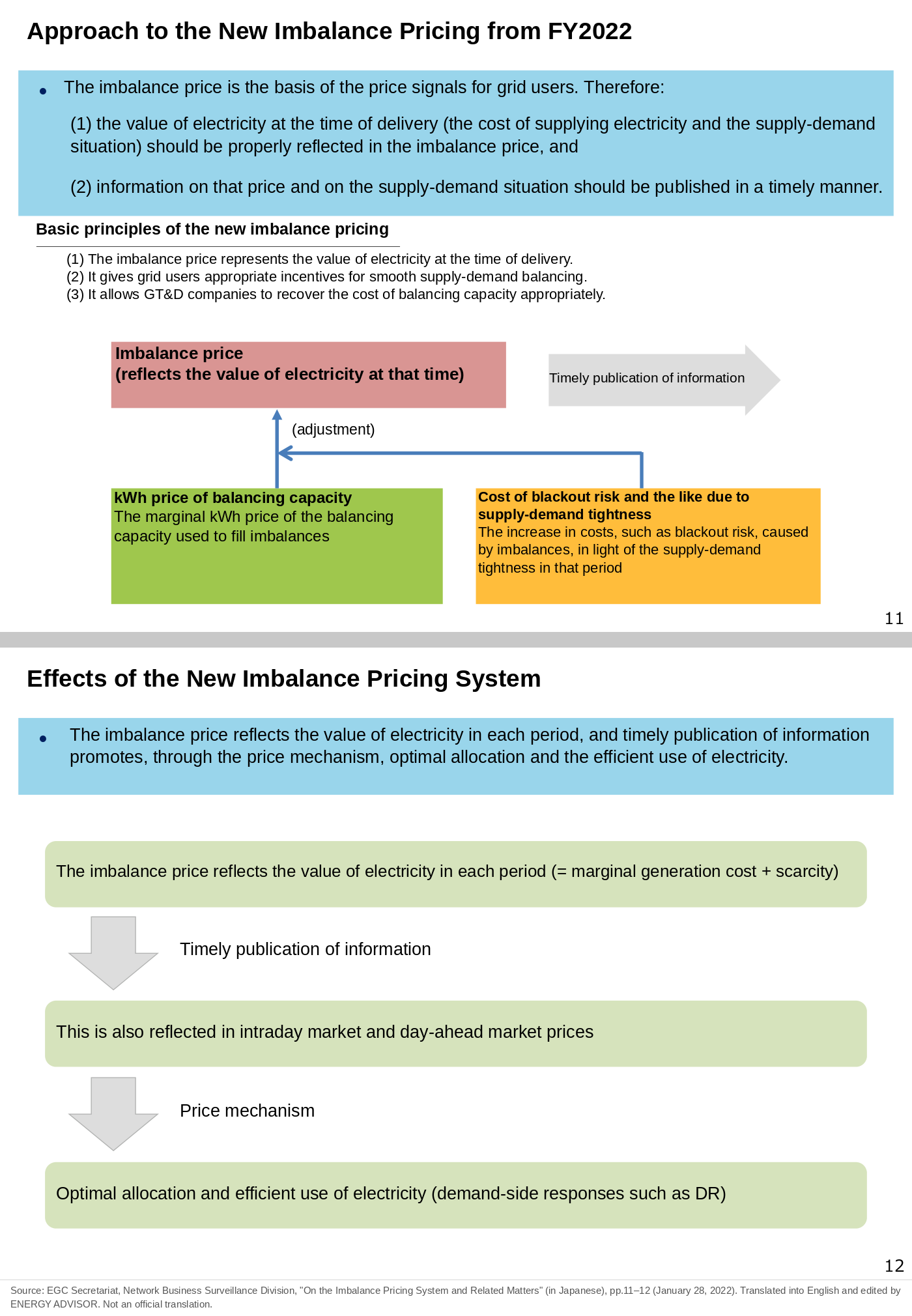
A new imbalance pricing system started in April 2022. Its basic idea is to reflect appropriately in the price the cost of electricity in real time and how tight the supply-demand balance is.
The imbalance price is the higher of the following two.
- Marginal kWh price of balancing capacity: The GT&D company adjusts imbalances by dispatching balancing capacity in order of kWh price, from the cheapest (merit order). This is the highest kWh price, that of the last resource dispatched. It is considered to represent the value of electricity at that time
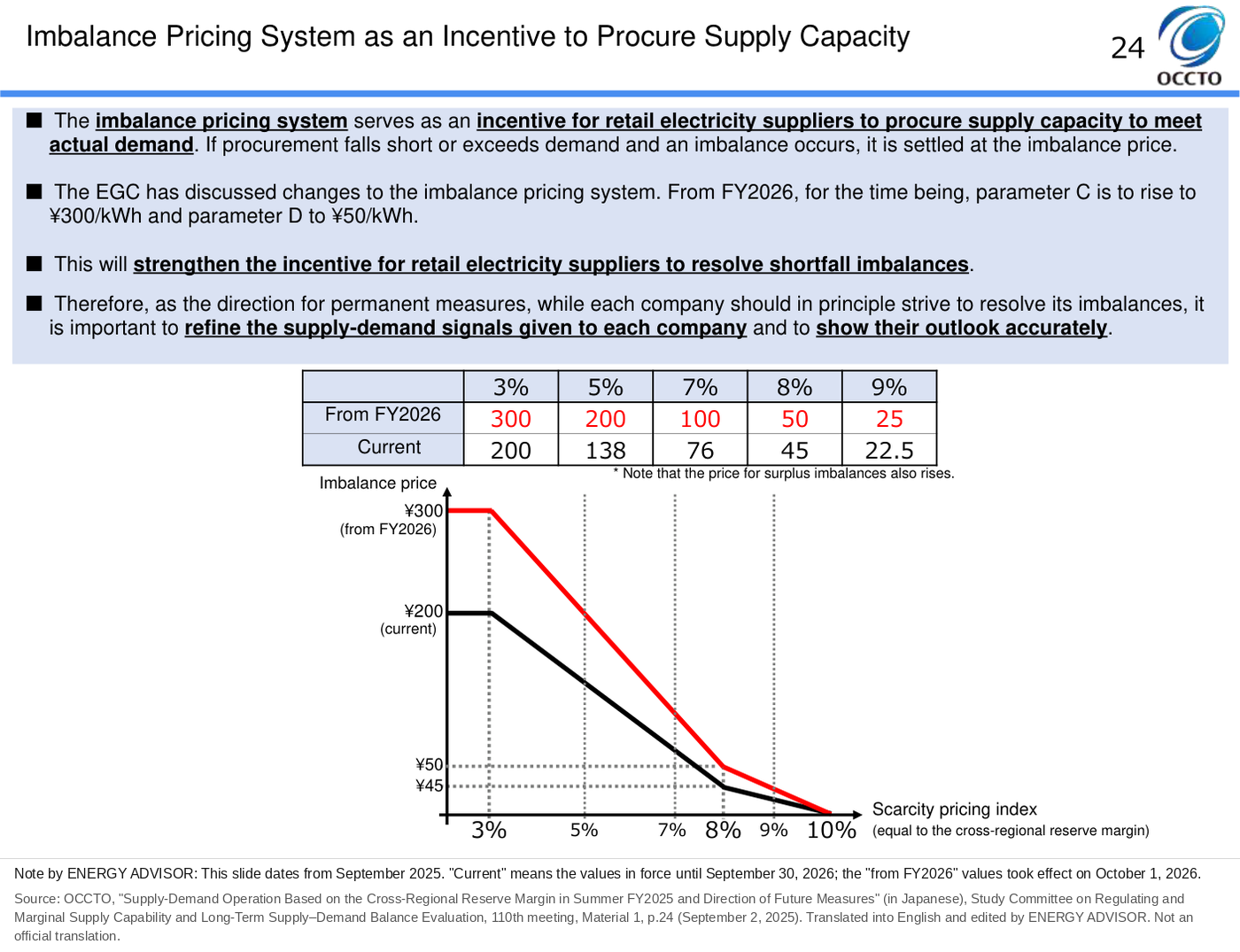
- Scarcity-adjusted imbalance price: A mechanism in which the price rises as the upward headroom available to the GT&D company (the scarcity pricing index) decreases. Shortfall imbalances when the supply-demand balance is tight increase the risk of large-scale blackouts and the cost of securing supply capacity urgently. This price is meant to reflect those costs
By raising the imbalance price when the supply-demand balance is tight, the system is expected to draw out additional supply capacity, such as demand response (DR: customers reducing their electricity use) and in-house generation. It is also expected to encourage customers to save electricity.
As exceptions, separate prices apply during output curtailment of solar and wind, during an area-wide blackout (a blackout of an entire area), and in similar cases. When the grid is in surplus during output curtailment of solar and other sources, the imbalance price is ¥0/kWh.
How the cap on the scarcity-adjusted imbalance price (parameter C) was handled is explained in History (4) and (5) below.
History (4): March 2023 to FY2024, 5-Minute Instructions, Reference to the Cross-Regional Reserve Margin, and the Balancing Market
- From March 2023, instructions for cross-regional balancing, which dispatches balancing capacity across areas, changed from every 15 minutes to every 5 minutes. The marginal kWh price for each 5 minutes is weighted by the imbalance volume in each 5 minutes and averaged to give the price for that 30-minute period
- The cap on the scarcity-adjusted imbalance price (parameter C) was set provisionally at ¥200/kWh when the system started, and the plan was to raise it to ¥600/kWh from FY2024. In November 2023, it was decided to keep it at ¥200/kWh for FY2024 as well. It remained at ¥200/kWh in FY2025 too
- From FY2024, the scarcity pricing index came to refer to the cross-regional reserve margin published by OCCTO. The cross-regional reserve margin is a ratio, viewed across areas, of how much spare supply capacity there is relative to demand
- From FY2024, trading of all products (primary to tertiary (2)) began in the balancing market, where GT&D companies buy balancing capacity. Except in Okinawa, the earlier balancing capacity tenders ended
History (5): From October 2026, a ¥300 Cap and the Cumulative Price Threshold Mechanism
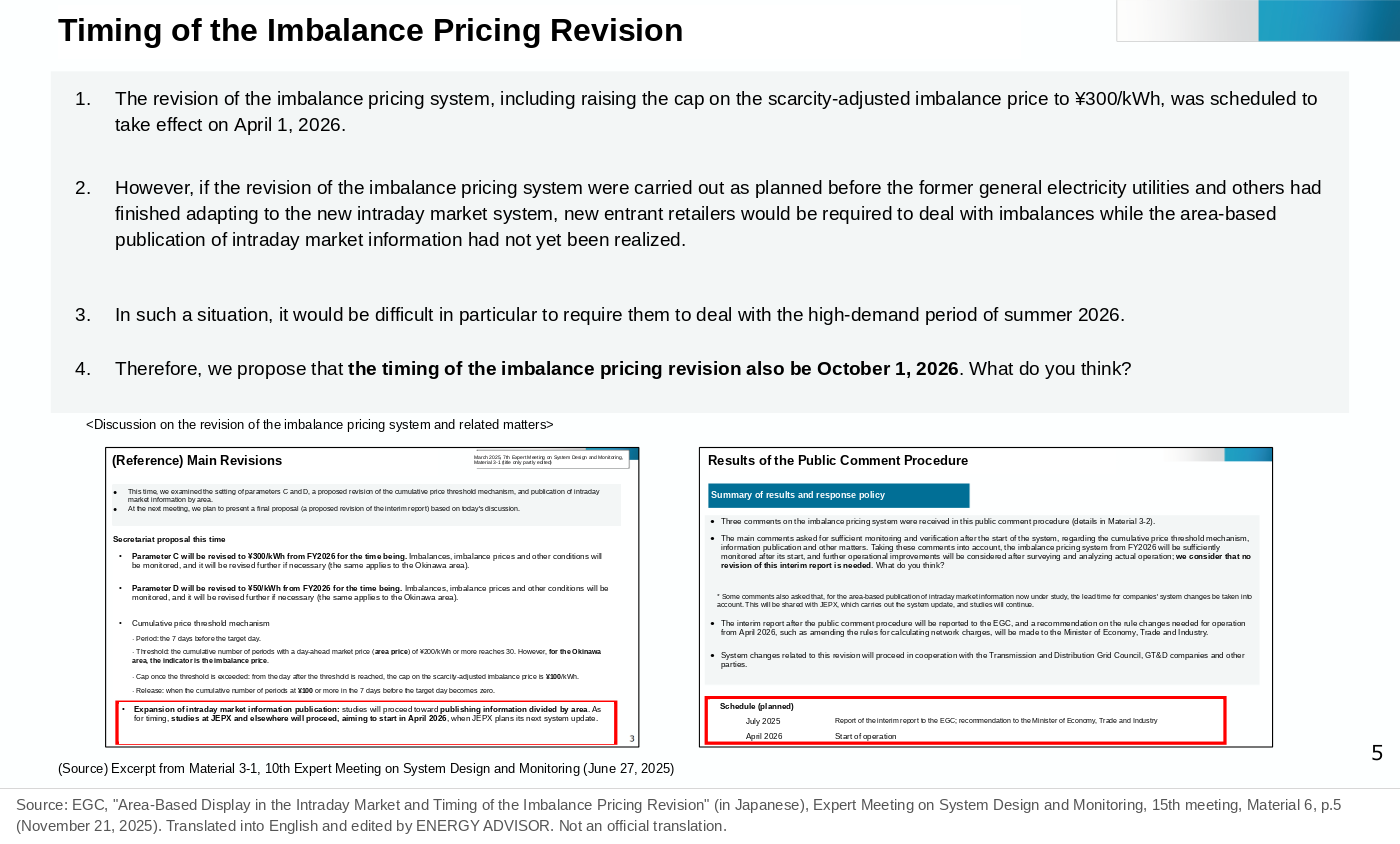
After discussions at the Expert Meeting on System Design and Monitoring of the Electricity and Gas Market Surveillance Commission (EGC), the following changes took effect on October 1, 2026. The EGC is a regulator under the Minister of Economy, Trade and Industry that monitors electricity markets and examines the details of pricing rules.
| Item | Until September 2026 | From October 1, 2026 |
|---|---|---|
| Cap on the scarcity-adjusted imbalance price (parameter C) | ¥200/kWh | ¥300/kWh (for the time being) |
| Price at the kink of the scarcity-adjusted imbalance price (parameter D) | ¥45/kWh | ¥50/kWh (for the time being) |
| Cumulative price threshold mechanism | None | If area prices of ¥200/kWh or more reach 30 periods in the preceding seven days, the cap is lowered to ¥100/kWh from the next day |
The changes were originally to take effect in April 2026. However, they were moved to October 1 to match the system upgrade of the intraday market (the market for same-day trading) of the Japan Electric Power Exchange (JEPX) (Article 01). The Imbalance Price Information Website states that the cap is, in principle, ¥600/kWh, and that ¥300/kWh is a provisional measure.
Summary
- An imbalance is the deviation between the plan a company submits under planned-value balancing and its actual generation or demand
- The GT&D company fills the deviation with balancing capacity, and it is settled at the imbalance price
- The current imbalance price is the higher of the marginal kWh price of balancing capacity and the scarcity-adjusted imbalance price
- From October 1, 2026, the cap on the scarcity-adjusted imbalance price became ¥300/kWh, and the cumulative price threshold mechanism started
Related articles are as follows.
| Article | Content |
|---|---|
| 05 Imbalance price calculation | The five calculation rules, and the formula and price table from October 2026 |
| 06 Checking imbalance prices | How to view prices and the calculation basis on the publication website |
| 07 Review of the scarcity price cap (parameter C) to ¥300/kWh | How the discussion went from ¥200 to ¥300 |
| 08 Imbalance prices from October 1, 2026 | The revision and results in the first half of FY2026 |
| 09 Resolving imbalances with balancing capacity | How GT&D companies fill imbalances |
This article is based on published materials from the Ministry of Economy, Trade and Industry and its Agency for Natural Resources and Energy, the Electricity and Gas Market Surveillance Commission, the Organization for Cross-regional Coordination of Transmission Operators (OCCTO) and other sources. The English translations of figures are by ENERGY ADVISOR and are not official translations. When using this information for decisions, please check the original sources. When we find an error, we correct the article and note the date of the correction.
Sources
- Electricity and Gas Market Surveillance Commission, “Imbalance Pricing System from FY2022 (Interim Report)” (5-minute instructions and weighted averaging: 2(2)②; parameters C and D and reference to the cross-regional reserve margin: 2(5); cumulative price threshold mechanism: 2(9); the revision date field reads “Reiwa 7 [2025], ● month ● day”) (in Japanese). https://www.egc.meti.go.jp/activity/emsc_systemsurveillance/pdf/010_03_03.pdf
- Electricity and Gas Market Surveillance Commission, Expert Meeting on System Design and Monitoring, 10th meeting, Material 3-1, “Detailed Design of the Imbalance Pricing System,” pp.3–4 (June 27, 2025) (in Japanese). https://www.egc.meti.go.jp/activity/emsc_systemsurveillance/pdf/010_03_01.pdf
- Electricity and Gas Market Surveillance Commission, Expert Meeting on System Design and Monitoring, 15th meeting, Material 6, “Area-Based Display in the Intraday Market and Timing of the Imbalance Pricing Revision,” pp.4–5 (November 21, 2025) (in Japanese). https://www.egc.meti.go.jp/activity/emsc_systemsurveillance/pdf/015_06_00.pdf
- Imbalance Price Information Website, “Frequently Asked Questions on the Central Imbalance Price Calculation System,” 1-1, 1-2, 1-7, 2-2 and 2-11 (updated October 1, 2026) (in Japanese). https://www.imbalanceprices-cs.jp/show/faq/faqInquiry.pdf
- OCCTO, Study Committee on Regulating and Marginal Supply Capability and Long-Term Supply–Demand Balance Evaluation, 86th meeting, Material 1, “Upper Limit of Balancing Capacity Procurement Volume,” p.2 (May 29, 2023) (in Japanese). https://www.occto.or.jp/iinkai/chouseiryoku/2023/files/chousei_86_01.pdf
- EGC Secretariat, Network Business Surveillance Division, “On the Imbalance Pricing System and Related Matters” (January 28, 2022; source of the figures in the original post) (in Japanese). https://www.egc.meti.go.jp/info/public/pdf/20220117001b.pdf
- Electricity and Gas Market Surveillance Commission, Expert Meeting on System Design and Monitoring, 5th meeting, Material 4, “Detailed Design of the Imbalance Pricing System,” p.38 (excerpt of the Interim Report [November 21, 2023]) (January 30, 2025) (in Japanese). https://www.egc.meti.go.jp/activity/emsc_systemsurveillance/pdf/005_04_00.pdf
- Agency for Natural Resources and Energy, “Interim Revision of Imbalance Prices” (Subcommittee on Electricity and Gas Basic Policy, Working Group on Market Design, 7th meeting, Material 4, June 6, 2017), p.2 (diagram of plans and imbalances) and p.3 (table of the history of imbalance pricing). Source of the figures in the original post; the original post attributed it to OCCTO, but it was submitted by ANRE (in Japanese). https://www.meti.go.jp/shingikai/enecho/denryoku_gas/denryoku_gas/seido_kento/pdf/007_04_00.pdf
- OCCTO, “Supply-Demand Balancing Function” (in Japanese). https://www.occto.or.jp/occto/about_occto/jukyu_chousei_kinou.html