Electricity demand and supply must always be equal. The capability needed to match supply and demand as demand changes is called “balancing capacity.” This article explains frequency control, one of the system stabilization duties that general transmission and distribution companies carry out using balancing capacity. The definition of balancing capacity and supply-demand balancing (resolving imbalances) are explained in Article 09.
Balancing Capacity and System Stabilization Duties
A general transmission and distribution company (GT&D company) operates the grid in each area and is ultimately responsible for matching supply and demand in its area. GT&D companies carry out system stabilization duties such as frequency control and supply-demand balancing.
Until FY2023 (April 2023–March 2024), the balancing capacity used for system stabilization duties was procured through balancing capacity tenders (Type I, II and I’). From FY2024, all products (primary to tertiary (2)) have been procured in the Supply and Demand Balancing Market (balancing market). Except in the Okinawa area, balancing capacity tenders have ended.
Frequency (50 Hz in Eastern Japan, 60 Hz in Western Japan)
Electricity can be alternating current (AC) or direct current (DC), and power systems use AC.
AC electricity is produced by huge magnets rotating inside generators. The direction and magnitude of AC electricity change periodically. The number of these cycles per second is called the “frequency” (unit: Hz). The rotational speed of a generator is proportional to the frequency.
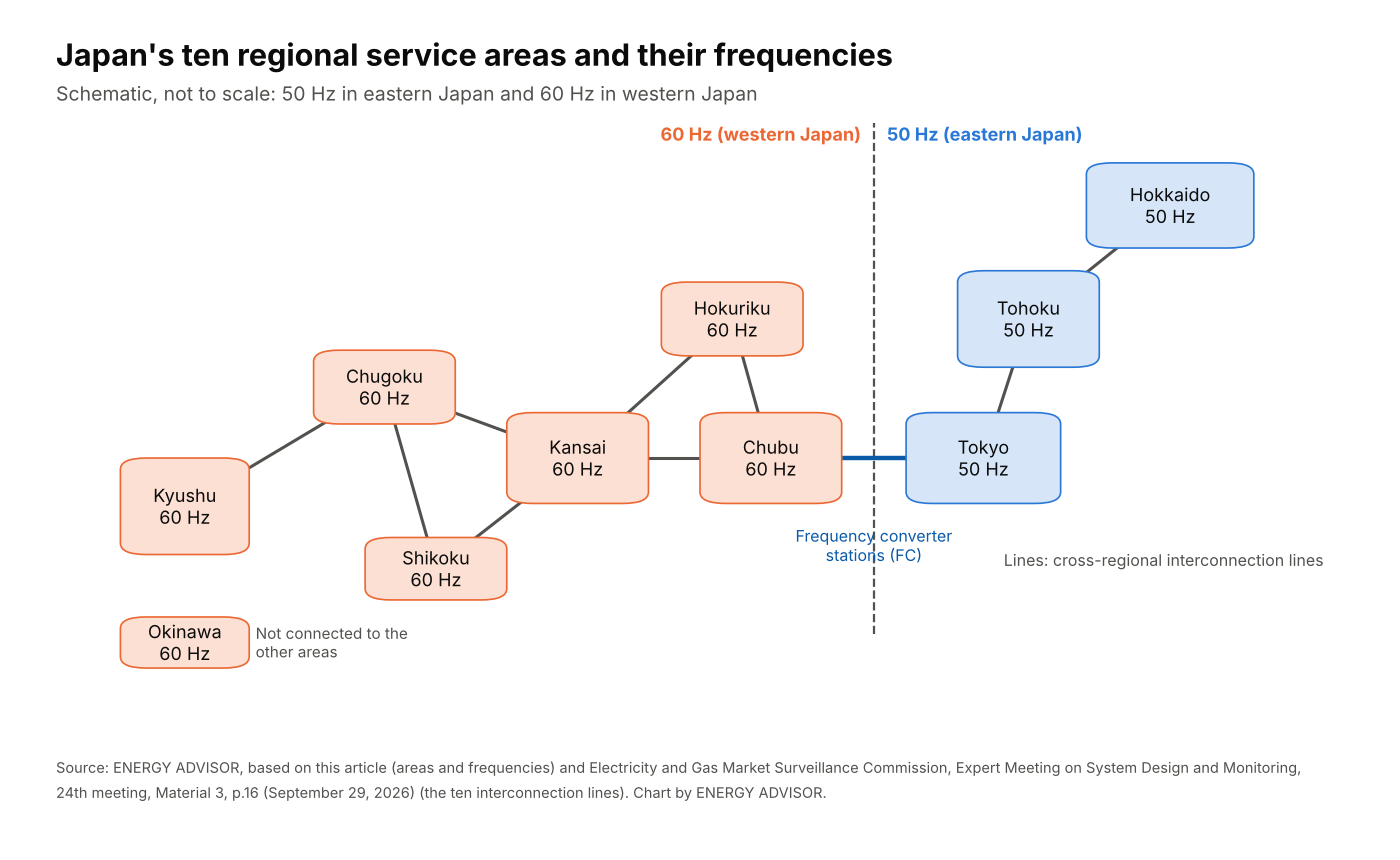
Japan uses electricity at two different frequencies: 50 Hz in eastern Japan and 60 Hz in western Japan. The Hokkaido, Tohoku and Tokyo areas run at 50 Hz, and the areas from Chubu westward run at 60 Hz (Figure 1).
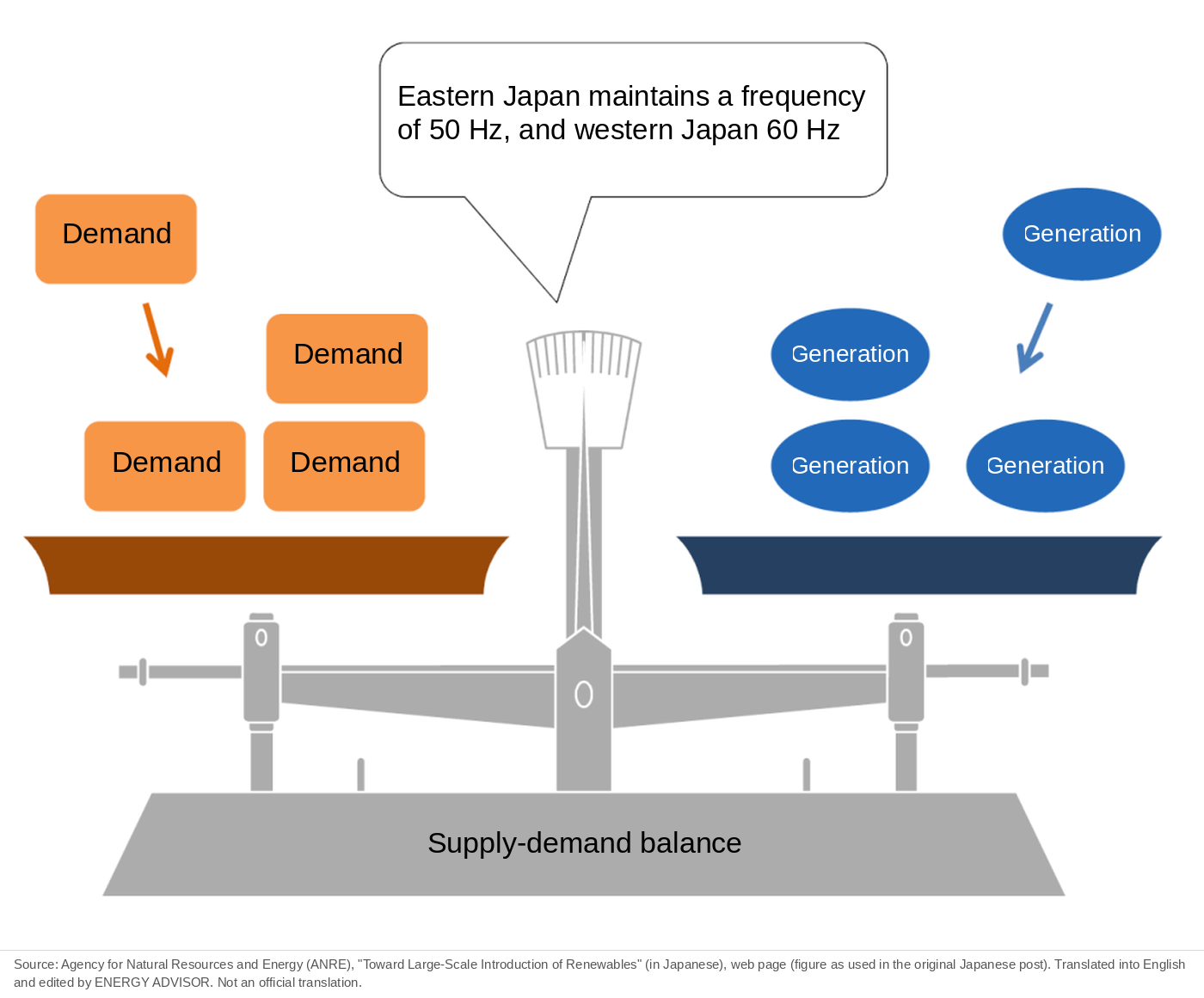
When demand and supply are in balance, the frequency is 50 Hz in eastern Japan and 60 Hz in western Japan. When supply is lower than demand, the frequency falls; when supply is higher than demand, the frequency rises. For a stable supply of electricity, the frequency must always be kept within a certain range.
To keep the frequency constant, generation must be adjusted continuously in response to changes in demand. GT&D companies carry out “frequency control” by controlling generator output with balancing capacity.
Ever-Changing Electricity Demand and Its Three Components
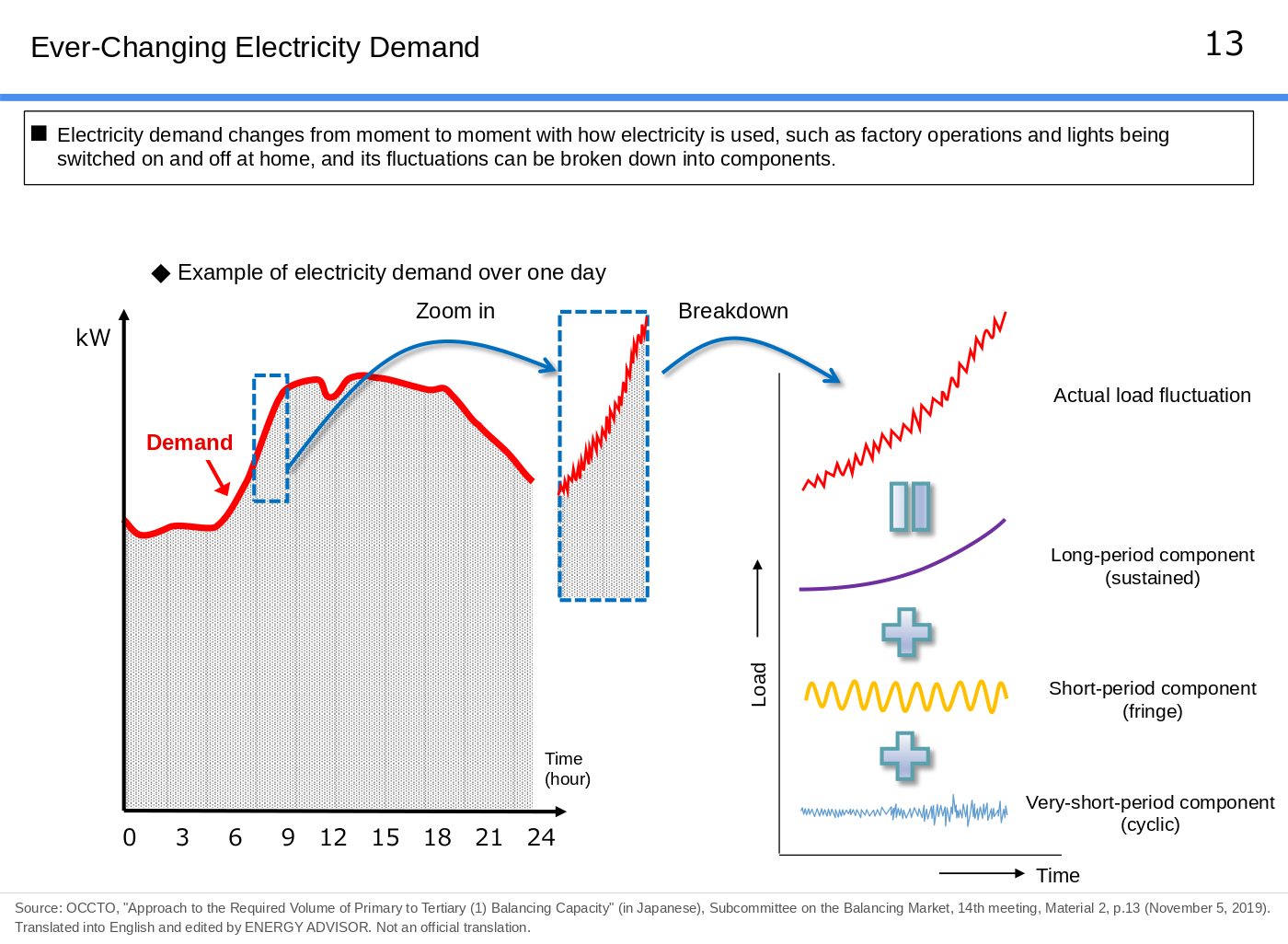
To keep the frequency constant, generation and demand must be matched. But electricity demand changes all the time for many reasons, such as factory operations, the business of commercial facilities, and households switching lighting, cooling and heating on and off. Matching it with generation is not easy.
Figure 3 shows an example of electricity demand over one day. Demand fluctuates constantly in small swings, but it can be divided into three components based on the period of the fluctuations.
| Component | Period of fluctuation |
|---|---|
| Very-short-period component | A few seconds to a few minutes |
| Short-period component | A few minutes to a little over ten minutes |
| Long-period component | A little over ten minutes to several hours |
Source: Organization for Cross-regional Coordination of Transmission Operators, JAPAN (OCCTO), Subcommittee on the Balancing Market, 19th meeting, Material 2-2, “Current Status of GF and LFC Operation” (submitted by the ten GT&D companies), pp.5–6
Frequency control responds to each of these components in a different way.
Frequency Control Functions of Generators
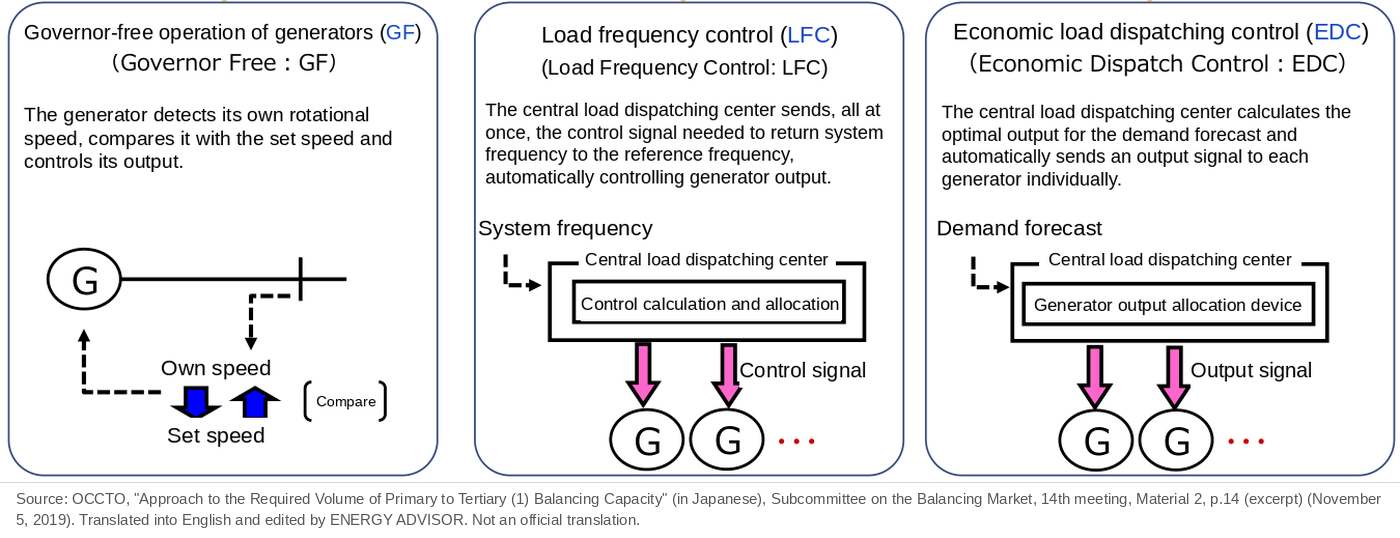
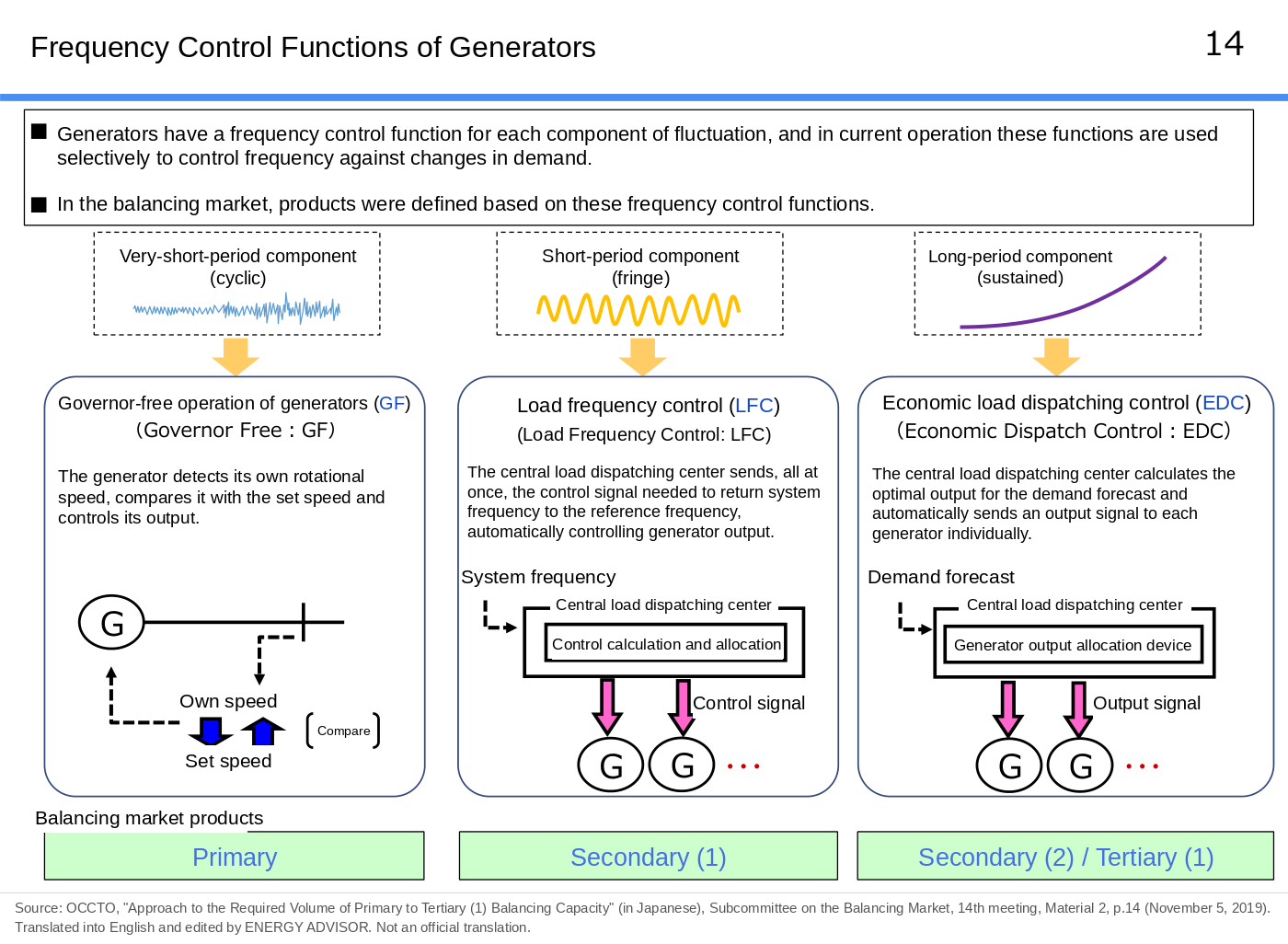
Generators secured as balancing capacity have frequency control functions (GF, LFC and EDC) that correspond to each component of demand fluctuation. In the real-time time frame, frequency control is carried out for each component by using these functions as appropriate (Figures 4 and 5).
Governor-free operation (GF) and primary balancing capacity
The “very-short-period component,” demand fluctuation over a few seconds to a few minutes, is handled by governor-free operation (GF) of generators.
A governor is a device that automatically adjusts the amount of steam or other driving force of a generator to keep the generator’s rotational speed (frequency) constant.
Governor-free operation is operation in which the generator’s output is allowed to adjust freely through the action of the governor, in response to changes in grid frequency. The generator itself detects its rotational speed, compares it with the set value, and adjusts its output to return to the reference frequency. Because it responds very quickly to frequency fluctuations, it is used for frequency control of the very-short-period component.
In the balancing market, this function is classified as primary balancing capacity.
Load frequency control (LFC) and secondary balancing capacity (1)
The “short-period component,” demand fluctuation over a few minutes to a little over ten minutes, is handled by load frequency control (LFC).
Load frequency control (LFC) is a function of each area’s central load dispatching center. The central load dispatching center is the control center that issues output instructions to power plants in the area. LFC calculates the amount of adjustment needed to return the current frequency to the reference frequency (50 Hz or 60 Hz). It then sends instructions to the target generators and controls their output automatically.
It is the core control for maintaining frequency, and generators under LFC are required to respond reliably and quickly.
In the balancing market, this function is classified as secondary balancing capacity (1).
Economic load dispatching control (EDC), secondary balancing capacity (2) and tertiary balancing capacity (1)
The “long-period component,” demand fluctuation over a little over ten minutes to several hours, is handled by economic load dispatching control (EDC).
Economic load dispatching control (EDC) is also a function of each area’s central load dispatching center. It forecasts demand changes from a little over ten minutes to several hours ahead and calculates the allocation of output that minimizes generation costs for the area as a whole. By controlling generator output based on this allocation, the total cost of the generators controlled by the central load dispatching center can be minimized.
In the balancing market, this function is classified as secondary balancing capacity (2) and tertiary balancing capacity (1).
Balancing Market Products and Frequency Control Functions
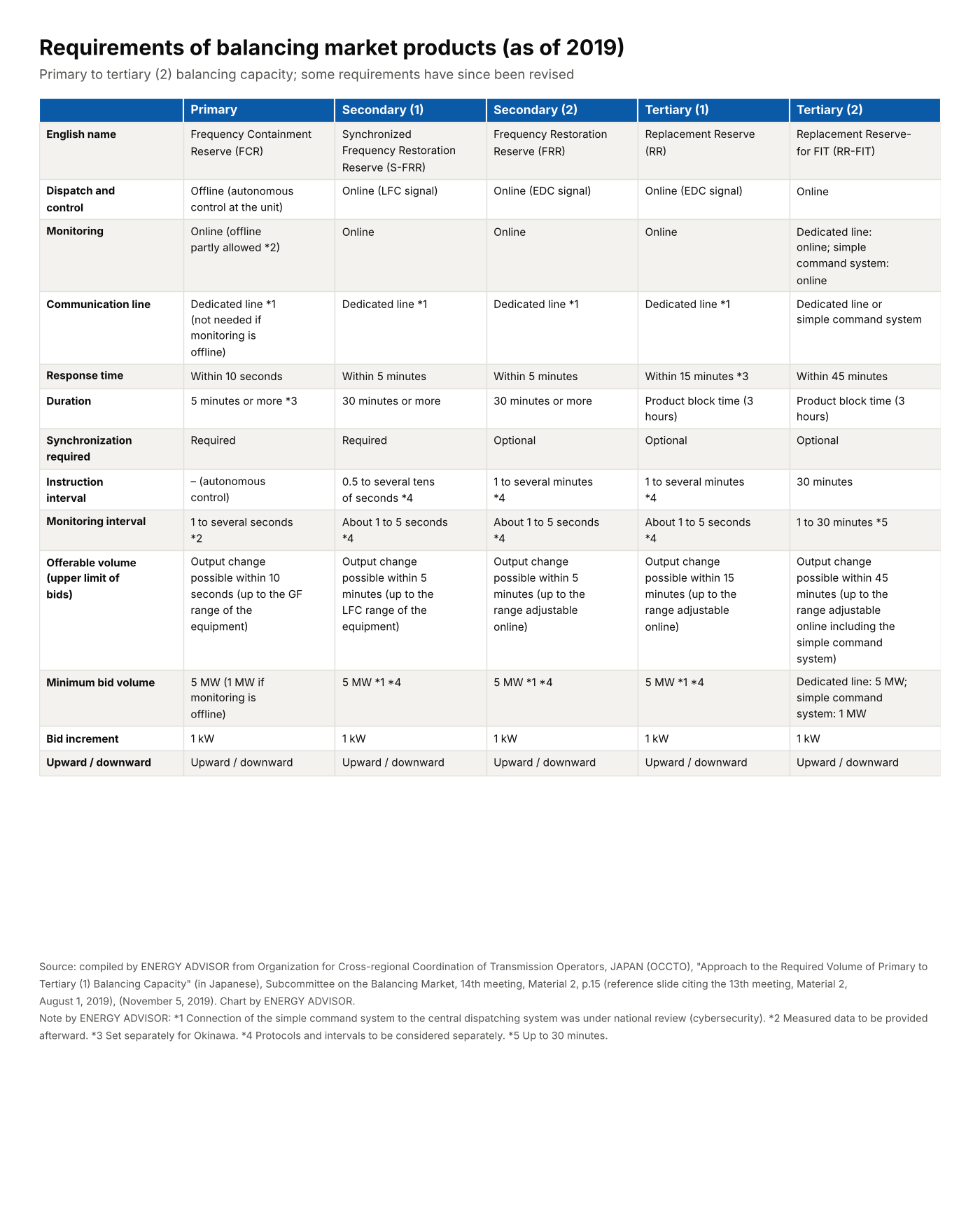
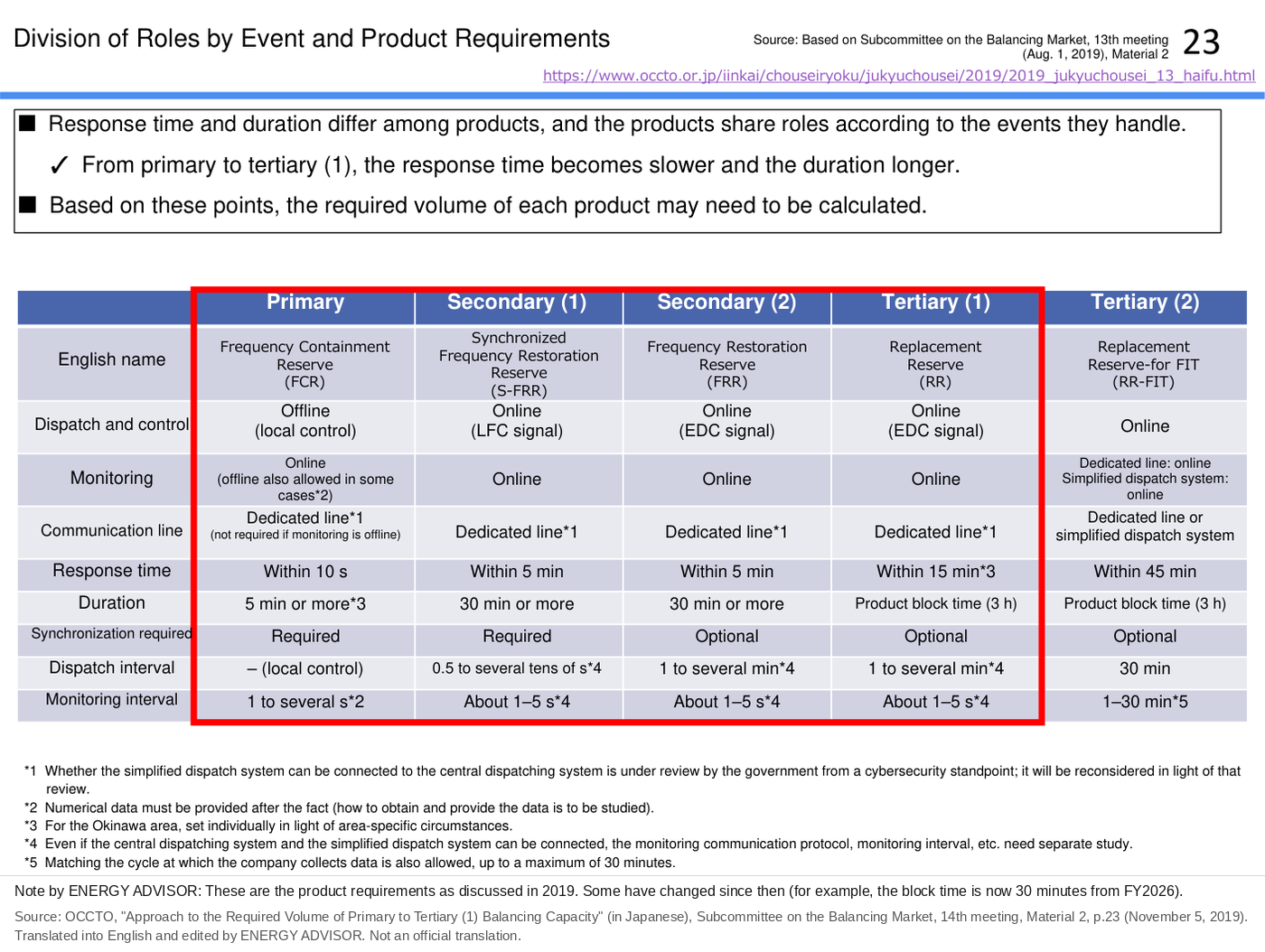
The requirements of the balancing market products are set with these frequency control functions (GF, LFC and EDC) in mind.
| Component of demand fluctuation | Frequency control function | Balancing market product |
|---|---|---|
| Very-short-period component (a few seconds to a few minutes) | Governor-free operation (GF) | Primary balancing capacity (Frequency Containment Reserve, FCR) |
| Short-period component (a few minutes to a little over ten minutes) | Load frequency control (LFC) | Secondary balancing capacity (1) (Synchronized Frequency Restoration Reserve, S-FRR) |
| Long-period component (a little over ten minutes to several hours) | Economic load dispatching control (EDC) | Secondary balancing capacity (2) (Frequency Restoration Reserve, FRR) and tertiary balancing capacity (1) (Replacement Reserve, RR) |
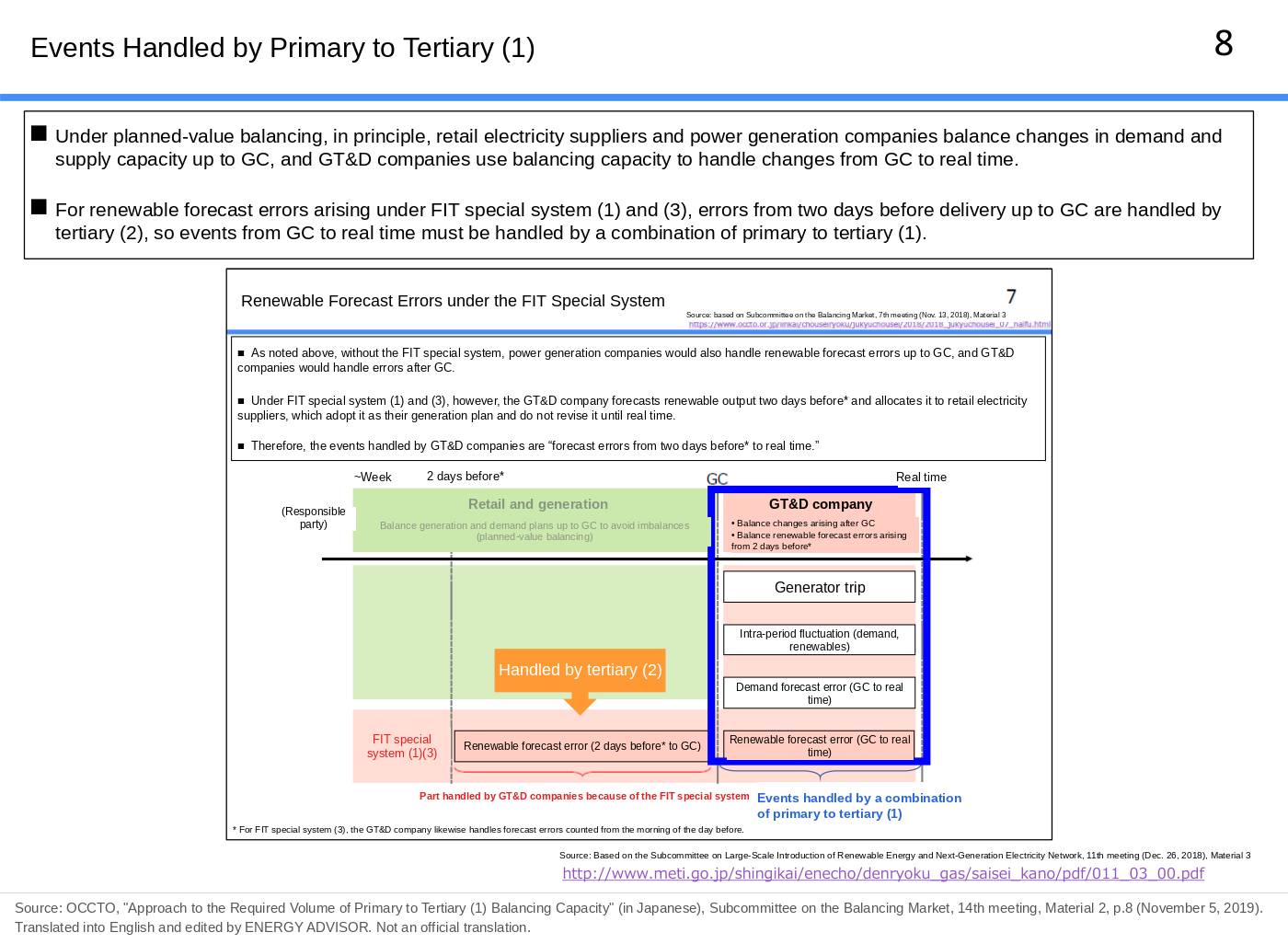
In addition, there is tertiary balancing capacity (2) (Replacement Reserve-for FIT, RR-FIT). It is a product that handles renewable forecast errors from two days before delivery up to gate closure that arise under the FIT special system (a mechanism in which GT&D companies and others forecast renewable output and prepare plans). Tertiary balancing capacity (2) is traded on the day before delivery.
Current State of Procurement in the Balancing Market
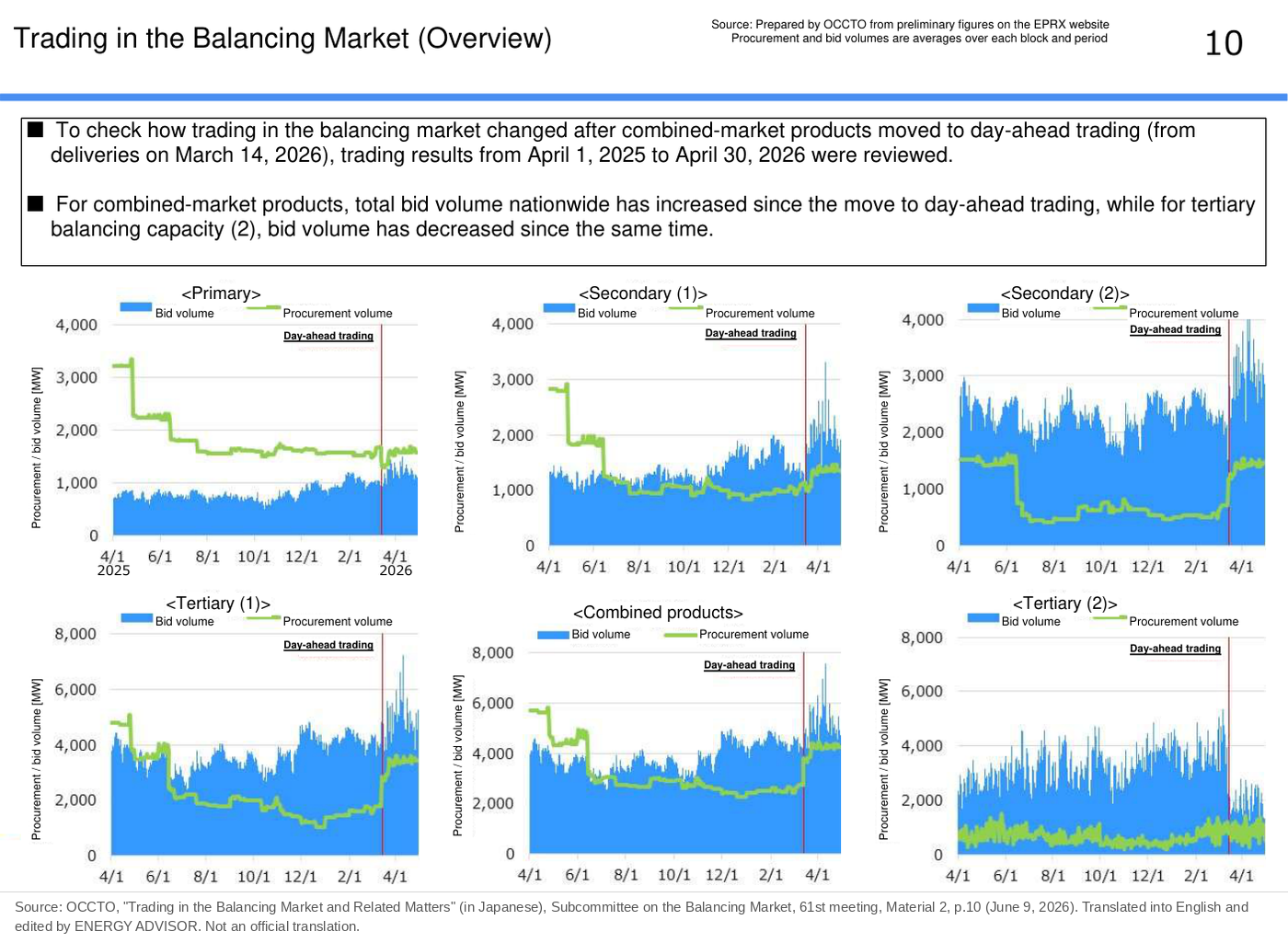
Trading of all products in the balancing market began in FY2024. However, because bids fall short and do not reach the procurement volume, there is no price competition, and the cost of procuring balancing capacity is high. From the FY2026 products, trading of primary to tertiary (1) and combined products was brought forward from week-ahead to day-ahead, and the time unit for bids was changed from 3 hours to 30 minutes (from deliveries on March 14, 2026).
According to OCCTO’s June 2026 report, bid volumes increased for many products and areas with the move to day-ahead trading. On the other hand, a certain shortfall continues for primary balancing capacity and secondary balancing capacity (1).
Summary
- To keep the frequency of the power system constant, GT&D companies control the generation output of balancing capacity secured in advance to match demand. This is called “frequency control”
- Actual fluctuations in electricity demand can be divided into a “long-period component,” a “short-period component” and a “very-short-period component,” and frequency control responds to each in a different way
- Generators secured as balancing capacity have frequency control functions (GF, LFC and EDC) corresponding to each component
- The balancing market products are set with these functions in mind. GF corresponds to primary balancing capacity, LFC to secondary balancing capacity (1), and EDC to secondary balancing capacity (2) and tertiary balancing capacity (1)
- In the balancing market, undersubscription continues, mainly for primary balancing capacity and secondary balancing capacity (1)
This article is based on published materials from the Ministry of Economy, Trade and Industry and its Agency for Natural Resources and Energy, the Electricity and Gas Market Surveillance Commission, the Organization for Cross-regional Coordination of Transmission Operators (OCCTO) and other sources. The English translations of figures are by ENERGY ADVISOR and are not official translations. When using this information for decisions, please check the original sources. When we find an error, we correct the article and note the date of the correction.
Sources
- OCCTO, Subcommittee on the Balancing Market, 14th meeting, Material 2 (events handled by tertiary (2): p.8; the three components of demand fluctuation, GF, LFC, EDC and their correspondence to products: p.14; product requirements: p.15) (in Japanese). https://www.occto.or.jp/iinkai/chouseiryoku/jukyuchousei/2019/files/jukyu_shijyo_14_02r.pdf
- OCCTO, Subcommittee on the Balancing Market, 19th meeting, Material 2-2, “Current Status of GF and LFC Operation” (submitted by the ten GT&D companies), pp.5–6 (periods of the three components of demand fluctuation; GF, LFC and EDC) (September 29, 2020) (in Japanese). https://www.occto.or.jp/iinkai/chouseiryoku/jukyuchousei/2020/files/jukyu_shijyo_19_02_02.pdf
- OCCTO, Study Committee on Regulating and Marginal Supply Capability and Long-Term Supply–Demand Balance Evaluation, 86th meeting, Material 1, “Upper Limit of Balancing Capacity Procurement Volume,” p.2 (May 29, 2023) (in Japanese). https://www.occto.or.jp/iinkai/chouseiryoku/2023/files/chousei_86_01.pdf
- OCCTO, Subcommittee on the Balancing Market, 61st meeting, Material 2, “Trading in the Balancing Market,” p.2, p.10 and p.35 (June 9, 2026) (in Japanese). https://www.occto.or.jp/assets/iinkai/jukyuchousei/61/jukyu_shijyo_61_02.pdf
- Electric Power Reserve eXchange, “Product Requirements and Trading Schedule of the Balancing Market,” 6th edition, p.2 (dispatch and control: primary is offline [local control], secondary (1) uses the LFC signal, secondary (2) and tertiary (1) use the EDC signal) (March 13, 2026) (in Japanese). https://www.eprx.or.jp/outline/docs/shouhin_ver.6_20260313.pdf
- OCCTO, Subcommittee on the Balancing Market, 61st meeting, Material 2, p.3 (product introduction schedule; tertiary (2) is procured cross-regionally on the day before delivery) (June 9, 2026) (in Japanese). https://www.occto.or.jp/assets/iinkai/jukyuchousei/61/jukyu_shijyo_61_02.pdf
- Central Research Institute of Electric Power Industry, “Basics of Electricity” (source of a figure in the original post) (in Japanese). https://criepi.denken.or.jp/koho/denki/index01.html
- Kansai Electric Power, “Electricity Classroom” (source of a figure in the original post) (in Japanese). https://www.kepco.co.jp/brand/for_kids/teach/2016_03/detail1.html
- Agency for Natural Resources and Energy, “Toward Large-Scale Introduction of Renewables” (source of a figure in the original post: the balance scale of demand and generation) (in Japanese). https://www.enecho.meti.go.jp/about/special/tokushu/saiene/keitouseiyaku.html