On Japan’s non-fossil certificate markets, a system called “full tracking” started in FY2021 (April 2021–March 2022). Previously, buyers of non-fossil certificates found it hard to know in detail which generators the electricity came from. Under the new system, attribute information such as the source type and the power plant is attached to the certificates, greatly improving transparency. All FIT non-fossil certificates have carried tracking information since FY2021, and all non-FIT non-fossil certificates since FY2024. This is an important change that makes companies’ RE100 compliance and carbon neutrality claims more credible. This article explains how tracking works, what attribute information is included, and how it is used in practice.
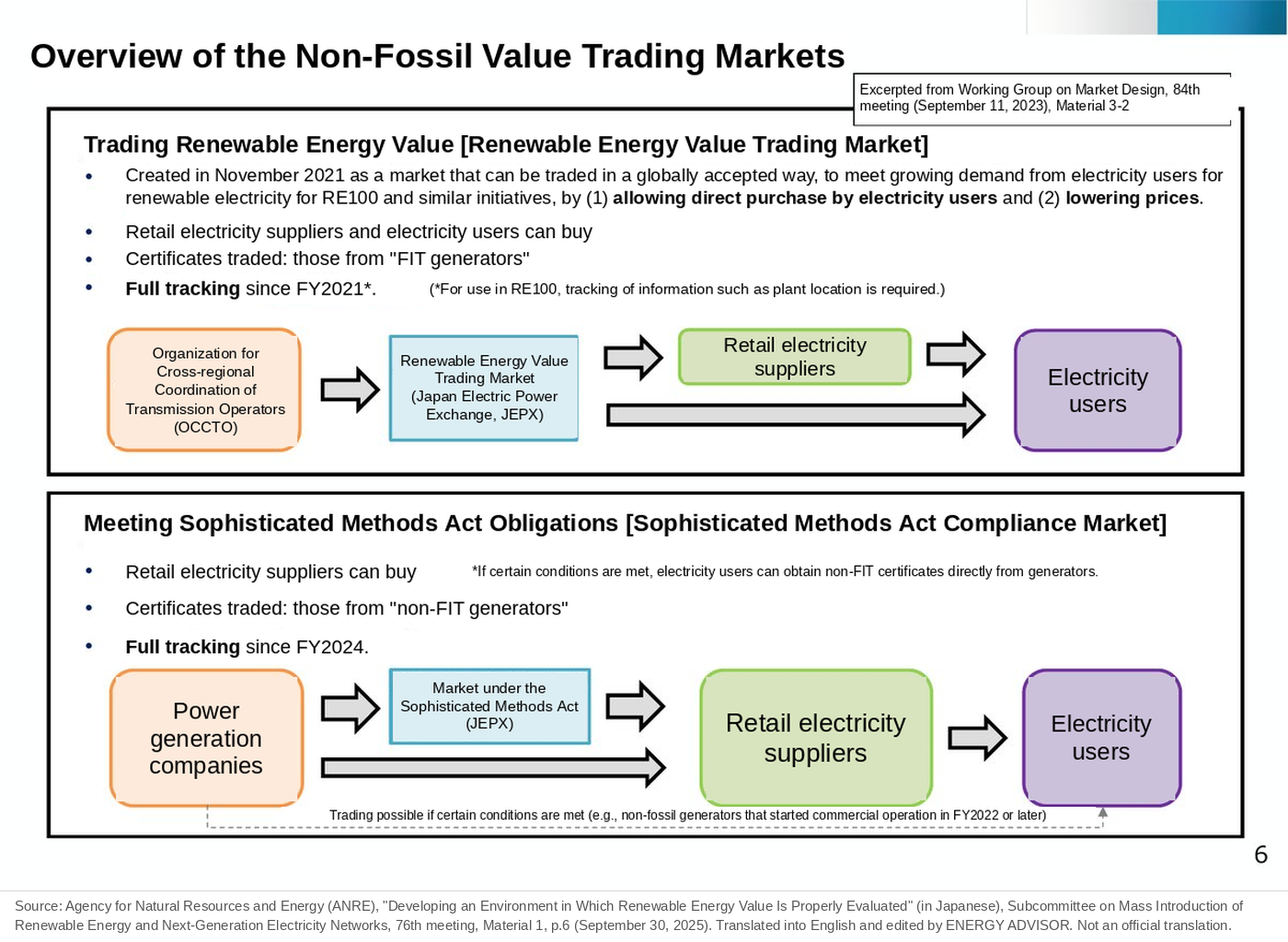
Non-fossil certificate auctions are held four times a year by the Japan Electric Power Exchange (JEPX), the exchange that runs wholesale electricity trading and non-fossil certificate trading. The seller of FIT certificates is the Organization for Cross-regional Coordination of Transmission Operators, JAPAN (OCCTO), the national body that coordinates supply and demand and other matters across Japan.
Purpose and Background of Tracking
Tracking is a system for recording and managing attribute information about electricity: “which generating facility produced how much electricity, and when.” For non-fossil certificates, information such as the source type (solar, wind, hydropower, etc.), the location of the power plant, the commissioning date, and whether the plant is covered by the FIT scheme is attached to the certificate.
The background is the need to meet international environmental initiatives. Global decarbonization initiatives such as RE100 (an international initiative of companies aiming to source 100% of the electricity they use from renewables), CDP (an international non-profit that collects and evaluates companies’ environmental information) and SBTi (an international mechanism that validates whether companies’ greenhouse gas reduction targets are science-based) require confirmation that electricity “really was generated from renewable energy.” Attribute information ensures the transparency and credibility of the environmental attributes when companies use non-fossil certificates.
History of Tracking: From Pilots to Full Tracking
Tracking of non-fossil certificates in Japan has been developed in stages. Before full tracking, there was a pilot of attaching tracking information. In December 2018, the Agency for Natural Resources and Energy (ANRE) announced a pilot to sell certificates with tracking information, such as the source type and plant location, in the February 2019 FIT non-fossil certificate auction. It was open to retail electricity suppliers and power generation companies that wished to take part (Working Group on Market Design, 27th meeting, Material 5-1).
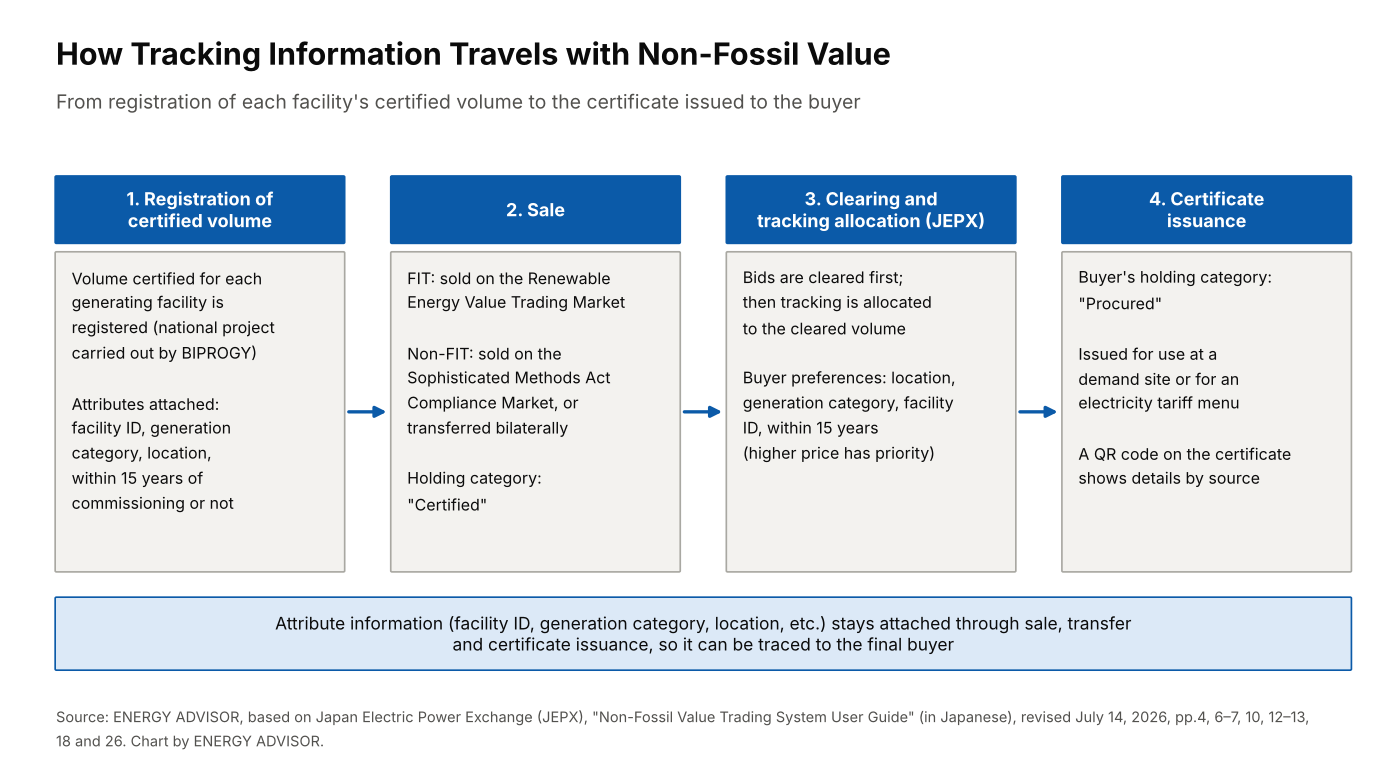
Later, the system moved to full tracking (attaching attribute information to every certificate): from FY2021 for FIT non-fossil certificates and from FY2024 for non-FIT non-fossil certificates. The volume of non-fossil value from each generating facility (the certified volume) is registered as a government program, and that information is attached to certificates in JEPX’s non-fossil value trading system.
Attribute Information and Its Uses
The main attribute information attached to tracked non-fossil certificates and its uses are as follows.
| Attribute item | Content and examples | Use |
|---|---|---|
| Source type (generation facility category) | Solar, wind, hydropower, biomass, geothermal, etc. | Identifying the target sources for a company’s 100% renewable goal |
| Generating facility (facility ID) | A number identifying each power plant | Uniquely identifying the generating facility |
| Location (prefecture and municipality) | Chiyoda Ward, Tokyo, etc. | Procuring renewables from a specified region |
| Commissioning date | April 1, 2020, etc. | Essential for judging RE100’s “within 15 years” requirement |
| FIT / non-FIT category | Covered or not covered by the FIT scheme | Distinguishing whether the electricity was purchased with funds from the renewable energy surcharge |
With this attribute information, buyers of non-fossil certificates can now see in detail “which source the electricity came from, and since when the generating facility has been operating.” The commissioning date in particular plays an important role in judging the “additionality” (contribution to new renewable deployment) that RE100 requires.
Certificates from small generating facilities (under 50 kW) have their data aggregated and are given an aggregated ID.
What Changed with Full Tracking
Before full tracking, not all certificates carried tracking information.
Full tracking changed this significantly. Every certificate carries tracking information from the moment it is issued. In other words, buyers can check the source type and plant details without any special procedure, because every certificate has attribute information.
When each unit of non-fossil value is created, the facility ID, generation facility category, location and other details are attached, and this attribute information is retained when certificates are traded or transferred, so they can be traced all the way to the final buyer.
RE100 and Tracking: The 15-Year Requirement
In the 2022 revision of its technical criteria, RE100 limited the renewable electricity that member companies buy to generators “within 15 years of commissioning (or repowering).” The 5th edition of March 2025 retains this requirement. Exceptions include self-generation and the first buyer to sign a long-term contract with a new plant. Separately, up to 15% of total electricity consumption may be sourced in ways that do not meet the 15-year condition (RE100 technical criteria, 5th edition, §5.4.2). This “within 15 years” rule is meant to ensure a contribution to new renewable deployment (additionality). It is based on the idea that buying only certificates from old generating facilities that are already fully operating would not achieve RE100’s original goal (promoting new renewable deployment to realize a decarbonized society).
To meet RE100 with non-fossil certificates, buyers need to choose certificates that are tracked and that come from facilities within 15 years of commissioning. Because the tracking information includes the commissioning date, buyers can select certificates that meet this condition. In JEPX buy bids, “commissioned within the last 15 years” can be specified as a condition. This item was previously labeled “RE100,” but in November 2024 the label was changed to “commissioned within the last 15 years” because the old label could be misleading (this item cannot be used for non-designated non-FIT certificates). In August 2025, following a change in RE100’s criteria, “biomass” and “coal co-firing” were added to JEPX’s generation facility categories.
Meeting International Decarbonization Frameworks
Tracking information on non-fossil certificates is important evidence for meeting international frameworks such as CDP and SBTi. With attribute information such as source type, power plant and commissioning date, companies can now state clearly in their reports to CDP and SBTi what kind of renewable electricity they procured.
Comparison with International Standards: I-REC and GO
Beyond non-fossil certificates, there are other systems worldwide that certify the attributes of renewable energy. The leading ones are the I-REC (International Renewable Energy Certificate) and the GO (Guarantee of Origin, an energy attribute certificate issued in EU member states and elsewhere). Both use tracking systems that record and manage information about the source and the power plant. The I-REC standard for electricity is operational in over 70 countries and regions (I-TRACK Foundation).
With the introduction of full tracking, Japan’s non-fossil certificates now also record attribute information for each generating facility, as I-RECs and GOs do. However, there are differences in specifications, such as the coding system for identifying generating facilities and the level of detail in attribute information.
Practical Points When Buying
When buying tracked non-fossil certificates, companies should check several practical points.
- Specifying conditions: In JEPX buy bids, the facility ID, the prefecture and municipality of the site, the generation facility category and “commissioned within the last 15 years” can be specified as first and second preferences. However, the narrower the conditions, the fewer the options and the harder it is to clear. Companies need to balance their decarbonization strategy against their procurement budget.
- Choosing FIT or non-FIT: Electricity users can buy only FIT certificates on JEPX. If an electricity user wants to use certificates from non-FIT generators (large hydropower, post-FIT, FIP, etc.), it must procure them through a retail electricity supplier’s tariff menu, or obtain them directly from a generator when certain conditions are met (such as non-fossil generators that started commercial operation in FY2022 or later).
- Retention of attribute information on transfer: Attribute information is retained when tracked non-fossil certificates are traded or transferred. Even when certificates are traded a second or third time, the final buyer can trace the information on the original generating facility, a benefit of full tracking.
Summary: Tracking and Transparency
Full tracking has changed Japan’s non-fossil certificate market significantly. Because certificates carry attribute information such as source type, power plant and commissioning date, companies can now procure renewable electricity whose environmental attributes have a clear origin. Tracking information provides the basis for meeting international decarbonization initiatives such as RE100, CDP and SBTi.
This article is based on published materials from the Ministry of Economy, Trade and Industry and its Agency for Natural Resources and Energy, the Electricity and Gas Market Surveillance Commission, the Organization for Cross-regional Coordination of Transmission Operators (OCCTO) and other sources. The English translations of figures are by ENERGY ADVISOR and are not official translations. When using this information for decisions, please check the original sources. When we find an error, we correct the article and note the date of the correction.
Sources
- Agency for Natural Resources and Energy (ANRE), Subcommittee on Mass Introduction of Renewable Energy and Next-Generation Electricity Networks, 76th meeting, Material 1, “Developing an Environment in Which Renewable Energy Value Is Properly Evaluated” (in Japanese), September 30, 2025, p.6 (full tracking on the Renewable Energy Value Trading Market [FIT] since FY2021 and on the Sophisticated Methods Act Compliance Market [non-FIT] since FY2024; electricity users can buy FIT certificates; “when certain conditions are met (such as non-fossil generators that started commercial operation in FY2022 or later),” electricity users can obtain non-FIT certificates directly from generators). https://www.meti.go.jp/shingikai/enecho/denryoku_gas/saisei_kano/pdf/076_01_00.pdf
- Japan Electric Power Exchange (JEPX), “Non-Fossil Value Trading System User Guide” (in Japanese) (revised July 14, 2026), revision history (“RE100” renamed “commissioned within the last 15 years” on November 8, 2024; “biomass” and “coal co-firing” added to generation facility categories on August 20, 2025, following changes to the RE100 criteria), p.4 (registration of certified volumes is carried out as a government program), p.6 (conditions that can be specified in buy bids; aggregated IDs for small generators under 50 kW). https://www.jepx.jp/nonfossil/outline/pdf/Guide_NF.pdf
- RE100, “RE100 technical criteria,” 5th edition (published March 24, 2025), §5.4.2 (pp.17–18: the limit of 15 years from commissioning or repowering, and its exceptions [self-generation, direct physical PPAs not using the grid, the original off-taker that signs a long-term contract with a new project, contracts for plants commissioned before January 1, 2024, etc.], and the exemption for up to 15% of total electricity consumption). https://www.theclimategroup.org/hubfs/RE100/PDFs/RE100%20technical%20criteria%20+%20appendices%20(15%20April%202025).pdf
- ANRE, “Pilot of Selling Non-Fossil Certificates with Tracking” (in Japanese), December 17, 2018 (Working Group on Market Design, 27th meeting, Material 5-1): a pilot to sell certificates with tracking information, such as source type and plant location, in the February 2019 FIT non-fossil certificate auction, open to retail electricity suppliers and power generation companies that wished to take part. https://www.meti.go.jp/shingikai/enecho/denryoku_gas/denryoku_gas/seido_kento/pdf/027_05_01.pdf
- I-TRACK Foundation website (“The I-REC Code for Electricity is operational in over 70 countries”; accessed October 22, 2026). https://www.trackingstandard.org/
- JEPX, “Non-Fossil Value Trading Rules” (in Japanese), Article 9 (FIT certificate trades are concluded between OCCTO and trading participants), Article 14, Paragraph 3 (members that are electricity users cannot buy anything other than FIT certificates). https://www.jepx.jp/nonfossil/outline/pdf/nonfossil_rules.pdf