Certificates and credits that represent environmental attributes play a growing role in meeting companies’ decarbonization targets. Several schemes and initiatives require companies to decarbonize, such as joining RE100, meeting the non-fossil power ratio under the Sophisticated Methods Act (short name of the Act on the Promotion of Use of Non-Fossil Energy Sources and Effective Use of Fossil Energy Materials by Energy Suppliers, a law that requires retail electricity suppliers with electricity sales of 0.5 TWh or more in the previous fiscal year to raise their share of non-fossil power; see article 12 in this series), and complying with the GX-ETS. At the same time, simply buying electricity is no longer enough to prove decarbonization. In Japan there are FIT non-fossil certificates, non-FIT non-fossil certificates (from post-FIT generators and others), J-Credits and Green Power Certificates, and markets for overseas renewable certificates (I-RECs, GOs) and carbon credits are also expanding, so companies can choose from a wide variety of environmental attributes.
This article explains the main types of environmental attributes used in Japan, how each works, and how companies use them.
Key point of this article: Environmental attributes fall broadly into domestic schemes (non-fossil certificates, J-Credits, Green Power Certificates) and overseas schemes (I-RECs, GOs, international carbon credits). Meeting RE100 requires, in principle, certificates with tracking information from generators within 15 years of commissioning. What can be used to meet GX-ETS obligations is J-Credits and JCM credits; non-fossil certificates cannot be used. Companies need to choose a combination of schemes to suit their purposes.
Overview of Environmental Attributes: Domestic and Overseas Schemes
The environmental attributes companies can use to meet decarbonization targets fall broadly into two groups: domestic schemes and overseas schemes. Japan’s non-fossil certificates turn the environmental attributes of generators covered by the FIT scheme, generators whose FIT period has ended, and others into certificates, and are traded on the markets of JEPX (the Japan Electric Power Exchange, which runs wholesale electricity trading and non-fossil certificate auctions). Overseas renewable certificates, on the other hand, are issued from renewable energy around the world and are used when companies pursue decarbonization globally.
Domestic and overseas schemes are used for different purposes. Meeting domestic schemes such as the Sophisticated Methods Act and the GX-ETS presupposes domestic certificates and credits. For renewable procurement at overseas sites and for international ESG ratings, overseas certificates play an important role.
Types of Domestic Environmental Attributes
First, it is important to distinguish the environmental attributes of electricity (in kWh) from CO2 reductions (in tonnes).
| Item | Non-fossil certificate | J-Credit | Green Power Certificate |
|---|---|---|---|
| What it represents | Environmental attributes of electricity from non-fossil sources | CO2 reductions and removals from energy efficiency, renewables, forest management, etc. | Environmental attributes of electricity generated from renewables |
| Unit | kWh | t-CO2 | kWh |
| Certification and operation | Government scheme; traded on JEPX | Ministry of Economy, Trade and Industry, Ministry of the Environment, Ministry of Agriculture, Forestry and Fisheries | Certified by the Japan Quality Assurance Organization (JQA) |
| Main trading venue | JEPX auctions (four times a year) | Carbon Credit Market (Tokyo Stock Exchange), bilateral trading | Purchase from issuers |
| Meeting GX-ETS obligations | Cannot be used | Can be used (up to 10% of actual emissions) | Cannot be used |
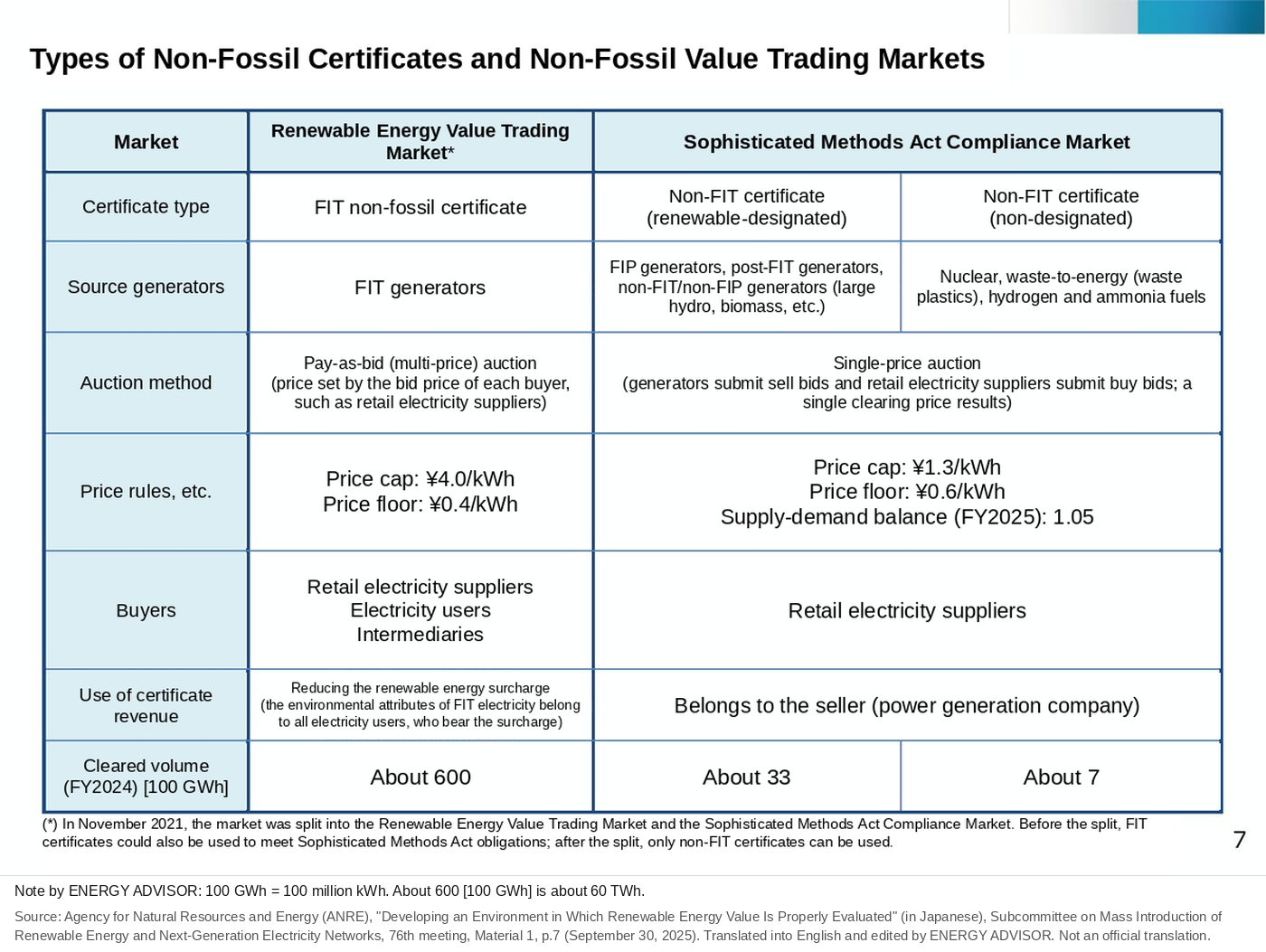
FIT Non-Fossil Certificates
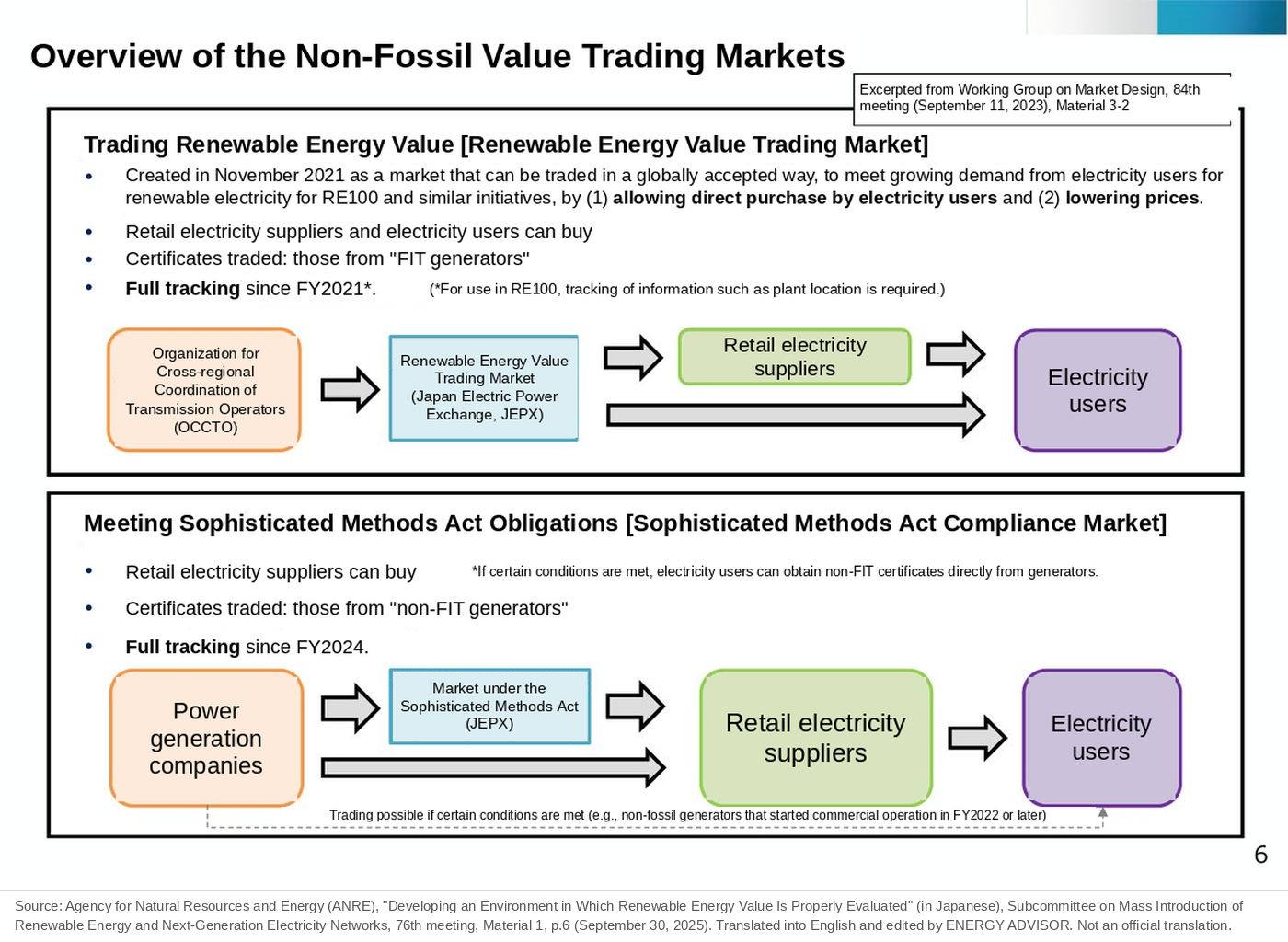
Certificates issued from renewable energy purchased under the Feed-in Tariff (FIT) scheme (solar, wind, hydropower, geothermal and biomass). OCCTO (the Organization for Cross-regional Coordination of Transmission Operators, JAPAN: the national body that coordinates supply and demand and other matters across Japan) acts as the seller, and the certificates are traded in auctions held four times a year (August, November, February and May). Since FY2021 (April 2021–March 2022), all certificates have been tracked and carry attribute information such as the plant location, source type and commissioning date.
Non-FIT Non-Fossil Certificates from Post-FIT and Other Generators (Renewable-Designated)
Certificates issued from generators whose FIT purchase period has ended (post-FIT), large hydropower, and FIP generators (generators under the FIP scheme, which supports renewables with a fixed add-on to the market price; see article 13 in this series). They are bought on the Sophisticated Methods Act Compliance Market, mainly by retail electricity suppliers (companies that sell electricity to households and businesses). Sell bids are scarce, and in many recent rounds they have cleared near the ¥1.3/kWh cap, above the price of FIT certificates (around ¥0.4/kWh). Because meeting RE100 requires, in principle, that a plant be within 15 years of commissioning, buyers need to check the commissioning date of certificates from post-FIT generators.
Non-FIT Non-Fossil Certificates (Non-Designated)
Certificates issued from non-fossil generators that are not designated as renewable, such as nuclear power. Renewable generators whose owners did not designate them as renewable also fall into this category. They can be used to meet Sophisticated Methods Act obligations, but not for RE100.
J-Credits
Credits certified by the government for CO2 reductions and removals from installing energy-efficient equipment, using renewables, forest management and other activities (J-Credit Scheme). One credit equals one tonne of CO2. Under the GX-ETS, they are recognized as “eligible carbon credits” that can be used to meet obligations for up to 10% of actual emissions when allowances are insufficient (see article 06 in this series).
Green Power Certificates
Certificates for the environmental attributes of electricity generated from renewable energy, under a system in which the Japan Quality Assurance Organization (JQA) accredits generating facilities and certifies generation volumes. It is a privately certified scheme, separate from non-fossil certificates.
Types of Overseas Environmental Attributes
Overseas environmental attributes consist of two layers: renewable energy attribute certificates and carbon credits.
I-REC (International Renewable Energy Certificate)
An international renewable energy certificate system. One I-REC represents 1 MWh of renewable electricity, and tracking information on the power plant is managed. The electricity standard is operational in over 70 countries and regions (I-TRACK Foundation).
GO (Guarantee of Origin)
A renewable energy attribute certificate issued in EU member states and elsewhere. It carries detailed tracking information on the generating facility.
International Carbon Credits (VCS, Gold Standard, etc.)
Carbon credits issued from a range of decarbonization projects, such as forest protection, renewable energy and methane reduction. One credit represents a reduction of one tonne of CO2, and they are used for companies’ voluntary offsetting (compensating for their own emissions with reductions elsewhere) and as a means of declaring carbon neutrality.
Full Tracking and Meeting RE100 in Practice
Full tracking of FIT certificates (since FY2021) has greatly increased the transparency of companies’ decarbonization efforts. Previously, it was hard to tell which power plant the “renewable electricity” a company bought came from. With full tracking, companies can know “when, where and from what” the electricity was generated, and show this to third parties.
In the 2022 revision of its technical criteria, RE100 limited purchases of renewable electricity to generators “within 15 years of commissioning (or repowering),” to encourage investment in new renewables. The 5th edition of March 2025 retains this requirement. Exceptions include self-generation and the first buyer to sign a long-term contract with a new plant, and separately, up to 15% of total electricity consumption may be sourced in ways that do not meet the 15-year condition (RE100 technical criteria, 5th edition, §5.4.2). The appendix to the 5th edition lists “NFC,” “GEC (Japan)” and “J-Credit (Renewable)” as attribute certificates commonly used in Japan (Appendix C). For Japan’s non-fossil certificates, the commissioning date is checked through the tracking information. Electricity from large hydropower or old solar plants that were commissioned many years ago is, in principle, not eligible for RE100.
When buying tracked FIT non-fossil certificates in Japan, buyers can specify as desired conditions in their bids the facility ID, the prefecture and municipality of the site, the generation facility category and “commissioned within the last 15 years.” Companies that need to report to RE100 can buy by specifying “commissioned within the last 15 years.”
GX-ETS and Environmental Attributes
The GX-ETS (GX Emissions Trading System) covers direct emissions (Scope 1) from each company’s factories and other facilities. When allowances are insufficient, what can be used to meet obligations is emission allowances bought on the market and eligible carbon credits (J-Credits and JCM credits [Joint Crediting Mechanism: a scheme that turns emission reductions achieved through Japan’s cooperation with developing countries and others into credits], up to 10% of actual emissions).
Non-fossil certificates and Green Power Certificates represent the environmental attributes of electricity and are a means of reducing indirect emissions from purchased electricity (Scope 2). They cannot be used to meet GX-ETS obligations (see article 22 in this series). International carbon credits such as VCS and Gold Standard are also not included among the GX-ETS’s eligible carbon credits.
Choosing by Purpose
Companies Prioritizing RE100
For companies that have joined or plan to join RE100, the main option is domestic FIT non-fossil certificates that are “tracked and within 15 years of commissioning.” The clearing price of FIT certificates has stayed near the ¥0.4/kWh floor (Working Group on Market Design, 109th meeting, Material 3, p.41). At overseas sites, they use overseas certificates such as I-RECs and GOs.
Companies Covered by the GX-ETS
For companies covered by the GX-ETS (companies whose direct CO2 emissions averaged 100,000 tonnes or more over the three fiscal years up to the previous year), the basic step is to cut their own direct emissions. Any shortfall in allowances is covered with allowances bought on the market and with J-Credits and JCM credits (up to 10%). If the aim is to reduce emissions from purchased electricity (Scope 2), they use non-fossil certificates or PPAs separately.
Retail Electricity Suppliers Covered by the Sophisticated Methods Act
The simplest way to achieve the non-fossil power ratio required by the Sophisticated Methods Act is to buy non-FIT certificates. Since the market split in November 2021, FIT certificates cannot be used to meet the Sophisticated Methods Act obligation (the exception is “substitute procurement,” in which, in years when non-FIT certificates are short, suppliers meet the obligation with FIT certificates bought at or above the non-FIT price cap; see article 20 in this series). Both renewable-designated and non-designated non-FIT certificates can be used to meet the Sophisticated Methods Act obligation.
Companies Addressing Supply Chain Emissions (Scope 3)
To reduce Scope 3 (emissions across the supply chain), measures such as supporting the supply of renewable electricity to suppliers are used. International carbon credits do not reduce Scope 3 emissions themselves; they are treated separately as voluntary offsetting.
Assessing the Credibility of Environmental Attributes
The credibility of environmental attributes depends on the integrity of the issuer, the completeness of tracking information, and whether there is independent third-party certification.
Credibility of Domestic Schemes
FIT non-fossil certificates are sold by OCCTO as a government scheme and traded in JEPX auctions, whose results are published. All FIT certificates have carried tracking information since FY2021, and all non-FIT certificates since FY2024.
Credibility of Overseas Schemes
I-RECs, GOs, VCS, Gold Standard and others are each operated on the basis of international certification systems.
Summary: Choosing Environmental Attributes That Fit the Purpose
The diversification of environmental attributes gives companies more freedom in their decarbonization efforts, but it also makes choosing harder. If meeting RE100 is essential, the main option is domestic FIT non-fossil certificates that are tracked and within 15 years of commissioning. Companies covered by the GX-ETS meet their obligations with allowances and J-Credits and JCM credits, and reduce emissions from purchased electricity with non-fossil certificates or PPAs.
When companies must meet several schemes and initiatives, it is important to set an “annual reduction target” and plan the combination of environmental attributes needed to achieve it. They need to choose with an understanding of the trade-offs: domestic versus overseas, single-year versus multi-year, and low cost versus high credibility.
This article is based on published materials from the Ministry of Economy, Trade and Industry and its Agency for Natural Resources and Energy, the Electricity and Gas Market Surveillance Commission, the Organization for Cross-regional Coordination of Transmission Operators (OCCTO) and other sources. The English translations of figures are by ENERGY ADVISOR and are not official translations. When using this information for decisions, please check the original sources. When we find an error, we correct the article and note the date of the correction.
Sources
- Agency for Natural Resources and Energy (ANRE), Subcommittee on Mass Introduction of Renewable Energy and Next-Generation Electricity Networks, 76th meeting, Material 1, “Developing an Environment in Which Renewable Energy Value Is Properly Evaluated” (in Japanese), September 30, 2025, note on p.7 (after the market split in November 2021, only non-FIT certificates can be used to meet Sophisticated Methods Act obligations), p.6 (full tracking of FIT certificates since FY2021 and of non-FIT certificates since FY2024), p.7 (source generators of the three certificate types). https://www.meti.go.jp/shingikai/enecho/denryoku_gas/saisei_kano/pdf/076_01_00.pdf
- ANRE, Working Group on Market Design, 109th meeting, Material 3, “Non-Fossil Value Trading” (in Japanese), December 12, 2025, p.44 (after the market split, FIT certificates cannot be used to meet Sophisticated Methods Act obligations). https://www.meti.go.jp/shingikai/enecho/denryoku_gas/jisedai_kiban/system_review/pdf/109_03_00.pdf
- Japan Electric Power Exchange (JEPX), “FY2026 Non-Fossil Value Trading Market Schedule” (in Japanese), June 25, 2026. https://www.jepx.jp/nonfossil/outline/pdf/market/nf_calendar2026.pdf
- ANRE, Working Group on Market Design, 109th meeting, Material 3, “Non-Fossil Value Trading” (in Japanese), December 12, 2025, p.41 (the weighted average price of FIT certificates was near the ¥0.4 floor except in the 4th round of FY2024; non-FIT certificates were at the ¥1.3 cap in three of the four rounds of the most recent year). https://www.meti.go.jp/shingikai/enecho/denryoku_gas/jisedai_kiban/system_review/pdf/109_03_00.pdf
- JEPX, “Non-Fossil Value Trading System User Guide” (in Japanese) (revised July 14, 2026), p.7 (buy-bid condition items). https://www.jepx.jp/nonfossil/outline/pdf/Guide_NF.pdf
- Japan Quality Assurance Organization, “Green Power Certification Standards” (in Japanese) (posted on the ANRE website, revised October 16, 2023). https://www.enecho.meti.go.jp/category/saving_and_new/green_energy/newenergy/geco2_iinnkai/40doc-r-1-1.pdf
- J-Credit Scheme official website (in Japanese). https://japancredit.go.jp/
- Industrial Structure Council, Subcommittee on Emissions Trading System, “Interim Summary: Matters Concerning Implementation Guidelines for the Allocation of Emission Allowances” (in Japanese), December 19, 2025, p.8 as printed on the slide (coverage: three-fiscal-year average of 100,000 tonnes or more up to the previous fiscal year), p.18 (credits usable under the system are J-Credits and JCM credits, capped at 10% of actual emissions in each fiscal year). https://www.meti.go.jp/shingikai/sankoshin/sangyo_gijutsu/emissions_trading/pdf/20251219_1.pdf
- GX League official website, “Emissions Trading System (GX-ETS)” (in Japanese). https://gx-league.go.jp/action/gxets/
- RE100, “RE100 technical criteria,” 5th edition (published March 24, 2025), §5.4.2 (pp.17–18: the limit of 15 years from commissioning or repowering, and its exceptions [self-generation, direct physical PPAs not using the grid, the original off-taker that signs a long-term contract with a new project, contracts for plants commissioned before January 1, 2024, etc.], and the exemption for up to 15% of total electricity consumption), Appendix C (p.32: NFC, GEC [Japan] and J-Credit [Renewable] as attribute certificates commonly used in Japan, and I-REC as another mechanism). https://www.theclimategroup.org/hubfs/RE100/PDFs/RE100%20technical%20criteria%20+%20appendices%20(15%20April%202025).pdf
- I-TRACK Foundation website (“The I-REC Code for Electricity is operational in over 70 countries”; accessed October 22, 2026). https://www.trackingstandard.org/
- JEPX, “Non-Fossil Value Trading Rules” (in Japanese), Article 9 (FIT certificate trades are concluded between OCCTO and trading participants), Article 14, Paragraph 4 (OCCTO places sell bids for the entire certified volume). https://www.jepx.jp/nonfossil/outline/pdf/nonfossil_rules.pdf
- JEPX, “FY2021 Non-Fossil Value Trading Market Schedule” (in Japanese) (no FIT certificate trading in the 1st round [August 2021]; 2nd round November 19–26, 2021). https://www.jepx.jp/nonfossil/outline/pdf/market/nf_calendar2021.pdf
- Year of the market split: the body text on p.39 and the note on p.40 of the 109th meeting, Material 3 (reproducing the 76th Subcommittee meeting, Material 1, p.8) say “November 2021,” while the notes on pp.39 and 44 say “November 2022.” Because JEPX’s FY2021 schedule shows FIT certificates traded in November 2021, this article uses November 2021.