The Sophisticated Methods Act (short name of the Act on the Promotion of Use of Non-Fossil Energy Sources and Effective Use of Fossil Energy Materials by Energy Suppliers) requires retail electricity suppliers above a certain size to raise their non-fossil power ratio in stages. With the target of 44% or more in FY2030 (April 2030–March 2031), buying non-fossil certificates has become an unavoidable management issue for retail electricity suppliers that do not own enough non-fossil generation of their own.
This article explains the obligation placed on retail electricity suppliers, the interim targets of Phase 3, which began in FY2026, how certificates are procured and what they actually cost, how costs are passed on to tariffs, and the challenges for new entrant retailers.
Key points
- 1Retail electricity suppliers whose electricity sales in the previous fiscal year were 0.5 TWh or more are subject to the Sophisticated Methods Act obligation.
- 2Phase 3 covers FY2026–FY2028. The final value of the FY2026 interim target is an external procurement ratio of 14.8%; in May 2026, ANRE proposed correcting it to about 15.8%.
- 3What suppliers buy for the Sophisticated Methods Act is non-FIT certificates (in JEPX’s four auctions a year, at around ¥1.2–1.3/kWh). Since the market split in November 2021, FIT certificates cannot be used to meet the obligation (the exception is substitute procurement).
The Non-Fossil Power Ratio Obligation on Retail Electricity Suppliers
The Sophisticated Methods Act requires retail electricity suppliers above a certain size to raise in stages the non-fossil power ratio of the electricity they supply.
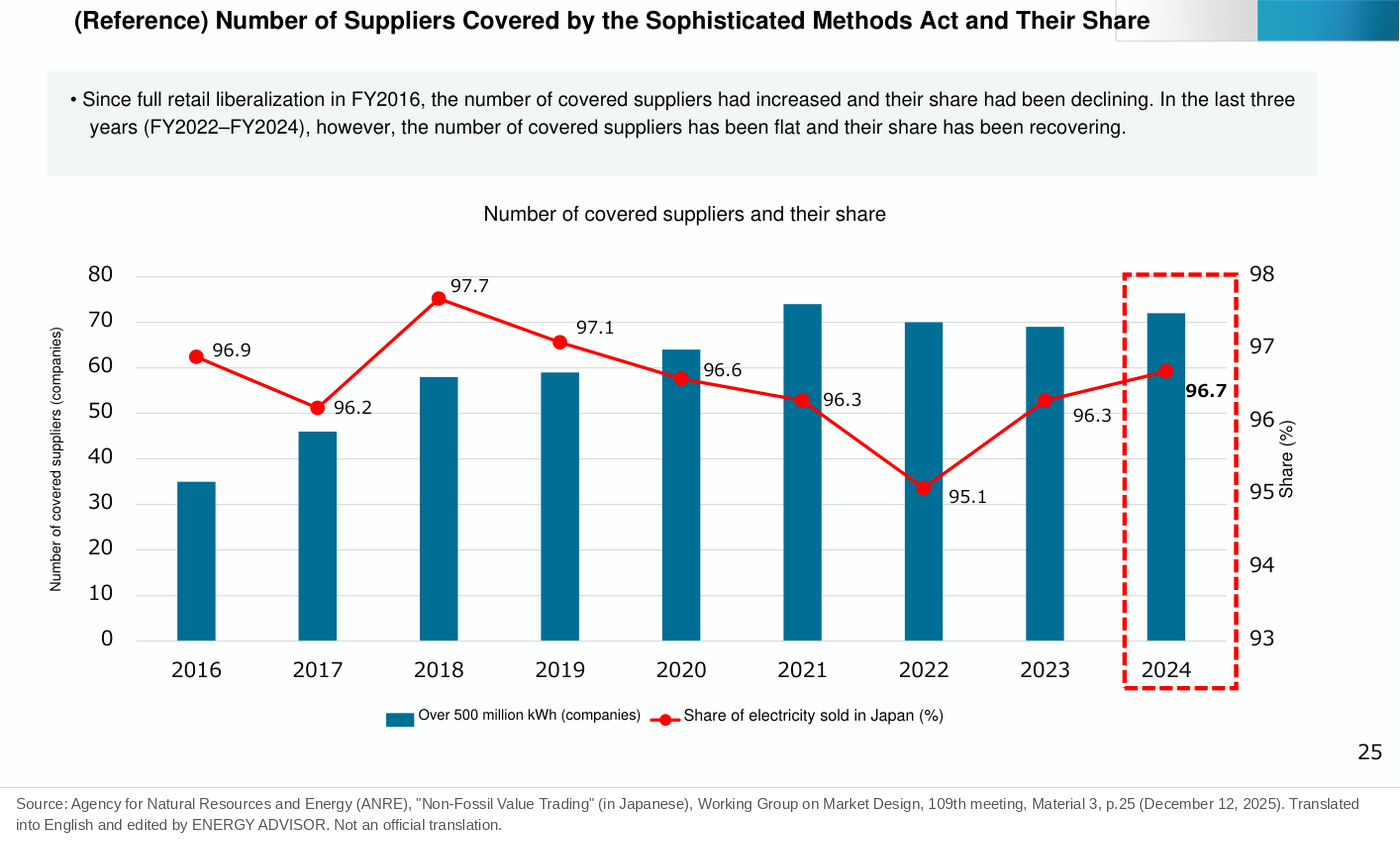
- Scope: retail electricity suppliers whose electricity sales in the previous fiscal year were 0.5 TWh or more (including general transmission and distribution companies, which operate the grid in each area, and registered specified transmission and distribution companies, which operate transmission and distribution in specific districts). According to the Agency for Natural Resources and Energy (ANRE), suppliers subject to the obligation account for about 97% of electricity sales.
- FY2030 target: a non-fossil power ratio of 44% or more
- Interim targets: each fiscal year, the government calculates and notifies an interim target for each supplier and evaluates its achievement.
- Measures toward meeting the target: the government provides guidance and advice (Article 6 of the Act) and can also issue recommendations and orders (Article 8 of the Act). Violating an order is subject to penalties.
The former general electricity utilities (incumbent regional utilities: the large utilities in each area) own non-fossil generation such as large hydropower and nuclear power. New entrant retailers (retailers that entered the market after liberalization), on the other hand, own little non-fossil generation and depend more on buying certificates.
There are two main routes for meeting the obligation.
| Route | Features | Feasibility for new entrant retailers |
|---|---|---|
| Securing own non-fossil generation | Owning solar, wind or hydropower generation, or long-term PPAs | Difficult (lack of capital) |
| Buying non-fossil certificates | Buying non-FIT certificates on the Sophisticated Methods Act Compliance Market (FIT certificates only for substitute procurement) | Essential (a recurring annual cost) |
In practice, many suppliers combine both.
How Phase 3 (FY2026–FY2028) Interim Targets Are Set
Like Phases 1 and 2, Phase 3 lasts three years (FY2026–FY2028). FY2029 onward is designated Phase 4 (provisional).
The method for setting interim targets keeps the Phase 2 approach of deriving targets from the outlook for certificate supply, with three revisions (see article 12 in this series for details):
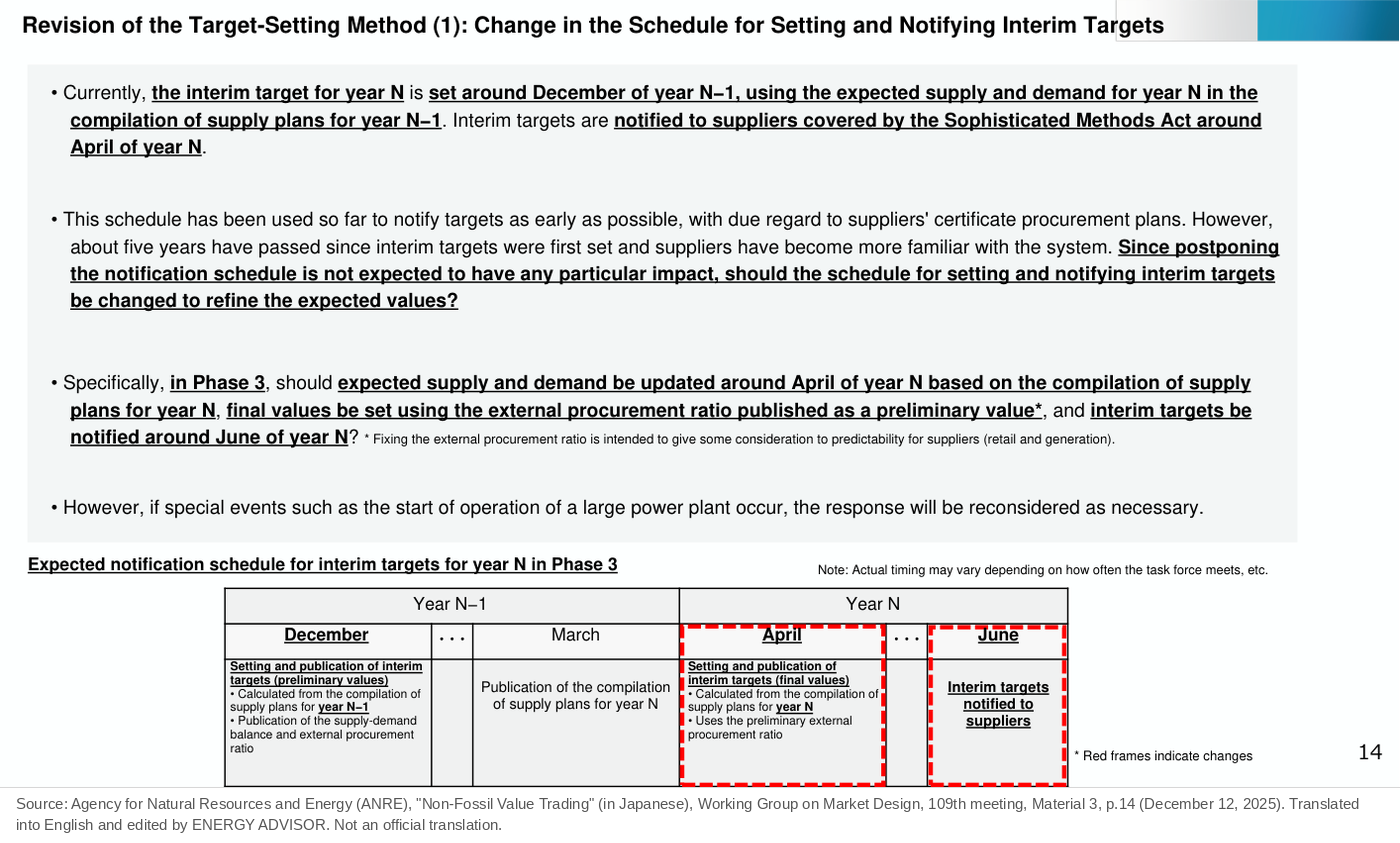
- Timing of notification: final values are set around April of year N based on the latest Electricity Supply Plan, and interim targets are notified around June of year N (previously set around December of year N-1).
- Deduction of intra-group transactions: intra-group transaction volumes of suppliers other than the former general electricity utilities are also deducted from the volume of certificates expected to reach the market (expected external supply).
- Deduction of voluntary demand: volumes of non-FIT certificates traded directly by electricity users and by retail electricity suppliers not subject to the obligation are also deducted.
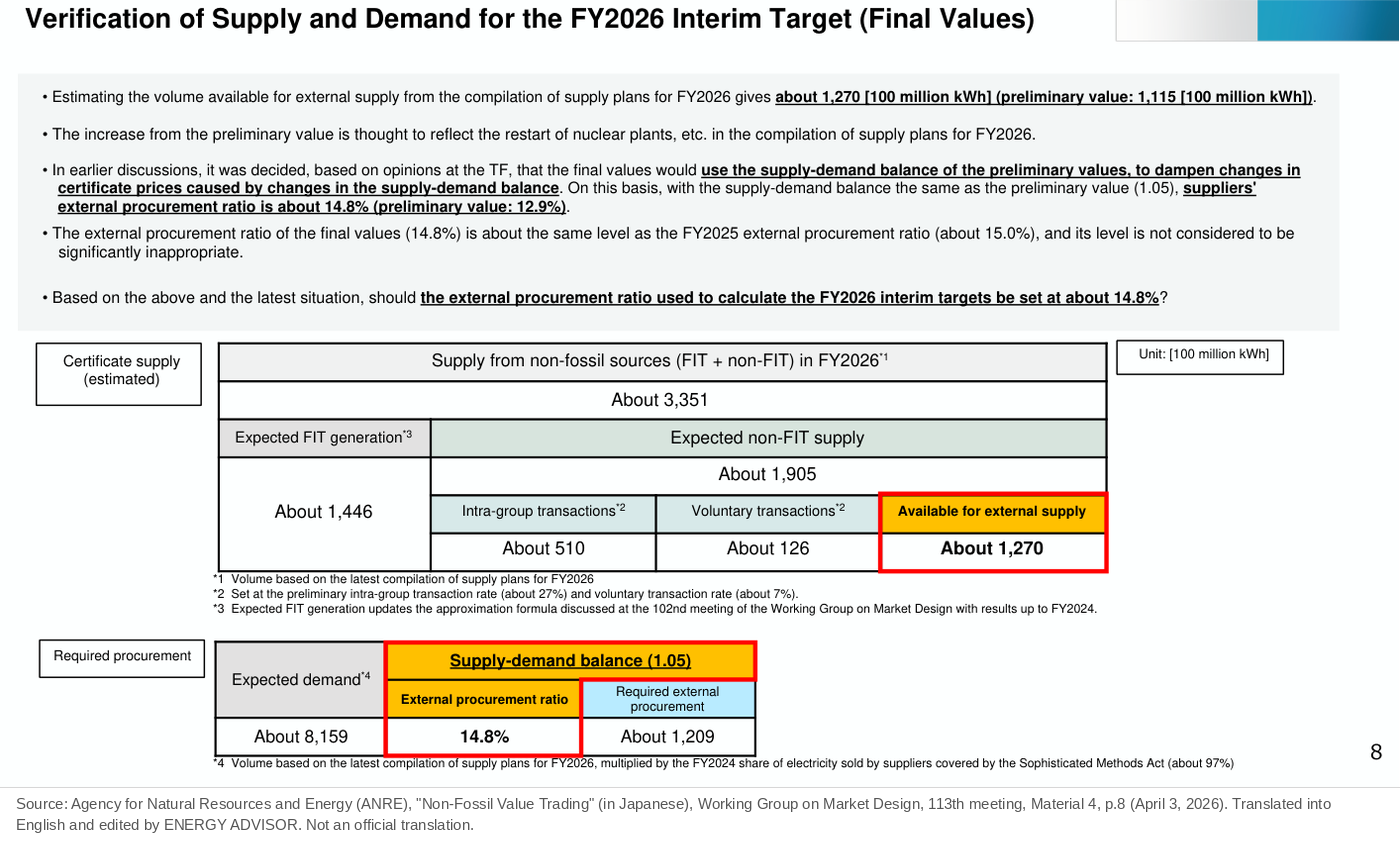
FY2026 Interim Target (Final Values)
| Item | Preliminary value | Final value |
|---|---|---|
| External procurement ratio | 12.9% | 14.8% |
| Expected external supply | About 111.5 TWh | About 127 TWh |
| Supply-demand balance | 1.05 | 1.05 |
In the final values, expected external supply increased and the external procurement ratio also rose. The document states that this is thought to reflect the inclusion of nuclear restarts and other factors in the FY2026 Electricity Supply Plan (113th meeting, Material 4, p.8). The external procurement ratio is multiplied by retail electricity suppliers’ demand forecast to give the volume of non-fossil electricity that must be procured externally (required external procurement). For FY2026, the industry-wide required external procurement is about 120.9 TWh, the demand forecast of about 815.9 TWh multiplied by 14.8%.
On May 13, 2026, the 1st meeting of the Working Group on Stable Power Supply was told that the lowering of the GF reference ratio (the threshold for a transitional relief that eases the interim targets of retailers with a high share of fossil generation) had not been reflected in the calculation of the final value. Recalculated, the external procurement ratio is about 15.8%, and ANRE proposed correcting the ratio used for the FY2026 interim targets to about 15.8% (Working Group on Stable Power Supply, 1st meeting, Material 9, p.5). The required external procurement above is based on the uncorrected 14.8%.
Procurement Methods and Actual Prices
Two Markets
Non-fossil certificates are traded on two markets operated by the Japan Electric Power Exchange (JEPX), Japan’s only wholesale power exchange (see article 17 in this series).
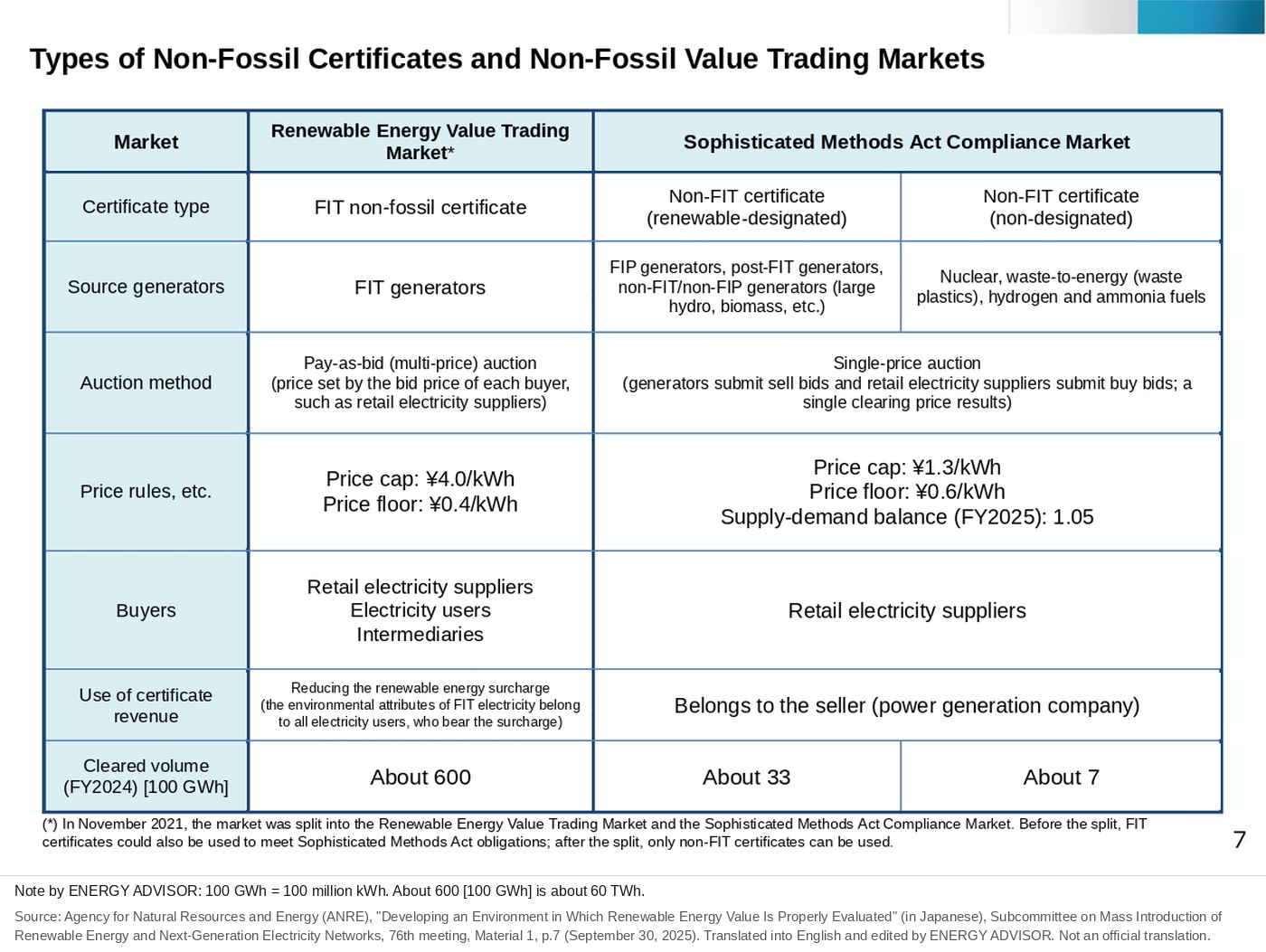
- Renewable Energy Value Trading Market: trades FIT non-fossil certificates. The seller is OCCTO (Organization for Cross-regional Coordination of Transmission Operators, JAPAN: the national body that coordinates supply and demand and other matters across Japan), and the entire environmental attributes of FIT electricity are put up for sale. Floor ¥0.40/kWh, cap ¥4.00/kWh. Electricity users can also take part. Retail electricity suppliers buy FIT certificates for renewable tariff menus and to improve their CO2 emission factors (they cannot be used to meet the Sophisticated Methods Act obligation).
- Sophisticated Methods Act Compliance Market: trades non-FIT non-fossil certificates (renewable-designated and non-designated). The sellers are generators such as large hydropower, post-FIT, FIP and nuclear plants. Floor ¥0.60/kWh, cap ¥1.30/kWh. Buyers are, in principle, retail electricity suppliers.
Since the market split in November 2021, FIT certificates cannot be used to meet the Sophisticated Methods Act obligation (ANRE, Subcommittee on Mass Introduction of Renewable Energy and Next-Generation Electricity Networks, Material 1, p.7). What suppliers buy on the market to meet Sophisticated Methods Act targets is non-FIT certificates. As an exception, in years when non-FIT certificates are in short supply, “substitute procurement” with FIT certificates may be allowed (see “Substitute Procurement” below).
Four Auctions a Year
Both markets hold auctions four times a year. In FY2026, the 1st round is held in August 2026, the 2nd in November, the 3rd in February 2027 and the 4th in May. The account transfer deadline for FY2026 certificates is June 25, 2027.
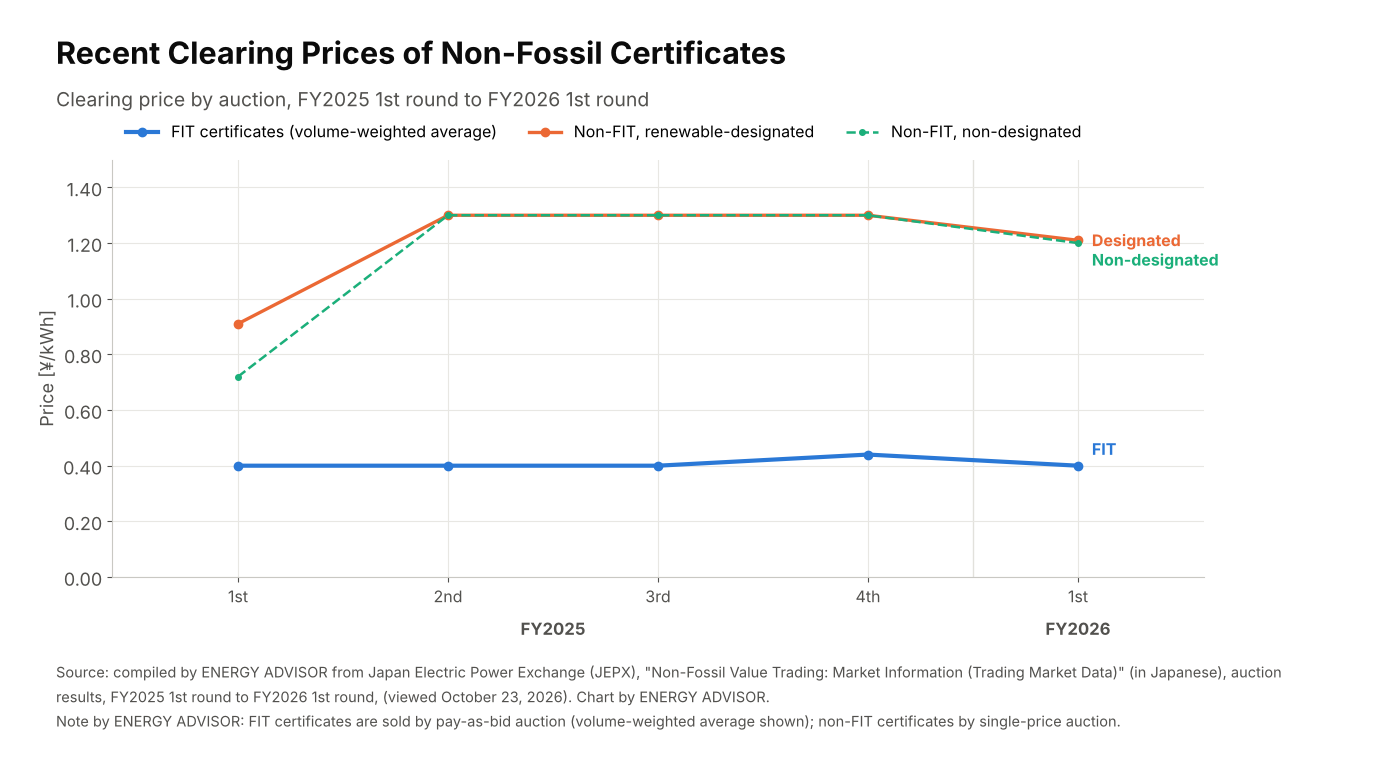
Recent Clearing Prices
Figures are from JEPX market data.
| Round | FIT (weighted average) | Non-FIT renewable-designated | Non-FIT non-designated |
|---|---|---|---|
| FY2025 1st (August 2025) | 0.40 | 0.91 | 0.72 |
| FY2025 2nd (November 2025) | 0.40 | 1.30 | 1.30 |
| FY2025 3rd (February 2026) | 0.40 | 1.30 | 1.30 |
| FY2025 4th (May 2026) | 0.44 | 1.30 | 1.30 |
| FY2026 1st (August 2026) | 0.40 | 1.21 | 1.20 |
(Unit: ¥/kWh)
The structure is that FIT certificates are near the floor because much goes unsold, and non-FIT certificates are near the cap because sell bids are scarce (see article 18 in this series).
Substitute Procurement
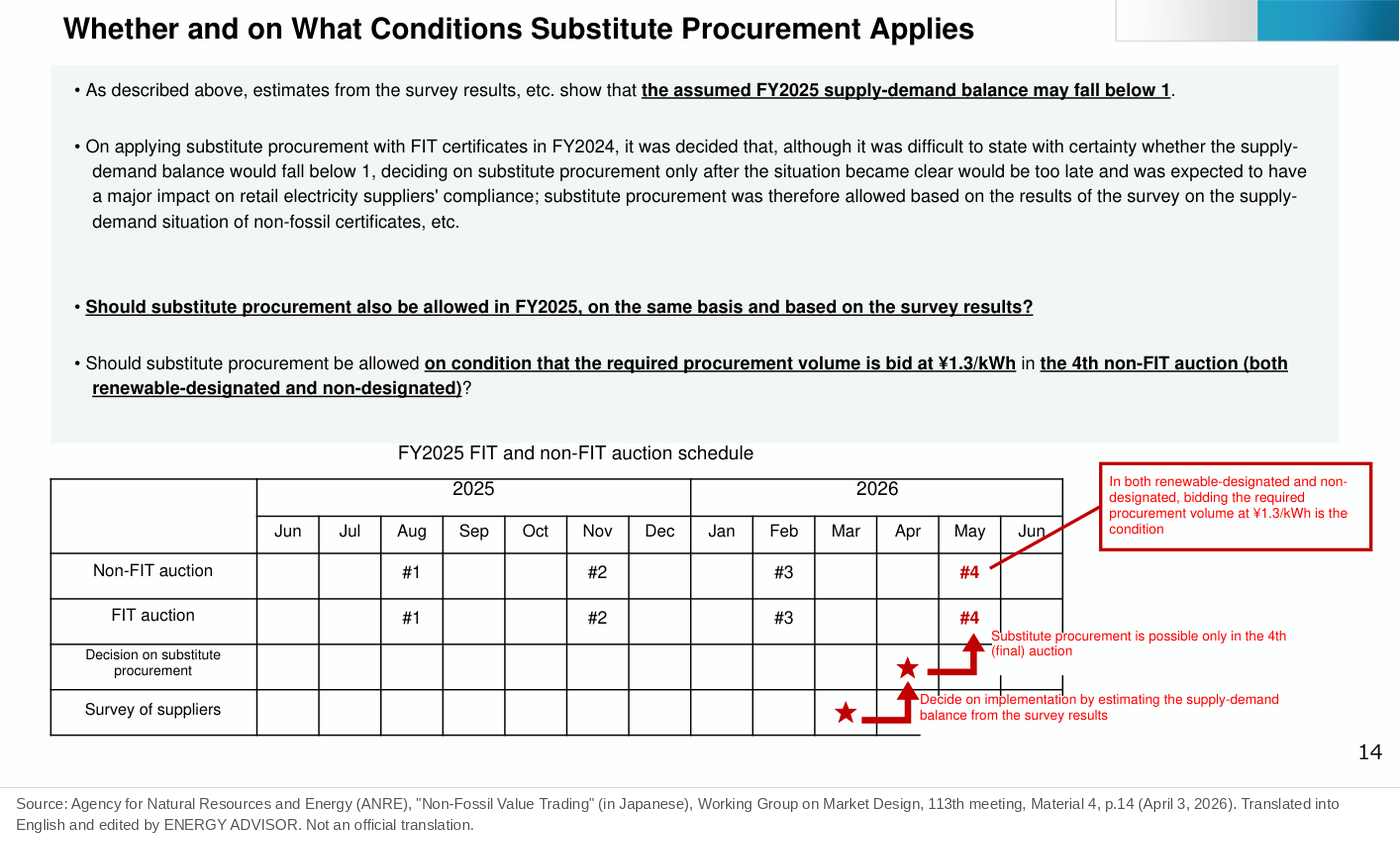
“Substitute procurement” has been set out as an alternative means of meeting the obligation when non-FIT certificates are in short supply. For FY2025, a draft was presented that would allow substitute procurement with FIT certificates on condition that the required volume is bid at ¥1.3/kWh in the 4th (final) non-FIT auction (both renewable-designated and non-designated), and that would set the price at or above the non-FIT market’s cap (¥1.3/kWh). The price for substitute procurement in FY2024 was also set at or above the non-FIT market’s cap (¥1.3/kWh). If the draft is adopted as is, substitute procurement can be used only in the final auction, so suppliers need to build bidding in the final round into their annual procurement plans.
Planning Procurement
Retail electricity suppliers estimate the volume of certificates they need from their sales outlook and take part in each auction. The key points are:
– Accuracy of demand forecasts: estimate the fiscal year’s electricity sales from the number of customers and actual usage.
– Using both products: bid for both renewable-designated and non-designated non-FIT certificates to reduce the risk of depending on one.
– Bid prices: in some rounds non-FIT certificates are hard to clear in full even near the cap, so plan on the basis of the conditions for substitute procurement in the final round (the FY2025 draft).
– Leeway: given that interim targets are notified around June, procure in a planned way from the early rounds.
Cost Differences
The external procurement ratio is a ratio applied to the industry-wide demand forecast to calculate required external procurement, separate from the calculation of each supplier’s interim target. For this reason, this article does not estimate procurement volumes for individual suppliers. What suppliers buy for the Sophisticated Methods Act is non-FIT certificates, priced near the ¥1.3/kWh cap. Even when FIT certificates are used for substitute procurement, the price is set at ¥1.3/kWh or more (the FY2025 draft), so the obligation cannot be met at the market price of FIT certificates (around ¥0.4).
Pass-Through to Tariffs and Disclosure
How retail electricity suppliers reflect the cost of non-fossil certificates in retail tariffs varies greatly with their business strategy and customer mix. There are three main types of pass-through.
| Type of pass-through | Features |
|---|---|
| Full inclusion | Certificate costs are included in the tariff for all electricity supplied |
| Green tariff | Separate renewable or zero-CO2 tariff plans are offered for environmentally minded customers |
| Option | A CO2-free option is added to an existing plan |
Some suppliers offer several types side by side to meet different customer preferences.
The presentation of tariff menus using non-fossil certificates is governed by rules in the Ministry of Economy, Trade and Industry (METI) “Guidelines for Electricity Retail Business.” The guidelines describe disclosing the use of non-fossil certificates together with the power source mix, and stating the CO2 emission factor alongside, as “desirable conduct.” On the other hand, claiming “renewable” or “zero CO2 emissions” without using the necessary non-fossil certificates is “problematic conduct.” When claiming “effectively XX% renewable electricity” using renewable-designated certificates, suppliers must show the power source mix or main sources clearly nearby and explain that the claim is based on the use of certificates (Guidelines, section 1(3), items i and u).
Challenges for New Entrant Retailers
The non-fossil power ratio obligation is a major competitive burden for new entrant retailers.
- Higher procurement cost burden than the incumbents: the large utilities own much existing non-fossil generation (hydropower, nuclear, etc.), while new entrant retailers depend on procurement from the market.
- Fixed costs of market participation: becoming a JEPX non-fossil value trading member costs an entry fee of ¥100,000 and an annual fee set for each fiscal year (¥600,000 for FY2026), and trading incurs a trading fee (¥0.001/kWh).
- Shortage of non-FIT certificates: sell bids for non-FIT certificates are scarce, and bids even at the ¥1.3/kWh cap continue not to clear in full.
- Weaker tariff competitiveness: if certificate costs cannot be reflected in tariffs and are absorbed, profit margins fall.
In Phase 3, the revised method for setting interim targets allows the volume of certificates actually reaching the market to be estimated more accurately. Even so, the external procurement ratio changes from year to year, depending on factors such as the progress of nuclear restarts. For new entrant retailers, a procurement plan that combines non-FIT certificates and their own non-fossil generation (including PPAs; see article 19 in this series), premised on the notification of interim targets around June each year, is essential.
Summary: Key Points of Non-Fossil Certificate Practice for Retail Electricity Suppliers
- Check the obligation: suppliers with electricity sales of 0.5 TWh or more in the previous fiscal year are subject to the Sophisticated Methods Act. The target is 44% or more in FY2030.
- Interim targets: Phase 3 (FY2026–FY2028) keeps the Phase 2 method with three revisions. The FY2026 external procurement ratio is 14.8% (final value; ANRE proposed in May 2026 to correct it to about 15.8%).
- Markets: what suppliers buy for the Sophisticated Methods Act is non-FIT certificates (Sophisticated Methods Act Compliance Market, four auctions a year, around ¥1.2–1.3). FIT certificates only for substitute procurement.
- Substitute procurement: a draft (FY2025) allows substitution with FIT certificates when non-FIT certificates are short, on condition of bidding at ¥1.3/kWh in the final auction.
- Reflecting costs in tariffs: choose from full inclusion, green tariff and option types.
This article is based on published materials from the Ministry of Economy, Trade and Industry and its Agency for Natural Resources and Energy, the Electricity and Gas Market Surveillance Commission, the Organization for Cross-regional Coordination of Transmission Operators (OCCTO) and other sources. The English translations of figures are by ENERGY ADVISOR and are not official translations. When using this information for decisions, please check the original sources. When we find an error, we correct the article and note the date of the correction.
Sources
- Agency for Natural Resources and Energy (ANRE), Working Group on Market Design, 113th meeting, Material 4, “Non-Fossil Value Trading” (in Japanese), April 3, 2026, p.6 and pp.8–9 (definition of required external procurement; final and preliminary values for FY2026), p.8 (the final values are thought to reflect nuclear restarts and other factors), pp.14 and 16 (draft conditions and price for substitute procurement; the FY2024 price was at or above the non-FIT cap of ¥1.3). https://www.meti.go.jp/shingikai/enecho/denryoku_gas/jisedai_kiban/system_review/pdf/113_04_00.pdf
- ANRE, Subcommittee on the Next-Generation Electricity and Gas Business Base, Working Group on Market Design, “24th Interim Report” (in Japanese) (final version published May 1, 2026; the draft was Material 3 of the 111th meeting in February 2026), p.33 (Phase 3 covers FY2026–FY2028; Phase 4 [provisional]), pp.34–35 (the three revisions; interim targets notified around June of year N) (page numbers were read via a summary and may be off by one). https://www.meti.go.jp/shingikai/enecho/denryoku_gas/jisedai_kiban/system_review/pdf/20260501_2.pdf
- ANRE, Working Group on Market Design, 109th meeting, Material 3, “Non-Fossil Value Trading” (in Japanese), December 12, 2025, pp.23–24 (the obligation applies to suppliers with sales of 0.5 TWh or more per year; share of electricity sales about 97%), pp.4–5 (non-FIT certificates at the ¥1.3 cap in the 2nd round of FY2025), p.44 (after the market split, FIT certificates cannot be used to meet Sophisticated Methods Act obligations), p.41 (FIT certificates near the ¥0.4 floor except in the 4th round of FY2024). https://www.meti.go.jp/shingikai/enecho/denryoku_gas/jisedai_kiban/system_review/pdf/109_03_00.pdf
- ANRE, Subcommittee on the Next-Generation Electricity and Gas Business Base, Material 5 (in Japanese), December 17, 2025, pp.3–4 (Articles 6 and 8 of the Act; penalties for violating an order). https://www.meti.go.jp/shingikai/enecho/denryoku_gas/jisedai_kiban/pdf/004_05_00.pdf
- Japan Electric Power Exchange (JEPX), “FY2026 Non-Fossil Value Trading Market Schedule” (in Japanese), June 25, 2026. https://www.jepx.jp/nonfossil/outline/pdf/market/nf_calendar2026.pdf
- JEPX, “Non-Fossil Value Trading Market Information (Trading Market Data)” (in Japanese) (five-year display, table view; accessed October 22, 2026): clearing date, cleared volume, clearing price, total sell volume and total buy volume for each round. https://www.jepx.jp/nonfossil/market-data/
- JEPX, “Non-Fossil Value Trading: Overview” (in Japanese) (FY2026 annual fee ¥600,000 [not subject to consumption tax]; trading fee ¥0.001/kWh [excluding tax]; accessed October 22, 2026). https://www.jepx.jp/nonfossil/outline/
- Ministry of Economy, Trade and Industry (METI), comparison table of revisions to the “Guidelines for Electricity Retail Business” (in Japanese) (published March 31, 2025), section 1(3), item i (i) (disclosing the use of non-fossil certificates and stating the CO2 emission factor alongside is desirable conduct), section 1(3), item u (i) (claiming “renewable” or “zero CO2 emissions” without using the necessary non-fossil certificates is problematic conduct; conditions for “effectively renewable” claims using renewable-designated certificates). https://www.meti.go.jp/press/2024/03/20250331007/20250331007-2.pdf
- JEPX, “Non-Fossil Value Trading Membership Rules” (in Japanese), Article 5 (entry fee of ¥100,000 and annual fee). https://www.jepx.jp/nonfossil/outline/pdf/nonfossil_memb_rules.pdf
- JEPX, “Price Limits for Non-Fossil Value Trading” (in Japanese), July 10, 2023. https://www.jepx.jp/nonfossil/outline/pdf/jepx20230710.pdf
- ANRE, Subcommittee on Mass Introduction of Renewable Energy and Next-Generation Electricity Networks, 76th meeting, Material 1, “Developing an Environment in Which Renewable Energy Value Is Properly Evaluated” (in Japanese), September 30, 2025, p.7 (note: after the market split in November 2021, only non-FIT certificates can be used to meet Sophisticated Methods Act obligations). https://www.meti.go.jp/shingikai/enecho/denryoku_gas/saisei_kano/pdf/076_01_00.pdf
- JEPX, “FY2021 Non-Fossil Value Trading Market Schedule” (in Japanese) (no FIT certificate trading in the 1st round [August 2021]; 2nd round November 19–26, 2021). https://www.jepx.jp/nonfossil/outline/pdf/market/nf_calendar2021.pdf
- Year of the market split: the body text on p.39 and the note on p.40 of the 109th meeting, Material 3 (reproducing the 76th Subcommittee meeting, Material 1, p.8) say “November 2021,” while the notes on pp.39 and 44 say “November 2022.” Because JEPX’s FY2021 schedule shows FIT certificates traded in November 2021, this article uses November 2021.