On Japan’s non-fossil certificate markets, the prices of the three products move differently. FIT non-fossil certificates stay near the floor of ¥0.4/kWh. Non-FIT non-fossil certificates have swung widely between the floor of ¥0.6/kWh and the cap of ¥1.3/kWh depending on the fiscal year, and since the 3rd round of FY2024 they have been near the cap, except in the 1st round of FY2025. (Japan’s fiscal year runs from April to March; FY2024 is April 2024–March 2025.)
This article explains the price caps and floors of the three products, the trend in clearing prices, why FIT certificates stick at the floor, why non-FIT certificates stick at the cap, the Phase 3 interim targets and the demand outlook, and what buyers should watch for. The Sophisticated Methods Act (short name of the Act on the Promotion of Use of Non-Fossil Energy Sources and Effective Use of Fossil Energy Materials by Energy Suppliers) is a law that requires retail electricity suppliers above a certain size to raise their share of non-fossil power, and it is the main source of demand for non-FIT certificates (see article 12 in this series).
Key points
- 1For FIT non-fossil certificates, sell volume (the entire environmental attributes of FIT electricity) far exceeds buy volume, and the volume-weighted average price remains near the ¥0.4/kWh floor.
- 2For non-FIT non-fossil certificates, sell bids are scarce, and since the 3rd round of FY2024 the price has generally been near the ¥1.30/kWh cap (¥0.7–0.9 range in the 1st round of FY2025, ¥1.2 range in the 1st round of FY2026).
- 3The price of non-FIT certificates depends on the relationship between the Sophisticated Methods Act interim targets and certificate supply (the supply-demand balance).
Three Certificate Products and Their Price Caps and Floors
There are three non-fossil certificate products, which are traded on different markets and have different price caps and floors.
| Product | Market | Auction method | Floor (¥/kWh) | Cap (¥/kWh) |
|---|---|---|---|---|
| FIT non-fossil certificate | Renewable Energy Value Trading Market | Pay-as-bid (multi-price) | 0.40 (since July 10, 2023; 0.30 before) | 4.00 |
| Non-FIT (renewable-designated) | Sophisticated Methods Act Compliance Market | Single-price | 0.60 | 1.30 |
| Non-FIT (non-designated) | Sophisticated Methods Act Compliance Market | Single-price | 0.60 | 1.30 |
In the pay-as-bid (multi-price) auction for FIT certificates, each winning buyer trades at its own bid price, so clearing prices vary even within a single auction (some rounds include trades at the highest price of ¥4.00). In the single-price auction for non-FIT certificates, everything clears at the one price where the sell and buy curves intersect.
Clearing Price Trends (FY2022–FY2026)
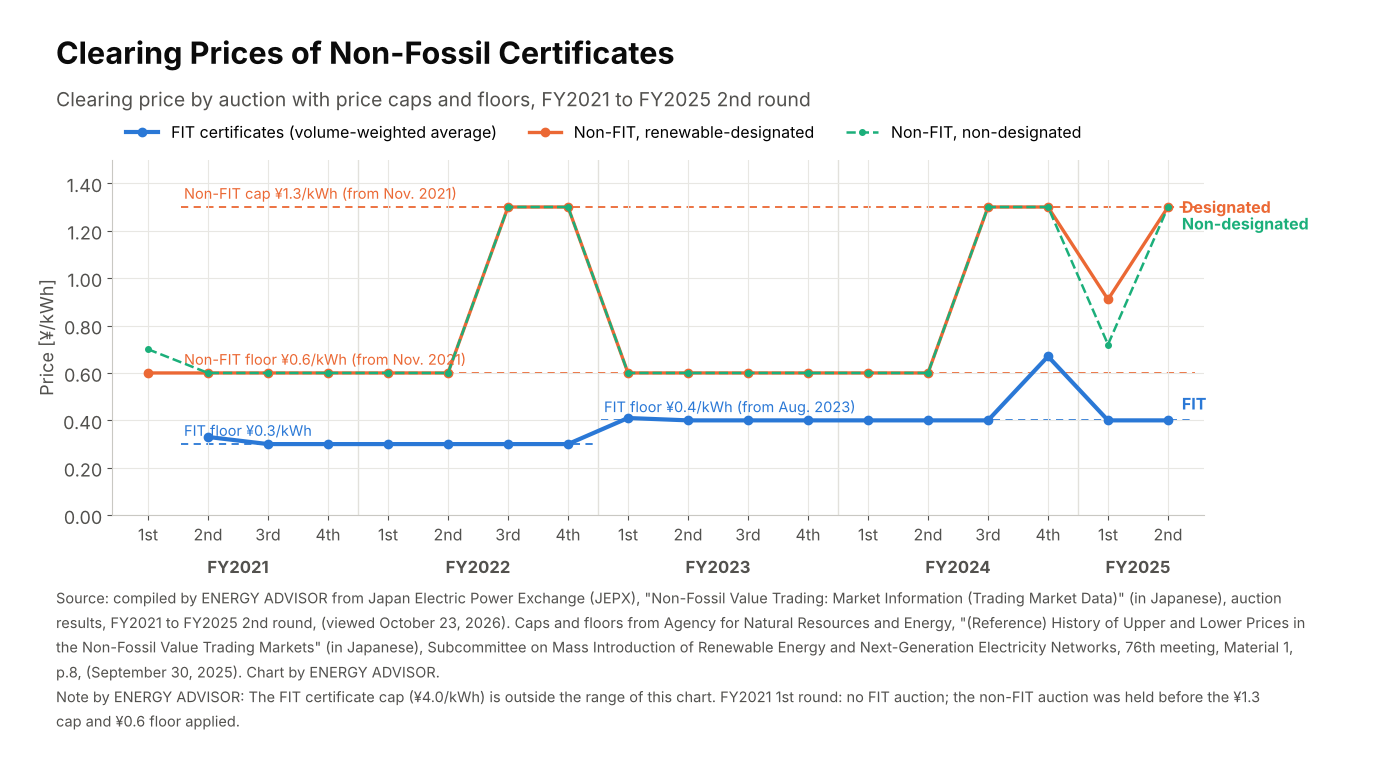
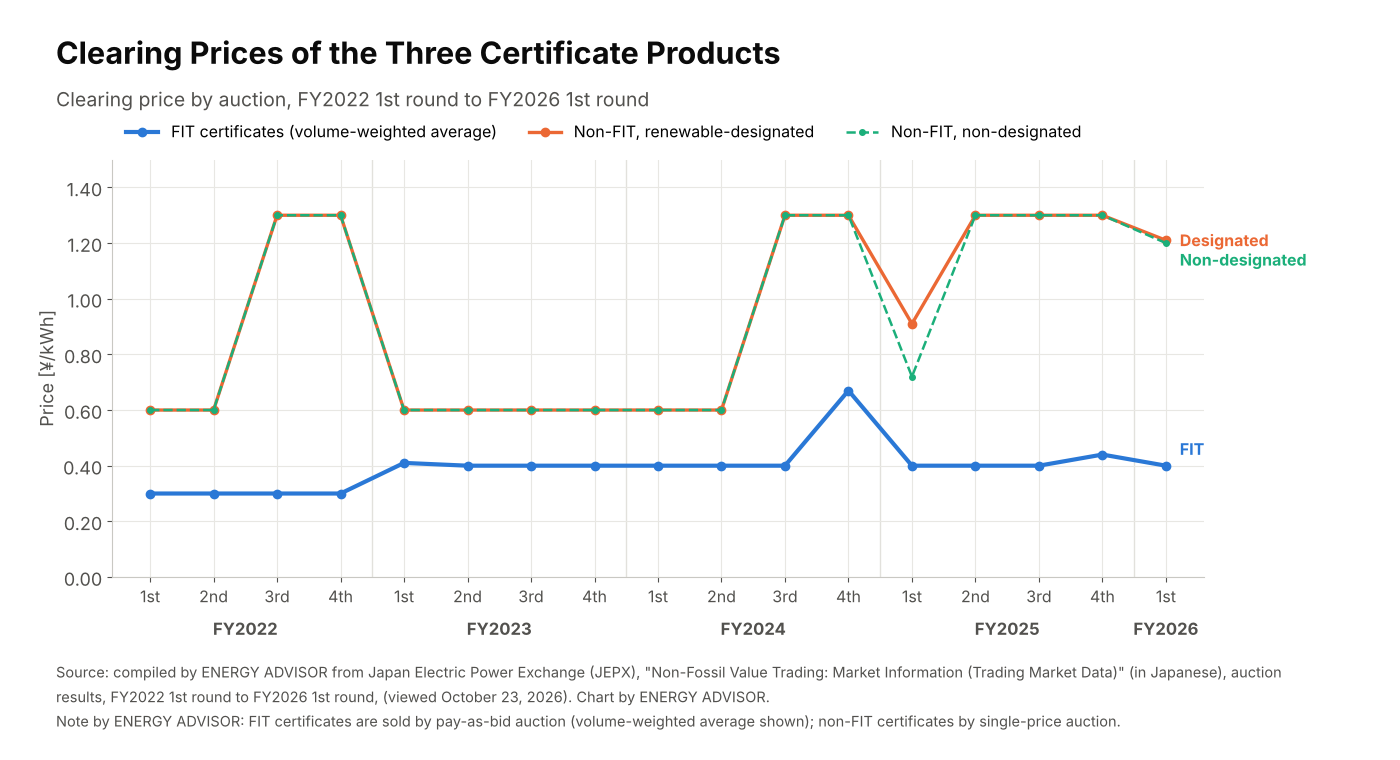
The clearing prices for each round are shown below. For FIT certificates, the figure is the average weighted by cleared volume. Figures are from JEPX market data. The Working Group on Market Design, 109th meeting, Material 3, p.41, also states that the weighted average price of FIT certificates was near the ¥0.4 floor except in the 4th round of FY2024, which included substitute procurement, and that non-FIT certificates cleared at a price other than the cap or floor in the 1st round of FY2025 and at the ¥1.3 cap in three of the four rounds of the most recent year.
| Fiscal year and round | FIT (weighted average) | Non-FIT renewable-designated | Non-FIT non-designated |
|---|---|---|---|
| FY2022 1st | 0.30 | 0.60 | 0.60 |
| FY2022 2nd | 0.30 | 0.60 | 0.60 |
| FY2022 3rd | 0.30 | 1.30 | 1.30 |
| FY2022 4th | 0.30 | 1.30 | 1.30 |
| FY2023 1st | 0.41 | 0.60 | 0.60 |
| FY2023 2nd | 0.40 | 0.60 | 0.60 |
| FY2023 3rd | 0.40 | 0.60 | 0.60 |
| FY2023 4th | 0.40 | 0.60 | 0.60 |
| FY2024 1st | 0.40 | 0.60 | 0.60 |
| FY2024 2nd | 0.40 | 0.60 | 0.60 |
| FY2024 3rd | 0.40 | 1.30 | 1.30 |
| FY2024 4th | 0.67 | 1.30 | 1.30 |
| FY2025 1st | 0.40 | 0.91 | 0.72 |
| FY2025 2nd | 0.40 | 1.30 | 1.30 |
| FY2025 3rd | 0.40 | 1.30 | 1.30 |
| FY2025 4th | 0.44 | 1.30 | 1.30 |
| FY2026 1st | 0.40 | 1.21 | 1.20 |
(Unit: ¥/kWh)
FIT certificates have stayed near ¥0.4 almost throughout since FY2023, when the minimum price rose from ¥0.3 to ¥0.4. Non-FIT certificates cleared at the ¥0.6 floor in every round of FY2023, but stuck at the ¥1.3 cap from the 3rd round of FY2024 and stayed close to the cap through FY2025.
Why FIT Certificates Stick at the Floor
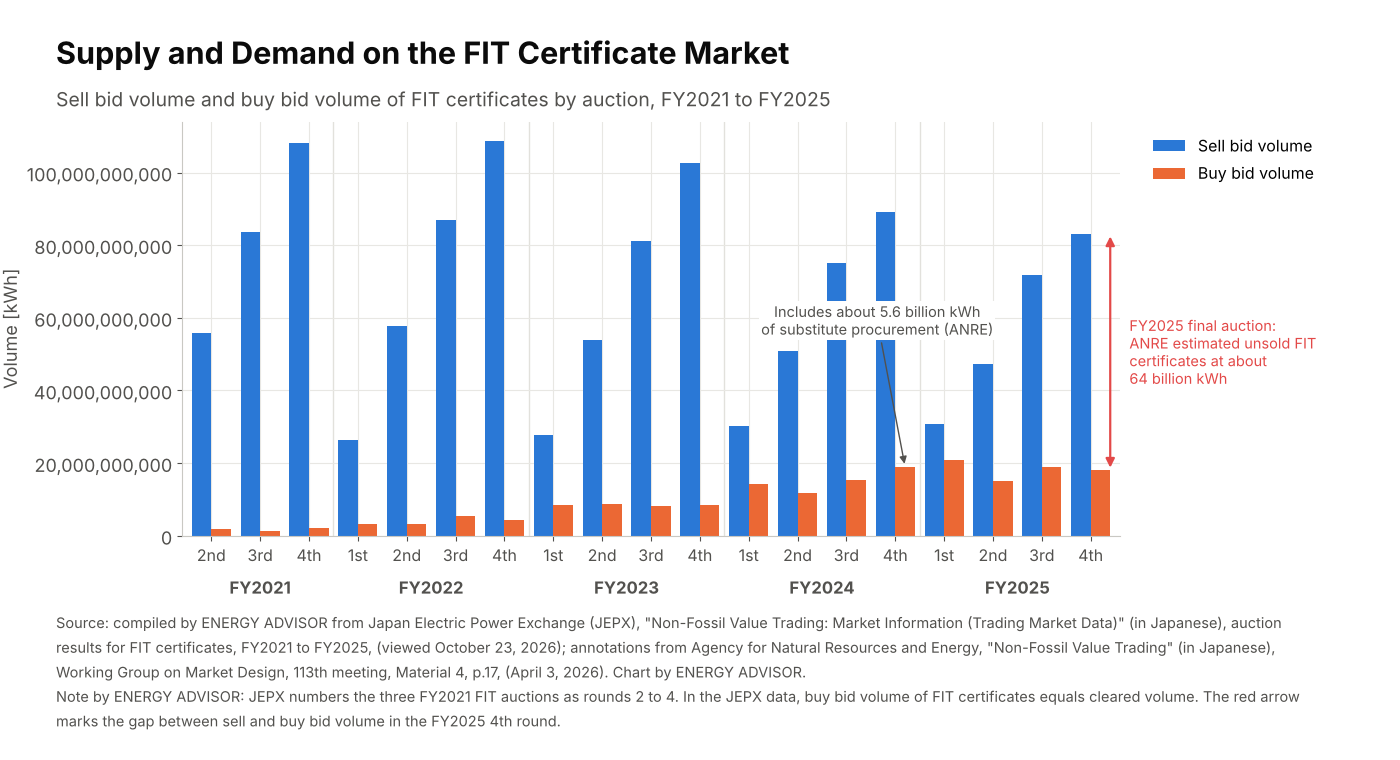
The seller of FIT certificates is the Organization for Cross-regional Coordination of Transmission Operators, JAPAN (OCCTO). The environmental attributes of FIT electricity are treated as belonging to electricity users as a whole, who bear the renewable energy surcharge, and the entire volume certified by OCCTO is put up for sale with no price condition. As a result, sell volume is very large.
| Fiscal year and round | Sell volume (TWh) | Cleared volume (TWh) |
|---|---|---|
| FY2025 1st | 30.89 | 20.98 |
| FY2025 2nd | 47.19 | 15.22 |
| FY2025 3rd | 71.79 | 18.88 |
| FY2025 4th | 83.18 | 18.00 |
| FY2026 1st | 32.41 | 23.12 |
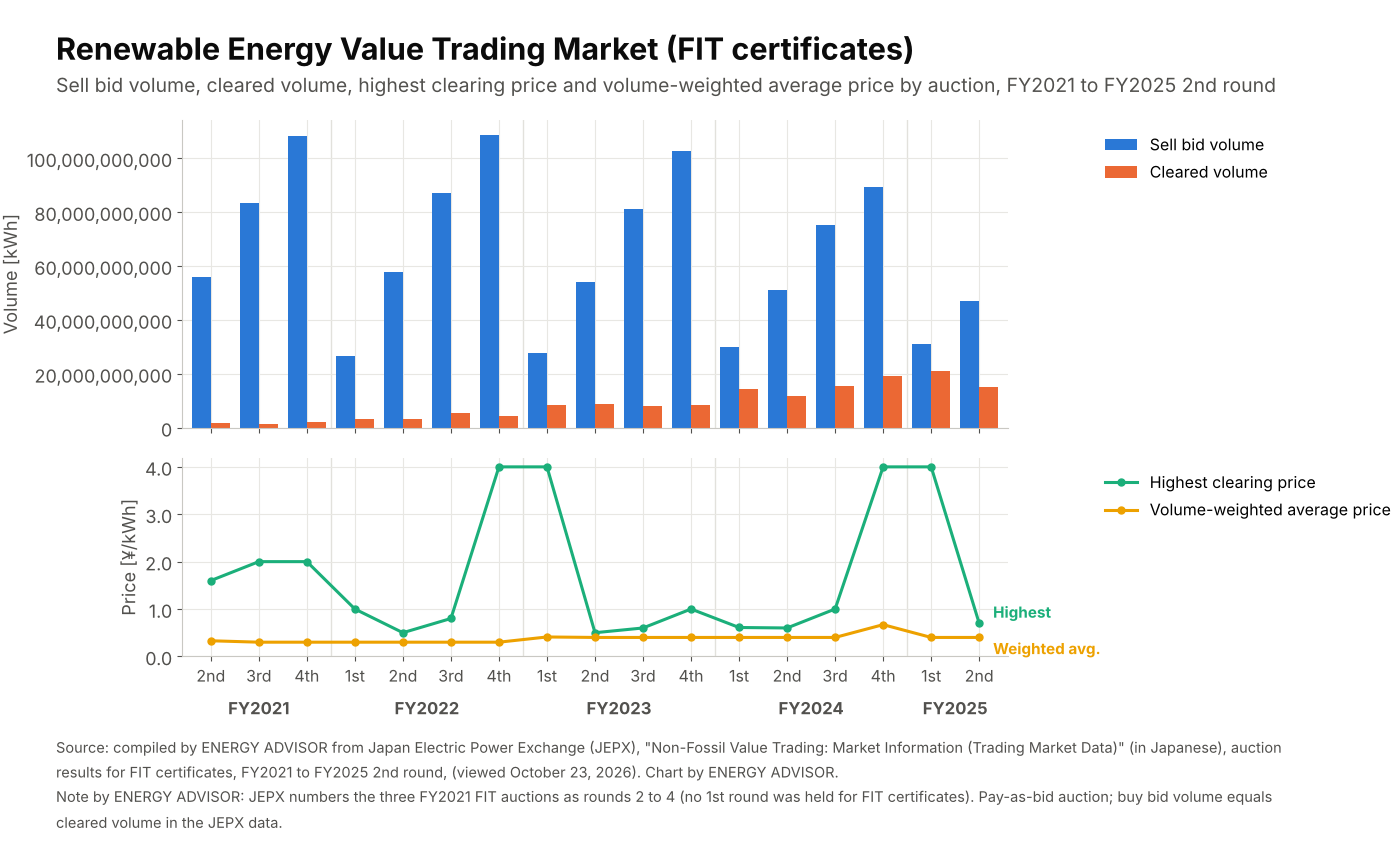
In every round, the entire buy volume cleared and much of the sell volume went unsold (JEPX market data). An Agency for Natural Resources and Energy (ANRE) document estimates the unsold volume of FIT certificates in the final FY2025 auction at about 64 TWh (113th meeting, Material 4, p.17). Subtracting the cleared volume of 18.00 TWh from the sell volume of 83.18 TWh in the 4th round of FY2025 in the table gives about 65.2 TWh, as unsold volume carries over to later rounds in the fiscal year.
In a pay-as-bid (multi-price) auction, when sell volume exceeds buy volume, buyers can clear even if they bid at the floor price. For this reason, many buyers bid at the ¥0.4 floor, and the weighted average price is near the floor. Cleared volume itself is growing (about 21.0 TWh in the 1st round of FY2025 and about 23.1 TWh in the 1st round of FY2026), and buying by electricity users and others is rising, but supply far exceeds it.
The weighted average price rose to ¥0.67 in the 4th round of FY2024 because buy bids in that round included about 5.6 TWh of “substitute procurement” (a way for retail electricity suppliers short of non-FIT certificates to meet their Sophisticated Methods Act obligations with FIT certificates; explained in a later section). The price for substitute procurement in FY2024 was set at or above the price cap of the non-FIT market (¥1.3/kWh). A draft proposes the same for FY2025 (113th meeting, Material 4, p.16).
Why Non-FIT Certificates Stick at the Cap
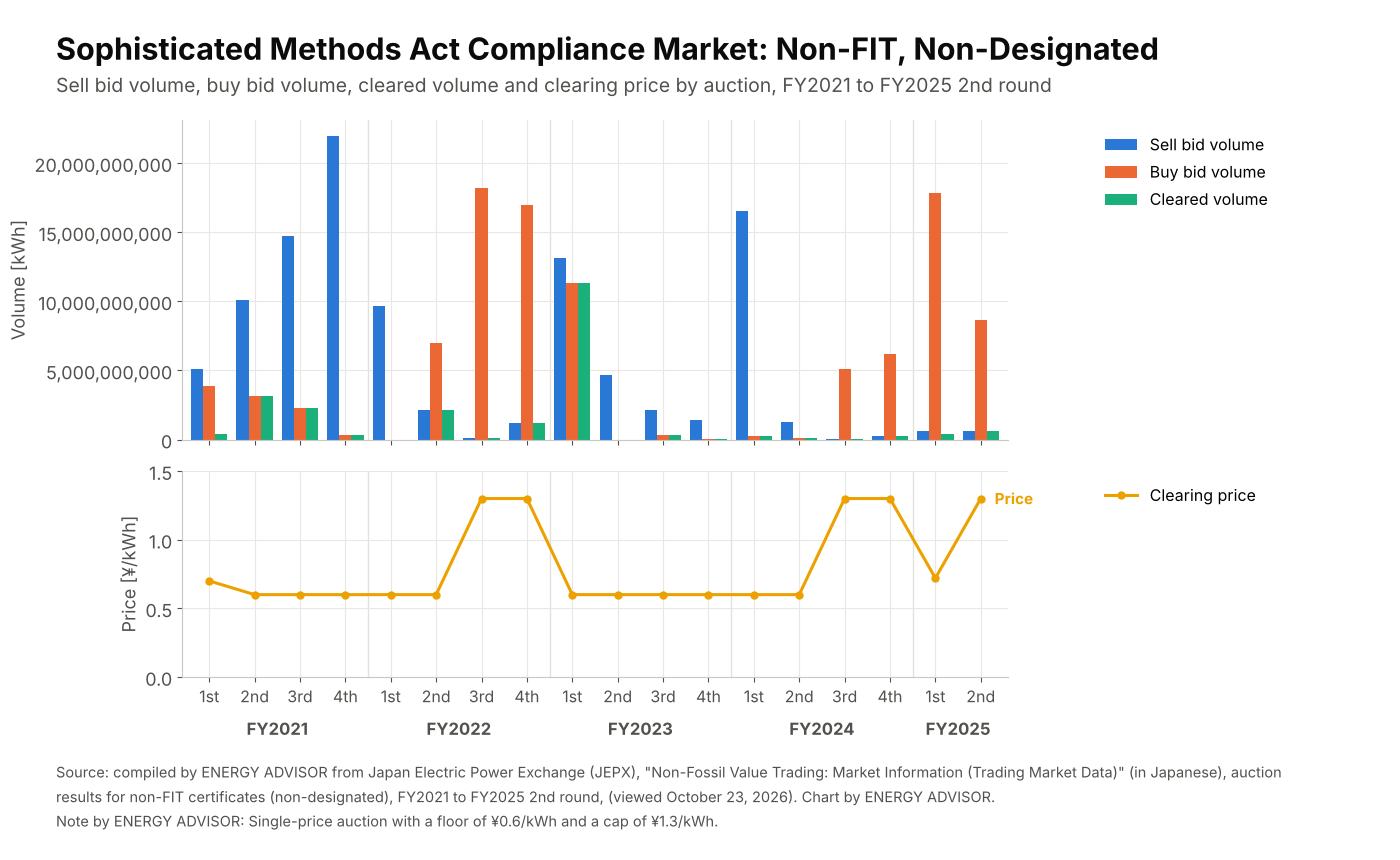
The sellers of non-FIT certificates are generators such as large hydropower, post-FIT, FIP and nuclear plants. Unlike FIT certificates, generators decide whether and how much to sell, so the volume reaching the market is limited. Meanwhile, the buyers, retail electricity suppliers, need certificates to meet the Sophisticated Methods Act interim targets.
| Fiscal year and round | Product | Sell volume (TWh) | Buy volume (TWh) | Cleared volume (TWh) | Share of buy volume cleared | Clearing price |
|---|---|---|---|---|---|---|
| FY2023 1st | Non-designated | 13.11 | 11.34 | 11.34 | 100% | 0.60 |
| FY2025 1st | Renewable-designated | 0.95 | 17.89 | 0.36 | About 2% | 0.91 |
| FY2025 1st | Non-designated | 0.62 | 17.82 | 0.43 | About 2% | 0.72 |
| FY2025 2nd | Renewable-designated | 1.77 | 8.54 | 0.62 | About 7% | 1.30 |
| FY2025 2nd | Non-designated | 0.61 | 8.67 | 0.59 | About 7% | 1.30 |
| FY2025 3rd | Renewable-designated | 0.82 | 2.72 | 0.82 | About 30% | 1.30 |
| FY2025 3rd | Non-designated | 1.00 | 3.47 | 1.00 | About 29% | 1.30 |
| FY2025 4th | Renewable-designated | 1.05 | 1.71 | 1.05 | About 61% | 1.30 |
| FY2025 4th | Non-designated | 2.00 | 3.71 | 2.00 | About 54% | 1.30 |
| FY2026 1st | Renewable-designated | 1.98 | 12.26 | 1.14 | About 9% | 1.21 |
| FY2026 1st | Non-designated | 0.20 | 11.15 | 0.11 | About 1% | 1.20 |
(Figures from JEPX market data. The Working Group on Market Design, 109th meeting, Material 3, pp.4–5, gives buy volumes rounded to 0.1 TWh: “17.8 TWh → 8.7 TWh” (non-designated) and “17.9 TWh → 8.5 TWh” (renewable-designated).)
In rounds where sell volume exceeded buy volume, as in the 1st round of FY2023, the market cleared at the ¥0.6 floor. In the 1st and 2nd rounds of FY2025 and the 1st round of FY2026, sell bids were scarce, and only about 1–9% of buy volume cleared. In the 3rd and 4th rounds of FY2025, buy volume fell sharply, so 30–60% of buy volume cleared, but the price stayed at the ¥1.3 cap.
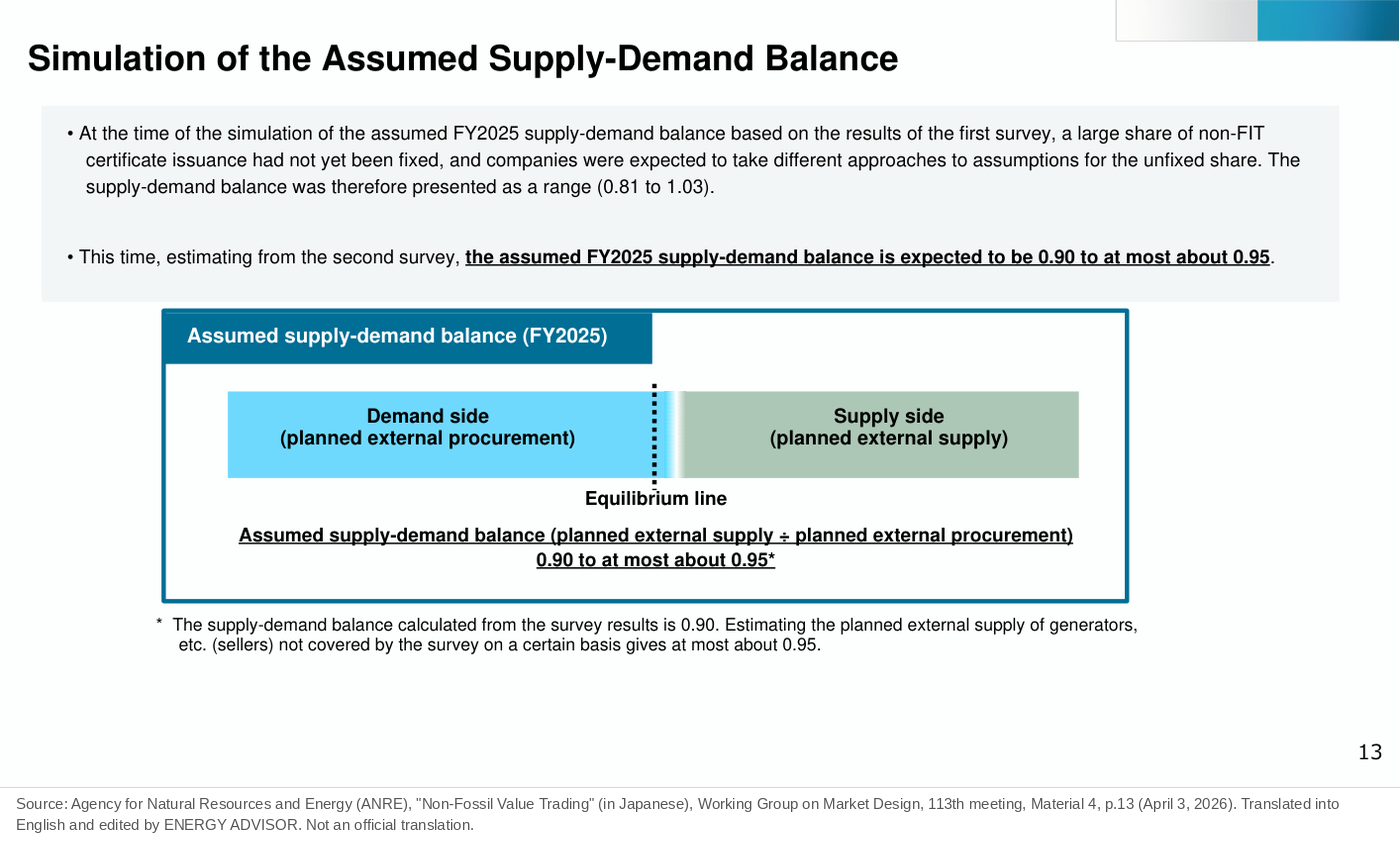
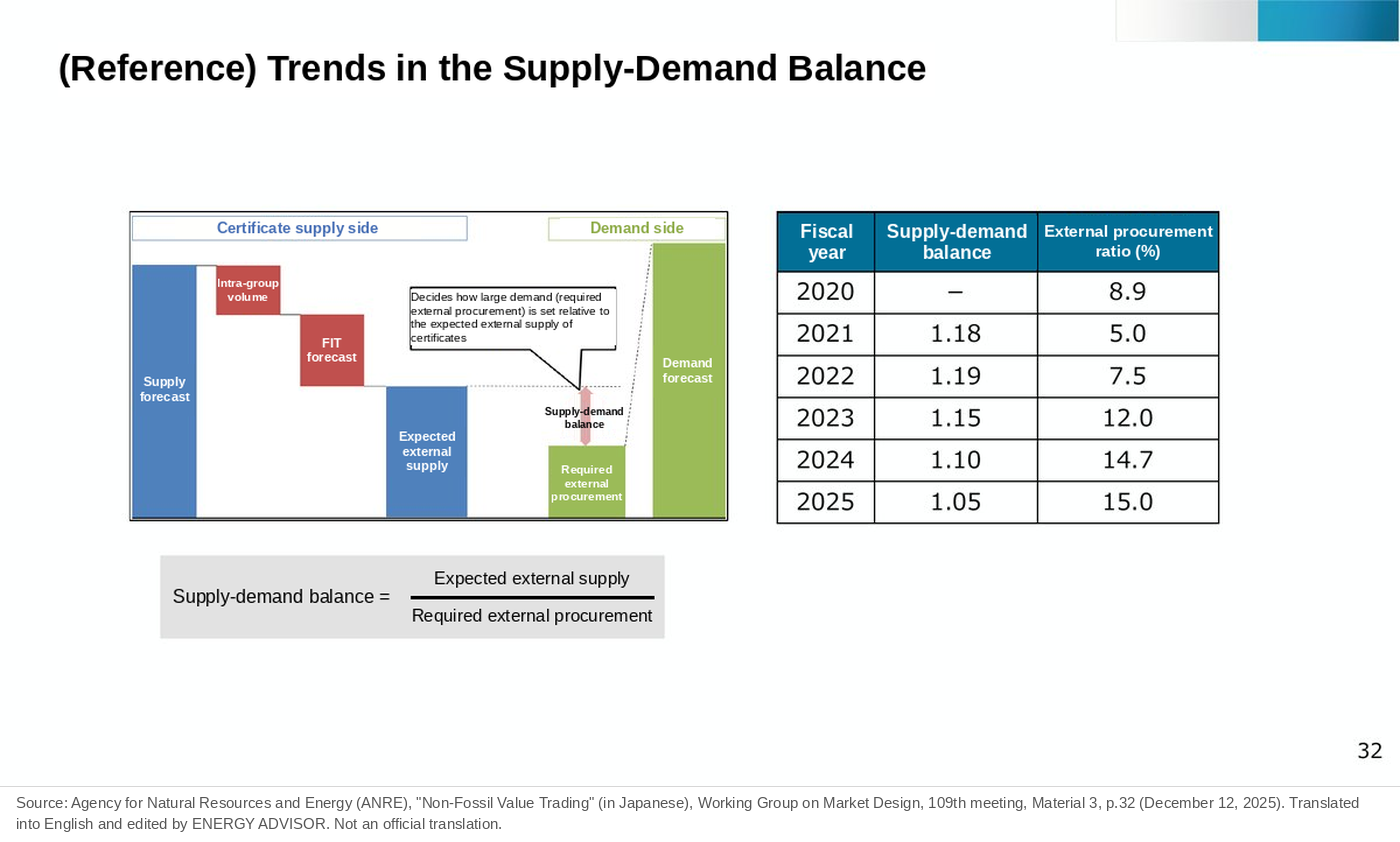
This supply-demand situation is determined by the relationship between the Sophisticated Methods Act interim targets and certificate supply. The government sets the interim targets while watching the “supply-demand balance”: the expected volume of non-FIT certificates to be sold on the market and elsewhere (expected external supply; FIT certificates are not included) divided by the volume that retail electricity suppliers need to procure externally (required external procurement) (see article 12 in this series). For FY2024, a supply-demand balance of about 1.10 had been assumed, but it was later estimated that it would come in at 0.99. For FY2025 as well, the assumed supply-demand balance was expected to be 0.90 to at most about 0.95. When the supply-demand balance falls below 1, there are not enough certificates on the market to meet the targets, and prices move toward the cap.
Phase 3 Interim Targets and the Demand Outlook
In Phase 3 of the Sophisticated Methods Act (FY2026–FY2028), the method for setting interim targets keeps the Phase 2 approach, but was revised to estimate more accurately the volume of certificates that will actually reach the market (see article 12 in this series).
The final values for the FY2026 interim target were set at an external procurement ratio of 14.8% and a supply-demand balance of 1.05. In the final values, expected external supply increased to about 127 TWh. The document states that this is thought to reflect the inclusion of nuclear restarts and other factors in the FY2026 Electricity Supply Plan.
On May 13, 2026, the 1st meeting of the Working Group on Stable Power Supply was told that the lowering of the GF reference ratio (the threshold for a transitional relief that eases the interim targets of retailers with a high share of fossil generation) had not been reflected in the calculation of the final value. Recalculated, the external procurement ratio is about 15.8%, and ANRE proposed correcting the ratio used for the FY2026 interim targets to about 15.8% (Working Group on Stable Power Supply, 1st meeting, Material 9, p.5).
In addition, “substitute procurement” has been set out as an alternative means of meeting obligations when the certificate supply-demand balance tightens. For FY2025, a draft was presented that would allow substitute procurement with FIT certificates on condition that the required volume is bid at ¥1.3/kWh in the 4th (final) non-FIT auction (both renewable-designated and non-designated), and that would set the procurement price at or above the non-FIT market’s cap (¥1.3/kWh). ANRE says the effect of substitute procurement on the FIT market would be limited, because unsold FIT certificates are large.
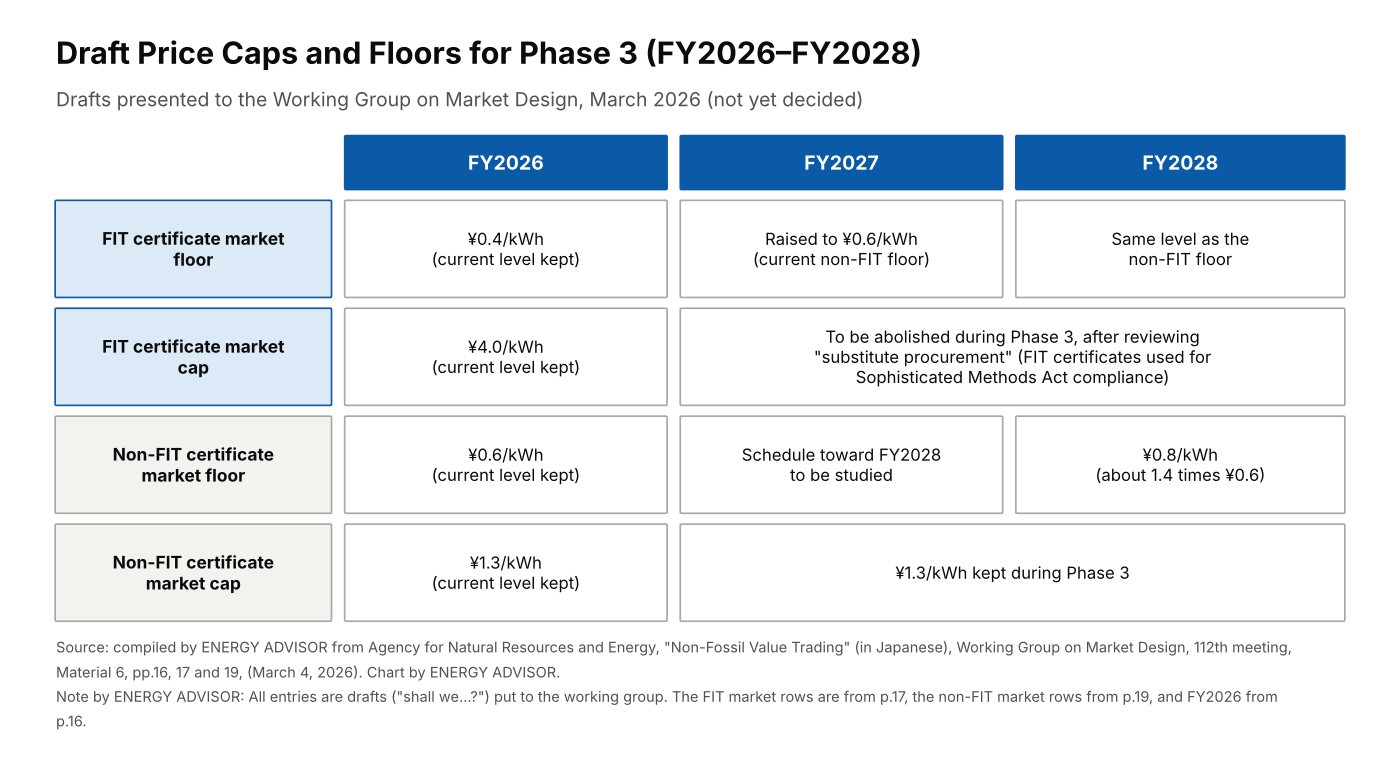
Revisions to the price caps and floors are also under discussion. At the Working Group on Market Design in March 2026, a draft was presented to keep each market’s caps and floors unchanged in FY2026. For FY2027 onward, the drafts are to raise the FIT certificate floor to ¥0.6/kWh, the same as for non-FIT certificates, and abolish the FIT certificate cap (¥4.0/kWh) during Phase 3, and to raise the non-FIT certificate floor to ¥0.8/kWh in FY2028 while keeping the cap (¥1.3/kWh) during Phase 3 (Working Group on Market Design, 112th meeting, Material 6, pp.16, 17 and 19). All of these are still drafts.
What Buyers Should Watch For
- FIT certificates: Because sell volume is large, bids at the ¥0.4 floor continue to clear easily. However, specifying detailed conditions, such as “commissioned within the last 15 years” or a particular region, reduces the eligible certificates and makes clearing harder.
- Non-FIT certificates: Because sell bids are scarce, in rounds such as the first of the fiscal year, even bids at the ¥1.3 cap continue not to clear in full. Retail electricity suppliers with Sophisticated Methods Act obligations need to check the conditions for substitute procurement in the final auction (under the FY2025 draft, bidding at ¥1.3/kWh).
- Schedule: Auctions are held four times a year (August, November, February and May). Under the FY2025 draft, substitute procurement is allowed only in the 4th (final) round.
Summary: The Price Structure of Non-Fossil Certificates
Clearing prices of non-fossil certificates plainly reflect market supply and demand. For FIT certificates, the entire environmental attributes of FIT electricity are put up for sale, so much goes unsold and the weighted average price stays near the ¥0.4/kWh floor. For non-FIT certificates, sell bids from generators are limited, and in fiscal years when supply falls short of the Sophisticated Methods Act interim targets, the price sticks at the ¥1.3/kWh cap. Future non-FIT certificate prices will depend on the level of each year’s interim target and on changes in supply, such as from nuclear restarts.
This article is based on published materials from the Ministry of Economy, Trade and Industry and its Agency for Natural Resources and Energy, the Electricity and Gas Market Surveillance Commission, the Organization for Cross-regional Coordination of Transmission Operators (OCCTO) and other sources. The English translations of figures are by ENERGY ADVISOR and are not official translations. When using this information for decisions, please check the original sources. When we find an error, we correct the article and note the date of the correction.
Sources
- Japan Electric Power Exchange (JEPX), “Non-Fossil Value Trading Market Information (Trading Market Data)” (in Japanese) (five-year display, table view; accessed October 22, 2026): clearing date, cleared volume, clearing price, total sell volume and total buy volume for each round. https://www.jepx.jp/nonfossil/market-data/
- Agency for Natural Resources and Energy (ANRE), Working Group on Market Design, 112th meeting, Material 6, “Non-Fossil Value Trading” (in Japanese), March 4, 2026, p.16 (draft to keep each market’s caps and floors unchanged in FY2026), p.17 (draft to raise the FIT certificate market floor to ¥0.6/kWh, the same as the non-FIT market, from FY2027, and to abolish the cap [¥4.0/kWh] during Phase 3), p.19 (draft to set the non-FIT certificate market floor at ¥0.8/kWh in FY2028 and keep the cap during Phase 3). https://www.meti.go.jp/shingikai/enecho/denryoku_gas/jisedai_kiban/system_review/pdf/112_06_00.pdf
- JEPX, “Price Limits for Non-Fossil Value Trading” (in Japanese), October 28, 2021, and July 10, 2023. https://www.jepx.jp/nonfossil/outline/pdf/jepx20211028.pdf / https://www.jepx.jp/nonfossil/outline/pdf/jepx20230710.pdf
- JEPX, “Non-Fossil Value Trading Rules” (in Japanese), Article 9 and Article 14, Paragraph 4 (OCCTO places sell bids for the entire volume of FIT certificates), Article 15 (auction methods). https://www.jepx.jp/nonfossil/outline/pdf/nonfossil_rules.pdf
- ANRE, Working Group on Market Design, 113th meeting, Material 4, “Non-Fossil Value Trading” (in Japanese), April 3, 2026, p.6 (expected external supply is the expected non-FIT supply [expected supply minus expected FIT generation] multiplied by the external supply ratio), p.8 (final values for FY2026), p.13 (assumed FY2025 supply-demand balance of about 0.90–0.95), pp.14–16 (draft conditions and price for substitute procurement), p.17 (unsold FIT certificates of about 64 TWh in the final FY2025 auction; about 5.6 TWh of substitute procurement in the 4th round of FY2024). https://www.meti.go.jp/shingikai/enecho/denryoku_gas/jisedai_kiban/system_review/pdf/113_04_00.pdf
- ANRE, Working Group on Market Design, “24th Interim Report (draft)” (in Japanese), February 2026, pp.13–14 (the FY2024 supply-demand balance was assumed at about 1.10 and later estimated to come in at 0.99). https://www.meti.go.jp/shingikai/enecho/denryoku_gas/jisedai_kiban/system_review/pdf/111_03_00.pdf
- Working Group on Market Design, “24th Interim Report” (in Japanese) (final version published May 1, 2026), p.13 (the FY2024 supply-demand balance was assumed at about 1.10 and is expected to come in at 0.99). https://www.meti.go.jp/shingikai/enecho/denryoku_gas/jisedai_kiban/system_review/pdf/20260501_2.pdf
- ANRE, Working Group on Market Design, 109th meeting, Material 3, “Non-Fossil Value Trading” (in Japanese), December 12, 2025, pp.4–5 (non-FIT buy volumes from the 1st to the 2nd round of FY2025; the 2nd round at the ¥1.3 cap), p.6 (FIT certificates: 21.0 TWh cleared in the 1st round of FY2025; 2nd round sell volume 47.2 TWh, cleared 15.2 TWh), pp.39–41 (history of caps and floors; FIT certificates near the ¥0.4 floor except in the 4th round of FY2024; non-FIT certificates at the cap in three of the four rounds of the most recent year). https://www.meti.go.jp/shingikai/enecho/denryoku_gas/jisedai_kiban/system_review/pdf/109_03_00.pdf