In April 2026, Japan’s emissions trading system, the GX Emissions Trading System (GX-ETS), started full operation on a mandatory basis. The power sector, meanwhile, has had a market for “non-fossil certificates” since 2018, which circulates the environmental attributes of renewable and nuclear electricity as certificates. Both schemes aim at decarbonization, but their scope and legal basis are entirely different.
This article explains the different roles of the GX-ETS and non-fossil certificates, the emission scopes each covers, the issue of preventing double counting, and the effect on the value of non-fossil generation of paid allocation for the power sector from FY2033 (April 2033–March 2034).
Key points
- 1The GX-ETS is an emissions trading system covering Scope 1 (direct emissions). Non-fossil certificates are environmental attribute certificates used to reduce Scope 2 (indirect emissions from purchased electricity and the like) and to meet Sophisticated Methods Act obligations.
- 2Because the two schemes differ in legal basis and scope, non-fossil certificates cannot be used directly to surrender GX-ETS allowances.
- 3The “eligible carbon credits” that can be used to meet GX-ETS obligations are J-Credits and JCM credits (up to 10% of annual actual emissions). Non-fossil certificates are not among them.
- 4Paid allocation for the power sector from FY2033 will raise the cost of thermal power and widen the cost gap with non-fossil generation (generation that emits no CO2).
GX-ETS and Non-Fossil Certificates: Different Roles
The GX-ETS and non-fossil certificates both aim at decarbonization, but their design philosophy and scope differ greatly.
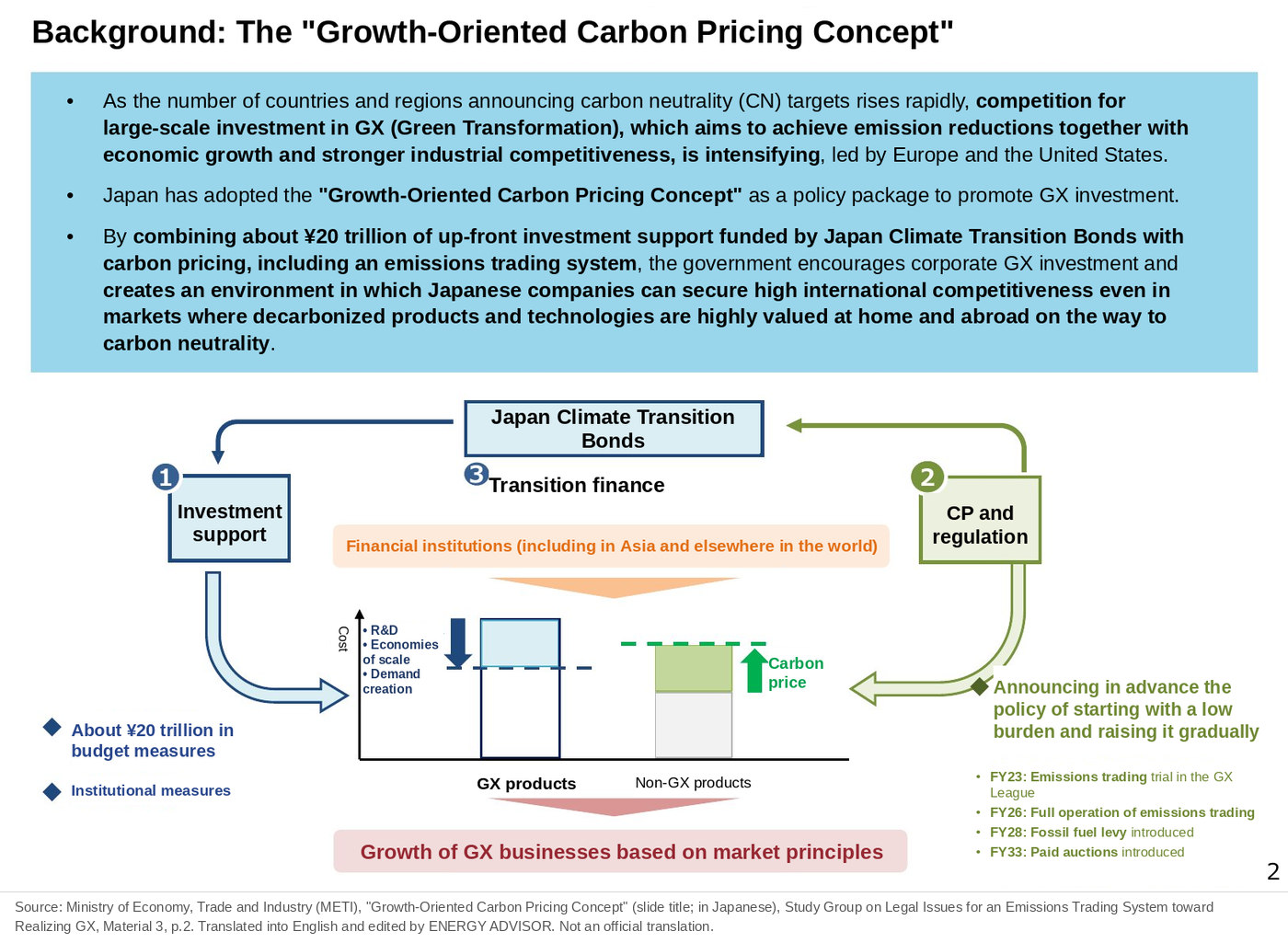
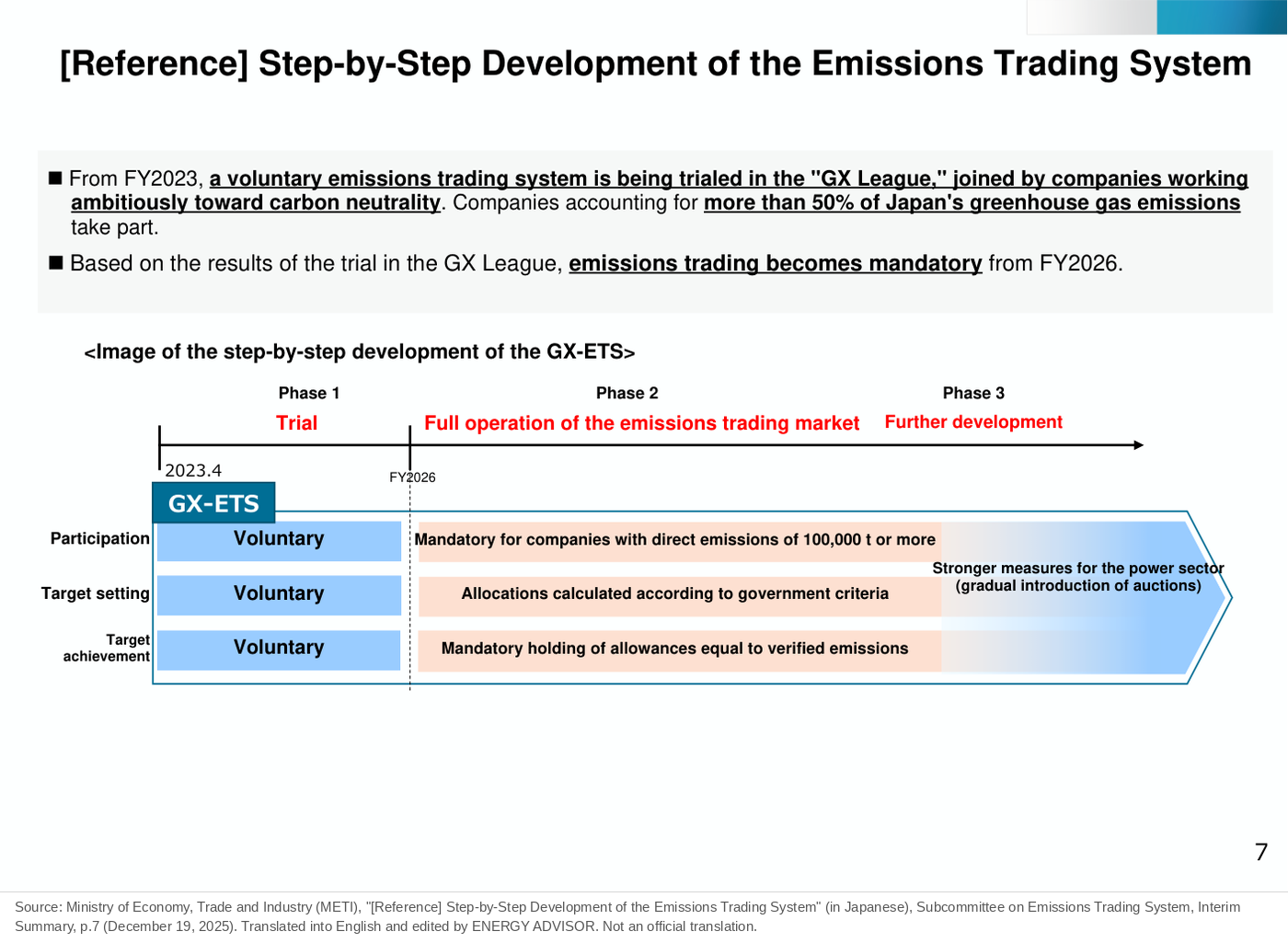
The GX-ETS (GX Emissions Trading System) is a mandatory scheme that started full operation in April 2026 under the GX Promotion Act (Act on the Promotion of a Smooth Transition to a Decarbonized Growth-Oriented Economic Structure, the law that sets out carbon pricing such as emissions trading and the fossil fuel levy). It allocates emission allowances to companies whose direct CO2 emissions (Scope 1) averaged 100,000 tonnes or more over the three fiscal years up to the previous year, and requires them to hold allowances equal to their surrender obligation. In the power sector, power generation companies are subject to the obligation, and paid auctions will also be introduced from FY2033.
Non-fossil certificates, on the other hand, are environmental attribute certificates that began trading in 2018. They turn the “value of not emitting CO2” of renewable and nuclear electricity into certificates. Under the Sophisticated Methods Act (short name of the Act on the Promotion of Use of Non-Fossil Energy Sources and Effective Use of Fossil Energy Materials by Energy Suppliers), retail electricity suppliers above a certain size (electricity sales of 0.5 TWh or more in the previous fiscal year) are obliged to source 44% of their electricity sales from non-fossil sources by FY2030, and retail suppliers procure non-fossil certificates to meet this obligation. A major difference from the GX-ETS is that the main buyers are electricity retailers, not power generation companies.
Different Scopes: Scope 1 and Scope 2
The biggest difference between the two schemes is the emission scope they cover.
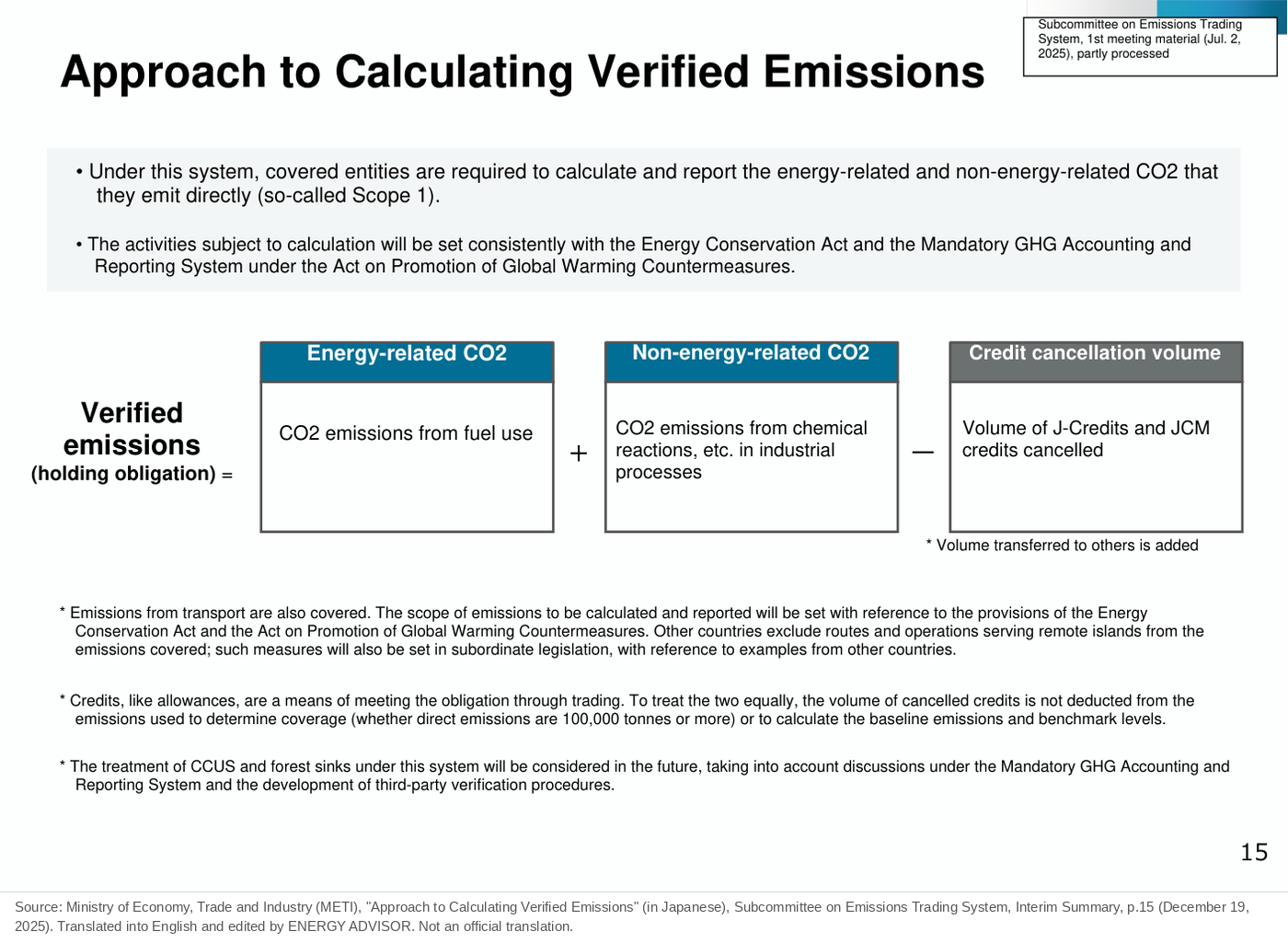
The GX-ETS covers only Scope 1 (direct emissions). It counts CO2 emitted directly at a company’s sites from fuel combustion or industrial processes. For power generation companies, this means emissions from burning fuel; for manufacturers, emissions from factory boilers and kilns. Indirect emissions from purchased electricity (Scope 2) and supply chain emissions (Scope 3) are currently outside the scheme.
Non-fossil certificates, by contrast, are used mainly for Scope 2, as a means of “counting as zero emissions” the indirect emissions from purchased electricity. When companies that use electricity report Scope 2 emissions under international climate disclosure frameworks such as CDP (an international non-profit that collects and evaluates companies’ environmental information) and SBT (an international mechanism for validating science-based reduction targets), they can buy non-fossil certificates (especially “renewable-designated” ones) to reduce their market-based Scope 2.
In other words, because the two schemes cover different scopes, one is not simply a substitute for the other. For GX-ETS-covered companies to reduce their own Scope 1 emissions, fuel switching and decarbonization of industrial processes are needed; buying non-fossil certificates does not directly help them meet their obligations.
Treatment of Eligible Carbon Credits in the GX-ETS
As a means of meeting the GX-ETS surrender obligation, besides acquiring and trading allowances, companies can use, within limits, “eligible carbon credits” recognized by the government.
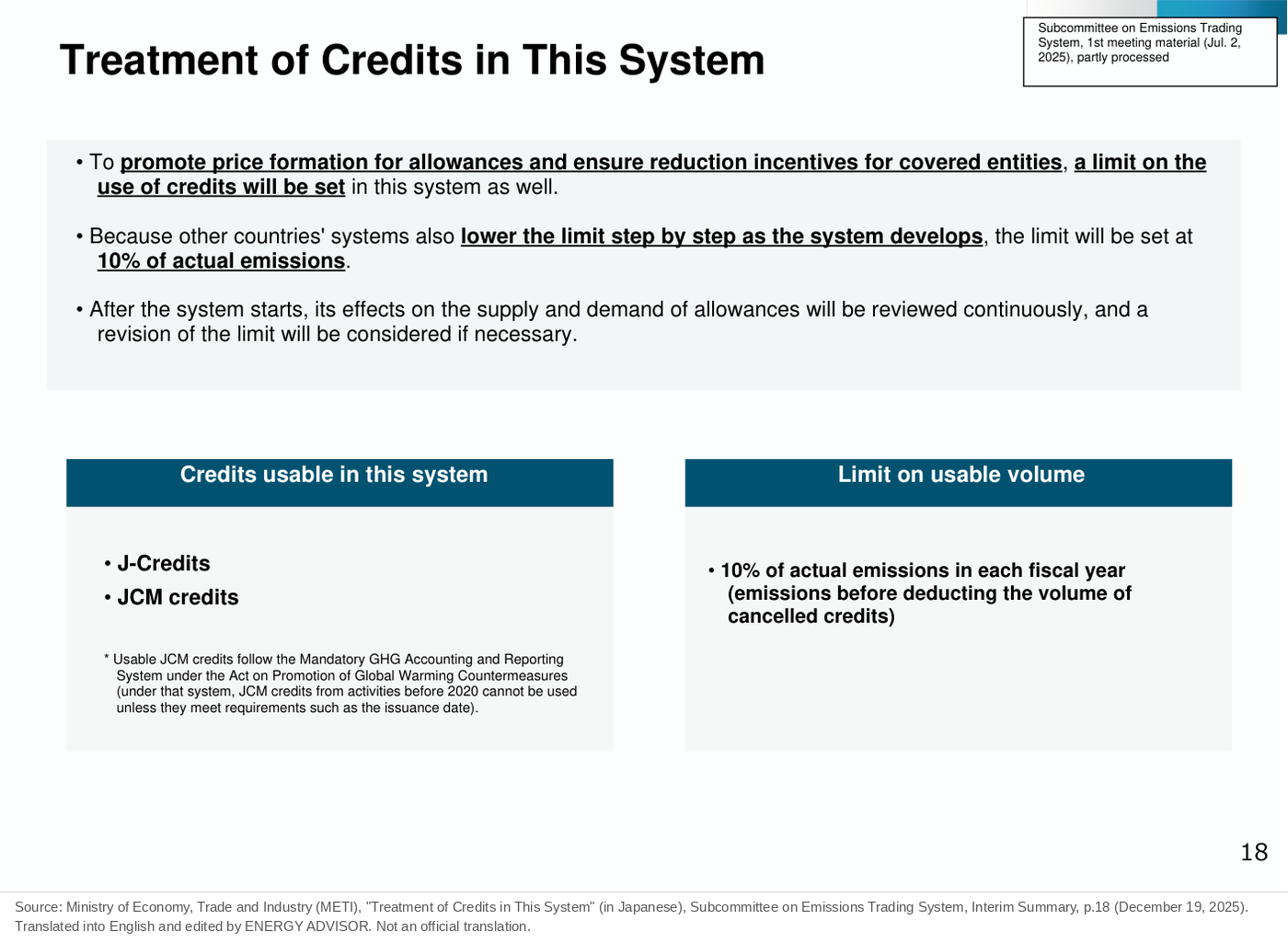
Two types are currently recognized as eligible carbon credits: J-Credits and JCM (Joint Crediting Mechanism) credits. Their use is capped at 10% of actual emissions in each fiscal year. These are credits for which the government has certified that “CO2 emission reductions or removals actually took place,” and like allowances, they can be used to meet obligations (up to 10% of actual emissions).
The key point here is that non-fossil certificates are not included among the GX-ETS’s eligible carbon credits. A non-fossil certificate represents “the environmental attributes of electricity,” which differs in nature from a credit that directly proves emission reductions or removals. When GX-ETS-covered companies offset Scope 1 emissions with credits, they must use J-Credits or JCM credits.
To summarize the difference between non-fossil certificates and J-Credits: a non-fossil certificate is “the environmental attributes per 1 kWh of electricity generated from renewables or nuclear power,” while a J-Credit is “a credit per tonne of CO2 reduced or removed through energy efficiency or forest absorption.” The former is used for electricity retailers’ Sophisticated Methods Act obligations, and the latter for companies’ voluntary offsetting and for meeting emissions trading obligations.
Preventing Double Counting
With the GX-ETS and non-fossil certificates coexisting, preventing double counting is important in the design of the schemes. Adjustments are needed so that the same emission reduction effect is not counted more than once in different schemes.
Within the GX-ETS, credits are treated as follows. The Interim Summary of the Industrial Structure Council’s Subcommittee on Emissions Trading System (December 2025) states that “credits, like allowances, are a means of enabling compliance through trading, and from the perspective of treating the two equally,” the “volume of cancelled credits is not deducted” from the emissions used to determine coverage under the scheme and to calculate baseline emissions and benchmark levels.
On the relationship among non-fossil certificates, the Sophisticated Methods Act and the GX-ETS, the Subcommittee on the Next-Generation Electricity and Gas Business Base concluded on December 17, 2025, that “for the time being, it is appropriate to keep the Sophisticated Methods Act and the ETS in parallel.”
Paid Allocation for the Power Sector from FY2033 and the Value of Non-Fossil Generation
From FY2033 (Reiwa 15), paid auctions targeting power generation companies will be introduced in Phase 3 of the GX-ETS. The GX Promotion Act provides that, from FY2033, allowances will be allocated, for a fee or free of charge, to power generation companies with large CO2 emissions (specified operators), and that the recipients and price of paid allocations will be determined by tender (Articles 27–29). It provides that specific matters concerning allocation by tender will be set separately by law (Article 31).
With paid allocation, thermal generators will need to buy allowances by tender, and the cost will be added to their generation costs. Non-fossil generation, which emits no CO2, does not need to buy allowances. Once paid auctions begin, the cost of thermal power will rise and the cost gap with non-fossil generation will widen. The effect on non-fossil certificate prices will depend on future scheme design.
In the decarbonization strategies of GX-ETS-covered companies, the first priority is to reduce their own direct Scope 1 emissions (fuel switching, process efficiency, introducing CCS, etc.). As a complementary means of meeting obligations with credits, eligible carbon credits (J-Credits and JCM credits) are the candidates. For reducing Scope 2 emissions and for external RE100 commitments, on the other hand, non-fossil certificates (especially renewable-designated ones) are an option.
Summary: The Relationship between Non-Fossil Certificates and the GX-ETS
The GX-ETS is a Scope 1 (direct emissions) scheme, and what can be used to meet its obligations is allowances and J-Credits and JCM credits (up to 10% of actual emissions). Non-fossil certificates are used to reduce Scope 2 and to meet Sophisticated Methods Act obligations, and cannot be used to meet GX-ETS obligations. The policy for the time being is to keep the Sophisticated Methods Act and the GX-ETS in parallel, and paid auctions for the power sector from FY2033 will be the next milestone in considering the relationship between the two schemes.
This article is based on published materials from the Ministry of Economy, Trade and Industry and its Agency for Natural Resources and Energy, the Electricity and Gas Market Surveillance Commission, the Organization for Cross-regional Coordination of Transmission Operators (OCCTO) and other sources. The English translations of figures are by ENERGY ADVISOR and are not official translations. When using this information for decisions, please check the original sources. When we find an error, we correct the article and note the date of the correction.
Sources
- Industrial Structure Council, Subcommittee on Emissions Trading System, “Interim Summary: Matters Concerning Implementation Guidelines for the Allocation of Emission Allowances” (in Japanese), December 19, 2025, pages as printed on the slides: p.6 (paid auctions for power generation companies from FY2033), p.7 (phased development of the GX-ETS: gradual introduction of auctions for the power sector in Phase 3), p.8 (three-fiscal-year average of 100,000 tonnes or more up to the previous fiscal year), p.15 (direct emissions [Scope 1] are covered; a note states that “credits, like allowances, … the volume of cancelled credits is not deducted”), p.18 (usable credits are J-Credits and JCM credits, up to 10% of actual emissions). https://www.meti.go.jp/shingikai/sankoshin/sangyo_gijutsu/emissions_trading/pdf/20251219_1.pdf
- Act on the Promotion of a Smooth Transition to a Decarbonized Growth-Oriented Economic Structure (Act No. 32 of 2023; provisions in force viewed on e-Gov Laws and Regulations Search on October 22, 2026) (in Japanese), Article 2, Paragraph 5 (specified operators are power generation companies with large CO2 emissions, as specified by Cabinet Order), Article 27 (allocation of specified operator allowances, for a fee or free of charge, from FY2033), Article 28 (specified operator charge), Article 29 (recipients and unit price of paid allocations determined by tender), Article 31 (matters concerning allocation by tender to be set separately by law). https://laws.e-gov.go.jp/law/505AC0000000032
- Agency for Natural Resources and Energy (ANRE), Working Group on Market Design, “24th Interim Report (draft)” (in Japanese), February 2026, p.43 (the 4th meeting of the Subcommittee on the Next-Generation Electricity and Gas Business Base on December 17, 2025, concluded that it is appropriate, for the time being, to keep the Sophisticated Methods Act and the ETS in parallel). https://www.meti.go.jp/shingikai/enecho/denryoku_gas/jisedai_kiban/system_review/pdf/111_03_00.pdf
- Working Group on Market Design, “24th Interim Report” (in Japanese) (final version published May 1, 2026), p.43 (likewise, it is appropriate, for the time being, to keep the Sophisticated Methods Act and the ETS in parallel). https://www.meti.go.jp/shingikai/enecho/denryoku_gas/jisedai_kiban/system_review/pdf/20260501_2.pdf
- ANRE, Subcommittee on Mass Introduction of Renewable Energy and Next-Generation Electricity Networks, 76th meeting, Material 1, “Developing an Environment in Which Renewable Energy Value Is Properly Evaluated” (in Japanese), September 30, 2025, p.13 (excerpt from the GX2040 Vision [February 2025]: the relationship of the Sophisticated Methods Act will be sorted out in light of the policy effects of expanding non-fossil generation and of reducing emission sources through emissions trading). https://www.meti.go.jp/shingikai/enecho/denryoku_gas/saisei_kano/pdf/076_01_00.pdf
- ANRE, Subcommittee on the Next-Generation Electricity and Gas Business Base, Material 5 (in Japanese), December 17, 2025, p.3 (the Sophisticated Methods Act covers suppliers with supply of 0.5 TWh or more in the previous fiscal year). https://www.meti.go.jp/shingikai/enecho/denryoku_gas/jisedai_kiban/pdf/004_05_00.pdf
- Ministry of Economy, Trade and Industry (METI), Study Group on Legal Issues for an Emissions Trading System toward Realizing GX, Material 3 (in Japanese), p.2, “Growth-Oriented Carbon Pricing Concept.” https://www.meti.go.jp/shingikai/sankoshin/sangyo_gijutsu/emissions_trading/pdf/001_03_00_gx.pdf