A non-FIT non-fossil certificate is a non-fossil certificate issued from generators outside the FIT scheme. There are two types, “renewable-designated” and “non-designated,” with different uses.
This article explains how non-FIT non-fossil certificates and their trading market work, the difference between renewable-designated and non-designated certificates, and how they compare with FIT non-fossil certificates, with recent clearing results.
Key point: Non-FIT non-fossil certificates are issued from several types of sources, including large hydropower, post-FIT generators, FIP generators and nuclear power. Renewable-designated certificates are intended for use under RE100, while non-designated certificates are used mainly to meet obligations under the Sophisticated Methods Act. Both are traded on the Sophisticated Methods Act Compliance Market (operated by JEPX), and buyers are, in principle, retail electricity suppliers.
Role of Non-FIT Certificates and How They Differ from FIT Certificates
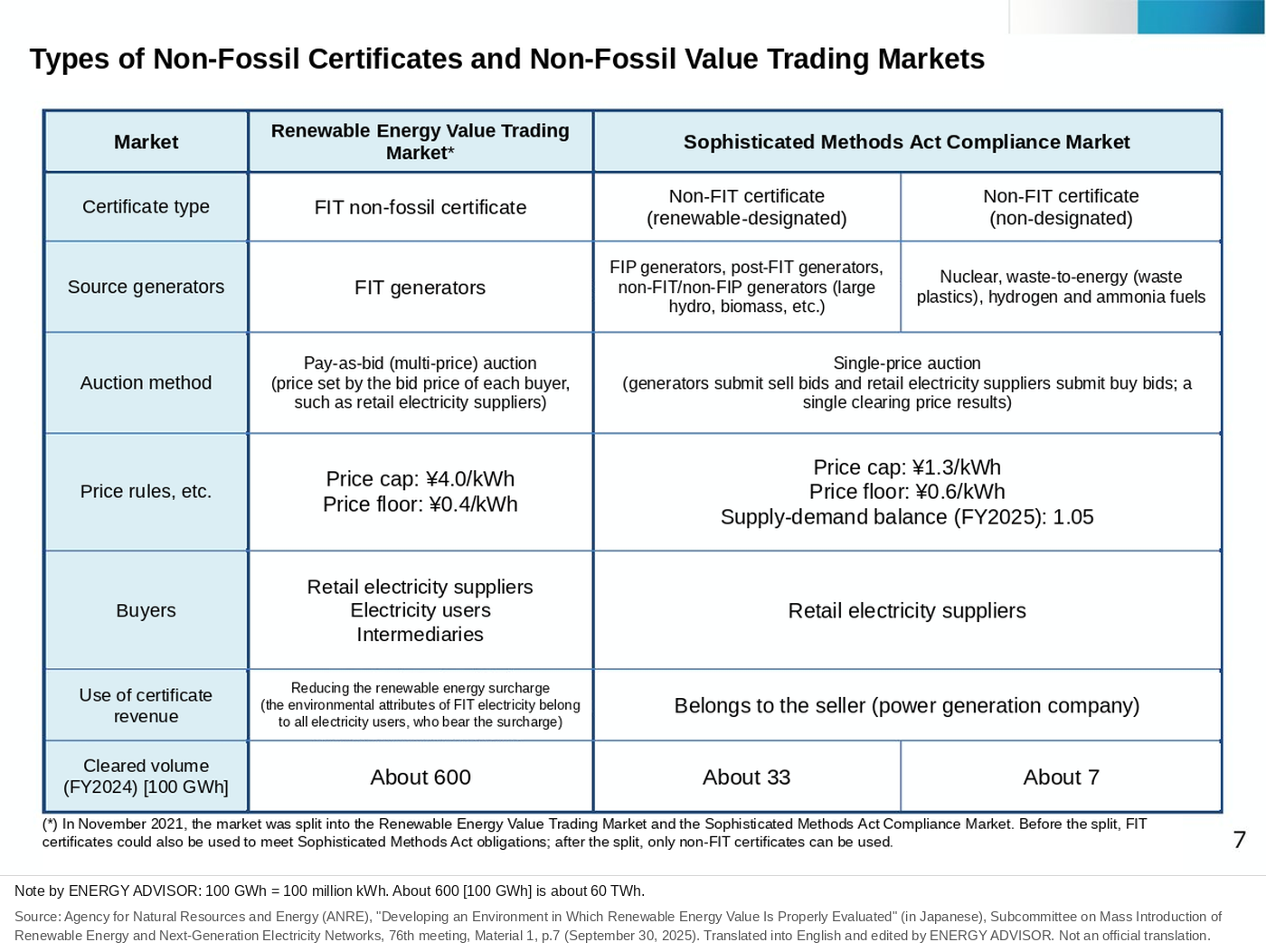
A non-FIT non-fossil certificate is issued from non-fossil generators outside the FIT scheme. Specifically, it is issued from large hydropower (30 MW or more), post-FIT generators (renewable generators whose FIT period has ended), FIP generators (generators that receive a subsidy on top of the market price), nuclear power, waste-to-energy (plastic portion) and others.
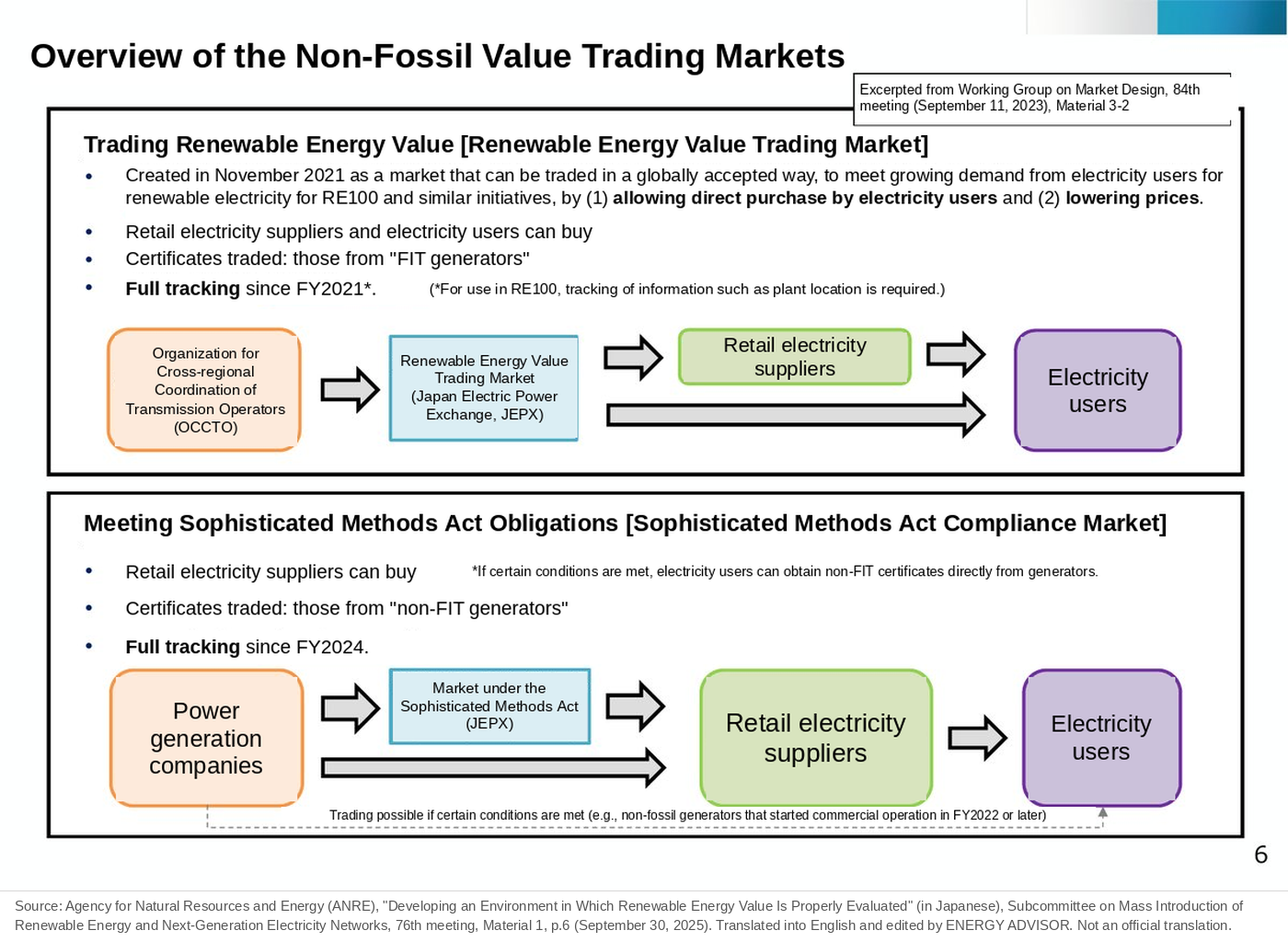
The main differences from FIT non-fossil certificates are who owns the environmental attributes and where they are traded. The environmental attributes of FIT certificates belong to electricity users as a whole. The Organization for Cross-regional Coordination of Transmission Operators, JAPAN (OCCTO), the national body that coordinates supply and demand and other matters across Japan, acts as the seller, and the certificates are traded, with electricity users among the participants, on the Renewable Energy Value Trading Market of the Japan Electric Power Exchange (JEPX), which runs wholesale electricity trading and non-fossil certificate trading. The environmental attributes of non-FIT certificates belong to the generator. The generator acts as the seller, and the certificates are sold mainly to retail electricity suppliers on the Sophisticated Methods Act Compliance Market.
Non-FIT non-fossil certificates are also divided into “renewable-designated” and “non-designated.” This classification strongly affects how the certificates can be used and how the market values them, so it is important to understand the characteristics of both before trading.
Renewable-Designated Certificates: Source Generators and Uses
Renewable-designated non-FIT non-fossil certificates are issued mainly from the following generators:
– Large hydropower (30 MW or more)
– Post-FIT generators (solar, wind and others whose FIT period has ended)
– FIP generators
Certificates from these generators can be used to meet companies’ RE100 and sustainability targets. For companies that need to meet RE100 (an international initiative of companies aiming to source 100% of the electricity they use from renewables), renewable-designated non-FIT non-fossil certificates are an important procurement option.
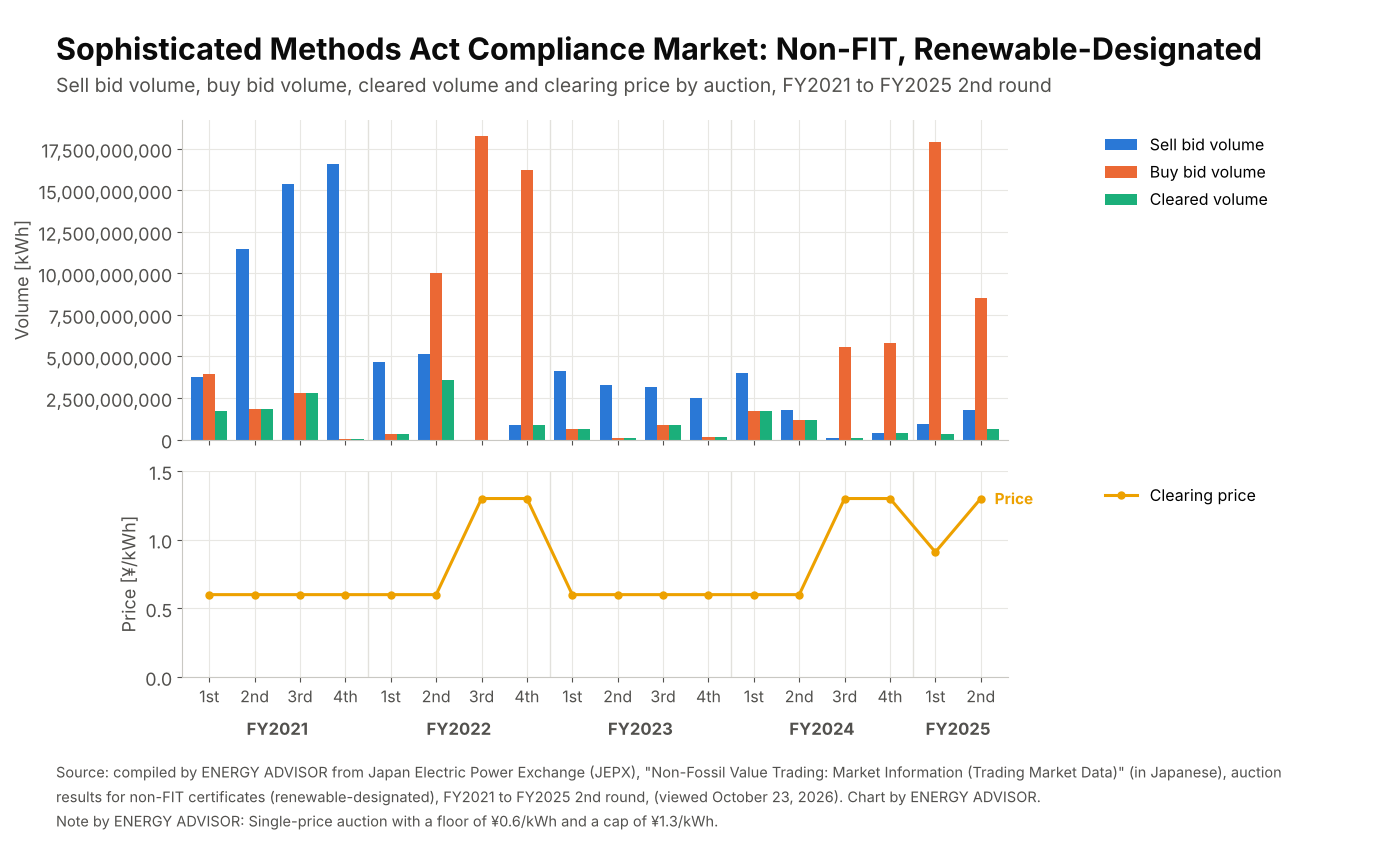
The clearing price of renewable-designated certificates was ¥0.91/kWh in the 1st round of FY2025 (August 2025), the ¥1.30/kWh cap in the 2nd to 4th rounds, and ¥1.21/kWh in the 1st round of FY2026 (August 2026) (JEPX market data; see the table below for details). (Japan’s fiscal year runs from April to March; FY2025 is April 2025–March 2026.)
Non-Designated Certificates: Source Generators and Uses
The main source of non-designated non-FIT non-fossil certificates is nuclear power. They also include waste-to-energy (plastic portion) and generation from hydrogen and ammonia fuel. Renewable generators whose owners did not designate them as renewable also fall into this category. This type of certificate cannot be used to meet RE100, and is traded mainly by retail electricity suppliers to meet their Sophisticated Methods Act obligations.
The Sophisticated Methods Act (short name of the Act on the Promotion of Use of Non-Fossil Energy Sources and Effective Use of Fossil Energy Materials by Energy Suppliers, a law that requires retail electricity suppliers above a certain size to raise their share of non-fossil power) requires retail electricity suppliers whose electricity sales in the previous fiscal year were 0.5 TWh or more to raise their non-fossil power ratio to 44% or more by FY2030 (see article 12 in this series). Non-designated certificates serve as a means to meet this requirement. They are certificates for regulatory compliance rather than for corporate sustainability strategies.
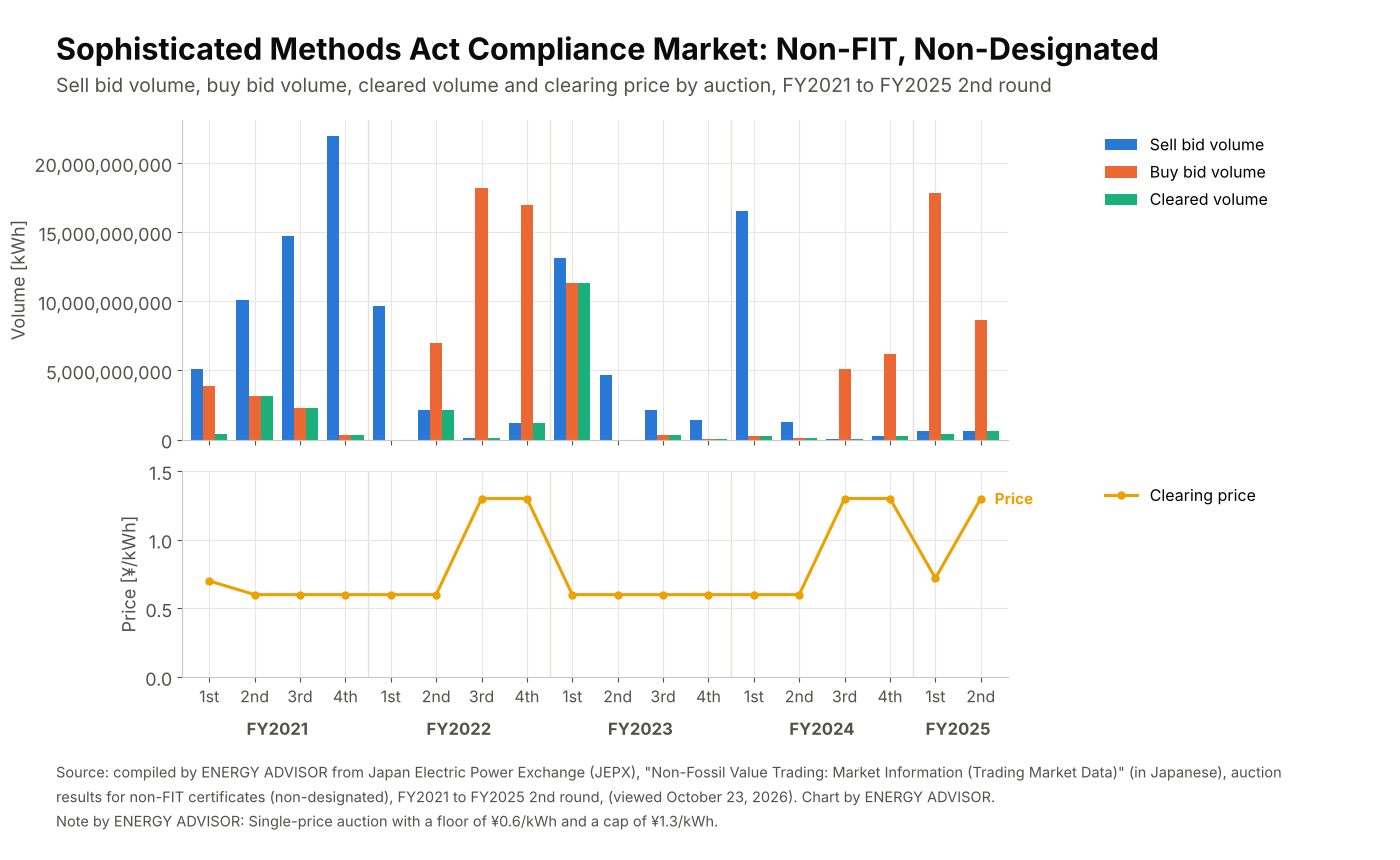
In price, non-designated certificates cleared at ¥0.72/kWh in the 1st round of FY2025, below renewable-designated certificates (¥0.91). In the 2nd to 4th rounds, both cleared at the ¥1.30/kWh cap, and in the 1st round of FY2026, non-designated certificates cleared at ¥1.20 and renewable-designated at ¥1.21, almost the same level (JEPX market data).
Sophisticated Methods Act Compliance Market: Mechanism and Auction Method
Non-FIT non-fossil certificates are traded on the Sophisticated Methods Act Compliance Market operated by JEPX (Japan Electric Power Exchange). This market is separate from the market for FIT non-fossil certificates, and buyers are, in principle, limited to retail electricity suppliers. Members that are electricity users cannot buy anything other than FIT certificates.
The auction method is a single-price auction. In this method, all participants clear at the same clearing price. Sell bids and buy bids are each stacked by price, and the price at the point where the sell curve (supply curve) and the buy curve (demand curve) intersect becomes the clearing price, and the volume at that point becomes the cleared volume. In other words, participants each state their own prices when bidding, but all cleared bids are settled at the same price.
Prices have a cap of ¥1.30/kWh and a floor of ¥0.60/kWh.
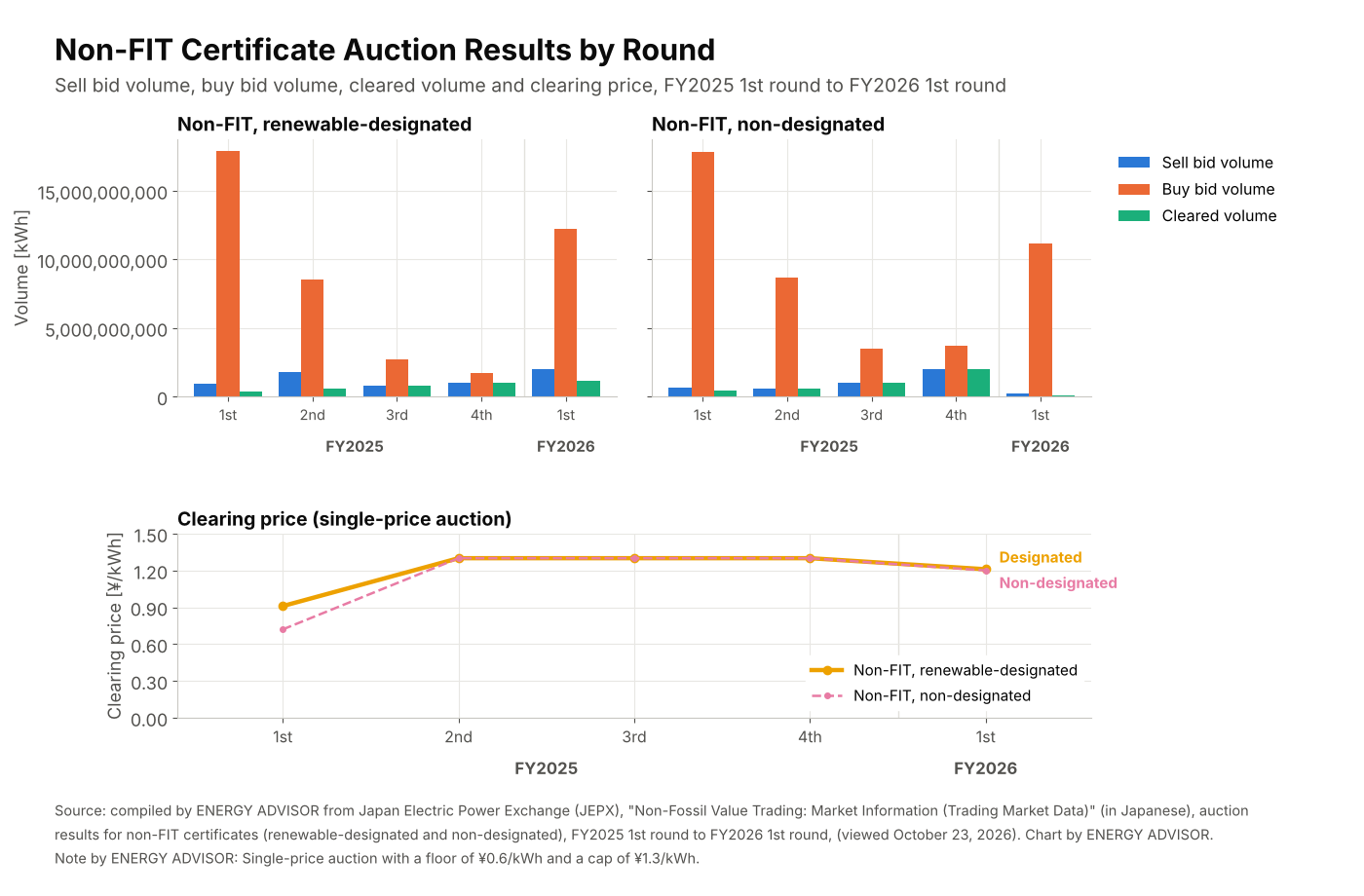
Clearing results since FY2025 are shown below (volumes in TWh, clearing price in ¥/kWh). Figures are from JEPX market data.
| Round | Product | Sell volume | Buy volume | Cleared volume | Share of buy volume cleared | Clearing price |
|---|---|---|---|---|---|---|
| FY2025 1st | Renewable-designated | 0.95 | 17.89 | 0.36 | About 2% | 0.91 |
| FY2025 1st | Non-designated | 0.62 | 17.82 | 0.43 | About 2% | 0.72 |
| FY2025 2nd | Renewable-designated | 1.77 | 8.54 | 0.62 | About 7% | 1.30 |
| FY2025 2nd | Non-designated | 0.61 | 8.67 | 0.59 | About 7% | 1.30 |
| FY2025 3rd | Renewable-designated | 0.82 | 2.72 | 0.82 | About 30% | 1.30 |
| FY2025 3rd | Non-designated | 1.00 | 3.47 | 1.00 | About 29% | 1.30 |
| FY2025 4th | Renewable-designated | 1.05 | 1.71 | 1.05 | About 61% | 1.30 |
| FY2025 4th | Non-designated | 2.00 | 3.71 | 2.00 | About 54% | 1.30 |
| FY2026 1st | Renewable-designated | 1.98 | 12.26 | 1.14 | About 9% | 1.21 |
| FY2026 1st | Non-designated | 0.20 | 11.15 | 0.11 | About 1% | 1.20 |
(The body text of the Working Group on Market Design, 109th meeting, Material 3, pp.4–5, gives buy volumes rounded to 0.1 TWh: “17.8 TWh → 8.7 TWh” (non-designated) and “17.9 TWh → 8.5 TWh” (renewable-designated). In the 2nd round of FY2025, for renewable-designated certificates, there were not enough buy bids at the same price, so part of the sell volume did not clear.)
In the 1st and 2nd rounds of FY2025 and the 1st round of FY2026, sell bids were scarce, and only about 1–9% of buy volume cleared. In the 3rd and 4th rounds of FY2025, buy volume fell sharply, so 30–60% of buy volume cleared, but the price stayed at the ¥1.30 cap. In FY2025, buy volume was larger in the earlier rounds of the fiscal year, and the limited volume of sell bids from the supply side (generators) is a challenge for the market.
Based on a survey of companies in October 2025, the Agency for Natural Resources and Energy (ANRE) indicated that actual volumes may differ from the expected external supply (the volume of certificates sold outside the company, on the market or bilaterally) assumed when setting the interim targets, and gave three possible reasons: (1) renewable generation may have fallen, for example hydropower output during drought, reducing certificate supply; (2) intra-group transactions, in which retail electricity suppliers other than the former general electricity utilities (incumbent regional utilities: the large utilities that have long supplied each region) use their own certificates to meet their own obligations, may have increased more than expected; and (3) voluntary demand for non-FIT certificates, such as direct purchases by electricity users and procurement by retail electricity suppliers not subject to the obligation, may have increased (Working Group on Market Design, 109th meeting, Material 3, p.9).
Note that if certain conditions are met (such as non-fossil generators that started commercial operation in FY2022 or later), electricity users can also obtain non-FIT certificates directly from generators.
Detailed Comparison with FIT Non-Fossil Certificates
| Item | FIT non-fossil certificate | Non-FIT non-fossil certificate |
|---|---|---|
| Source generators | Solar, wind, hydropower, geothermal and biomass under FIT | Large hydropower (30 MW or more), post-FIT, FIP, nuclear, waste-to-energy (plastic portion), etc. |
| Owner and seller of environmental attributes | Electricity users as a whole (sold by OCCTO) | Generator |
| Trading market | Renewable Energy Value Trading Market (JEPX) | Sophisticated Methods Act Compliance Market (JEPX) |
| Buyers | Retail electricity suppliers, electricity users, intermediaries | In principle, retail electricity suppliers |
| Auction method | Pay-as-bid (multi-price) auction | Single-price auction |
| Price cap and floor | ¥4.00 and ¥0.40/kWh | ¥1.30 and ¥0.60/kWh |
| Main uses | RE100, improving CO2 emission factors (Sophisticated Methods Act compliance only through substitute procurement) | Sophisticated Methods Act compliance (all), RE100 (renewable-designated) |
The biggest differences from FIT certificates are the range of sellers and buyers, and the supply volume. FIT electricity is purchased with funds from the renewable energy surcharge, and the entire volume of its environmental attributes is put on the market, so sell volume is very large. By contrast, generators decide whether to sell certificates from non-FIT generators, so the volume reaching the market is limited. As a result, the market for non-FIT non-fossil certificates is small, and prices tend to stick at the cap.
Summary: Current State and Challenges of Non-FIT Certificates
Non-FIT non-fossil certificates serve as a mechanism to draw non-fossil value from existing generators outside FIT. The design divides the roles: renewable-designated certificates support companies’ RE100 targets, and non-designated certificates support retail electricity suppliers’ compliance with the Sophisticated Methods Act.
However, in the 1st and 2nd rounds of FY2025 and the 1st round of FY2026, a clear problem emerged: sell bids were scarce and most buy volume did not clear. ANRE has cited as possible reasons lower renewable generation due to drought and other factors, an increase in intra-group transactions outside the former general electricity utilities, and an increase in voluntary demand.
When using this market, it is important to understand the different uses of renewable-designated and non-designated certificates, the eligibility rules (buyers are, in principle, retail electricity suppliers) and how the single-price auction works.
This article is based on published materials from the Ministry of Economy, Trade and Industry and its Agency for Natural Resources and Energy, the Electricity and Gas Market Surveillance Commission, the Organization for Cross-regional Coordination of Transmission Operators (OCCTO) and other sources. The English translations of figures are by ENERGY ADVISOR and are not official translations. When using this information for decisions, please check the original sources. When we find an error, we correct the article and note the date of the correction.
Sources
- Agency for Natural Resources and Energy (ANRE), Working Group on Market Design, 109th meeting, Material 3, “Non-Fossil Value Trading” (in Japanese), December 12, 2025, p.9 (possible reasons for the gap between expected external supply and actual volumes: lower expected certificate supply due to drought and other factors, in-house and intra-group transactions outside the former general electricity utilities, increase in voluntary demand for non-FIT certificates), pp.4–5 (buy volumes from the 1st to the 2nd round of FY2025: non-designated 17.8 → 8.7 TWh, renewable-designated 17.9 → 8.5 TWh; the 2nd round cleared at the ¥1.3 cap; part of the renewable-designated sell volume did not clear due to a lack of buy bids at the same price), p.8 (expected supply-demand balance for FY2025), p.13 (revisions to interim targets in Phase 3), pp.23–24 (the obligation applies to suppliers with sales of 0.5 TWh or more per year), p.41 (the 1st round of FY2025 cleared at prices other than the cap or floor). https://www.meti.go.jp/shingikai/enecho/denryoku_gas/jisedai_kiban/system_review/pdf/109_03_00.pdf
- Japan Electric Power Exchange (JEPX), “Non-Fossil Value Trading Market Information (Trading Market Data)” (in Japanese) (five-year display, table view; accessed October 22, 2026): clearing date, cleared volume, clearing price, total sell volume and total buy volume for each round. https://www.jepx.jp/nonfossil/market-data/
- JEPX, “Non-Fossil Value Trading Rules” (in Japanese), Article 10 (definitions of the three products; non-designated includes certificates whose renewable origin was not designated and certificates from non-renewable non-fossil generators), Article 14, Paragraph 3 (members that are electricity users cannot buy anything other than FIT certificates), Article 15 (single-price auction). https://www.jepx.jp/nonfossil/outline/pdf/nonfossil_rules.pdf
- JEPX, “Price Limits for Non-Fossil Value Trading” (in Japanese), July 10, 2023. https://www.jepx.jp/nonfossil/outline/pdf/jepx20230710.pdf
- ANRE, Subcommittee on Mass Introduction of Renewable Energy and Next-Generation Electricity Networks, 76th meeting, Material 1, “Developing an Environment in Which Renewable Energy Value Is Properly Evaluated” (in Japanese), September 30, 2025, note on p.7 (after the market split in November 2021, only non-FIT certificates can be used to meet Sophisticated Methods Act obligations), p.6 (“when certain conditions are met (such as non-fossil generators that started commercial operation in FY2022 or later),” electricity users can obtain non-FIT certificates directly from generators; full tracking of non-FIT certificates since FY2024), p.7 (source generators of the three certificate types). https://www.meti.go.jp/shingikai/enecho/denryoku_gas/saisei_kano/pdf/076_01_00.pdf
- ANRE, Working Group on Market Design, 109th meeting, Material 3, “Non-Fossil Value Trading” (in Japanese), December 12, 2025, p.44 (after the market split, FIT certificates cannot be used to meet Sophisticated Methods Act obligations). https://www.meti.go.jp/shingikai/enecho/denryoku_gas/jisedai_kiban/system_review/pdf/109_03_00.pdf
- JEPX, “FY2021 Non-Fossil Value Trading Market Schedule” (in Japanese) (no FIT certificate trading in the 1st round [August 2021]; 2nd round November 19–26, 2021). https://www.jepx.jp/nonfossil/outline/pdf/market/nf_calendar2021.pdf
- Year of the market split: the body text on p.39 and the note on p.40 of the 109th meeting, Material 3 (reproducing the 76th Subcommittee meeting, Material 1, p.8) say “November 2021,” while the notes on pp.39 and 44 say “November 2022.” Because JEPX’s FY2021 schedule shows FIT certificates traded in November 2021, this article uses November 2021.