The non-fossil certificate market (held by the Japan Electric Power Exchange [JEPX], which runs wholesale electricity trading and non-fossil certificate trading) was substantially restructured in November 2021. Non-fossil certificates, previously traded on a single market, were split between two markets: the Renewable Energy Value Trading Market and the Sophisticated Methods Act Compliance Market. This change responded to growing demand from electricity users for renewable energy procurement, such as under RE100 (an international initiative of companies aiming to source 100% of the electricity they use from renewables). The two markets differ substantially, down to the types of certificates traded, the participants and the auction method.
This article explains how the two markets came about and how they work, and sets out the features and role of each, drawing on clearing results.
Key points
- 1Since November 2021, non-fossil certificates have been traded on two separate markets.
- 2On the Renewable Energy Value Trading Market, FIT non-fossil certificates can be traded by participants including electricity users. On the Sophisticated Methods Act Compliance Market, in principle only retail electricity suppliers can buy non-FIT non-fossil certificates.
- 3The two markets also use different auction methods, and their roles are clearly separated. Both are held by JEPX four times a year.
History of the Restructuring and Why There Are Two Markets
When the scheme began in May 2018, the non-fossil certificate market was operated as a single market. On this market, only retail electricity suppliers traded, buying non-fossil certificates to meet the non-fossil power ratio targets set by the Sophisticated Methods Act (short name of the Act on the Promotion of Use of Non-Fossil Energy Sources and Effective Use of Fossil Energy Materials by Energy Suppliers).
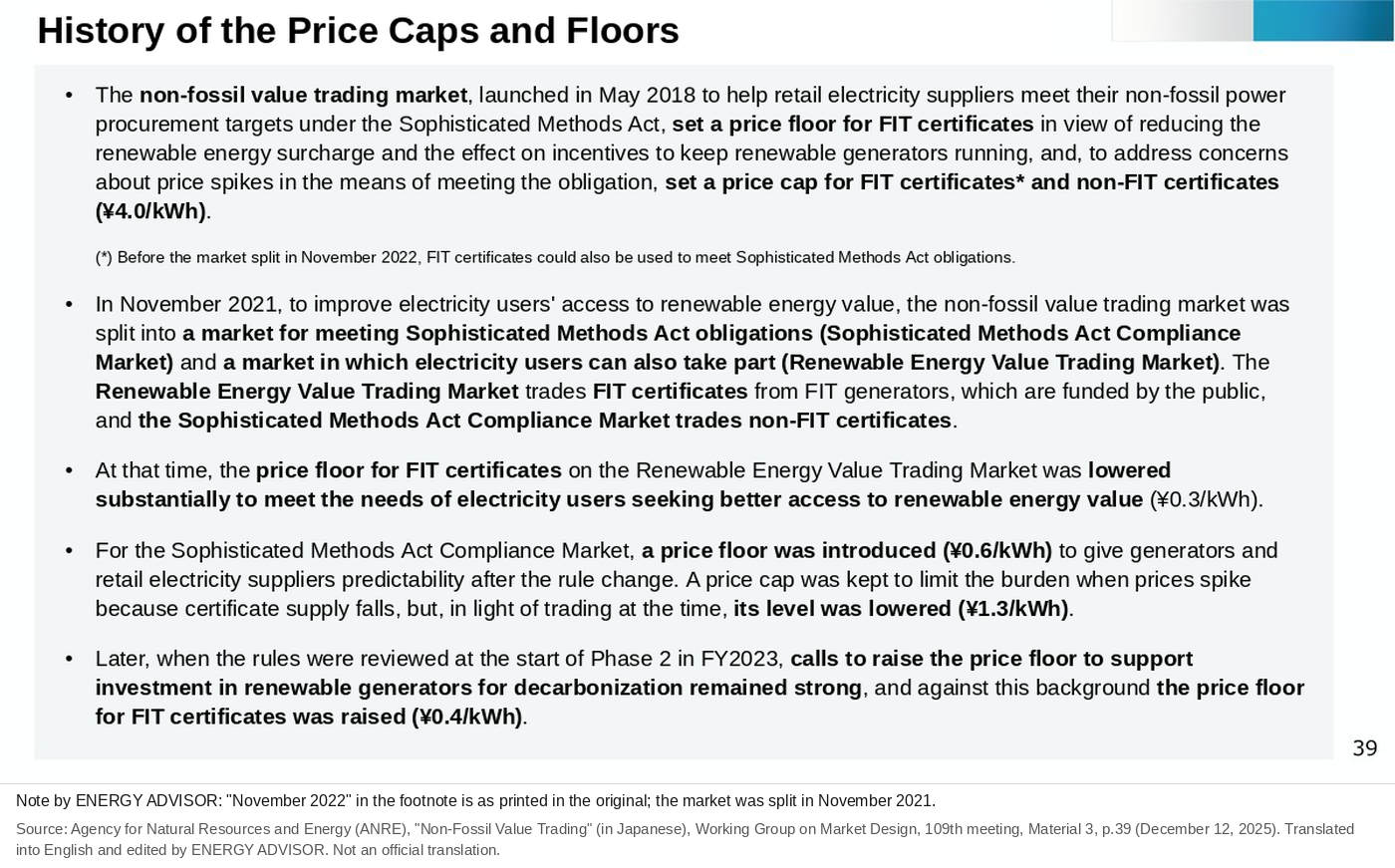
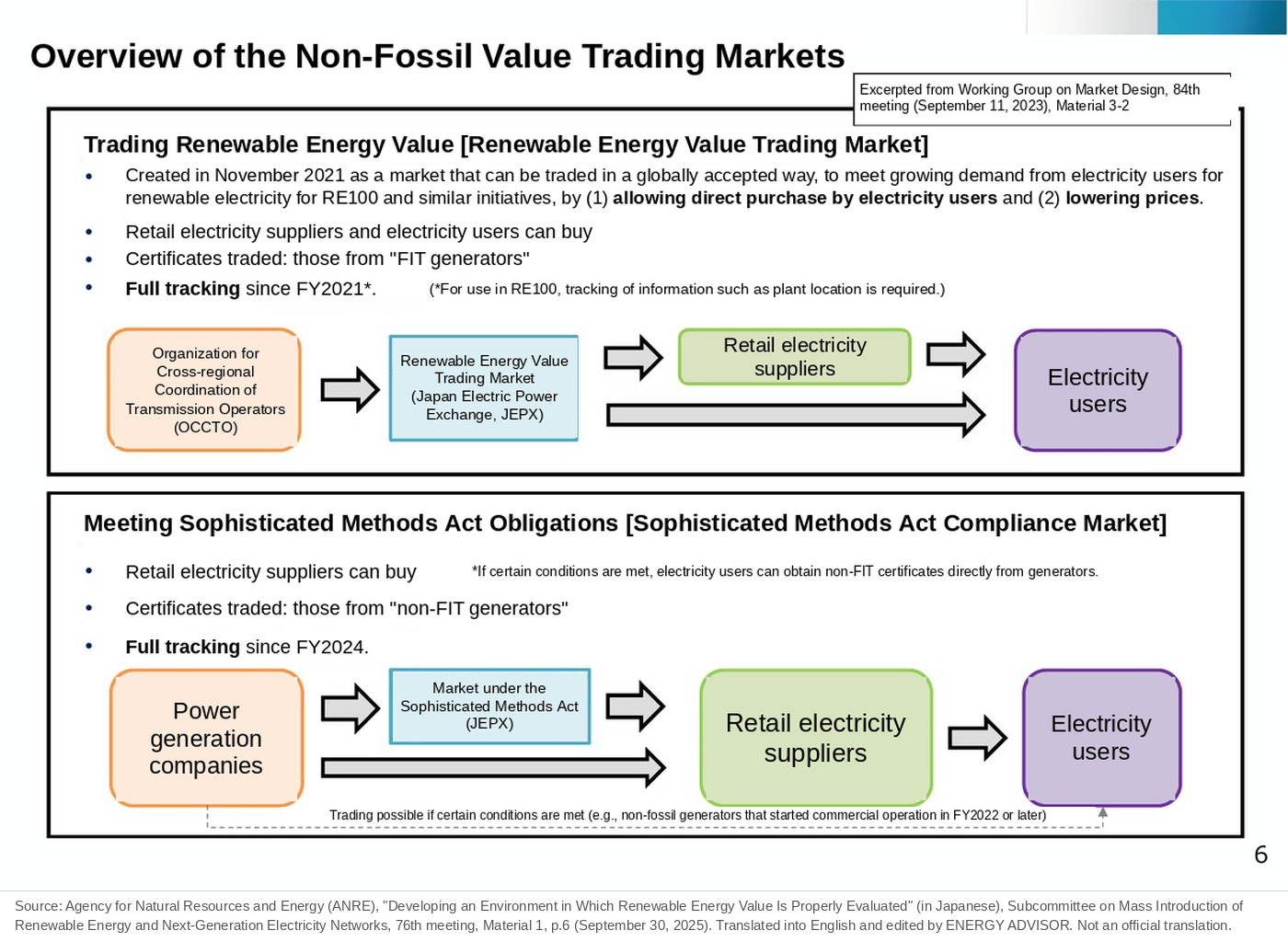
Later, demand from electricity users for renewable electricity, such as under RE100, grew. In response, the Renewable Energy Value Trading Market was created in November 2021 as a market where certificates can be traded in an internationally accepted form, by (1) allowing electricity users to buy directly and (2) lowering prices. This created the following two-market structure:
- Renewable Energy Value Trading Market: a market that allows direct purchase by electricity users and meets international demand for renewable procurement
- Sophisticated Methods Act Compliance Market: a market that takes over the function of the previous market, aimed at meeting statutory targets
With this two-market structure, participants with different needs can trade certificates on the market that suits them.
Renewable Energy Value Trading Market: FIT Certificates and Electricity Users
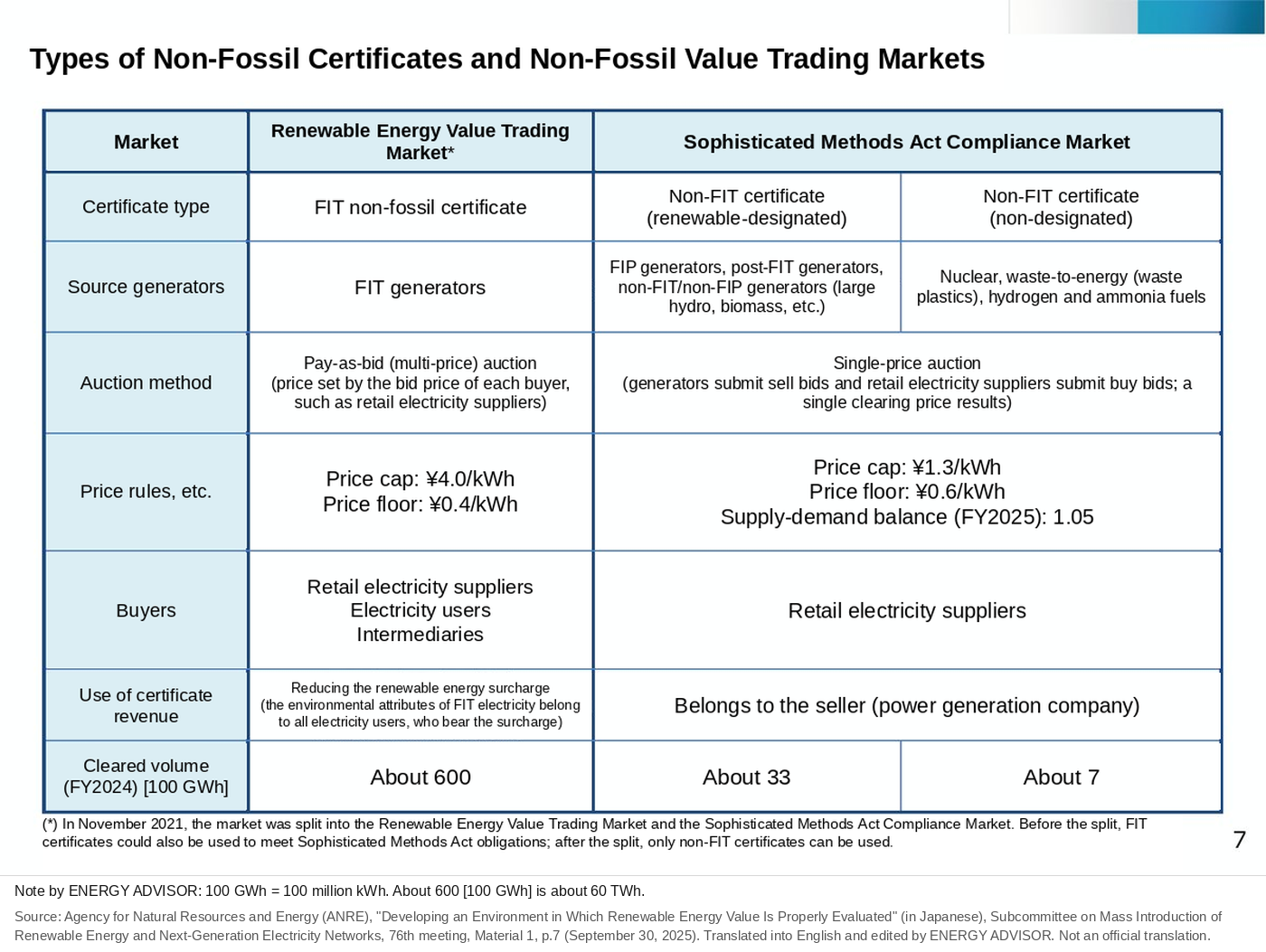
The Renewable Energy Value Trading Market trades non-fossil certificates from renewable generation certified under the FIT scheme. A major feature of this market is that not only retail electricity suppliers but also electricity users and intermediaries can participate directly. This allows electricity users seeking to meet RE100 requirements or corporate sustainability targets to buy certificates directly.
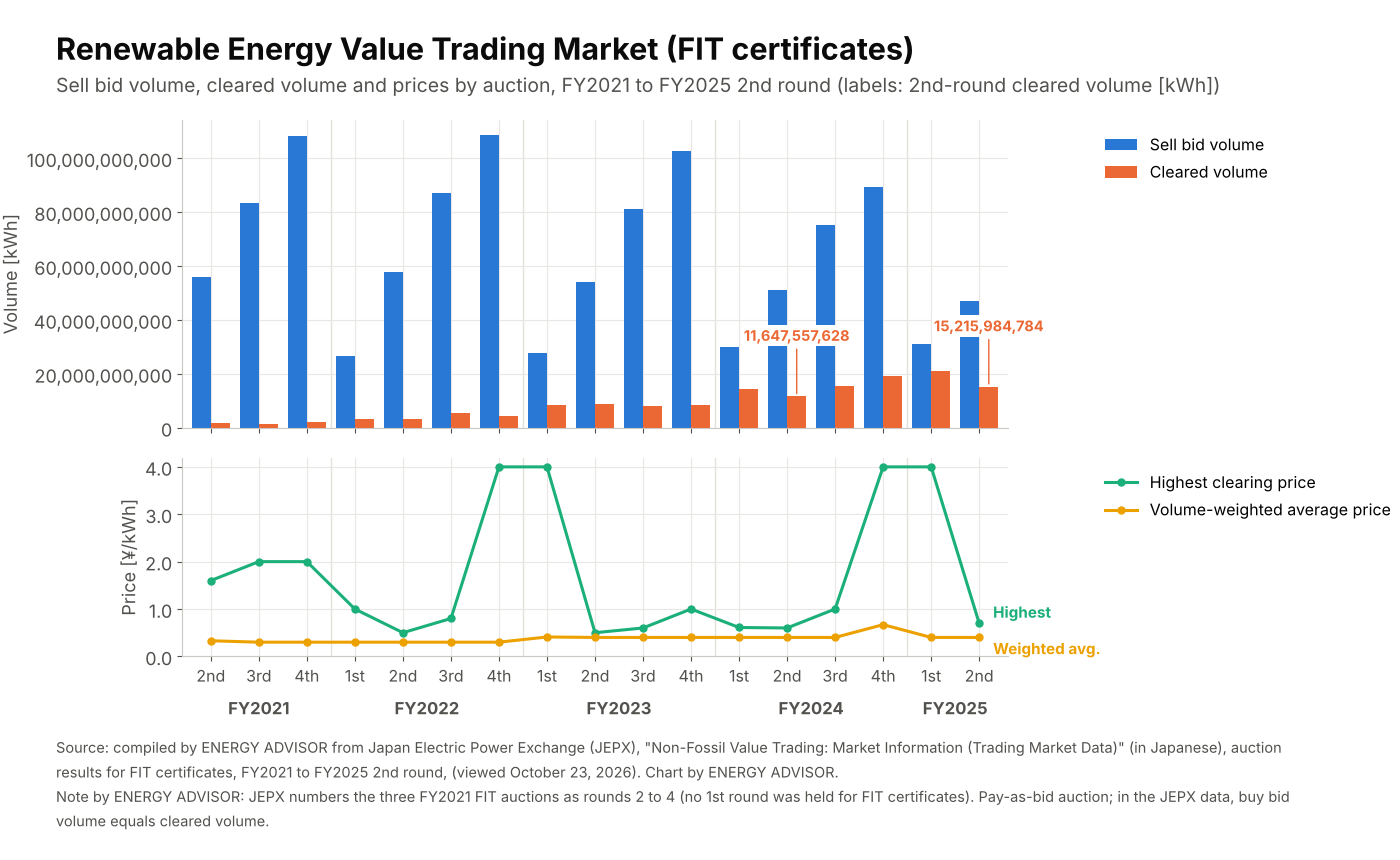
The auction format is a pay-as-bid (multi-price) auction, in which each winning buyer trades at the price it bid.
Auctions on the Renewable Energy Value Trading Market are held four times a year, in late August, November, February and May.
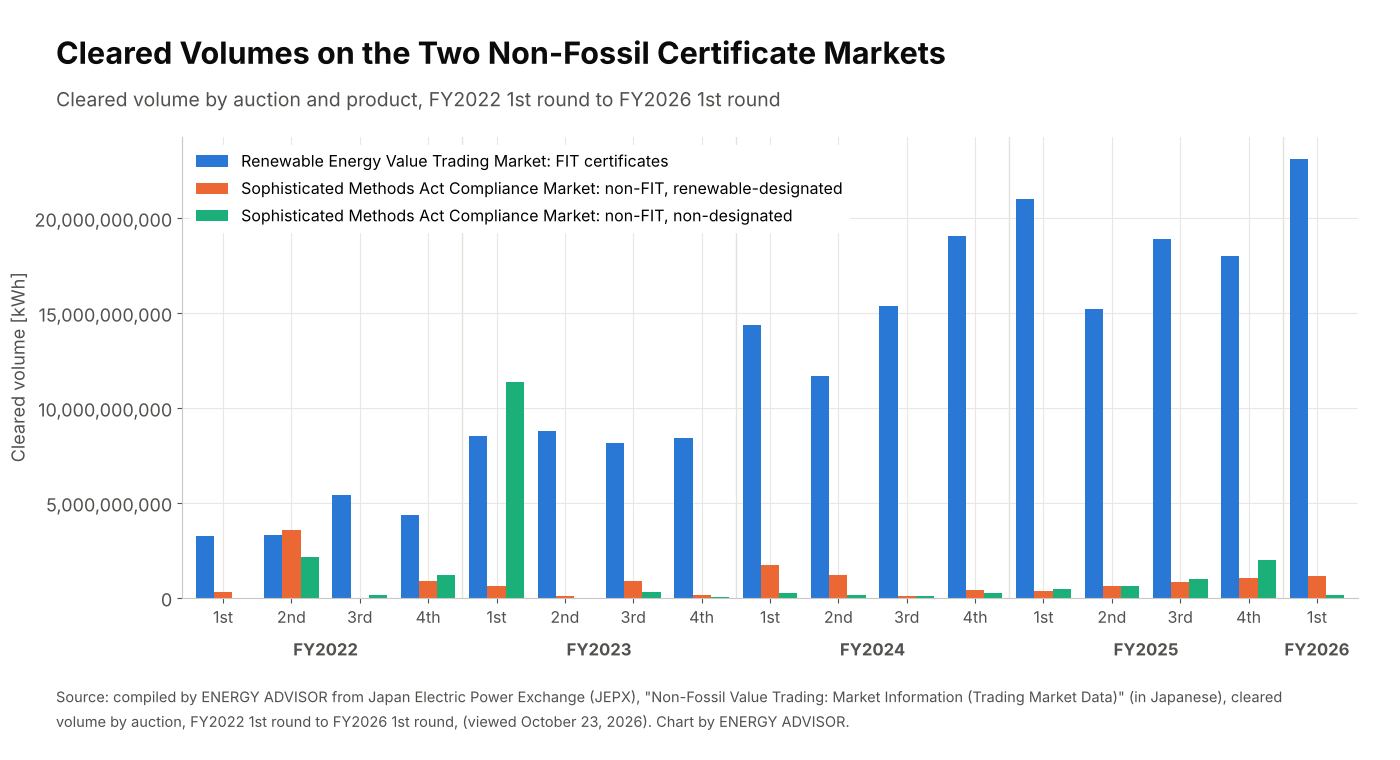
In cleared volume, the 2nd auction of FY2024 (November 2024) cleared 11.6 TWh, the 1st round of FY2025 (August 2025) 21.0 TWh, and the 2nd round of FY2025 (November 2025) 15.2 TWh, about 30% more than the 2nd round of the previous fiscal year. The 1st round of FY2026 (August 2026) cleared about 23.1 TWh (JEPX market data). (Japan’s fiscal year runs from April to March; FY2026 is April 2026–March 2027.)
The account transfer deadline for FY2026 certificates is June 25, 2027. Because buyers must confirm how they will use purchased certificates by this date, they should note that the processing period is short, especially when buying in the May auction.
Sophisticated Methods Act Compliance Market: Trading Non-FIT Certificates
The Sophisticated Methods Act Compliance Market is the market for meeting the non-fossil power ratio targets for retail electricity suppliers set by the Sophisticated Methods Act. Buyers on this market are, in principle, limited to retail electricity suppliers; electricity users and intermediaries cannot buy non-FIT certificates.
The market trades “non-FIT non-fossil certificates.” These are certificates from renewable generation not certified under the FIT scheme (post-FIT generators, large hydropower, FIP generators, etc.) and from other non-fossil generators such as nuclear power and waste-to-energy using waste plastics. Non-FIT non-fossil certificates are further divided into “renewable-designated” and “non-designated” (see article 15 in this series).
This market uses a single-price auction. Generators place sell bids and retail electricity suppliers place buy bids, resulting in one clearing price.
Cleared volumes on the Sophisticated Methods Act Compliance Market are smaller than on the Renewable Energy Value Trading Market. In FY2025, renewable-designated and non-designated certificates together cleared about 6.9 TWh over four rounds, and in the 1st round of FY2026, renewable-designated certificates cleared about 1.14 TWh and non-designated about 0.11 TWh (compiled from JEPX market data; FIT certificates cleared about 73.1 TWh over the four FY2025 rounds). Even so, its role as a procurement channel for retail electricity suppliers to meet their statutory obligations remains important.
Comparing the Two Markets: Certificates, Participants and Auction Method
| Item | Renewable Energy Value Trading Market | Sophisticated Methods Act Compliance Market |
|---|---|---|
| Certificates traded | FIT non-fossil certificates | Non-FIT non-fossil certificates (renewable-designated and non-designated) |
| Seller | OCCTO (Organization for Cross-regional Coordination of Transmission Operators, JAPAN: the national body that coordinates supply and demand and other matters across Japan). Entire volume of environmental attributes of FIT electricity | Generators |
| Buyers | Retail electricity suppliers, electricity users, intermediaries | In principle, retail electricity suppliers |
| Auction method | Pay-as-bid (multi-price) auction | Single-price auction |
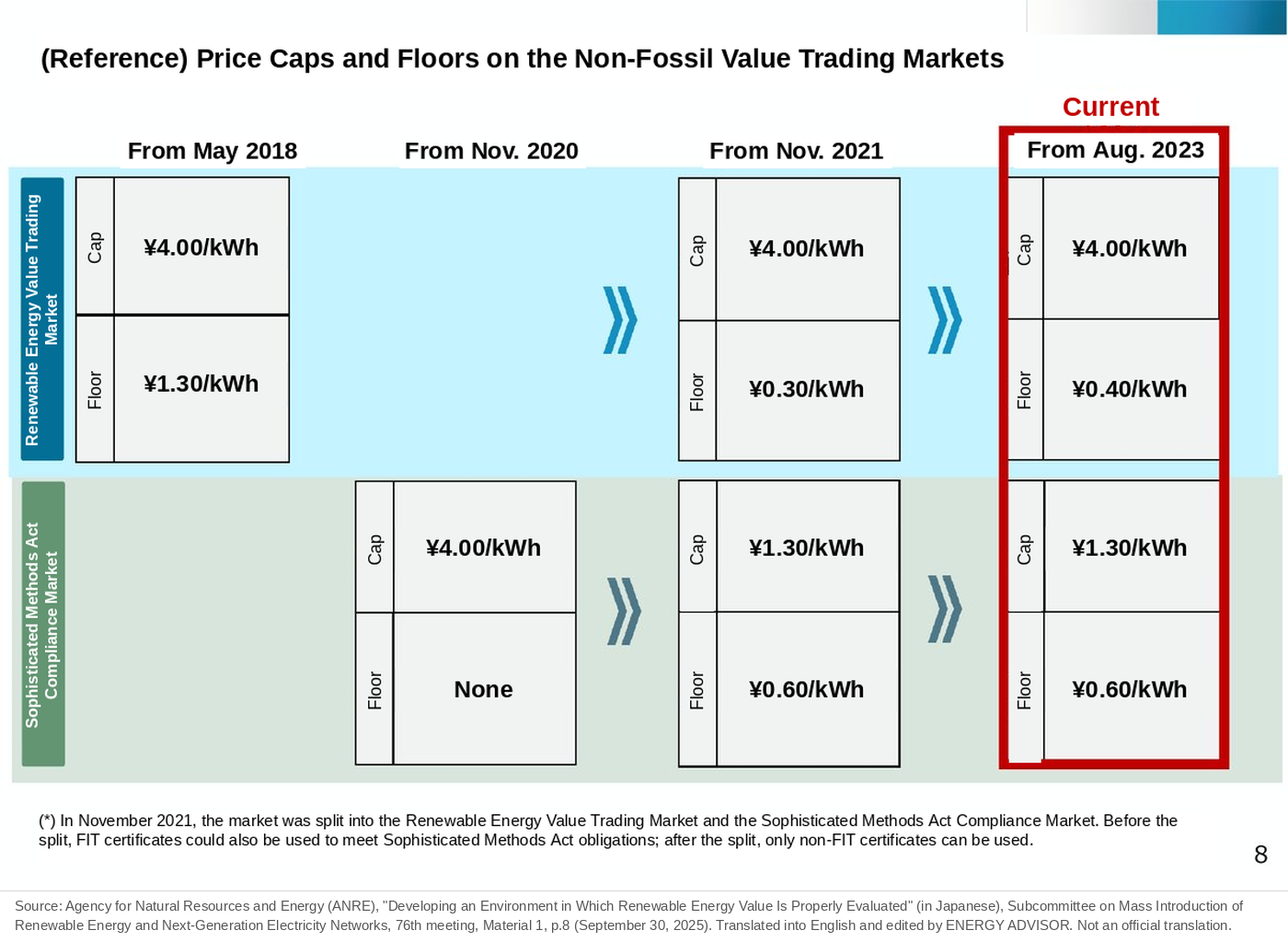
| Price cap and floor | ¥4.00 and ¥0.40/kWh | ¥1.30 and ¥0.60/kWh |
| Auction frequency | Four times a year (August, November, February, May) | Four times a year (August, November, February, May) |
| Account transfer deadline | June 25, 2027, for FY2026 certificates | June 25, 2027, for FY2026 certificates |
| Main purpose | RE100, corporate sustainability targets, renewable procurement by electricity users | Retail electricity suppliers meeting Sophisticated Methods Act targets |
The two markets differ substantially in their basic elements: the certificates traded, the participants and the auction method.
Structural Change from Electricity Users’ Participation
Allowing electricity users to participate directly in the Renewable Energy Value Trading Market brought a major structural change to Japan’s non-fossil certificate market. Whereas certificates had mainly been obtained indirectly through retail electricity suppliers, electricity users can now take part in auctions directly and obtain certificates that fit their own sustainability strategies.
All non-fossil certificate auctions are conducted through the Japan Electric Power Exchange (JEPX). As market operator, JEPX runs the auctions, manages clearing data and monitors market participants. The results of every auction are published on JEPX’s website.
Summary: Roles of the Two Markets
With the November 2021 restructuring, the non-fossil certificate market was split into the Renewable Energy Value Trading Market and the Sophisticated Methods Act Compliance Market. On the Renewable Energy Value Trading Market, FIT non-fossil certificates are traded in a pay-as-bid (multi-price) auction, and electricity users can participate directly. On the Sophisticated Methods Act Compliance Market, non-FIT non-fossil certificates are traded in a single-price auction, and buyers are, in principle, retail electricity suppliers.
Clearing results show that cleared volume on the Renewable Energy Value Trading Market is growing. To plan their procurement, retail electricity suppliers and electricity users need to understand the details, including the characteristics of both markets, the auction schedule and the account transfer deadline.
This article is based on published materials from the Ministry of Economy, Trade and Industry and its Agency for Natural Resources and Energy, the Electricity and Gas Market Surveillance Commission, the Organization for Cross-regional Coordination of Transmission Operators (OCCTO) and other sources. The English translations of figures are by ENERGY ADVISOR and are not official translations. When using this information for decisions, please check the original sources. When we find an error, we correct the article and note the date of the correction.
Sources
- Japan Electric Power Exchange (JEPX), “FY2026 Non-Fossil Value Trading Market Schedule” (in Japanese), June 25, 2026. https://www.jepx.jp/nonfossil/outline/pdf/market/nf_calendar2026.pdf
- Agency for Natural Resources and Energy (ANRE), Working Group on Market Design, 109th meeting, Material 3, “Non-Fossil Value Trading” (in Japanese), December 12, 2025, p.6 (FIT certificates: FY2025 1st round 21.0 TWh, 2nd round 15.2 TWh; previous year’s 2nd round 11.6 TWh). https://www.meti.go.jp/shingikai/enecho/denryoku_gas/jisedai_kiban/system_review/pdf/109_03_00.pdf
- JEPX, “Non-Fossil Value Trading Market Information (Trading Market Data)” (in Japanese) (five-year display, table view; accessed October 22, 2026): clearing date, cleared volume, clearing price, total sell volume and total buy volume for each round. https://www.jepx.jp/nonfossil/market-data/
- JEPX, “Non-Fossil Value Trading Rules” (in Japanese), Articles 9 and 14 (OCCTO is the seller of FIT certificates), Article 14, Paragraph 3 (members that are electricity users cannot buy anything other than FIT certificates), Article 15 (auction methods). https://www.jepx.jp/nonfossil/outline/pdf/nonfossil_rules.pdf
- JEPX, “Price Limits for Non-Fossil Value Trading” (in Japanese), July 10, 2023. https://www.jepx.jp/nonfossil/outline/pdf/jepx20230710.pdf
- ANRE, Subcommittee on Mass Introduction of Renewable Energy and Next-Generation Electricity Networks, 76th meeting, Material 1, “Developing an Environment in Which Renewable Energy Value Is Properly Evaluated” (in Japanese), September 30, 2025, p.6 (reasons for creating the market in November 2021), p.8 (chart of price caps and floors over time). https://www.meti.go.jp/shingikai/enecho/denryoku_gas/saisei_kano/pdf/076_01_00.pdf
- ANRE, Working Group on Market Design, 109th meeting, Material 3, “Non-Fossil Value Trading” (in Japanese), December 12, 2025, p.39 (history of price caps and floors: market launch in May 2018, market split in November 2021). https://www.meti.go.jp/shingikai/enecho/denryoku_gas/jisedai_kiban/system_review/pdf/109_03_00.pdf
- Year of the market split: the body text on p.39 and the note on p.40 of the 109th meeting, Material 3 (reproducing the 76th Subcommittee meeting, Material 1, p.8) say “November 2021,” while the notes on pp.39 and 44 say “November 2022.” Because JEPX’s FY2021 schedule shows FIT certificates traded in November 2021, this article uses November 2021.