A FIT non-fossil certificate turns the environmental attributes of renewable electricity covered by the Feed-in Tariff (FIT) scheme into a certificate. It plays an important role as a way for companies to meet their decarbonization targets. Since the market split in November 2021, FIT certificates cannot be used to meet obligations under the Sophisticated Methods Act (see article 12 in this series). The exception is “substitute procurement” in years when non-FIT certificates are in short supply (Subcommittee on Mass Introduction of Renewable Energy and Next-Generation Electricity Networks, Material 1, p.7). Since FY2021 (April 2021–March 2022), all FIT certificates have carried tracking information (information about the power plant), so attributes such as the plant’s location and type of source can be identified.
This article explains how FIT non-fossil certificates work, how their prices on the trading market have moved, and how companies use them.
Key points
- 1FIT non-fossil certificates are issued from five renewable sources, including solar and wind, and traded in auctions held four times a year.
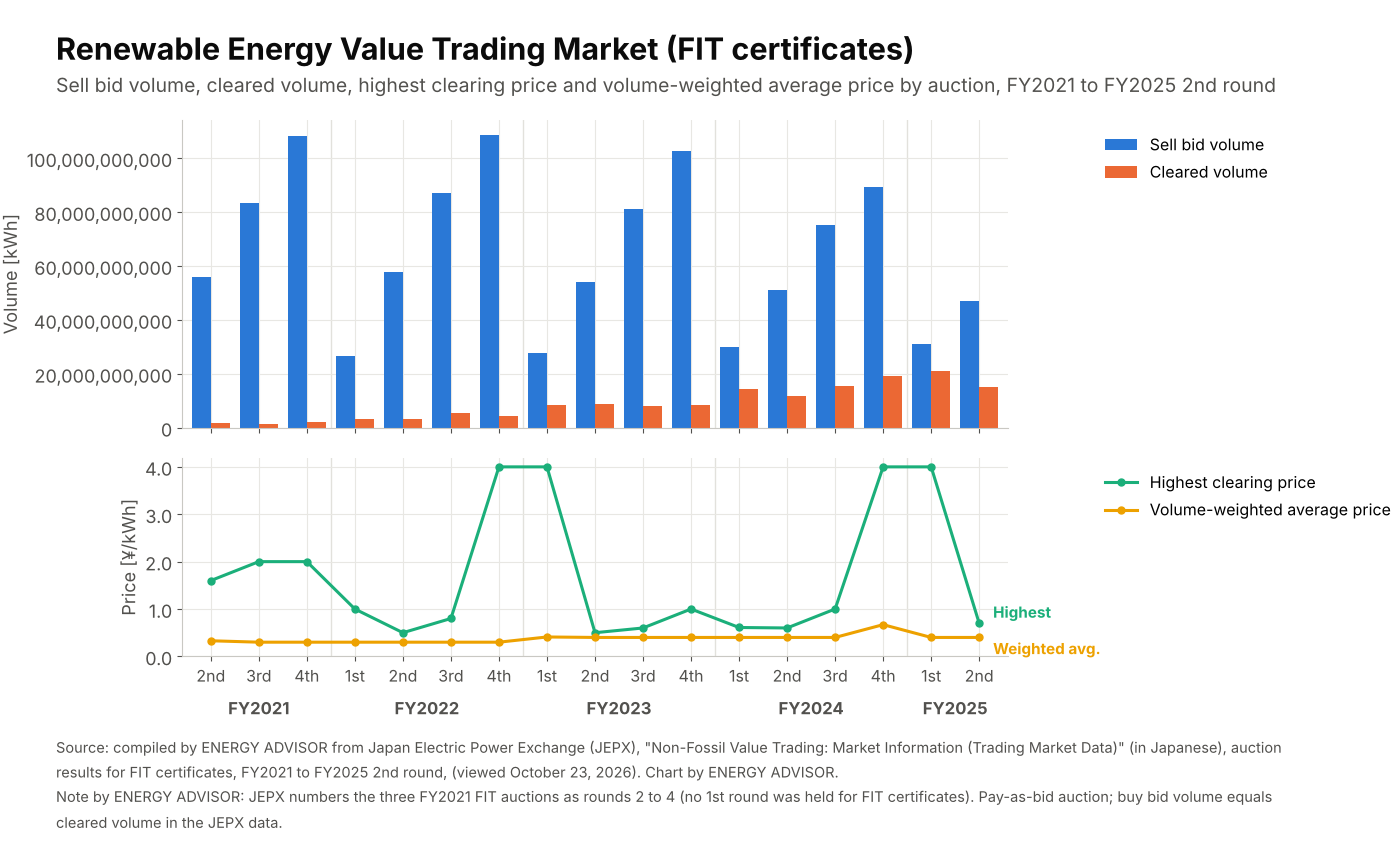
- 2The minimum bid price has been ¥0.4/kWh since FY2023. Because sell volume far exceeds buy volume, the volume-weighted average price stays near the ¥0.4 floor.
- 3Certificates with tracking information are used by companies, for example to meet the requirements of RE100 (an international initiative of companies aiming to source 100% of the electricity they use from renewables).
What a FIT Non-Fossil Certificate Is
A FIT non-fossil certificate is a certificate for the environmental attributes of renewable electricity purchased under the Feed-in Tariff (FIT) scheme. Since the FIT scheme began in Japan in 2012, solar power and other sources have grown rapidly, and this certificate makes their environmental attributes tradable.
FIT non-fossil certificates are the most widely traded type of non-fossil certificate. Looking at cleared volumes in FY2025, FIT certificates totaled about 73.1 TWh over the four auctions, while the two types of non-FIT certificates together totaled about 6.9 TWh (compiled from JEPX market data).
Source Generators
Five types of sources are covered: solar, wind, hydropower, geothermal and biomass. All are covered by the FIT scheme, and their electricity is purchased by general transmission and distribution companies (GT&D companies: the ten regulated regional companies that operate the grid in each area) at purchase prices set by the government.
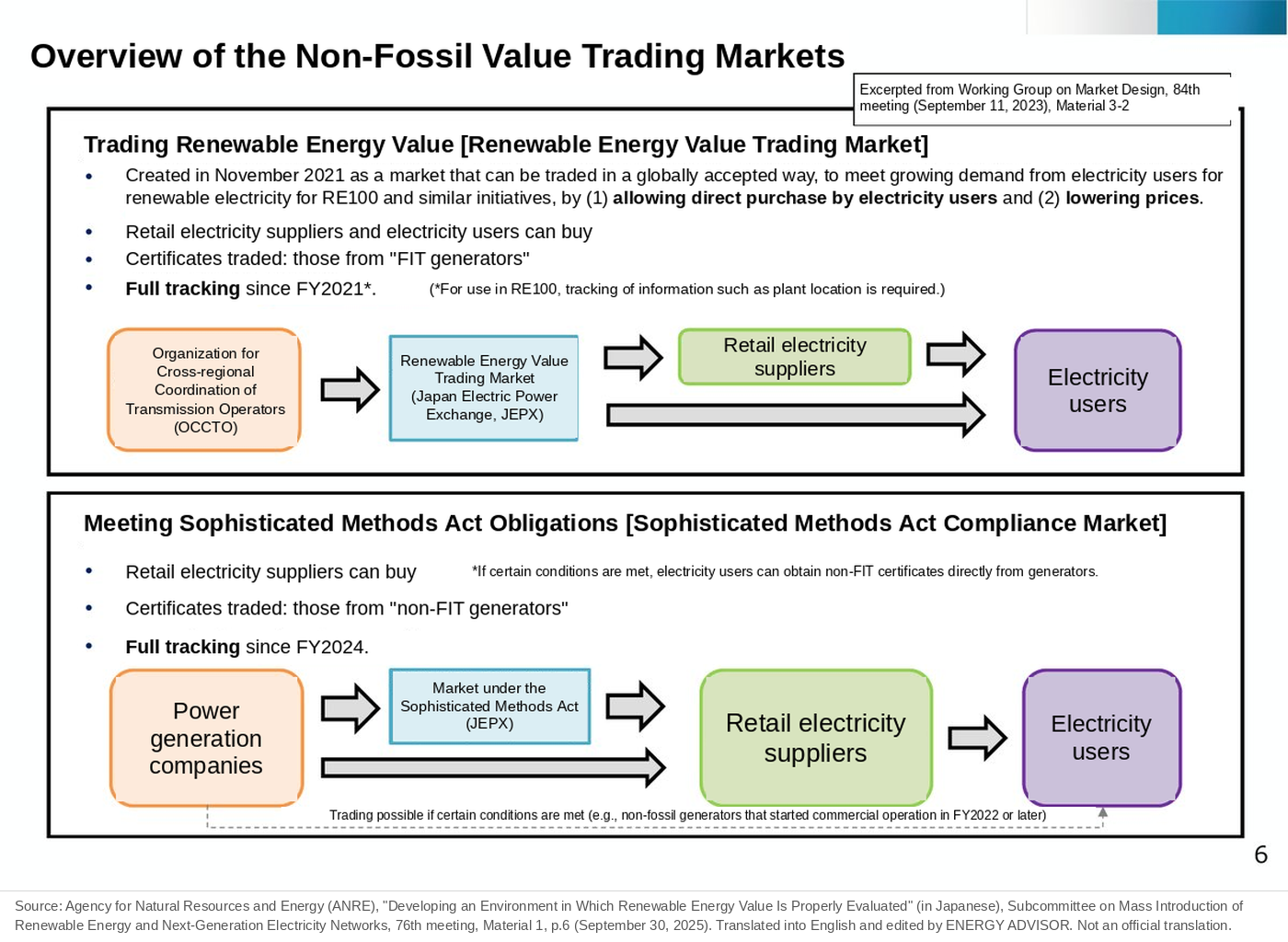
When electricity from FIT generators is purchased, its environmental attributes do not belong to the generator. The cost of purchasing FIT electricity is covered by the renewable energy surcharge (a charge that every electricity user pays in proportion to the electricity they use), so the environmental attributes are treated as belonging to electricity users as a whole, who bear the surcharge. The entire volume of these environmental attributes certified by the Organization for Cross-regional Coordination of Transmission Operators, JAPAN (OCCTO) becomes certificates, and OCCTO acts as the seller on the market. The sales revenue is used to reduce the burden of the renewable energy surcharge.
Four Auctions a Year and Eligible Participants
FIT non-fossil certificates are traded on the Renewable Energy Value Trading Market operated by the Japan Electric Power Exchange (JEPX), Japan’s only wholesale power exchange. There are two non-fossil certificate markets: FIT certificates are traded on this market, and non-FIT certificates on the Sophisticated Methods Act Compliance Market (see article 17 in this series).
Auctions are held four times a year. The FY2026 schedule is as follows.
| Round | Bidding period for FIT certificates | Clearing date |
|---|---|---|
| 1st | August 25–31, 2026 | August 31 |
| 2nd | November 24–30, 2026 | November 30 |
| 3rd | February 19–26, 2027 | February 26 |
| 4th | May 17–21, 2027 | May 21 |
The account transfer deadline for FY2026 certificates is June 25, 2027.
Participation is limited to JEPX’s non-fossil value trading members. Membership is open to corporations in Japan: retail electricity suppliers, power generation companies and transmission and distribution companies, as well as other corporations (electricity users and intermediaries). Electricity users, in principle, use only the FIT certificate market. Membership requires an entry fee of ¥100,000 and an annual fee set for each fiscal year (¥600,000 for FY2026). The trading fee is ¥0.001/kWh (excluding tax, FY2026). FIT certificates bought on JEPX may be resold only to corporations.
Retail electricity suppliers buy certificates to supply their customers with electricity as renewable power. Electricity users buy them to meet their own CO2 reduction targets or RE100 requirements.
Price Formation and Recent Clearing Results
The auction uses the pay-as-bid (multi-price) auction method. The seller (OCCTO) places sell bids for the entire volume with no price condition, and buyers place buy bids specifying price and volume. Buy bids are cleared in descending order of price up to the sell volume, and each cleared bid pays its own bid price.
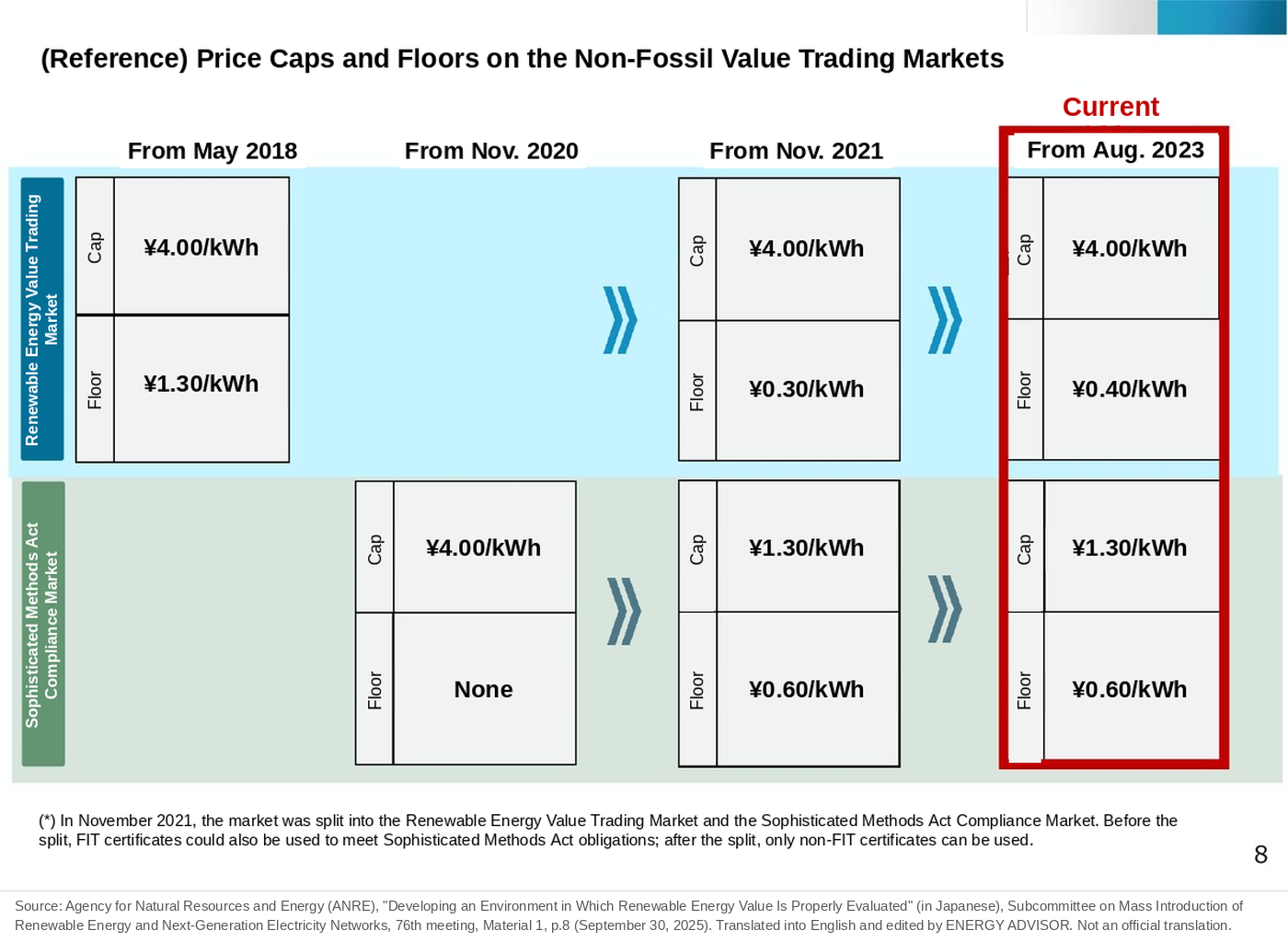
Prices have a cap and a floor. The price floor was ¥0.30/kWh from October 28, 2021, and has been ¥0.40/kWh since July 10, 2023. The price cap is ¥4.00/kWh.
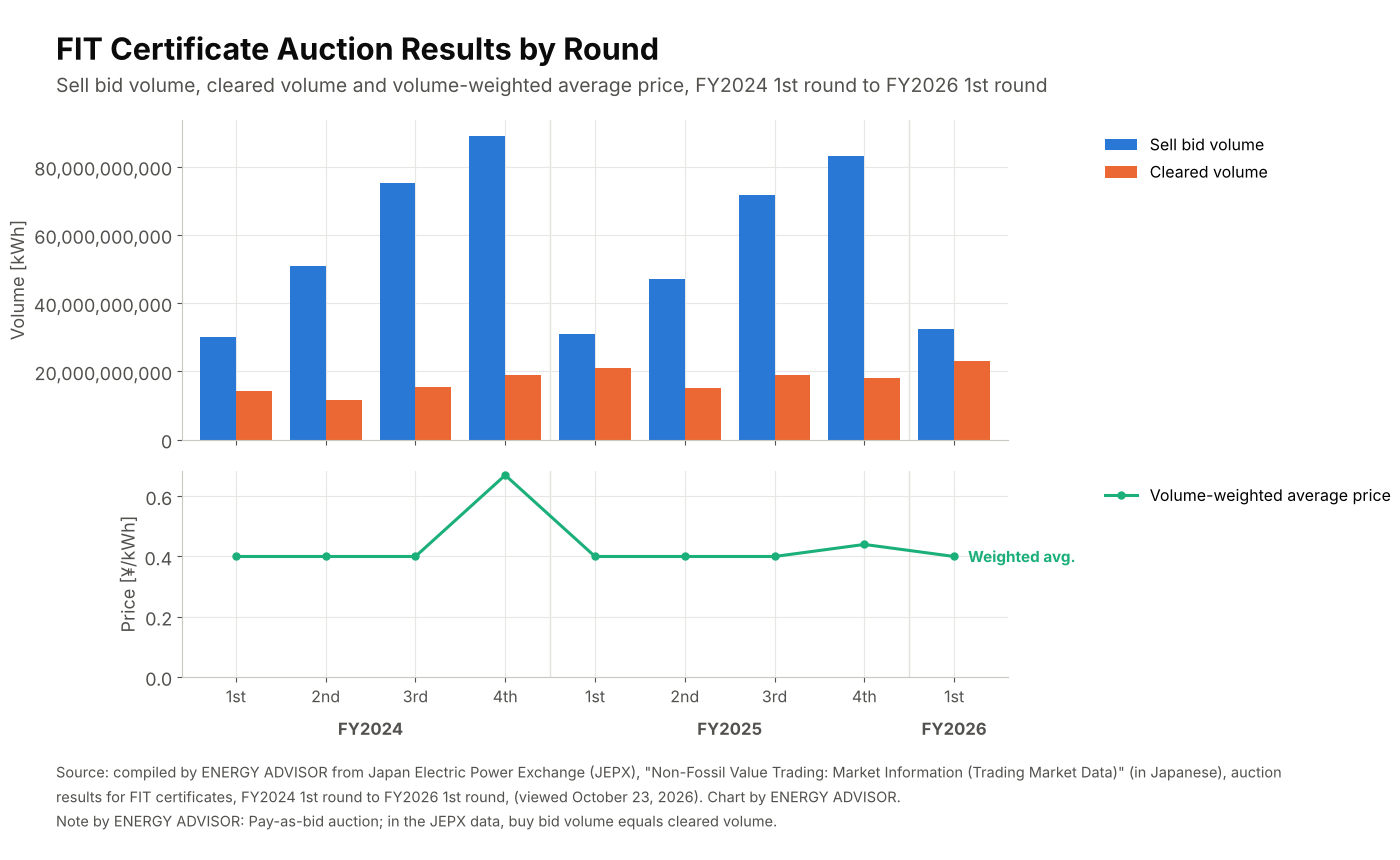
Clearing results since FY2024 are shown below. The clearing price is the average weighted by cleared volume. Figures are from JEPX market data.
| Round | Clearing date | Sell volume (TWh) | Cleared volume (TWh) | Weighted average (¥/kWh) | Highest (¥/kWh) |
|---|---|---|---|---|---|
| FY2024 1st | August 30, 2024 | 30.09 | 14.38 | 0.40 | 0.61 |
| FY2024 2nd | November 29, 2024 | 50.98 | 11.65 | 0.40 | 0.60 |
| FY2024 3rd | February 28, 2025 | 75.23 | 15.34 | 0.40 | 1.00 |
| FY2024 4th | May 23, 2025 | 89.13 | 19.07 | 0.67 | 4.00 |
| FY2025 1st | August 29, 2025 | 30.89 | 20.98 | 0.40 | 4.00 |
| FY2025 2nd | November 28, 2025 | 47.19 | 15.22 | 0.40 | 0.70 |
| FY2025 3rd | February 27, 2026 | 71.79 | 18.88 | 0.40 | 4.00 |
| FY2025 4th | May 22, 2026 | 83.18 | 18.00 | 0.44 | 4.00 |
| FY2026 1st | August 31, 2026 | 32.41 | 23.12 | 0.40 | 4.00 |
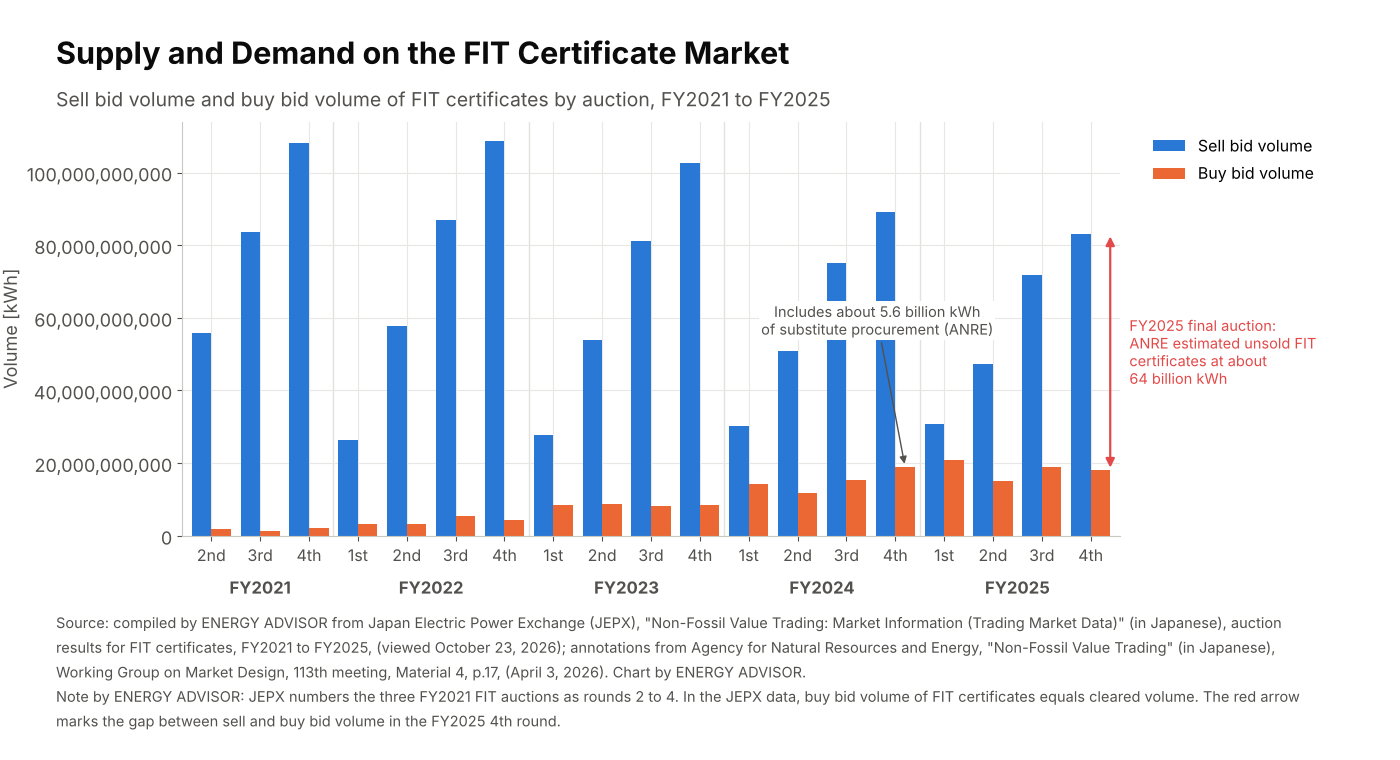
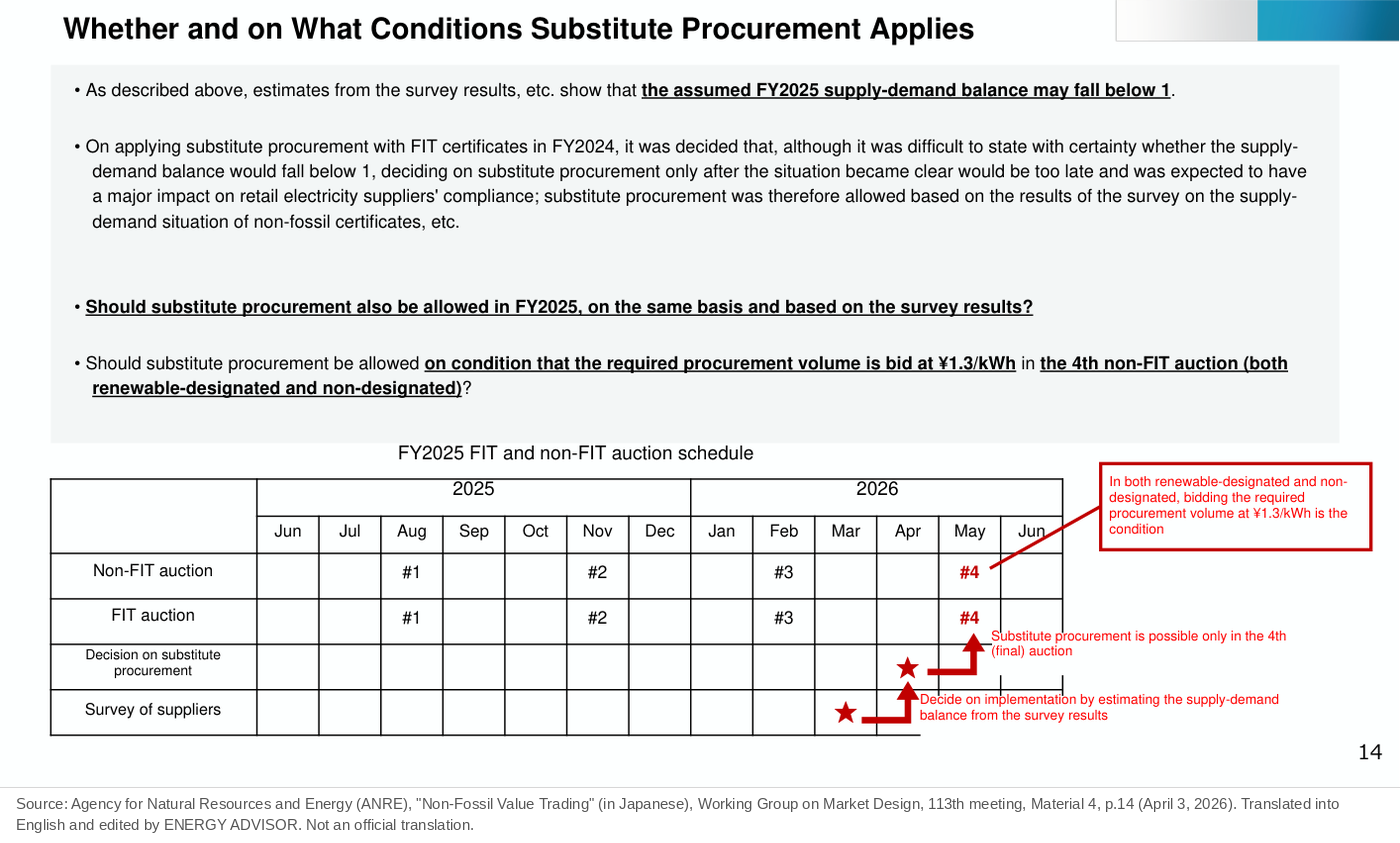
For FIT certificates, the entire buy volume has cleared in every round, and much of the sell volume has gone unsold. Sell volume has grown round by round. An Agency for Natural Resources and Energy (ANRE) document estimates the unsold volume in the final FY2025 auction at about 64 TWh (113th meeting, Material 4, p.17); unsold volume carries over to later rounds within the fiscal year. Cleared volume has grown, but sell volume is far larger, so the weighted average price stays near the ¥0.4/kWh floor. The FY2024 4th round (¥0.67) was the round in which buy bids included about 5.6 TWh of “substitute procurement,” in which retail electricity suppliers short of non-FIT certificates meet their obligations with FIT certificates. The price for substitute procurement in FY2024 was set at or above the price cap of the non-FIT market (¥1.3/kWh). For FY2025, a draft proposes a price of ¥1.3/kWh or more “in the same way as FY2024” (Working Group on Market Design, 113th meeting, Material 4, p.16; see article 18 in this series).
Uses of Certificates with Tracking
Since FY2021, all FIT non-fossil certificates have carried tracking information (all non-FIT certificates since FY2024). Tracking information is attribute information showing “when, where and from what” the electricity was generated, such as the type and location of the generating facility.
This is important for meeting the requirements of international decarbonization initiatives. RE100 in particular (an international initiative of companies aiming to source 100% of the electricity they use from renewables) requires certificates that identify the power plant, and limits eligibility to plants within 15 years of commissioning (or repowering) (RE100 technical criteria; introduced in the 2022 revision and retained in the 5th edition of March 2025). This “within 15 years” criterion is based on the idea of encouraging investment in new renewables (additionality). Exceptions include self-generation and the first buyer to sign a long-term contract with a new plant. Separately, up to 15% of total electricity consumption may be sourced in ways that do not meet the 15-year condition (RE100 technical criteria, 5th edition, §5.4.2).
In a buy bid, the following items can be specified as conditions for the desired certificates (first and second preferences can be specified):
– Facility ID (to specify a particular power plant)
– Prefecture and municipality of the site
– Generation facility category (main and sub-categories such as solar and wind)
– Commissioned within the last 15 years (for certificates from renewable plants within 15 years of commissioning)
In November 2024, JEPX changed the label of this last item from “RE100” to “commissioned within the last 15 years,” because the old label could be misleading. The more detailed the conditions, the fewer certificates qualify.
Purchase Procedure
The steps to buy FIT non-fossil certificates are as follows.
- Become a JEPX non-fossil value trading member (pay the entry fee and annual fee).
- During the bidding period of one of the four annual auctions, place a buy bid specifying price, volume and desired attributes.
- Once the bid clears, settle the payment and fees.
- Confirm how the certificates will be used (own use or resale) and have them issued as certificates (Non-Fossil Value Trading System User Guide, pp.12–18). Certificates must be processed by the account transfer deadline.
Companies can also buy through intermediaries or retail electricity suppliers without becoming JEPX members.
Summary: Using FIT Non-Fossil Certificates
FIT non-fossil certificates link Japan’s renewable energy policy with companies’ decarbonization targets. They are issued from five renewable sources, including solar and wind, and traded in auctions held four times a year. Tracking information makes it easier for companies to meet international frameworks such as RE100.
When considering FIT non-fossil certificates, the key is to work out three things in advance: (1) the balance between purchase volume and targets, (2) how to choose tracking attributes (whether to specify “commissioned within the last 15 years”), and (3) a purchase plan aligned with the four-auction schedule.
This article is based on published materials from the Ministry of Economy, Trade and Industry and its Agency for Natural Resources and Energy, the Electricity and Gas Market Surveillance Commission, the Organization for Cross-regional Coordination of Transmission Operators (OCCTO) and other sources. The English translations of figures are by ENERGY ADVISOR and are not official translations. When using this information for decisions, please check the original sources. When we find an error, we correct the article and note the date of the correction.
Sources
- Japan Electric Power Exchange (JEPX), “FY2026 Non-Fossil Value Trading Market Schedule” (in Japanese), June 25, 2026. https://www.jepx.jp/nonfossil/outline/pdf/market/nf_calendar2026.pdf
- JEPX, “Price Limits for Non-Fossil Value Trading” (in Japanese), October 28, 2021 (FIT certificate price floor ¥0.30/kWh, price cap ¥4.00/kWh). https://www.jepx.jp/nonfossil/outline/pdf/jepx20211028.pdf
- JEPX, “Price Limits for Non-Fossil Value Trading” (in Japanese), July 10, 2023 (FIT certificate price floor ¥0.40/kWh). https://www.jepx.jp/nonfossil/outline/pdf/jepx20230710.pdf
- Agency for Natural Resources and Energy (ANRE), Working Group on Market Design, 109th meeting, Material 3, “Non-Fossil Value Trading” (in Japanese), December 12, 2025, p.6 (FIT certificates, FY2025 2nd round: sell volume 47.2 TWh, cleared 15.2 TWh; 1st round 21.0 TWh; previous year’s 2nd round 11.6 TWh), p.41 (weighted average price near the ¥0.4 floor except in the FY2024 4th round, which included substitute procurement). https://www.meti.go.jp/shingikai/enecho/denryoku_gas/jisedai_kiban/system_review/pdf/109_03_00.pdf
- JEPX, “Non-Fossil Value Trading Market Information (Trading Market Data)” (in Japanese) (five-year display, table view; accessed October 22, 2026): clearing date, cleared volume, clearing price, total sell volume and total buy volume for each round. https://www.jepx.jp/nonfossil/market-data/
- JEPX, “Non-Fossil Value Trading: Overview” (in Japanese) (FY2026 annual fee ¥600,000 [not subject to consumption tax]; trading fee ¥0.001/kWh [excluding tax]; accessed October 22, 2026). https://www.jepx.jp/nonfossil/outline/
- JEPX, “Non-Fossil Value Trading Rules” (in Japanese), Article 8 (FIT certificates bought on JEPX may be resold only to corporations), Articles 9 and 14 (OCCTO is the seller), Article 15 (pay-as-bid auction). https://www.jepx.jp/nonfossil/outline/pdf/nonfossil_rules.pdf
- RE100, “RE100 technical criteria,” 5th edition (published March 24, 2025), §5.4.2 (pp.17–18: the limit of 15 years from commissioning or repowering, and its exceptions [self-generation, direct physical PPAs not using the grid, the original off-taker that signs a long-term contract with a new project, contracts for plants commissioned before January 1, 2024, etc.], and the exemption for up to 15% of total electricity consumption). https://www.theclimategroup.org/hubfs/RE100/PDFs/RE100%20technical%20criteria%20+%20appendices%20(15%20April%202025).pdf
- JEPX, “Non-Fossil Value Trading Membership Rules” (in Japanese), Article 2 (eligibility), Article 5 (entry fee of ¥100,000 and annual fee). https://www.jepx.jp/nonfossil/outline/pdf/nonfossil_memb_rules.pdf
- JEPX, “Non-Fossil Value Trading System User Guide” (in Japanese) (revised July 14, 2026), revision history (“RE100” renamed “commissioned within the last 15 years” on November 8, 2024), p.3 (electricity users in principle use only the FIT market), p.7 (buy-bid condition items), pp.12–18 (certificate issuance). https://www.jepx.jp/nonfossil/outline/pdf/Guide_NF.pdf
- ANRE, Subcommittee on Mass Introduction of Renewable Energy and Next-Generation Electricity Networks, 76th meeting, Material 1, “Developing an Environment in Which Renewable Energy Value Is Properly Evaluated” (in Japanese), September 30, 2025, note on p.7 (after the market split in November 2021, only non-FIT certificates can be used to meet Sophisticated Methods Act obligations), p.6 (full tracking for FIT certificates since FY2021 and for non-FIT certificates since FY2024), p.7 (revenue reduces the renewable energy surcharge). https://www.meti.go.jp/shingikai/enecho/denryoku_gas/saisei_kano/pdf/076_01_00.pdf
- ANRE, Working Group on Market Design, 109th meeting, Material 3, “Non-Fossil Value Trading” (in Japanese), December 12, 2025, p.44 (after the market split, FIT certificates cannot be used to meet Sophisticated Methods Act obligations). https://www.meti.go.jp/shingikai/enecho/denryoku_gas/jisedai_kiban/system_review/pdf/109_03_00.pdf
- ANRE, Working Group on Market Design, 113th meeting, Material 4, “Non-Fossil Value Trading” (in Japanese), April 3, 2026, p.16 (the FY2024 substitute procurement price was set at or above the non-FIT cap of ¥1.3/kWh, with a draft to do the same in FY2025), p.17 (estimated unsold FIT certificates of about 64 TWh in the final FY2025 auction; buy bids in the FY2024 4th round included about 5.6 TWh of substitute procurement). https://www.meti.go.jp/shingikai/enecho/denryoku_gas/jisedai_kiban/system_review/pdf/113_04_00.pdf
- ANRE, Working Group on Market Design, 109th meeting, Material 3, “Non-Fossil Value Trading” (in Japanese), December 12, 2025, pp.39–41 (history of price caps and floors; the floor raised to ¥0.4 at the start of the second phase in FY2023). https://www.meti.go.jp/shingikai/enecho/denryoku_gas/jisedai_kiban/system_review/pdf/109_03_00.pdf
- Year of the market split: the body text on p.39 and the note on p.40 of the 109th meeting, Material 3 (reproducing the 76th Subcommittee meeting, Material 1, p.8) say “November 2021,” while the notes on pp.39 and 44 say “November 2022.” Because JEPX’s FY2021 schedule shows FIT certificates traded in November 2021, this article uses November 2021.
- JEPX, “FY2021 Non-Fossil Value Trading Market Schedule” (in Japanese) (no FIT certificate trading in the 1st round [August 2021]; 2nd round November 19–26, 2021). https://www.jepx.jp/nonfossil/outline/pdf/market/nf_calendar2021.pdf