As companies accelerate their push toward carbon neutrality, two mechanisms are drawing attention: “non-fossil certificates” and “PPAs (power purchase agreements).” Both are important for supporting the supply of renewable energy, but their roles differ. This article explains, for corporate energy managers, the purpose of these two mechanisms, how they work, and how they relate to each other.
A non-fossil certificate is “proof of renewables”; a PPA is “a means of securing renewables.” This article explains the difference between the two and how to combine them.
Role of Non-Fossil Certificates
A non-fossil certificate is a certificate proving that electricity comes from non-fossil sources such as renewable energy. Electricity has the same properties whatever source it comes from; a non-fossil certificate is a mechanism for separating and trading its “provenance” (which source generated it).
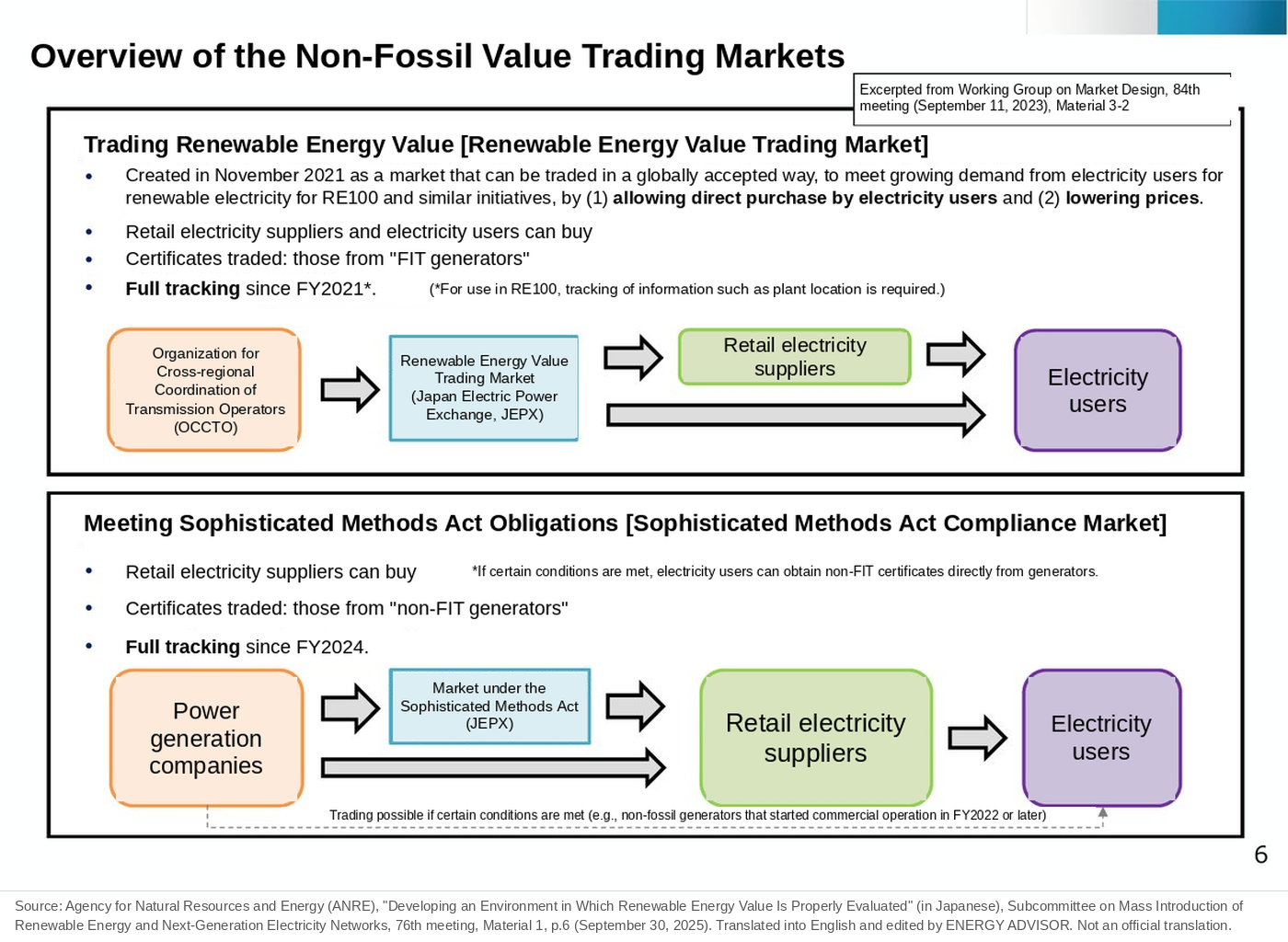
In Japan, the non-fossil certificate market started in May 2018. In November 2021, it was split into two: the Renewable Energy Value Trading Market (FIT certificates), in which electricity users can also take part, and the Sophisticated Methods Act Compliance Market (non-FIT certificates) for retail electricity suppliers (see article 17 in this series).
How Corporate PPAs Work: Two Types
A PPA (power purchase agreement) is a long-term contract in which a generator and an electricity user (a company or other organization) agree in advance on the price, volume and period of electricity supply. It is a mechanism that lets companies secure renewables reliably and gives generators predictability for their investment.
PPAs fall into two broad types.
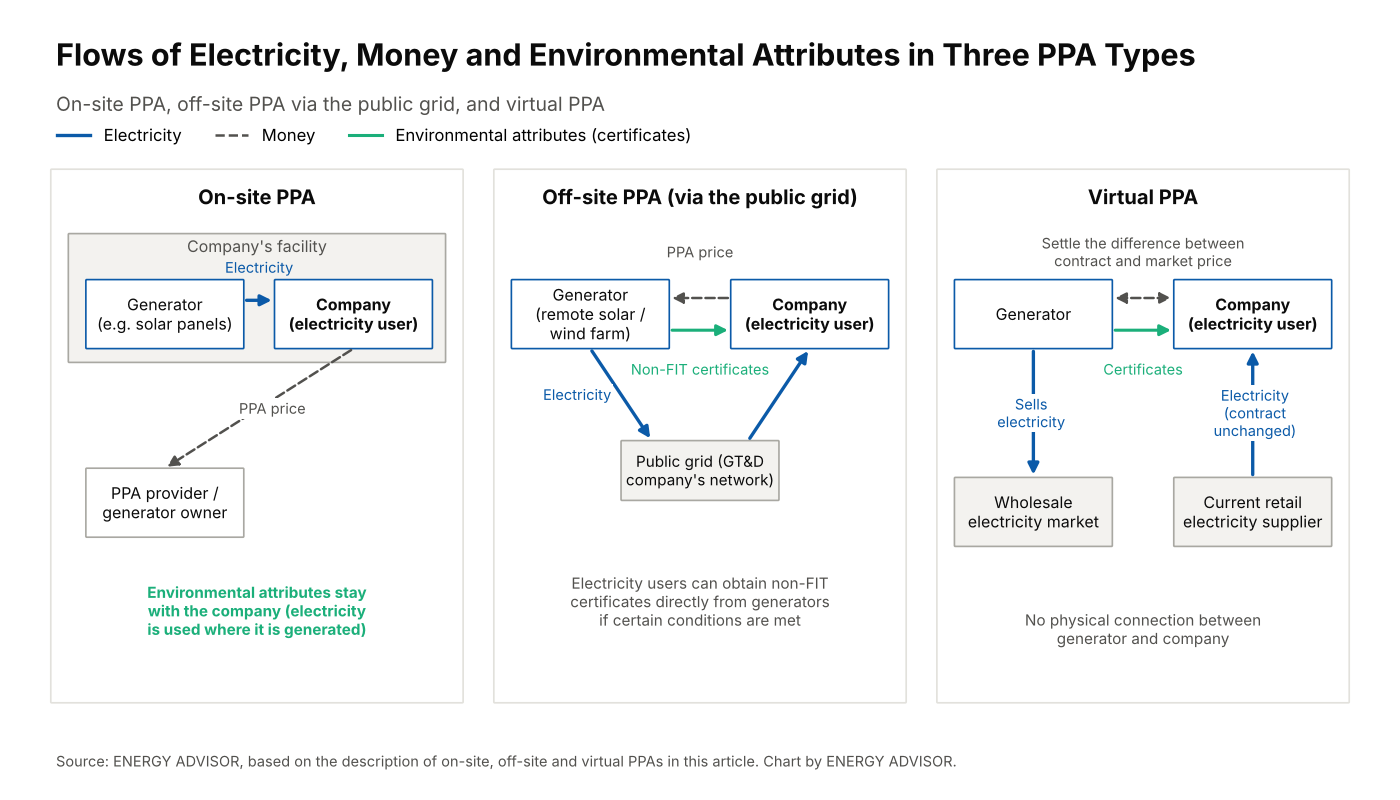
On-Site PPA
A contract in which solar panels or wind turbines are installed at the company’s facility and the company buys the electricity they generate directly. The company receives renewable supply within its own facility; this is the simplest PPA model.
Its advantages include the short physical distance from generation to consumption, which minimizes transmission and distribution losses. In addition, if the company makes full use of its site, it may be able to install renewables at a large scale.
Off-Site PPA
A form in which the company buys, through a contract, electricity from a location away from its facilities (a large solar or wind farm, etc.). It allows the company to secure renewables at a larger scale than on-site PPAs.
Off-site PPAs have two further subtypes:
– Direct connection: a generating facility dedicated to the company is built, and its electricity is delivered to the company through a private wire. This is the most stable option, but the initial investment is large.
– Via the public grid: electricity generated by the generator is delivered to the company through the network of a general transmission and distribution company (GT&D company: the regulated regional company that operates the grid in each area). Combining several generators makes it possible to spread risk.
PPAs are often long-term contracts, and this long duration gives generators investment predictability and enables large-scale renewable deployment.
Environmental Attributes in Physical PPAs
Electricity secured through a PPA is linked to the environmental attributes of its source. Companies can count the non-fossil attributes under a PPA toward their own emission reductions.
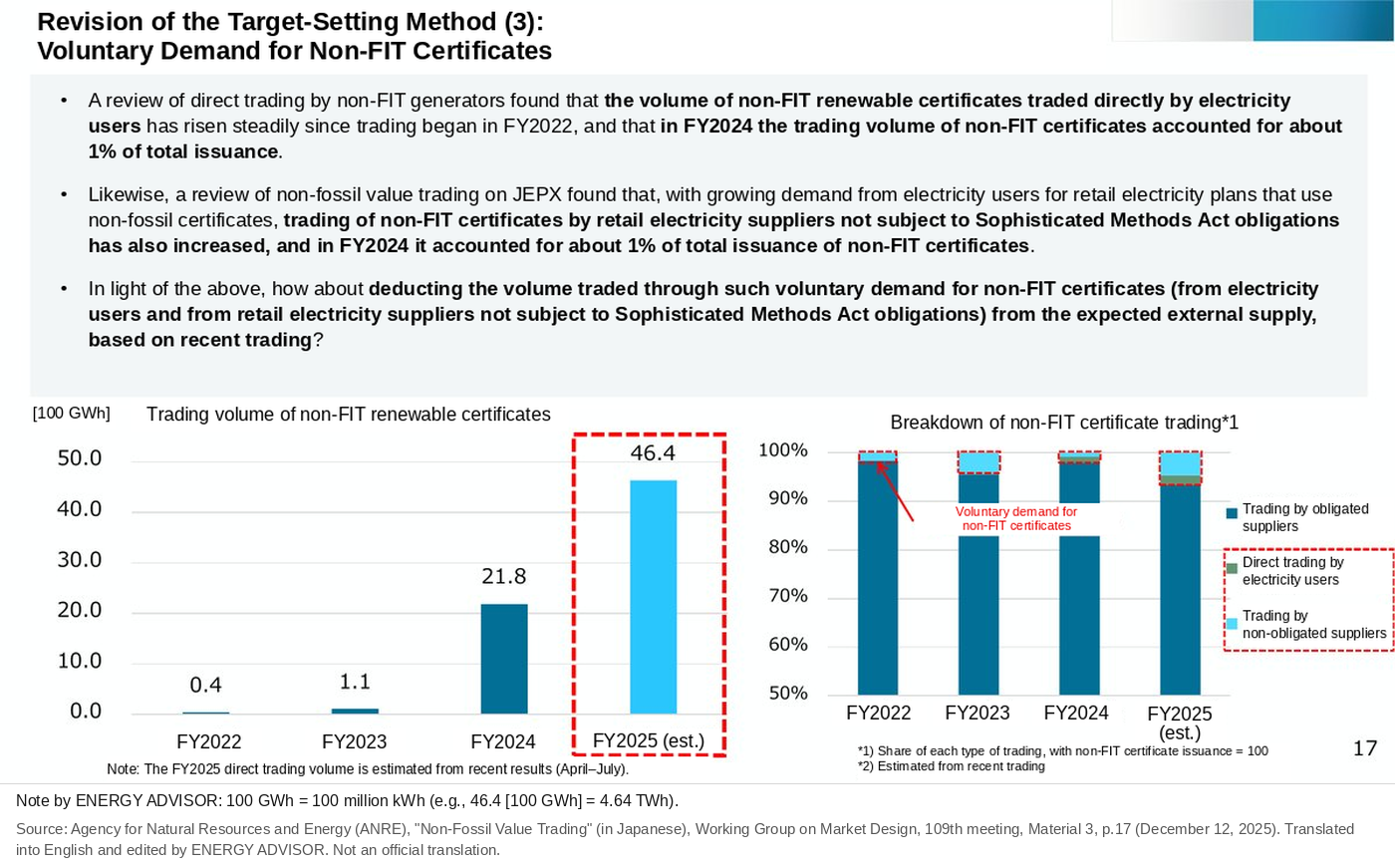
In an on-site PPA, the generated electricity is used as is, so the environmental attributes stay with the company. For off-site PPAs via the public grid in Japan, if certain conditions are met (such as non-fossil generators that started commercial operation in FY2022 or later), electricity users can obtain non-FIT non-fossil certificates directly from generators. The volume of non-FIT renewable certificates traded directly by electricity users has risen sharply, from 0.04 TWh in FY2022 to 0.11 TWh in FY2023, 2.18 TWh in FY2024 and 4.64 TWh in FY2025 (estimated from results for April–July). (Japan’s fiscal year runs from April to March; FY2025 is April 2025–March 2026.) Direct trading in FY2024 was about 1% of all non-FIT certificates issued (Working Group on Market Design, 109th meeting, Material 3, p.17).
If the PPA is structured to include the environmental attributes, there is no need to buy non-fossil certificates separately.
RE100’s technical criteria (5th edition, March 2025) limit the renewable electricity purchased to generators within 15 years of commissioning, but make an exception for the first buyer (original off-taker) that signs a long-term contract with a new plant (such as a PPA via the public grid or a virtual PPA) (§5.4.2).
PPA Contract Pricing Strategy
The contract price may be agreed as a fixed price, or it may be linked to the market (varying with market prices). A fixed price makes budget planning easier for the company, but it may miss long-term cost reduction opportunities. A market-linked price is flexible, but the company bears the price fluctuation risk.
Virtual PPAs and Non-Fossil Certificates
How a Virtual PPA Works
A virtual PPA (vPPA) is a model in which the generator and the electricity user are not physically connected and settle a market-based price difference through a bilateral contract. The generator sells the electricity it generates on the market. The electricity user keeps buying electricity from its current retail electricity supplier, settles the difference between the contract price and the market price, and receives the environmental attributes (certificates).
A vPPA can be introduced without changing the electricity contract, and requires less initial investment than an on-site PPA. However, the effective PPA price may change with market price fluctuations, so risk management is needed.
Using Non-Fossil Certificates Alone
This is the case in which a company does not change its existing electricity contract (buying from a normal retail electricity supplier) and buys only non-fossil certificates in addition.
This approach is easy to introduce and requires almost no initial investment. By buying non-fossil certificates already in circulation on the market, the company can treat the corresponding electricity as “effectively from non-fossil sources.” It is a means of reducing indirect emissions from purchased electricity (Scope 2) under the market-based method. However, because the company physically receives electricity from the grid as before, it is a complementary means for companies seeking “genuine use of renewables.”
(Note) There are two methods for calculating Scope 2 emissions: the “location-based method,” which uses the average emission factor of the local electricity grid, and the “market-based method,” which uses emission factors that reflect contracts and certificates. The effect of non-fossil certificates and PPAs is reflected in the market-based method (GHG Protocol, “Scope 2 Guidance,” p.8, §1.5, and pp.25–26, §4.1).
Comparison Table: PPAs vs. Buying Non-Fossil Certificates
| Item | Corporate PPA | Virtual PPA | Buying non-fossil certificates |
|---|---|---|---|
| Mechanism | Long-term contract directly with the generator; physical electricity supply | Price settlement via the market; no physical connection | Buying only the non-fossil attributes; electricity contracted separately |
| Environmental attributes | Included in the contract; no extra purchase needed | Certificates received under the contract | Counted for the volume purchased; reduces Scope 2 (market-based) |
| Initial investment | High (generation-related) | Medium | Low |
| Contract period | Often long-term (depends on the contract) | Depends on the contract | Short-term purchases also possible |
| Price stability | Can be fixed; easy long-term forecasting | Market-linked; fluctuation risk | Depends on market prices |
| Difficulty of introduction | High (suitable site, funding, contract negotiation) | Medium | Low (immediate purchase possible) |
Which approach to choose depends greatly on the company’s size, electricity consumption, target date for carbon neutrality and budget.
Summary: Understanding Environmental Attributes in PPAs
Non-fossil certificates and PPAs (both physical and virtual) are complementary mechanisms that support companies in achieving carbon neutrality. Non-fossil certificates procure only the environmental attributes; PPAs procure electricity and environmental attributes together.
If a company receives the environmental attributes under a physical PPA, it can directly reduce its Scope 2 emissions. Because a virtual PPA does not involve physical electricity supply, the transfer of environmental attributes must be made clear in the contract. Non-fossil certificates alone can also reduce Scope 2 (market-based).
This article is based on published materials from the Ministry of Economy, Trade and Industry and its Agency for Natural Resources and Energy, the Electricity and Gas Market Surveillance Commission, the Organization for Cross-regional Coordination of Transmission Operators (OCCTO) and other sources. The English translations of figures are by ENERGY ADVISOR and are not official translations. When using this information for decisions, please check the original sources. When we find an error, we correct the article and note the date of the correction.
Sources
- Agency for Natural Resources and Energy (ANRE), Subcommittee on Mass Introduction of Renewable Energy and Next-Generation Electricity Networks, 76th meeting, Material 1, “Developing an Environment in Which Renewable Energy Value Is Properly Evaluated” (in Japanese), September 30, 2025, p.6 (“when certain conditions are met (such as non-fossil generators that started commercial operation in FY2022 or later),” electricity users can obtain non-FIT certificates directly from generators). https://www.meti.go.jp/shingikai/enecho/denryoku_gas/saisei_kano/pdf/076_01_00.pdf
- ANRE, Working Group on Market Design, 109th meeting, Material 3, “Non-Fossil Value Trading” (in Japanese), December 12, 2025, p.17 (direct trading in FY2024 was about 1% of all non-FIT certificates issued; volume of non-FIT renewable certificates traded directly by electricity users: 0.04 TWh in FY2022, 0.11 TWh in FY2023, 2.18 TWh in FY2024, 4.64 TWh in FY2025 [estimated from results for April–July]), p.39 (market launched in May 2018 and split in November 2021). https://www.meti.go.jp/shingikai/enecho/denryoku_gas/jisedai_kiban/system_review/pdf/109_03_00.pdf
- GHG Protocol, “GHG Protocol Scope 2 Guidance” (an amendment to the Corporate Standard, 2015), p.8, §1.5 (the location-based method reflects the average emission intensity of the grids where consumption occurs; the market-based method reflects emissions from electricity that companies have purposefully chosen), pp.25–26, §4.1 and Table 4.1 (definitions of the two methods). https://ghgprotocol.org/sites/default/files/2023-03/Scope%202%20Guidance.pdf
- RE100, “RE100 technical criteria,” 5th edition (published March 24, 2025), §5.4.2 (pp.17–18: the limit of 15 years from commissioning or repowering, and its exceptions [self-generation, direct physical PPAs not using the grid, the original off-taker that signs a long-term contract with a new project, contracts for plants commissioned before January 1, 2024, etc.], and the exemption for up to 15% of total electricity consumption). https://www.theclimategroup.org/hubfs/RE100/PDFs/RE100%20technical%20criteria%20+%20appendices%20(15%20April%202025).pdf