What Non-Coincidence Means
Frequency Containment Reserve (FCR; primary), Synchronized Frequency Restoration Reserve (S-FRR; secondary (1)), Frequency Restoration Reserve (FRR; secondary (2)) and Replacement Reserve (RR; tertiary (1)) in the Supply and Demand Balancing Market (balancing market; article 1) are products that respond to changes arising after GC (gate closure, the deadline for plans one hour before real time). The changes they cover are forecast errors and intra-period fluctuation in normal conditions, and generator trips in contingencies. Each product is defined by the role it plays (article 2).
Dividing balancing capacity finely into products lets resources with only specific capabilities take part in the market. It has been thought that more new entrants would increase competition and lower procurement costs.
On the other hand, the thermal generators that provide most balancing capacity almost always have several capabilities covering FCR to RR, not just the capability for one product.
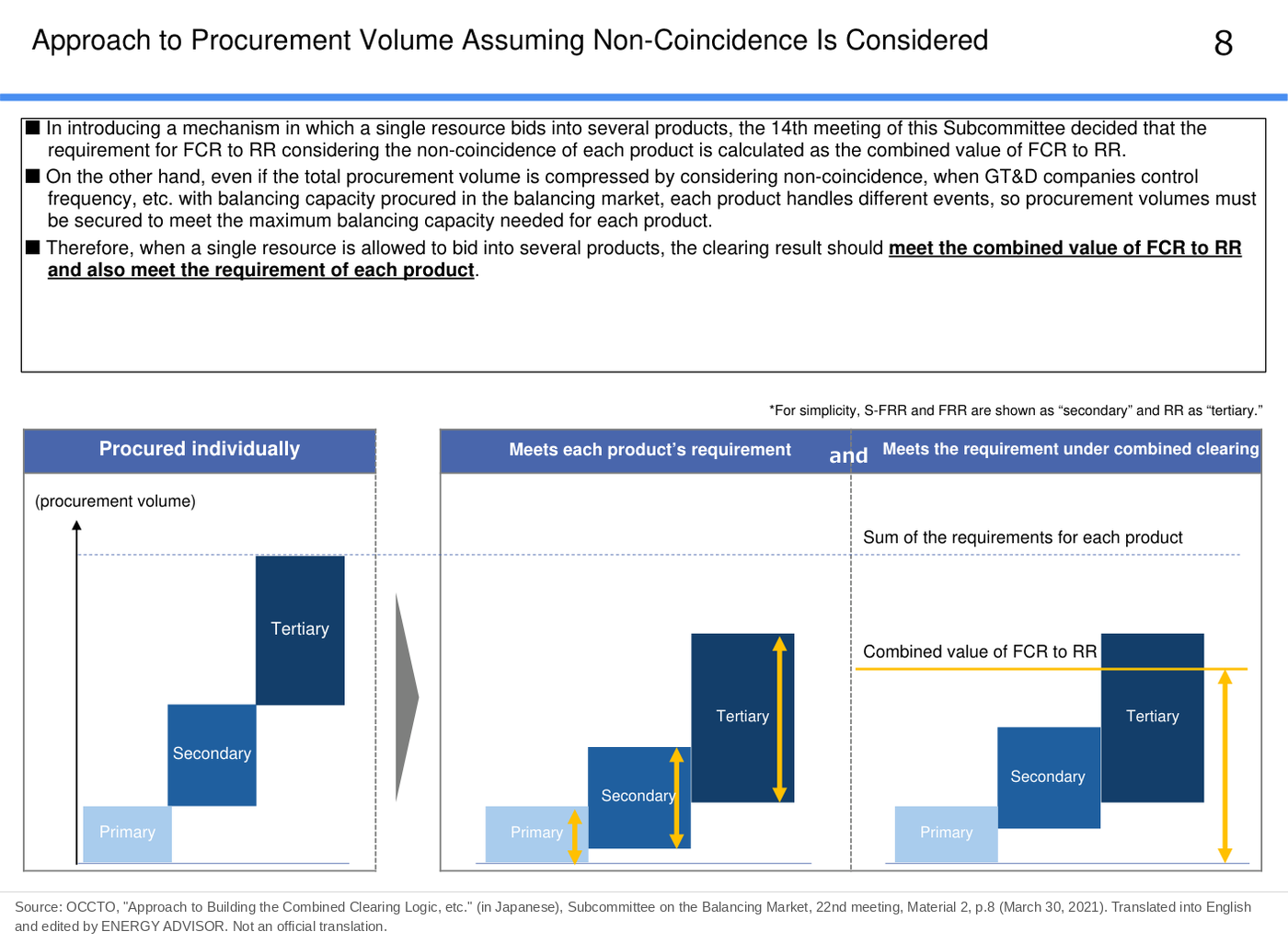
In addition, the timing at which each of FCR to RR is needed is not always the same. This is called “non-coincidence.” In actual operation, a single thermal generator uses several roles corresponding to FCR to RR as the timing requires.
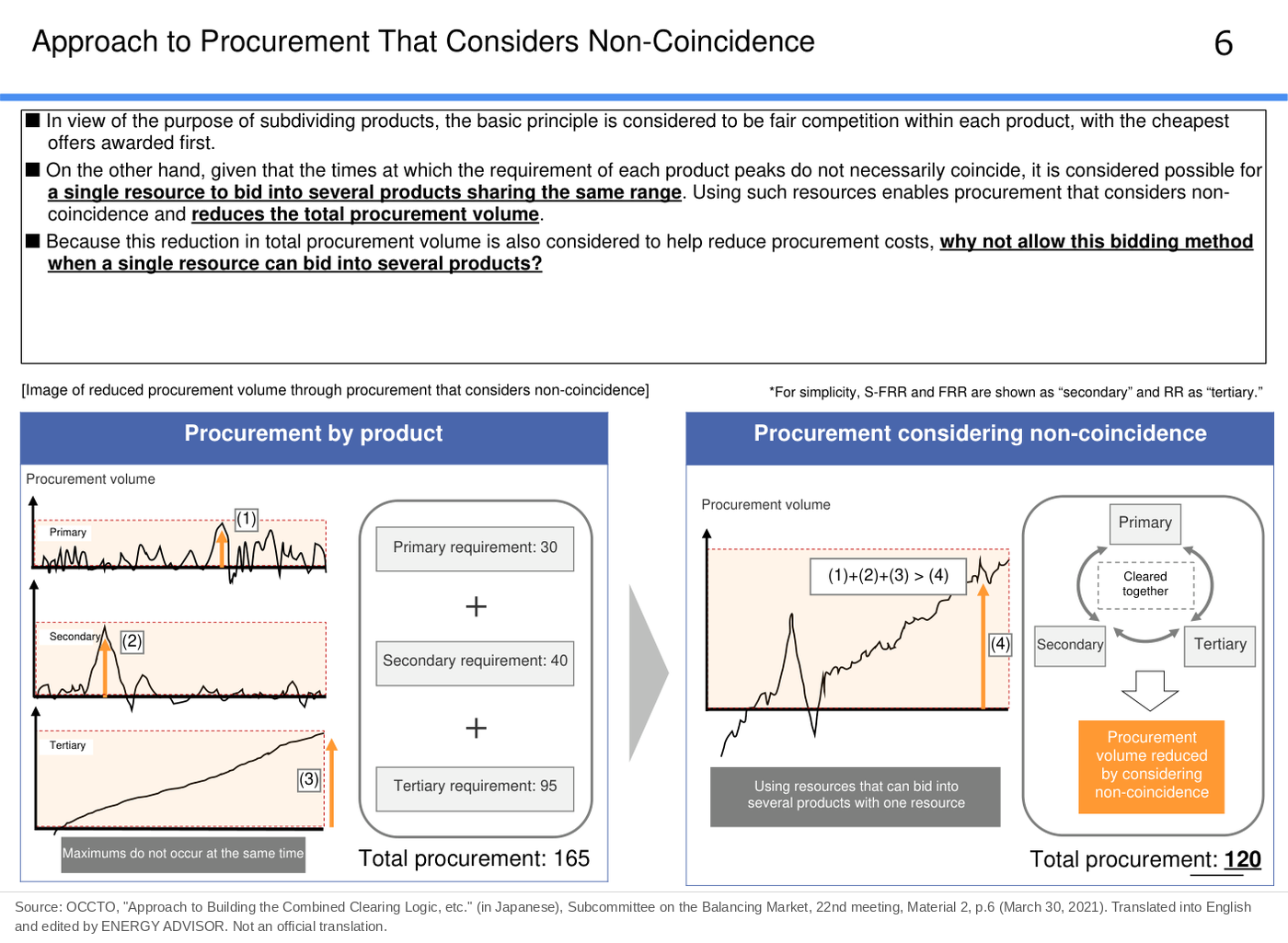
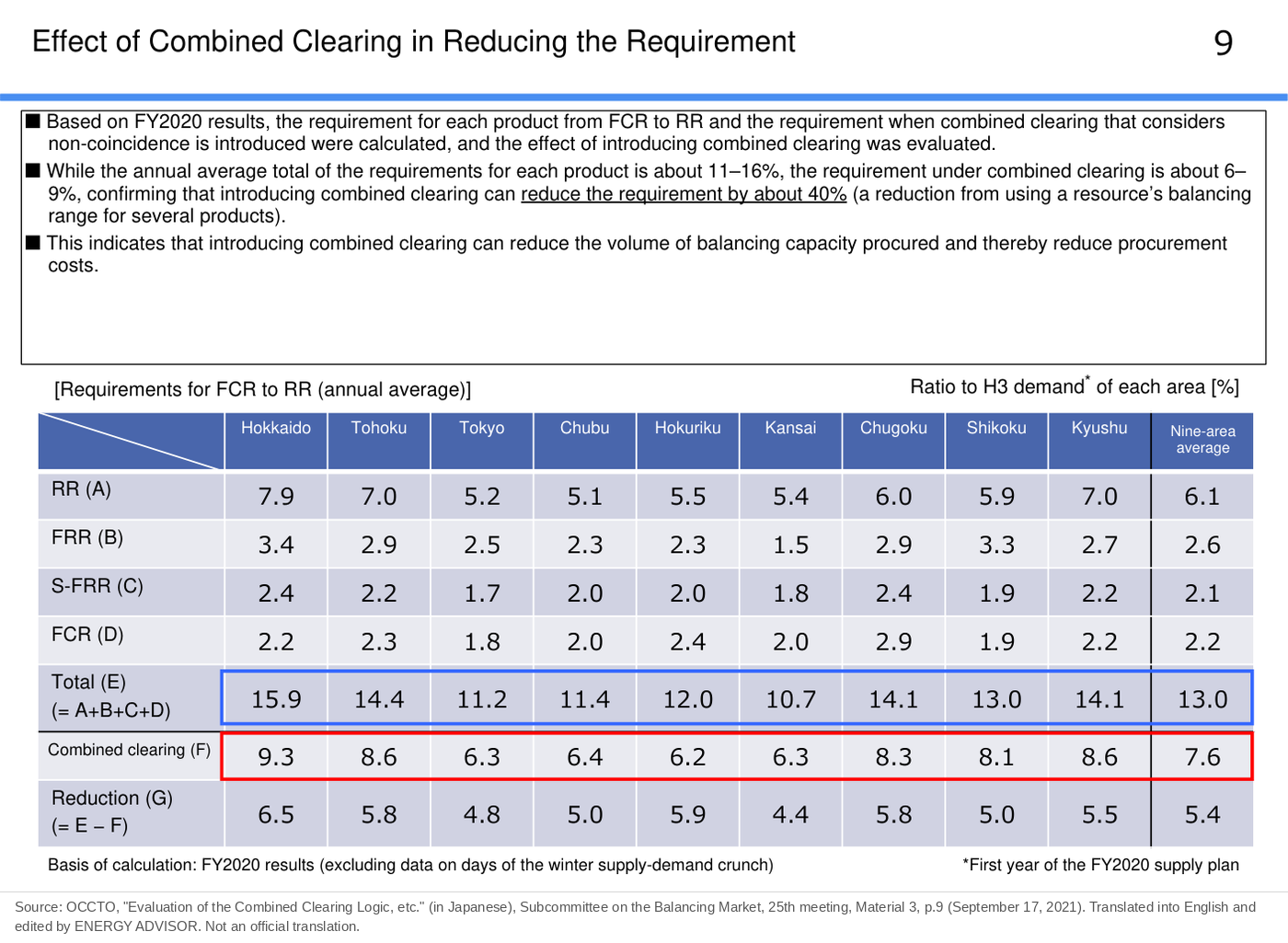
Taking non-coincidence into account, one resource can share the same output range to fulfill the roles of several products. It also reduces the volume to be procured. In an example given by the Organization for Cross-regional Coordination of Transmission Operators, JAPAN (OCCTO), procuring FCR 30, secondary 40 and tertiary 95 separately by product gives a total of 165, while combined clearing that considers that the maximums of each product do not occur at the same time requires only 120 (OCCTO, Subcommittee on the Balancing Market, 22nd meeting, Material 2, p.6; the numbers are an illustrative example). OCCTO made a trial calculation of the requirement for FCR to RR based on FY2020 results (OCCTO, Subcommittee on the Balancing Market, 25th meeting, Material 3, p.9). In Japan, the fiscal year runs from April to March.
| Condition of the trial calculation | Requirement for FCR to RR (annual average, as a ratio to each area’s H3 demand) |
|---|---|
| Secured separately by product (total) | About 11–16% |
| Combined clearing that considers non-coincidence | About 6–9% |
H3 demand is the average of the three highest daily peak demands in the month. It was confirmed that combined clearing could reduce the requirement by about 40%.
The Combined Clearing Logic and the Idea of Combined Bidding
Purpose of Introduction
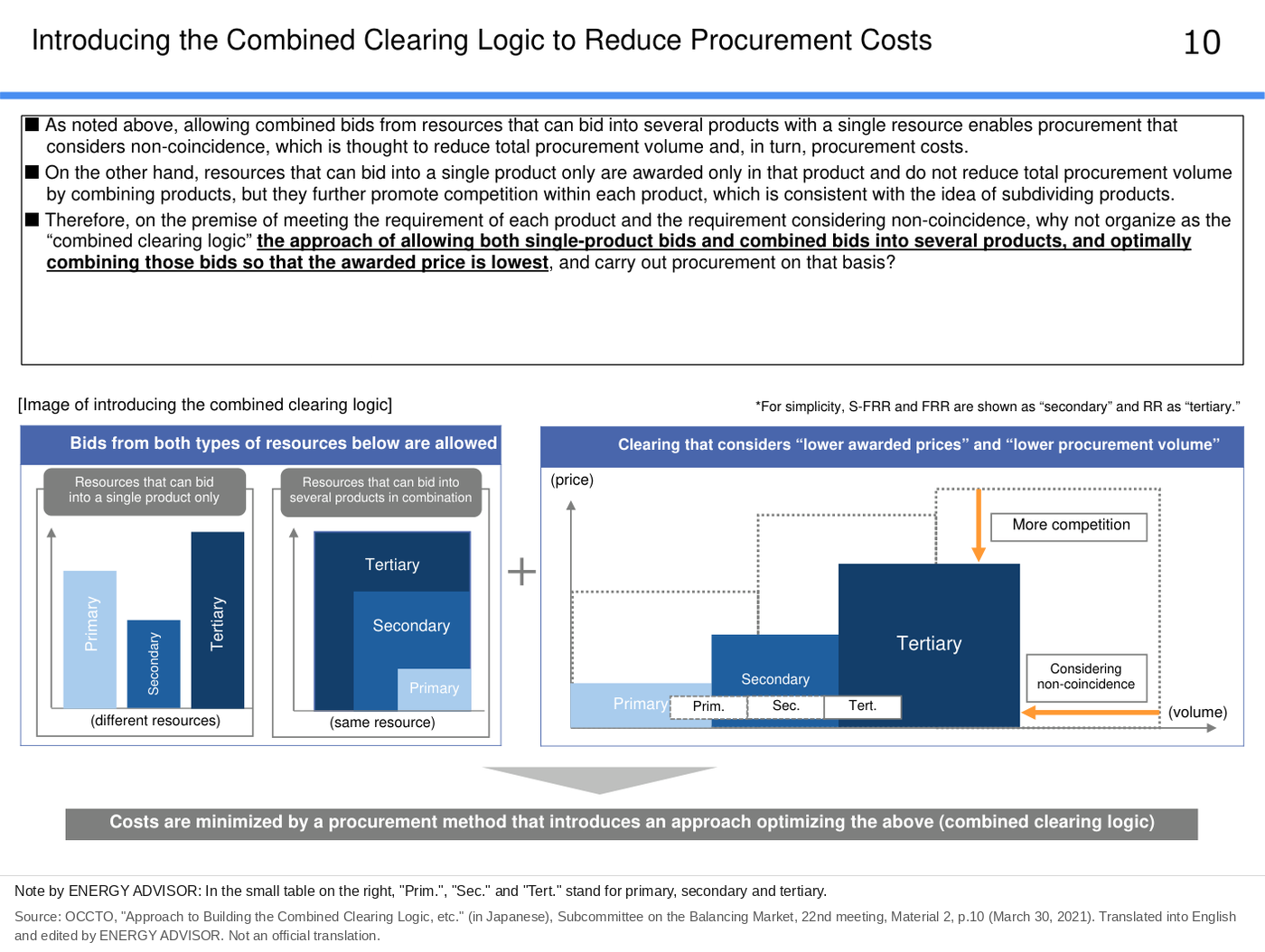
The “combined clearing logic” is an approach that finds the combination with the lowest awarded price from “resources that can bid into only one product” and “resources that can bid into several products together” (22nd meeting, Material 2, p.10). It has two purposes.
- Lower awarded prices through more competition
- Lower procurement volumes by taking non-coincidence into account
How to Bid into Several Products
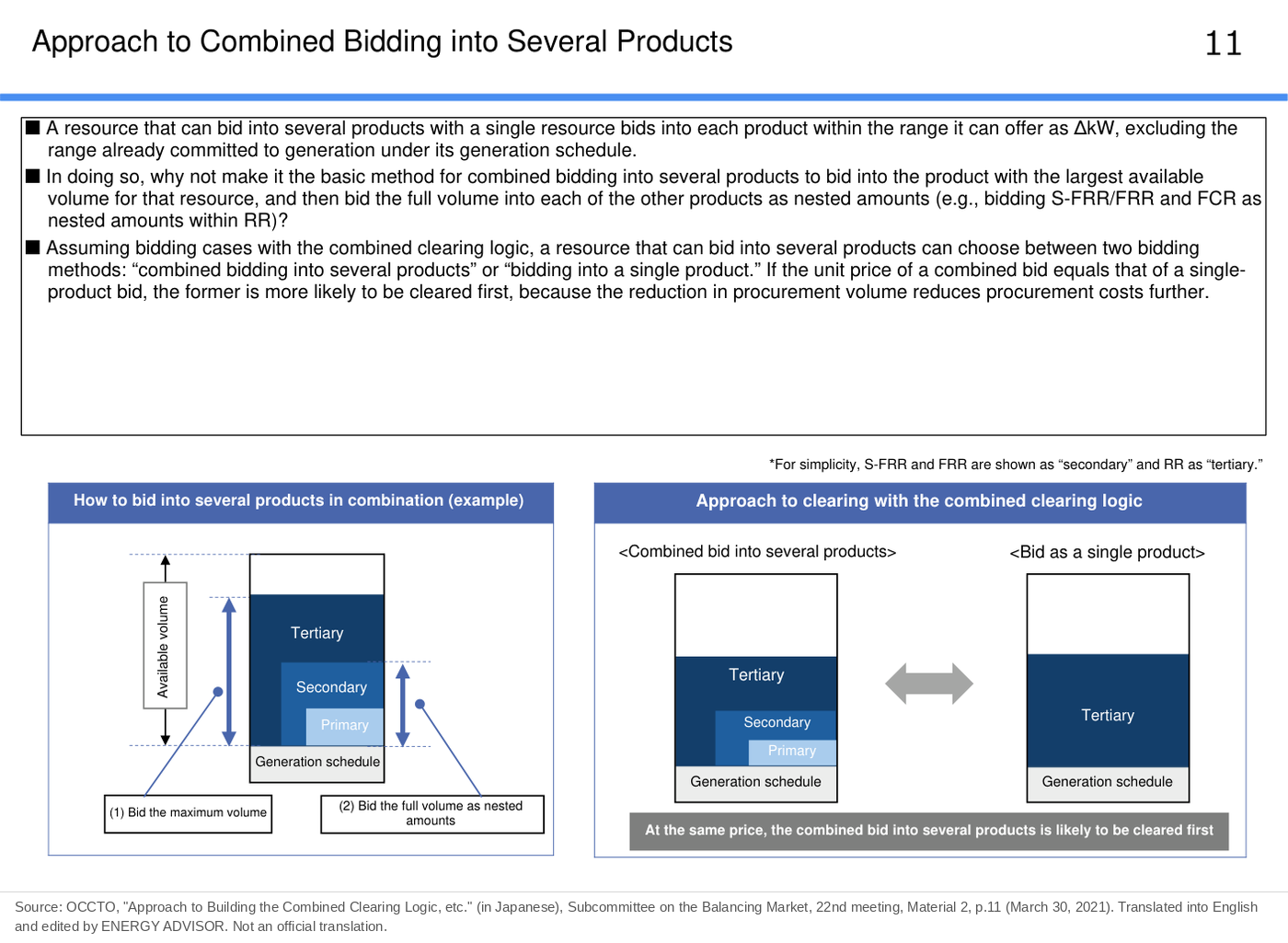
A resource that can bid into several products bids into each product within the range of ΔkW (available reserve capacity) left after excluding the part already scheduled to generate under its generation plan.
The method is to “bid the maximum volume” into the product for which the resource can offer the largest volume, and to “bid the full volume as a nested amount” into each of the other products (nested bidding). For example, if the volume that can be offered for RR is the largest, the resource bids the maximum volume into RR and bids into secondary and FCR as nested amounts within it. Nested here means that part of the RR bid volume is shown overlapping as the secondary and FCR bid volumes, so the total output range does not exceed the RR bid volume.
It was considered that if the unit price of a combined bid is the same as that of a bid into a single product, the combined bid, which can reduce procurement volume, is more likely to clear first (22nd meeting, Material 2, p.11 and p.13).
FY2024: Trading Begins as the Combined Product
This approach was actually launched as the “combined product” together with the start of trading of all products in April 2024. Today, FCR, S-FRR, FRR and RR, together with the combined product, are called the “combined market.”
From delivery on March 14, 2026, the combined market moved from week-ahead trading to day-ahead trading, and the bidding time unit changed from 3 hours to 30 minutes. Bids are accepted from 11:30 to 14:00 on the day before delivery, and clearing is completed by 15:00 on the day before (Electric Power Reserve eXchange (EPRX), product requirements, 6th edition, p.3).
From FY2026 (April 2026–March 2027), the combined product requirement is treated as follows (OCCTO, Study Committee on Regulating and Marginal Supply Capability and Long-Term Supply–Demand Balance Evaluation, 117th meeting, Material 4, p.22 and p.74).
| Cross-regional reserve margin in the plan for two days ahead | Combined product requirement | Volume procured in the market | Volume secured through spare-capacity utilization contracts |
|---|---|---|---|
| 10% or more | 1σ | 1σ | — |
| Below 10% | 3σ | 1σ | 3σ−1σ |
The cross-regional reserve margin is an indicator published by OCCTO that shows how much supply capacity exceeds demand. A spare-capacity utilization contract is a contract under which the general transmission and distribution company (GT&D company) uses the spare capacity of resources already running (article 3).
Together with FCR and S-FRR, the combined product is subject to the lowering of the price cap. The cap became ¥15/ΔkW per 30 minutes from delivery on March 14, 2026, and ¥10/ΔkW per 30 minutes for delivery from September 1, 2026 (Subcommittee on the Balancing Market, 62nd meeting, Material 2, pp.15–16).
On the combined product after the move to day-ahead trading, OCCTO reported the following (Subcommittee on the Balancing Market, 61st meeting, Material 2, pp.19–20 and p.25).
- The deduction of unoffered headroom ended, and negotiated contracts for pumped storage were forgone or not concluded in the Hokkaido and Tokyo areas, so the procurement volume increased after the move to day-ahead trading.
- National bid volumes increased, but in some areas bid volumes fell, causing undersubscription, and no major change was seen in the shortfall rate. Bid volumes increased in the Hokkaido, Tokyo and Chubu areas, and days with shortfalls occurred in the Hokuriku and Kansai areas.
- In the evening lighting hours (the hours when lighting demand rises), bid volumes fell because resources that could be offered to the combined product cleared in the day-ahead market (spot market).
- In a trial calculation using March 2026 results, the move to 30-minute units made bid volumes about 30% larger than if 3-hour blocks had been kept. However, this trial calculation is based on data after the move to day-ahead trading and does not show the effect of the 30-minute change alone.
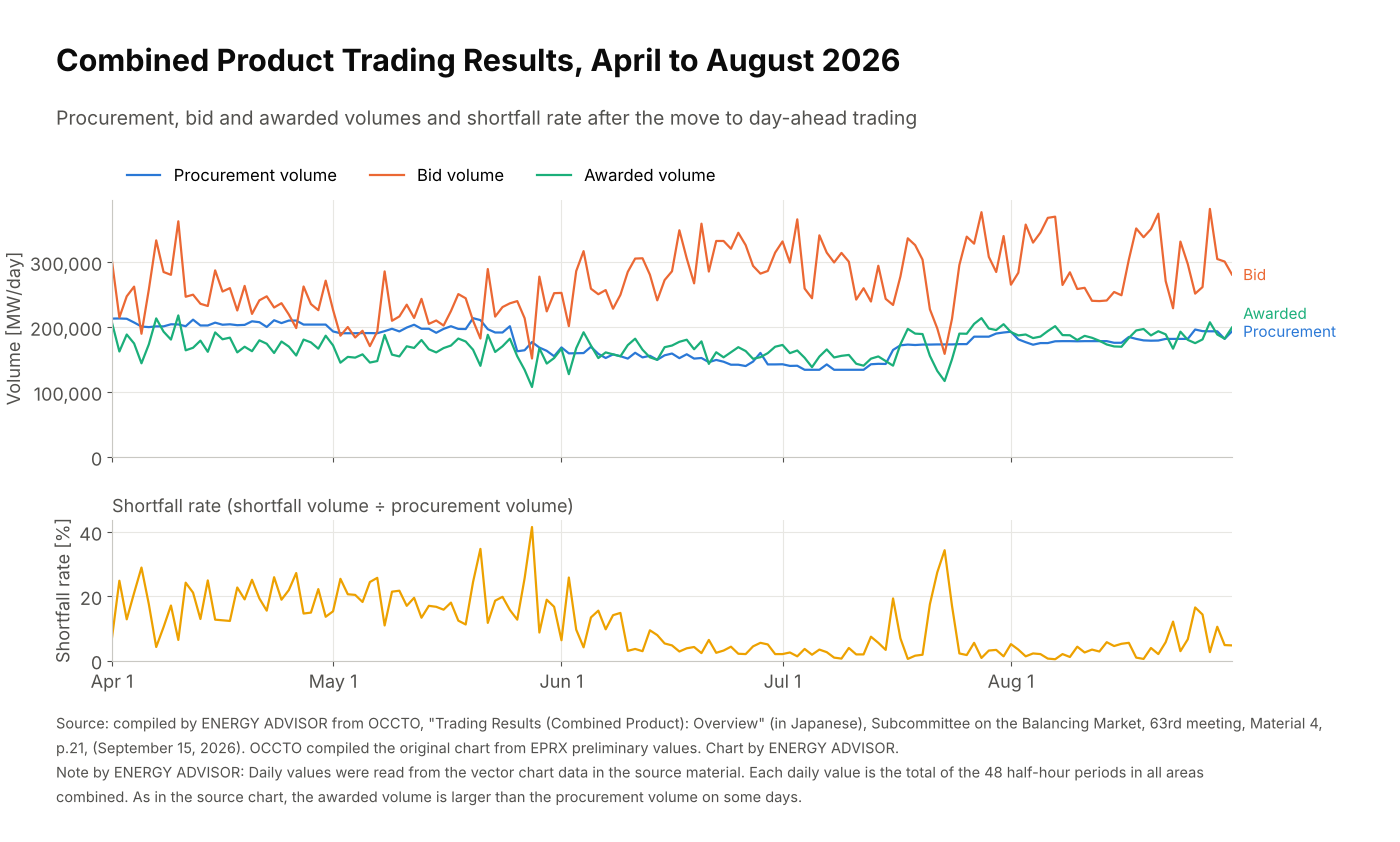
For the first half of FY2026 (up to August 31), OCCTO reported that national bid volumes increased, and that shortfall rates were high in many areas at the start of the fiscal year but an improving trend was seen from June, led by the Hokuriku, Kansai and Chugoku areas (Subcommittee on the Balancing Market, 63rd meeting, Material 4, pp.21–22).
Effect on Batteries: The Concern and What Actually Happened
The Concern at the Design Stage
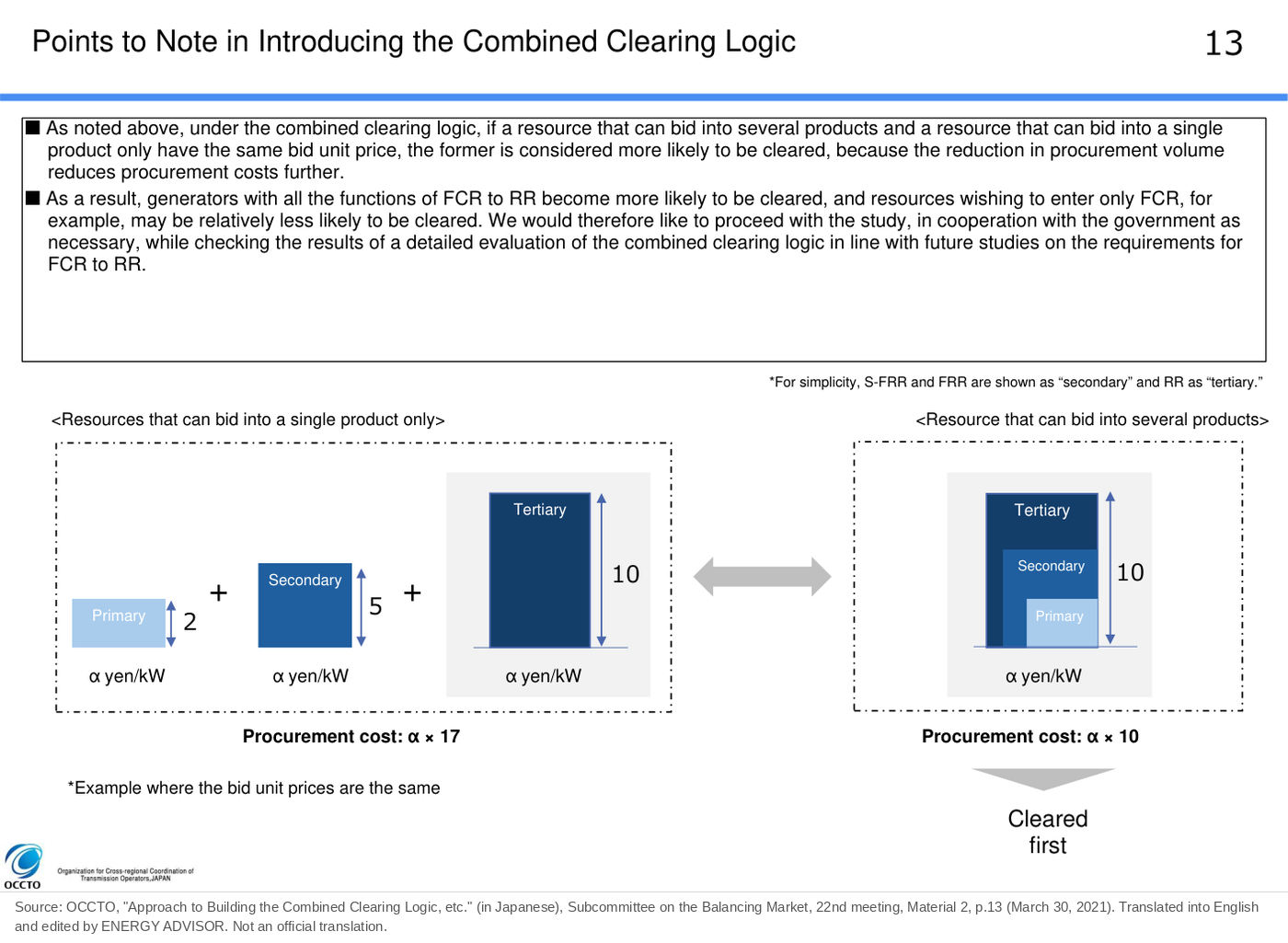
Comparing the procurement cost of resources that can bid into only one product with that of resources that can bid into several products, it was thought that bidding into several products with the same resource would be cheaper and more likely to clear. It was therefore noted that resources with all the functions of FCR to RR (for example, thermal generators) would clear more easily, and that grid-scale battery storage and other resources wishing to enter only FCR could find it relatively harder to clear (22nd meeting, Material 2, p.13).
In the material’s example, when all bid prices are ¥α/kW, collecting FCR 2, secondary 5 and tertiary 10 from resources that can each bid into only a single product costs α×17. On the other hand, if one resource that can bid into several products bids tertiary 10 with secondary and FCR nested within it, the cost is only α×10, so this clears first (same, p.13).
What Actually Happened After Launch
Since the FY2024 launch, batteries have actually entered the balancing market. OCCTO reports that after the move to day-ahead trading, the main resources whose national awarded volumes increased in the combined product were thermal, followed by hydro and pumped storage. Awarded volumes of batteries also tend to increase. The weighted average awarded price of batteries has fallen. OCCTO gives as reasons that the increase in thermal created price competition to raise the chance of being awarded, or that the lower price cap also lowered the awarded prices of some resources (61st meeting, Material 2, p.29).
Remaining Issue: How to Assess FCR Response Alone
A resource cleared in combination responds at the same time to instructions for FCR to RR with one output range. In the performance assessment that checks whether it responded as cleared, how to separate out and evaluate only the FCR part of the combined response has therefore become an issue. At present, a tolerance range is set that includes FCR, and a method of separating out FCR alone is still being studied as an issue for FY2028 onward (OCCTO, Subcommittee on the Balancing Market, 57th meeting, Material 5, pp.26–27 and p.32).
Link to the Co-Optimization Market
Combined clearing is the idea of allocating the several capabilities of one resource at once, taking into account differences in when they are needed. The “co-optimization market (simultaneous market for energy and balancing capacity)” extends this idea to energy (kWh) and balancing capacity (ΔkW) and clears both at the same time (article 11).
Summary
The timing at which each of FCR to RR is needed does not always coincide (non-coincidence). In addition, some resources, such as thermal generators, have capabilities that can cover all of FCR to RR.
Taking non-coincidence into account, one resource was therefore allowed to bid into several products together. The basic method is to bid the maximum volume into the product with the largest offerable volume and to bid the full volume as nested amounts into the other products. A trial calculation based on FY2020 results indicated that the requirement could be reduced by about 40%.
This mechanism has been traded as the combined product since FY2024, and moved to day-ahead trading in 30-minute units from March 2026. Batteries have actually entered and increased their awarded volumes. A method of separating out and assessing FCR response alone is still being studied.
This article is based on published materials from the Ministry of Economy, Trade and Industry and its Agency for Natural Resources and Energy, the Electricity and Gas Market Surveillance Commission, the Organization for Cross-regional Coordination of Transmission Operators (OCCTO) and other sources. The English translations of figures are by ENERGY ADVISOR and are not official translations. When using this information for decisions, please check the original sources. When we find an error, we correct the article and note the date of the correction.
Sources
- OCCTO, Subcommittee on the Balancing Market, 22nd meeting, Material 2, “Organizing the Approach to Building the Combined Clearing Logic” (in Japanese), p.6, p.8, p.10, p.11 and p.13, March 30, 2021. https://www.occto.or.jp/assets/iinkai/chouseiryoku/jukyuchousei/2020/files/jukyu_shijyo_22_02.pdf
- OCCTO, Subcommittee on the Balancing Market, 25th meeting, Material 3, “Evaluation of the Combined Clearing Logic and Related Matters” (in Japanese), p.9, September 17, 2021. https://www.occto.or.jp/iinkai/chouseiryoku/jukyuchousei/2021/files/jukyu_shijyo_25_03.pdf
- Electric Power Reserve eXchange (EPRX), “Product Requirements and Trading Schedule of the Supply and Demand Balancing Market (6th edition)” (in Japanese), p.3, March 13, 2026. https://www.eprx.or.jp/outline/docs/shouhin_ver.6_20260313.pdf
- OCCTO, Study Committee on Regulating and Marginal Supply Capability and Long-Term Supply–Demand Balance Evaluation, 117th meeting, Material 4, “Status of Discussions in the Subcommittee on the Balancing Market (FY2025 Report)” (in Japanese), p.22 and p.74, March 16, 2026. https://www.occto.or.jp/assets/chousei_117_04.pdf
- OCCTO, Subcommittee on the Balancing Market, 57th meeting, Material 5, “Direction and Summary of Discussions in the Subcommittee on the Balancing Market (Results for the First Half of FY2025 and Plans for the Second Half of FY2025)” (in Japanese), pp.26–27 and p.32, September 26, 2025. https://www.occto.or.jp/assets/iinkai/chouseiryoku/jukyuchousei/2025/files/jukyu_shijyo_57_05.pdf
- OCCTO, Subcommittee on the Balancing Market, 61st meeting, Material 2, “Trading Status of the Balancing Market” (in Japanese), pp.19–20, p.25 and p.29, June 9, 2026. https://www.occto.or.jp/assets/iinkai/jukyuchousei/61/jukyu_shijyo_61_02.pdf
- OCCTO, Subcommittee on the Balancing Market, 63rd meeting, Material 4, “Direction and Summary of Discussions in the Subcommittee on the Balancing Market (Results for the First Half of FY2026 and Plans for the Second Half of FY2026 Onward)” (in Japanese), pp.21–22, September 15, 2026. https://www.occto.or.jp/assets/iinkai/jukyuchousei/63/jukyu_shijyo_63_04.pdf
- OCCTO, Subcommittee on the Balancing Market, 62nd meeting, Material 2, “Results of Fact-Finding Surveys on the Balancing Market” (in Japanese), pp.15–16, July 31, 2026. https://www.occto.or.jp/assets/iinkai/jukyuchousei/62/jukyu_shijyo_62_02.pdf