What Balancing Capacity Tenders Were
General transmission and distribution companies (GT&D companies; the companies that operate each area’s grid) need to secure balancing capacity to control frequency and balance supply and demand. Up to FY2023 (April 2023–March 2024), they collected it mainly through “balancing capacity tenders.” In Japan, the fiscal year runs from April to March. A balancing capacity tender was a system in which a GT&D company invited resources to offer balancing capacity. It was based on the government’s “Approach to Procurement of Balancing Capacity Through Tenders by GT&D Companies,” issued on October 17, 2016. Each GT&D company decided the tender volume, based on the results of studies by the Organization for Cross-regional Coordination of Transmission Operators, JAPAN (OCCTO) (OCCTO, Study Committee on Regulating and Marginal Supply Capability and Long-Term Supply–Demand Balance Evaluation, 62nd meeting, Material 5, p.2). This “Approach” uses three points as the basis for its review: fair opportunity for all resources to participate, transparency and appropriateness of the procurement costs ultimately borne by customers, and securing a stable supply (“Approach to Procurement of Balancing Capacity Through Tenders by GT&D Companies,” p.5).
Because a resource secured through a tender was held as a whole, its “supply capacity (kW)” and “balancing capacity (ΔkW)” could be operated together.
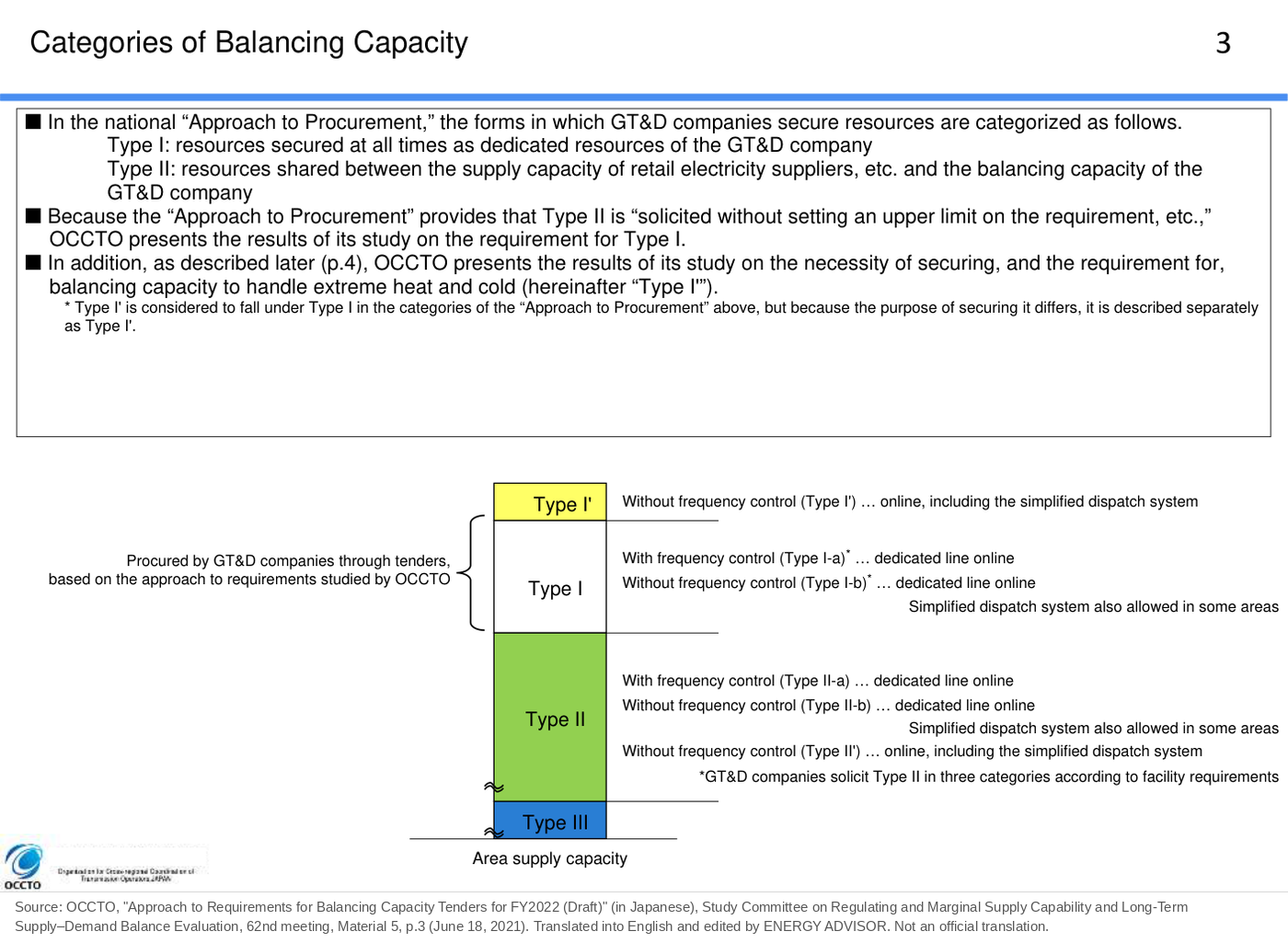
Type I and Type II Resources
Resources collected through tenders fell broadly into two groups.
- Type I resources: Resources secured for the whole year as dedicated resources of the GT&D company
- Type II resources: “Shared” resources that run as supply capacity for retail electricity suppliers, with their spare output also used by the GT&D company
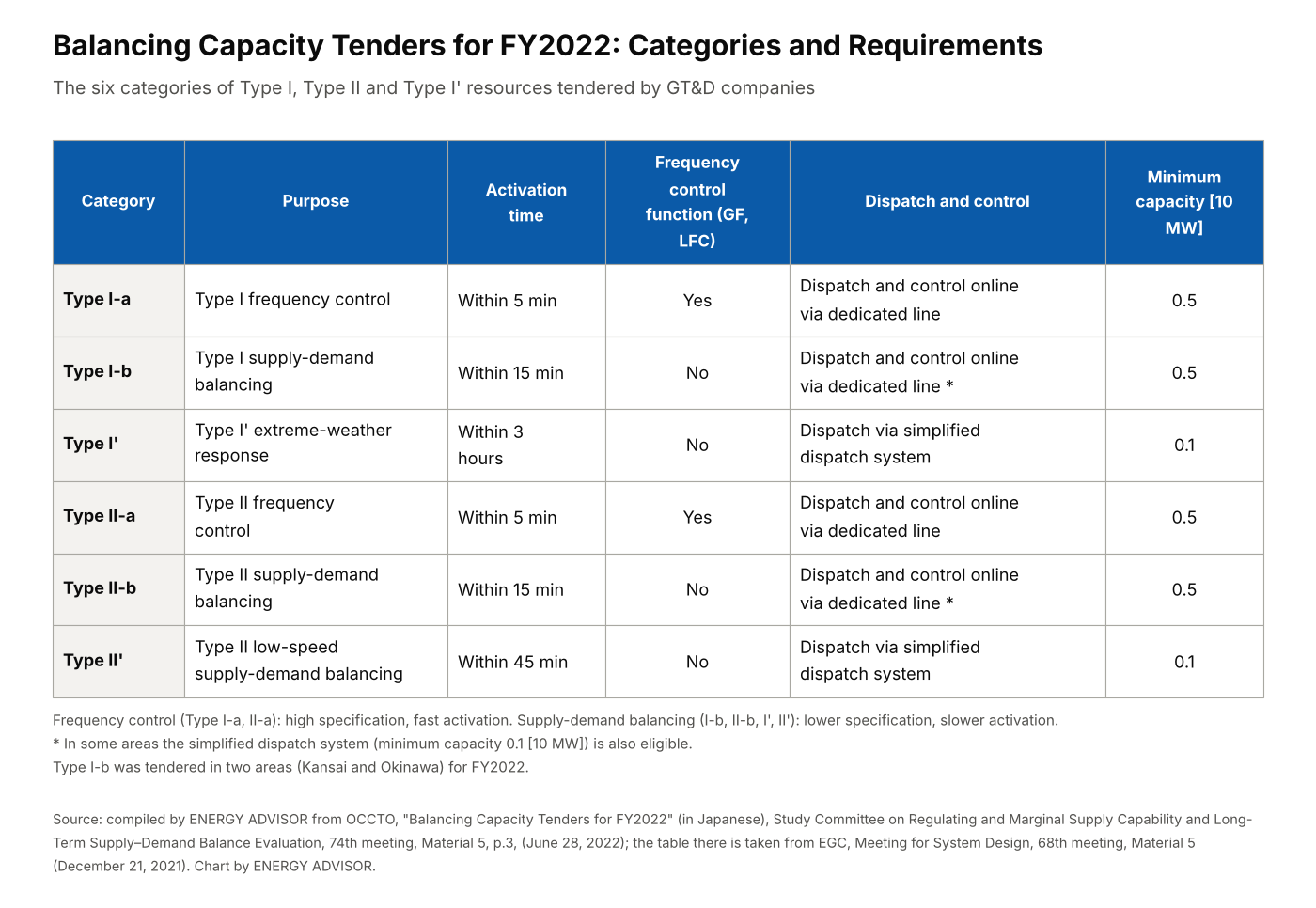
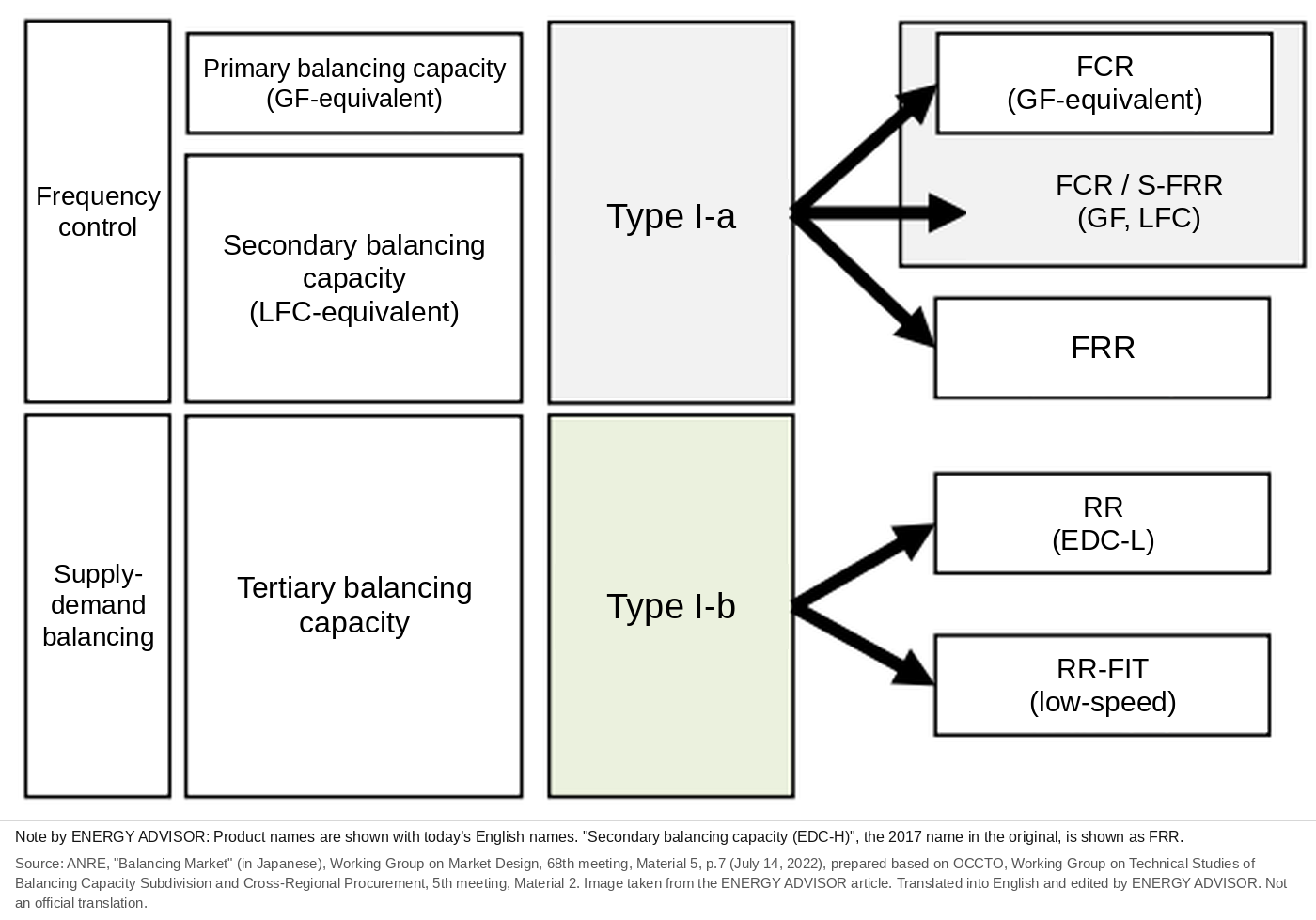
Type I and Type II resources were further divided by the time from instruction to output (activation time), whether they had frequency control functions, and other factors. Resources with short activation times and frequency control functions (Type I-a and Type II-a) were used mainly for frequency control, and the others for supply-demand balancing.
The procurement volume of Type I resources was capped at 7% of H3 demand (for each month, the average of the three highest daily peak demands). This is because increasing Type I resources could reduce the supply capacity available to retail electricity suppliers by the amount held exclusively by GT&D companies. Fluctuations beyond 7% were handled with the spare capacity of Type II resources (OCCTO, Study Committee on Regulating and Marginal Supply Capability and Long-Term Supply–Demand Balance Evaluation, 86th meeting, Material 1, p.3).
Why kW and ΔkW Are Procured Separately
The Supply and Demand Balancing Market (balancing market) stopped procuring kW and ΔkW together, and was designed to procure only ΔkW (balancing capacity) in the market, when it is needed and in the volume needed. Compared with tenders that hold resources for a full year, the aim is to open participation to many resources, make procurement costs transparent, and secure balancing capacity efficiently (EPRX, “What Is the Supply and Demand Balancing Market”).
Supply capacity (kW) is secured through other mechanisms, such as the capacity market (a market that secures future supply capacity four years before the delivery year).
The Order of the Transition, FY2021–FY2024
The transition from balancing capacity tenders to the balancing market proceeded product by product.
| Fiscal year | Balancing market products | Balancing capacity tenders |
|---|---|---|
| Up to FY2020 | None | Type I and Type II resources |
| FY2021 | Trading of Replacement Reserve-for FIT (RR-FIT; tertiary balancing capacity (2)) begins | Type I and Type II resources (part of Type II spare capacity is replaced by RR-FIT) |
| FY2022 and FY2023 | Trading of Replacement Reserve (RR; tertiary balancing capacity (1)) begins | Type I and Type II resources (part of Type II spare capacity is replaced by RR) |
| FY2024 | Trading of Frequency Containment Reserve (FCR; primary), Synchronized Frequency Restoration Reserve (S-FRR; secondary (1)) and Frequency Restoration Reserve (FRR; secondary (2)) begins. All products in place | Ended, except in the Okinawa area |
The table above looks at the bands of procured volume (OCCTO, Working Group on Technical Studies of Balancing Capacity Subdivision and Cross-Regional Procurement, 38th meeting, Material 2, p.5). RR and RR-FIT sit in the band that had been Type II spare capacity. Type I resources, on the other hand, were still secured at the same 7% in almost all areas in FY2022 as in FY2021. This is because the requirement for Type I-a exceeded 7% in almost all areas, and even in areas where it was below 7%, Type I-b was procured in view of the risk of under-procurement of RR (same, p.6).
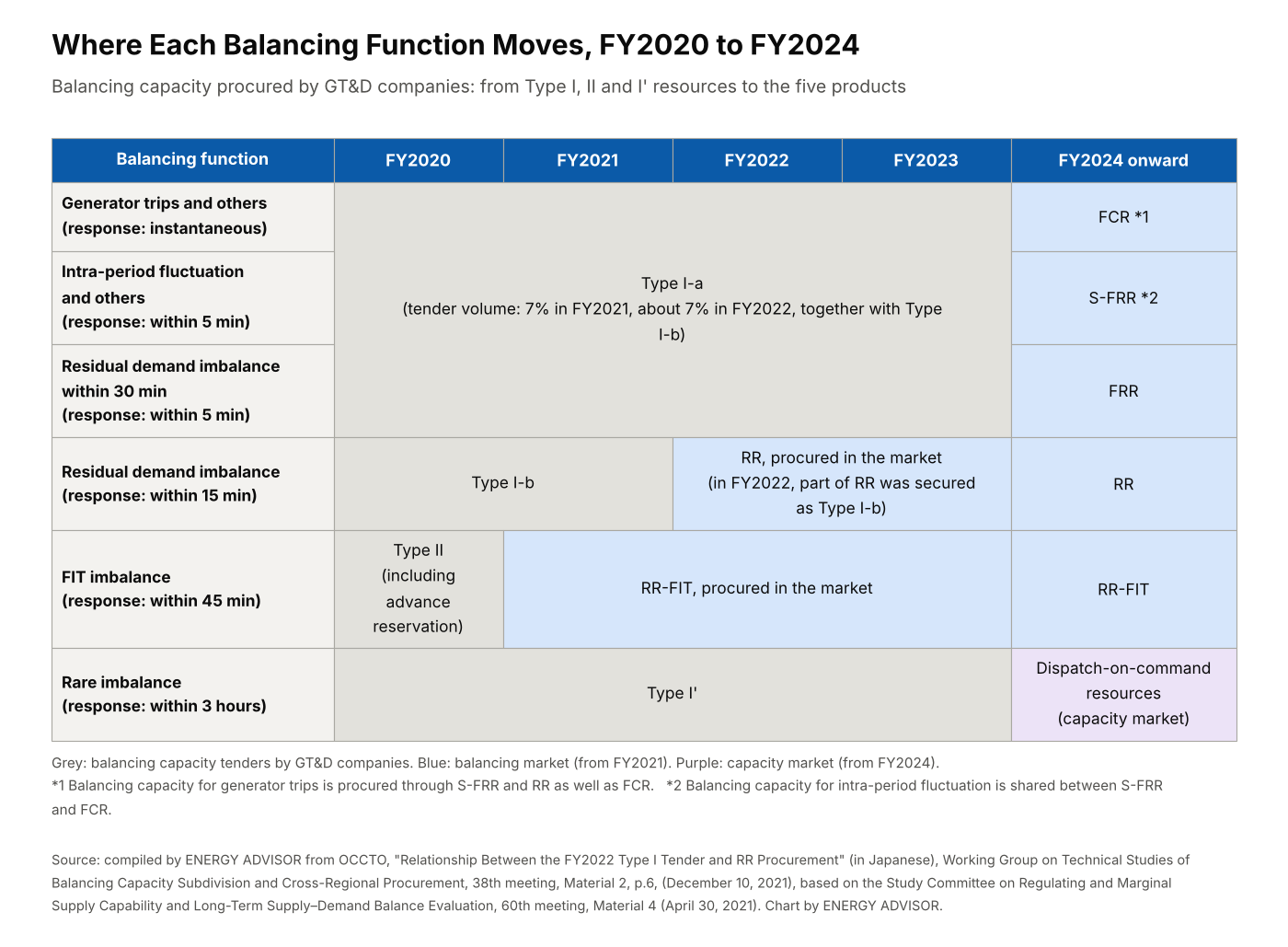
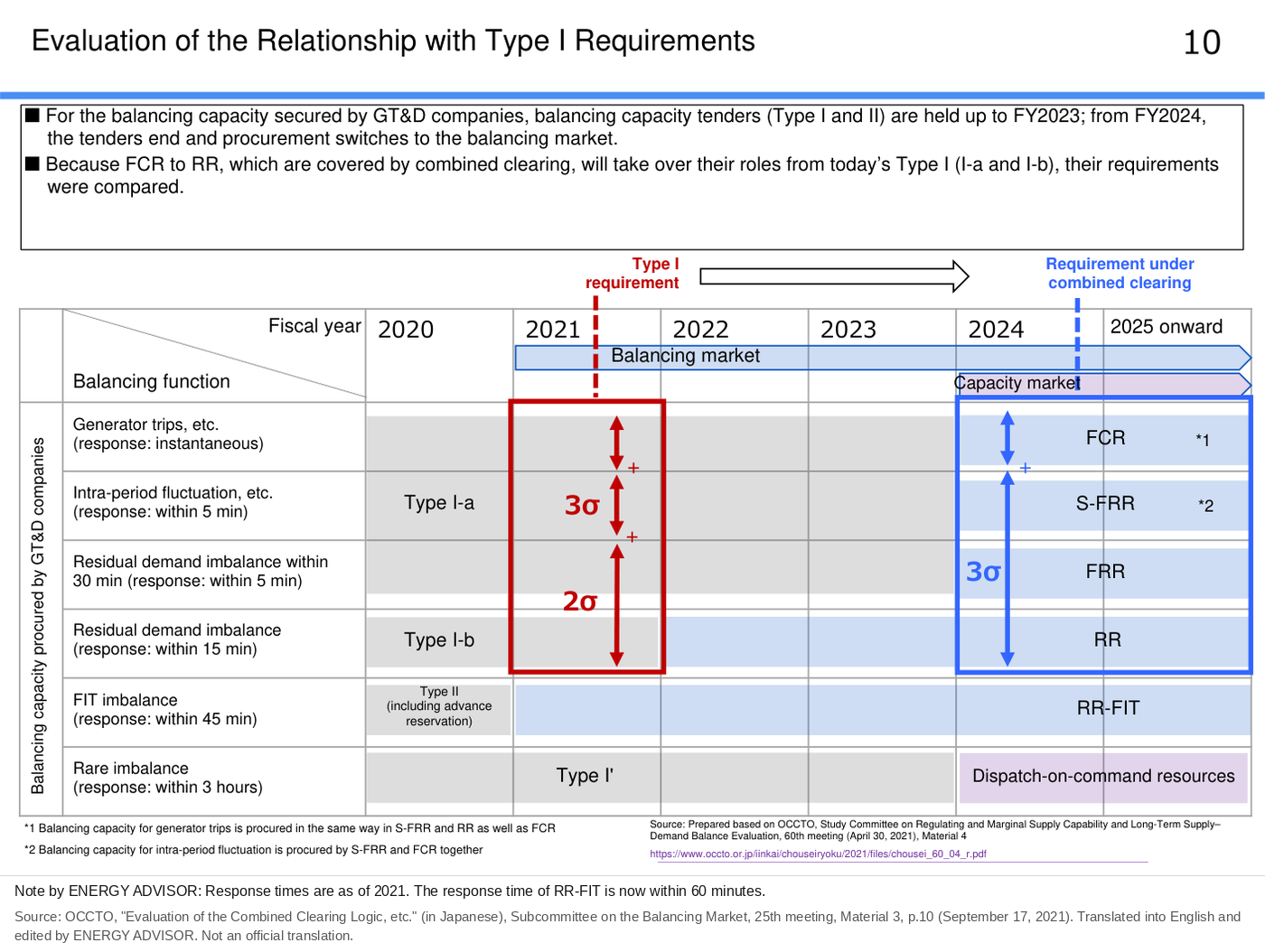
The roles moved as follows (OCCTO, Subcommittee on the Balancing Market, 25th meeting, Material 3, p.10).
| Tender resource | Role it covered | Where it moved in the balancing market |
|---|---|---|
| Type I-a | Responding to generator trips, intra-period fluctuation, and residual demand deviations within 30 minutes (frequency control) | FCR, S-FRR and FRR from FY2024 |
| Type I-b | Residual demand deviations (supply-demand balancing) | RR from FY2022 |
| Type II (including advance reservation) | Forecast error of FIT renewables | RR-FIT from FY2021 |
| Type I’ | Supply-demand deviations that rarely occur (rare imbalances; response within 3 hours) | Dispatch-on-command resources in the capacity market from FY2024 |
Residual demand is demand minus renewable output. Dispatch-on-command resources are one of the categories of resources secured in the capacity market. They include resources that find it hard to keep supplying electricity steadily, specified curtailment requests (requests to customers to reduce their electricity use), and small facilities of less than 1,000 kW, which together provide supply capacity of 1,000 kW or more (OCCTO, “Main Auction Application Guidelines for the Capacity Market (Delivery Year: FY2030),” pp.11–12).
Up to FY2020
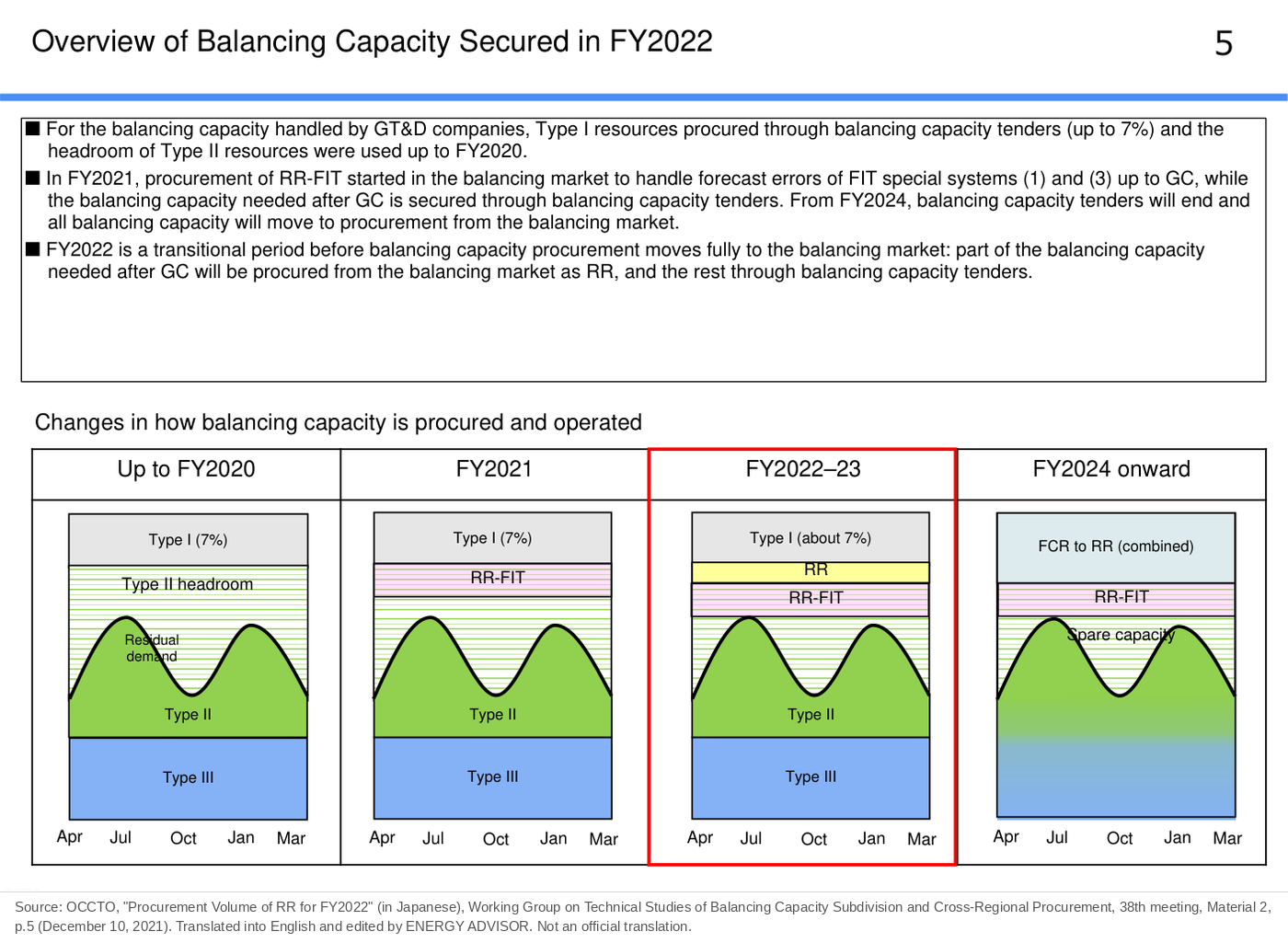
GT&D companies secured Type I resources (up to 7%) and Type II resources through balancing capacity tenders. They used Type I resources for frequency control and supply-demand balancing. Type II resources ran according to their generation plans as supply capacity for retail electricity suppliers, and if spare capacity remained after GC (gate closure, the deadline for plans one hour before real time), the GT&D company used that spare capacity.
FY2021
The balancing market opened, and part of Type II spare capacity was replaced by RR-FIT. RR-FIT is balancing capacity that covers renewable forecast error up to GC under FIT special system (1) and (3) (the arrangements under which GT&D companies forecast renewable output).
FY2022 and FY2023
As a transitional period before the full move to the market, part of Type II spare capacity was replaced by RR. RR is balancing capacity that plays the role of economic load dispatching control (EDC) for the long-period component of demand. Because Type I resources still remained in this period, the procurement volume of RR was adjusted so that Type I resources and RR together would not provide too much balancing capacity (article 7).
FY2024: End of Balancing Capacity Tenders and Spare-Capacity Utilization Contracts
In FY2024, balancing capacity tenders ended except in the Okinawa area, and the Type I and Type II system was abolished. In principle, all balancing capacity (FCR to RR-FIT) came to be procured from the balancing market (OCCTO, Study Committee on Regulating and Marginal Supply Capability and Long-Term Supply–Demand Balance Evaluation, 86th meeting, Material 1, p.2 and p.4).
At the same time, “spare-capacity utilization contracts” began. A spare-capacity utilization contract is required of resources with balancing functions in the capacity market, and allows the GT&D company to use their spare capacity. The difference from Type II resources lies in the authority to start up and shut down.
| Item | Type II resources (up to FY2023) | Spare-capacity utilization contract (from FY2024) |
|---|---|---|
| Authority to start up and shut down | Held by the GT&D company | In principle, held by the generation side (BG) |
| Spare capacity the GT&D company can use | Includes capacity from additional start-ups | In principle, only the spare capacity of resources already running |
| Positioning | One of the main means of procuring balancing capacity | A supplementary means after securing capacity in the market |
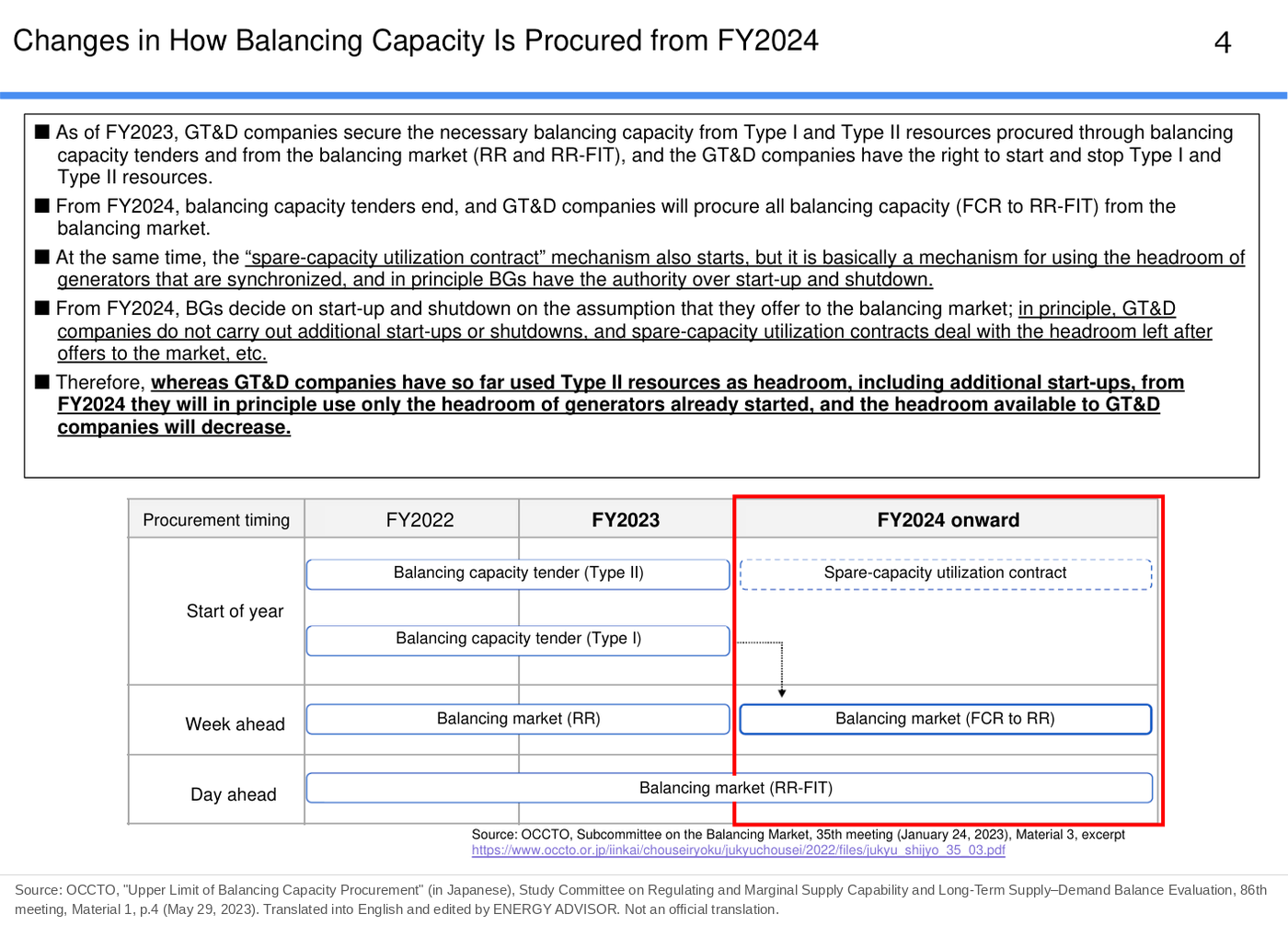
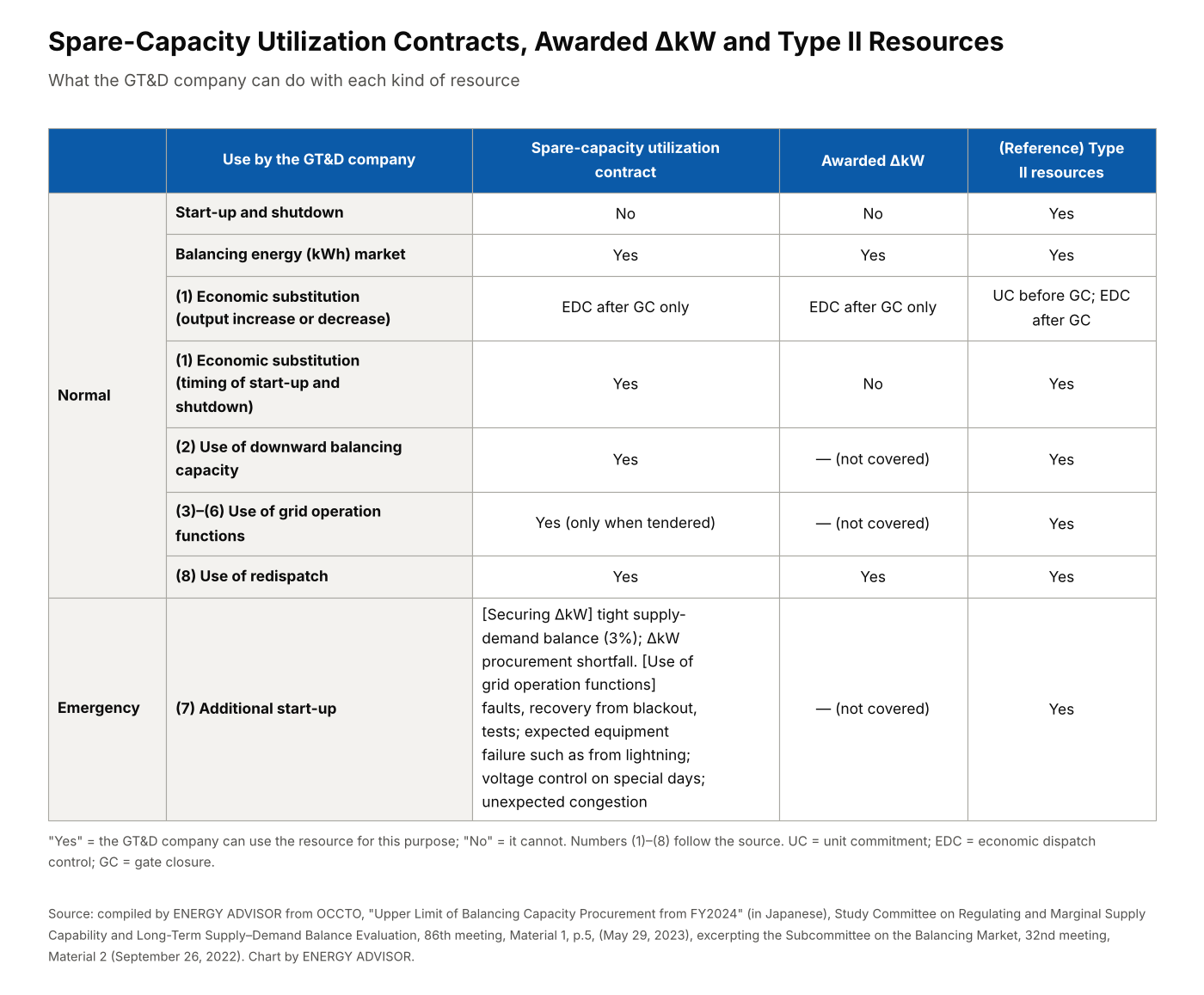
A balancing group (BG) is a group of power generation companies and retail electricity suppliers responsible for planned-value balancing (matching actual supply and demand to submitted plans in every 30-minute period). From FY2024, the BG decides on start-up and shutdown of resources on the assumption that they will be offered to the balancing market, and additional start-ups by the GT&D company are, in principle, not carried out. The spare capacity the GT&D company can use is therefore smaller than in the Type II era (same, p.4).
For this reason, OCCTO concluded that from FY2024 there would be no 7% cap like that for Type I resources, and that the full requirement for balancing capacity would be procured in the balancing market. Spare-capacity utilization contracts were positioned as a supplementary means for economic substitution (same, p.5 and p.19).
What Happened After the Transition
After the full transition, things happened in the balancing market that differed from expectations. Articles 1 and 10 explain them in detail.
- Under-procurement: After trading of all products began in April 2024, bids continued to fall short of the procurement volume in all products. RR had faced the same problem since it started in FY2022.
- Out-of-market procurement: As emergency measures against undersubscription, negotiated contracts for pumped storage (from the Chubu area in July 2024) and an operation that deducted the spare capacity of resources already running (unoffered headroom) from the procurement volume (June 2025 to March 2026) were introduced. At the Working Group on Market Design of the Agency for Natural Resources and Energy (ANRE) in May 2025, a direction was presented to also use procurement means other than the balancing market for the time being. The means to be used alongside it are resources under spare-capacity utilization contracts and negotiated contracts for pumped storage and similar resources (OCCTO, Study Committee on Regulating and Marginal Supply Capability and Long-Term Supply–Demand Balance Evaluation, 117th meeting, Material 4, p.71).
- Review of the requirement and procurement volume: The volume procured in the market was reduced from the 3σ-equivalent value to the 1σ-equivalent value, with the rest secured through spare-capacity utilization contracts.
- Day-ahead trading: From delivery on March 14, 2026, trading of FCR to RR and the combined product moved from week-ahead to day-ahead.
In the tender era, GT&D companies could start up resources, including Type II resources, and use them as spare capacity. The loss of that means with the move to the market is the background to the debate over out-of-market procurement and the positioning of spare-capacity utilization contracts.
Related Articles
- Overview of the balancing market and the 2026 changes: article 1
- The five products and frequency control: article 2
- Explanations of each product: article 4 (FCR) to article 8 (RR-FIT)
- Negotiated contracts for pumped storage: article 10
This article is based on published materials from the Ministry of Economy, Trade and Industry and its Agency for Natural Resources and Energy, the Electricity and Gas Market Surveillance Commission, the Organization for Cross-regional Coordination of Transmission Operators (OCCTO) and other sources. The English translations of figures are by ENERGY ADVISOR and are not official translations. When using this information for decisions, please check the original sources. When we find an error, we correct the article and note the date of the correction.
Sources
- OCCTO, Study Committee on Regulating and Marginal Supply Capability and Long-Term Supply–Demand Balance Evaluation, 86th meeting, Material 1, “Upper Limit of Balancing Capacity Procurement” (in Japanese), pp.2–5 and p.19, May 29, 2023. https://www.occto.or.jp/iinkai/chouseiryoku/2023/files/chousei_86_01.pdf
- OCCTO, Study Committee on Regulating and Marginal Supply Capability and Long-Term Supply–Demand Balance Evaluation, 74th meeting, Material 5, “Compilation of the Plans for Securing Balancing Capacity for FY2022 (Report)” (in Japanese), p.3 (six categories of Type I and Type II resources), June 28, 2022. https://www.occto.or.jp/assets/iinkai/chouseiryoku/2022/files/chousei_74_05.pdf
- OCCTO, Study Committee on Regulating and Marginal Supply Capability and Long-Term Supply–Demand Balance Evaluation, 62nd meeting, Material 5, “Approach to Requirements for Balancing Capacity Tenders for FY2022 (Draft)” (in Japanese), pp.2–3 (procurement approach, Type I and Type II categories), June 18, 2021. https://www.occto.or.jp/assets/iinkai/chouseiryoku/2021/files/chousei_62_05r.pdf
- ANRE, Working Group on Market Design, 68th meeting, Material 5, “The Balancing Market” (in Japanese), p.7 (transition of Type I-a and I-b), July 14, 2022. https://www.meti.go.jp/shingikai/enecho/denryoku_gas/denryoku_gas/seido_kento/pdf/068_05_00.pdf
- OCCTO, Subcommittee on the Balancing Market, 25th meeting, Material 3, “Evaluation of the Combined Clearing Logic and Related Matters” (in Japanese), p.10 (evaluation of the relationship with Type I requirements), September 17, 2021. https://www.occto.or.jp/iinkai/chouseiryoku/jukyuchousei/2021/files/jukyu_shijyo_25_03.pdf
- OCCTO, Working Group on Technical Studies of Balancing Capacity Subdivision and Cross-Regional Procurement, 38th meeting, Material 2, “Procurement Volume of RR for FY2022” (in Japanese), p.5 and p.6, December 10, 2021. https://www.occto.or.jp/assets/iinkai/chouseiryoku/sagyoukai/2021/files/chousei_sagyokai_38_02.pdf
- Electric Power Reserve eXchange (EPRX), “What Is the Supply and Demand Balancing Market” (in Japanese), accessed October 2026. https://www.eprx.or.jp/outline/outline.html
- Government of Japan, “Approach to Procurement of Balancing Capacity Through Tenders by GT&D Companies” (in Japanese) (posted on the website of the Electricity and Gas Market Surveillance Commission), p.2 and p.5, October 17, 2016. https://www.egc.meti.go.jp/info/guideline/pdf/20171211.pdf
- OCCTO, “Main Auction Application Guidelines for the Capacity Market (Delivery Year: FY2030)” (in Japanese), pp.11–12 (categories of resources providing capacity), July 30, 2026. https://www.occto.or.jp/assets/market-board/market/jitsujukyukanren/260730_mainauction_boshuyoukou_jitsujukyu2030.pdf
- OCCTO, Study Committee on Regulating and Marginal Supply Capability and Long-Term Supply–Demand Balance Evaluation, 117th meeting, Material 4, “Status of Discussions in the Subcommittee on the Balancing Market (FY2025 Report)” (in Japanese), p.2, p.63, p.65 and p.71, March 16, 2026. https://www.occto.or.jp/assets/chousei_117_04.pdf