What the Balancing Market Is
General transmission and distribution companies (GT&D companies; the companies that operate each area’s grid and are responsible for frequency and the supply-demand balance) need to secure balancing capacity to balance supply and demand and to control frequency.
The Operational Rules of the Organization for Cross-regional Coordination of Transmission Operators, JAPAN (OCCTO) define “balancing capacity” as follows (Article 2, Paragraph 2, Item 6, version amended on August 1, 2026).
“Balancing capacity” means the capability of generation facilities (including pumped-storage hydropower facilities), storage facilities, demand response and other systems that control electricity supply and demand, and anything equivalent to them (excluding network facilities), that is needed for frequency control, supply-demand balancing and other system stabilization duties.
In the past, this balancing capacity was collected through “balancing capacity tenders.” Because a resource secured through a tender was held as a whole, its “supply capacity (kW)” and “balancing capacity (ΔkW)” could be operated together.
GT&D companies later moved to a system that procures only the balancing capacity of resources. The market for procuring that balancing capacity is the “Supply and Demand Balancing Market” (balancing market), which opened in April 2021. Products were added in stages, and trading of all five products was in place in FY2024 (April 2024–March 2025). In Japan, the fiscal year runs from April to March. The balancing capacity tenders ended in FY2024, except in the Okinawa area. The first article gives an overview of the market, and the third article explains the transition from tenders.
What Balancing Capacity Deals With
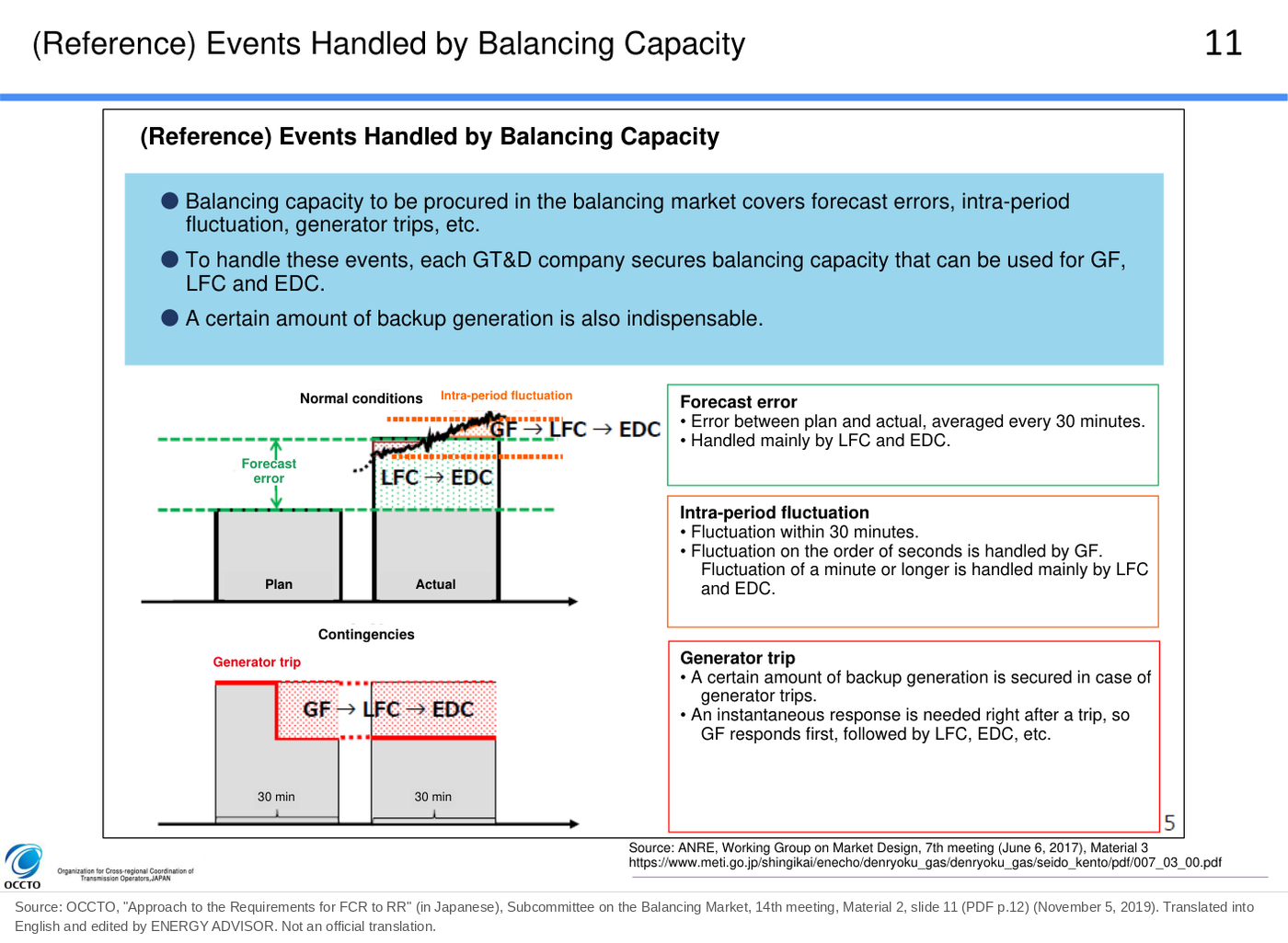
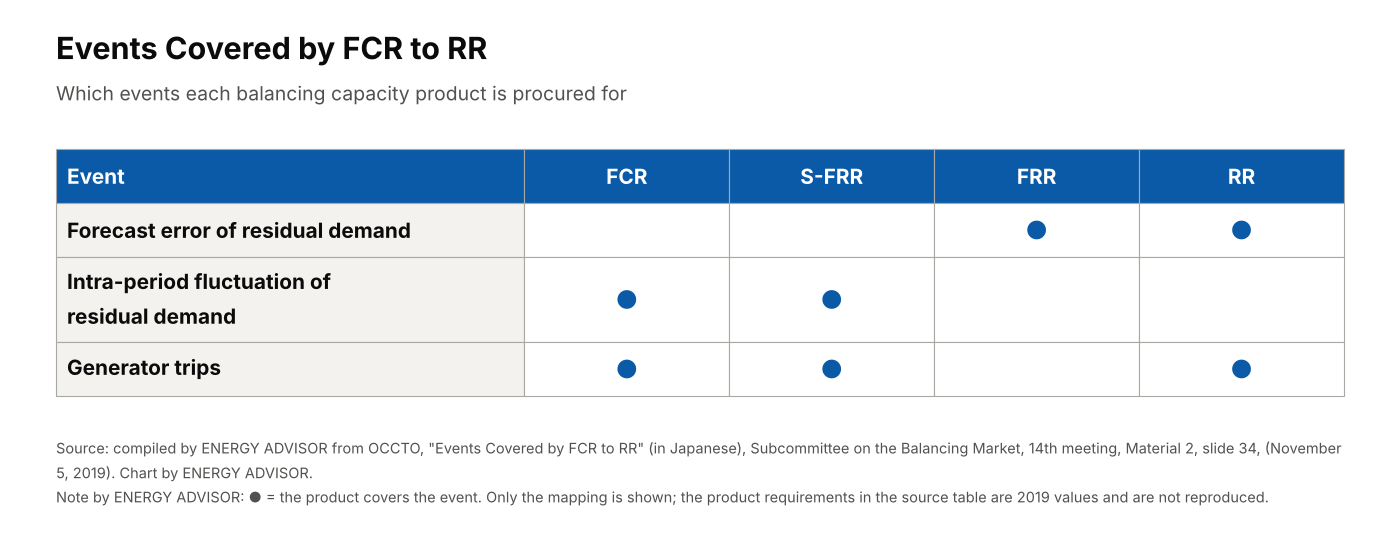
The events handled with balancing capacity procured in the balancing market fall broadly into two groups: normal conditions and contingencies.
In Japan, power generation companies and retail electricity suppliers prepare plans for every 30 minutes and submit them by one hour before real time (gate closure, GC). Any mismatch that arises after GC is covered by the GT&D company with balancing capacity.
Normal Conditions
In normal conditions, balancing capacity is used to deal with the “forecast error” between actual and forecast values of demand and renewable output.
In addition, plans are made in 30-minute units. Fluctuations in demand and renewables over periods shorter than 30 minutes (“intra-period fluctuation”) must also be finely adjusted with balancing capacity.
Forecast Error
Demand forecast error:
Retail electricity suppliers forecast demand and prepare demand plans. However, no plan can match actual demand exactly, so a difference between forecast and actual arises after GC. This is called “forecast error,” and balancing capacity is used to match demand and supply.
Renewable forecast error:
Among the forecasts made under FIT special system (1) and (3) (the arrangements under which GT&D companies forecast renewable output), the difference between the output forecast at GC and the actual value is also handled with balancing capacity. FIT stands for the Feed-in Tariff (FIT) scheme.
Intra-Period Fluctuation
Intra-period fluctuation of demand and renewables:
Actual demand changes from moment to moment, and renewable output also changes from moment to moment. Even if forecast and actual values match as 30-minute averages, small fluctuations occur over periods shorter than 30 minutes.
This is called “intra-period fluctuation,” and balancing capacity is also used to match demand and supply against it.
Contingencies
A contingency here means a generator stopping unexpectedly because of a fault or other trouble (generator trip).
When a generator trip occurs, supply capacity drops suddenly and frequency falls sharply, which could lead to a large-scale blackout. The lost supply capacity therefore needs to be made up immediately with balancing capacity.
Generators’ Frequency Control Functions
The products of the balancing market are divided into five types (FCR to RR-FIT) based on the frequency control functions of generators. GT&D companies use the products they procure to deal with normal conditions and contingencies.
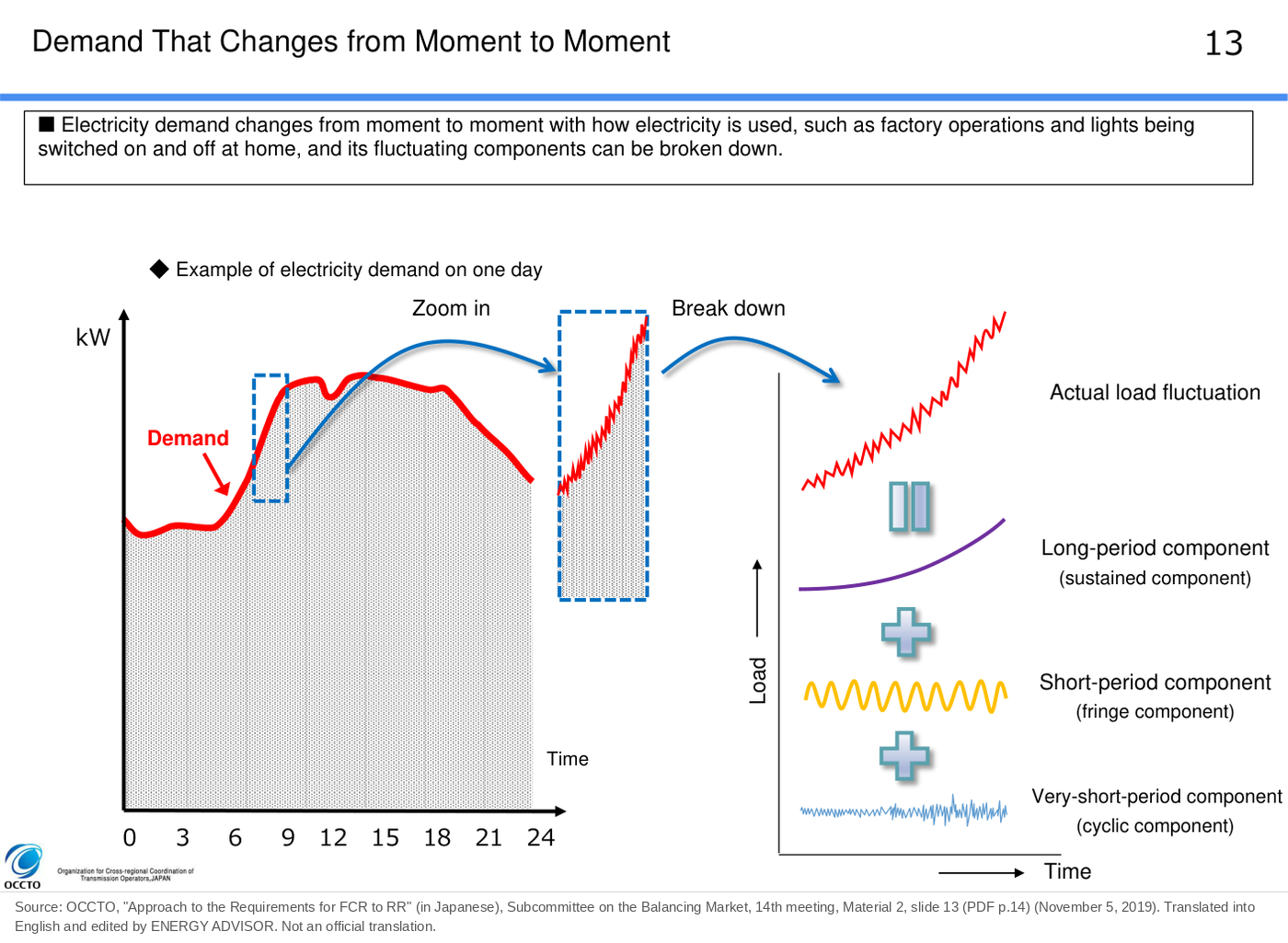
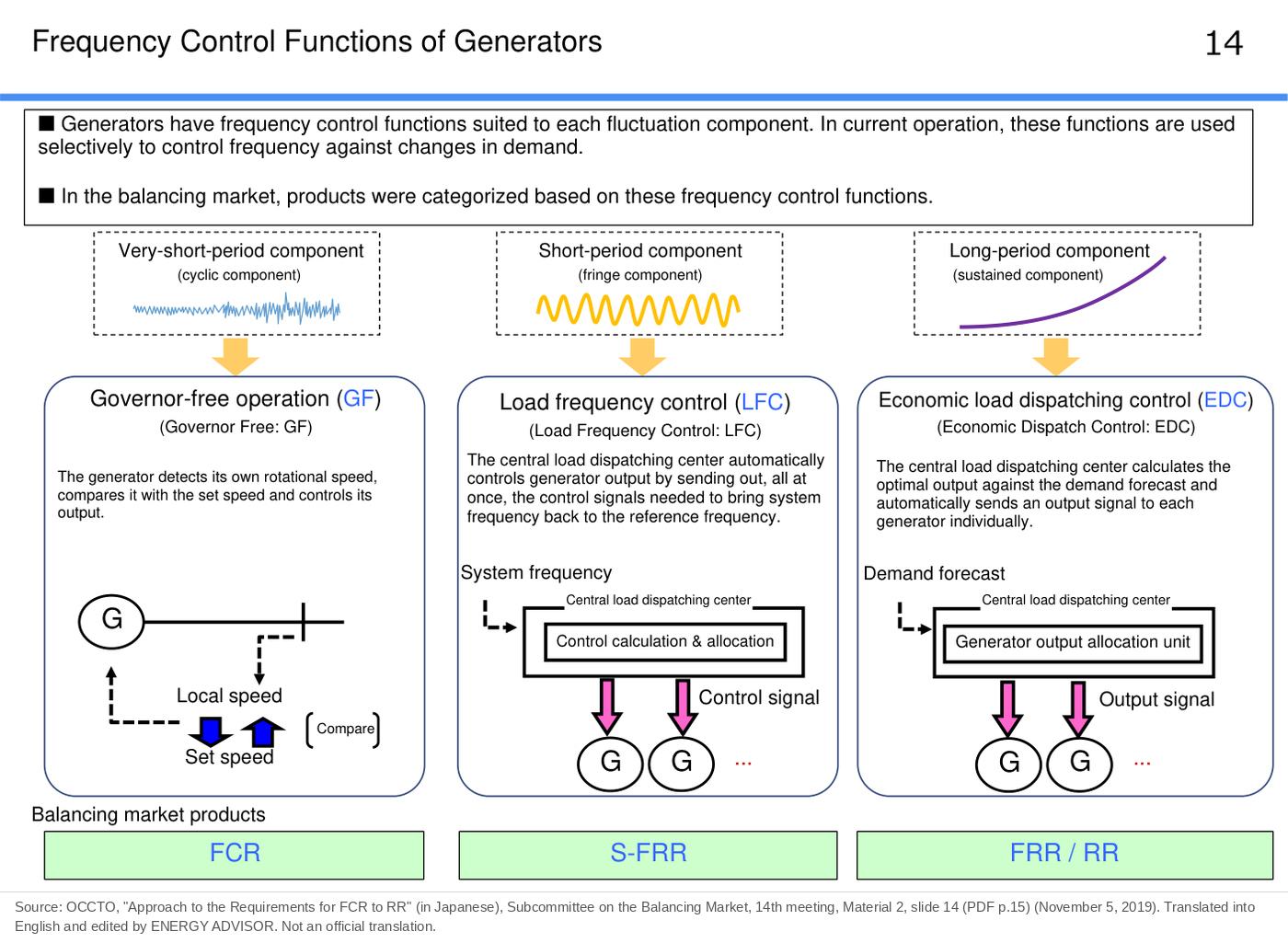
Generators have frequency control functions called governor-free operation (GF), load frequency control (LFC) and economic load dispatching control (EDC), and each function handles a different period of demand fluctuation. These functions are essential to a stable power supply, and the requirements of the balancing market’s products are set so that they have the same functions.
Governor-Free Operation (GF)
The “very-short-period component,” demand fluctuation of a few seconds to a few minutes, is handled by generators’ governor-free operation (GF).
A governor is a device that automatically adjusts the steam flow or other driving power of a generator to keep its rotational speed (frequency) constant.
Governor-free operation is operation in which the generator’s output is allowed to change freely through the action of the governor in response to changes in grid frequency. It adjusts output automatically so that the frequency deviation does not grow. Returning frequency to the reference value is the role of LFC, described next.
Because it can react quickly to frequency fluctuations, it is used for frequency control of the very-short-period component. In the balancing market, it corresponds to Frequency Containment Reserve (FCR; primary balancing capacity).
Load Frequency Control (LFC)
The “short-period component,” demand fluctuation of a few minutes to around ten-plus minutes, is handled by load frequency control (LFC).
Load frequency control is a function in which each area’s central load dispatching center (the GT&D company’s control room) calculates the adjustment needed to bring the current frequency back to the reference frequency (50 Hz or 60 Hz), sends control instructions to the target generators, and controls their output automatically. In Japan, the east runs at 50 Hz and the west at 60 Hz.
It is the core of frequency control, and generators under LFC must respond reliably and quickly. In the balancing market, it corresponds to Synchronized Frequency Restoration Reserve (S-FRR; secondary balancing capacity (1)).
Economic Load Dispatching Control (EDC)
The “long-period component,” demand fluctuation of around ten-plus minutes to several hours, is handled by economic load dispatching control (EDC).
Economic load dispatching control is a function in which each area’s central load dispatching center forecasts demand changes from around ten-plus minutes to several hours ahead and calculates the output allocation that minimizes generation cost for the whole area.
By controlling generator output based on this allocation, the total cost of the generators controlled by the central load dispatching center can be minimized. In the balancing market, it corresponds to Frequency Restoration Reserve (FRR; secondary balancing capacity (2)) and Replacement Reserve (RR; tertiary balancing capacity (1)).
How GF, LFC and EDC Map to the Five Products
The relationship among components of demand fluctuation, frequency control functions and balancing market products is summarized below.
| Component of demand fluctuation | Typical period | Generator function | Balancing market product |
|---|---|---|---|
| Very-short-period component | Seconds to minutes | Governor-free operation (GF) | FCR |
| Short-period component | Minutes to around ten-plus minutes | Load frequency control (LFC) | S-FRR |
| Long-period component | Around ten-plus minutes to several hours | Economic load dispatching control (EDC) | FRR and RR |
| Forecast error of FIT renewables (from two days ahead to GC) | — | — | Replacement Reserve-for FIT (RR-FIT; tertiary balancing capacity (2)) |
Requirements of the Five Products
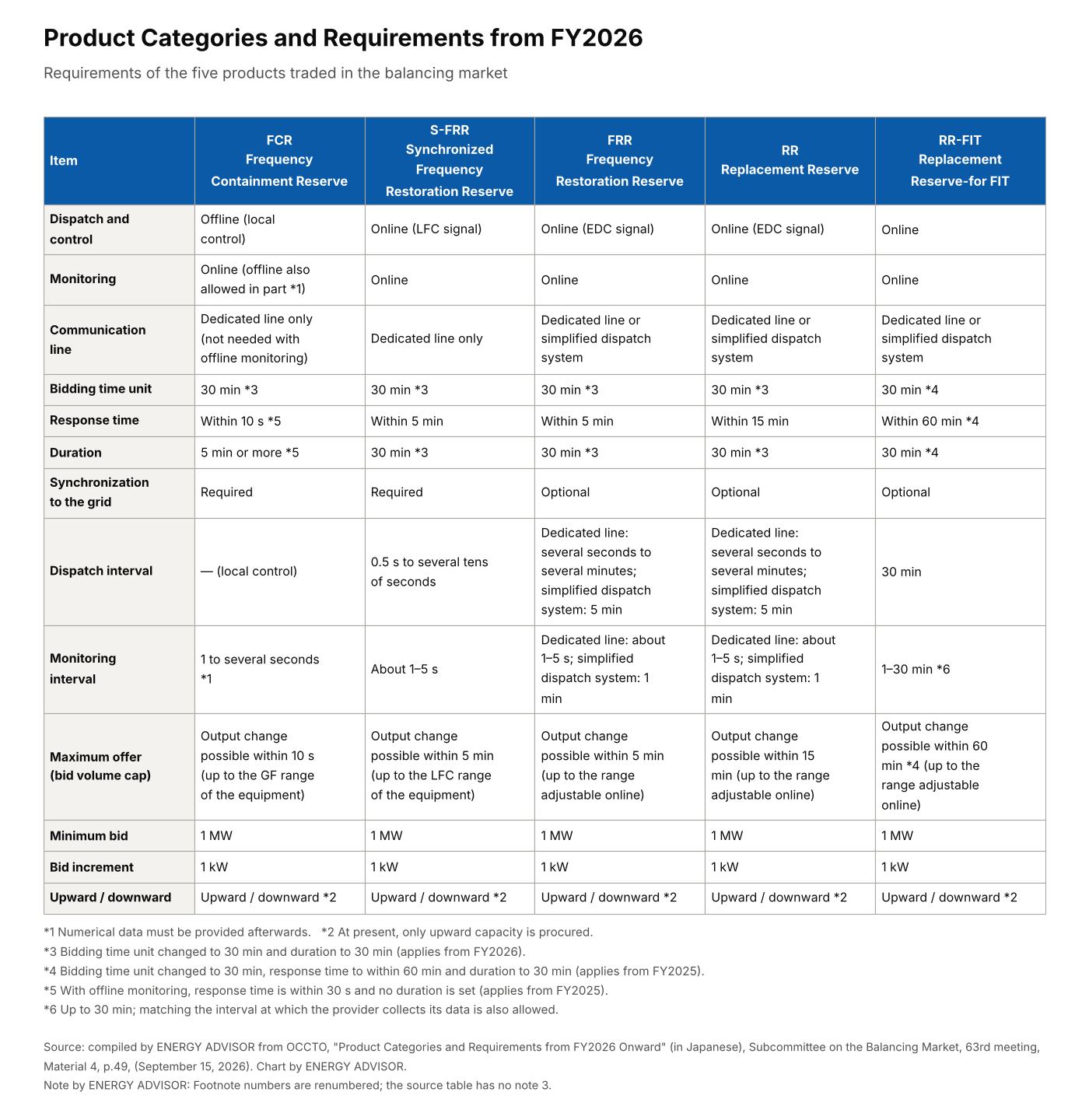
The main requirements of each product under the product requirements of March 2026 (6th edition) are as follows.
| Item | FCR | S-FRR | FRR | RR | RR-FIT |
|---|---|---|---|---|---|
| Instruction and control | Offline (local control) | Online (LFC signal) | Online (EDC signal) | Online (EDC signal) | Online |
| Response time | Within 10 seconds | Within 5 minutes | Within 5 minutes | Within 15 minutes | Within 60 minutes |
| Duration | 5 minutes or more | 30 minutes | 30 minutes | 30 minutes | 30 minutes |
| Synchronization | Required | Required | Optional | Optional | Optional |
| Communication line | Dedicated communication line only (not needed with offline monitoring) | Dedicated communication line only | Dedicated communication line or simplified dispatch system | Dedicated communication line or simplified dispatch system | Dedicated communication line or simplified dispatch system |
| Bidding time unit | 30 minutes | 30 minutes | 30 minutes | 30 minutes | 30 minutes |
| Minimum bid | 1 MW | 1 MW | 1 MW | 1 MW | 1 MW |
Some terms are explained below.
- Local control: Control in which the resource measures frequency at its own site and changes its own output. Only FCR uses this method.
- Synchronized: The state in which a generator is connected to the grid and running. For products where it is “required” (must be synchronized), the resource must be connected to the grid during the time slots in which it provides balancing capacity.
- Simplified dispatch system: A communication method other than a dedicated communication line. The instruction interval is 5 minutes and the monitoring interval is 1 minute (product requirements, 6th edition, p.2). It can be used for FRR, RR and RR-FIT.
- When FCR is monitored offline (a method in which actual data are submitted afterward), the response time is within 30 seconds and no duration is set.
At present, only upward balancing capacity (the side that increases output) is procured.
Why Only RR-FIT Has a Different Time Frame
FCR to RR are products that respond to changes that arise after GC (forecast errors, intra-period fluctuation and generator trips).
RR-FIT is a product that covers the part of renewable forecast error, held by GT&D companies under FIT special system (1) and (3), that arises between two days ahead and GC. Because an instruction only needs to be issued at GC (one hour before real time), its response time is set long, at within 60 minutes. Article 8 explains it in detail.
Detailed Articles on Each Product
- FCR (equivalent to GF): article 4
- S-FRR (equivalent to LFC): article 5
- FRR (equivalent to EDC; not used for contingencies): article 6
- RR (equivalent to EDC): article 7
- RR-FIT (forecast error of FIT renewables): article 8
- Combined product (one resource offering FCR to RR together): article 9
Summary
The balancing market trades five types of products (FCR to RR-FIT), divided according to generators’ frequency control functions. Trading of all products was in place in FY2024.
GT&D companies use the balancing capacity procured in the balancing market to deal with normal conditions (forecast errors and intra-period fluctuation) and contingencies (generator trips).
Generators have frequency control functions called governor-free operation (GF), load frequency control (LFC) and economic load dispatching control (EDC), which are essential to a stable power supply. The requirements of the balancing market’s products are set so that they meet these functions.
This article is based on published materials from the Ministry of Economy, Trade and Industry and its Agency for Natural Resources and Energy, the Electricity and Gas Market Surveillance Commission, the Organization for Cross-regional Coordination of Transmission Operators (OCCTO) and other sources. The English translations of figures are by ENERGY ADVISOR and are not official translations. When using this information for decisions, please check the original sources. When we find an error, we correct the article and note the date of the correction.
Sources
- OCCTO, “Operational Rules” (in Japanese), Article 2, Paragraph 2, Item 6 (amended August 1, 2026). https://www.occto.or.jp/assets/occto/article/index/gyoumukitei2608.pdf
- OCCTO, Subcommittee on the Balancing Market, 14th meeting, Material 2, “Approach to the Requirements for FCR to RR” (in Japanese), slide numbers 11, 13, 14 and 34 (PDF pages 12, 14, 15 and 35), November 5, 2019. https://www.occto.or.jp/iinkai/chouseiryoku/jukyuchousei/2019/files/jukyu_shijyo_14_02r.pdf
- OCCTO, Subcommittee on the Balancing Market, 63rd meeting, Material 4, “Direction and Summary of Discussions in the Subcommittee on the Balancing Market (Results for the First Half of FY2026 and Plans for the Second Half of FY2026 Onward)” (in Japanese), p.49, September 15, 2026. https://www.occto.or.jp/assets/iinkai/jukyuchousei/63/jukyu_shijyo_63_04.pdf
- Electric Power Reserve eXchange (EPRX), “What Is the Supply and Demand Balancing Market” (in Japanese), accessed October 2026. https://www.eprx.or.jp/outline/outline.html
- EPRX, “Product Requirements and Trading Schedule of the Supply and Demand Balancing Market (6th edition)” (in Japanese), p.2, March 13, 2026. https://www.eprx.or.jp/outline/docs/shouhin_ver.6_20260313.pdf
- OCCTO, Study Committee on Regulating and Marginal Supply Capability and Long-Term Supply–Demand Balance Evaluation, 86th meeting, Material 1, “Upper Limit of Balancing Capacity Procurement” (in Japanese), p.2, May 29, 2023. https://www.occto.or.jp/iinkai/chouseiryoku/2023/files/chousei_86_01.pdf