Role of RR
Replacement Reserve (RR; tertiary balancing capacity (1)) is one of the five products of the Supply and Demand Balancing Market (balancing market; the market in which general transmission and distribution companies, or GT&D companies, procure balancing capacity; see article 1). Trading began in April 2022.
RR is balancing capacity against the “long-period component,” demand fluctuation of around ten-plus minutes to several hours.
Demand fluctuation is divided by period into “very-short-period,” “short-period” and “long-period” components. Of these, the long-period component has been handled by economic load dispatching control (EDC). EDC is a function in which each area’s central load dispatching center (the GT&D company’s control room) forecasts demand changes from around ten-plus minutes to several hours ahead and allocates output so that generation cost for the whole area is minimized (article 2). Like Frequency Restoration Reserve (FRR; secondary balancing capacity (2)), RR was designed as a product equivalent to this control function provided by EDC.
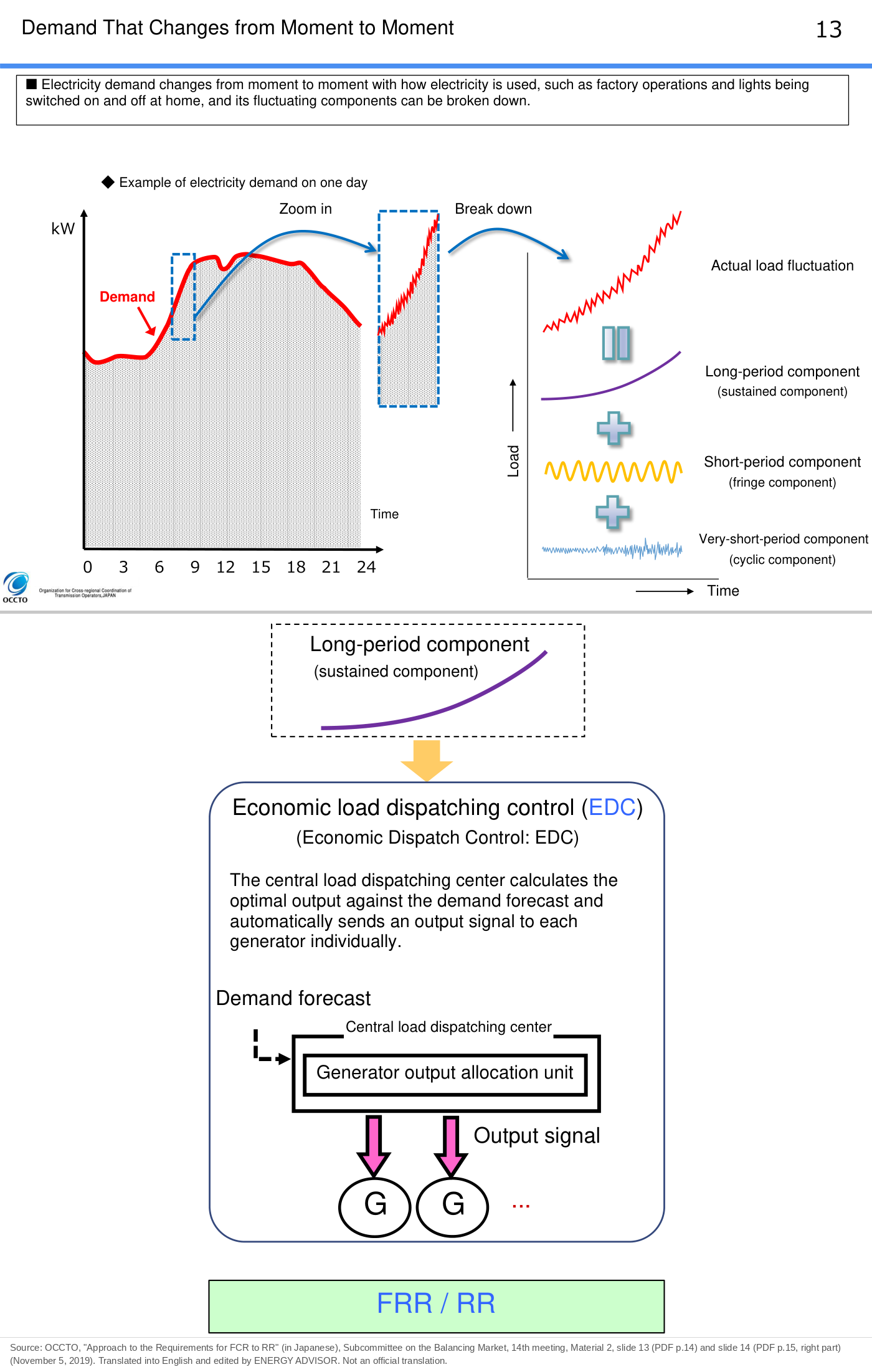
Role in Normal Conditions (Responding to Forecast Errors of Demand and Renewables)
Demand Forecast Error
Retail electricity suppliers forecast their own demand in 30-minute units and prepare a “balancing group schedule.” A balancing group (BG) is a group of companies responsible for matching actual results to plans. Because no BG schedule can match actual demand exactly, a difference between forecast and actual arises after gate closure (GC; the deadline for plans one hour before real time).
This is called “forecast error.” RR is responsible for adjusting this forecast error between the BG schedule and actual demand.
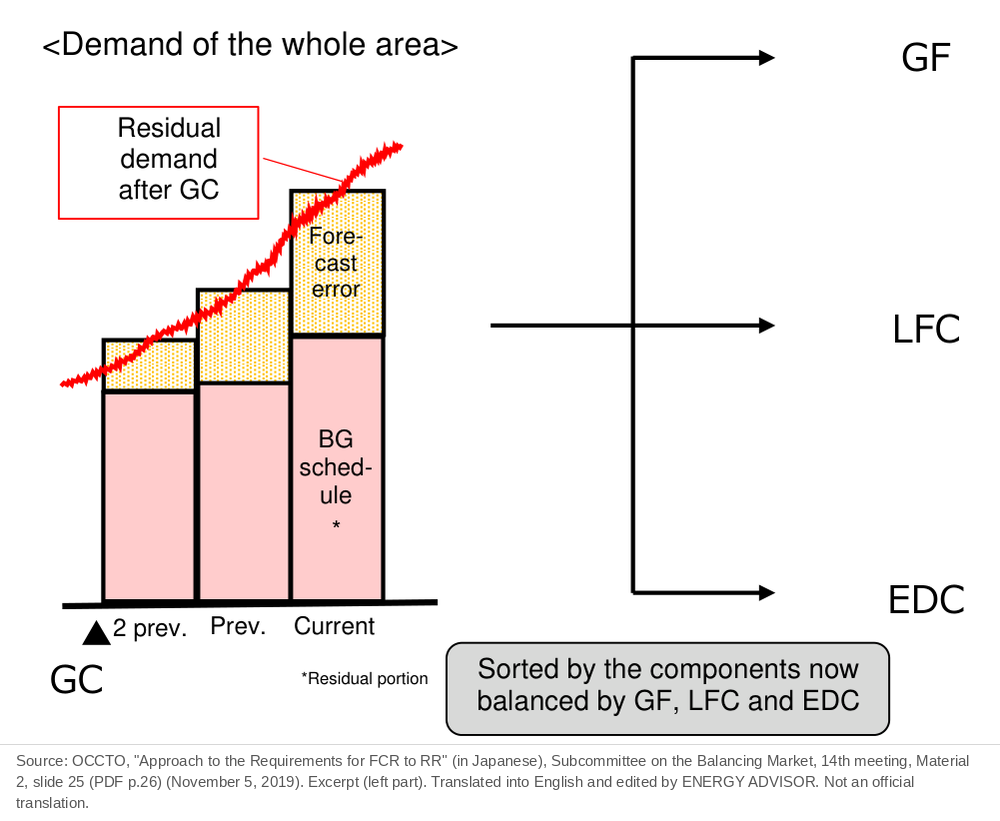
Renewable Forecast Error
In forecasts made under FIT special system (1) and (3) (the arrangements under which GT&D companies forecast renewable output), forecast error also arises between the forecast value at GC and the actual value. RR also responds to this renewable forecast error after GC.
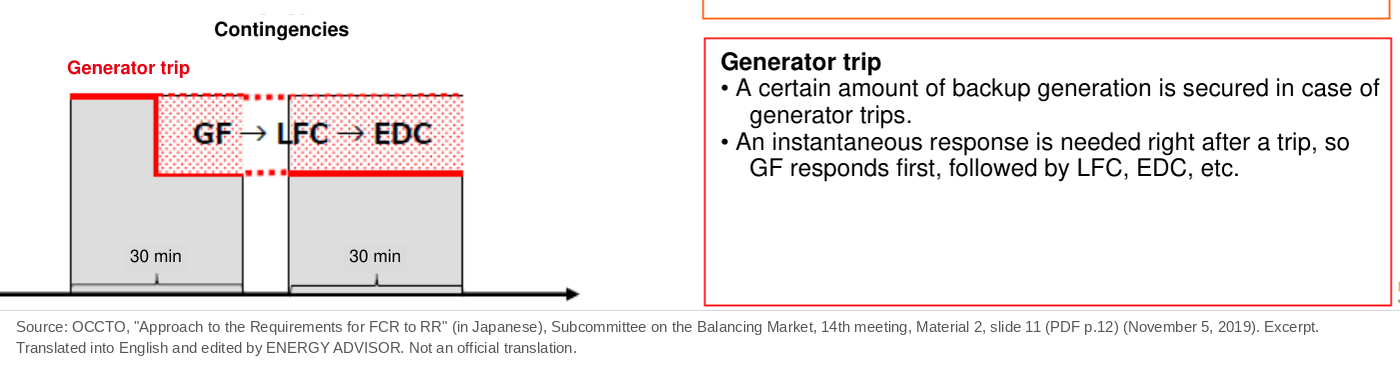
Role in Contingencies
A contingency here means a generator stopping unexpectedly because of a fault or other trouble (generator trip). When a generator trip occurs, supply capacity drops suddenly and frequency falls, which could lead to a large-scale blackout.
Against a frequency drop caused by a generator trip, balancing capacity is handed over in order, starting with Frequency Containment Reserve (FCR; primary), which responds fast but has a short duration, then Synchronized Frequency Restoration Reserve (S-FRR; secondary (1)), and then RR, to restore frequency. RR covers the last stage.
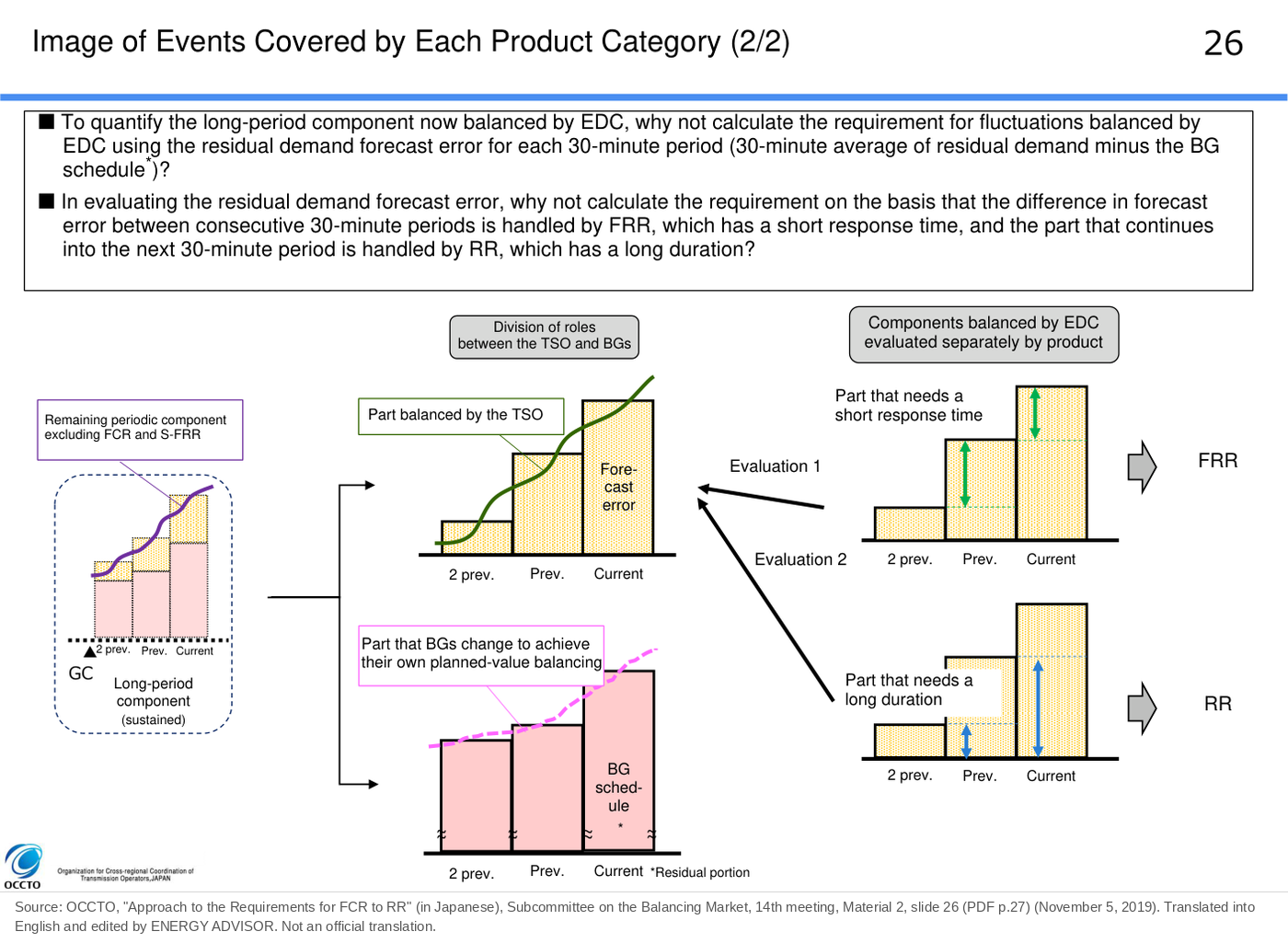
Division of Roles with FRR
The long-period component of demand includes, in addition to demand forecast error, changes that BGs make to their own generation plans to comply with planned-value balancing. What the GT&D company adjusts is therefore the “forecast error” part, which is the long-period component minus the part due to BG schedules.
This forecast error is shared between FRR and RR according to their response speed.
| Product | Part it covers | Characteristics |
|---|---|---|
| FRR | The change in forecast error between one 30-minute period and the next | Fast response (within 5 minutes) |
| RR | The part of the forecast error that persists across periods | Slower response (within 15 minutes), but can keep providing output |
For example, if the forecast error grows from two periods before to the previous period and then to the current period, FRR adjusts the increase in each period. After FRR has adjusted, RR takes over from the next 30-minute period, and FRR gets ready for the next adjustment.
Product Requirements
The main requirements of RR are as follows (Electric Power Reserve eXchange (EPRX), product requirements, 6th edition, March 13, 2026).
| Item | Requirement |
|---|---|
| Instruction and control | Online (EDC signal) |
| Communication line | Dedicated communication line or simplified dispatch system |
| Response time | Within 15 minutes |
| Duration | 30 minutes |
| Synchronization | Optional |
| Instruction interval | Dedicated line: a few seconds to a few minutes / simplified dispatch system: 5 minutes |
| Bidding time unit and minimum bid | 30 minutes, 1 MW |
The simplified dispatch system is a communication method other than a dedicated communication line (instruction interval 5 minutes, monitoring interval 1 minute; product requirements, 6th edition, p.2).
How the Requirement Is Set
Approach at the Design Stage
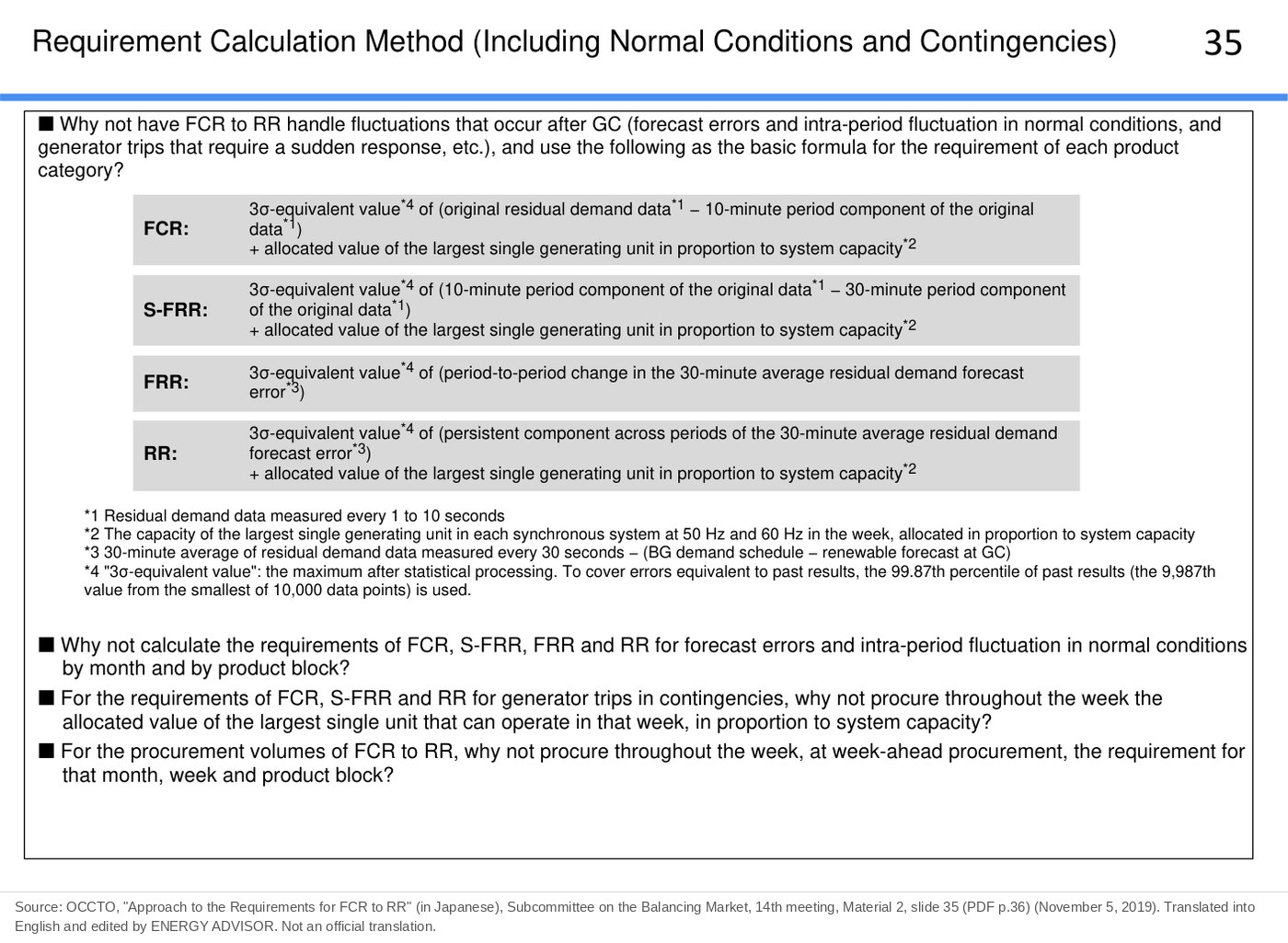
The RR requirement was designed as the sum of the requirement for normal conditions and the requirement for contingencies (Organization for Cross-regional Coordination of Transmission Operators, JAPAN (OCCTO), Subcommittee on the Balancing Market, 14th meeting, Material 2, slide 35, PDF page 36).
RR = requirement for normal conditions + requirement for contingencies
- Requirement for normal conditions: The 3σ-equivalent value of (the part of the 30-minute average of residual demand forecast error that persists across periods)
- Requirement for contingencies: For each synchronous system at 50 Hz and at 60 Hz, the capacity of the largest single generating unit, allocated in proportion to each area’s system capacity
The 30-minute average of residual demand forecast error is “the 30-minute average of 30-second measurement data of residual demand (demand minus renewables) − (BG demand plan − renewable forecast at GC).” The 3σ-equivalent value is a statistically processed maximum; specifically, the 99.87th percentile.
Treatment from FY2026
From FY2026 (April 2026–March 2027), the requirement changes according to how much supply margin there is (OCCTO, Study Committee on Regulating and Marginal Supply Capability and Long-Term Supply–Demand Balance Evaluation, 117th meeting, Material 4, p.22 and p.74). In Japan, the fiscal year runs from April to March.
| Cross-regional reserve margin in the plan for two days ahead | RR requirement | Volume procured in the market | Volume secured through spare-capacity utilization contracts |
|---|---|---|---|
| 10% or more | 1σ | 1σ | — |
| Below 10% | 3σ | 1σ | 3σ−1σ |
The cross-regional reserve margin is an indicator published by OCCTO that shows how much supply capacity exceeds demand. A spare-capacity utilization contract is a contract under which the GT&D company uses the spare capacity of resources already running (article 3).
EPPS is a function of the frequency converters that link 50 Hz and 60 Hz. When frequency falls, it instantly sends power from the healthy side to the faulted side. For delivery from April 26, 2025, the expected effect of EPPS has been deducted from the contingency requirement in areas that were ready (same, pp.61–62).
Transitional Period, FY2022–FY2023
Trading of RR began in April 2022, but up to FY2023, Type I resources from the balancing capacity tenders (resources dedicated to GT&D companies, capped at 7% of H3 demand, the average of the three highest daily peak demands in each month) were still being secured (article 3).
If the requirement based on procuring the full volume in the market had been bought as RR as it was, there would have been too much balancing capacity together with Type I resources. In FY2022, the RR procurement volume was therefore adjusted so that “Type I + RR” would be about the same as the requirement for combined clearing of FCR to RR in FY2024. In addition, buying too much RR in the previous week could have left too few sell bids in the subsequent day-ahead market (spot market) and hindered retail electricity suppliers’ procurement. A further adjustment was therefore added that capped “Type I + RR” at the available supply capacity minus the area’s demand forecast (OCCTO, Working Group on Technical Studies of Balancing Capacity Subdivision and Cross-Regional Procurement, 38th meeting, Material 2, p.9, p.17 and p.21, December 10, 2021).
When the balancing capacity tenders ended in FY2024, this transitional treatment was abolished.
Problems with Week-Ahead Trading and the Move to Day-Ahead Trading
What Happened Under Week-Ahead Trading
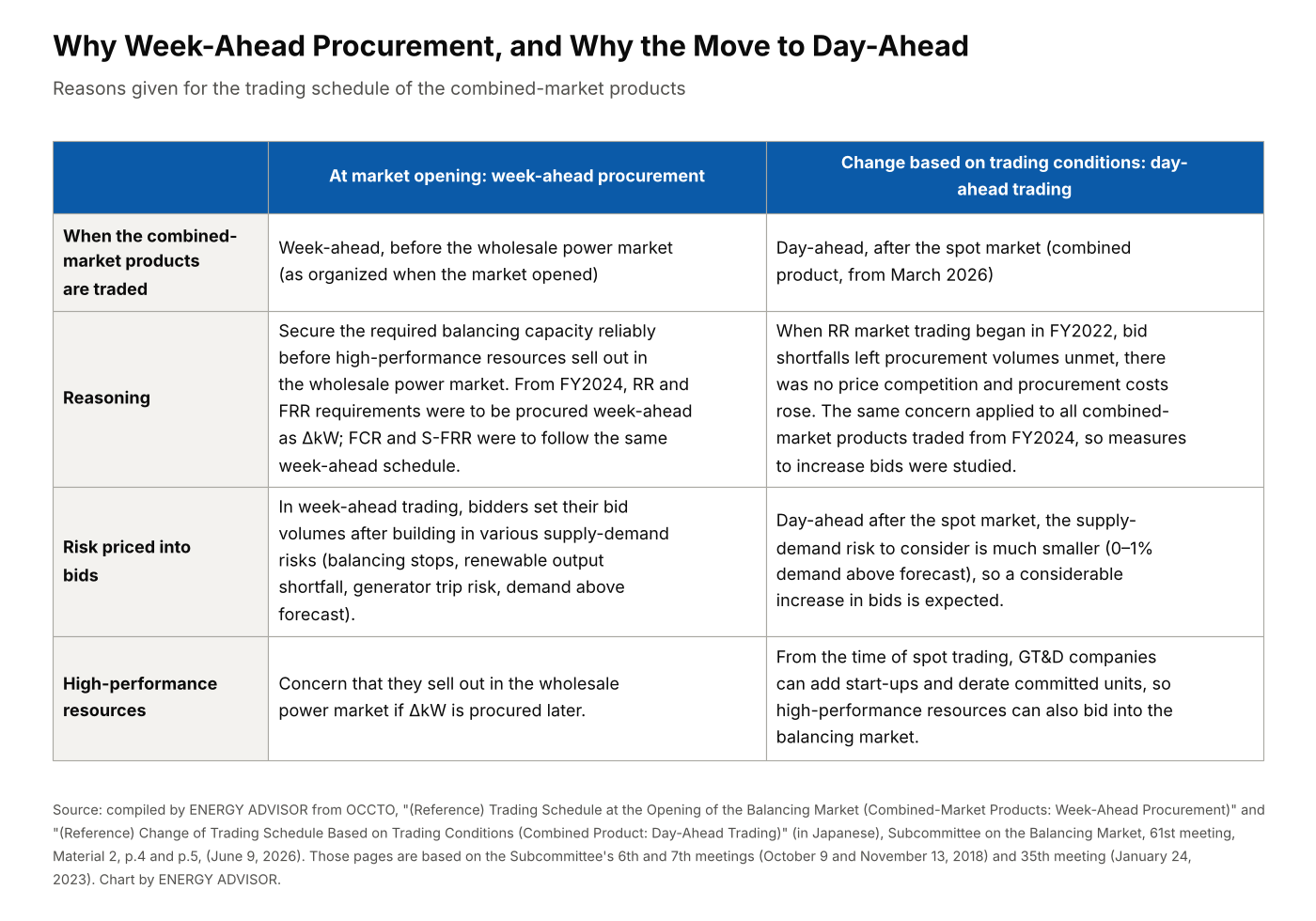
Since trading began in FY2022, RR has faced undersubscription: bids did not reach the procurement volume, price competition did not work, and procurement costs rose. Because the same was feared for FCR to FRR, which started in FY2024, measures to increase bids were studied (OCCTO, Subcommittee on the Balancing Market, 61st meeting, Material 2, p.5).
When the market started, it had been decided to trade week-ahead, based on the idea of reliably securing balancing capacity before high-performance resources sold out in the wholesale electricity market (same, p.4). However, under week-ahead trading, sellers set their bid volumes allowing for risks such as supply-demand changes one week ahead, so bid volumes were limited (same, p.5).
Move to Day-Ahead Trading (from March 2026)
Moving to day-ahead was expected to reduce the supply-demand risks sellers had to allow for and to increase bid volumes. At first, there was concern that high-performance resources would sell out in the wholesale electricity market. On this, it was concluded that by starting up additional resources at the time of spot trading and holding the output of running resources below maximum (derating), they could also bid into the balancing market (same, p.5).
Thus, from delivery on March 14, 2026, FCR to RR, including RR, and the combined product moved to day-ahead trading, and the bidding time unit changed from 3 hours to 30 minutes.
| Item | Up to delivery on March 13, 2026 | From delivery on March 14, 2026 |
|---|---|---|
| Trading timing | Week-ahead (bids accepted from Monday 14:00 to Tuesday 14:00 of the previous week, cleared by Tuesday 15:00) | Day-ahead (bids accepted from 11:30 to 14:00, cleared by 15:00) |
| Bidding time unit | 3-hour blocks | 30 minutes |
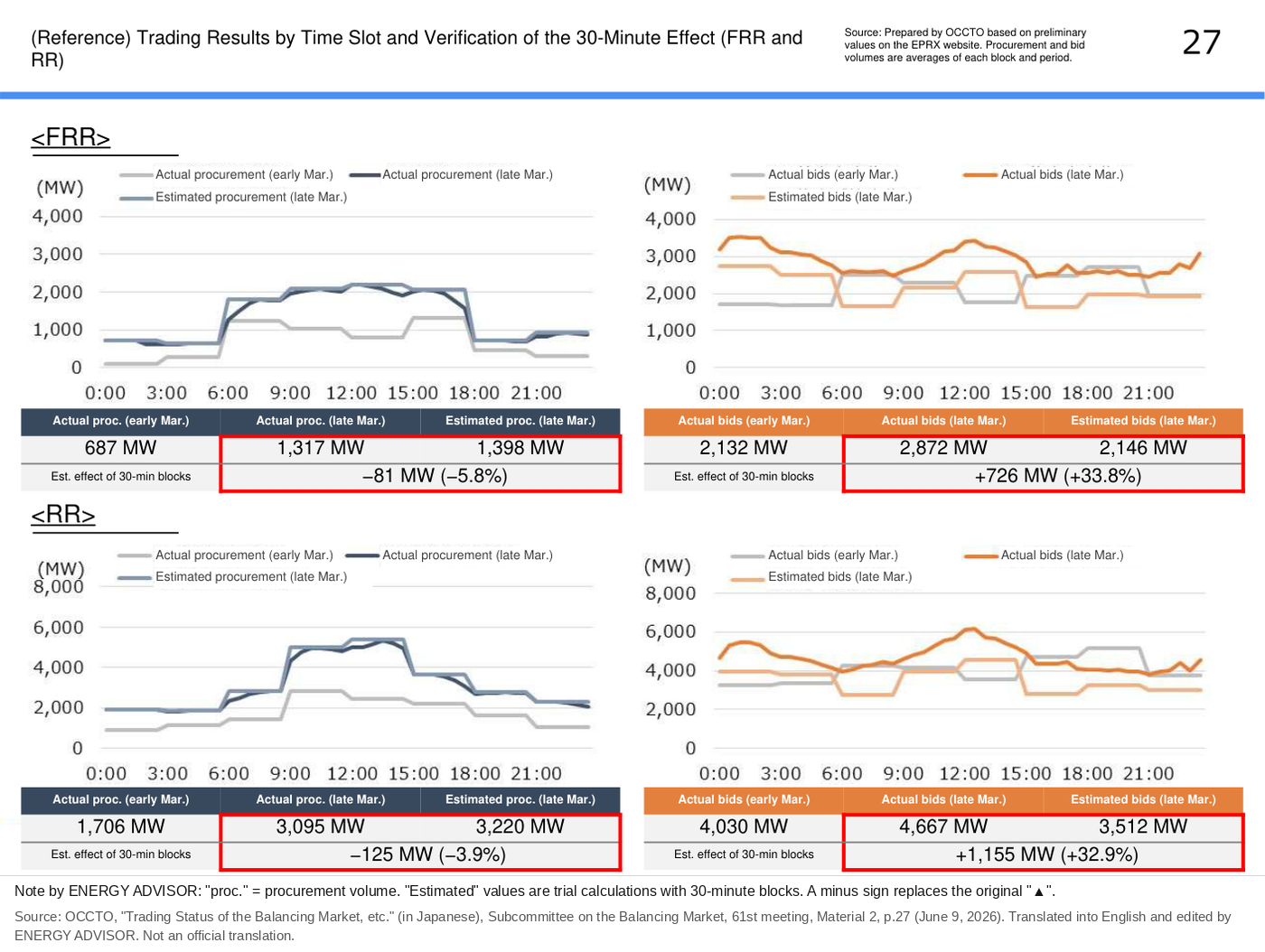
On RR after the move to day-ahead trading, OCCTO reported the following (61st meeting, Material 2, pp.17–18 and p.27).
- The deduction of unoffered headroom ended, and negotiated contracts for pumped storage were forgone or not concluded in the Hokkaido and Tokyo areas, so the procurement volume increased after the move to day-ahead trading.
- National bid volumes increased, but in some areas bid volumes fell, causing undersubscription, and the shortfall rate rose. Bid volumes increased in the Tokyo and Chubu areas and fell in the Kansai and Chugoku areas.
- In a trial calculation using March 2026 results, the move to 30-minute units made RR bid volumes about 30% larger than if 3-hour blocks had been kept. However, this trial calculation is based on data after the move to day-ahead trading and does not show the effect of the 30-minute change alone.
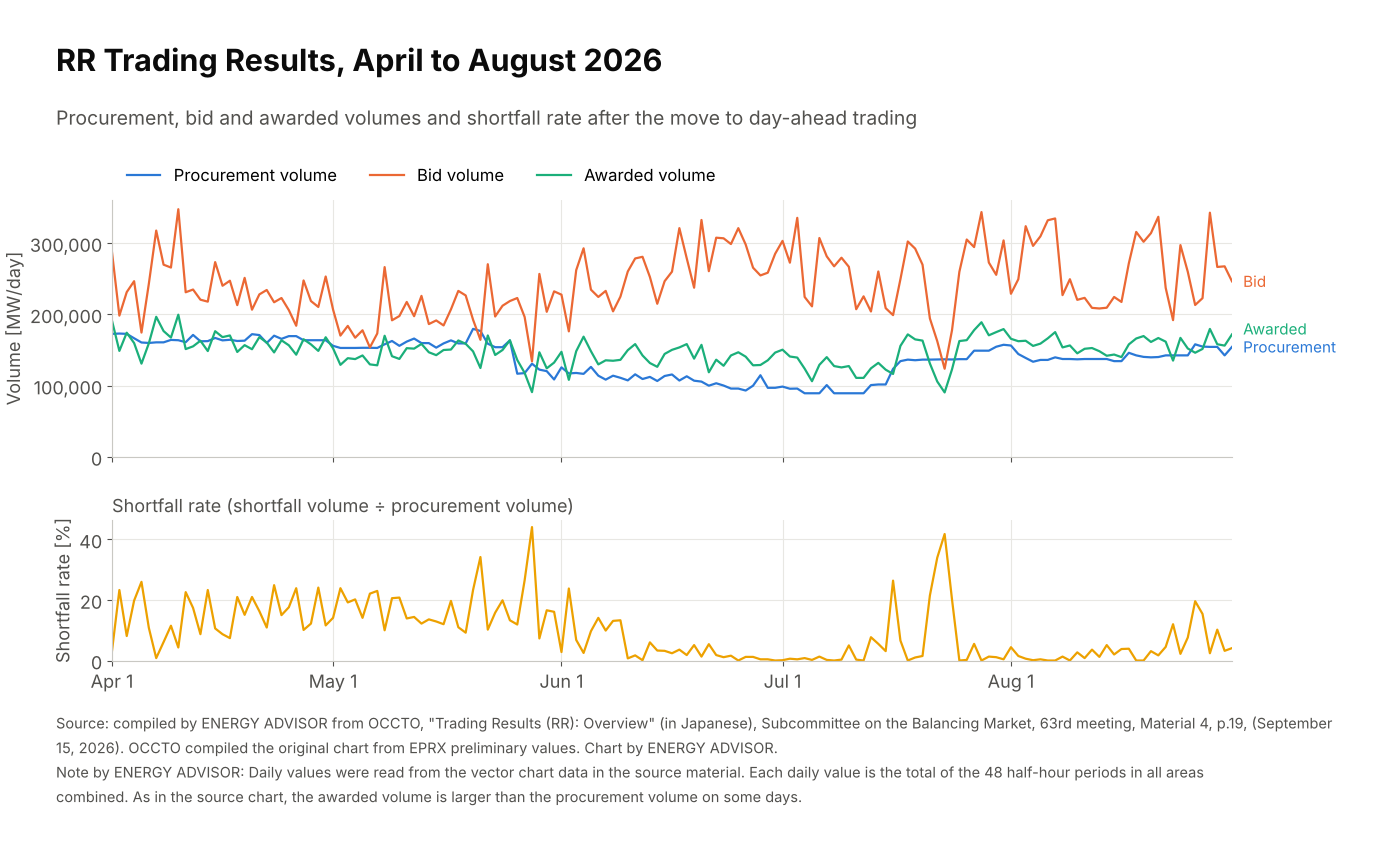
For the first half of FY2026 (up to August 31), OCCTO reported that national bid volumes increased, and that the shortfall rate was high at the start of the fiscal year but some improvement was seen from June. Many areas met their procurement volumes, while days with somewhat high shortfall rates were also seen in the Hokkaido, Hokuriku and Kansai areas (Subcommittee on the Balancing Market, 63rd meeting, Material 4, pp.19–20).
Cross-Regional Procurement
RR has used “cross-regional procurement,” in which several areas procure jointly, since trading began in FY2022. From March 2026, it moved to day-ahead cross-regional procurement (OCCTO, Subcommittee on the Balancing Market, 57th meeting, Material 5, p.3).
Summary
RR was designed as a product equivalent to the control function of economic load dispatching control (EDC), and trading began in April 2022.
In normal conditions, it adjusts the part of the “forecast error” (the long-period component of demand minus the part due to BG schedules) that persists across periods. In contingencies, it takes over the role from FCR and S-FRR and restores frequency.
Because bids were hard to attract under week-ahead trading, it moved to day-ahead trading in 30-minute units from March 2026. After the move, national bid volumes increased, but shortfalls continue in some areas.
This article is based on published materials from the Ministry of Economy, Trade and Industry and its Agency for Natural Resources and Energy, the Electricity and Gas Market Surveillance Commission, the Organization for Cross-regional Coordination of Transmission Operators (OCCTO) and other sources. The English translations of figures are by ENERGY ADVISOR and are not official translations. When using this information for decisions, please check the original sources. When we find an error, we correct the article and note the date of the correction.
Sources
- Electric Power Reserve eXchange (EPRX), “Product Requirements and Trading Schedule of the Supply and Demand Balancing Market (6th edition)” (in Japanese), p.2 and p.3, March 13, 2026. https://www.eprx.or.jp/outline/docs/shouhin_ver.6_20260313.pdf
- OCCTO, Subcommittee on the Balancing Market, 14th meeting, Material 2, “Approach to the Requirements for FCR to RR” (in Japanese), slide numbers 11, 13, 14, 25–27 and 35 (PDF pages 12, 14, 15, 26–28 and 36), November 5, 2019. https://www.occto.or.jp/iinkai/chouseiryoku/jukyuchousei/2019/files/jukyu_shijyo_14_02r.pdf
- OCCTO, Study Committee on Regulating and Marginal Supply Capability and Long-Term Supply–Demand Balance Evaluation, 86th meeting, Material 1, “Upper Limit of Balancing Capacity Procurement” (in Japanese), p.3 (Type I resources capped at 7% of H3 demand), May 29, 2023. https://www.occto.or.jp/iinkai/chouseiryoku/2023/files/chousei_86_01.pdf
- OCCTO, Working Group on Technical Studies of Balancing Capacity Subdivision and Cross-Regional Procurement, 38th meeting, Material 2, “Procurement Volume of RR for FY2022” (in Japanese), p.9, p.17 and p.21, December 10, 2021. https://www.occto.or.jp/assets/iinkai/chouseiryoku/sagyoukai/2021/files/chousei_sagyokai_38_02.pdf
- OCCTO, Study Committee on Regulating and Marginal Supply Capability and Long-Term Supply–Demand Balance Evaluation, 117th meeting, Material 4, “Status of Discussions in the Subcommittee on the Balancing Market (FY2025 Report)” (in Japanese), p.22, pp.61–62 and p.74, March 16, 2026. https://www.occto.or.jp/assets/chousei_117_04.pdf
- OCCTO, Subcommittee on the Balancing Market, 57th meeting, Material 5, “Direction and Summary of Discussions in the Subcommittee on the Balancing Market (Results for the First Half of FY2025 and Plans for the Second Half of FY2025)” (in Japanese), p.3, September 26, 2025. https://www.occto.or.jp/assets/iinkai/chouseiryoku/jukyuchousei/2025/files/jukyu_shijyo_57_05.pdf
- OCCTO, Subcommittee on the Balancing Market, 63rd meeting, Material 4, “Direction and Summary of Discussions in the Subcommittee on the Balancing Market (Results for the First Half of FY2026 and Plans for the Second Half of FY2026 Onward)” (in Japanese), pp.19–20, September 15, 2026. https://www.occto.or.jp/assets/iinkai/jukyuchousei/63/jukyu_shijyo_63_04.pdf
- OCCTO, Subcommittee on the Balancing Market, 61st meeting, Material 2, “Trading Status of the Balancing Market” (in Japanese), pp.4–5, pp.17–18 and p.27, June 9, 2026. https://www.occto.or.jp/assets/iinkai/jukyuchousei/61/jukyu_shijyo_61_02.pdf