FIT Special Systems and Renewable Forecast Errors
Planned-Value Balancing and Balancing Capacity
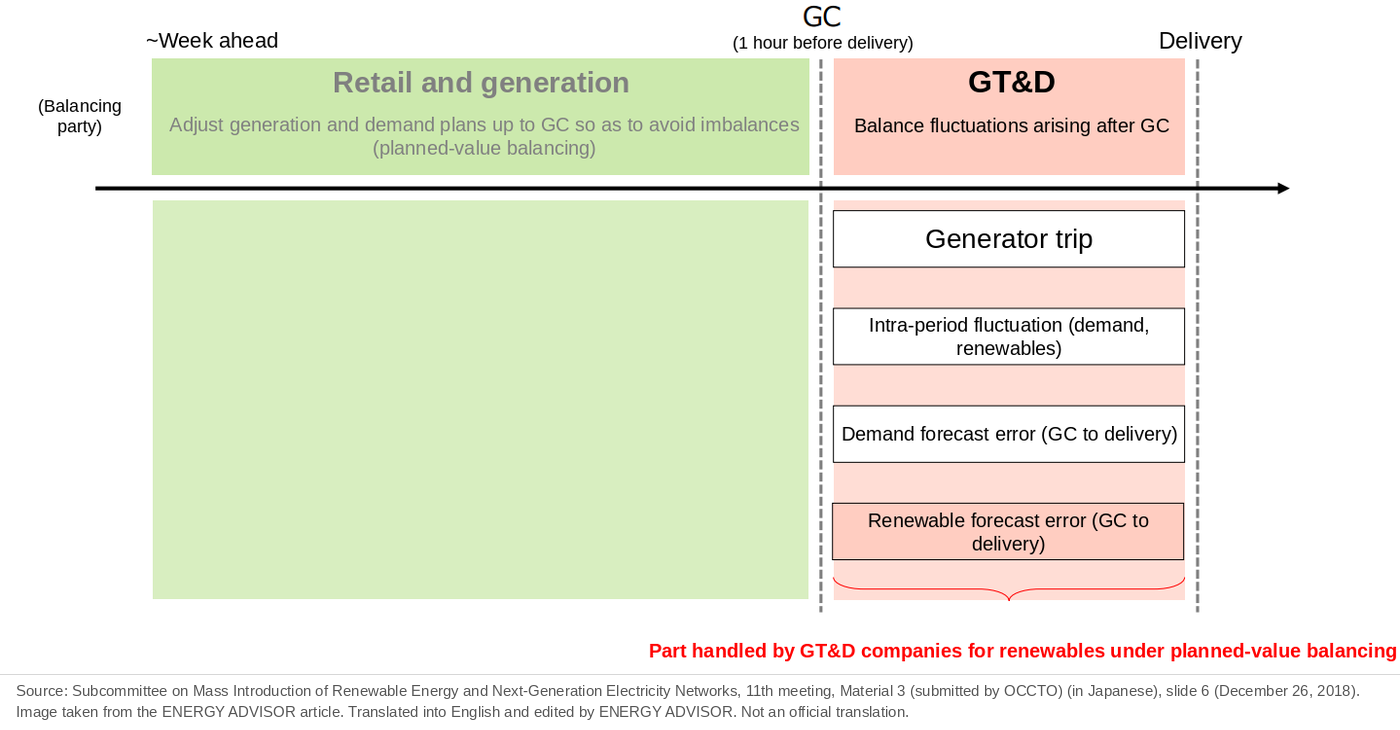
Japan uses planned-value balancing (30-minute balancing against plans): power generation companies and retail electricity suppliers prepare plans for every 30 minutes and must match their actual results to those plans. Both adjust their generation and demand plans by gate closure (GC; the deadline for plans one hour before real time) so that no imbalance (deviation between plan and result) arises.
“Generator trips,” “intra-period fluctuation,” “demand forecast errors” and “renewable forecast errors” that arise after GC are handled with the balancing capacity secured by the general transmission and distribution company (GT&D company; the company that operates each area’s grid).
Without the FIT Special Systems
Without the FIT special systems, renewable forecast errors are handled by the power generation company, which revises its plan, up to GC, and by the GT&D company after GC.
Renewable Forecast Errors Under FIT Special System (1) and (3)
FIT is the Feed-in Tariff (FIT) scheme, under which renewable electricity is purchased at prices set by the government. FIT special system (1) and (3) are arrangements under which the GT&D company forecasts the output of FIT generators (prepares their generation plans).
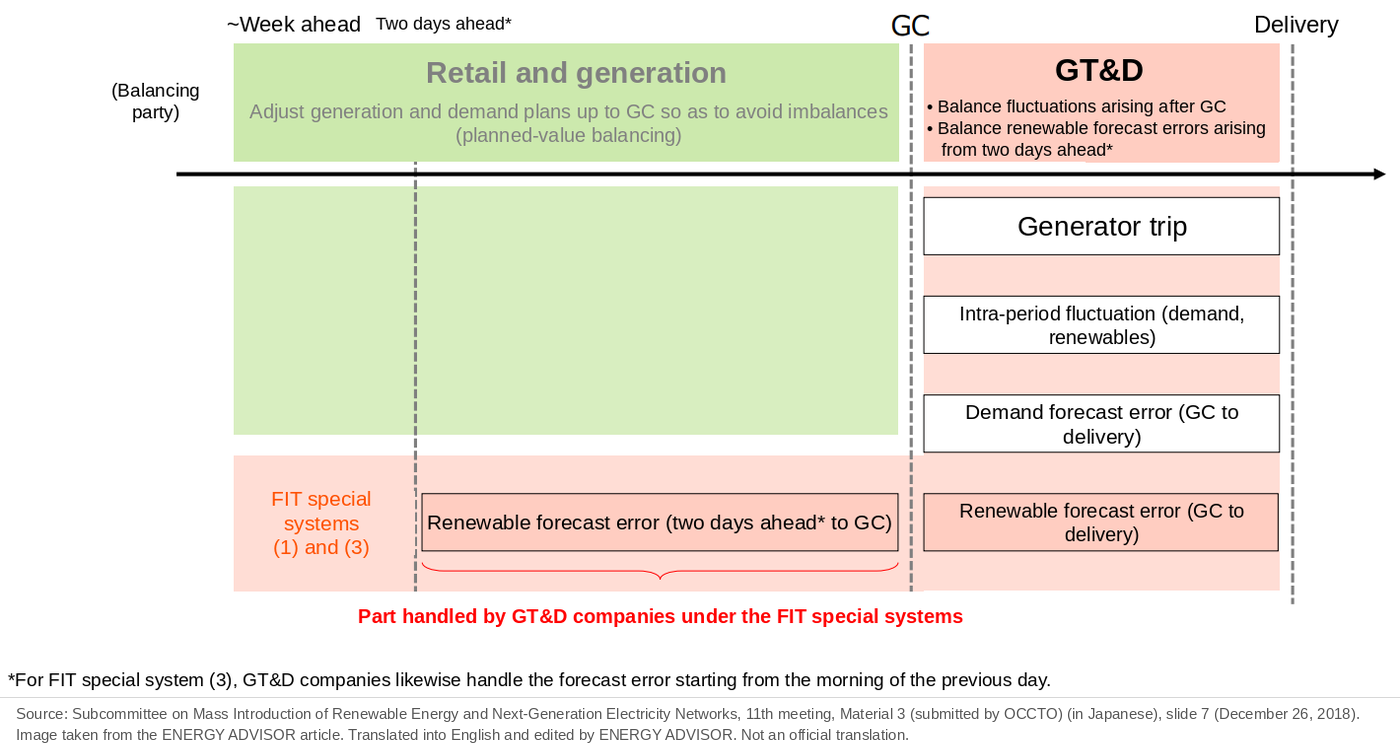
Under FIT special system (1) and (3), the GT&D company forecasts renewable output from two days ahead to the day before, and that value is treated as the plan. The starting point of the forecast is two days ahead under special system (1) and the morning of the day before under (3) (Organization for Cross-regional Coordination of Transmission Operators, JAPAN (OCCTO), submitted to the Subcommittee on Mass Introduction of Renewable Energy and Next-Generation Electricity Networks, 11th meeting, Material 3, notes to slides 7 and 8). Power generation companies and retail electricity suppliers do not revise this plan up to GC. The GT&D company therefore also has to handle the renewable forecast error that arises between the forecast two days ahead and GC.
| Period of forecast error | Without the FIT special systems | Under FIT special system (1) and (3) |
|---|---|---|
| From two days ahead to GC | The power generation company revises its plan | The GT&D company handles it (RR-FIT) |
| After GC | The GT&D company handles it (FCR to RR) | The GT&D company handles it (FCR to RR) |
Role of RR-FIT
Replacement Reserve-for FIT (RR-FIT; tertiary balancing capacity (2)) is balancing capacity that covers the renewable forecast error “from two days ahead to GC” held by GT&D companies under FIT special system (1) and (3). Trading began in April 2021 as the first product of the Supply and Demand Balancing Market (balancing market).
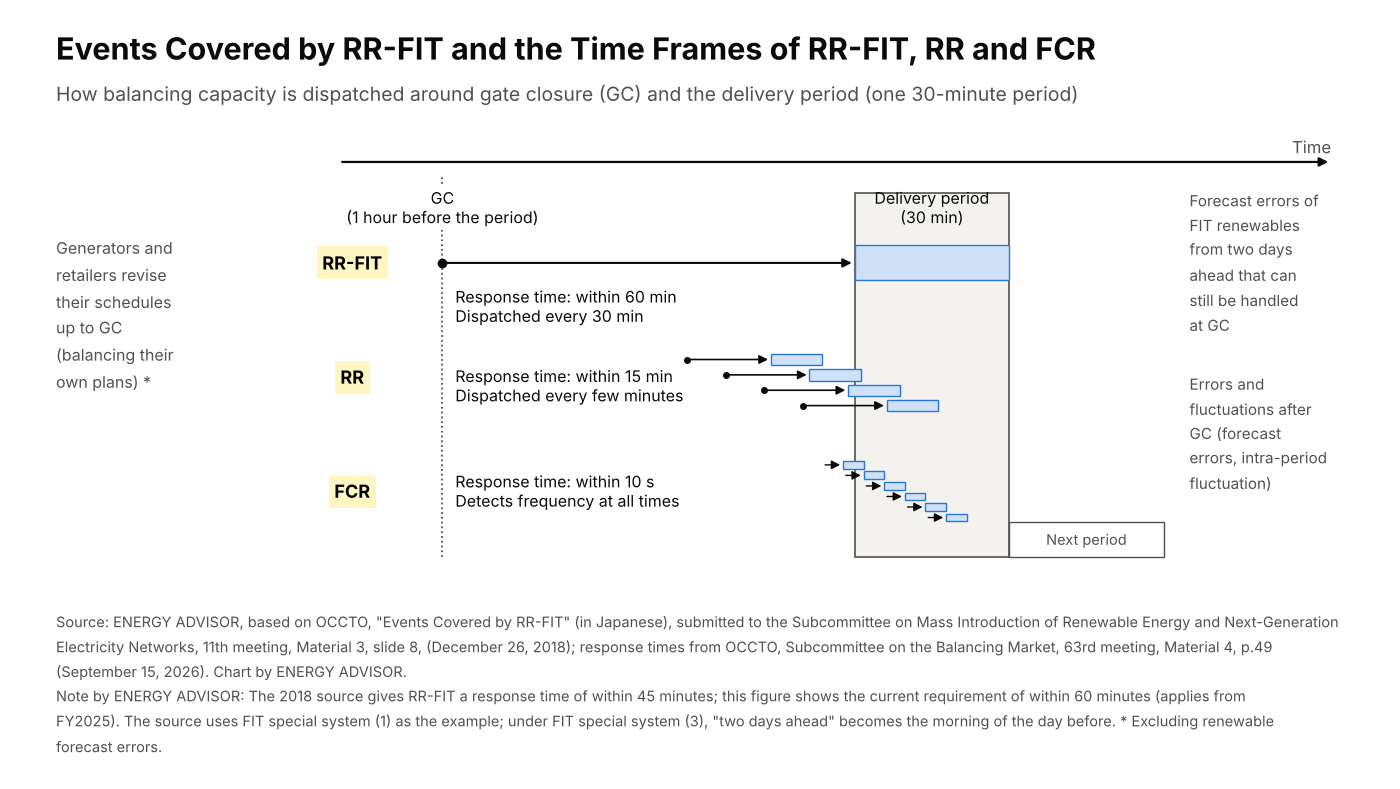
The error RR-FIT covers is the error that arises up to GC. GT&D companies can therefore issue instructions at GC (one hour before the period). Because resources with a long time from instruction to output (response time) can also take part, new entrants were expected to bring prices down.
For errors and fluctuations after GC, GT&D companies issue instructions as needed to Synchronized Frequency Restoration Reserve (S-FRR), Frequency Restoration Reserve (FRR) and Replacement Reserve (RR) to keep supply and demand in balance. RR-FIT is balancing capacity on a different time frame from Frequency Containment Reserve (FCR) to RR (article 2).
Product Requirements
The main requirements of RR-FIT are as follows (Electric Power Reserve eXchange (EPRX), product requirements, 6th edition, March 13, 2026).
| Item | Requirement |
|---|---|
| Instruction and control | Online |
| Communication line | Dedicated communication line or simplified dispatch system |
| Response time | Within 60 minutes |
| Duration | 30 minutes |
| Synchronization | Optional |
| Instruction interval | 30 minutes |
| Bidding time unit and minimum bid | 30 minutes, 1 MW |
From FY2025 (April 2025–March 2026), the bidding time unit changed from 3-hour blocks (six 30-minute periods) to 30-minute periods (OCCTO, Subcommittee on the Balancing Market, 57th meeting, Material 5, p.23). In Japan, the fiscal year runs from April to March.
How the Requirement Is Set
Approach at the Design Stage
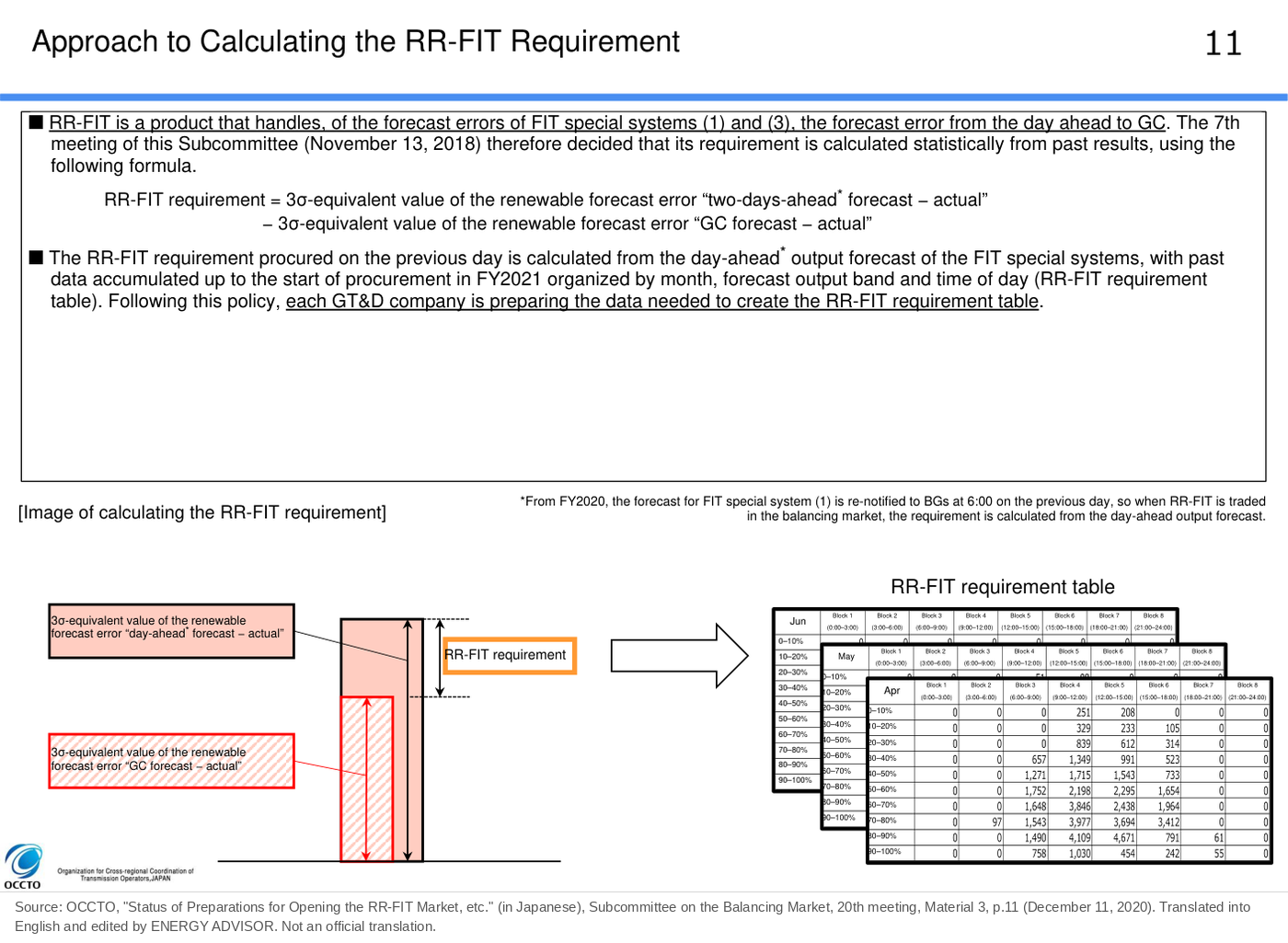
At the design stage, the RR-FIT requirement was calculated with the following formula (OCCTO, Subcommittee on the Balancing Market, 20th meeting, Material 3, p.11, December 11, 2020).
RR-FIT = 3σ-equivalent value of the forecast error “forecast two days ahead − actual” − 3σ-equivalent value of the forecast error “forecast at GC − actual”
The idea is that the forecast error from two days ahead to GC can be expressed as the difference between the “forecast error two days ahead” and the “forecast error at GC.” Errors after GC are covered by FCR to RR. The 3σ-equivalent value is a statistically processed maximum (the 99.87th percentile).
How It Is Set Today
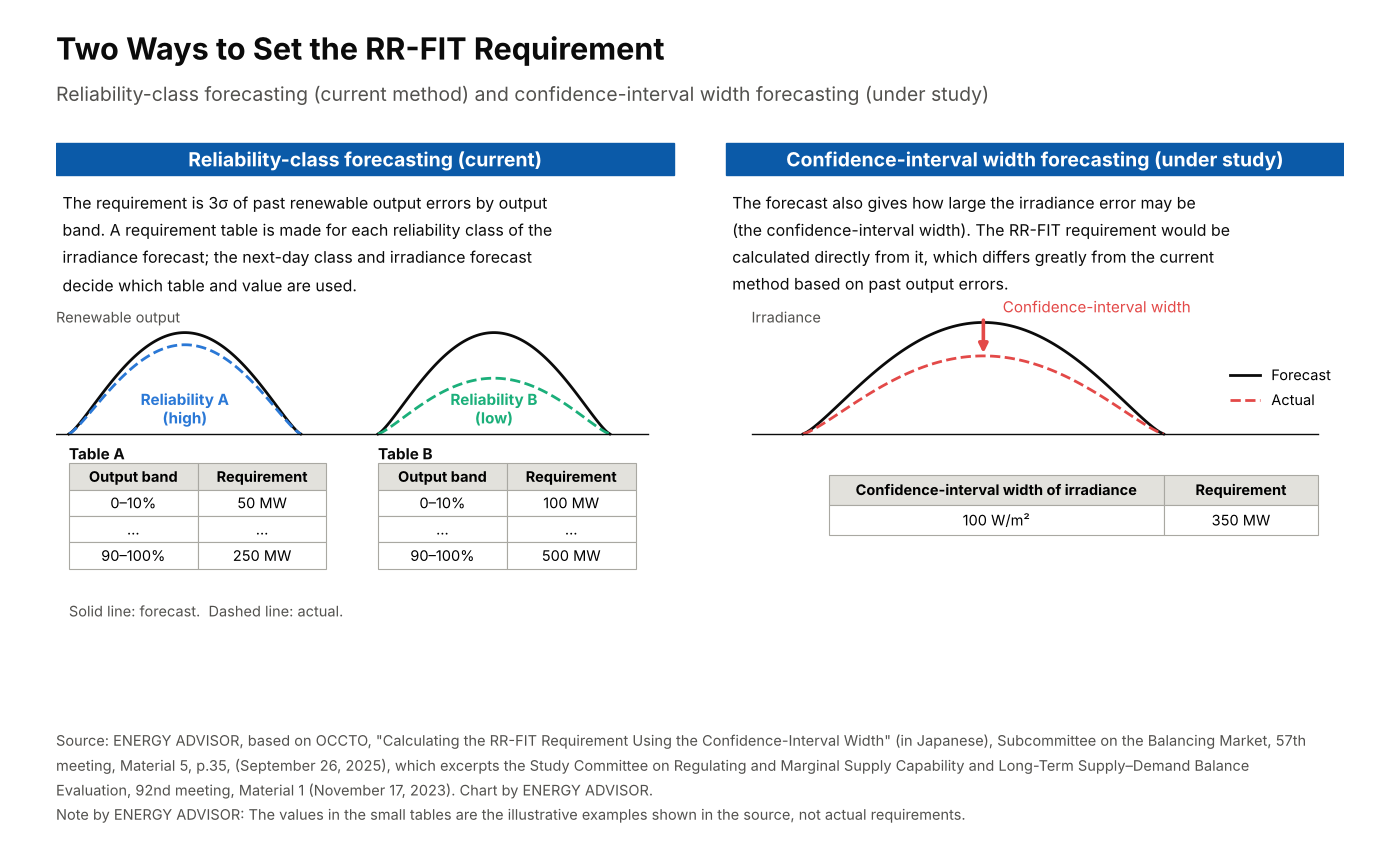
Today, the RR-FIT requirement is set using “reliability-class forecasting,” based on past actual errors in renewable output. Reliability-class forecasting is a method that switches the error table used according to how accurate the solar irradiance forecast is likely to be (its reliability). The requirement is set according to the next day’s solar irradiance forecast (OCCTO, 57th meeting, Material 5, p.35).
The following measures have been taken to reduce the requirement.
| Measure | Content | Source |
|---|---|---|
| Procurement reduction factor | A factor for reducing the volume solicited in the market. From November 2024, revised to a new approach to the factor (Working Group on Market Design, 97th meeting) | 57th meeting, Material 5, p.7 and p.23 |
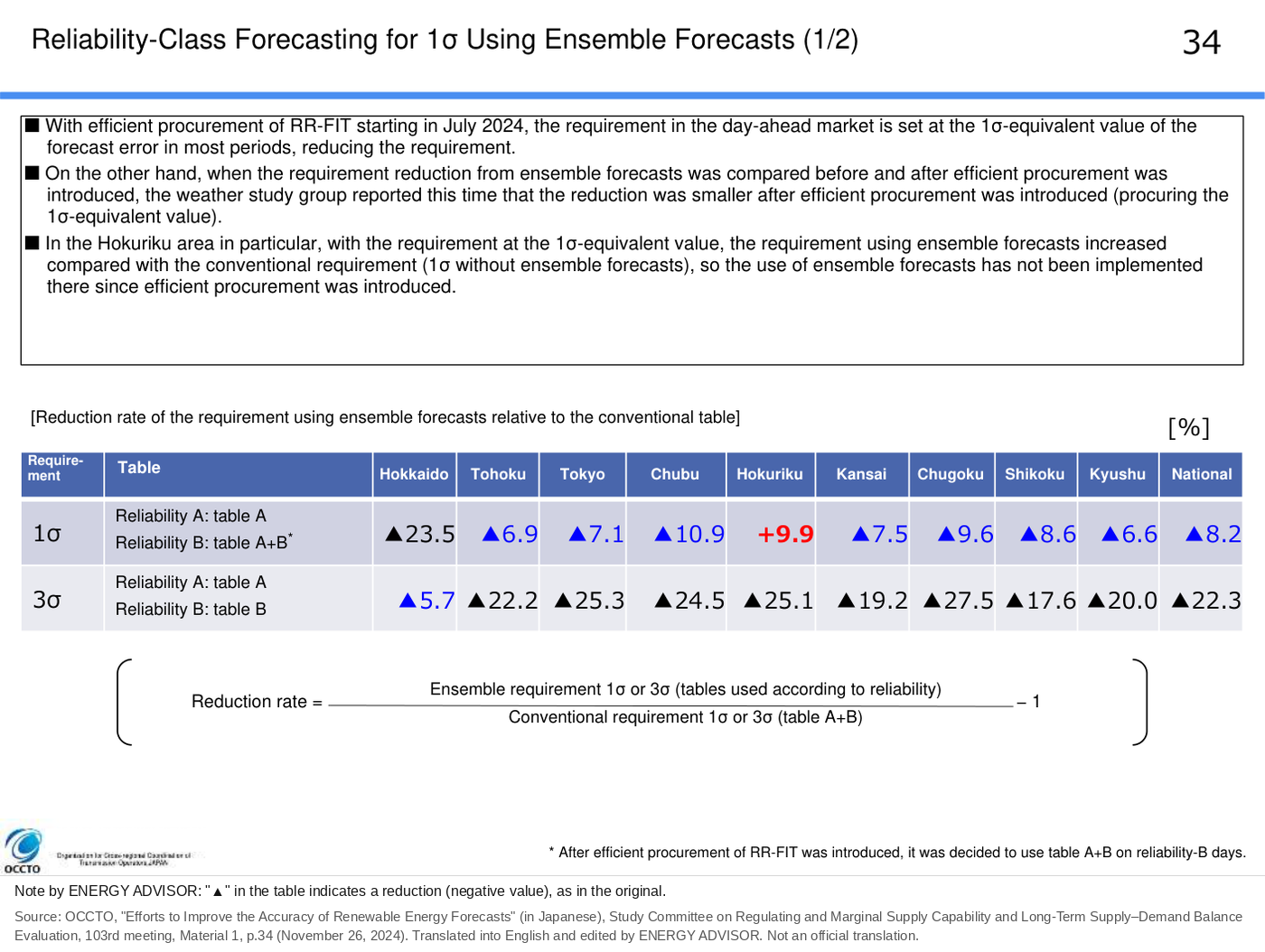
| Efficient procurement | The volume procured in the balancing market on the day before delivery is set at the 1σ-equivalent value of the forecast error for most periods. From July 2024 | Study Committee on Regulating and Marginal Supply Capability and Long-Term Supply–Demand Balance Evaluation, 103rd meeting, Material 1, p.34 |
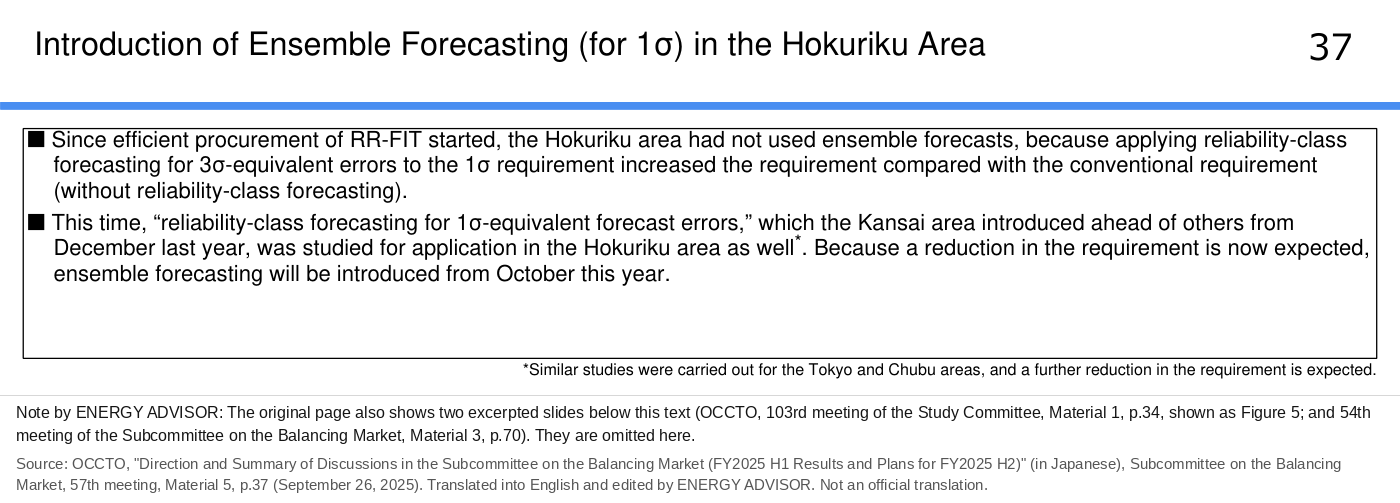
| Reliability-class forecasting for 1σ | Introduced first in the Kansai area from trading in December 2024, and also applied in the Hokuriku area | 103rd meeting, Material 1, p.37; 57th meeting, Material 5, p.37 |
| Introduction of ensemble forecasting (Hokuriku) | After efficient procurement began (July 2024), the Hokuriku area had suspended use of ensemble forecasting for the 1σ-equivalent value. From October 2025, it is used again in Hokuriku. The same effect is expected in Tokyo and Chubu | 57th meeting, Material 5, p.37; Subcommittee on the Balancing Market, 54th meeting, Material 3, p.64 |
| Move to 30-minute periods | From FY2025. Effects of right-sizing the requirement and increasing bid volumes | Same, p.23 |
Ensemble forecasting is a method that runs several weather forecasts with slightly different conditions side by side to see the spread of the forecasts. In addition, a method using the “confidence-interval width” to derive the requirement directly from the solar irradiance forecast continues to be studied, based on the results of a project of the New Energy and Industrial Technology Development Organization (NEDO) (technology development to improve the accuracy of weather forecasts) (same, p.26 and p.35).
EPRX publishes the RR-FIT requirement and the procurement reduction factor every month.
Procurement Shortfalls and Measures Since FY2021
In FY2021, when trading began, there were occasions when RR-FIT was under-procured (Agency for Natural Resources and Energy (ANRE), Study Group on the Wholesale Electricity Market, the Balancing Market and Supply-Demand Operation, 2nd meeting, Material 3, p.3, February 14, 2022). Since then, the requirement and procurement volume have been reduced through the measures in the table above. OCCTO reported that, as of the first half of FY2025, RR-FIT maintained a high procurement rate (57th meeting, Material 5, p.23).
Setting a price cap for RR-FIT to curb price spikes was still described as under study as of September 2026 (Subcommittee on the Balancing Market, 62nd meeting, Reference Material 1, p.18; 63rd meeting, Material 4, p.9).
RR-FIT After the Move to Day-Ahead Trading
RR-FIT has been traded day-ahead since its start. From delivery on March 14, 2026, the combined market (FCR to RR and the combined product) also moved to day-ahead trading and began trading at the same time as RR-FIT. Bids are accepted from 11:30 to 14:00 on the day before delivery, and clearing is completed by 15:00 on the day before (EPRX, product requirements, 6th edition, p.3).
There had been concern that, with the same timing, bids would skew toward one of the two markets. OCCTO reported the following (Subcommittee on the Balancing Market, 61st meeting, Material 2, p.2, pp.21–22 and p.35).
- From the time the combined market moved to day-ahead trading, RR-FIT bid volumes fell and undersubscription became more frequent. Average awarded prices also continue to swing sharply.
- By area, bid volumes increased in the Shikoku area but fell in all other areas. Shortfalls became more frequent in the Tohoku, Chubu, Chugoku and Kyushu areas.
- On the other hand, this did not lead to a continuing shortfall or a surge in procurement costs. Because little time had passed since the move to day-ahead trading, no clear skew of bids between RR-FIT and the combined market could be confirmed.
- Permanent measures against skew will be considered as needed, while watching future trading conditions and movements of the procurement reduction factor.
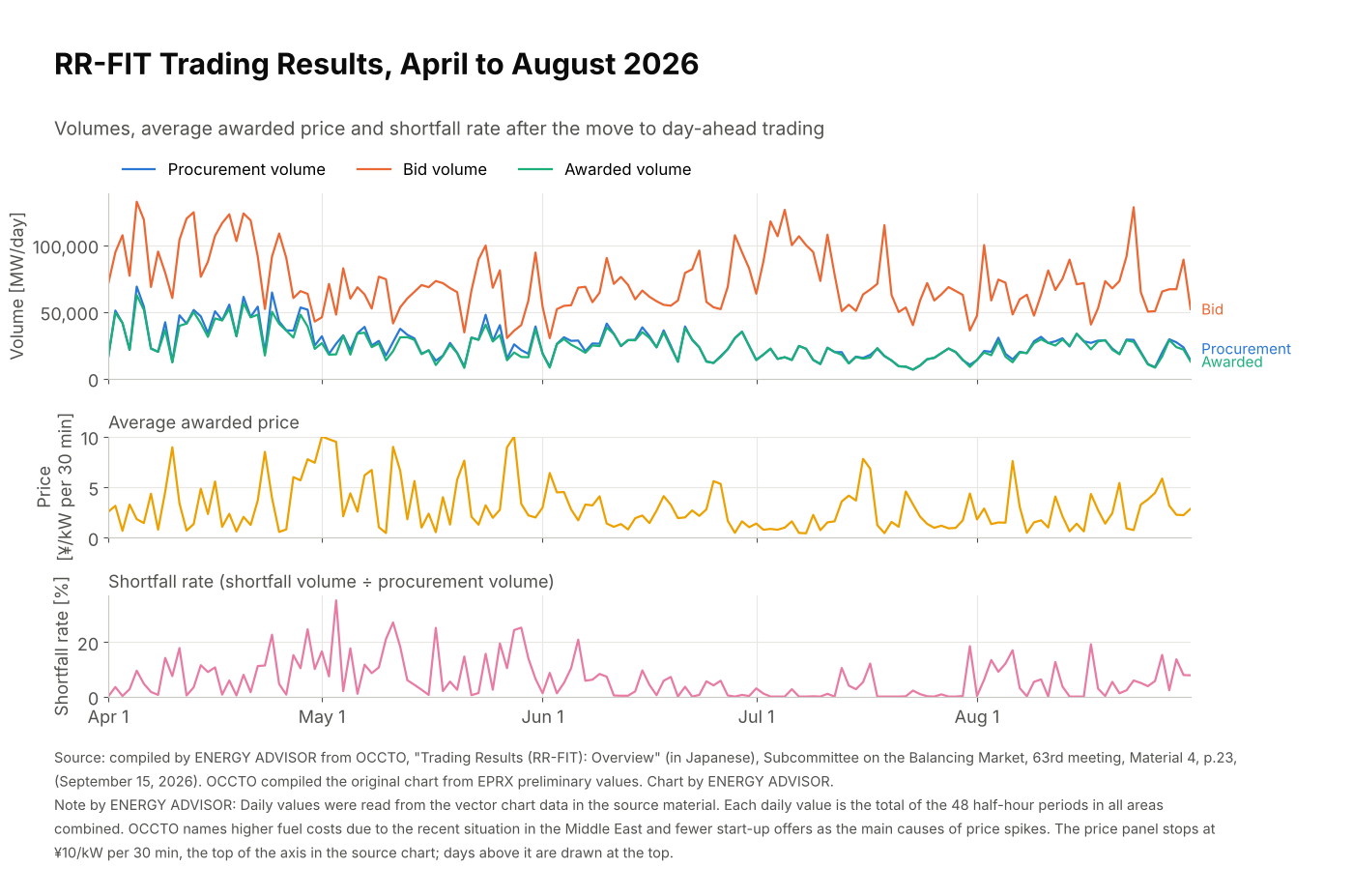
For the first half of FY2026 (up to August 31) as well, OCCTO reported that bid volumes fell compared with the previous year, undersubscription became more frequent, and many days had high shortfall rates. Average awarded prices also continue to swing sharply. OCCTO cites as the main causes of the price spikes the rise in fuel costs due to the situation in the Middle East and a decrease in resources that start up to provide balancing capacity (start-up offers). By area, shortfalls became more frequent in many areas (Subcommittee on the Balancing Market, 63rd meeting, Material 4, p.23 and p.25).
Summary
RR-FIT is balancing capacity for the renewable forecast error “from two days ahead to GC” that GT&D companies handle under FIT special system (1) and (3). Trading began in April 2021 as the first product of the balancing market.
Because instructions can be issued at GC, its response time is set long, at within 60 minutes.
In response to procurement shortfalls at the start, the requirement and procurement volume have been reduced through reliability-class forecasting, efficient procurement from the 1σ-equivalent value, the procurement reduction factor, the move to 30-minute periods and other measures. From March 2026, it trades at the same time as the combined market, and RR-FIT bid volumes have fallen.
This article is based on published materials from the Ministry of Economy, Trade and Industry and its Agency for Natural Resources and Energy, the Electricity and Gas Market Surveillance Commission, the Organization for Cross-regional Coordination of Transmission Operators (OCCTO) and other sources. The English translations of figures are by ENERGY ADVISOR and are not official translations. When using this information for decisions, please check the original sources. When we find an error, we correct the article and note the date of the correction.
Sources
- ANRE, Study Group on the Wholesale Electricity Market, the Balancing Market and Supply-Demand Operation, 2nd meeting, Material 3, “Review of the Previous Study Group and Next Steps” (in Japanese), p.3, February 14, 2022. https://www.meti.go.jp/shingikai/energy_environment/oroshi_jukyu/pdf/002_03_00.pdf
- Subcommittee on Mass Introduction of Renewable Energy and Next-Generation Electricity Networks, 11th meeting, Material 3, “Quantitative Assessment of Balancing Capacity for Renewables Under FIT Imbalance Special System (1) and (3)” (submitted by OCCTO) (in Japanese), slides 6–8 and 10, December 26, 2018. https://www.meti.go.jp/shingikai/enecho/denryoku_gas/saisei_kano/pdf/011_03_00.pdf
- OCCTO, Subcommittee on the Balancing Market, 20th meeting, Material 3, “Status of Preparations for Opening the RR-FIT Market” (in Japanese), p.11 (requirement formula at the design stage), December 11, 2020. https://www.occto.or.jp/iinkai/chouseiryoku/jukyuchousei/2020/files/jukyu_shijyo_20_03.pdf
- OCCTO, Study Committee on Regulating and Marginal Supply Capability and Long-Term Supply–Demand Balance Evaluation, 103rd meeting, Material 1 (in Japanese), p.34 and p.37, November 26, 2024. https://www.occto.or.jp/iinkai/chouseiryoku/2024/files/chousei_103_01.pdf
- OCCTO, Subcommittee on the Balancing Market, 54th meeting, Material 3, “FY2024 Ex-Post Review and FY2025 Ex-Ante Evaluation of RR-FIT” (in Japanese), p.64, March 4, 2025. https://www.occto.or.jp/assets/iinkai/chouseiryoku/jukyuchousei/2024/files/jukyu_shijyo_54_03.pdf
- Electric Power Reserve eXchange (EPRX), “What Is the Supply and Demand Balancing Market” (in Japanese), accessed October 2026. https://www.eprx.or.jp/outline/outline.html
- EPRX, “Product Requirements and Trading Schedule of the Supply and Demand Balancing Market (6th edition)” (in Japanese), p.2 and p.3, March 13, 2026. https://www.eprx.or.jp/outline/docs/shouhin_ver.6_20260313.pdf
- EPRX, “News” (in Japanese) (monthly updates of the RR-FIT requirement and procurement reduction factor). https://www.eprx.or.jp/j_information/
- OCCTO, Subcommittee on the Balancing Market, 57th meeting, Material 5, “Direction and Summary of Discussions in the Subcommittee on the Balancing Market (Results for the First Half of FY2025 and Plans for the Second Half of FY2025)” (in Japanese), p.7, p.9, p.23, p.26, p.35 and p.37, September 26, 2025. https://www.occto.or.jp/assets/iinkai/chouseiryoku/jukyuchousei/2025/files/jukyu_shijyo_57_05.pdf
- OCCTO, Subcommittee on the Balancing Market, 62nd meeting, Reference Material 1, “Direction and Summary of Discussions in the Subcommittee on the Balancing Market” (in Japanese), p.18, July 31, 2026. https://www.occto.or.jp/assets/iinkai/jukyuchousei/62/jukyu_shijyo_62_sankou_01.pdf
- OCCTO, Subcommittee on the Balancing Market, 63rd meeting, Material 4, “Direction and Summary of Discussions in the Subcommittee on the Balancing Market (Results for the First Half of FY2026 and Plans for the Second Half of FY2026 Onward)” (in Japanese), p.9, p.23 and p.25, September 15, 2026. https://www.occto.or.jp/assets/iinkai/jukyuchousei/63/jukyu_shijyo_63_04.pdf
- OCCTO, Subcommittee on the Balancing Market, 61st meeting, Material 2, “Trading Status of the Balancing Market” (in Japanese), p.2, pp.21–22 and p.35, June 9, 2026. https://www.occto.or.jp/assets/iinkai/jukyuchousei/61/jukyu_shijyo_61_02.pdf