Many companies start considering a contract review after feeling the rise in electricity costs, but keep putting it off without knowing when and in what steps to proceed. In high-voltage electricity contracts in particular, there are several things to check, such as the contract term, the conditions of the early termination fee, and how to proceed with the internal approval process (the company’s internal decision procedure). This article sets out the timing and internal steps for reviewing an electricity contract.
Key points
- 1A review of an electricity contract starts with checking the contract renewal month and the conditions of the early termination fee.
- 2If you proceed with comparison without understanding the content of your current contract (contract term, early termination fee, rate structure), unexpected costs may arise.
- 3A certain preparation period is needed from obtaining quotations to switching contracts.
- 4Internal consideration may require building agreement among several stakeholders, such as accounting, purchasing and on-site departments.
- 5It is important to make the review decision based on a comparison that applies past actual usage data.
Part 2 looked at the background to the rise in electricity costs, Part 9 at the points for checking quotations, and Part 11 at the approach of comparing by applying past actual results; Parts 12 and 13 took up assessing a supplier to switch to and decarbonization. This is the final part of the main series, turning what has been covered so far into actual internal steps.
Checking the Content of the Current Contract
The first step in considering a review of an electricity contract is to check the content of the current contract. Specifically, check the contract expiry date, whether there is an early termination fee for cancellation during the term and how much, and the rate structure (whether it is by season and time of day, market-linked, and so on). These conditions change when you can move on a review.
In some cases, a period is set during the contract term when you can cancel without an early termination fee; in others, an automatic renewal clause means the contract continues once a certain time has passed. For this reason, it is important to check the contract and the terms and conditions of supply early.
If you rush to check the contract only after electricity costs have risen, you may find the renewal timing has already passed.
Good Timing for a Review
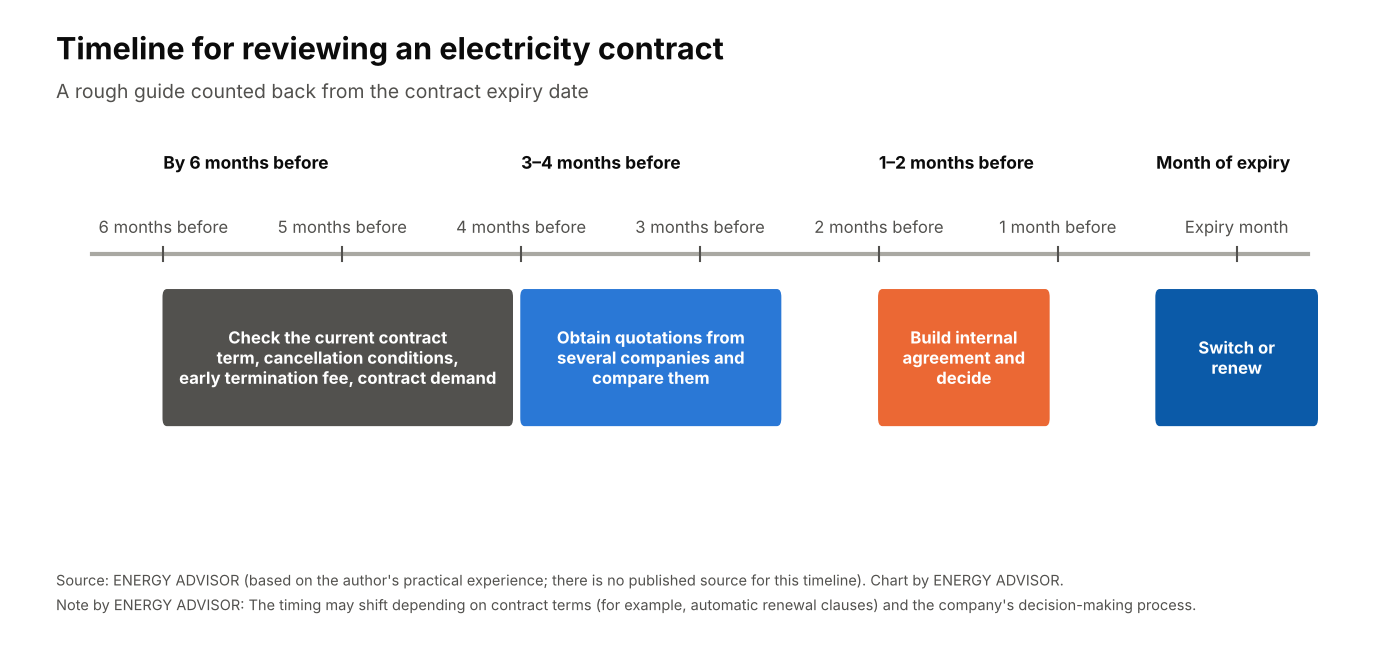
In general, starting to consider a review several months before the contract expiry date makes it easier to secure the time needed to obtain quotations, build internal agreement and complete the switching procedures. In addition, points at which the environment around electricity charges changes, such as trends in the fuel cost adjustment and market prices as seen in Part 2, are also occasions to review the contract.
For example, when the calculation method of the fuel cost adjustment changes or the standard tariff is revised, it is important to check how your current contract is affected.
A rough guide to the concrete steps is as follows.
| Rough timing | What to do |
|---|---|
| By 6 months before contract expiry | Check the content of the current contract (contract term, cancellation conditions, early termination fee, contract demand) |
| 3–4 months before expiry | Obtain quotations from several companies and compare them |
| 1–2 months before expiry | Build internal agreement and decide whether to switch |
| Month of expiry | Switching procedures or renewal of the current contract |
*A general rough guide from the author’s practical experience, without a published source. It may shift depending on contract terms and the company’s decision-making process.
Events That Often Trigger a Review
Apart from the contract renewal month, there are events that often trigger a review: for example, when government support measures start or end, when the scope of support changes, or when expanding or downsizing equipment greatly changes electricity consumption or the 30-minute demand. The 30-minute demand here refers to the highest, in that month, of the average power values measured every 30 minutes. The government electricity bill relief for usage in July to September 2026 did not include extra-high-voltage supply (Part 6). For contract categories outside the scope of support like this, you may need to consider responses that do not rely on support.
When such internal or external changes occur, it is important to recheck the content of the current contract without waiting for the contract expiry date.
If you put off a review only because “there is still time left on the contract,” you may find, by the time you notice the change in the environment, that your response is late.
From Obtaining Quotations to Comparison
When proceeding with a review, you obtain quotations from several companies, including your current supplier, and compare them on aligned conditions. When checking quotations, it is effective to check one by one the five points confirmed in Part 9, such as how contract demand is calculated, whether there is a fuel cost adjustment, and market-linked pricing clauses.
In comparing, as confirmed in Part 11, the method of applying each company’s unit prices to your own past actual data, rather than an estimate with assumed future conditions, leads to a comparison closer to reality. Note, however, that this is a check of trends based on past results and does not guarantee future electricity charges.
Even if obtaining quotations itself is not difficult, the work of comparing them on aligned conditions takes effort, so it tends to be put off.
How to Obtain the “Actual Demand Data” That Underpins Comparison
To compare by back-testing, your company’s actual demand data, not only monthly electricity consumption but also usage in each 30-minute period and the trend of the 30-minute demand, is the foundation. In the author’s view, this actual demand data is the most important thing of all in comparing electricity contracts.
First, the monthly meter reading notice and bill show only monthly aggregate values, such as monthly electricity consumption and maximum demand (the 30-minute demand); they do not show the trend for each 30-minute period.
Source: Kyushu Electric Power, “Explanation of Bill Contents” (in Japanese)
More detailed 30-minute interval data may be available from your electricity supplier’s web membership service. For example, TEPCO Energy Partner’s web service for corporate customers, “Business TEPCO,” allows 30-minute electricity data to be downloaded in CSV format, going back up to 24 months for one site, or up to 6 months when two to five sites are selected together (some contract types do not support downloads). Tohoku Electric Power also has an “Electricity Usage Record Inquiry Service” where 30-minute interval consumption data can be checked. Because availability differs by electricity supplier, the starting point is to find out what can be checked in your supplier’s web service.
Source: TEPCO Energy Partner, “I Want to Download 30-Minute Electricity Values” (in Japanese); Tohoku Electric Power, “Electricity Usage Record Inquiry Service” (in Japanese)
Even if you have a contract with a new entrant retailer, there is a mechanism through which general transmission and distribution companies (the companies that operate the transmission and distribution network in each area) provide 30-minute electricity data to retail electricity suppliers, so the starting point is to check with and ask your supplier. Another method is to use a general transmission and distribution company’s “B-route service (high-voltage)” to obtain the 30-minute values measured by the smart meter (a meter that measures usage every 30 minutes and transmits it) directly with your own energy management equipment.
Source: Organization for Cross-regional Coordination of Transmission Operators, JAPAN (OCCTO), “Switching Support System (30-Minute Electricity Volumes and Fixed Usage)” (in Japanese); TEPCO Power Grid, “B-Route Service” (in Japanese)
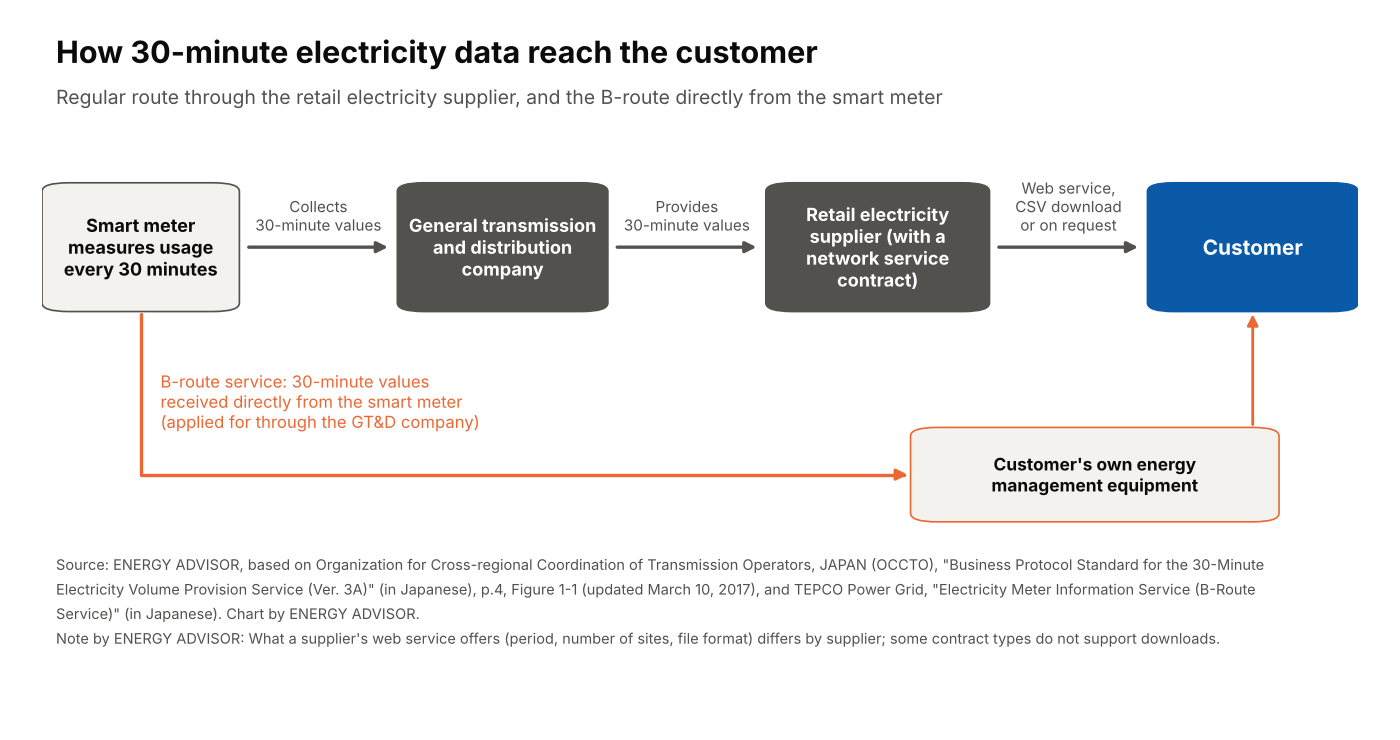
What matters is not to start collecting data just before the contract renewal, but to obtain such actual data every month as a routine and accumulate it within the company. With actual data at hand, you can estimate “how much this year would have cost on another plan” at any time, and move straight to a realistic comparison at the time of contract renewal without rushing.
Collecting actual data retroactively once you need it takes effort. Downloading it as a monthly task prepares you for the review.
Points to Note in Building Internal Agreement
A review of an electricity contract may involve several stakeholders, such as the accounting department, the purchasing department and on-site equipment staff. Changes in contract demand or in the rate structure may affect not only electricity charges but also the company’s budget planning and equipment operation, so it is important to proceed while sharing information among stakeholders.
Also, because switching contracts may require a certain procedural period, it is important to work backward from the desired switching date and set a schedule for internal decision-making.
In the course of the review, preparing materials that set out the expected effects of both continuing the current contract and switching makes internal explanation and agreement easier. In particular, conditions such as changes in contract demand and whether there is an early termination fee are issues that relate not only to the size of the amounts but also to the company’s risk tolerance, so it is important to share them with stakeholders at an early stage.
Steps to Avoid Putting Off the Review
As electricity charges continue to rise, putting off a contract review may leave the contract continuing on expensive terms. On the other hand, deciding to switch too hastily may cause unexpected costs from overlooking early termination fees or contract terms. For this reason, it is important to proceed with the steps of checking the current contract, comparing quotations and building internal agreement on a schedule with room to spare.
Summary
A review of an electricity contract starts by checking the contract term, early termination fee and rate structure of the current contract. By starting preparation several months before the contract expiry date, comparing quotations from several companies on aligned conditions, and building agreement with internal stakeholders, you can proceed with the review on a manageable schedule. In comparing, checking by applying past actual data leads to a decision closer to reality. For that reason, accumulating actual demand data, such as 30-minute interval data and the 30-minute demand, as a routine is the best preparation for the review. How to compare high-voltage electricity as a whole is as explained together in Part 1.
Looking Back on the Series: 14 Main Parts and a Special Edition
This series has built up understanding step by step: from checking the background to the rise in electricity costs, to the knowledge needed to read bills and contracts on your own, to how to put checking quotations and reviewing contracts into practice. High-voltage and extra-high-voltage electricity contracts look complex, but by building up knowledge one piece at a time, you can get closer to being able to check your own contract and decide on a review.
Looking back over the whole, this series consisted of the following three stages.
Notice (Parts 2–3): understand why prices rose
- Part 2: The 2026 spot market price surge: three causes and the summer tender for additional supply capacity
- Part 3: Fuel cost adjustment moves to a “one-month average” (April 2026) and the effect on bills
Be able to read (Parts 4–8): read your own contract and bill on your own
- Part 4: Standard tariffs: the only published price benchmark for high-voltage supply
- Part 5: How market-linked plans work and their risks: what to check before signing
- Part 6: How to read a high-voltage electricity bill: six components, and when government bill relief applies
- Part 7: Capacity contributions: a cost for future supply capacity borne by retail electricity suppliers and others since FY2024
- Part 8: How contract demand is set: 30-minute demand under the actual-demand method and the demand charge
Act (Parts 9–14): be in a position to carry out a review
- Part 9: Checking high-voltage quotations: five points for comparison
- Part 10: What changed when the former standard tariffs ended (March 2026): consolidation into the three current plans
- Part 11: Comparing by “applying past actual usage”: how it differs from forward-looking simulation
- Part 12: Market exit and bankruptcy risk of new entrant retailers: how to assess a supplier before switching
- Part 13: Consider electricity cost review and decarbonization together: responding to customers’ renewable energy requests
- Part 14: When and how to review an electricity contract (this article)
The entry point is the overview article, Part 1.
This series has explained the rules on the premise of the TEPCO area. The special edition sets out where to check the standard plans in areas other than TEPCO’s.
This article is based on published materials from the Ministry of Economy, Trade and Industry and its Agency for Natural Resources and Energy, the Electricity and Gas Market Surveillance Commission, the Organization for Cross-regional Coordination of Transmission Operators (OCCTO) and other sources. The English translations of figures are by ENERGY ADVISOR and are not official translations. When using this information for decisions, please check the original sources. When we find an error, we correct the article and note the date of the correction.
Sources
- TEPCO Energy Partner, “Revisions to Extra-High-Voltage and High-Voltage Standard Tariffs from April 1, 2026” (in Japanese). https://www.tepco.co.jp/ep/corporate/plan_h/minaoshi_2026.html
- METI, “Special Approvals Granted to Allow Discounts on Electricity and City Gas Charges in Connection with the Electricity and Gas Bill Relief for Usage in July, August and September 2026” (in Japanese), June 12, 2026. https://www.meti.go.jp/press/2026/06/20260612003/20260612003.html
- Electricity and Gas Price Shock Mitigation Program, official website (in Japanese) (confirming that coverage was low-voltage and high-voltage; October 22, 2026). https://denkigas-gekihenkanwa.go.jp/
- Agency for Natural Resources and Energy, “How to Switch Electricity Companies” (in Japanese). https://www.enecho.meti.go.jp/category/electricity_and_gas/electric/electricity_liberalization/step/
- Kyushu Electric Power, “Explanation of Bill Contents” (in Japanese). https://www.kyuden.co.jp/library/image/business/results/pdf/seikyusho-mikata.pdf
- TEPCO Energy Partner, “I Want to Download 30-Minute Electricity Values” (in Japanese). https://support.tepco.co.jp/hc/ja/articles/30742220080281
- TEPCO Energy Partner, Business TEPCO, “Bulk Download Operating Instructions” (in Japanese). https://support.tepco.co.jp/hc/ja/article_attachments/30742139344537
- Tohoku Electric Power, “Electricity Usage Record Inquiry Service” (in Japanese). https://www.zf1.tohoku-epco.co.jp/F4HA/f4hd/ce/F4HCEW030Page.jsp?hj=01
- OCCTO, “Switching Support System (30-Minute Electricity Volumes and Fixed Usage)” (in Japanese). https://www.occto.or.jp/various/sw_system/kouri_ippan_renkei.html
- TEPCO Power Grid, “Electricity Meter Information Service (B-Route Service)” (in Japanese). https://www.tepco.co.jp/pg/consignment/liberalization/smartmeter-broute.html
- OCCTO, “Business Protocol Standard for the 30-Minute Electricity Volume Provision Service (Ver. 3A)” (in Japanese), updated March 10, 2017, p.4, “Figure 1-1: Image of the 30-minute electricity volume provision service” (transmission and distribution companies provide the 30-minute electricity volumes collected from meters to the retail electricity suppliers that have network service contracts). https://www.occto.or.jp/assets/system/gijutsu/files/30MdennryokuryouBP_Ver3A_20170310.pdf