Staff at companies on high-voltage or extra-high-voltage contracts sometimes notice an unfamiliar item called the “capacity contribution” on their electricity bills or notices. It is listed separately from the demand charge and the fuel cost adjustment, and many say they do not know when or why this cost started. This article sets out what the capacity contribution is.
Key points
- 1The capacity contribution is the cost of the mechanism for securing future electricity supply capacity (the capacity market). Since FY2024 (April 2024–March 2025), retail electricity suppliers, general transmission and distribution companies and others have paid it.
- 2Each retail electricity supplier’s burden is set according to factors such as its share of demand (kW) at the annual peak. How it is passed on to customers differs by retail electricity supplier.
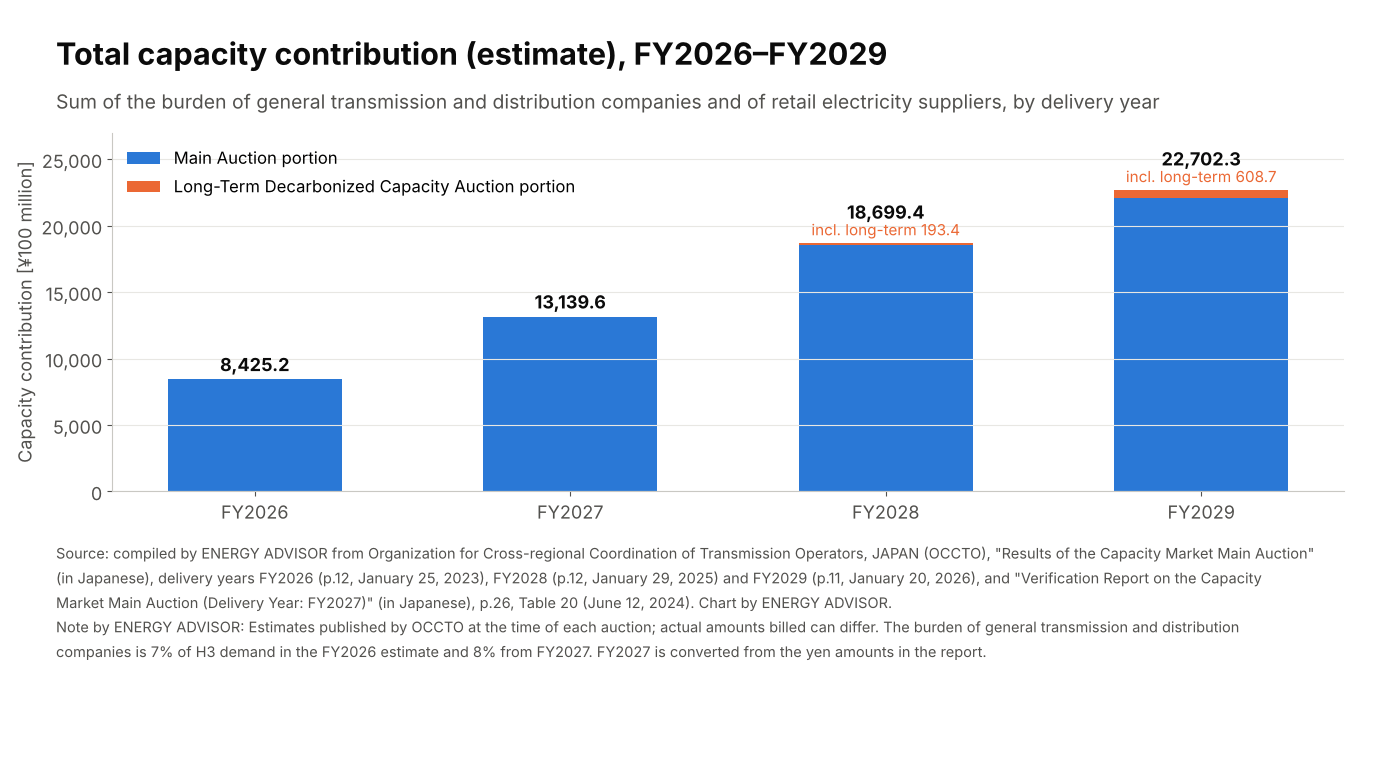
- 3Most of the total cost is the total clearing cost of the Main Auction for each fiscal year. From FY2028, the cost of the Long-Term Decarbonized Capacity Auction is also added. In OCCTO’s estimates, the total capacity contribution rises from about ¥842.5 billion in FY2026 to about ¥2.2702 trillion in FY2029.
- 4The capacity contribution is a cost under the rules, and it cannot be avoided by changing your electricity supplier.
Part 6 looked at the six items that make up a high-voltage bill. This part looks in detail at the “capacity contribution,” the newest of those six items and one expected to keep rising.
Related: For details of how the capacity market itself, on which the capacity contribution is based, works (including the requirements imposed on power generation companies), see “How the Capacity Market Works (Requirements)” (in Japanese).
How the Capacity Contribution Works
The capacity contribution is a cost of securing the capacity (supply capacity) of generating facilities and similar resources needed for a stable electricity supply. Retail electricity suppliers and others pay it to the Organization for Cross-regional Coordination of Transmission Operators, JAPAN (OCCTO), and the cost is passed on to customers as part of the electricity charge. In other words, it is not a cost for the electricity actually used (kWh), but a cost of maintaining supply capacity into the future.
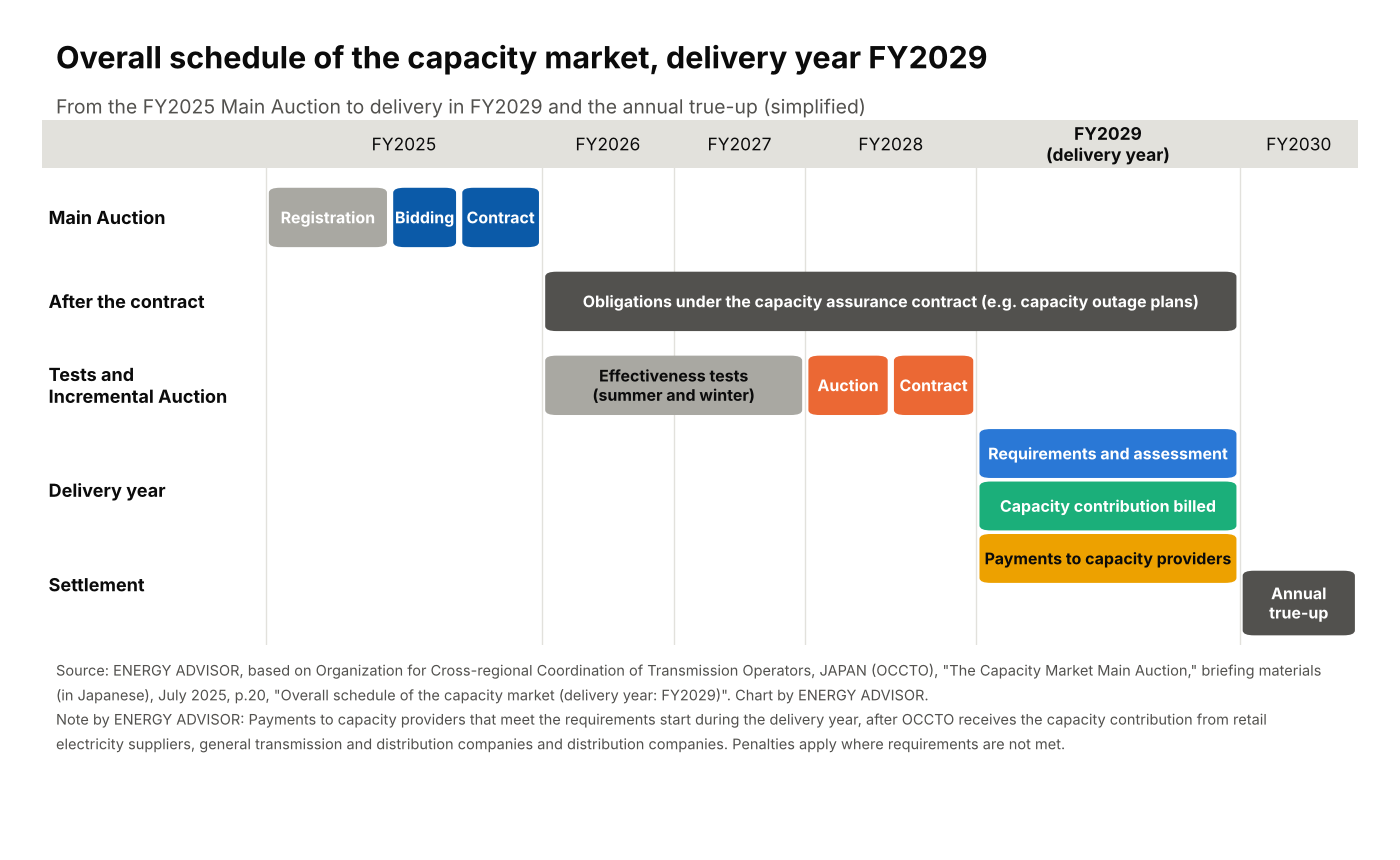
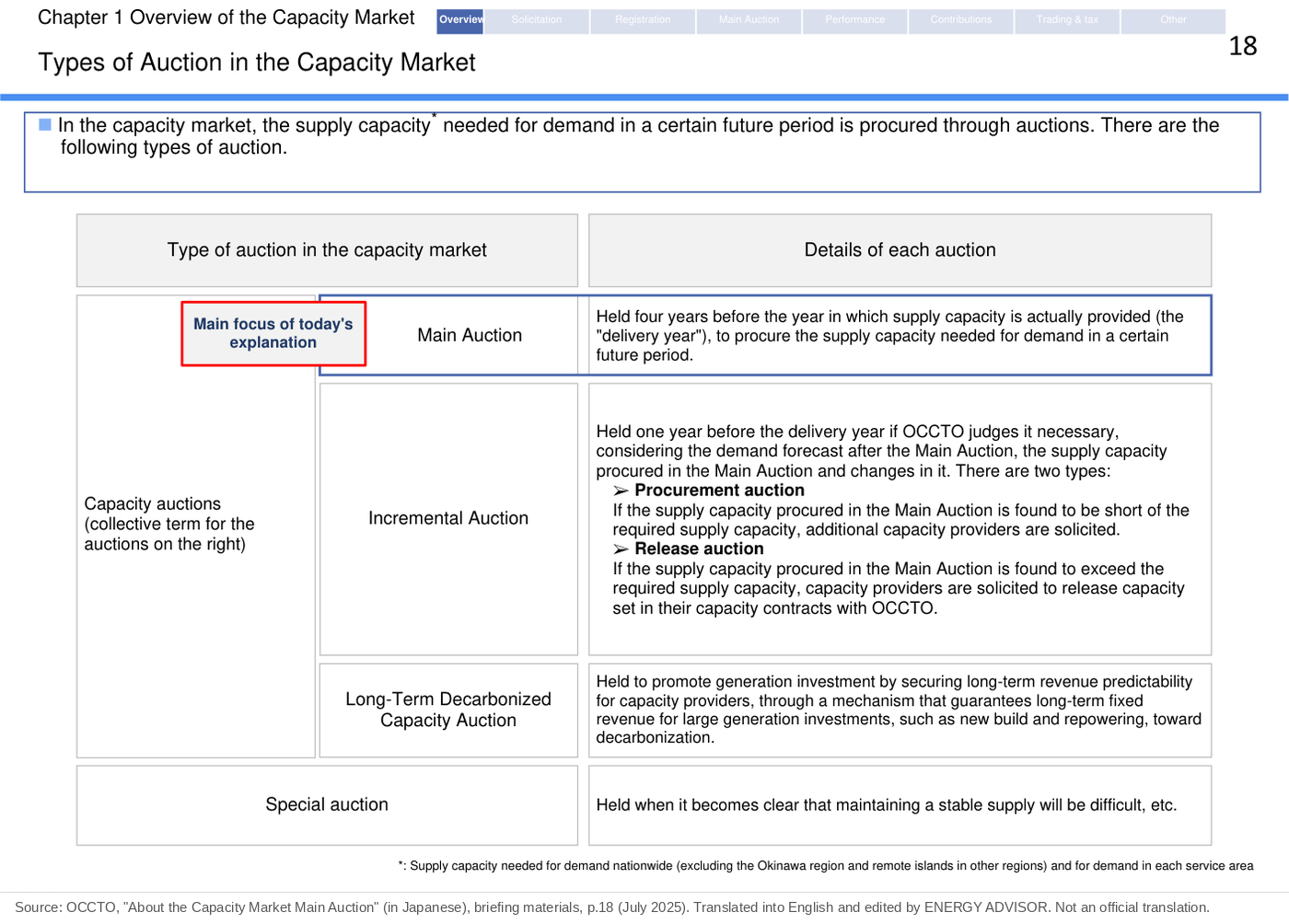
The source of this cost is the “capacity market” run by OCCTO. In the capacity market, the supply capacity (kW) needed in the fiscal year four years later (the delivery year) is secured through an auction (the Main Auction), and payments are made to the winning power generation companies and others. The funds for those payments are borne as the capacity contribution. The first delivery year of the capacity market was FY2024, and the capacity contribution has been paid since FY2024.
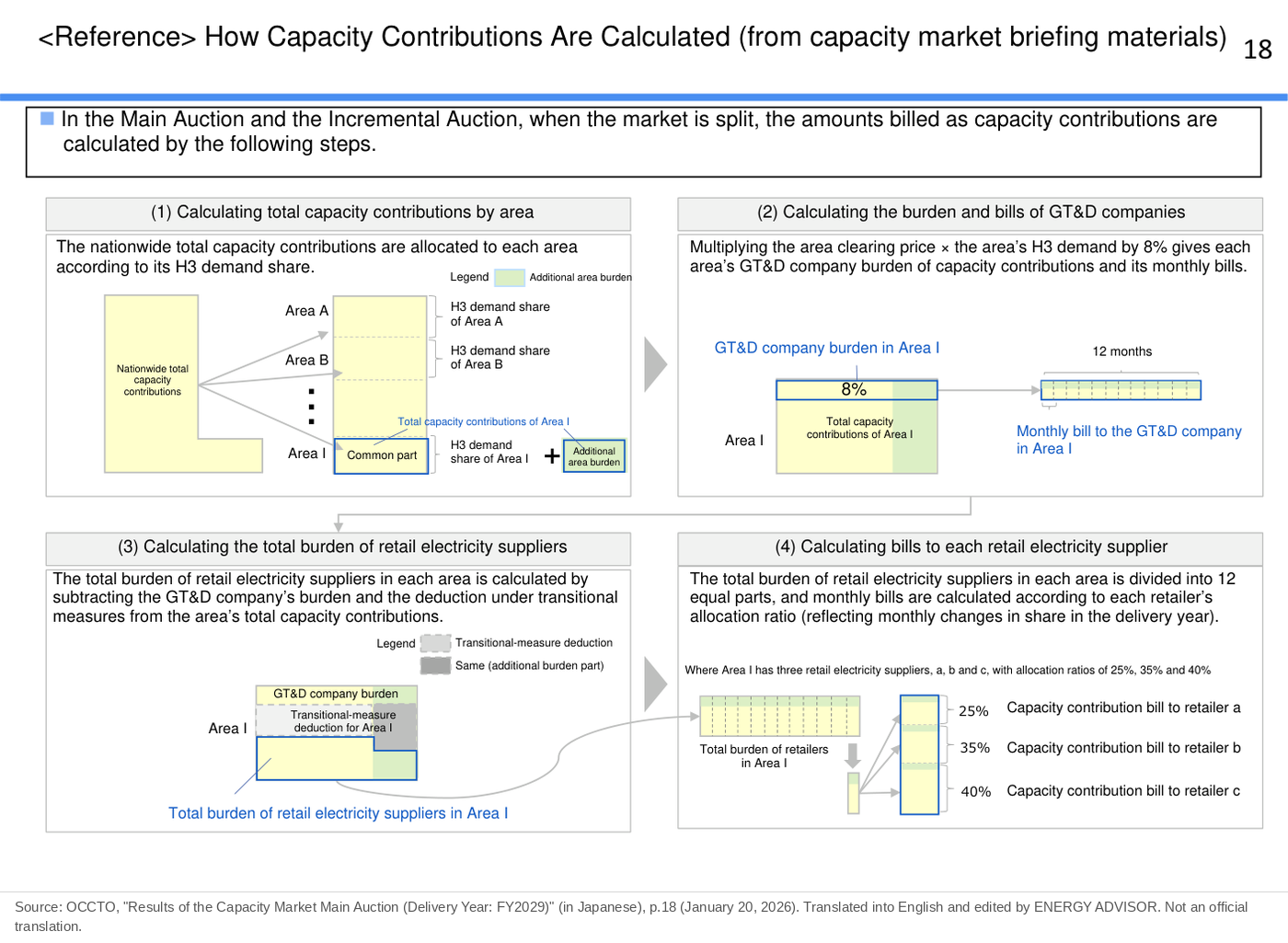
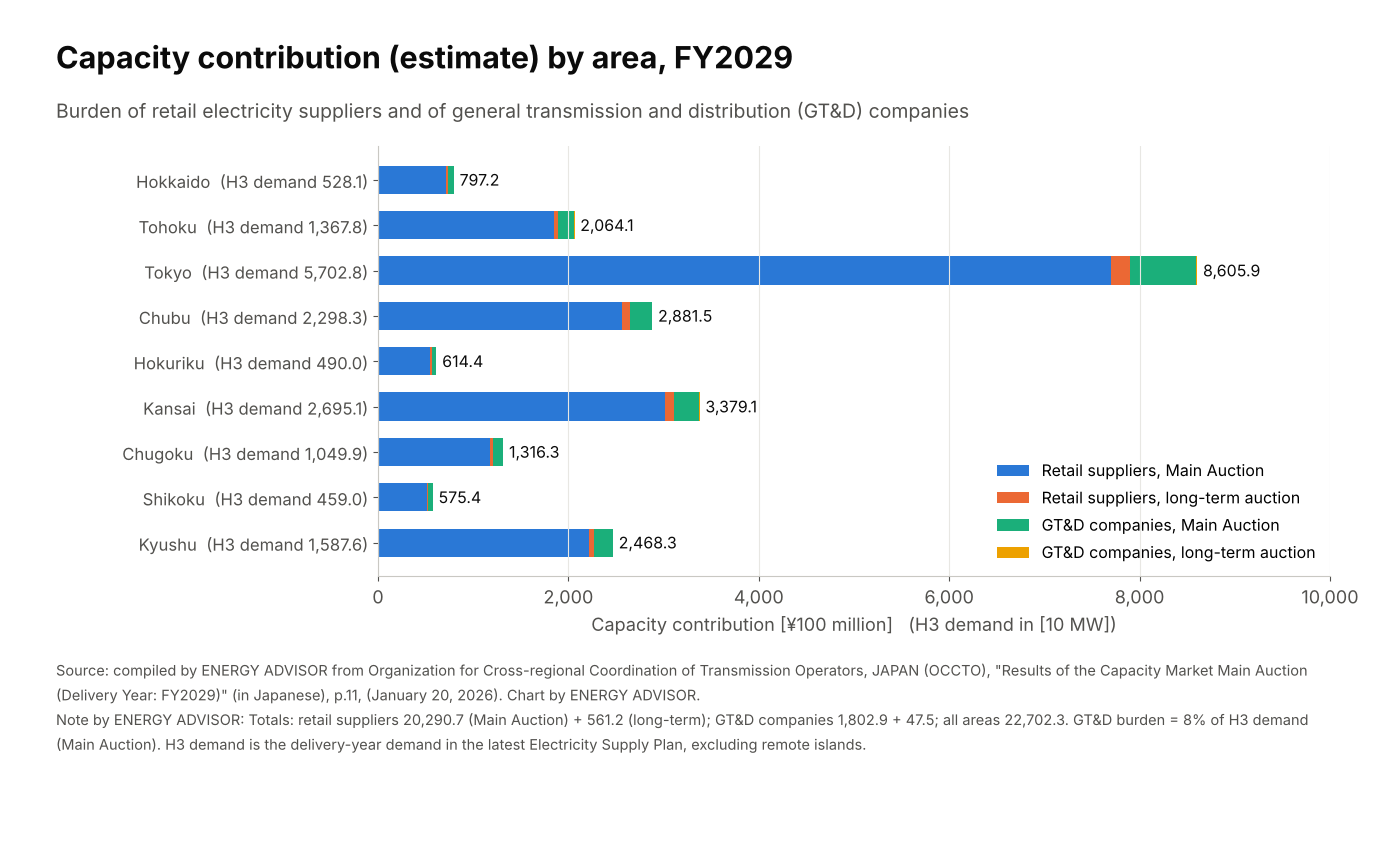
Those who pay are retail electricity suppliers, as well as general transmission and distribution companies and licensed distribution companies. The total burden of general transmission and distribution companies and licensed distribution companies is calculated by multiplying the area’s clearing price by the area’s H3 demand and the burden rate. H3 demand is an indicator of demand in the delivery year expected in the Electricity Supply Plan (the supply and demand plans that electricity businesses submit to OCCTO every year). The burden rate is 6% for FY2024 and 8% from FY2025.
The total burden of retail electricity suppliers is calculated by subtracting the total burden of general transmission and distribution companies and licensed distribution companies, and the deduction under transitional measures, from the area’s total capacity contribution. It is allocated to each retail electricity supplier according to factors such as its share of demand (kW) at the annual peak.
Source: OCCTO, “Learn About the Capacity Contribution!” (in Japanese), checked October 22, 2026; OCCTO, “Results of the Capacity Market Main Auction (Delivery Year: FY2026)” (in Japanese) (definition of H3 demand)
For this reason, the amount OCCTO charges a retail electricity supplier depends on the kW at the peak of the demand that the supplier serves. How it is passed on to customers’ bills (in proportion to contract demand, to electricity consumption, or otherwise) differs by retail electricity supplier.
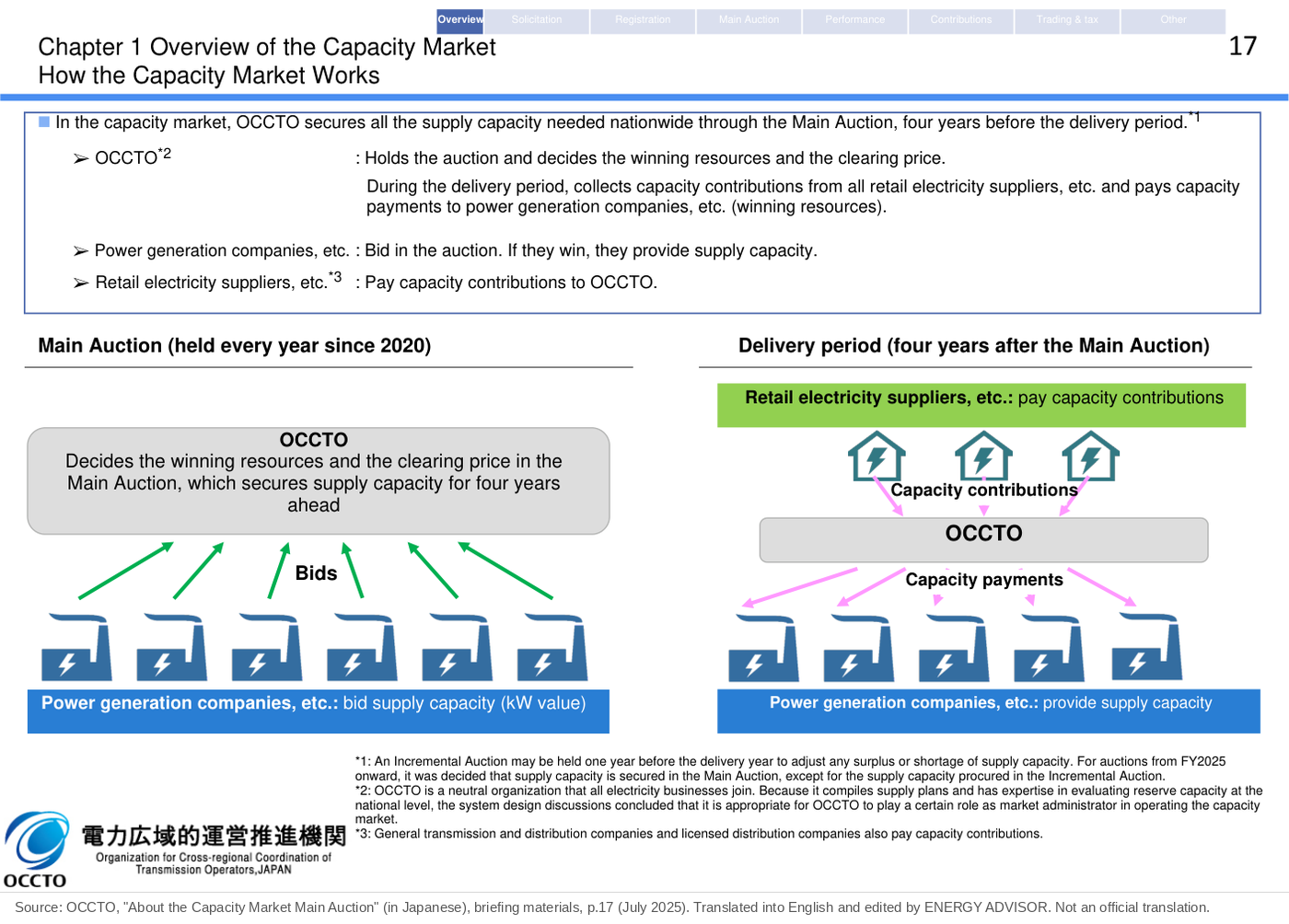
Source: OCCTO, “The Capacity Market Main Auction,” briefing materials (in Japanese), July 2025
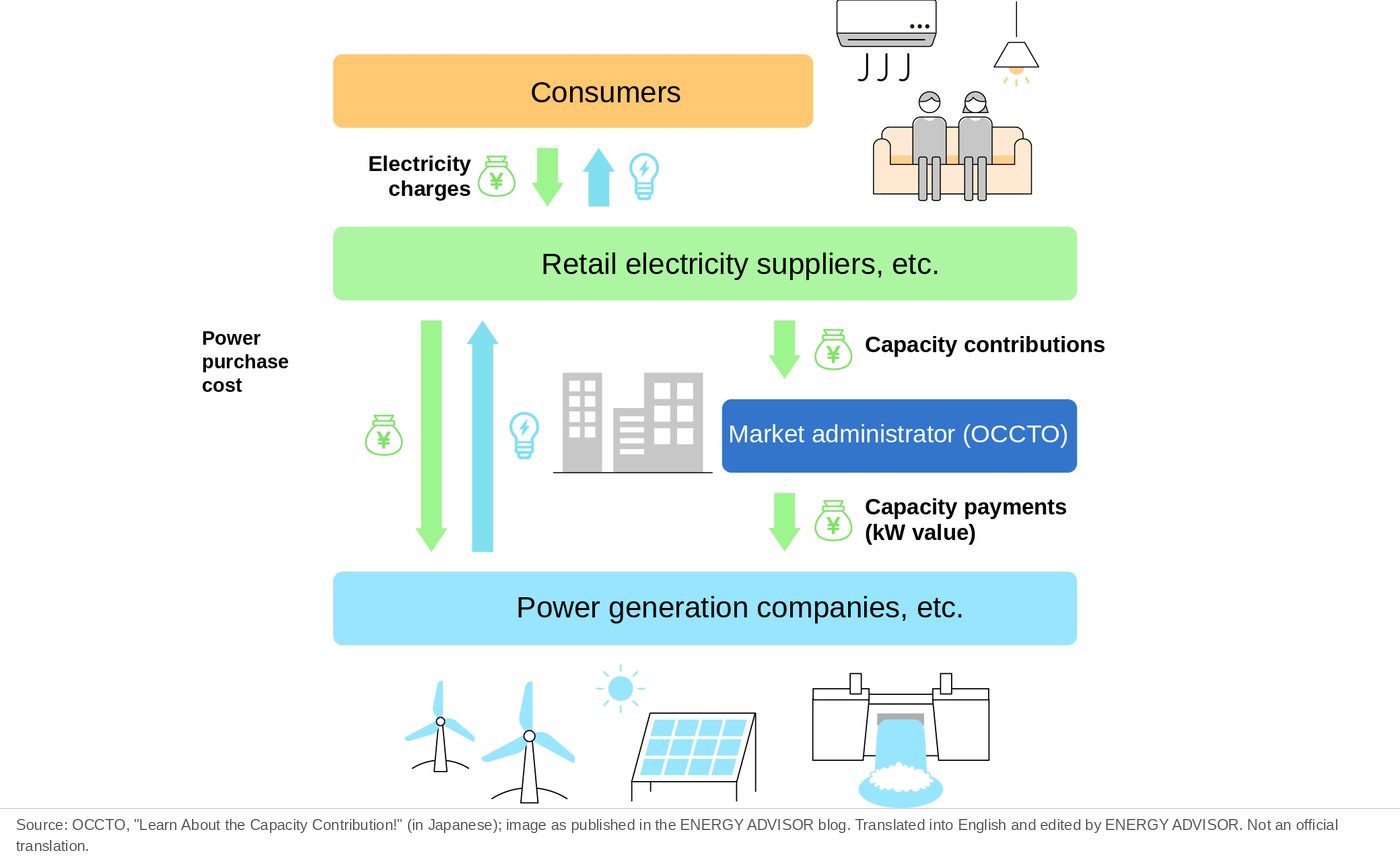
Source: OCCTO, “Learn About the Capacity Contribution!” (in Japanese)
Looking only at the name “capacity contribution,” some people get the impression that it is a new tax. In fact, it is the cost of the capacity market, a mechanism that secures in advance the supply capacity needed for a stable electricity supply.
Why the Cost Is Added
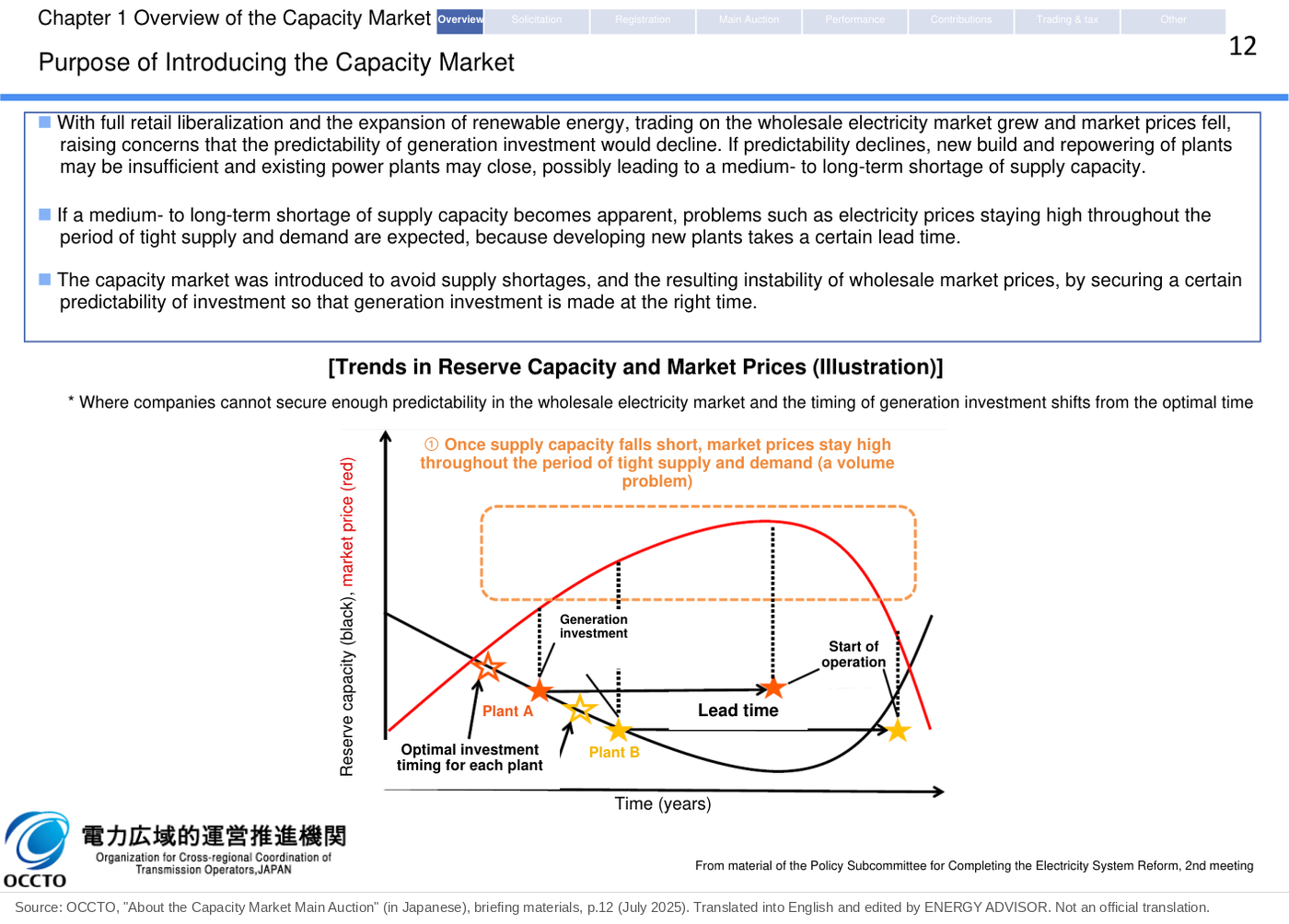
Electricity supply capacity is hard to secure unless businesses can expect in advance to recover the costs of building and maintaining power plants. For this reason, a mechanism was set up to secure the supply capacity needed in the future in a planned way, and customers broadly bear part of the cost.
The detailed operating rules and scope of the mechanism are set out in OCCTO’s briefing materials on the system (listed in the sources).
Totals by Fiscal Year and a Rough Amount per kW
Most of the total capacity contribution is the total clearing cost of the Main Auction for each fiscal year. From FY2028, the cost of the Long-Term Decarbonized Capacity Auction (another OCCTO auction that encourages large investments for decarbonization, such as new build and repowering of power plants, by securing long-term fixed revenue for them) is also added. The estimates of the capacity contribution that OCCTO has shown in its auction results materials are as follows.
| Delivery year | Total capacity contribution (estimate) | Rough amount per kW per month borne by retail electricity suppliers |
|---|---|---|
| FY2026 | About ¥842.5 billion | About ¥405 |
| FY2027 | About ¥1.3140 trillion | About ¥622 |
| FY2028 | About ¥1.8699 trillion (of which about ¥19.3 billion for the Long-Term Decarbonized Capacity Auction) | About ¥879 (Main Auction portion) |
| FY2029 | About ¥2.2702 trillion (of which about ¥60.9 billion for the Long-Term Decarbonized Capacity Auction) | About ¥1,045 (Main Auction portion) |
(Notes: The total clearing cost after the transitional-measure deduction is about ¥842.5 billion for FY2026, about ¥1.3140 trillion for FY2027, about ¥1.8506 trillion for FY2028 and about ¥2.2094 trillion for FY2029. The capacity contribution (estimate) is the sum of the burden of general transmission and distribution companies and that of retail electricity suppliers. The burden of retail electricity suppliers (estimate) is ¥773.41 billion for FY2026, about ¥1.1986 trillion for FY2027, ¥1.69352 trillion (Main Auction portion) + ¥17.84 billion (long-term portion) for FY2028, and ¥2.02907 trillion (Main Auction portion) + ¥56.12 billion (long-term portion) for FY2029. H3 demand (national total) is 159,035 MW for FY2026, 160,597.9 MW for FY2027, 160,577 MW for FY2028 and 161,786 MW for FY2029. The rough amount per kW per month is the author’s calculation, dividing the burden of retail electricity suppliers (Main Auction portion) by the national total of H3 demand and then by 12. It is a national average and does not reflect differences in clearing prices by area or each retail electricity supplier’s share at the peak. It differs from actual amounts billed. The FY2026 estimate was calculated with the burden of general transmission and distribution companies at 7% of H3 demand. This was later changed to 8%, and the estimates from FY2027 use 8%.)
The figures in the earlier version of this article (in Japanese), “¥409/kW for FY2026,” “about ¥879/kW for FY2028” and “about ¥1,045/kW for FY2029,” are almost the same as this “rough amount per kW per month borne by retail electricity suppliers” (they match for FY2028 and FY2029; for FY2026 it is about ¥405).
Source: OCCTO, “Results of the Capacity Market Main Auction” (in Japanese), delivery year FY2026 (January 25, 2023), pp.9–10 and 12; FY2028 (January 29, 2025), pp.9–10 and 12; FY2029 (January 20, 2026), pp.9–11; “Verification Report on the Capacity Market Main Auction (Delivery Year: FY2027)” (in Japanese) (June 12, 2024), pp.4–5, 9 and 26
Source: OCCTO, briefing materials on the system (in Japanese), July 2025
Effect on Electricity Charges
The total capacity contribution (estimate) rises from about ¥842.5 billion in FY2026 to about ¥2.2702 trillion in FY2029. The rough amount per kW per month borne by retail electricity suppliers also rises from about ¥405 in FY2026 to about ¥1,045 in FY2029 (Main Auction portion). For this reason, even companies that do not yet feel a large effect on their bills need to expect a heavier burden in the future.
How It Appears on the Bill
The name and position of the capacity contribution on the bill may differ by retail electricity supplier. In some cases it is combined with the demand charge or the energy charge; in others it is shown as a separate item. How to check the six components of the bill one line at a time is as seen in Part 6.
Because the capacity contribution is a cost based on the rules, it cannot be avoided by switching electricity suppliers. For this reason, rather than responding to the capacity contribution itself, it is important to understand the overall structure of electricity charges and keep track of it together with the other variable items.
Summary
The capacity contribution is a cost of securing future electricity supply capacity. Since FY2024, retail electricity suppliers, general transmission and distribution companies and others have paid it, and customers bear the retail electricity suppliers’ share through their electricity charges. Each retail electricity supplier’s burden is set by factors such as its kW share at the annual peak, and how it is passed on to customers differs by supplier. In OCCTO’s estimates, the total capacity contribution rises from about ¥842.5 billion in FY2026 to about ¥2.2702 trillion in FY2029. Bearing in mind that it is a cost that cannot be avoided by switching suppliers, it is important to check the breakdown of your bill.
This article is based on published materials from the Ministry of Economy, Trade and Industry and its Agency for Natural Resources and Energy, the Electricity and Gas Market Surveillance Commission, the Organization for Cross-regional Coordination of Transmission Operators (OCCTO) and other sources. The English translations of figures are by ENERGY ADVISOR and are not official translations. When using this information for decisions, please check the original sources. When we find an error, we correct the article and note the date of the correction.
Sources
- OCCTO, “Learn About the Capacity Contribution!” (in Japanese) (payments from FY2024, who pays and burden rates, calculation and allocation of the total burden of retail electricity suppliers; checked October 22, 2026). https://www.occto.or.jp/capacity-market/kyoshutsukin_know/
- OCCTO, “Results of the Capacity Market Main Auction (Delivery Year: FY2026)” (in Japanese), published January 25, 2023 (total clearing cost reflecting transitional measures ¥842.5 billion, pp.9–10; capacity contribution (estimate): general transmission and distribution companies ¥69.11 billion, retail electricity suppliers ¥773.41 billion; definition and national total of H3 demand 159,035 MW, p.12). https://www.occto.or.jp/assets/market-board/market/oshirase/2022/files/230125_mainauction_youryouyakujokekka_kouhyou_jitsujukyu2026.pdf
- OCCTO, “Verification Report on the Capacity Market Main Auction (Delivery Year: FY2027)” (in Japanese), June 12, 2024 (total contract value after the transitional-measure deduction ¥1.3140 trillion, pp.4–5; national total of H3 demand 160,597,900 kW, p.9, Table 6; auction results published January 24, 2024; capacity contribution (estimate) for retail electricity suppliers ¥1,198,630,803,899, p.26). https://www.occto.or.jp/market-board/market/oshirase/2024/files/240612_mainauction_kensyoreport_jitsujukyu2027.pdf
- OCCTO, “Results of the Capacity Market Main Auction (Delivery Year: FY2028)” (in Japanese), published January 29, 2025 (total clearing cost reflecting transitional measures ¥1.8506 trillion, pp.9–10; capacity contribution (estimate): general transmission and distribution companies ¥158.58 billion, retail electricity suppliers ¥1.71136 trillion, of which Main Auction portion ¥1.69352 trillion; H3 demand 160,577 MW, p.12). https://www.occto.or.jp/market-board/market/oshirase/2024/files/250129_mainauction_youryouyakujokekka_kouhyou_jitsujukyu2028.pdf
- OCCTO, “Results of the Capacity Market Main Auction (Delivery Year: FY2029)” (in Japanese), published January 20, 2026 (total clearing cost reflecting transitional measures ¥2.2094 trillion, pp.9–10; capacity contribution (estimate): general transmission and distribution companies ¥185.04 billion, retail electricity suppliers ¥2.08519 trillion, of which Main Auction portion ¥2.02907 trillion and Long-Term Decarbonized Capacity Auction portion ¥56.12 billion; H3 demand 161,786 MW, p.11). https://www.occto.or.jp/assets/news/capacity-market/260120_mainauction_youryouyakujokekka_kouhyou_jitsujukyu2029.pdf
- OCCTO, “The Capacity Market Main Auction,” briefing materials (in Japanese), July 2025. https://www.occto.or.jp/assets/market-board/market/oshirase/2025/files/20250709_youryou_seidosetsumei.pdf
- Pages of OCCTO, “The Capacity Market Main Auction,” briefing materials (in Japanese), July 2025: p.12 “Purpose of introducing the capacity market”; p.17 “How the capacity market works” (the Main Auction four years before the delivery period secures the supply capacity needed nationwide all at once); p.18 “Types of auctions in the capacity market” (purpose of the Long-Term Decarbonized Capacity Auction); p.20 “Overall schedule of the capacity market (delivery year: FY2029)”; p.93 “Overview of the capacity contribution”