At the end of March 2026, TEPCO Energy Partner (TEPCO EP)’s former standard tariffs (those from FY2023 or earlier; Japan’s fiscal year runs from April to March) ended, and the standard tariff was revised on April 1, 2026. Some companies that have kept the same contract for many years have moved to the new standard tariff without noticing this change. This article sets out what changed with the end of the former standard tariffs and the April 2026 revision.
Key points
- 1TEPCO EP’s former standard tariffs (those from FY2023 or earlier) ended at the end of March 2026, and the standard tariff was revised on April 1, 2026.
- 2The current standard tariff has three types: the Basic Plan, the Zero Market Adjustment Plan and the Market-Linked Plan.
- 3Once the planned supply volume cap is reached, applications for plans other than the Market-Linked Plan close, and only the Market-Linked Plan is accepted.
- 4On November 1, 2026, unit prices will change to reflect the revision of network charges.
- 5Points that contract holders should check.
Part 4 looked at the basic mechanism of the standard tariff (the three plans: the Basic Plan, the Zero Market Adjustment Plan and the Market-Linked Plan). This part looks at what specifically happened to that standard tariff in 2026.
End of the Former Tariffs at the End of March 2026 and the April Revision
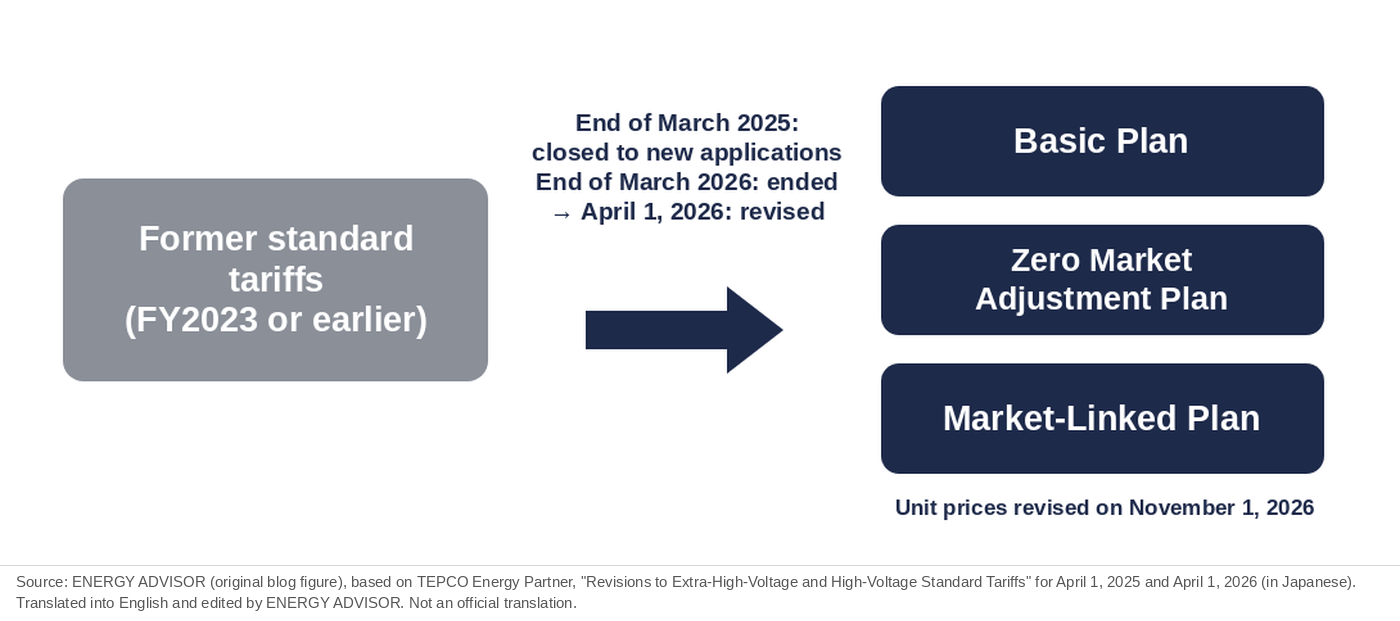
Among TEPCO EP’s standard tariffs for high-voltage and extra-high-voltage supply, the former standard tariffs that had continued since FY2023 or earlier ended at the end of March 2026. The ending proceeded in two stages. Some plans that had still been accepting new applications also closed to new applications at the end of March 2025, and all former standard tariffs ended at the end of March 2026. Customers that had a former standard tariff as of the end of March 2026 and continue their contract with TEPCO EP from April are contracted under the standard tariff. Then, on April 1, 2026, the revision to the new standard tariff took effect. Standard tariffs are reviewed every fiscal year, and they were also revised in FY2025. In FY2026, unit prices also change in the middle of the fiscal year, on November 1, 2026, to reflect the revision of the network charges (fees for using the transmission and distribution network) of the general transmission and distribution companies (for a comparison of unit prices, see Part 4). For this reason, contract holders need to check every year on the assumption that the content may have changed.
Source: TEPCO Energy Partner, “Revisions to Extra-High-Voltage and High-Voltage Standard Tariffs from April 1, 2025” (in Japanese) (the two-stage ending of the former standard tariffs and how contracts are treated afterward; checked October 22, 2026); TEPCO Energy Partner, “Revisions to Extra-High-Voltage and High-Voltage Standard Tariffs from April 1, 2026, Reflection of the November 1, 2026 Network Charge Revision in Electricity Rates, and Partial Revision of Supply Conditions” (in Japanese)
TEPCO EP’s list of rate plans closed to new applications at the end of March 2025 names four high-voltage plans: Gyomuyo Kisetsubetsu Jikantaibetsu Denryoku (seasonal time-of-use power for business), Gyomuyo Denryoku (power for business), Koatsu Kisetsubetsu Jikantaibetsu Denryoku (high-voltage seasonal time-of-use power) and Koatsu Denryoku (high-voltage power).
Source: Figure published on TEPCO Energy Partner’s page “Revisions to Extra-High-Voltage and High-Voltage Standard Tariffs from April 1, 2026” (in Japanese)
In the range the author has seen in practice, because standard tariffs are often switched automatically, it is not unusual for contract holders to find that they have moved to a new tariff “without noticing.”
Position of the Standard Tariff
A standard tariff is a standard rate menu for high-voltage and extra-high-voltage customers that a major regional utility (retail electricity supplier) publishes on its official website and elsewhere. While new entrant retailers do not publish their unit prices, the standard tariff serves as a benchmark for comparison, as one of the few pieces of published information. The details of the standard tariff are as seen in Part 4.
Differences Between the Former and Current Standard Tariffs
The former standard tariffs were TEPCO Energy Partner’s standard rate menus that had continued since FY2023 or earlier. In contrast, from FY2024 the structure of the standard tariff itself was revised and reorganized into three plans: the Basic Plan, the Zero Market Adjustment Plan and the Market-Linked Plan. Then, at the end of March 2026, contracts under the former standard tariffs themselves ended, and from April 1, 2026 everything has been consolidated into this three-plan structure.
Source: TEPCO Energy Partner, “Revisions to Extra-High-Voltage and High-Voltage Standard Tariffs from April 1, 2026” (in Japanese)
In other words, companies that had continued under a former standard tariff and continue their contract from April 2026 are now contracted under the standard tariff, and their plan name has changed.
| Item | Former standard tariffs (until end of March 2026) | Current standard tariff (from April 2026) |
|---|---|---|
| Plan structure | Structure from FY2023 or earlier | Three types (Basic / Zero Market Adjustment / Market-Linked) |
| New applications | Closed at the end of March 2025 (including some plans that had still been accepting them) | Accepted (plans other than the Market-Linked Plan close once the planned supply volume cap is reached) |
| Current status | Ended at the end of March 2026 | Consolidated into the current structure with the revision of April 1, 2026 (unit prices revised on November 1, 2026) |
| Applications after the planned supply volume cap is reached | – (already ended) | Market-Linked Plan only |
Source: TEPCO Energy Partner, “Revisions to Extra-High-Voltage and High-Voltage Standard Tariffs from April 1, 2026” (in Japanese)
Position of the Three Current Plans as the Destination
The current standard tariff has three types: the Basic Plan, the Zero Market Adjustment Plan and the Market-Linked Plan. The unit price structure of each plan is as seen in Part 4, and the risks of the Market-Linked Plan are as seen in Part 5. Here, it is enough to confirm that the destination for those moving from the former standard tariffs is this three-plan structure.
Acceptance Cap and Treatment of New Applications
Under the current standard tariff, TEPCO Energy Partner states that once the planned supply volume cap it has set is reached, applications for plans other than the Market-Linked Plan will close. It also states that applications may close depending on supply-demand conditions even before the cap is reached. After applications close, in principle only the Market-Linked Plan is accepted.
Source: TEPCO Energy Partner, “Revisions to Extra-High-Voltage and High-Voltage Standard Tariffs from April 1, 2026” (in Japanese), checked October 22, 2026
In other words, once the cap is reached, new contracts can no longer be made for plans that build in the fuel cost adjustment, such as the Basic Plan and the Zero Market Adjustment Plan, and only the Market-Linked Plan, which directly reflects wholesale electricity market prices, remains as an option. For this reason, companies about to sign a new high-voltage contract and companies considering a review of an existing contract need to understand that the range of plans they can choose may change depending on when they apply. The status of applications can be checked on TEPCO Energy Partner’s official website before applying.
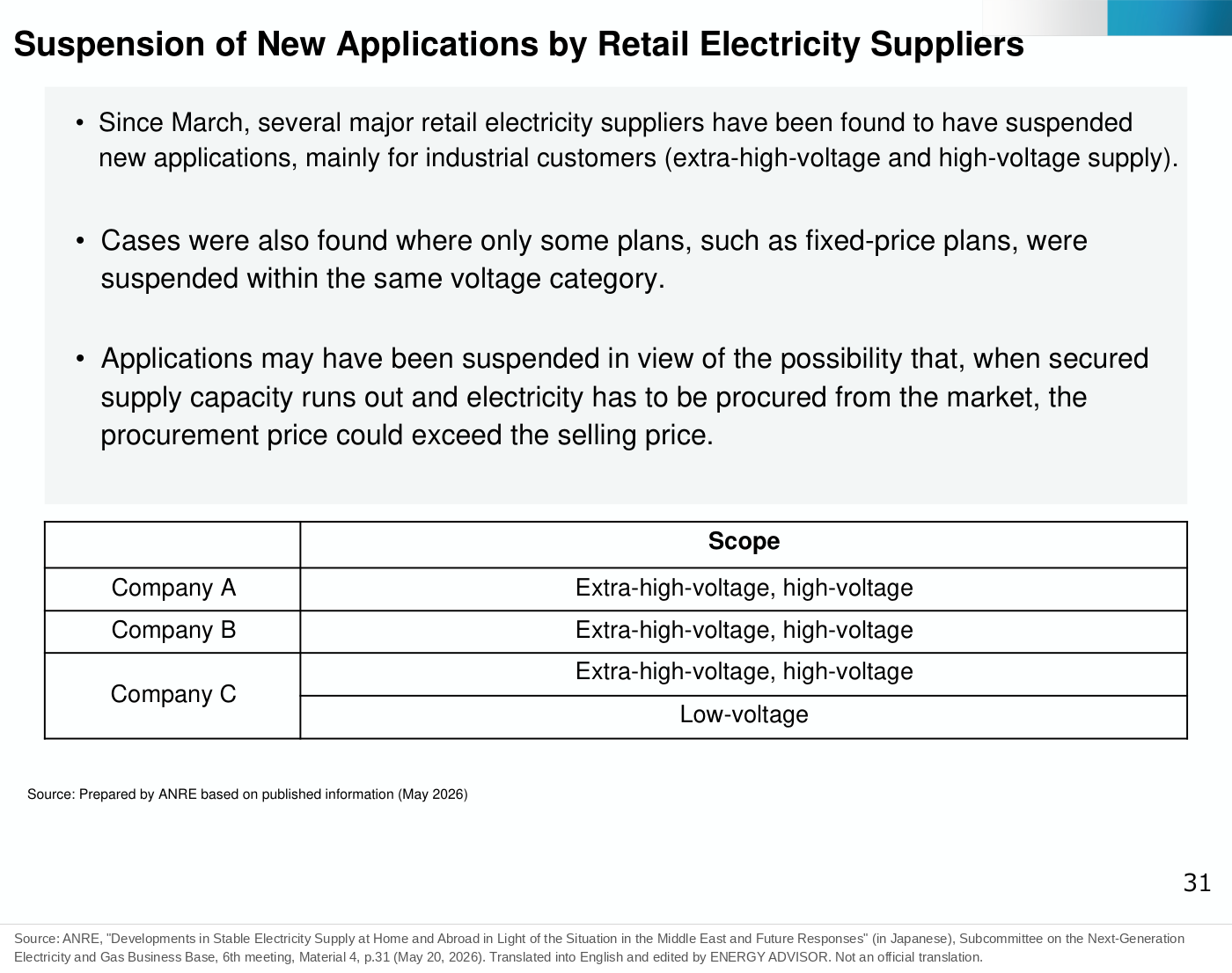
A material of the Agency for Natural Resources and Energy (ANRE) (May 20, 2026) also shows that since March 2026, several major retail electricity suppliers have been found to have suspended new applications, mainly for extra-high-voltage and high-voltage supply, and that some have suspended only certain menus, such as fixed-price menus, within the same voltage category (the suppliers are not named).
Source: Agency for Natural Resources and Energy, “Developments in Stable Electricity Supply at Home and Abroad in Light of the Situation in the Middle East and Future Responses” (in Japanese), Advisory Committee for Natural Resources and Energy, Subcommittee on the Next-Generation Electricity and Gas Business Base, May 20, 2026, Material 4, p.31
Frequency of Standard Tariff Reviews
Standard tariffs were reviewed in FY2025 and again in FY2026. In other words, the standard tariff is not something you check once and are done with; it is information you should check again every fiscal year.
Source: TEPCO Energy Partner, “Revisions to Extra-High-Voltage and High-Voltage Standard Tariffs from April 1, 2025” (in Japanese); TEPCO Energy Partner, “Revisions to Extra-High-Voltage and High-Voltage Standard Tariffs from April 1, 2026” (in Japanese)
Points That Contract Holders Should Check
The first step is to check which of the Basic Plan, the Zero Market Adjustment Plan and the Market-Linked Plan your company is on. Then it is important to check how each item on the bill, such as the fuel cost adjustment and the amount corresponding to the capacity contribution, is changing. How to check the bill is as described in Part 6.
It is also important to check how the contract name and plan name are written on the bill and the contract. Even if notices continue to use the name of a former standard tariff, the actual conditions applied may follow the April 2026 revision, so it is important to compare both the name and the actual conditions.
Summary
TEPCO Energy Partner’s former standard tariffs (those from FY2023 or earlier) ended at the end of March 2026, and the standard tariff was revised on April 1, 2026. The current standard tariff has three types, the Basic Plan, the Zero Market Adjustment Plan and the Market-Linked Plan, and once the planned supply volume cap is reached, only the Market-Linked Plan is accepted. On November 1, 2026, unit prices will change to reflect the revision of network charges. Because standard tariffs may be reviewed every fiscal year and also in the middle of a fiscal year, contract holders should check their content regularly. How to compare high-voltage electricity as a whole is as confirmed in Part 1.
This article is based on published materials from the Ministry of Economy, Trade and Industry and its Agency for Natural Resources and Energy, the Electricity and Gas Market Surveillance Commission, the Organization for Cross-regional Coordination of Transmission Operators (OCCTO) and other sources. The English translations of figures are by ENERGY ADVISOR and are not official translations. When using this information for decisions, please check the original sources. When we find an error, we correct the article and note the date of the correction.
Sources
- TEPCO Energy Partner, “Revisions to Extra-High-Voltage and High-Voltage Standard Tariffs from April 1, 2026, Reflection of the November 1, 2026 Network Charge Revision in Electricity Rates, and Partial Revision of Supply Conditions” (in Japanese) (including the description of the acceptance cap; checked October 22, 2026). https://www.tepco.co.jp/ep/corporate/plan_h/minaoshi_2026.html
- TEPCO Energy Partner, “Revisions to Extra-High-Voltage and High-Voltage Standard Tariffs from April 1, 2025” (in Japanese) (“some plans that had continued to accept new applications also closed to new applications at the end of March 2025, and all former standard tariffs will end at the end of March 2026”; checked October 22, 2026). https://www.tepco.co.jp/ep/corporate/plan_h/minaoshi_2025.html
- TEPCO Energy Partner, “Reflection of the Network Charge Revision in the Company’s Electricity Rates and Partial Revision of Supply Conditions” (in Japanese), August 31, 2026. https://www.tepco.co.jp/ep/notice/pressrelease/2026/pdf/26×3101.pdf
- TEPCO Energy Partner, figure on the standard tariff revision page (list of rate plans closed to new applications) (in Japanese). https://www.tepco.co.jp/ep/corporate/plan_h/images/m2026zu04v9.png
- Agency for Natural Resources and Energy, “Developments in Stable Electricity Supply at Home and Abroad in Light of the Situation in the Middle East and Future Responses” (in Japanese), Advisory Committee for Natural Resources and Energy, Subcommittee on the Next-Generation Electricity and Gas Business Base, May 20, 2026, Material 4, p.31, “Suspension of new applications by retail electricity suppliers” (compiled by ANRE from published information, May 2026). https://www.meti.go.jp/shingikai/enecho/denryoku_gas/jisedai_kiban/pdf/006_04_00.pdf