A growing number of companies reviewing their electricity costs have experiences such as “a customer asked us to report our CO2 emissions” or “we were asked to switch to electricity from renewable energy.” There is a reason why customers larger than the company itself take an interest even in how it procures electricity. This article sets out the mechanism behind this with objective data and primary sources, and looks at realistic ways to respond when asked.
Key points
- 1Large companies have a framework (Scope 3) for understanding and disclosing the CO2 emissions of their “entire supply chain,” including their business partners as well as themselves, and this is the starting point of the requests to small and medium-sized enterprises (SMEs).
- 2Government policies, such as the declaration of carbon neutrality by 2050, the GX Promotion Strategy and mandatory disclosure for listed companies, are accelerating this trend.
- 3Public surveys also show that the number of SMEs asked by business partners to measure or reduce emissions is actually increasing.
- 4The realistic starting point for SMEs is thorough energy saving and the use of rate menus offered by electricity suppliers, such as “effectively renewable” and “CO2-free” menus.
- 5If you also check whether decarbonization menus are available, and their conditions, when reviewing electricity costs (obtaining competitive quotes), you avoid doing the work twice.
By Part 12, the materials for deciding on a “cost review,” including assessing a supplier to switch to, were in place. This part takes up decarbonization as another issue to consider at the same time as the cost review.
Why Customers Ask for “Decarbonization”: The Scope 3 Mechanism
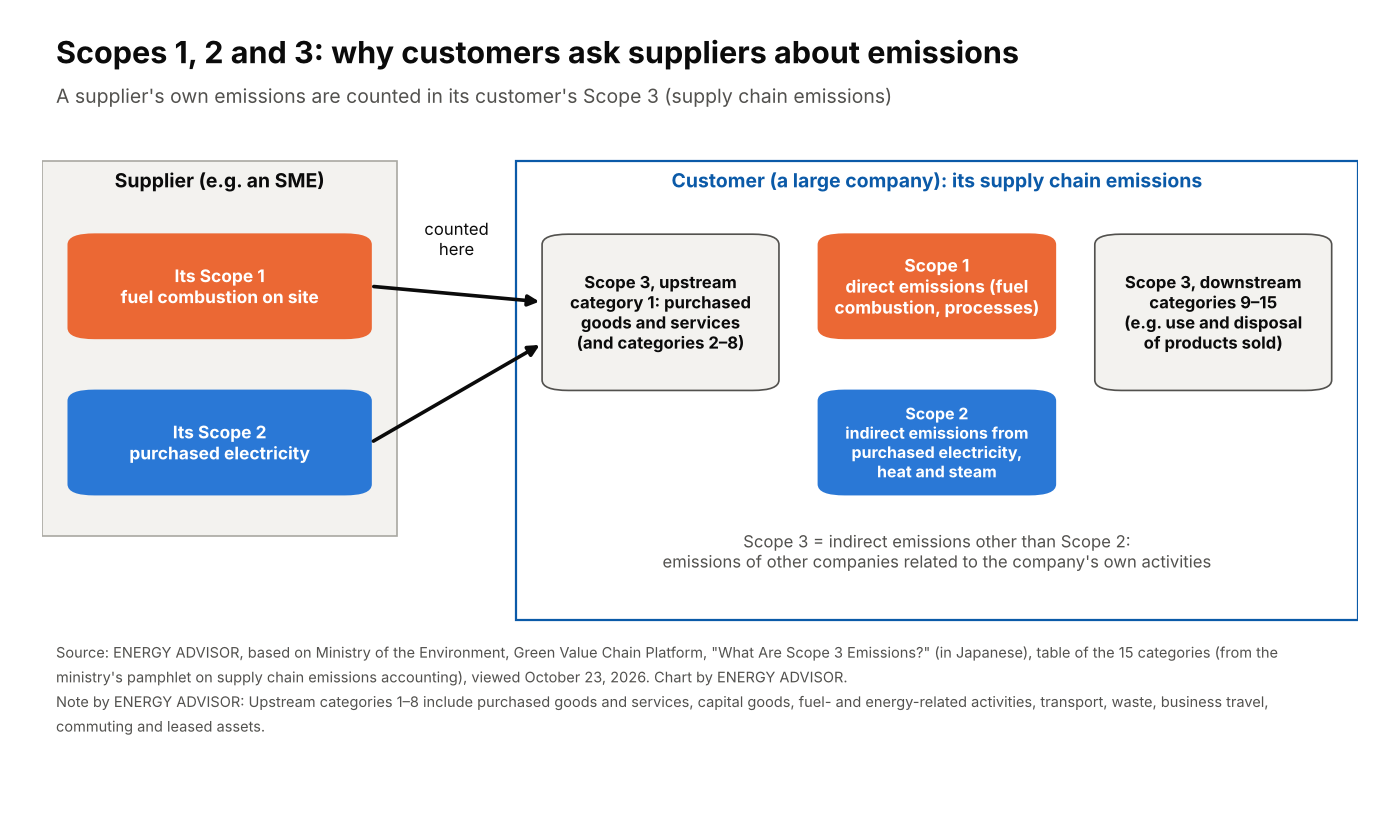
The starting point lies in how companies count their CO2 emissions. The international accounting standard (the GHG Protocol) captures a company’s emissions to include not only its own fuel combustion and similar sources (Scope 1) and the use of purchased electricity (Scope 2), but also the emissions of “other companies” related to its business activities, such as raw material procurement and transport (Scope 3).
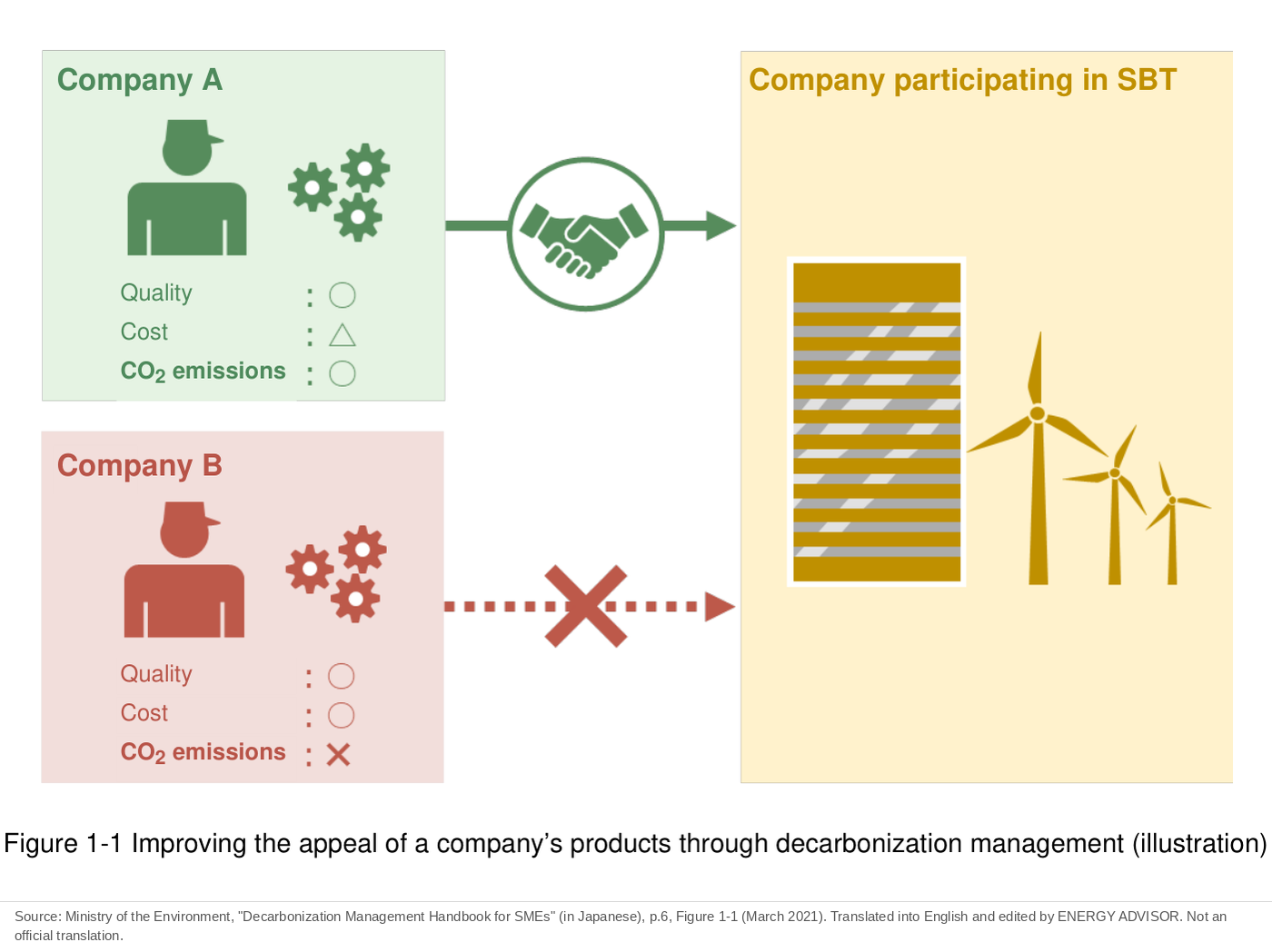
In other words, when a large company tries to calculate and disclose the “emissions of its entire supply chain,” the emissions of the business partners that supply its parts and materials, including SMEs, are counted as its Scope 3. Customers asking SMEs to report or reduce emissions or to switch to renewable electricity is a consequence of this mechanism.
The question “why ask a company of this size to report its emissions?” is explained once you know how Scope 3 is counted. The customer needs data from its suppliers for its own disclosure.
Government Policy and Mandatory Disclosure Accelerating the Requests
What drives this trend is government policy. Japan declared “carbon neutrality by 2050” in October 2020, and in July 2023 the Cabinet approved the “GX Promotion Strategy,” which aims to achieve both decarbonization and economic growth (GX = Green Transformation, the government’s term for the economic and social transformation toward decarbonization).
Source: Prime Minister’s Office of Japan, policy speech at the 203rd Diet session (October 26, 2020) (in Japanese); METI, “Strategy for Promoting the Transition to a Decarbonized Growth-Oriented Economic Structure (GX Promotion Strategy)” (in Japanese), July 28, 2023
In addition, disclosure of sustainability information (including emissions) is being made mandatory in stages for companies listed on the TSE Prime Market (the top market segment of the Tokyo Stock Exchange). On February 20, 2026, the Financial Services Agency (FSA) promulgated and put into force amendments to the Cabinet Office Order on Disclosure of Corporate Affairs and related orders (entry into force on the day of promulgation; the provisions on statements based on the sustainability disclosure standards apply from the application dates below). Companies listed on the TSE Prime Market with an average market capitalization of ¥1 trillion or more are required to make disclosures based on the SSBJ Standards (the disclosure standards set by the Sustainability Standards Board of Japan) in their annual securities reports. This applies from the fiscal year ending March 2027 for companies with a market capitalization of ¥3 trillion or more, and from the fiscal year ending March 2028 for the other companies covered. Because disclosure requires Scope 3, that is, emissions data from business partners, requests from large companies to suppliers are set to grow stronger.
Source: FSA, Financial System Council, Working Group on Disclosure and Assurance of Sustainability-related Financial Information, “Interim Report” (in Japanese), July 17, 2025; FSA, “Promulgation of the ‘Cabinet Office Order Partially Amending the Cabinet Office Order on Disclosure of Corporate Affairs and the Cabinet Office Order on Disclosure of Information on Specified Securities’ and Others, and Results of the Public Consultation” (in Japanese), February 20, 2026
In fact, the number of Japanese companies joining international frameworks for emission reduction keeps rising. Japanese companies with validated science-based targets (SBT) or commitments exceeded 2,000 as of October 2025. According to a Ministry of the Environment (MOE) material, 59 Japanese companies had joined RE100, which aims for 100% renewable electricity for business operations, as of August 10, 2021, ranking second by country after the United States (79 companies).
Source: WWF Japan (announcement of October 8, 2025) (in Japanese); Ministry of the Environment, “Status of RE100” (as of August 10, 2021) (in Japanese)
There are also data showing how SMEs see it. According to the 2024 White Paper on Small and Medium Enterprises in Japan, the number of SMEs receiving requests from business partners to cooperate in decarbonization (energy saving, calculating CO2 emissions, setting reduction targets and so on) has increased in every industry compared with 2020. In addition, a 2024 survey by the Tokyo Chamber of Commerce and Industry found that 25.7% of SMEs had received requests from business partners to understand or measure their greenhouse gas emissions or similar.
Source: Small and Medium Enterprise Agency, 2024 White Paper on Small and Medium Enterprises in Japan, Part 1, Chapter 4, Section 5, “GX” (in Japanese); Tokyo Chamber of Commerce and Industry, “Survey on Energy Saving and Decarbonization at SMEs” (in Japanese), June 25, 2024
Because mandatory disclosure for customers starts in stages from the fiscal year ending March 2027, companies that have not yet received requests may receive them in the future. It is efficient to prepare on the occasion of an electricity cost review.
How SMEs Can Start: Steps Shown in Public Materials
What to start with when you receive a request, or when preparing for one, is shown in the Ministry of the Environment’s “Decarbonization Management Handbook for SMEs.” The procedure for drawing up a reduction plan has four steps. Step 1 considers a long-term policy for energy transition; Step 2 identifies short- to medium-term energy-saving measures; Step 3 considers ways to procure renewable electricity; and Step 4 examines the measures and compiles them into a plan. As basic policies, it presents a combination of three directions: “promote energy saving,” “lower the carbon intensity of energy” and “promote electrification.”
Source: Ministry of the Environment, “Decarbonization Management Handbook for SMEs” (in Japanese)
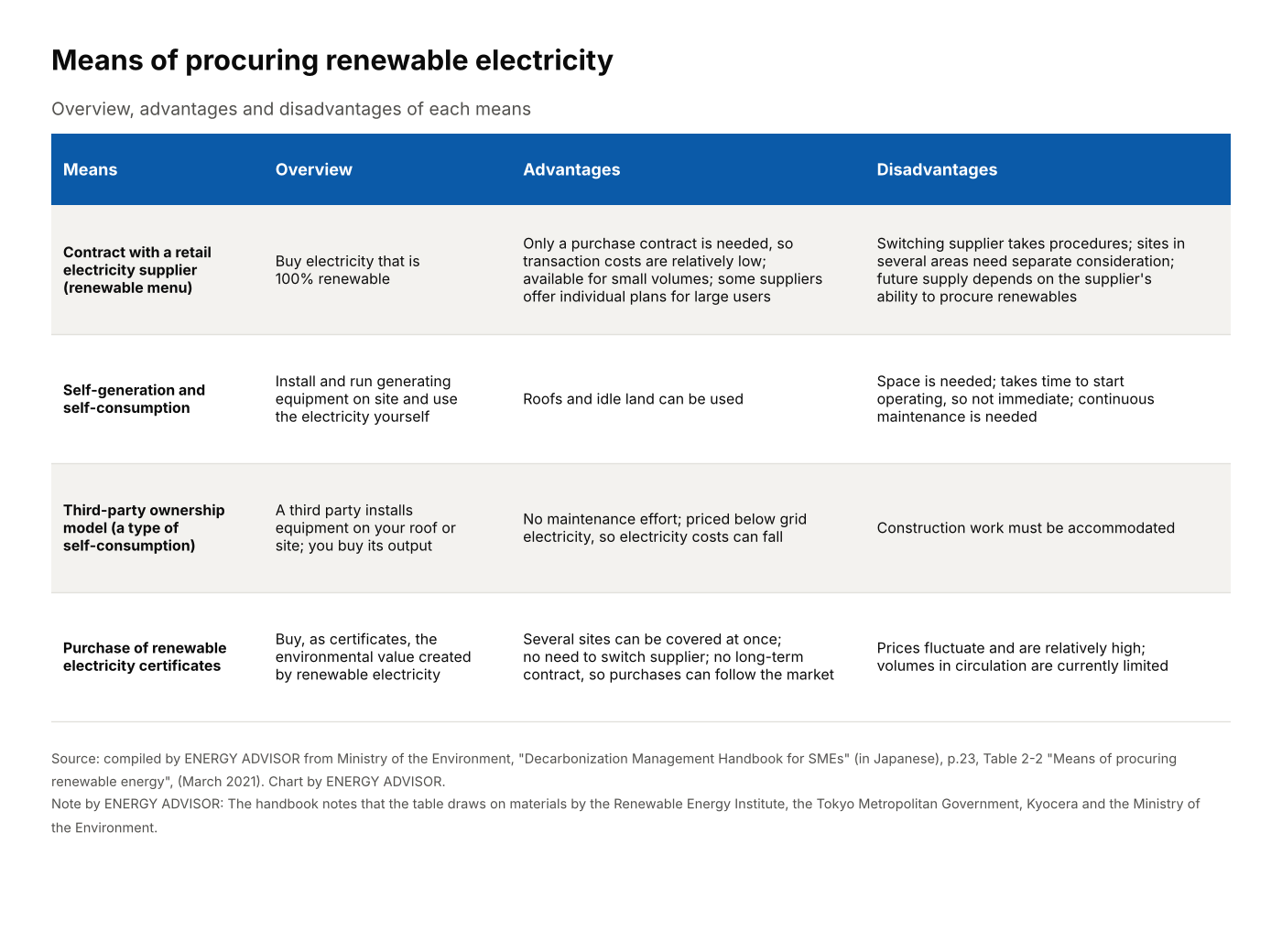
In other words, even in the path shown in public materials, alongside energy saving to cut wasteful use, “reviewing how electricity is procured,” that is, switching to electricity from renewable sources, is positioned as a main measure for SMEs. This has exactly the same entry point as the “electricity cost review” covered in this series.
A Realistic Option: Electricity Suppliers’ Decarbonization Menus
Switching to renewable electricity tends to bring to mind large undertakings such as buying certificates yourself or signing contracts directly with generators. For SMEs, however, the most realistic starting point is the decarbonization rate menus offered by the electricity supplier you have a contract with (or from which you obtain quotations). In fact, the major utilities offer “effectively renewable” and “CO2-free” menus for high-voltage and extra-high-voltage corporate customers.
| Electricity supplier | Example menu | Outline (checked on each company’s website on October 22, 2026) |
|---|---|---|
| TEPCO Energy Partner | Aqua Premium | Combines electricity from hydropower with renewable-designated non-FIT non-fossil certificates (in principle for large customers of 500 kW or more whose contract demand is set by negotiation; 10% or more of the facility’s electricity consumption, or 1,000,000 kWh or more per year) |
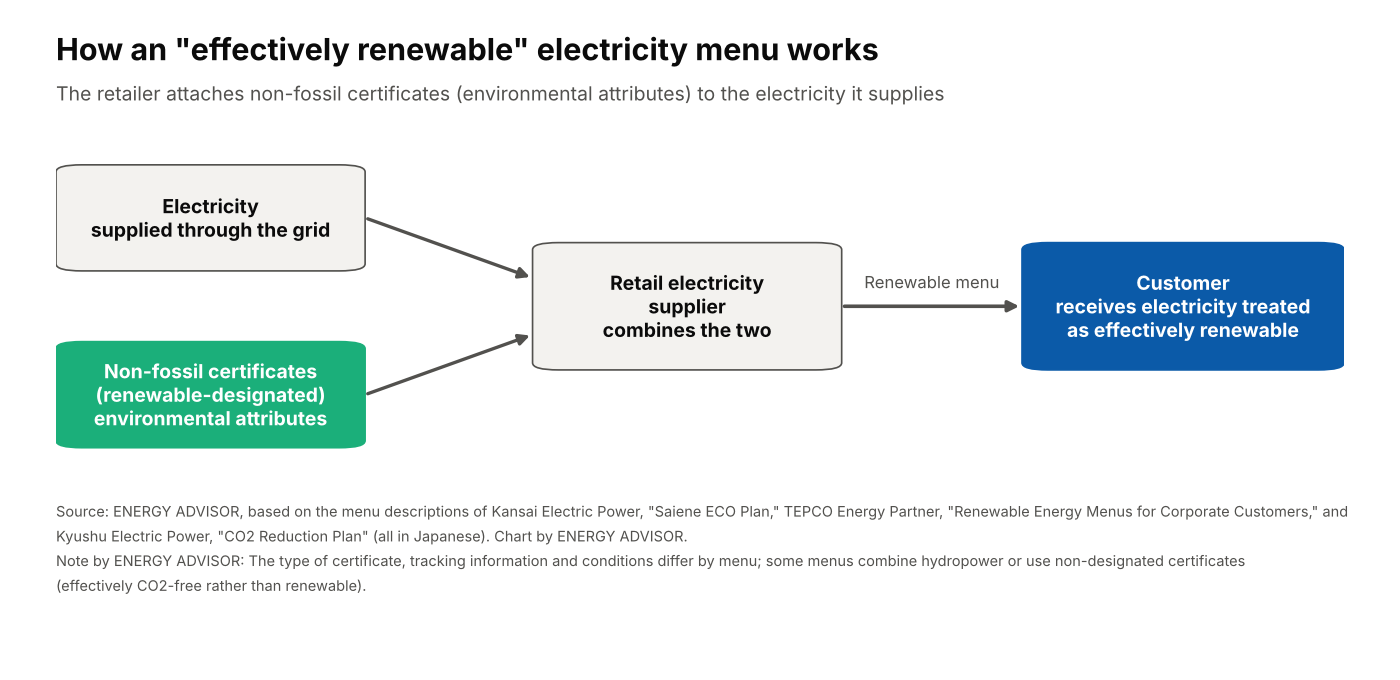
| Kansai Electric Power | Saiene ECO Plan (renewable ECO plan) | Makes electricity effectively renewable by attaching renewable-designated non-fossil certificates. Three types: standard, with tracking, and premium; the one with tracking meets RE100 requirements |
| Chubu Electric Power Miraiz | Green Denki (prefecture versions for Shinshu, Mie Umashikuni and Shizuoka) | Adds CO2-free value derived from hydropower and other sources (CO2-free option charge ¥4.40/kWh, tax included; for high-voltage business power and high-voltage power; checked October 22, 2026) |
| Kyushu Electric Power | CO2 Reduction Plan | Makes electricity effectively CO2-free by combining non-FIT non-fossil certificates (non-designated) and others (for extra-high-voltage and high-voltage corporate customers) |
| Shikoku Electric Power | CO2-Free Menu (high-voltage, 6,000 V or more) | Adds a charge equivalent to the environmental attributes to the electricity consumption of the main contract and attaches non-fossil certificates (such as Saiene Plus+_RE100) |
Source: TEPCO Energy Partner, “Renewable Energy Menus for Corporate Customers”; Kansai Electric Power, “Saiene ECO Plan”; Chubu Electric Power Miraiz, “Green Denki”; Kyushu Electric Power, “CO2 Reduction Plan”; Shikoku Electric Power, “CO2-Free Menu” (all in Japanese)
Related: For details of how the non-fossil certificate, the means of decarbonization, works (the two markets: the Renewable Energy Value Trading Market and the Sophisticated Methods Act Compliance Market), see “Two Trading Markets for Non-Fossil Value” (in Japanese).
Source: Kansai Electric Power, “Saiene ECO Plan” (in Japanese)
Many of these menus work by having the electricity supplier procure environmental attributes called “non-fossil certificates” (certificates representing the value of not emitting CO2 that electricity from non-fossil sources has) and supply them combined with ordinary electricity. Because the supplier handles procuring the certificates and the procedures, in most cases the SME as the customer does not need to set up the mechanism itself. The level of the additional charge and the conditions differ by menu, so check them individually when obtaining quotations.
You may also receive proposals from electricity suppliers or related businesses to sign a long-term power purchase agreement with a generating facility (a so-called PPA, power purchase agreement). It is enough to approach such proposals, as with an electricity cost review, by checking the terms one by one against your own actual usage.
Electricity cost review and decarbonization are often handled by different departments and tend to be considered separately. From the viewpoint of electricity procurement, however, both are themes that can be considered within the same contract. Simply asking “do you have an effectively renewable menu?” when obtaining competitive quotes is already a form of preparation.
Summary
Behind customers asking SMEs for decarbonization is Scope 3, a mechanism for understanding and disclosing the emissions of the entire supply chain, and government policies such as the declaration of carbon neutrality by 2050, the GX Promotion Strategy and mandatory disclosure for listed companies are accelerating this trend. Public surveys also show that the number of SMEs asked to measure or reduce emissions is actually increasing, and these requests are set to spread further. As the Ministry of the Environment’s handbook shows, the realistic starting point for SMEs is thorough energy saving and switching to electricity from renewable sources. The latter can be considered, in the form of electricity suppliers’ “effectively renewable” and “CO2-free” menus, from exactly the same entry point as an electricity cost review. When obtaining competitive quotes, it is effective to also check whether decarbonization menus are available, and their conditions. How to compare high-voltage electricity as a whole is as explained together in Part 1.
This article is based on published materials from the Ministry of Economy, Trade and Industry and its Agency for Natural Resources and Energy, the Electricity and Gas Market Surveillance Commission, the Organization for Cross-regional Coordination of Transmission Operators (OCCTO) and other sources. The English translations of figures are by ENERGY ADVISOR and are not official translations. When using this information for decisions, please check the original sources. When we find an error, we correct the article and note the date of the correction.
Sources
- Ministry of the Environment, Green Value Chain Platform, “What Are Scope 3 Emissions?” (in Japanese). https://www.env.go.jp/earth/ondanka/supply_chain/gvc/estimate_03.html
- Prime Minister’s Office of Japan, policy speech at the 203rd Diet session and declaration of carbon neutrality by 2050 (October 26, 2020) (in Japanese). https://www.kantei.go.jp/jp/99_suga/actions/202010/26shu_san_honkaigi.html
- METI, “Strategy for Promoting the Transition to a Decarbonized Growth-Oriented Economic Structure (GX Promotion Strategy)” (in Japanese), July 28, 2023. https://www.meti.go.jp/press/2023/07/20230728002/20230728002.html
- FSA, Financial System Council, Working Group on Disclosure and Assurance of Sustainability-related Financial Information, “Interim Report” (in Japanese), July 17, 2025. https://www.fsa.go.jp/singi/singi_kinyu/tosin/20250717/01.pdf
- FSA, “Promulgation of the ‘Cabinet Office Order Partially Amending the Cabinet Office Order on Disclosure of Corporate Affairs and the Cabinet Office Order on Disclosure of Information on Specified Securities’ and Others, and Results of the Public Consultation” (in Japanese), published February 20, 2026, updated March 19, 2026. https://www.fsa.go.jp/news/r7/shouken/20260220/20260220.html
- WWF Japan, “More Than 2,000 Japanese Companies with SBT Validation or Commitment” (in Japanese), October 8, 2025. https://www.wwf.or.jp/press/6071.html
- Ministry of the Environment, “Status of RE100” (in Japanese). https://www.env.go.jp/earth/ondanka/supply_chain/files/RE100_joukyou.pdf
- Small and Medium Enterprise Agency, 2024 White Paper on Small and Medium Enterprises in Japan, Part 1, Chapter 4, Section 5, “GX” (in Japanese). https://www.chusho.meti.go.jp/pamflet/hakusyo/2024/chusho/b1_4_5.html
- Tokyo Chamber of Commerce and Industry, “Survey on Energy Saving and Decarbonization at SMEs” (in Japanese), June 25, 2024. https://www.tokyo-cci.or.jp/page.jsp?id=1203364
- Ministry of the Environment, “Decarbonization Management Handbook for SMEs” (in Japanese). https://www.env.go.jp/earth/SMEs_handbook.pdf
- Chubu Electric Power Miraiz, “Green Denki” (in Japanese), checked October 22, 2026. https://miraiz.chuden.co.jp/business/electric/menu/co2_free/
- Decarbonization menu pages of TEPCO Energy Partner, Kansai Electric Power, Kyushu Electric Power and Shikoku Electric Power (in Japanese). https://www.tepco.co.jp/ep/eco/plan/corporate/index-j.html / https://sol.kepco.jp/ecoplan/ / https://www.kyuden.co.jp/agreement_rate_co2_free.html / https://www.yonden.co.jp/business/price/co2-free.html
- Ministry of the Environment, “Decarbonization Management Handbook for SMEs” (in Japanese), March 2021, p.6, “Figure 1-1: Improving the appeal of your products through decarbonization management (image)”; p.23, “Table 2-2: Means of procuring renewable electricity.” https://www.env.go.jp/earth/SMEs_handbook.pdf
- Ministry of the Environment, Green Value Chain Platform, “Status of SBT, RE100 and TCFD Initiatives” (in Japanese) (152 Japanese companies in SBT and 59 in RE100, both as of August 10, 2021, the latest in the ministry’s materials). https://www.env.go.jp/earth/ondanka/supply_chain/intr_trends.html