When considering a review of high-voltage electricity costs, deciding to switch to a new entrant retailer based only on low prices can lead to unexpected situations after signing. In fact, while many new entrant retailers registered after liberalization, quite a few found it hard to continue their business and exited the market or went bankrupt. This article sets out the market exit and bankruptcy risk of new entrant retailers and the points to consider when assessing a supplier to switch to.
Key points
- 1While many new entrant retailers registered after liberalization, a certain number have exited or gone bankrupt.
- 2According to a Teikoku Databank survey (published March 28, 2024, as of March 22, 2024), 119 of 706 registered new entrant retailers had exited the market or gone bankrupt.
- 3If a new entrant retailer exits, its customers in principle move to mechanisms such as last-resort supply.
- 4When considering a supplier to switch to, it is important to check not only price but also business continuity and contract terms.
- 5The conditions of the contract term and early termination fee are also one of the factors in assessing a supplier to switch to.
Part 9 listed checking the contract term and early termination fee as one of the five points for checking quotations. This part looks in detail at the risk behind it: the risk to the continuity of the supplier itself.
Status of Market Exits and Bankruptcies of New Entrant Retailers
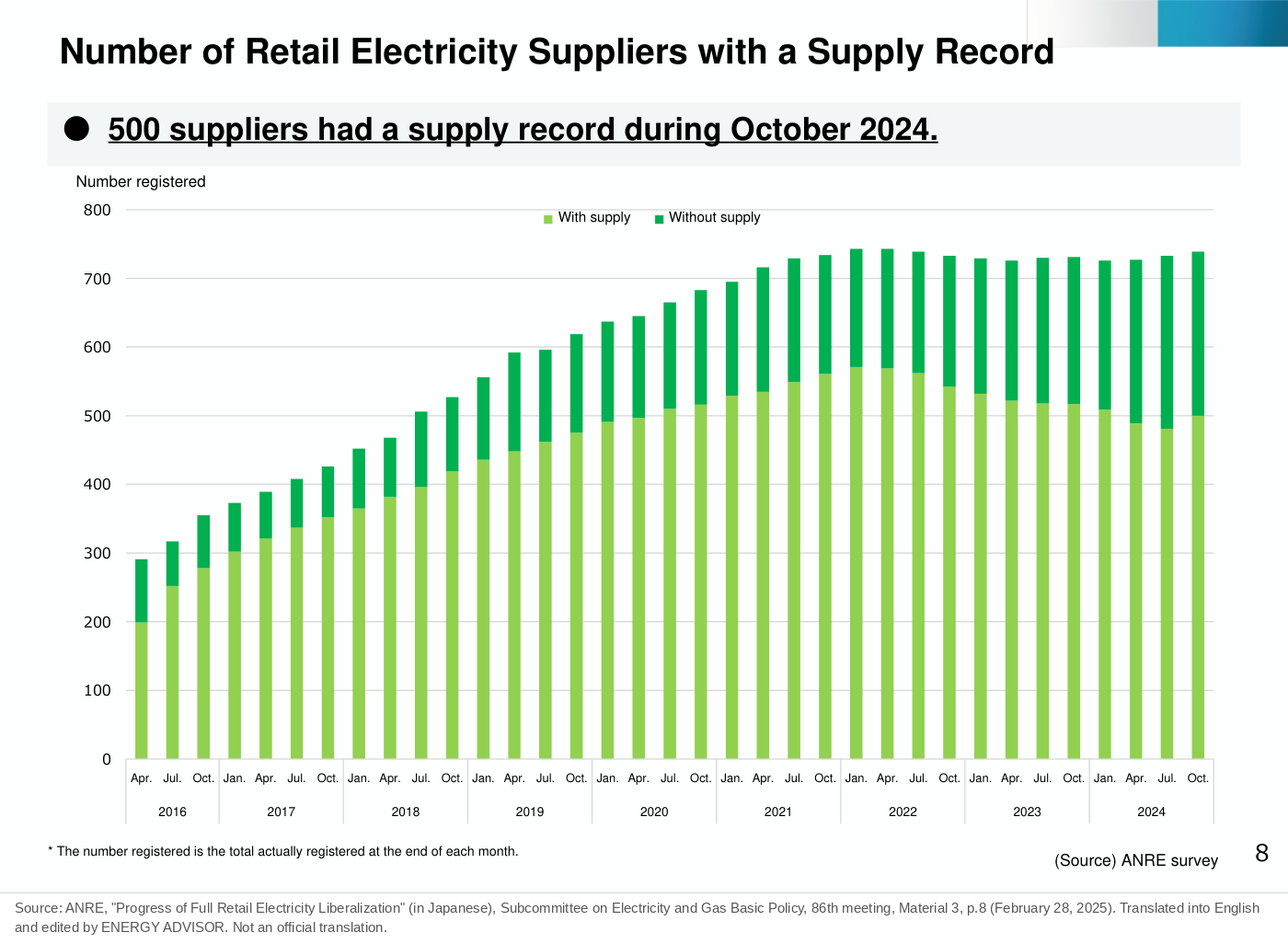
Many new entrant retailers entered the market after liberalization, but some later found it hard to continue their business because of changes in the business environment. According to a survey published on March 28, 2024 by Teikoku Databank (a private Japanese credit research company), taking the 706 new entrant retailers registered as of April 7, 2021 as a fixed sample, a cumulative 119 (16.9%) had “exited” or “gone bankrupt or closed” as of March 22, 2024. The breakdown was 87 exits and 32 bankruptcies or closures. In addition, a cumulative 69 (9.8%) had suspended new sign-ups, and 47 (6.7%) had resumed accepting contracts, against a background such as the later calming of market prices.
Source: Teikoku Databank, “Survey on Market Exits by ‘New Entrant Electricity Retailers’ (March 2024)” (in Japanese)
Because a certain number of new entrant retailers have thus already stopped their business, when considering a supplier to switch to, you need to check not only the price but also the supplier’s situation.
Some companies that signed contracts during the period when new entrant retailers multiplied were later forced to review their contracts because their supplier exited.
| Category | Number of companies | Share |
|---|---|---|
| Registered new entrant retailers (sample, as of April 7, 2021) | 706 | — |
| Exited or bankrupt (cumulative, survey as of March 22, 2024) | 119 (87 exits, 32 bankruptcies/closures) | 16.9% |
| Suspended new sign-ups (cumulative) | 69 | 9.8% |
| Resumed accepting contracts | 47 | 6.7% |
Source: Teikoku Databank, “Survey on Market Exits by ‘New Entrant Electricity Retailers’ (March 2024)” (in Japanese)
New Entrant Retailers Dependent on Market Procurement
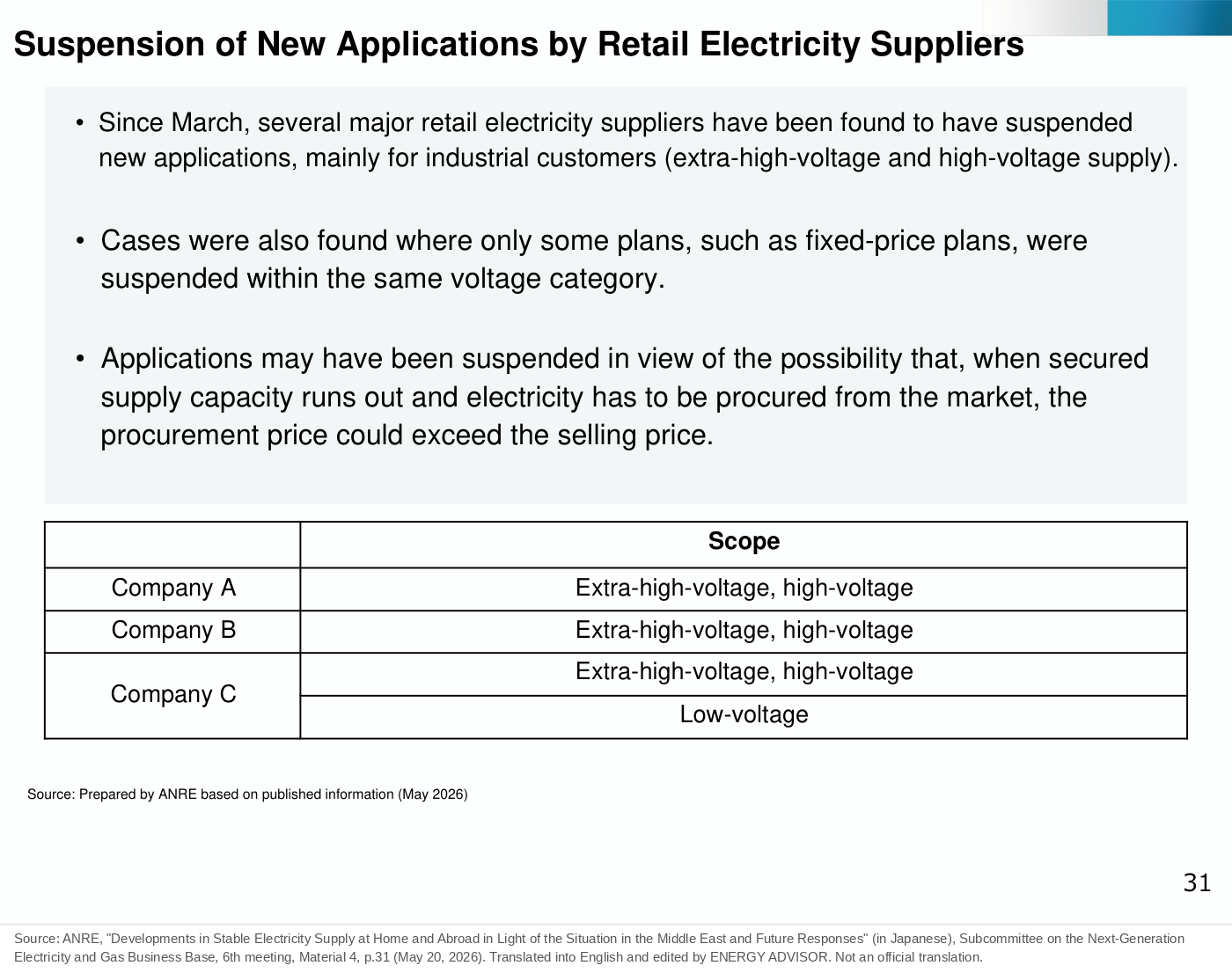
Some new entrant retailers depended on the day-ahead market (spot market) of JEPX (the Japan Electric Power Exchange) for their electricity procurement. How Market-Linked Plans work and their risks are as explained in detail in Part 5.
What Happens If Your Supplier Exits
If the new entrant retailer you have a contract with stops its business, you can no longer receive supply under the plan you contracted. In such cases, there is a system under which electricity supply continues temporarily through mechanisms such as last-resort supply by the general transmission and distribution company. Last-resort supply is a system in which the general transmission and distribution company (the company that operates the transmission and distribution network in each area) supplies electricity to high-voltage and higher customers that cannot reach a supply contract with any retail electricity supplier. If you lose your contract because your supplier exits, you are also covered if you cannot contract with another retail electricity supplier. However, you need to check the price level and conditions of last-resort supply in the terms and conditions of the general transmission and distribution company in each area.
According to the Electricity and Gas Market Surveillance Commission (EGC), the number of last-resort supply contracts fell from 2,562 as of April 1, 2025 to 1,782 as of April 1, 2026. However, from the survey as of April 1, 2026, Okinawa Electric Power was added to the survey, because high-voltage supply was added to the scope of its last-resort supply terms and conditions. Care is needed with this difference in scope when comparing with the previous year. The EGC also published the number as of July 1 on July 15, 2026.
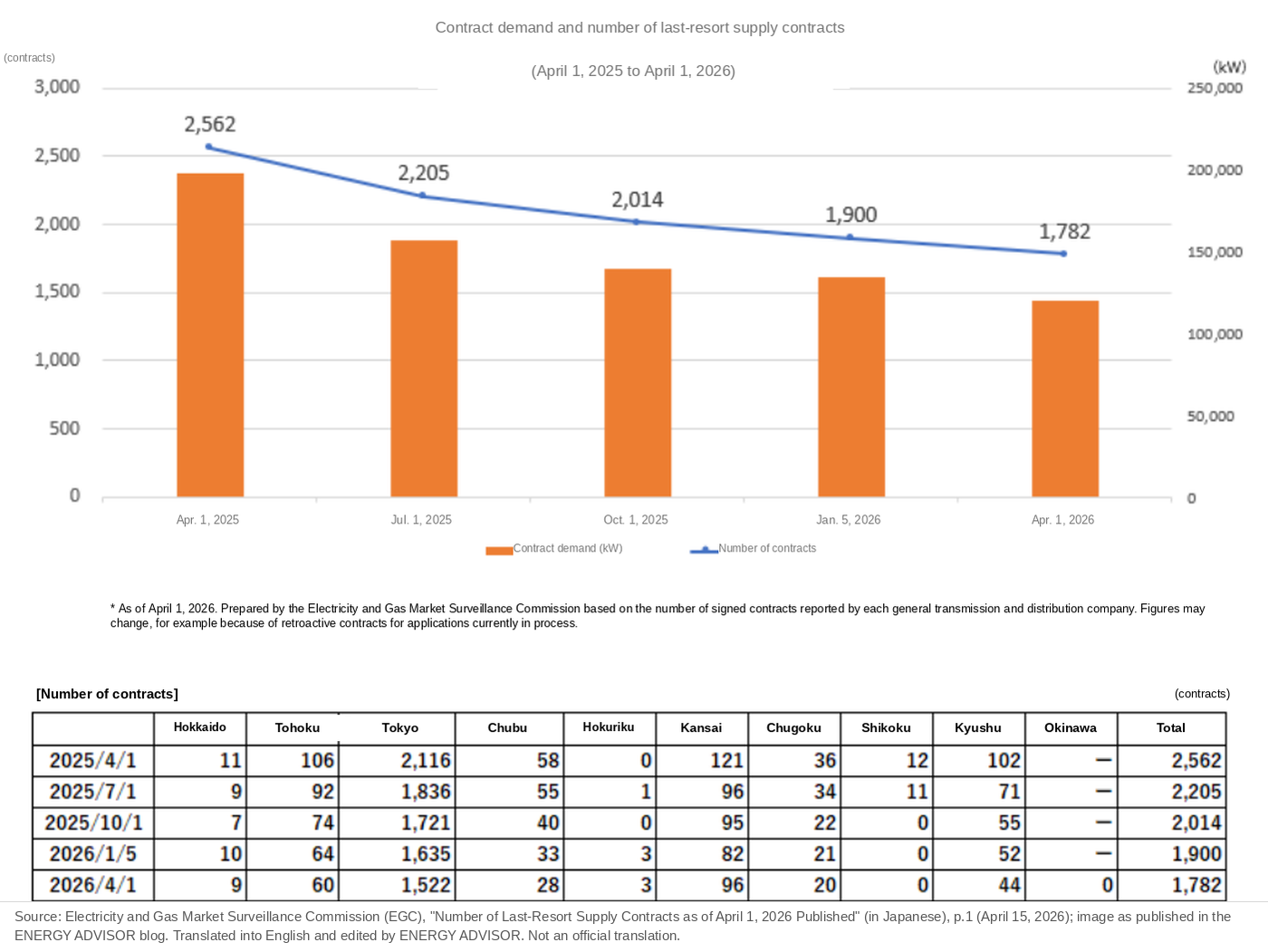
Source: EGC, “Number of Last-Resort Supply Contracts as of April 1, 2026 Published” (in Japanese), April 15, 2026
In the case of TEPCO Power Grid, last-resort supply covers high-voltage and higher customers that cannot reach a supply contract with any retail electricity supplier. The contract term is within one year, and it can be renewed if the customer cannot contract with a retail electricity supplier within the term. A market price adjustment rate reflecting wholesale electricity market prices is applied to the charges. The company’s Last-Resort Electricity Supply Terms and Conditions (effective November 1, 2026) set the unit prices for high-voltage Last-Resort Power A (demand using lighting and small equipment, among others) at a demand charge of ¥3,181.80 per kW and an energy charge of ¥20.96 per kWh, to which the fuel and other cost adjustment and the market price adjustment are added. Because last-resort supply is only a temporary supply mechanism, it is important to check the supplier’s situation from the contract stage, rather than rushing to respond after the supplier has exited.
Source: TEPCO Power Grid, “Last-Resort Supply Contracts” (in Japanese), checked October 22, 2026; TEPCO Power Grid, “Last-Resort Electricity Supply Terms and Conditions” (in Japanese), effective November 1, 2026, Article 15
How to Gather Information Before Signing
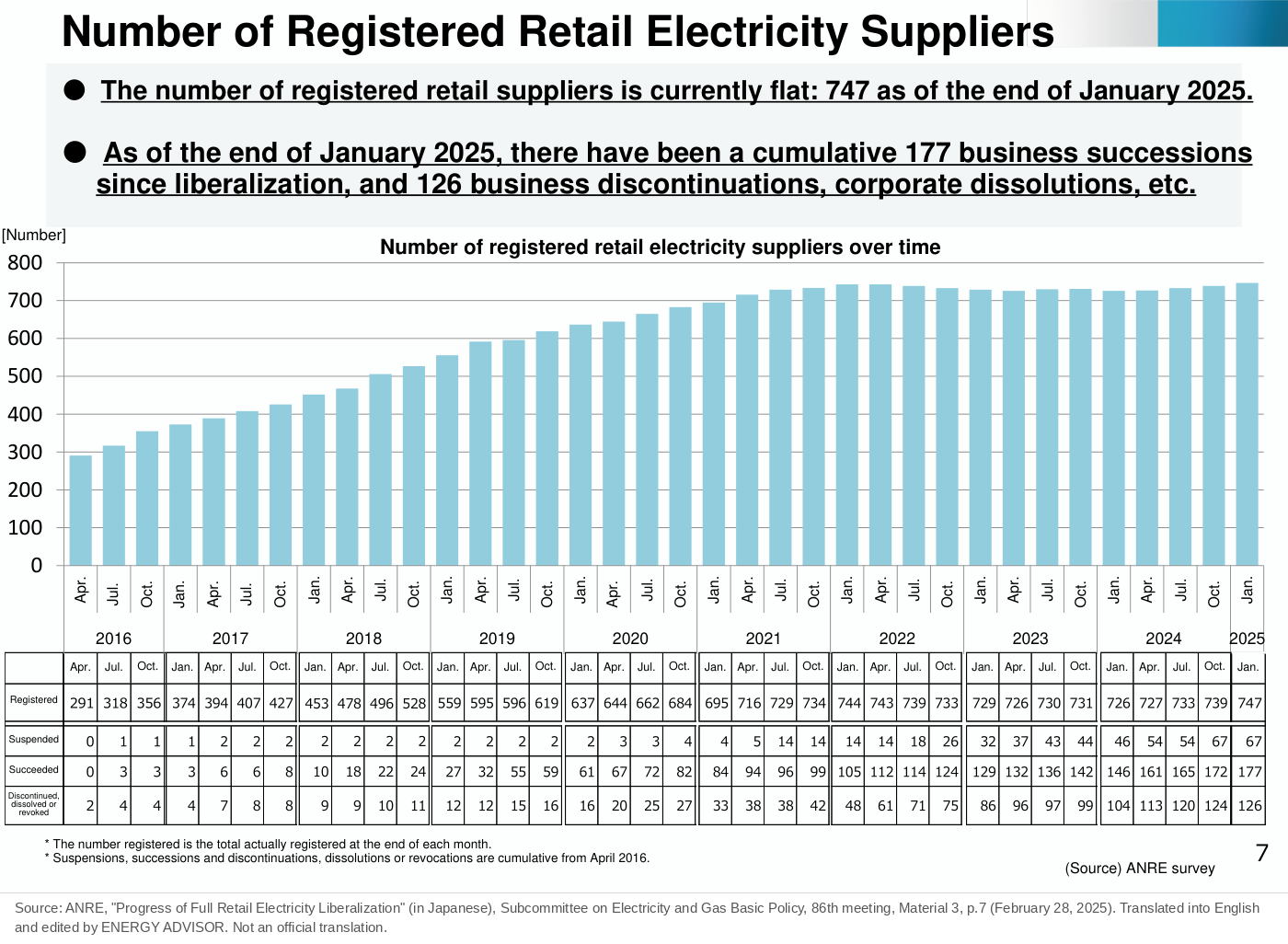
It is not easy for customers to fully understand a new entrant retailer’s business continuity in advance, but some clues can be checked: for example, the financial results the supplier publishes, how it procures electricity (whether it owns its own generation or depends on market procurement), and how many years it has been in business.
An official primary source for checking electricity sales volumes is the “Status of Electricity Trading (Results of the Electricity Trading Report),” published monthly by the EGC. It is official statistics compiled from mandatory reporting under the Electricity Business Act, and it shows trends in the sales volume and sales share of new entrant retailers as a whole, as well as sales by voltage category (extra-high-voltage, high-voltage and low-voltage) and by service area. When considering a switch, understanding overall market trends with this material makes it easier to align the premises for the decision.
Source: EGC, “Status of Electricity Trading (Results of the Electricity Trading Report)” (in Japanese)
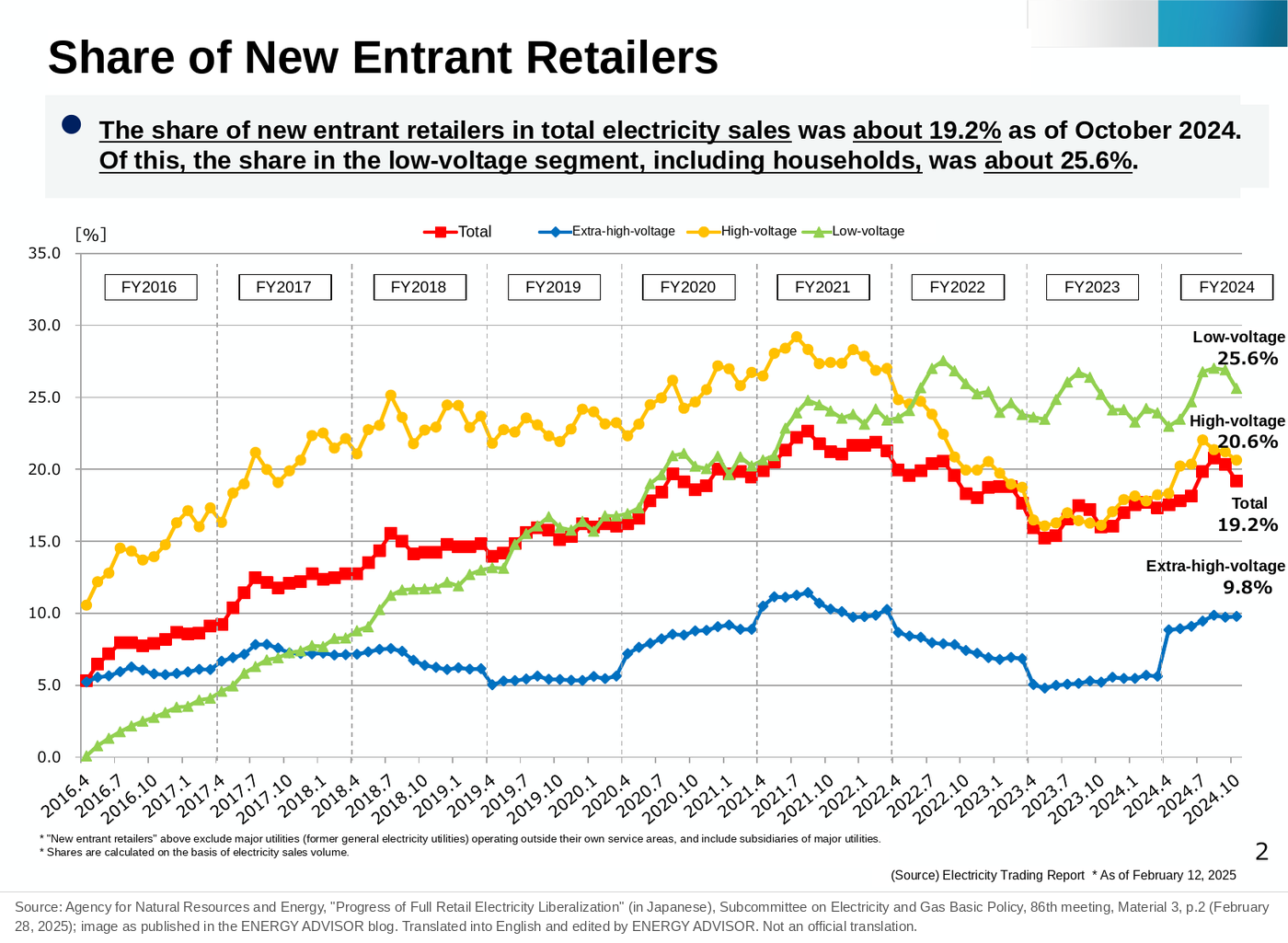
Source: Agency for Natural Resources and Energy, Subcommittee on Electricity and Gas Basic Policy, 86th meeting, Material 3, “Progress of Full Retail Electricity Liberalization” (in Japanese)
Sales volumes for each retail electricity supplier (by individual company) are not currently published by government agencies (individual company data existed in the Agency for Natural Resources and Energy’s electric power survey statistics only up to FY2015, that is, April 2015–March 2016). Rankings on private aggregation websites are sometimes used to get a sense of each company’s size, but note that these are not government statistics themselves; they are reference information based on their own aggregation. The reliable way is to check the financial results and supply record of each candidate supplier individually.
Also, rather than judging from a single source, combining several sources, such as statistics published by industry associations and research organizations and the reputation among business partners and peers, leads to a more careful decision. Note, however, that even this information cannot reliably predict future business continuity.
Points to Check When Assessing a Supplier to Switch To
When considering an electricity supplier to switch to, check the following points as well as how low the offered unit prices are (the five points for checking quotations are in Part 9).
| Item | What to check |
|---|---|
| Contract term and early termination fee | The contract term, and whether there is an early termination fee for cancellation during the term |
| Scope of market linkage | Whether the rate structure is market-linked and, if so, how far the linkage extends |
| How contract demand is calculated | Whether the method of calculating contract demand stated in the quotation matches your company’s actual situation |
By checking conditions other than price in this way, you can reduce to some extent the risk of unexpected situations after switching. However, because it is difficult for customers to fully understand a supplier’s financial condition and continuity in advance, it is important to decide while checking several sources.
Summary
While many new entrant retailers registered after liberalization, according to a Teikoku Databank survey (published March 28, 2024), 119 of the 706 registered as of April 7, 2021 had exited or gone bankrupt as of March 22, 2024. If a new entrant retailer exits, its customers move to mechanisms such as last-resort supply, but at the stage of choosing a supplier, checking not only price but also conditions such as the contract term, the early termination fee and the rate structure is important in assessing the risk. How to compare high-voltage electricity as a whole is as explained together in Part 1.
This article is based on published materials from the Ministry of Economy, Trade and Industry and its Agency for Natural Resources and Energy, the Electricity and Gas Market Surveillance Commission, the Organization for Cross-regional Coordination of Transmission Operators (OCCTO) and other sources. The English translations of figures are by ENERGY ADVISOR and are not official translations. When using this information for decisions, please check the original sources. When we find an error, we correct the article and note the date of the correction.
Sources
- Teikoku Databank, “Survey on Market Exits by ‘New Entrant Electricity Retailers’ (March 2024)” (in Japanese), published March 28, 2024. https://www.tdb.co.jp/report/industry/5mwc1cunt7/
- EGC, “Number of Last-Resort Supply Contracts as of April 1, 2026 Published” (in Japanese), April 15, 2026. https://www.egc.meti.go.jp/info/public/pdf/20260415001a.pdf
- TEPCO Power Grid, “Last-Resort Supply Contracts” (in Japanese) (coverage, contract term, market price adjustment rate; checked October 22, 2026). https://www.tepco.co.jp/pg/consignment/lr/index.html
- EGC, “Number of Last-Resort Supply Contracts as of July 1, 2026 Published” (in Japanese), July 15, 2026. https://www.egc.meti.go.jp/info/public/pdf/20260715001a.pdf
- EGC, “Status of Electricity Trading (Results of the Electricity Trading Report)” (in Japanese). https://www.egc.meti.go.jp/info/business/report/results.html
- Agency for Natural Resources and Energy, Subcommittee on Electricity and Gas Basic Policy, 86th meeting (February 28, 2025), Material 3, “Progress of Full Retail Electricity Liberalization” (in Japanese). https://www.meti.go.jp/shingikai/enecho/denryoku_gas/denryoku_gas/pdf/086_03_00.pdf
- TEPCO Power Grid, “Last-Resort Electricity Supply Terms and Conditions” (in Japanese), effective November 1, 2026, filed October 14, 2026, Article 15 (Last-Resort Power A) and Article 16 (Last-Resort Power B): contract period within one year; high-voltage demand charge ¥3,181.80/kW and energy charge ¥20.96/kWh, plus the fuel and other cost adjustment and the market price adjustment. https://www.tepco.co.jp/pg/company/clause/pdf/agreement_supply_261101.pdf
- Agency for Natural Resources and Energy, “Developments in Stable Electricity Supply at Home and Abroad in Light of the Situation in the Middle East and Future Responses” (in Japanese), Advisory Committee for Natural Resources and Energy, Subcommittee on the Next-Generation Electricity and Gas Business Base, May 20, 2026, Material 4, p.31, “Suspension of new applications by retail electricity suppliers.” https://www.meti.go.jp/shingikai/enecho/denryoku_gas/jisedai_kiban/pdf/006_04_00.pdf