When a company on a high-voltage contract collects quotations from several electricity suppliers and tries to compare them, it sometimes runs into the problem that the quotations are written in different formats, and simply lining up the amounts does not give a correct comparison. Part of the background is that, unlike low-voltage household electricity, high-voltage electricity has no common comparison website. This article sets out five points to keep in mind when checking quotations for high-voltage electricity.
Key points
- 1High-voltage quotations are hard to compare because several factors, such as how contract demand is calculated, are intertwined.
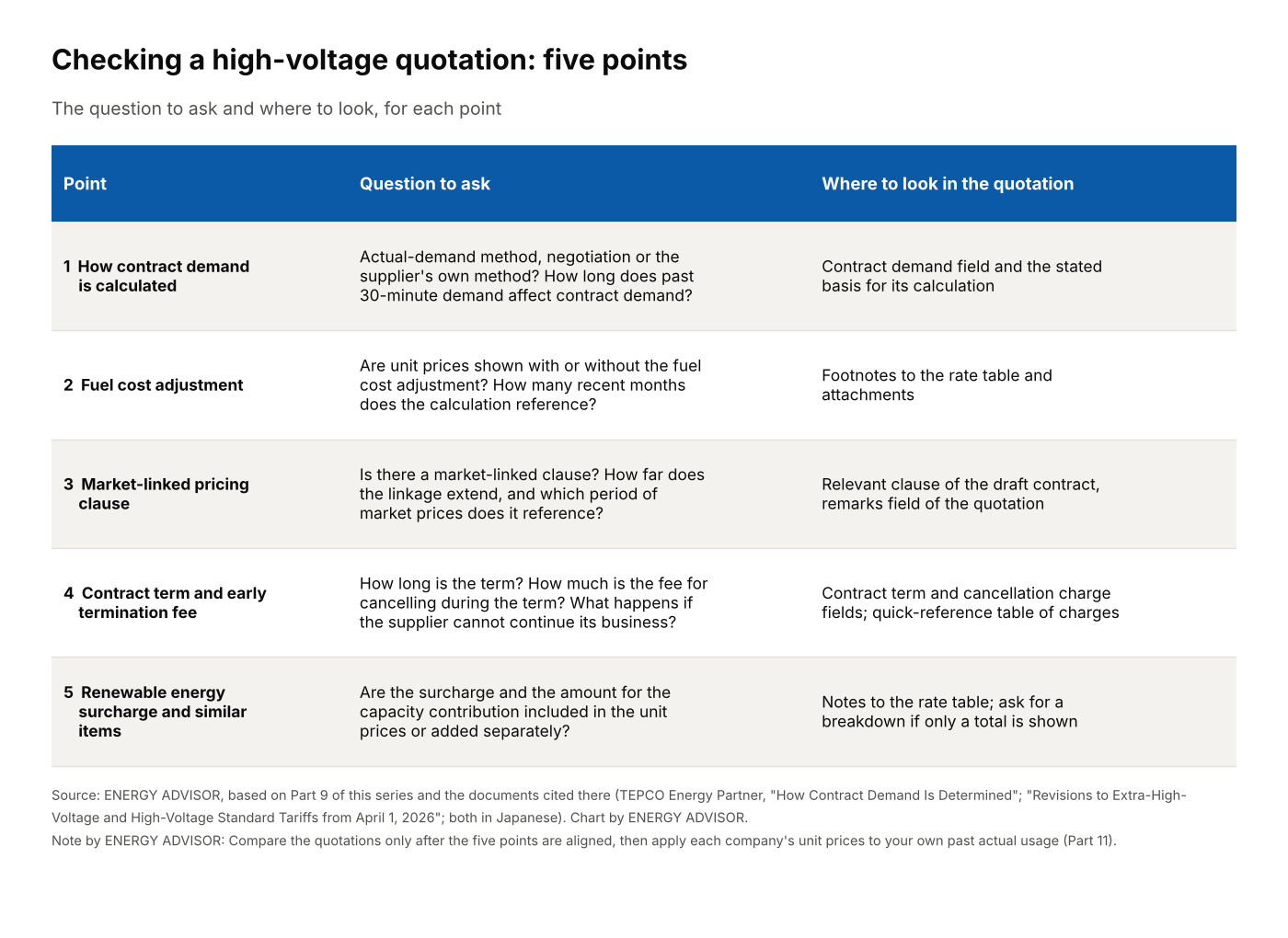
- 2The five points to check are: (1) how contract demand is calculated, (2) whether there is a fuel cost adjustment and what it references, (3) whether there is a market-linked pricing clause, (4) the contract term and early termination fee, and (5) how the renewable energy surcharge and similar items are treated.
- 3It is important to compare differences in terms one by one, not only the total amount.
- 4An effective way to compare quotations is to check them by applying past actual usage data.
- 5Depending on the contract, the customer may bear the risk of market price changes.
In this series, Parts 1 to 3 looked at the background to the rise in electricity costs, and Parts 4 to 8 looked at the knowledge needed to read contracts and bills on your own, such as standard tariffs, how to read a bill, and how contract demand is set. From this part, that knowledge is put to use in checking actual quotations.
Why High-Voltage Quotations Are Hard to Compare
Unlike low-voltage household electricity, high-voltage electricity has no common comparison website. Behind this are four factors: (1) differences in how contract demand is calculated (the actual-demand method, negotiated contract demand, and new entrant retailers’ own methods), (2) the variety of rate structures (by season and time of day, market-linked), (3) the lack of a common quotation format, and (4) whether plans by load factor (the ratio showing how much electricity is used on average relative to contract demand) are offered. These are points the author organized through actual work comparing quotations, as seen in Part 1.
For this reason, lining up several quotations and comparing only the totals may lead you to miss differences in terms. The standard tariff, the only published benchmark for high-voltage supply, is as seen in Part 4; understanding its content makes it easier to place each company’s quotation in relative terms. When you receive a quotation, it is therefore effective to check the following five points one by one.
There are many situations in which you are tempted to judge only by the total amount at the bottom of the quotation. However, if the terms behind that amount differ by company, it is not a simple comparison.
Point 1: How Contract Demand Is Calculated
Contract demand is the power value (kW) used as the basis for calculating the demand charge. Under the actual-demand method for contract demand of less than 500 kW, contract demand is generally set every month based on the highest 30-minute demand in the past 12 months including the current month. For 500 kW or more, on the other hand, negotiated contract demand, set through discussion with the utility, applies, and some new entrant retailers use their own calculation methods.
Source: TEPCO Energy Partner, “How Contract Demand Is Determined” (in Japanese)
When checking a quotation, it is important to check whether it assumes the actual-demand method, negotiated contract demand or the supplier’s own method, and also how past 30-minute demand affects contract demand. The detailed mechanism of how contract demand is set is as seen in Part 8. The first step is to check whether the contract demand assumed in the quotation matches your company’s actual usage.
Example questions to ask: “Is the contract demand in this quotation calculated by the actual-demand method or by negotiation?” “For how long is past 30-minute demand reflected in the contract demand?”
Where to look in the quotation: Check the figure in the contract demand field of the quotation and where the basis for its calculation (the actual-demand method, negotiation or the supplier’s own method) is stated. Many quotations do not state the basis, so if it is not stated, ask the sales representative.
Example warning signs: Be careful if the calculation method for contract demand is not stated in the quotation and is only explained verbally, or if the quotation assumes a contract demand clearly lower than your company’s actual usage.
Point 2: Whether There Is a Fuel Cost Adjustment and What It References
The fuel cost adjustment is an adjustment that reflects changes in fuel prices in electricity charges. The unit prices in a quotation may or may not include the fuel cost adjustment, so you need to check which basis they are presented on. The calculation method of the fuel cost adjustment and the period it references may also differ by company.
Example questions to ask: “Do the unit prices in this quotation include the fuel cost adjustment or not?” “For the calculation period of the fuel cost adjustment, the average of how many recent months does it reference?”
Where to look in the quotation: Check footnotes to the rate table and attachments for any statement of whether the fuel cost adjustment is included or charged separately. When comparing with a regional utility’s standard tariff, you need to align the assumptions about how it is included before comparing unit prices.
Example warning signs: Be careful if unit prices are presented as extremely low compared with the regional utility’s standard tariff but there is no explanation of how the fuel cost adjustment is treated, or if you cannot get a clear answer to a question about the calculation period.
Point 3: Whether There Is a Market-Linked Pricing Clause
A market-linked pricing clause is a condition under which part or all of the energy charge changes in line with the price in the day-ahead market (spot market) of JEPX (the Japan Electric Power Exchange). Under a market-linked plan, the customer bears the risk that electricity charges rise when market prices rise. How Market-Linked Plans work and their risks are as seen in Part 5.
It is important to check whether the quotation includes a market-linked clause and, if so, how far the linkage extends.
Example questions to ask: “Does this contract include a market-linked pricing clause? If so, how far does the linkage extend?” “How many recent months of market prices does it reference?”
Where to look in the quotation: Check the relevant clause in the draft contract, or the remarks field of the quotation, for any statement about market linkage. The key is to look for a statement of the scope of linkage (all or part of the energy charge).
Example warning signs: If only the words “market-linked” appear, with no explanation in the quotation or verbally of the scope of linkage or the reference period, you must check before signing.
The words “market-linked” alone do not tell you how much the charges may change. Before signing, it is important to check, including the past trend of market prices.
The Benchmark for Comparison: Whether It Is the Same as the Major Utility in the Area
In the author’s practical experience, many large new entrant retailers align their calculation methods for the fuel cost adjustment and the market price adjustment with those of the major utility in the area (the former general electricity utility). Aligning the calculation methods makes comparison easier for customers. However, the “content” of market-linked pricing clauses and fuel cost adjustments is not necessarily the same at every company. For this reason, the emphasis in checking can be set out as follows. If you have a contract with the major utility in the area, check the adjustment items of the plan you have contracted. When comparing with a new entrant retailer’s quotation, first check whether its calculation methods for the fuel cost adjustment and market linkage are “the same as the major utility in the area” or “its own method.” And for companies that adopt their own elements that differ from the standard methods, such as their own fuel cost adjustment or their own market-linked pricing clause, particular care is needed because the way prices move may differ greatly.
Example question to ask: “Are your calculation methods for the fuel cost adjustment and the market price adjustment the same as the standard tariff of the major utility in this area? If not, what is different?”
Point 4: Contract Term and Early Termination Fee
Check the contract term stated in the quotation and whether there is an early termination fee for cancellation during the term, and how much. If you may consider switching to another electricity supplier during the contract term, the conditions of the early termination fee are one of the factors in the decision. Also check what happens if your electricity supplier can no longer continue its business. In that case, the supply of electricity itself continues under mechanisms such as last-resort supply by the general transmission and distribution company (a system in which the general transmission and distribution company temporarily supplies electricity to high-voltage and extra-high-voltage customers that have lost their supplier), but you will need to reconsider where to switch (Part 12).
As one example of how early termination charges are set, TEPCO Energy Partner revised the calculation method for early termination charges in the Basic Plan and the Zero Market Adjustment Plan together with the revision of standard tariffs on April 1, 2026. The charge for cancellation in the fiscal year before supply starts was lowered from “demand charge × remaining contract term × 10%” before the revision to “demand charge × remaining contract term × 5%” after the revision (the charge for cancellation in the fiscal year supply starts remains unchanged at 10%).
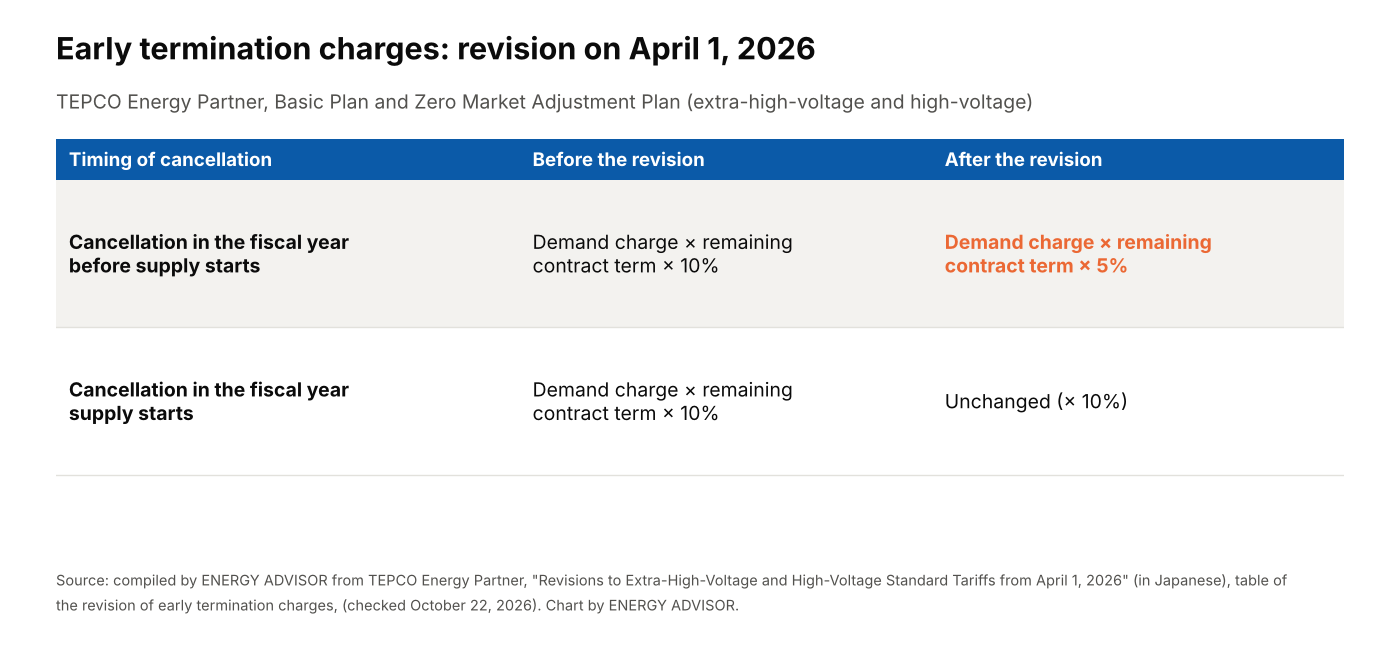
Source: TEPCO Energy Partner, “Revisions to Extra-High-Voltage and High-Voltage Standard Tariffs from April 1, 2026” (in Japanese)
Thus, even in a supplier’s standard tariff, the rules for calculating cancellation charges may change with the annual revision, so it is important to also check “as of when” the rules behind the cancellation conditions in the quotation apply.
Example questions to ask: “How many years is the contract term? How much is the early termination fee if we cancel during the term?” “If your company can no longer continue its business, what happens to customers under contract?”
Where to look in the quotation: Check the fields for the contract term and the cancellation charge, and, at some companies, a quick-reference table of cancellation charges provided as an attachment. Also check as of which fiscal year the rules for calculating the cancellation charge apply.
Example warning signs: Be careful if the quotation says nothing about the contract term or the cancellation charge and the conditions are presented for the first time just before signing, or if you get only vague answers to your questions.
Point 5: How the Renewable Energy Surcharge and Similar Items Are Treated
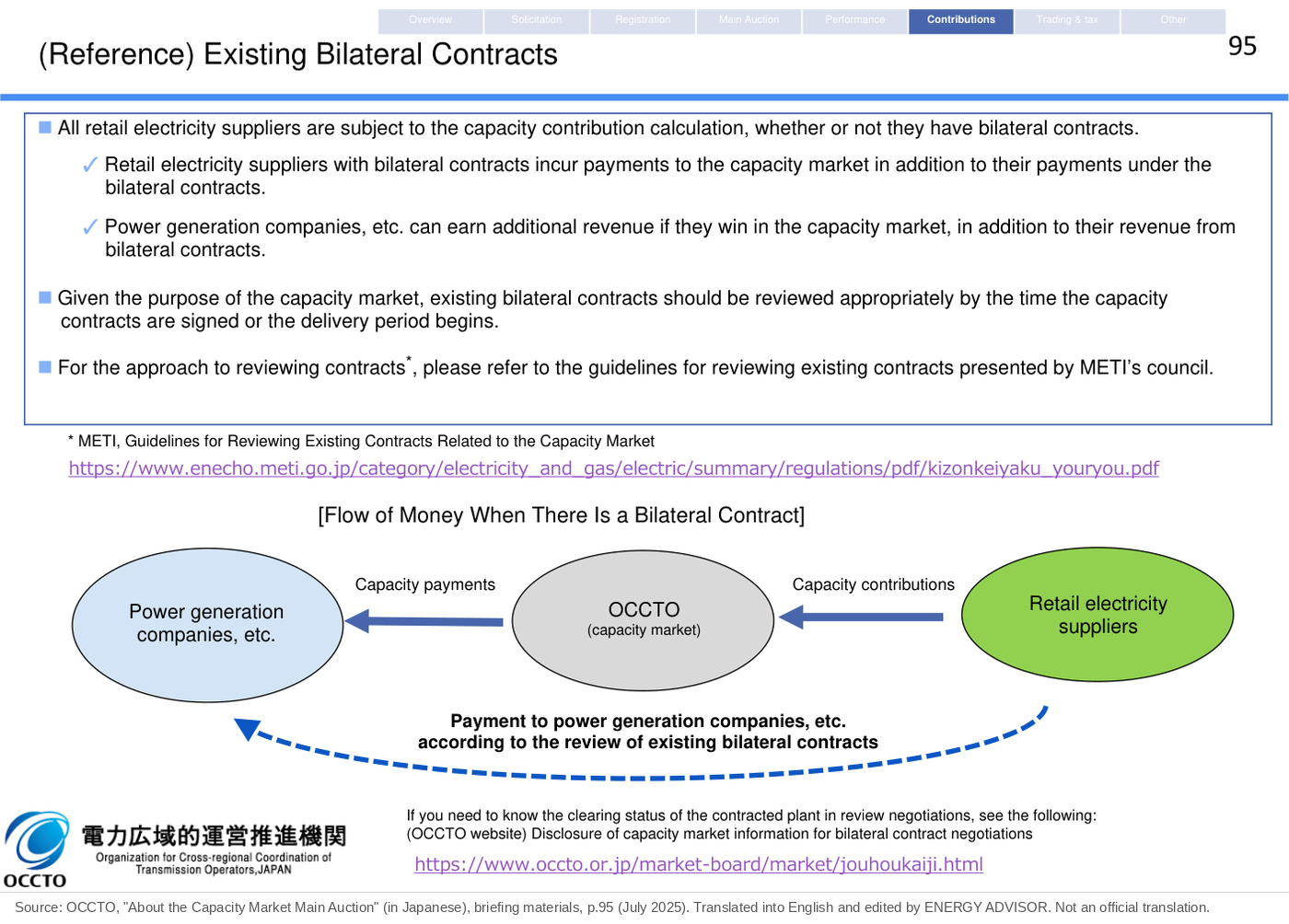
The renewable energy surcharge (renewable energy power promotion surcharge) is a cost borne by electricity users to support the spread of renewable energy. You also need to check whether other costs based on the rules, such as the capacity contribution, are included in the unit prices of the quotation or added as separate items.
Example question to ask: “Do the unit prices in this quotation include the renewable energy surcharge and the amount corresponding to the capacity contribution, or are they added separately?”
Where to look in the quotation: Check the notes to the rate table and explanations in attachments. Some quotations show only a total with no breakdown, so it is effective to ask for materials that show the breakdown.
Example warning signs: If only a total is presented and you cannot get a clear answer to questions about the breakdown, be careful, because the terms of other items may also be vague.
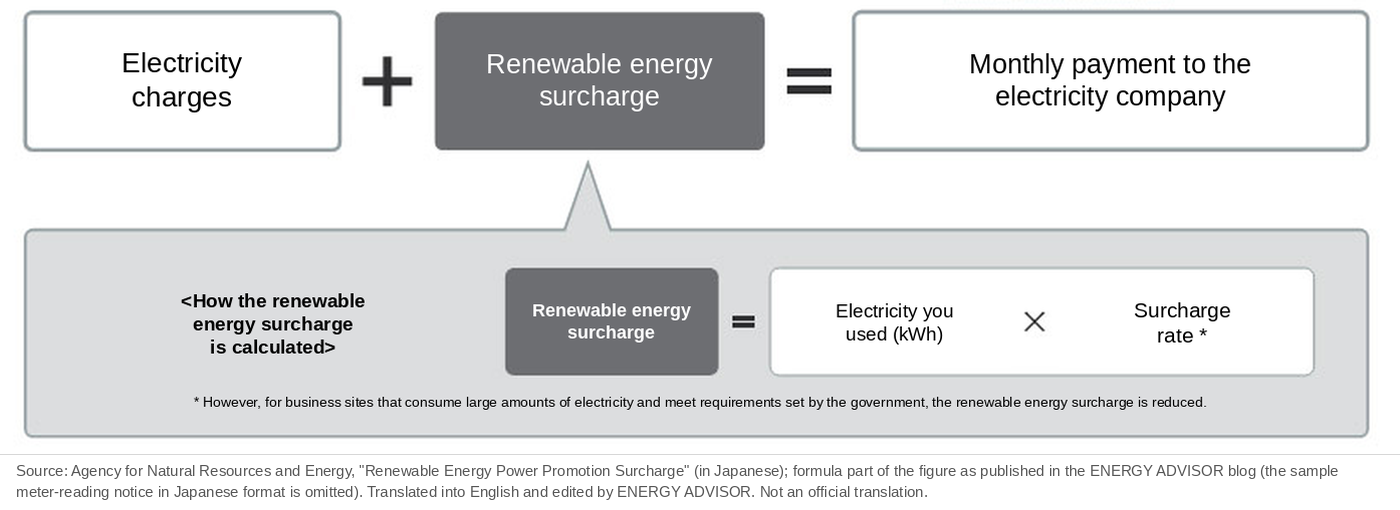
Source: Agency for Natural Resources and Energy, “Renewable Energy Power Promotion Surcharge” (in Japanese)
Basic Approach to Comparing Quotations
When comparing several quotations, an effective method is to align the conditions and then apply each company’s unit prices to your company’s past actual usage. This is not a forward-looking simulation with assumed values, but a calculation based on the electricity actually used and the time periods in which it was used (explained in detail in Part 11). However, this is only a check of trends based on past results and does not guarantee future electricity charges.
From Receiving Quotations to Signing a Contract
After checking the five points, the next step is to line up quotations with similar terms and examine them against the results of applying them to actual data. At this stage, it is important to share within the company not only the difference in amounts but also how much the costs would be affected if market prices change during the contract term, and the conditions for early cancellation.
It is also important to ask the electricity supplier before signing if anything in the quotation is unclear. In particular, for items that affect future bills, such as the fuel cost adjustment and market-linked pricing clauses, checking not only what is written but also the specific calculation method makes it easier to prevent misunderstandings after signing.
Summary
When comparing quotations for high-voltage electricity, it is important to check not only the total but also five points one by one: (1) how contract demand is calculated, (2) whether there is a fuel cost adjustment and what it references, (3) whether there is a market-linked pricing clause, (4) the contract term and early termination fee, and (5) how the renewable energy surcharge and similar items are treated. Because there is no common comparison website for high-voltage electricity and differences in terms greatly affect the amounts, it is effective to check these points and then apply them to your company’s actual data. Why high-voltage and extra-high-voltage electricity prices are hard to compare, and the overall picture, are as seen in Part 1.
This article is based on published materials from the Ministry of Economy, Trade and Industry and its Agency for Natural Resources and Energy, the Electricity and Gas Market Surveillance Commission, the Organization for Cross-regional Coordination of Transmission Operators (OCCTO) and other sources. The English translations of figures are by ENERGY ADVISOR and are not official translations. When using this information for decisions, please check the original sources. When we find an error, we correct the article and note the date of the correction.
Sources
- TEPCO Energy Partner, “How Contract Demand Is Determined” (in Japanese). https://www.tepco.co.jp/ep/corporate/charge_c/decision01.html
- TEPCO Energy Partner, “Revisions to Extra-High-Voltage and High-Voltage Standard Tariffs from April 1, 2026, Reflection of the November 1, 2026 Network Charge Revision in Electricity Rates, and Partial Revision of Supply Conditions” (in Japanese) (including the revision of the early termination charge from 10% to 5%; checked October 22, 2026). https://www.tepco.co.jp/ep/corporate/plan_h/minaoshi_2026.html
- Agency for Natural Resources and Energy, “Renewable Energy Power Promotion Surcharge” (in Japanese). https://www.enecho.meti.go.jp/category/saving_and_new/saiene/kaitori/surcharge.html
- OCCTO, “Learn About the Capacity Contribution!” (in Japanese). https://www.occto.or.jp/capacity-market/kyoshutsukin_know/
- METI, “Setting Purchase Prices from FY2026 and the Surcharge Rate for FY2026” (in Japanese), March 19, 2026. https://www.meti.go.jp/press/2025/03/20260319004/20260319004.html
- OCCTO, “The Capacity Market Main Auction,” briefing materials (in Japanese), July 2025, p.95, “(Reference) Existing bilateral contracts” (all retail electricity suppliers are subject to the capacity contribution calculation, whether or not they have bilateral contracts). https://www.occto.or.jp/assets/market-board/market/oshirase/2025/files/20250709_youryou_seidosetsumei.pdf