Staff at companies on high-voltage contracts sometimes say they do not know on what basis the demand charge is set. In particular, when the demand charge does not fall much even after efforts to reduce electricity use, the background is often a lack of understanding of how the contract demand itself is set. This article sets out how contract demand for high-voltage supply is determined.
Key points
- 1Contract demand is the power value (kW) used as the basis for calculating the demand charge.
- 2For high-voltage supply with contract demand of less than 500 kW, the “actual-demand method” is used, and contract demand is set every month based on the highest 30-minute demand in the past 12 months including the current month.
- 3Under the actual-demand method, once the highest power use in a 30-minute period (the 30-minute demand) jumps, it remains a factor pushing up contract demand for the following 12 months.
- 4For contract demand of 500 kW or more, “negotiated contract demand,” set through discussion with the utility, generally applies.
- 5Because the demand charge is calculated by multiplying contract demand (kW) by a unit price, the level of contract demand has a large effect on the total electricity charge.
Part 6 confirmed that a high-voltage bill has the structure “demand charge = contract demand × unit price.” This part looks at how that contract demand itself is set.
Definition of Contract Demand
Contract demand is the power value (kW) used, under the contract with the utility, as the basis for calculating the demand charge. High-voltage and extra-high-voltage electricity charges consist mainly of the “demand charge” and the “energy charge,” and the demand charge is calculated by multiplying contract demand (kW) by a unit price. In other words, the higher the contract demand, the higher the demand charge, regardless of how much electricity is used.
There are two broad ways of setting contract demand for high-voltage supply: the “actual-demand method” and “negotiated contract demand.” The actual-demand method generally applies to customers with contract demand of less than 500 kW, and negotiated contract demand to customers with 500 kW or more.
Source: TEPCO Energy Partner, “How Contract Demand Is Determined” (in Japanese)
The demand charge is an item that tends to be overlooked more than the energy charge, which changes with usage. However, because the level of contract demand itself sets the demand charge, the starting point is to understand how your company’s contract demand is set.
The “30-Minute Demand” Under the Actual-Demand Method
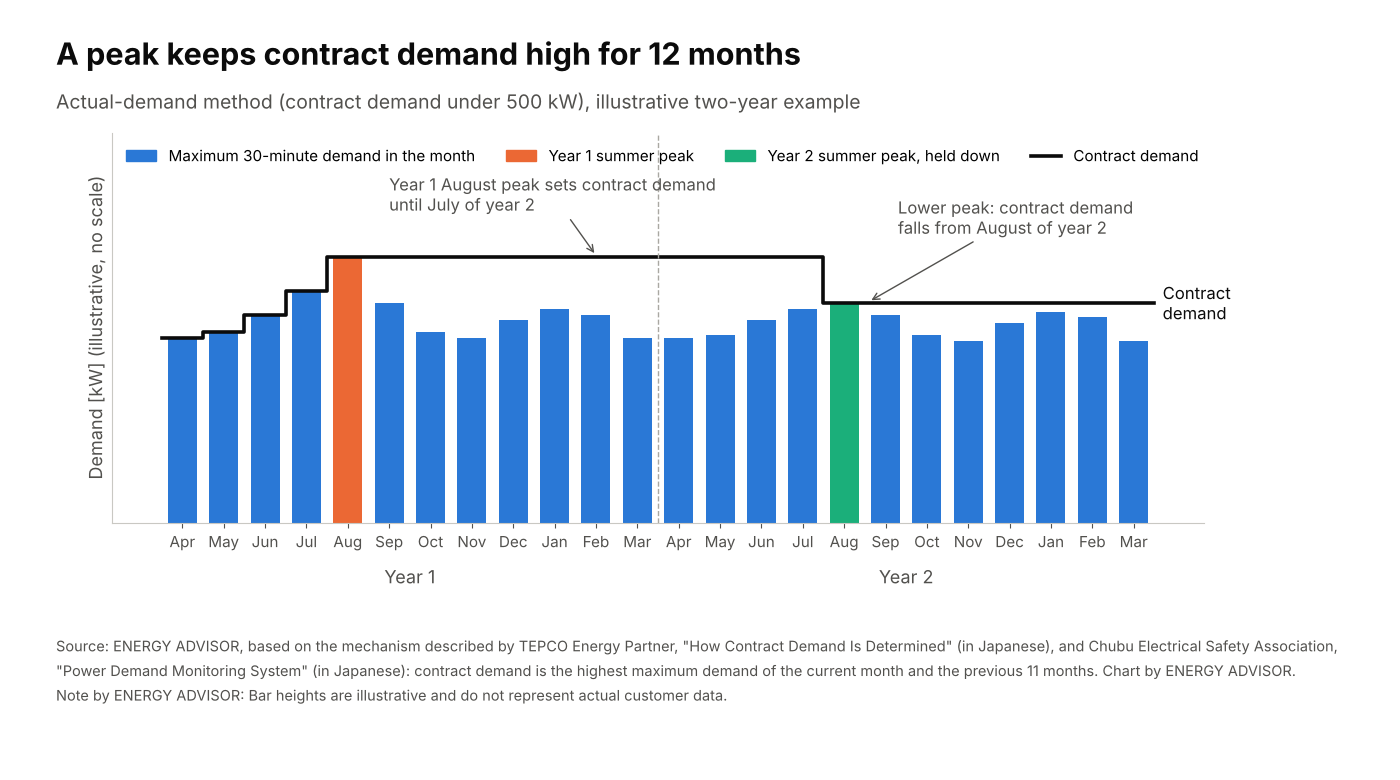
Here, the 30-minute demand refers to the highest of the average power values measured every 30 minutes. Under the actual-demand method for contract demand of less than 500 kW, the highest 30-minute demand in the past 12 months including the current month is treated as that month’s contract demand. In other words, contract demand is not set once a year and fixed; it is set again every month against this basis.
Source: TEPCO Energy Partner, “How Contract Demand Is Determined” (in Japanese)
Specifically, if power use jumps in a given month for a temporary reason and the 30-minute demand exceeds past levels, that maximum continues to affect the calculation of contract demand for the following 12 months. For this reason, if power use jumps temporarily in summer or winter, contract demand stays at a level higher than actual average usage for nearly a year.
Source: Chubu Electrical Safety Association, “Power Demand Monitoring System” (in Japanese)
The fact that a temporary peak in demand affects the whole demand charge for a block of 12 months afterward is hard to notice without understanding how the actual-demand method works.
Negotiated Contract Demand at 500 kW or More, and Own Methods at New Entrant Retailers
For customers with contract demand of 500 kW or more, “negotiated contract demand,” under which contract demand is set through discussion with the utility, generally applies instead of the actual-demand method. Under negotiated contract demand, the level of contract demand is agreed individually based on the customer’s equipment and actual usage.
In addition, some new entrant retailers use their own calculation methods that differ from those of the regional utility. Checking whether your contract demand is set by the actual-demand method, by negotiation, or by a new entrant retailer’s own method is an essential point when comparing quotations as well.
Calculating the Demand Charge
The demand charge is calculated by multiplying contract demand (kW) by the demand charge unit price of your rate plan. For example, for the high-voltage Basic Plan (Kanto area), the demand charge is ¥2,530.00 per kW at the unit price effective April 1, 2026, and ¥2,651.50 per kW from November 1, 2026 (tax included; the November revision reflects the revision of network charges; see Part 4).
Source: TEPCO Energy Partner, “FY2026 Electricity Rate Table (Extra-High-Voltage and High-Voltage)” (in Japanese); same company, “Electricity Rate Table (Extra-High-Voltage and High-Voltage)” (in Japanese), from November 1, 2026
So if contract demand rises by 100 kW, a simple calculation shows the monthly demand charge also rises by 100 times the unit price. The demand charge for high-voltage supply also has a mechanism of discounts and surcharges according to the power factor (the share of the electricity delivered that actually does work). Check the conditions in your supplier’s terms and conditions of supply. A key feature of the demand charge is that, while the energy charge changes with usage, the demand charge stays at a fixed level unless the contract demand is revised.
For reference, the demand charge and energy charge unit prices of the standard tariffs effective April 1, 2026 (high-voltage Basic Plan / Zero Market Adjustment Plan), and those from November 1, 2026, are shown in the table in Part 4.
What to Check When Reviewing Contract Demand
Under the actual-demand method, once contract demand jumps, it continues to affect the calculation of the demand charge for the following 12 months as the past maximum 30-minute demand. For this reason, if power use jumps for a sudden reason, check how long the effect will last, and then check whether there is room to consider measures to hold down the next peak.
Using Demand Monitoring Services
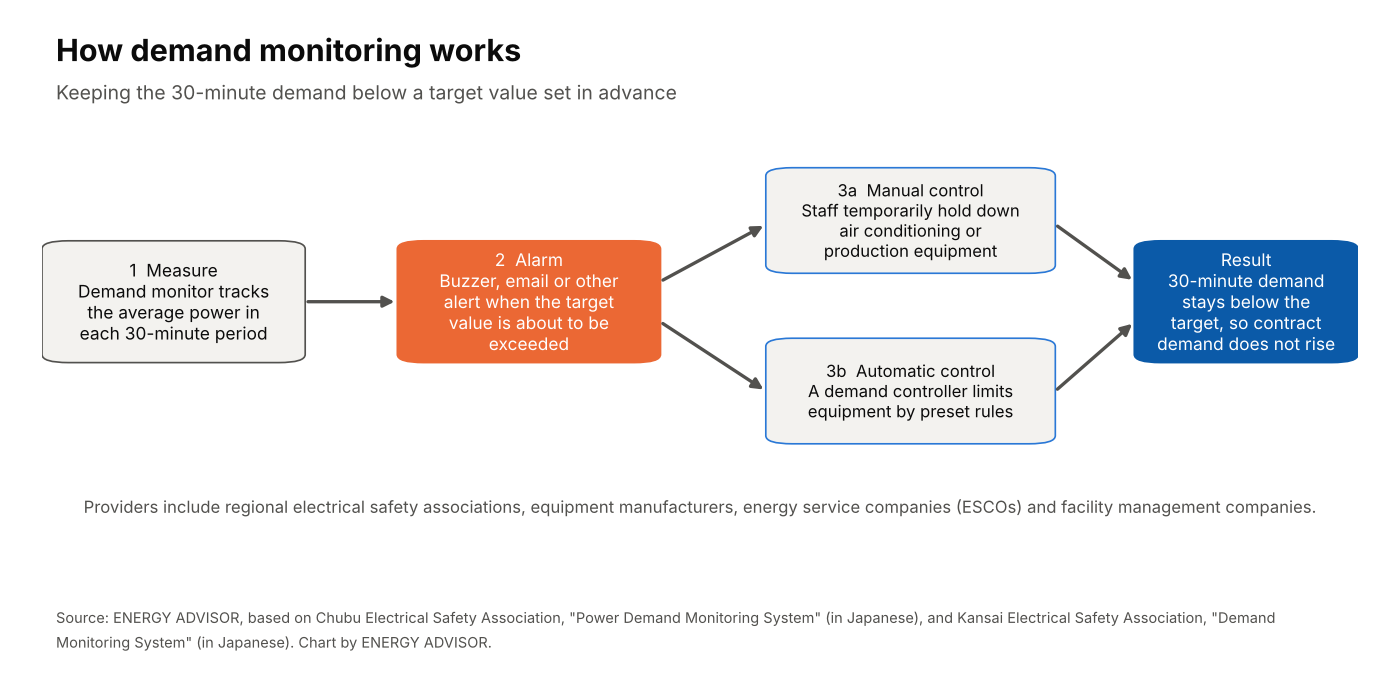
Managing the 30-minute demand is not generally done by staff watching alone; it is common to use specialized services or devices. A demand monitor constantly monitors the average power in each 30-minute period and issues an alarm by buzzer, email or other means when it is about to exceed a preset target value. By temporarily holding down air conditioning or production equipment in response to the alarm, the rise in the 30-minute demand, and in turn the rise in contract demand, is prevented. There are also devices called “demand controllers” that automatically control air conditioning and other equipment by predetermined rules when the target value is approached.
These services are offered by a wide range of providers. In addition to regional electrical safety associations (organizations that take on, on behalf of businesses, the safety management of high-voltage receiving equipment, or cubicle-type substations), they are offered by equipment manufacturers that make the devices, energy service companies (ESCOs), and facility management companies for buildings and factories. For example, the Chubu Electrical Safety Association sets the information delivery fee for demand monitoring at ¥3,850 per month (tax included) for customers that have a contract with it for safety management services.
Source: Kansai Electrical Safety Association, “Demand Monitoring System” (in Japanese); Chubu Electrical Safety Association, “Power Demand Monitoring System” (in Japanese)
Source: Chubu Electrical Safety Association, “Power Demand Monitoring System” (in Japanese)
The basic measures for holding down the 30-minute demand are peak shaving, which reduces use in the hours of highest use; peak shifting, which moves high-load work and equipment operation to other times; and operation that avoids starting several pieces of equipment at the same time. Another method is to combine solar power and batteries to reduce purchased electricity during daytime peak hours. Because costs and effects differ by provider and type of contract, it is important to compare several services when introducing one.
However, the method of calculating contract demand (the actual-demand method, negotiated contract demand, or a new entrant retailer’s own method) and the conditions for revising it differ by utility and rate plan, so you need to check the details of your individual contract.
Summary
Contract demand is the power value (kW) used as the basis for calculating the high-voltage demand charge. Under the actual-demand method for contract demand of less than 500 kW, it is set every month based on the highest 30-minute demand in the past 12 months including the current month. When a temporary peak occurs, that maximum remains a factor pushing up contract demand for 12 months. Negotiated contract demand applies to customers with 500 kW or more, and some new entrant retailers use their own calculation methods. Because the demand charge is calculated by multiplying contract demand (kW) by a unit price, understanding the level of contract demand is the basis for understanding the total electricity charge. How to check each item on the bill is as seen in Part 6.
This article is based on published materials from the Ministry of Economy, Trade and Industry and its Agency for Natural Resources and Energy, the Electricity and Gas Market Surveillance Commission, the Organization for Cross-regional Coordination of Transmission Operators (OCCTO) and other sources. The English translations of figures are by ENERGY ADVISOR and are not official translations. When using this information for decisions, please check the original sources. When we find an error, we correct the article and note the date of the correction.
Sources
- TEPCO Energy Partner, “How Contract Demand Is Determined” (in Japanese). https://www.tepco.co.jp/ep/corporate/charge_c/decision01.html
- TEPCO Energy Partner, “FY2026 Electricity Rate Table (Extra-High-Voltage and High-Voltage)” (in Japanese), effective April 1, 2026. https://www.tepco.co.jp/ep/corporate/plan_h/pdf/2026minaoshisiryou.pdf
- TEPCO Energy Partner, “Electricity Rate Table (Extra-High-Voltage and High-Voltage)” (in Japanese), from November 1, 2026. https://www.tepco.co.jp/ep/corporate/plan_h/pdf/202611minaoshisiryou.pdf
- Kansai Electrical Safety Association, “Demand Monitoring System” (in Japanese). https://www.ksdh.or.jp/service/security/demand.html
- Chubu Electrical Safety Association, “Power Demand Monitoring System” (in Japanese). https://www.cdh.or.jp/service/hoan/kanri/kanri6.html
- Kansai Electric Power, “What Is a Demand Monitor?” (in Japanese) (a reference in the original article; not used in the text). https://sol.kepco.jp/useful/aircontrol/w/demandkanshi/