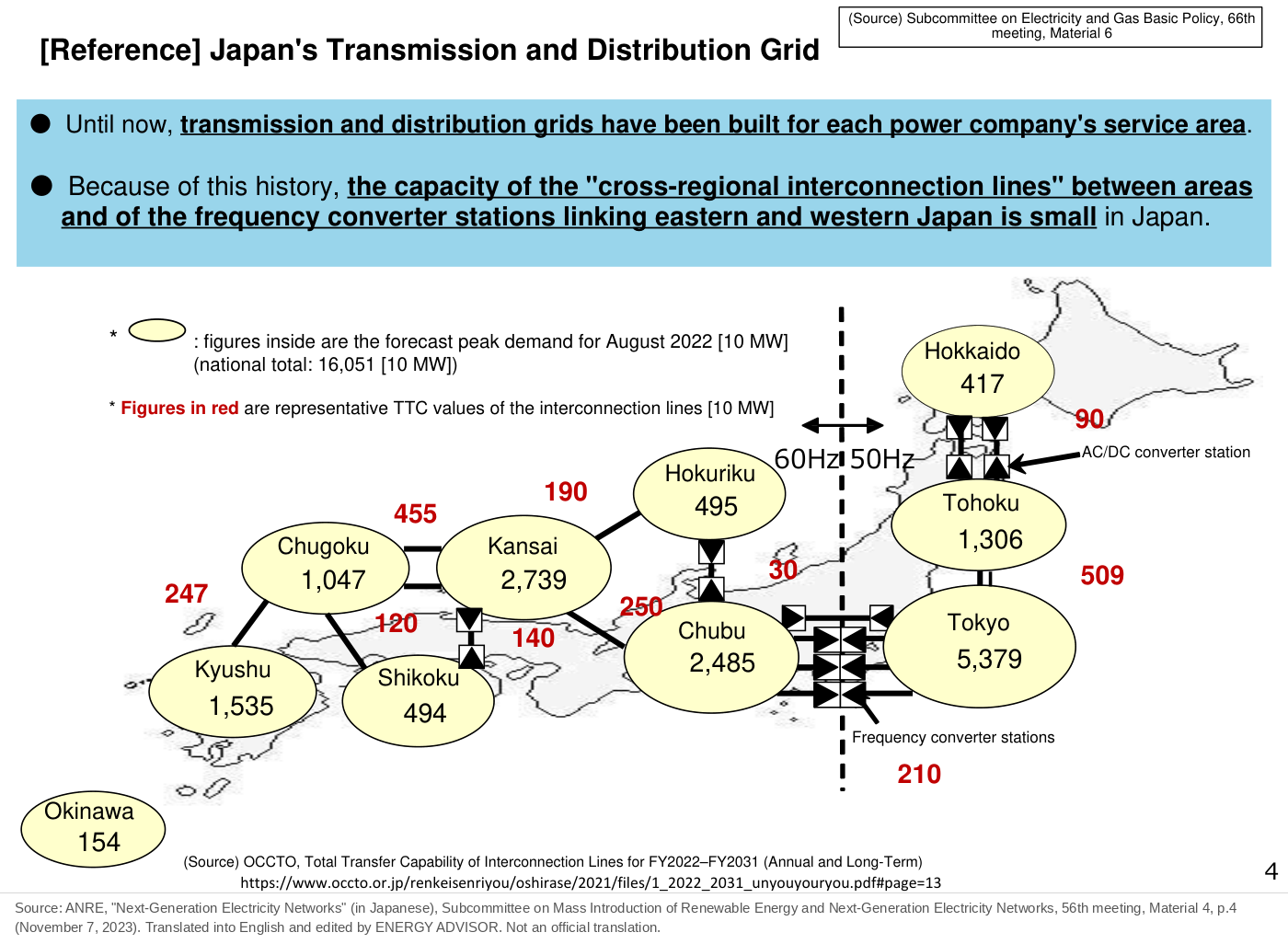
The main series (Parts 1 to 14) has explained how high-voltage and extra-high-voltage electricity charges work, mainly using TEPCO Energy Partner’s standard tariff as the example. However, companies with high-voltage contracts are located all over Japan, and when the supplier’s area changes, both the names of standard plans and the calculation rules for the fuel cost adjustment change. This special edition sets out the high-voltage standard plans of the former general electricity utilities in nine areas (the major utility in each area; this article covers the nine mainland utilities, excluding Okinawa Electric Power in Okinawa, which is not connected to the other areas by transmission lines), so that the differences among the companies can be checked in tables for each component of electricity charges covered in this series.
Key points
- 1The basic structure of the bill (six components, such as the demand charge, the energy charge and the fuel cost adjustment) is a common framework nationwide, but the names of adjustment items and the calculation rules differ by area.
- 2TEPCO Energy Partner shortened the calculation period of the fuel cost adjustment to a “one-month average” (April 2026), and Chubu Electric Power Miraiz also revised its calculation period in April 2026. Many other areas use a three-month average.
- 3The calculation period of the market price adjustment is split: one month in Kanto, Hokuriku, Kansai and Kyushu, and three months in Hokkaido and Chugoku.
- 4Items corresponding to the “market price adjustment,” which reflects prices in the JEPX day-ahead market (spot market), have been introduced in many areas, but both the names and the calculation methods differ by company.
- 5The renewable energy surcharge and the capacity contribution are nationwide schemes.
- 6Standard plans may stop accepting new applications because of supply volume caps or similar limits, so they are not necessarily “open at any time.”
The Way to Read Is Common Nationwide; the Rules Differ by Area
The framework of the components that make up a high-voltage bill, namely the demand charge, the energy charge, the fuel cost adjustment, the market price adjustment (for standard tariffs), the renewable energy surcharge and the amount corresponding to the capacity contribution, is common in every area. How to read these six components was checked one line at a time in Part 6.
On the other hand, “under what names and structures standard plans are published” and “by what rules changes in fuel prices and market prices are reflected in charges” differ by the major utility in each area. In other words, the approach seen in Part 4, “using the standard tariff as the benchmark,” can be used nationwide, but the benchmark itself needs to be rechecked in each area. Below, using these six components as the axis, the differences among the nine mainland utilities are set out in tables for each component (checked on each company’s official website as of July 11, 2026, with calculation periods rechecked on October 22, 2026; companies that could not be rechecked are noted in the tables).
The information on each company in this article is based on each company’s official website (primary information), but it is as of the time of checking. Later revisions may not be reflected, so considering a contract requires the latest content of each utility’s official website and its terms and conditions of supply.
Components 1 and 2: Demand Charge and Energy Charge: How Standard Plans Are Published
Each company publishes the unit prices of the demand charge and the energy charge on its official website as standard plans (standard tariffs). TEPCO Energy Partner’s rate table also lists unit prices for each area from Hokkaido to Kyushu (pp.4–6 of the rate table from November 1, 2026). For this reason, TEPCO EP’s standard tariff can also serve as comparison material in areas outside Kanto. In addition, each general transmission and distribution company’s network charges will be revised on November 1, 2026. In response, TEPCO EP is revising its unit prices from the same day (Part 4). The responses of the other companies need to be checked on each company’s official website. Because unit prices themselves are revised, this article does not show them and instead sets out each company’s “official place to check.”
| Area | Company | How standard plans are published | Official place to check |
|---|---|---|---|
| Hokkaido | Hokkaido Electric Power | Published as a list of rate menus for corporate customers | Rate menus |
| Tohoku | Tohoku Electric Power | Published as “standard tariffs” (contract plans) | Contract plans |
| Kanto | TEPCO Energy Partner | Three standard tariff plans (Basic / Zero Market Adjustment / Market-Linked) | Standard tariffs |
| Chubu | Chubu Electric Power Miraiz | Standard tariffs (High-Voltage Time Plan, High-Voltage Plan, Business Plan and others) | High-voltage power |
| Hokuriku | Hokuriku Electric Power | Published as an outline of standard tariffs | High-voltage electricity rates |
| Kansai | Kansai Electric Power | Published with separate structures for contract demand under / at or above 500 kW (High-Voltage Power AS, BS, AL, BL and others) | High-voltage under 500 kW / 500 kW or more |
| Chugoku | Chugoku Electric Power | Rate table published as “standard rate menus” | Rate table |
| Shikoku | Shikoku Electric Power | Published as plans for high-voltage supply of 6,000 V or more | High-voltage plans |
| Kyushu | Kyushu Electric Power | Published as an outline of rate menus and a rate table | Rate menus |
(All linked pages are in Japanese.)
Source: Each company’s official website (listed in the Sources at the end)
Checking the nine companies’ official pages side by side shows that some companies use the same term “standard tariff” and some do not, and that plan names vary, such as “Gyomuyo Denryoku” (power for business) and “Koatsu Denryoku A” (high-voltage power A). Even for the same high-voltage supply, the terminology itself differs when the area changes. This is another side of the “difficulty of comparing high-voltage supply” seen in Part 1.
Component 3: Fuel Cost Adjustment: Calculation Periods That Differ by Area
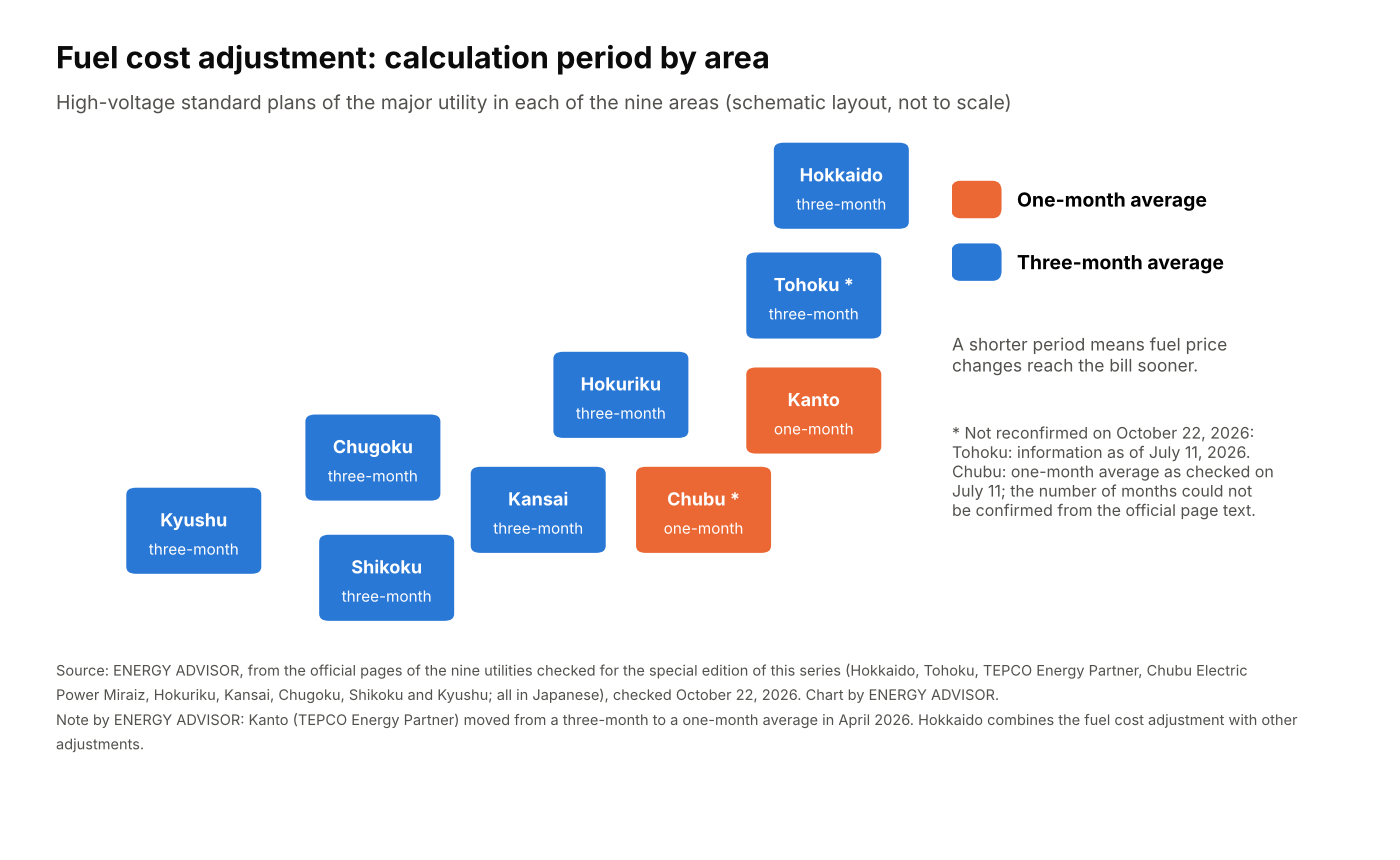
All companies have a fuel cost adjustment, but the calculation period (the average of how many months of fuel prices is reflected) differs. As seen in Part 3, the shorter the calculation period, the faster changes in fuel prices reach the bill.
| Area | Company | Calculation period of the fuel cost adjustment | Change in FY2026 | Check on October 22, 2026 |
|---|---|---|---|---|
| Hokkaido | Hokkaido Electric Power | Three-month average (operated as a single “fuel and other cost adjustment” combined with the market price adjustment and others) | — | Confirmed on official page |
| Tohoku | Tohoku Electric Power | Three-month average | Only the market price adjustment moved to a one-month average from April 2026 | Could not be checked (information as of July 11) |
| Kanto | TEPCO Energy Partner | One-month average (from April 2026) | Calculation period shortened from a three-month average | Confirmed on official page |
| Chubu | Chubu Electric Power Miraiz | Calculation period revised from April 2026 (one-month average as checked on July 11) | Changed to a three-element structure adding the “Henry Hub price adjustment rate” | Revision and the Henry Hub price adjustment rate item confirmed; the number of months in the average could not be confirmed from the text of the official page |
| Hokuriku | Hokuriku Electric Power | Three-month average (three-month moving average) | — | Confirmed on official page |
| Kansai | Kansai Electric Power | Three-month average (October 2026 calculated from the average fuel prices of May–July 2026) | — | Confirmed in the monthly fuel cost adjustment announcement (August 28, 2026) |
| Chugoku | Chugoku Electric Power | Three-month average | — | Confirmed on official page |
| Shikoku | Shikoku Electric Power | Three-month average | — | Confirmed on official page |
| Kyushu | Kyushu Electric Power | Three-month average | — | Confirmed on official page |
Source: Chubu Electric Power Miraiz, “Revision of Extra-High-Voltage and High-Voltage Standard Tariffs”; Tohoku Electric Power, “Revision of the Fuel and Other Cost Adjustment for High-Voltage and Extra-High-Voltage Supply”; and other companies’ official pages (all in Japanese; listed at the end)
The Henry Hub price adjustment rate is an adjustment item unique to Chubu Electric Power Miraiz that reflects changes in the price of Henry Hub, the US natural gas benchmark (Henry Hub is the name of a natural gas delivery hub in Louisiana, and its trading price serves as the benchmark for US natural gas prices), in electricity charges.
In other words, even if fuel prices move in the same way in the same month, the speed at which this is reflected on bills differs by area. The phenomenon “the company in the neighboring area hasn’t raised prices yet, but our contract has already gone up” can quite normally arise from this difference in calculation periods.
Component 4: Market Price Adjustment: Names and Designs That Differ by Company
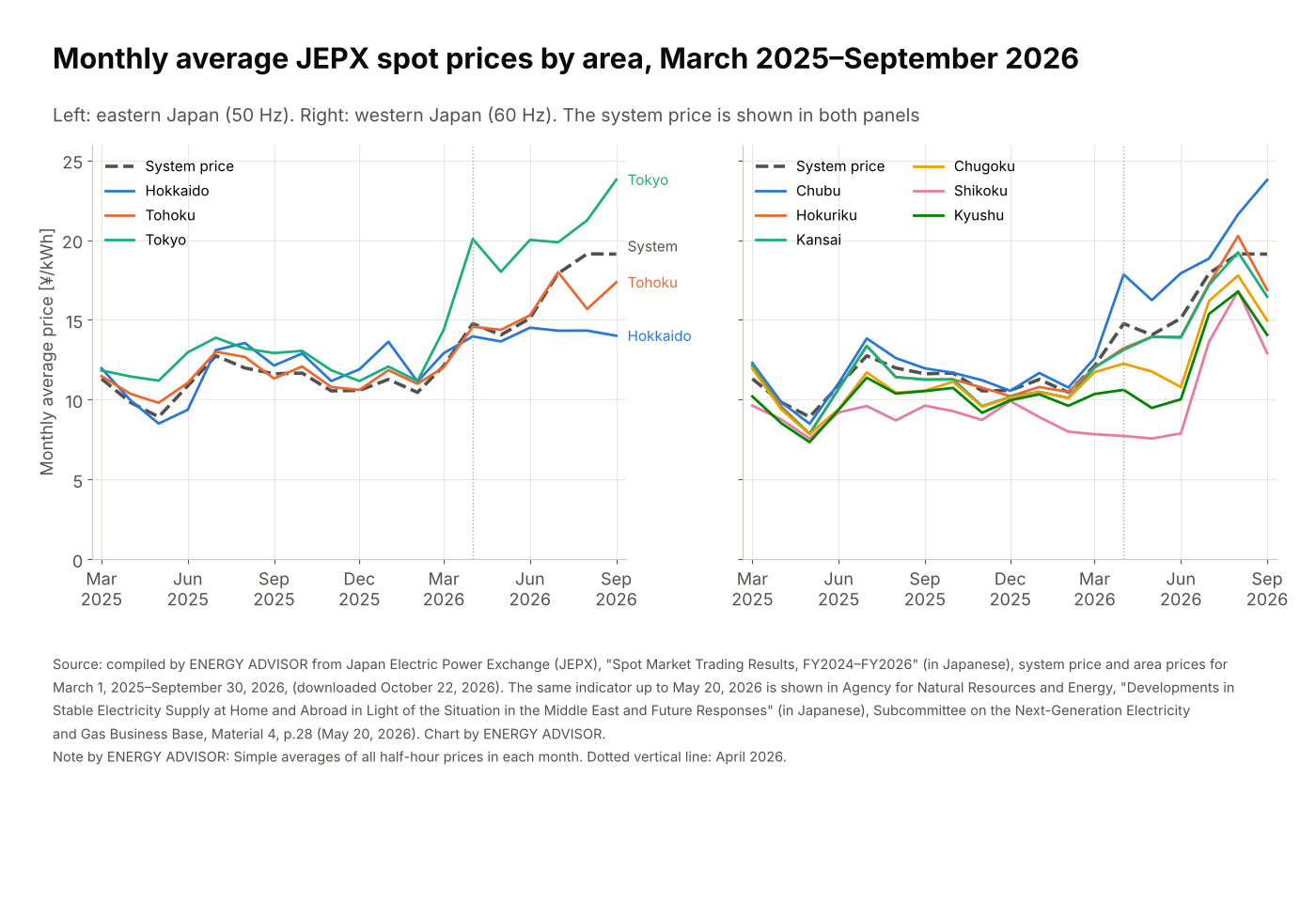
Mechanisms that reflect changes in JEPX spot market prices in charges have been introduced in many areas, but the names, calculation periods and methods differ by company.
| Area | Company | Name of the item | Calculation period (average market price) | Design features | Check on October 22, 2026 |
|---|---|---|---|---|---|
| Hokkaido | Hokkaido Electric Power | Included in the fuel and other cost adjustment | Three-month average | Handles the fuel cost adjustment, market price adjustment and remote-island universal service adjustment combined as one | Confirmed on official page |
| Tohoku | Tohoku Electric Power | Market price adjustment | One-month average (shortened from April 2026) | — | Could not be checked (information as of July 11) |
| Kanto | TEPCO Energy Partner | Market price adjustment rate | One-month average | The share of the market reflected differs among the three plans | Confirmed on official page |
| Chubu | Chubu Electric Power Miraiz | Wholesale market price adjustment (built into the fuel cost adjustment) | Revised from April 2026 (number of months in the average could not be confirmed) | Introduced in April 2023. From April 2026, a three-element structure of fuel price, Henry Hub price adjustment and wholesale market price adjustment | Three-element structure confirmed |
| Hokuriku | Hokuriku Electric Power | Market price adjustment rate | One month (average of Hokuriku area prices from 6:00 to 18:00, from the 24th of each month to the 23rd of the next) | The sum with the fuel cost adjustment rate is called the “fuel and other cost adjustment rate” | Confirmed on official page |
| Kansai | Kansai Electric Power | Market price adjustment | One month (from the 21st to the 20th of the next month) | Calculated under the electricity supply conditions effective April 1, 2025. Adjustment coefficient set monthly | Confirmed on official page |
| Chugoku | Chugoku Electric Power | Market price adjustment rate | Three-month average | A separate item alongside the remote-island universal service adjustment rate | Confirmed on official page |
| Shikoku | Shikoku Electric Power | Not stated on official pages | — | The high-voltage (6,000 V or more) rates page and the fuel cost adjustment page do not mention a market price adjustment | Checked October 22, 2026 |
| Kyushu | Kyushu Electric Power | Market price adjustment rate | One-month average | Calculated by comparing each month’s average market price with the reference price | Confirmed on official page |
Source: Hokkaido Electric Power, “Method of the Fuel and Other Cost Adjustment”; Kansai Electric Power, “Market Price Adjustment System”; Kyushu Electric Power, “Market Price Adjustment System”; and other companies’ official pages (all in Japanese; listed at the end)
The remote-island universal service adjustment is an adjustment item related to the mechanism by which customers in an area bear the cost of keeping electricity rates on remote islands at the same level as on the mainland.
The way of thinking about how changes in market prices spread to charges, as set out for Market-Linked Plans in Part 5, is useful nationwide. However, which adjustment items apply to your contract, and with what formulas, must always be checked in your supplier’s official materials.
Even under the same name, “market price adjustment,” the calculation period, reference price and adjustment coefficient differ by company. When reading examples from other areas or explanatory articles on the internet, keeping in mind that they are not necessarily the same as the rules in your own area helps prevent misunderstanding.
Components 5 and 6: Renewable Energy Surcharge and Capacity Contribution: Common Nationwide
The unit price of the renewable energy surcharge (¥4.18/kWh for FY2026, that is, April 2026–March 2027) is uniform nationwide and the same in every area. The capacity contribution is also a nationwide scheme borne by each company. How it is passed on to electricity charges (as a separate item or included in other charges) differs by company and plan, but the framework of the scheme is common. How these two components work is as seen in Parts 6 and 7.
An Extra Difference: Standard Plans Are Not Necessarily “Open at Any Time”
Standard plans may have a cap on the volume that can be supplied. Here are actual examples of suspended applications.
| Company | Period | Details |
|---|---|---|
| Tohoku Electric Power | September 2022 – February 2023 | Suspended new applications for standard tariffs for high-voltage and above (accepting only market-linked menus) |
| Chugoku Electric Power | January 2023 | Reached the cap on supply volume just one day after starting to accept standard rate menus, and closed applications (later resumed) |
| Kyushu Electric Power | December 2023 | Suspended new applications for seasonal time-of-use tariffs (menus with unit prices divided by season and time of day) |
Source: Tohoku Electric Power, “Changes to the Standard Terms and Conditions for Extra-High-Voltage and High-Voltage Electricity and Resumption of Applications for Standard Tariffs”; Chugoku Electric Power, “End of Acceptance of New Applications for Standard Rate Menus”; Kyushu Electric Power, “Revision of the ‘Standard Tariffs’ for High-Voltage and Higher Customers” (all in Japanese)
TEPCO Energy Partner’s standard tariff also has a condition that applications for plans other than the Market-Linked Plan will close once the planned supply volume cap is reached (as seen in Part 10). When considering a switch or a new contract, it is important to check, among other things, whether the plan you want is currently accepting applications.
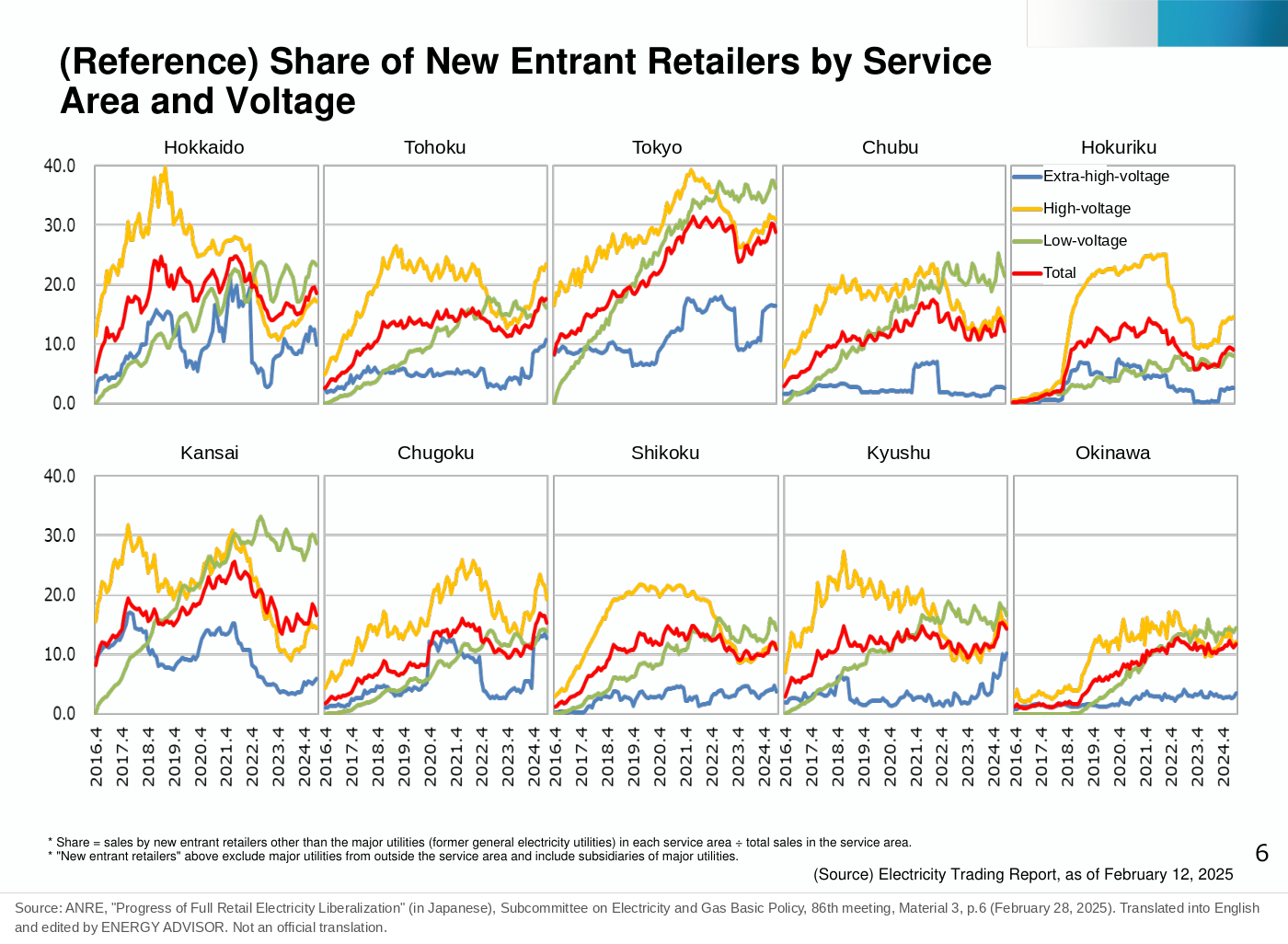
Differences in the competitive environment by area also show in the share of new entrant retailers.
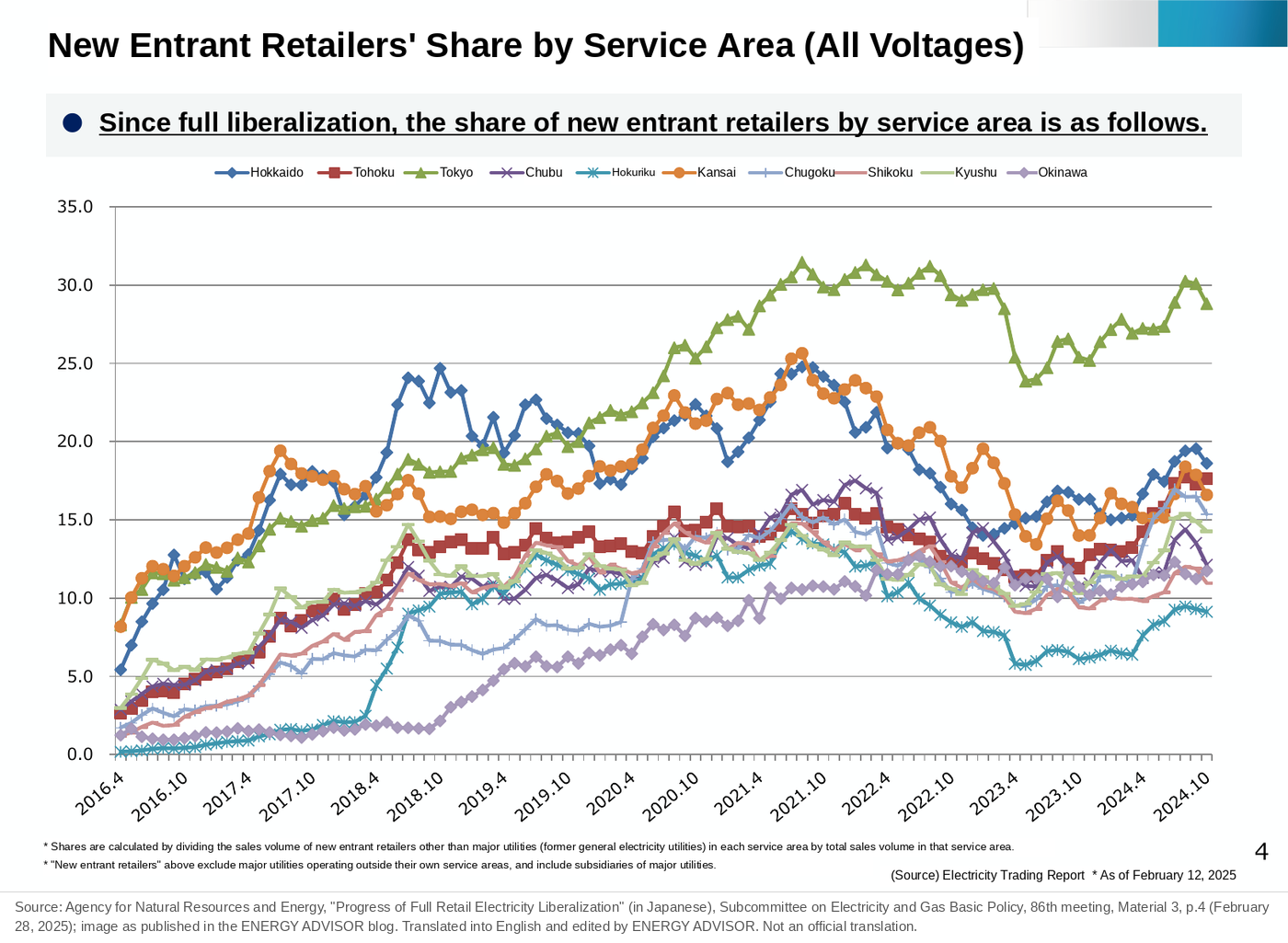
Source: Agency for Natural Resources and Energy, Subcommittee on Electricity and Gas Basic Policy, 86th meeting, Material 3, “Progress of Full Retail Electricity Liberalization” (in Japanese), February 28, 2025
Three Steps to Check in Your Own Area
The checking procedure is the same in every area.
| Step | What to check | What you can find out |
|---|---|---|
| 1 | The rate plan and rate table pages on the major utility’s official website | The names and structure of standard plans and current unit prices |
| 2 | The monthly notice pages for the fuel cost adjustment and market price adjustment | The latest adjustment rates and calculation rules (the average of how many months) |
| 3 | The terms and conditions of supply and supply condition documents | Details such as how contract demand is set and cancellation conditions |
By matching the item names on your bill with the names of adjustment items on the official website, you can understand by which rules your contract is calculated. From there, you can put into practice in your own area the five points for checking quotations in Part 9 and the back-testing approach in Part 11.
In practice, the more regional the area, the less information on high-voltage electricity charges there is on the internet. However, the major utility in every area publishes primary information. “There are few explanatory articles” and “it cannot be checked” are different things. With the approach of this series and the habit of going to official primary information, you can check in the same way in any area.
Summary
For high-voltage electricity charges, the framework of the bill’s structure is common nationwide, but the names of standard plans, the calculation period of the fuel cost adjustment and the design of the market price adjustment differ by area. For the calculation period of the fuel cost adjustment, TEPCO Energy Partner shortened it to a one-month average in April 2026, and Chubu Electric Power Miraiz also revised it at the same time, but in other areas, such as Kansai Electric Power, the three-month average is the norm. The calculation period of the market price adjustment is one month in Kanto, Hokuriku, Kansai and Kyushu, and three months in Hokkaido and Chugoku. Also, because there are actual examples of standard plans suspending applications, when considering a contract or switch, it is effective to check three things on the official website of the major utility in your area: the rate table, the notices of adjustment rates, and the terms and conditions. The content of this article is information as of the time of checking, and each company’s conditions are revised. Revisions of calculation periods were also made in April 2026 at TEPCO Energy Partner (fuel cost adjustment) and Chubu Electric Power Miraiz (fuel cost adjustment and wholesale market price adjustment). Tohoku Electric Power’s move to a one-month average for the market price adjustment (April 2026) is information as of July 2026 and could not be rechecked in October (see the table).
This article is based on published materials from the Ministry of Economy, Trade and Industry and its Agency for Natural Resources and Energy, the Electricity and Gas Market Surveillance Commission, the Organization for Cross-regional Coordination of Transmission Operators (OCCTO) and other sources. The English translations of figures are by ENERGY ADVISOR and are not official translations. When using this information for decisions, please check the original sources. When we find an error, we correct the article and note the date of the correction.
Sources
- Hokkaido Electric Power, “Rate Menus” (in Japanese). https://www.hepco.co.jp/business/price/ratemenu/ratemenu.html / “Method of the Fuel and Other Cost Adjustment” (in Japanese). https://www.hepco.co.jp/business/price/system/method.html
- Tohoku Electric Power, “Contract Plans” (in Japanese). https://www.tohoku-epco.co.jp/dbusiness/menu/plan.html / “Revision of the Fuel and Other Cost Adjustment for High-Voltage and Extra-High-Voltage Supply” (in Japanese). https://www.tohoku-epco.co.jp/info/dbusiness/ryokin2025/ / “Changes to the Standard Terms and Conditions for Extra-High-Voltage and High-Voltage Electricity and Resumption of Applications for Standard Tariffs” (in Japanese). https://www.tohoku-epco.co.jp/info/dbusiness/20230130/
- TEPCO Energy Partner, “Revisions to Extra-High-Voltage and High-Voltage Standard Tariffs from April 1, 2026, Reflection of the November 1, 2026 Network Charge Revision in Electricity Rates, and Partial Revision of Supply Conditions” (in Japanese), checked October 22, 2026. https://www.tepco.co.jp/ep/corporate/plan_h/minaoshi_2026.html
- Chubu Electric Power Miraiz, “Revision of Extra-High-Voltage and High-Voltage Standard Tariffs” (in Japanese), November 27, 2025. https://miraiz.chuden.co.jp/info/press/1217078_1938.html / “Fuel Cost Adjustment System (Corporate, High-Voltage / Extra-High-Voltage)” (in Japanese). https://miraiz.chuden.co.jp/business/electric/contract/fuelcost/high/ / “High-Voltage Power” (in Japanese). https://miraiz.chuden.co.jp/business/electric/menu/factory/hi_under/
- Hokuriku Electric Power, “Customers Receiving High-Voltage Supply (Electricity Rates)” (in Japanese). https://www.rikuden.co.jp/jiyuka/ryokin2.html / “Fuel and Other Cost Adjustment System” (in Japanese). https://www.rikuden.co.jp/jiyuka/nentyou.html
- Kansai Electric Power, “Fuel Cost Adjustment and Other Items for October 2026 Electricity Rates” (in Japanese), August 28, 2026. https://www.kepco.co.jp/corporate/pr/2026/pdf/20260828_1j.pdf / “Fuel Cost Adjustment System” (in Japanese). https://biz.kepco.jp/elec/seido/nencho/ / “High-Voltage (Contract Demand Under 500 kW)” (in Japanese). https://biz.kepco.jp/elec/menu/500kw_less/ / “High-Voltage (Contract Demand of 500 kW or More)” (in Japanese). https://biz.kepco.jp/elec/menu/500kw_more/ / “Market Price Adjustment System” (in Japanese). https://biz.kepco.jp/elec/seido/market_adjustment/
- Chugoku Electric Power, “Electricity Rate Table (High-Voltage and Extra-High-Voltage Customers)” (in Japanese). https://www.energia.co.jp/elec/pricelist_d.html / “Guide to the Fuel and Other Cost Adjustment System” (in Japanese). https://www.energia.co.jp/elec/seido/nencho/index_d.html / “End of Acceptance of New Applications for Standard Rate Menus” (in Japanese). https://www.energia.co.jp/houjin/2023/14488.html
- Shikoku Electric Power, “Customers Such as Office Buildings, Commercial Facilities and Factories (High-Voltage, 6,000 V or More)” (in Japanese) (confirmed on October 22, 2026 that there is no mention of a market price adjustment). https://www.yonden.co.jp/business/price/6000v/ / “Fuel Cost Adjustment System and Rate Table” (in Japanese). https://www.yonden.co.jp/customer/price/fuel_adjustments.html
- Kyushu Electric Power, “Outline of Rate Menus and Rate Table (Customers on the Main Island of Kyushu)” (in Japanese). https://www.kyuden.co.jp/business/menu/menu-select/mainland.html / “Market Price Adjustment System” (in Japanese). https://www.kyuden.co.jp/business/structure/market-system.html / “Revision of the ‘Standard Tariffs’ for High-Voltage and Higher Customers” (in Japanese). https://www.kyuden.co.jp/business/revision.html
- Agency for Natural Resources and Energy, Subcommittee on Electricity and Gas Basic Policy, 86th meeting (February 28, 2025), Material 3, “Progress of Full Retail Electricity Liberalization” (in Japanese). https://www.meti.go.jp/shingikai/enecho/denryoku_gas/denryoku_gas/pdf/086_03_00.pdf
- Agency for Natural Resources and Energy, “Next-Generation Electricity Networks” (in Japanese), Advisory Committee for Natural Resources and Energy, Subcommittee on Mass Introduction of Renewable Energy and Next-Generation Electricity Networks, 56th meeting, Material 4, November 7, 2023, p.4, “[Reference] Japan’s transmission and distribution network.” https://www.meti.go.jp/shingikai/enecho/denryoku_gas/saisei_kano/pdf/056_04_00.pdf
- Agency for Natural Resources and Energy, “Developments in Stable Electricity Supply at Home and Abroad in Light of the Situation in the Middle East and Future Responses” (in Japanese), Advisory Committee for Natural Resources and Energy, Subcommittee on the Next-Generation Electricity and Gas Business Base, May 20, 2026, Material 4. https://www.meti.go.jp/shingikai/enecho/denryoku_gas/jisedai_kiban/pdf/006_04_00.pdf