The bill of a company on a high-voltage contract lists several items, but many companies keep paying every month without knowing what each item means. To judge which item caused a change in electricity costs, you need to understand the components of the bill. This article checks, one line at a time, the six components that make up a high-voltage electricity bill. It also uses the example of usage in July to September 2026 to show where a temporary discount, such as government electricity bill relief, appears on the bill.
Key points
- 1A high-voltage electricity bill consists of six components: the demand charge, the energy charge, the fuel cost adjustment, the market price adjustment (for standard tariffs), the renewable energy surcharge, and the amount corresponding to the capacity contribution.
- 2From April 2026, the calculation period of the fuel cost adjustment was shortened to a “one-month average,” and the time lag between a movement in fuel or market prices and its arrival on the bill became effectively about one to two months.
- 3Standard tariffs have an item called the market price adjustment, separate from the fuel cost adjustment, and the level of this rate differs among the three plans.
- 4The capacity contribution is a cost borne by retail electricity suppliers and others since FY2024, and it is expected to rise further from FY2028.
- 5The government provided relief that discounted electricity charges for usage in July to September 2026. It covered low-voltage and high-voltage supply; extra-high-voltage supply was not included. The relief ended with September usage.
- 6The government’s “usage in month X” and the “month X” on a utility’s bill can differ by one month.
Part 3 looked at the fuel cost adjustment, Part 4 at the standard tariff, and Part 5 at how the market price adjustment works. This part checks the six components of the bill, including these, all together, with the aim of being able to read a high-voltage electricity bill on your own.
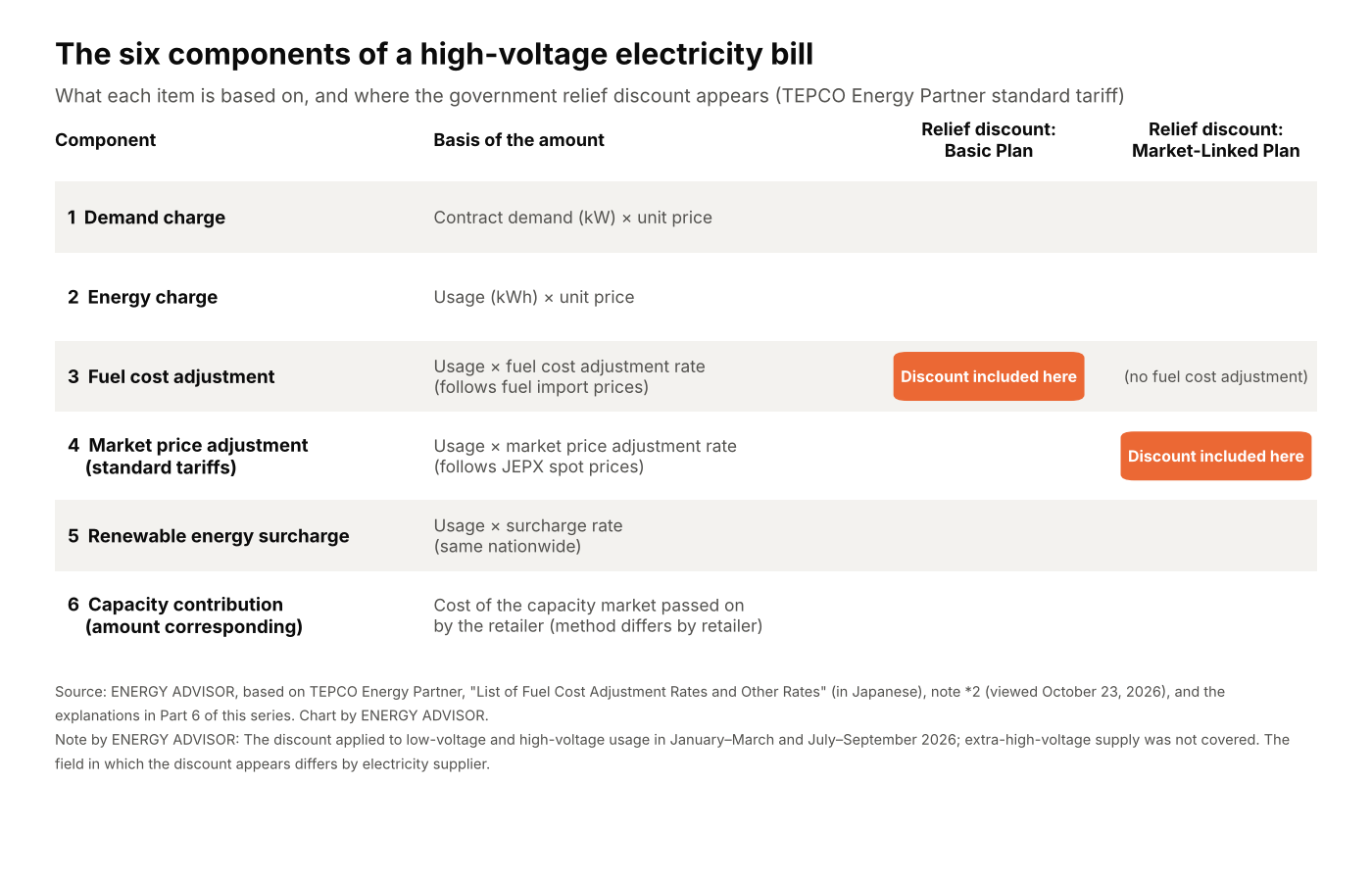
The Six Components of a Bill
A high-voltage electricity bill basically consists of the following six components: first, the demand charge; second, the energy charge; third, the fuel cost adjustment; fourth, the market price adjustment (for standard tariffs); fifth, the renewable energy surcharge; and sixth, the amount corresponding to the capacity contribution. Each is checked in turn below.
Demand Charge
The demand charge is a fixed charge incurred every month according to the contract demand (kW). For reference, the demand charge of the high-voltage Basic Plan (Kanto area) is ¥2,530.00 per kW at the unit price effective April 1, 2026, and ¥2,651.50 per kW from November 1, 2026 (tax included; the November revision reflects the revision of network charges; see Part 4).
Source: TEPCO Energy Partner, “FY2026 Electricity Rate Table (Extra-High-Voltage and High-Voltage)” (in Japanese); same company, “Electricity Rate Table (Extra-High-Voltage and High-Voltage)” (in Japanese), from November 1, 2026
Where to check on your own bill: Check the contract demand (kW) shown in the “demand charge” field of the bill and the unit price shown next to it. Checking that the contract demand multiplied by the unit price matches the amount in the demand charge field makes it easier to understand how it is calculated. If the contract demand figure itself has changed from the previous month, it is a good idea to check the reason as well.
Energy Charge
The energy charge is calculated by multiplying the electricity actually used (kWh) by the unit price. An example unit price for the high-voltage Basic Plan (Kanto area) is ¥17.43 per kWh at the unit price effective April 1, 2026, and ¥17.47 per kWh from November 1, 2026 (tax included).
Source: TEPCO Energy Partner, “FY2026 Electricity Rate Table (Extra-High-Voltage and High-Voltage)” (in Japanese); same (from November 1, 2026)
Where to check on your own bill: Check the usage (kWh) and the unit price shown in the “energy charge” field of the bill. In plans whose unit prices are divided by season and time of day, the usage and unit price for each category are often shown in separate fields, and the sum of each multiplication is the total energy charge. If you do not know the unit price categories, a reliable method is to check the name of the rate plan you have contracted and compare it with the utility’s rate table.
Energy charges often have unit prices divided into three or more time periods, and the details on the bill are hard to follow at first.
Fuel Cost Adjustment
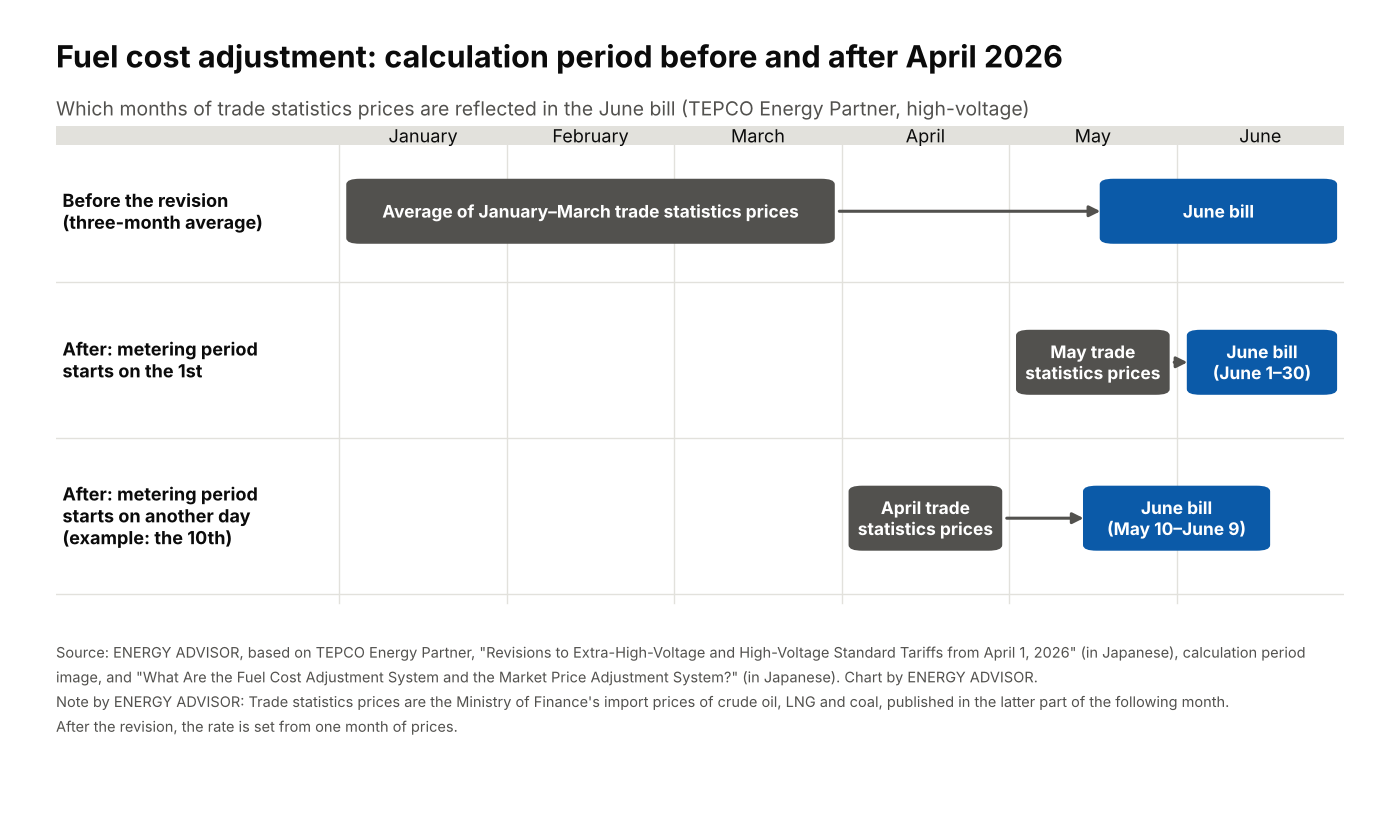
The fuel cost adjustment is an item that reflects changes in fuel import prices in electricity charges. TEPCO Energy Partner’s official fuel cost adjustment rates for high-voltage supply (Basic Plan, customers whose metering period does not start on the 1st of each month, tax included) were −¥0.90 per kWh in April 2026, ¥0.07 in May, ¥0.89 in June and ¥1.47 in July. Of these, the values for April and for August to October are published including the discount from government bill relief, which is explained later. In addition, from April 2026 the calculation period was shortened from a “three-month average” to a “one-month average,” so market trends are reflected on bills sooner. The details of this change are as seen in Part 3.
Source: TEPCO Energy Partner, “List of Fuel Cost Adjustment Rates and Other Rates” (in Japanese), checked October 22, 2026
Source: TEPCO Energy Partner, “What Are the Fuel Cost Adjustment System and the Market Price Adjustment System?” (in Japanese)
Where to check on your own bill: Check the unit price (¥/kWh) shown in the field called “fuel cost adjustment” or similar, and that month’s usage. A month in which the unit price is shown as negative means that amount is deducted from the electricity charge. Keeping a record of how much the unit price moved from the previous month makes it easier to see upward and downward trends.
The monthly fuel cost adjustment rates (April to October 2026) and the values excluding the discount are shown in the table in Part 3.
Market Price Adjustment (for Standard Tariffs)
The market price adjustment is an item that reflects changes in prices in the JEPX day-ahead market (spot market) in electricity charges. If you have a standard tariff, this market price adjustment appears on the bill separately from the fuel cost adjustment. The three plans, the Basic Plan, the Zero Market Adjustment Plan and the Market-Linked Plan, differ in how much of the market price is reflected, and the market price adjustment rate moves the most in the Market-Linked Plan. However, the energy charge of the Market-Linked Plan is lower than that of the Basic Plan, so a comparison of the totals is shown in Part 5. Taking July 2026 (high-voltage, customers whose metering period does not start on the 1st of each month, tax included) as an example, the daytime rate was ¥6.15/kWh for the Basic Plan and ¥14.26/kWh for the Market-Linked Plan. The details of how this item works are as seen in Part 5.
Source: TEPCO Energy Partner, “Notice of Fuel Cost Adjustment and Other Rates (July 2026)” (in Japanese)
Where to check on your own bill: If the bill has a field called “market price adjustment” or “market price adjustment rate,” check the unit prices and time periods for your plan. Because it is easy to confuse with the fuel cost adjustment, it is important to check each unit price on the assumption that the two items are shown separately.
Renewable Energy Surcharge
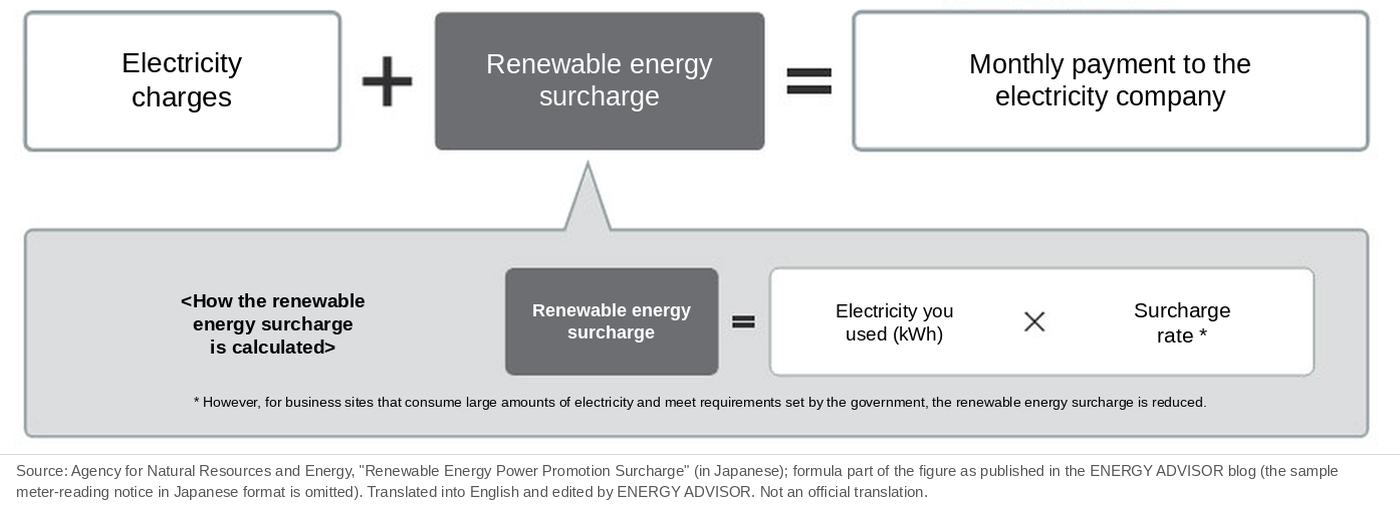
The renewable energy surcharge is an item through which electricity users bear, according to their usage, the costs of the Feed-in Tariff (FIT) scheme for renewable energy (a scheme under which electricity generated from renewables is purchased at prices set by the government) and similar schemes. The unit price is revised every fiscal year, so you need to check the unit price for that month shown on the bill. Because the amount is calculated by multiplying the electricity used by the unit price, high-voltage and extra-high-voltage customers with large usage tend to have larger amounts for this item. The unit price for FY2026 (April 2026–March 2027; Japan’s fiscal year runs from April to March) is ¥4.18 per kWh, applied from bills for meter readings in May 2026 to those in April 2027.
Source: METI, “Setting Purchase Prices from FY2026 and the Surcharge Rate for FY2026” (in Japanese), March 19, 2026
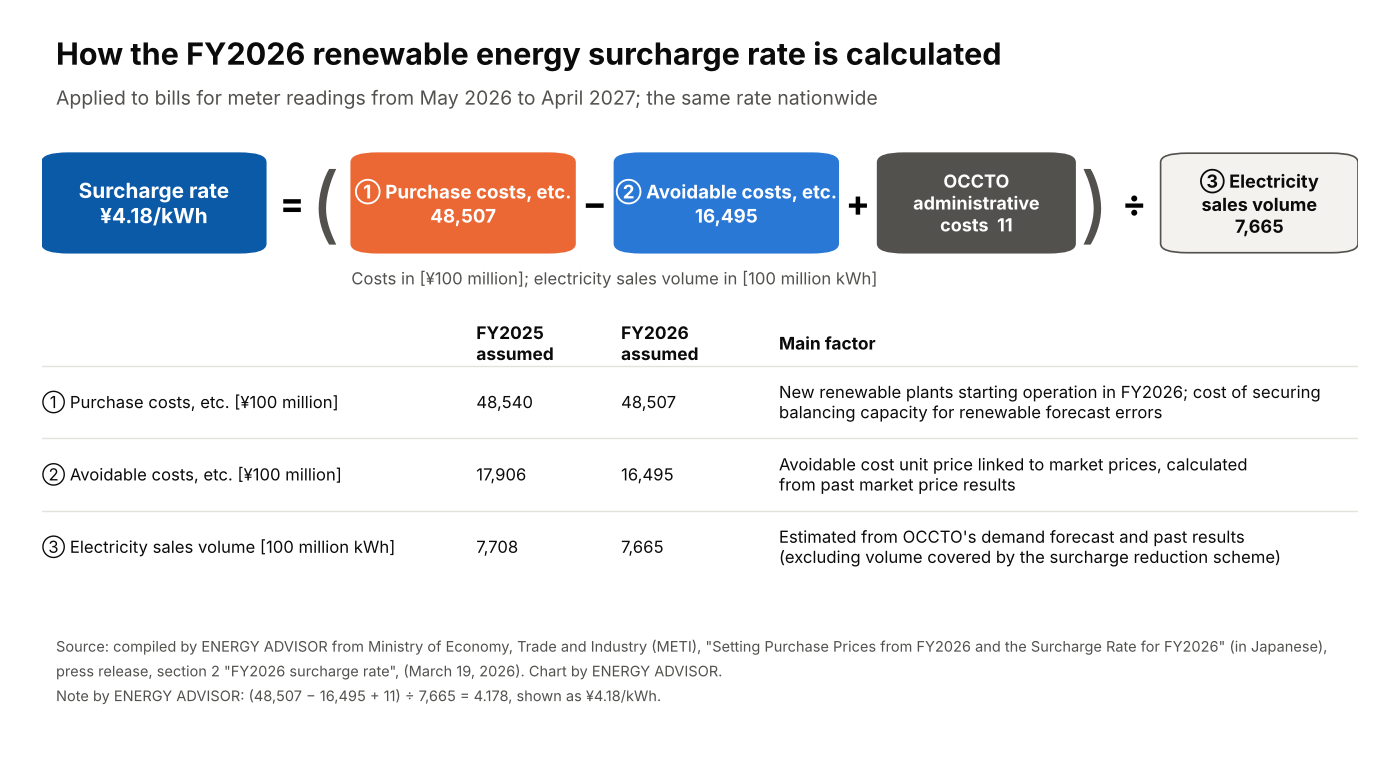
Source: METI, “Setting Purchase Prices from FY2026 and the Surcharge Rate for FY2026” (in Japanese), March 19, 2026
Where to check on your own bill: Check the field called “renewable energy power promotion surcharge” or similar. Because the unit price is the same nationwide, this is an item whose amount you can verify as long as you know the usage. It is a good idea to also check whether the unit price has been revised when the fiscal year changes.
Amount Corresponding to the Capacity Contribution
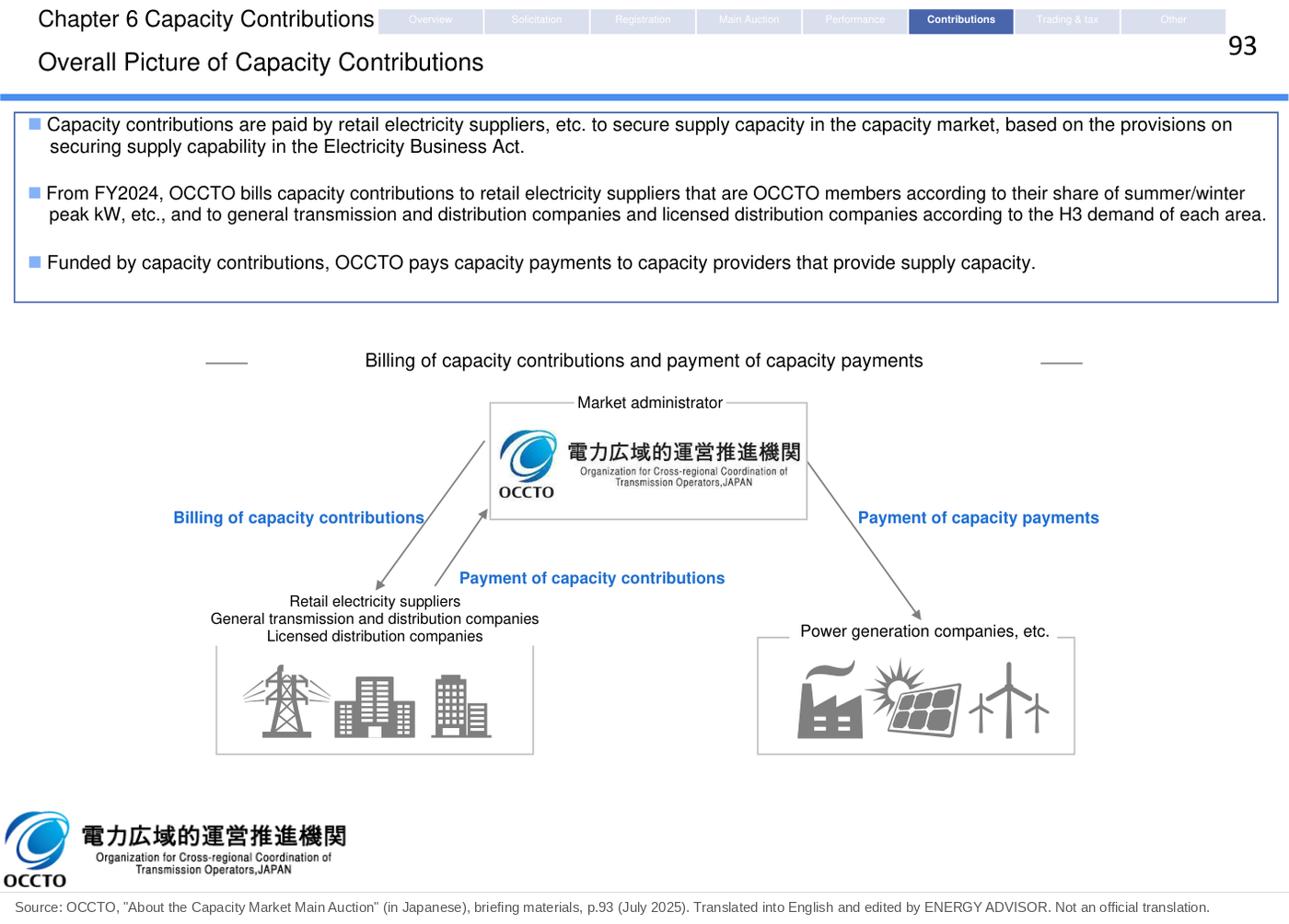
The capacity contribution is the cost of the mechanism for securing future supply capacity (the capacity market). Since FY2024, retail electricity suppliers, general transmission and distribution companies and others have paid it to the Organization for Cross-regional Coordination of Transmission Operators, JAPAN (OCCTO). Most of the total capacity contribution is the total clearing cost of the Main Auction (about ¥842.5 billion for FY2026 and about ¥2.2094 trillion for FY2029). From FY2028, the cost of the Long-Term Decarbonized Capacity Auction is also added, and OCCTO’s estimate puts the capacity contribution for FY2029 at about ¥2.2702 trillion in total (FY2029 auction results, p.11; the amounts by fiscal year and the rough amount per kW are in Part 7).
Source: OCCTO, “Learn About the Capacity Contribution!” (in Japanese) (payments since FY2024, who pays); OCCTO, “Results of the Capacity Market Main Auction (Delivery Year: FY2026)” (in Japanese) (total clearing cost); OCCTO, “Results of the Capacity Market Main Auction (Delivery Year: FY2029)” (in Japanese) (total clearing cost)
Where to check on your own bill: Depending on the bill, there may be a separate field for the “amount corresponding to the capacity contribution,” or it may be included in another item such as the energy charge. If you cannot find a separate field, checking the calculation method with your electricity supplier makes it easier to understand the outlook for future increases.
Because the capacity contribution is a relatively new item on the bill, its very existence is sometimes not known. Since it is expected to rise further, it is worth understanding it early.
When Government Bill Relief Applies (Example of Usage in July–September 2026)
In addition to the six components so far, a discount from government relief may temporarily appear on the bill. Using the 2026 example, this section checks how it works and how it appears on the bill.
What the Relief Covered
There were two rounds of government electricity bill discount relief in 2026. The first covered usage in January, February and March 2026. In TEPCO EP’s high-voltage listing, a discount of ¥2.30/kWh for February and March and ¥0.80/kWh for April is included in the fuel cost adjustment rate. Extra-high-voltage supply was not covered this time either.
Source: TEPCO Energy Partner, “Application for Approval of Special Measures in Connection with the Electricity and Gas Bill Relief” (in Japanese), December 5, 2025; TEPCO Energy Partner, “List of Fuel Cost Adjustment Rates and Other Rates” (in Japanese) (notes; checked October 22, 2026)
As the second round, against the background of the rising fuel cost adjustment and the surge in JEPX spot market prices (Part 2), the government provided relief that discounted electricity and gas charges for usage in July, August and September 2026. The explanation below uses this second round as the example. On June 12, 2026, the Ministry of Economy, Trade and Industry (METI) announced that, in connection with this relief, it had granted special approval allowing utilities to discount their charges. This relief is sometimes called an “electricity subsidy,” but it is a mechanism that, based on the national budget, deducts from the electricity charge the amount obtained by multiplying the electricity used (kWh) by a unit rate. Corporations with high-voltage contracts (including small and medium-sized enterprises) were also covered.
The discount rate differs by month.
| Usage month (meter-reading month) | High-voltage | Low-voltage |
|---|---|---|
| Usage in July 2026 (meter reading in August) | ¥1.8/kWh | ¥3.5/kWh |
| Usage in August 2026 (meter reading in September) | ¥2.3/kWh | ¥4.5/kWh |
| Usage in September 2026 (meter reading in October) | ¥1.8/kWh | ¥3.5/kWh |
Source: METI, “Special Approvals Granted to Allow Discounts on Electricity and City Gas Charges in Connection with the Electricity and Gas Bill Relief for Usage in July, August and September 2026” (in Japanese), June 12, 2026
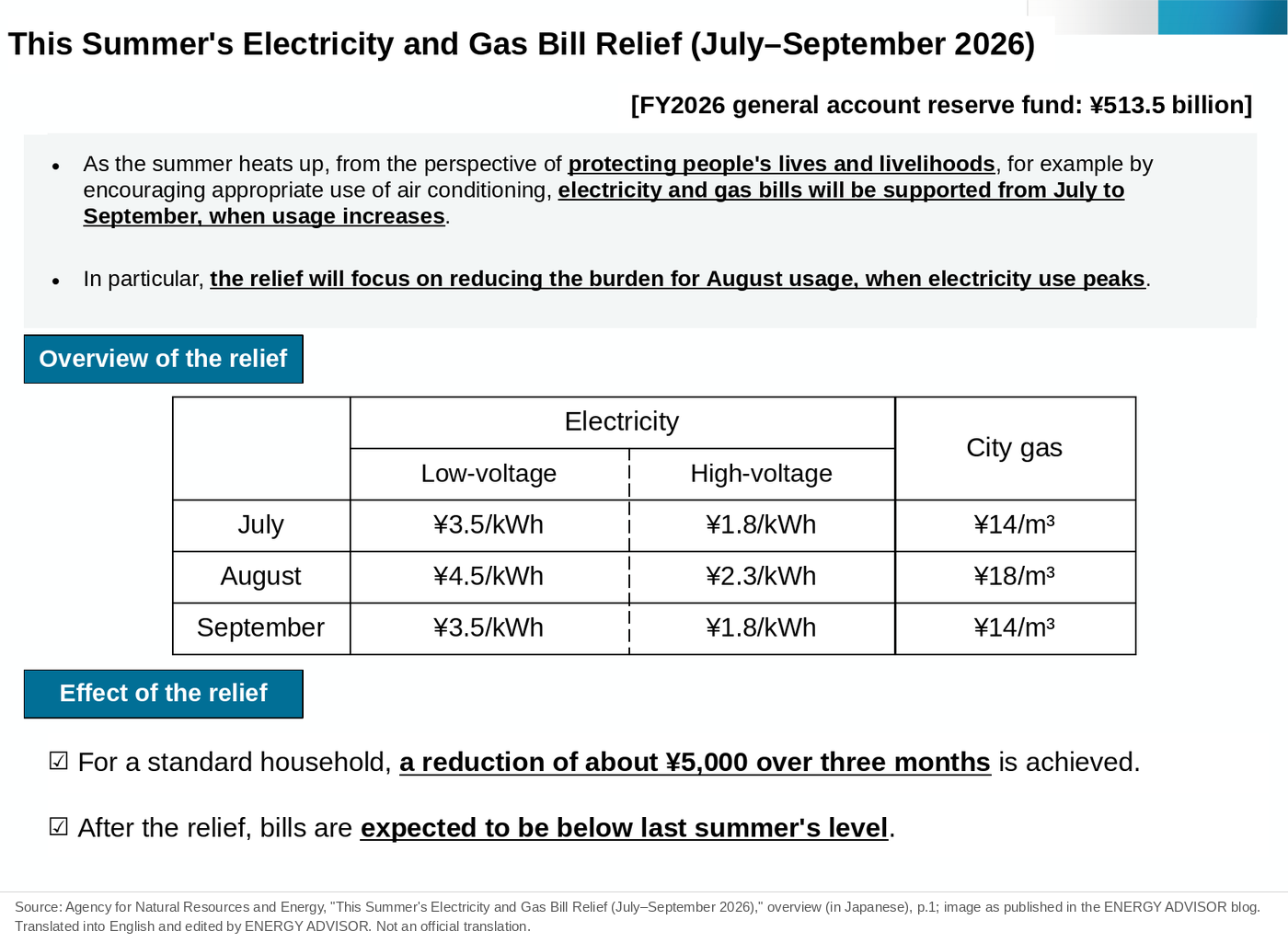
Source: Agency for Natural Resources and Energy, “This Summer’s Electricity and Gas Bill Relief,” overview (in Japanese)
When checking the bill, you need to compare the unit rate for each month, including the fact that only August usage has a higher rate.
Extra-High-Voltage Supply Not Included
The discount rates of this relief were set for low-voltage and high-voltage supply, and extra-high-voltage supply was not included. As seen in Part 1, extra-high-voltage supply is, in rate plans, the category for receiving voltage of 20,000 V or more (roughly 2,000 kW or more in contract demand, as a guide).
Source: Electricity and Gas Price Shock Mitigation Program, official website (in Japanese), checked October 22, 2026
Even when facing the same rise in electricity costs, whether relief is available depends on the contract category. Customers close to the boundary between high-voltage and extra-high-voltage need to check which category their contract falls under. For extra-high-voltage customers, the response to a higher electricity cost burden centers not on waiting for relief measures but on what the company can do itself: checking whether there is room to review how contract demand is calculated, understanding the rate structure such as the fuel cost adjustment and market-linked pricing clauses, and comparing quotations from several companies.
Rough Size of the Discount
To get a rough idea of the size of the discount, here is a simple calculation assuming a high-voltage customer with monthly usage of 30,000 kWh.
| Usage month | High-voltage discount rate | Discount for monthly usage of 30,000 kWh (simple calculation) |
|---|---|---|
| Usage in July 2026 | ¥1.8/kWh | About ¥54,000 |
| Usage in August 2026 | ¥2.3/kWh | About ¥69,000 |
| Usage in September 2026 | ¥1.8/kWh | About ¥54,000 |
These amounts are only rough figures obtained by multiplying usage by the unit rate. The actual discount differs depending on the meter-reading period and contract terms.
End of the Relief
The relief ended with usage in September 2026. As of October 22, 2026, the program’s official website has no notice of an extension beyond October or of new relief. Because the discount disappears from October usage, the amount on the bill appears higher by that amount even if actual electricity use and unit prices do not change. When comparing bills before and after the end of the relief, you need to check them separately for whether a discount was included.
Source: Electricity and Gas Price Shock Mitigation Program, official website (in Japanese), checked October 22, 2026
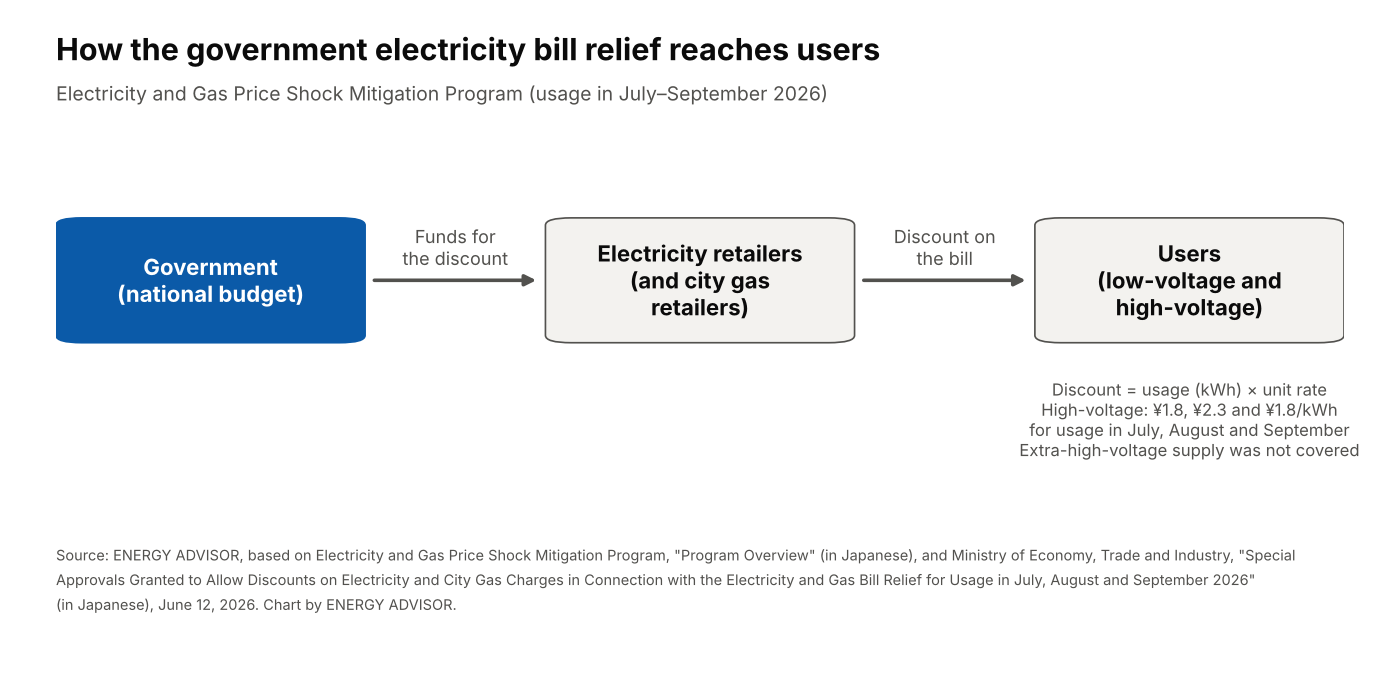
Source: Electricity and Gas Price Shock Mitigation Program, “Program Overview” (in Japanese)
Gap Between the Usage Month and the Billing Month
Meter reading is the process by which the utility fixes each month’s usage, and its date marks the billing cut-off. The government’s relief sets rates by “usage in month X,” but the “month X” on utility bills and rate tables may be shown one month later.
For example, Kyushu Electric Power shows the government’s discounts for usage in July, August and September as “August,” “September” and “October” (“October” is ¥3.50/kWh for low-voltage and ¥1.80/kWh for high-voltage; the company’s announcement of August 28, 2026). TEPCO Energy Partner’s high-voltage rate list also shows the discount rates as ¥1.80 for “August,” ¥2.30 for “September” and ¥1.80 for “October,” one month off from the government’s rates for usage in July, August and September.
| Government category | High-voltage discount rate | TEPCO EP high-voltage listing | Kyushu Electric Power listing |
|---|---|---|---|
| Usage in July 2026 (meter reading in August) | ¥1.8/kWh | August, ¥1.80 | August, ¥1.80 |
| Usage in August 2026 (meter reading in September) | ¥2.3/kWh | September, ¥2.30 | September, ¥2.30 |
| Usage in September 2026 (meter reading in October) | ¥1.8/kWh | October, ¥1.80 | October, ¥1.80 |
Source: METI (June 12, 2026); TEPCO Energy Partner, “List of Fuel Cost Adjustment Rates and Other Rates” (in Japanese), checked October 22, 2026; Kyushu Electric Power (August 28, 2026)
In addition, the field of the bill in which the discount appears also differs by company. In TEPCO Energy Partner’s high-voltage Basic Plan, the discount rate is shown included in the fuel cost adjustment rate (it is not included in the Basic Plan’s market price adjustment rate). In the Market-Linked Plan, which has no fuel cost adjustment, the discount is shown included in the market price adjustment rate (notes in TEPCO EP’s rate list; Part 5). For this reason, the fuel cost adjustment rates for April and for August to October 2026 moved to the negative side by the amount of the discount (table in Part 3). Reading a month with a negative fuel cost adjustment rate as “fuel prices fell” would be a mistake.
Time Lag Before Price Rises Reach the Bill
The fuel cost adjustment and clauses linked to market prices are not reflected directly in the month in which fuel or market prices move. There is a certain time lag between a price change and its reflection in the unit prices on the bill.
For TEPCO Energy Partner’s fuel cost adjustment for high-voltage supply, each month’s rate is set based on recent trade statistics prices (import price statistics published by the Ministry of Finance). For customers whose metering period starts on the 1st of each month, the trade statistics prices of the previous month are reflected in the current month’s rate; for customers whose metering period does not start on the 1st, those of the month before the previous month are reflected. In other words, changes are effectively reflected on the bill one to two months later.
Source: TEPCO Energy Partner, “What Are the Fuel Cost Adjustment System and the Market Price Adjustment System?” (in Japanese)
The market price adjustment of the Market-Linked Plan is also based on the average JEPX spot market price of the most recent one month and is reflected under the same start-of-period rule as the fuel cost adjustment, so it is designed with an effective lag of one to two months. However, this is how the standard tariffs of regional utilities work. For new entrant retailers’ own adjustment items, some terms and conditions of supply set a longer time lag. It is important to check the reference period and the timing of reflection individually in the terms and conditions of your electricity supplier.
Because the month in which you see news that “market prices have risen” and the month in which the bill amount actually moves are different, the link between the two can be hard to notice. Knowing how the time lag works makes it easier to trace back the reasons for changes in the bill.
Relationship with How Contract Demand Is Calculated
Because the demand charge depends on contract demand, it is also important to understand how contract demand itself is calculated. The actual-demand method sets contract demand based on the highest measured power use (the 30-minute demand). Under the actual-demand method for contract demand of less than 500 kW, contract demand is generally set every month based on the highest 30-minute demand in the past 12 months including the current month. For 500 kW or more, negotiated contract demand applies, and some new entrant retailers use their own calculation methods. Watching how the contract demand field on the bill moves each month makes it easier to trace the reasons for changes in the demand charge (see Part 8 for details).
How to Check: Why Check the Whole Bill
Once you can check each of the six components, it becomes easier to isolate which item caused a change in electricity costs. For example, the rules and materials to check differ depending on whether it was a month when the fuel cost adjustment rose, when the market price adjustment rose, when the amount corresponding to the capacity contribution rose, or when the government discount ended. For this reason, it is important to record the trend of each item, not just the total amount of the bill.
Summary
A high-voltage electricity bill consists of six components: the demand charge, the energy charge, the fuel cost adjustment, the market price adjustment (for standard tariffs), the renewable energy surcharge, and the amount corresponding to the capacity contribution. Of these, the fuel cost adjustment’s calculation period was shortened from April 2026, so market trends are reflected sooner. The capacity contribution is expected to rise further. For both the fuel cost adjustment and the market price adjustment, there is an effective time lag of about one to two months before price changes are reflected on the bill; under the old system, the time lag was about three months.
For usage in July to September 2026, a discount from government relief was applied. It covered low-voltage and high-voltage supply, and extra-high-voltage supply was not included. The government’s “usage” months and a utility’s “month X” can differ by one month, and the field in which the discount is included also differs by company. Once you can check each item on the bill one by one, it becomes easier to understand what drives changes in the amount. The unit prices and rules in this article are examples from TEPCO Energy Partner. The framework of a bill’s components is common nationwide, but the names of adjustment items and calculation rules differ by area (differences by area nationwide are set out in the special edition).
This article is based on published materials from the Ministry of Economy, Trade and Industry and its Agency for Natural Resources and Energy, the Electricity and Gas Market Surveillance Commission, the Organization for Cross-regional Coordination of Transmission Operators (OCCTO) and other sources. The English translations of figures are by ENERGY ADVISOR and are not official translations. When using this information for decisions, please check the original sources. When we find an error, we correct the article and note the date of the correction.
Sources
- TEPCO Energy Partner, “List of Fuel Cost Adjustment Rates and Other Rates” (in Japanese) (including the discount rates in note *2; checked October 22, 2026). https://www.tepco.co.jp/ep/private/fuelcost2/newlist/index-j.html
- TEPCO Energy Partner, “Application for Approval of Special Measures in Connection with the Electricity and Gas Bill Relief” (in Japanese), December 5, 2025. https://www.tepco.co.jp/ep/notice/pressrelease/2025/pdf/25×2801.pdf
- TEPCO Energy Partner, “Notice of Fuel Cost Adjustment and Other Rates (July 2026)” (in Japanese) (as at the time of the original article; the same URL now shows the latest month). https://www.tepco.co.jp/ep/corporate/adjust2/new/index-j.html
- TEPCO Energy Partner, “Notice of Fuel Cost Adjustment and Other Rates (April 2026)” (in Japanese). https://www.tepco.co.jp/ep/corporate/adjust2/backnumber/2604.html
- TEPCO Energy Partner, “What Are the Fuel Cost Adjustment System and the Market Price Adjustment System?” (in Japanese). https://www.tepco.co.jp/ep/corporate/adjust2/index-j.html
- TEPCO Energy Partner, “FY2026 Electricity Rate Table (Extra-High-Voltage and High-Voltage)” (in Japanese), effective April 1, 2026. https://www.tepco.co.jp/ep/corporate/plan_h/pdf/2026minaoshisiryou.pdf
- TEPCO Energy Partner, “Electricity Rate Table (Extra-High-Voltage and High-Voltage)” (in Japanese), from November 1, 2026. https://www.tepco.co.jp/ep/corporate/plan_h/pdf/202611minaoshisiryou.pdf
- TEPCO Energy Partner, “How Contract Demand Is Determined” (in Japanese). https://www.tepco.co.jp/ep/corporate/charge_c/decision01.html
- METI, “Setting Purchase Prices from FY2026 and the Surcharge Rate for FY2026” (in Japanese), March 19, 2026. https://www.meti.go.jp/press/2025/03/20260319004/20260319004.html
- OCCTO, “Results of the Capacity Market Main Auction (Delivery Year: FY2029)” (in Japanese), published January 20, 2026. https://www.occto.or.jp/assets/news/capacity-market/260120_mainauction_youryouyakujokekka_kouhyou_jitsujukyu2029.pdf
- OCCTO, “Results of the Capacity Market Main Auction (Delivery Year: FY2026)” (in Japanese). https://www.occto.or.jp/assets/market-board/market/oshirase/2022/files/230125_mainauction_youryouyakujokekka_kouhyou_jitsujukyu2026.pdf
- OCCTO, “Learn About the Capacity Contribution!” (in Japanese). https://www.occto.or.jp/capacity-market/kyoshutsukin_know/
- METI, “Special Approvals Granted to Allow Discounts on Electricity and City Gas Charges in Connection with the Electricity and Gas Bill Relief for Usage in July, August and September 2026” (in Japanese), June 12, 2026. https://www.meti.go.jp/press/2026/06/20260612003/20260612003.html
- Agency for Natural Resources and Energy, “This Summer’s Electricity and Gas Bill Relief,” overview (in Japanese). https://www.enecho.meti.go.jp/category/gekihen_lp/gaiyo.pdf
- Electricity and Gas Price Shock Mitigation Program, official website (in Japanese), checked October 22, 2026. https://denkigas-gekihenkanwa.go.jp/ / “Program Overview” https://denkigas-gekihenkanwa.go.jp/business
- Kyushu Electric Power, press release (in Japanese), August 28, 2026. https://www.kyuden.co.jp/press/2026/h260828-1.html
- OCCTO, “The Capacity Market Main Auction,” briefing materials (in Japanese), July 2025, p.93, “Overview of the capacity contribution.” https://www.occto.or.jp/assets/market-board/market/oshirase/2025/files/20250709_youryou_seidosetsumei.pdf
- Agency for Natural Resources and Energy, “Renewable Energy Power Promotion Surcharge” (in Japanese). https://www.enecho.meti.go.jp/category/saving_and_new/saiene/kaitori/surcharge.html