Even when you want to save energy, it is hard to judge by feel alone where in your factory or building, and by how much, energy use can be cut. That is why many small and medium-sized enterprises (SMEs) use public energy audits, most of whose cost is borne by the government. This article uses published collections of audit cases to check the standard measures for the three main types of equipment with large savings potential, namely air conditioning, compressors and lighting, and explains what you actually get when you have an audit and how to read the report.
Key points
- 1Air conditioning, lighting and compressors are among the equipment types with the most improvement proposals in public energy audits, and the standard measures for them are published as collections of cases.
- 2When you have a public energy audit (an energy-saving optimization audit or one by Shoene Otasuke-tai), an audit report based on an expert’s on-site survey is prepared.
- 3An audit report is basically divided into “operational improvements that need no investment” and “equipment upgrades that involve investment,” and the key to reading it is to compare savings and payback periods to set priorities.
- 4The savings in published case collections are individual audit results, and they vary greatly with the size of the facility and the condition of the equipment, so they cannot be applied directly to your company.
- 5The proposals made in an audit can be carried out by placing them directly in the three stages set out in Part 7: operational improvements → review of electricity contracts → capital investment in equipment.
Part 7 of this series, “SMEs and Decarbonization,” sorted CO2 reduction measures into three stages: operational improvements → review of electricity contracts → capital investment in equipment. This extra article looks concretely at what operational improvements and capital investment involve, based on the collection of public energy audit cases published by The Energy Conservation Center, Japan (ECCJ), a general incorporated foundation, and also sets out what kind of report you get when you actually have an audit and how to read it.
Air Conditioning, Compressors and Lighting: Standard Measures for the Three Main Types of Equipment with Large Savings Potential
First, we check which equipment to tackle first. According to the case collection in which ECCJ compiled the results of energy audits from FY2019 to FY2023, factories tend to receive many improvement proposals related to utilities (compressors and boilers) in addition to air conditioning and lighting, while in buildings air conditioning and lighting are said to generally account for 70% of energy use.
The measures proposed for each type of equipment in actual audit cases are as follows.
For air conditioning, besides relaxing temperature and humidity set points, one case at an electronic components manufacturer in Hokkaido found a temperature difference of 10°C or more between ceiling and floor during heating; the proposal was to install circulators to mix the air and relax the set temperature (investment ¥192,000, payback 1.2 years). In a case at a building in the Tohoku region, an operational improvement was proposed to reduce the air conditioning load caused by ventilation itself, by reviewing the excessive amount of outside air brought into exhibition rooms and meeting rooms.
For compressors, the standard proposals are operational improvements such as lowering discharge pressure, preventing compressed air leaks in the air piping, cleaning intake filters and shortening operating hours. In a case at a furniture manufacturer in Kyushu, lowering the compressor discharge pressure from 0.7 MPa(G) to 0.6 MPa(G) and cleaning the intake filter were both proposed as operational improvements that could be carried out at no additional cost.
For lighting, the main measure is replacing fluorescent and mercury lamps with LED lamps. The case collection says that planned replacement is desirable because the manufacture, export and import of fluorescent lamps for general lighting are being phased out. According to the Ministry of the Environment’s guidance, the start of the ban on manufacture, export and import differs by lamp type as follows.
| Type | Start of the ban on manufacture, export and import |
|---|---|
| Bulb-shaped | January 1, 2026 (January 1, 2027 for those over 30 W) |
| Compact | January 1, 2027 |
| Straight tube and circular (with phosphors mainly composed of halophosphate) | January 1, 2027 |
| Straight tube and circular (others) | January 1, 2028 |
Source: Ministry of the Environment, “Regulation of Fluorescent Lamps for General Lighting” (in Japanese)
In fact, in the case at the building in Tohoku, a proposal was made to replace 5,451 fixtures, including fluorescent, incandescent and halogen lamps, with LED lamps all at once (investment ¥50.926 million, payback 6.5 years).
Reviewing air conditioning set temperatures and lighting switch-off times may look unspectacular, but judging from the case collection, exactly these everyday operational aspects are the first measures listed as ones that can be carried out at zero additional cost.
Where to Get a Public Energy Audit and What the Report Contains
By actually having an energy audit, you can have these standard measures proposed in a form tailored to your own equipment. There are two main channels for public energy audits available to SMEs.
One is the “energy-saving optimization audit” carried out by ECCJ. It is open to SMEs and to sites with annual energy use (crude oil equivalent) of less than 1,500 kL, among others, and provides an audit with an on-site survey by experts. In FY2026, the audit fee is ¥9,460 to ¥30,470 (including tax), depending on the site’s annual energy use and other factors. For example, a quick audit for less than 100 kL (crude oil equivalent) costs ¥9,460, and a basic large-scale audit for 1,500 kL or more costs ¥30,470. The flow is: application, issue of a letter of acceptance and invoice, scheduling, and a one-day on-site audit, after which a report summarizing the audit results and improvement proposals is submitted, and a briefing is held about two weeks later (there is no briefing for the quick audit).
Sources: ECCJ, “Energy-Saving Optimization Audit: Service Details” (FY2026 fee table) (in Japanese); Energy-Saving and Power-Saving Portal Site, “Energy Audit Flowchart” (FY2026 Energy Use Optimization Audit, etc. Project column) (in Japanese); same, “What Is the Energy-Saving Optimization Audit?” (in Japanese)
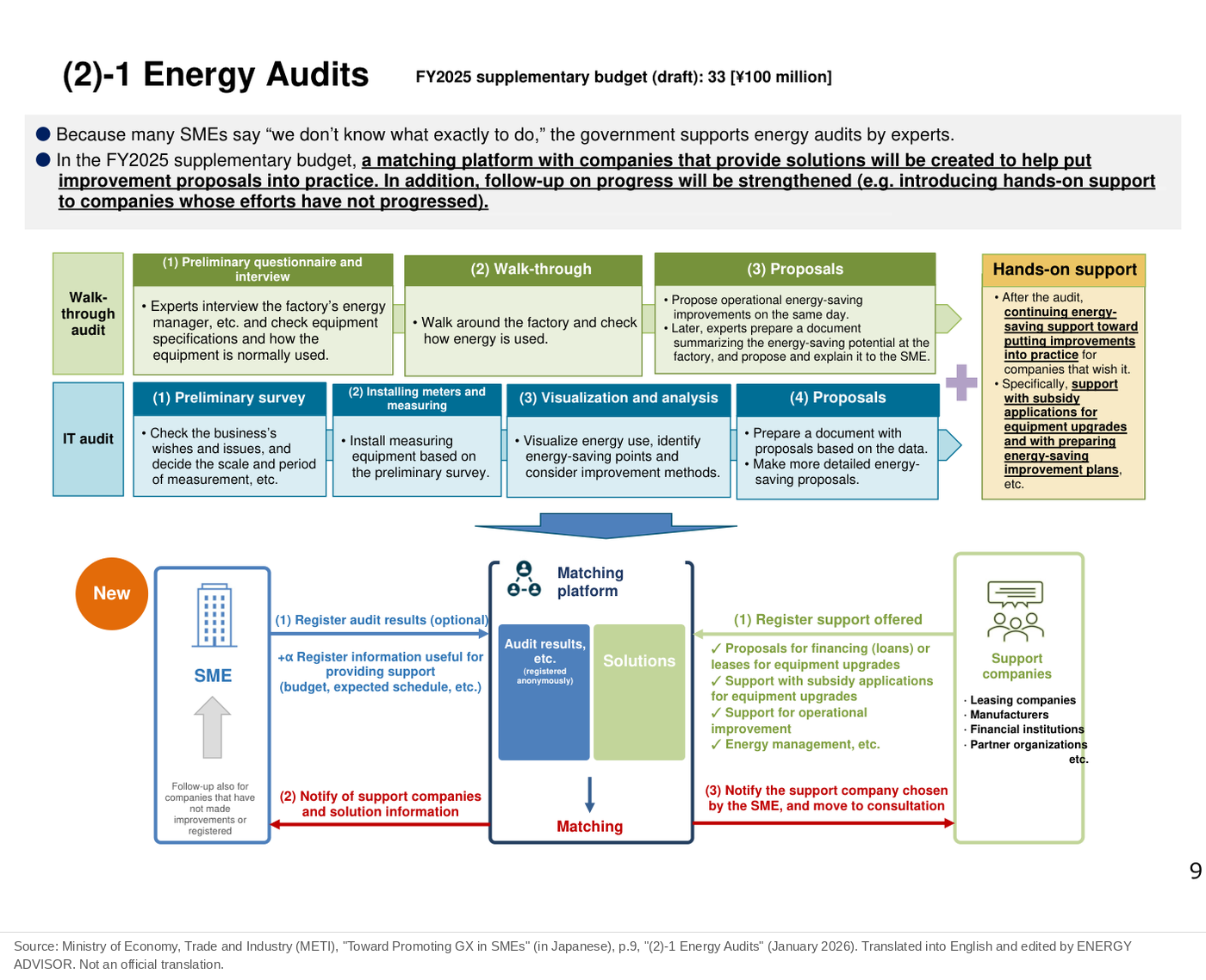
The other is “Shoene Otasuke-tai” (local organizations that provide low-cost energy-saving support to SMEs), for which the Sustainable open Innovation Initiative (SII) serves as secretariat under the supervision of the Agency for Natural Resources and Energy (ANRE) of the Ministry of Economy, Trade and Industry. It has stages consisting of a walk-through audit, an IT audit and hands-on support, and its stated feature is that the same expert can handle everything end to end, from the audit to the installation of equipment and the introduction of support measures from financial institutions and local governments.
Source: SII, “Energy Audit” portal (in Japanese)
An audit report states the energy-saving effects for the whole site (energy savings in crude oil equivalent, energy cost savings and CO2 emission reductions), as well as the energy-saving effect, savings in yen and equipment outline for each measure. ECCJ says that about 40% of the improvement proposals in its reports are operational improvements that cost nothing, and that immediate cost savings directly linked to management improvement can be expected.
Source: ECCJ, “What Is the Energy-Saving Optimization Audit?” (in Japanese)
How to Read an Audit Report: Separate Operational Improvements from Capital Investment and Set Priorities
Looking at the case collection, the reports are always divided into two sections, “operational improvements that can be carried out without cost” and “investment improvements toward further efficiency,” and the latter states the investment amount and payback period (the number of years needed to recover the investment from the savings) for each measure. The basic way to read a report is first to use this division to sort “measures you can start right away” from “measures that need an investment decision,” and then, among the investment improvements, to consider those with shorter payback periods first.
In the case at the electronic components manufacturer in Hokkaido, among the investment improvements, installing circulators (investment ¥192,000, payback 1.2 years) can be recovered relatively quickly, whereas installing solar PV (investment ¥10.78 million, payback 12.5 years) and converting outdoor mercury lamps to LED (investment ¥190,000, payback 14.6 years) were assessed as taking more than ten years to recover. In the case at the building in Tohoku, too, installing inverters on air handler fans (investment ¥880,000, payback 0.6 years) and insulating hot water piping (investment ¥406,000, payback 0.8 years) can be recovered in less than a year, whereas the LED lighting replacement (investment ¥50.926 million, payback 6.5 years) takes longer to recover because of the larger investment.
In the case at the furniture manufacturer in Kyushu, a proposal to replace an aging inlet-throttle compressor with an inverter type has a payback period as long as 36 years because of the short operating hours, but it is positioned as an energy-saving effect that can be obtained if carried out at the time of replacement due to aging. This is an example showing that, rather than mechanically cutting measures off by payback period alone, you also need to check whether the equipment is already due for replacement.
Note here that these savings and payback periods are only the audit results for individual sites. The savings from operational improvements were about ¥1.41 million a year at the electronic components manufacturer in Hokkaido (40 employees) and about ¥17.9 million a year at the building in Tohoku (about 1,300 occupants); the level varies greatly with the size of the facility and the condition of the equipment. The figures in the case collection should be taken not as a general benchmark applicable to your company, but as a reference for checking what to look for when reading a report.
Besides the payback period, whether the measure coincides with the timing of replacement due to aging is also a factor in the decision.
Carrying Out Audit Results by Placing Them in the Three Stages: Operations → Contracts → Equipment
The division of an audit report into “operational improvements” and “investment improvements” corresponds directly to the first stage (operational improvements) and the third stage (capital investment in equipment) of the three reduction stages covered in Part 7. Operational improvement proposals, such as relaxing air conditioning set temperatures, lowering compressor discharge pressure and reviewing lighting switch-off times, are carried out one by one as the first stage with no additional cost, and investment improvement proposals involving equipment upgrades are considered in turn as the third stage after comparing savings and payback periods.
On the other hand, audit reports mainly contain proposals on how equipment is used and upgraded, and the second stage (review of electricity contracts), that is, reviewing the contract with the power company and the tariff plan, is usually an issue that needs to be checked separately from the audit. As set out in Part 7, the basic approach is to consider the three reduction stages in the order operational improvements → review of electricity contracts → capital investment in equipment, and audit results are positioned as making the content of the first and third of these stages concrete.
The units used in audit reports for energy use (kL, crude oil equivalent) and CO2 emissions (t-CO2) are also based on the same thinking as the calculation formulas for electricity (Scope 2) and fuels (Scope 1) covered in Part 4 and Part 6. After carrying out the measures shown in an audit, you can apply them to the cycle “estimate → implement → reflect in the calculation” covered in Part 7, and confirm the reduction effect in figures by recalculating with your post-implementation energy use.
Summary
Air conditioning, lighting and compressors are among the equipment types with the most improvement proposals in public energy audits, and standard measures such as relaxing set temperatures, dealing with compressed air leaks and converting to LED can be checked in published audit case collections. SMEs can use public audits, such as ECCJ’s “energy-saving optimization audit” and “Shoene Otasuke-tai,” whose secretariat is SII, for low audit fees. Audit reports are divided into “operational improvements that need no investment” and “equipment upgrades that involve investment,” and the basic way to read the latter is to compare savings and payback periods to set priorities. However, the savings levels in the case collections are individual audit results and cannot be applied directly to your company. It is important to position audit results as the concrete content of the first and third of the three stages set out in Part 7 (operational improvements → review of electricity contracts → capital investment in equipment), and, after implementation, to link them to a cycle in which the reduction effect is calculated again.
Related Articles
- Part 7: The Order of Reduction Measures: Operational Improvements, Contract Review and Capital Investment (in Japanese)
- Part 6: Calculating Scope 1, and How Far You Can Go for Free (in Japanese)
The information in this article is current as of the time of posting and may have changed by the time you read it.
This article is based on published materials from the Ministry of Economy, Trade and Industry and its Agency for Natural Resources and Energy, the Electricity and Gas Market Surveillance Commission, the Organization for Cross-regional Coordination of Transmission Operators (OCCTO) and other sources. The English translations of figures are by ENERGY ADVISOR and are not official translations. When using this information for decisions, please check the original sources. When we find an error, we correct the article and note the date of the correction.
Sources
- ECCJ, “Energy-Saving Case Collection Leading to Management Improvement, FY2024” (in Japanese). https://www.shindan-net.jp/pdf/shindan_jirei2024.pdf
- ECCJ, “Energy-Saving Optimization Audit: Service Details” (audit flow: briefing about two weeks after the report is submitted; viewed October 22, 2026) (in Japanese). https://www.shindan-net.jp/service/shindan
- Ministry of Economy, Trade and Industry (METI), “Toward Promoting GX in SMEs” (January 2026) (in Japanese). https://www.meti.go.jp/policy/energy_environment/global_warming/SME/pamphlet/gx_gaiyou.pdf
- ECCJ, “What Is the Energy-Saving Optimization Audit?” (in Japanese). https://www.shindan-net.jp/service/shindan/about.html
- SII, “Energy Audit” portal (in Japanese). https://shoeneshindan.jp/
- Energy-Saving and Power-Saving Portal Site, “Energy Audit Flowchart” (FY2026 Energy Use Optimization Audit, etc. Project column) (in Japanese). https://shoeneshindan.jp/assets/docs/r7h_shoeneshindanfurochato.pdf
- Ministry of the Environment, “Regulation of Fluorescent Lamps for General Lighting” (in Japanese). https://www.env.go.jp/chemi/tmms/lamp.html