From Part 1 to Part 12, this series, “SMEs and Decarbonization,” explained in order everything from how customers come to ask for emission reports, to how to count your own emissions, how to proceed with reductions, and which subsidies you can use. This article organizes the questions that tend to come up across the whole series into a Q&A of 20 questions, and explains them in an accessible way with pointers to the relevant parts, so that you can pick out and read the questions that interest you.
Key points
- 1It consists of 20 Q&As in five categories: “Basics,” “Calculation,” “Reduction,” “Money” and “Responding to customers.”
- 2Each answer is limited to the key points, and the details can be checked at the links (the relevant parts) in the text.
- 3It avoids assertions and guarantees, and separates what can happen as a matter of fact from responses that are generally recommended.
- 4Answers involving figures cite primary sources.
Basics
Q1. A customer sent us a survey asking, “Please tell us your CO2 emissions.” Are we suspected of some violation?
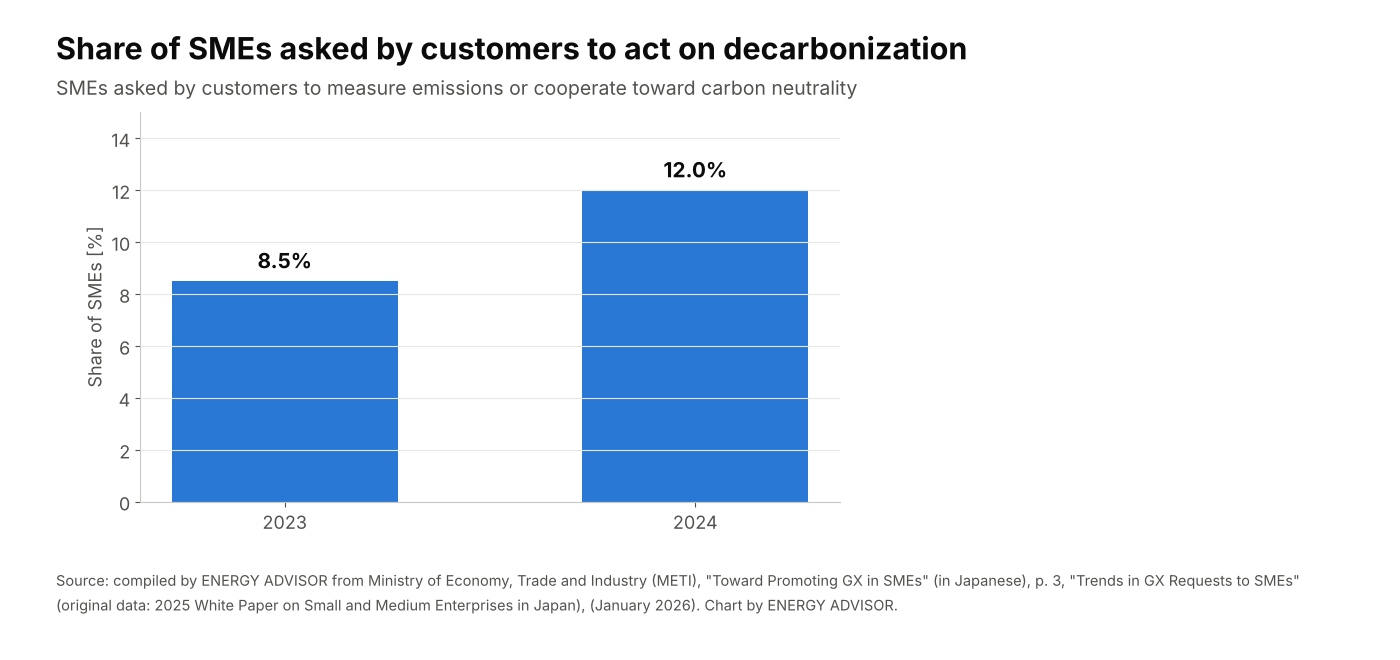
No, you are not suspected of breaking the law. In most cases, a large company that is your customer is asking all its suppliers alike, as part of an effort to understand and disclose “emissions across the whole supply chain,” including not only its own but also those of its suppliers. According to materials from the Ministry of Economy, Trade and Industry (METI), the share of small and medium-sized enterprises (SMEs) receiving such requests rose from 8.5% in 2023 to 12.0% in 2024, which suggests that particular companies are not being singled out.
Source: METI, “Toward Promoting GX in SMEs” (January 2026), p.3 (in Japanese)
For details, see Part 1.
Q2. Is calculating CO2 emissions required by law?
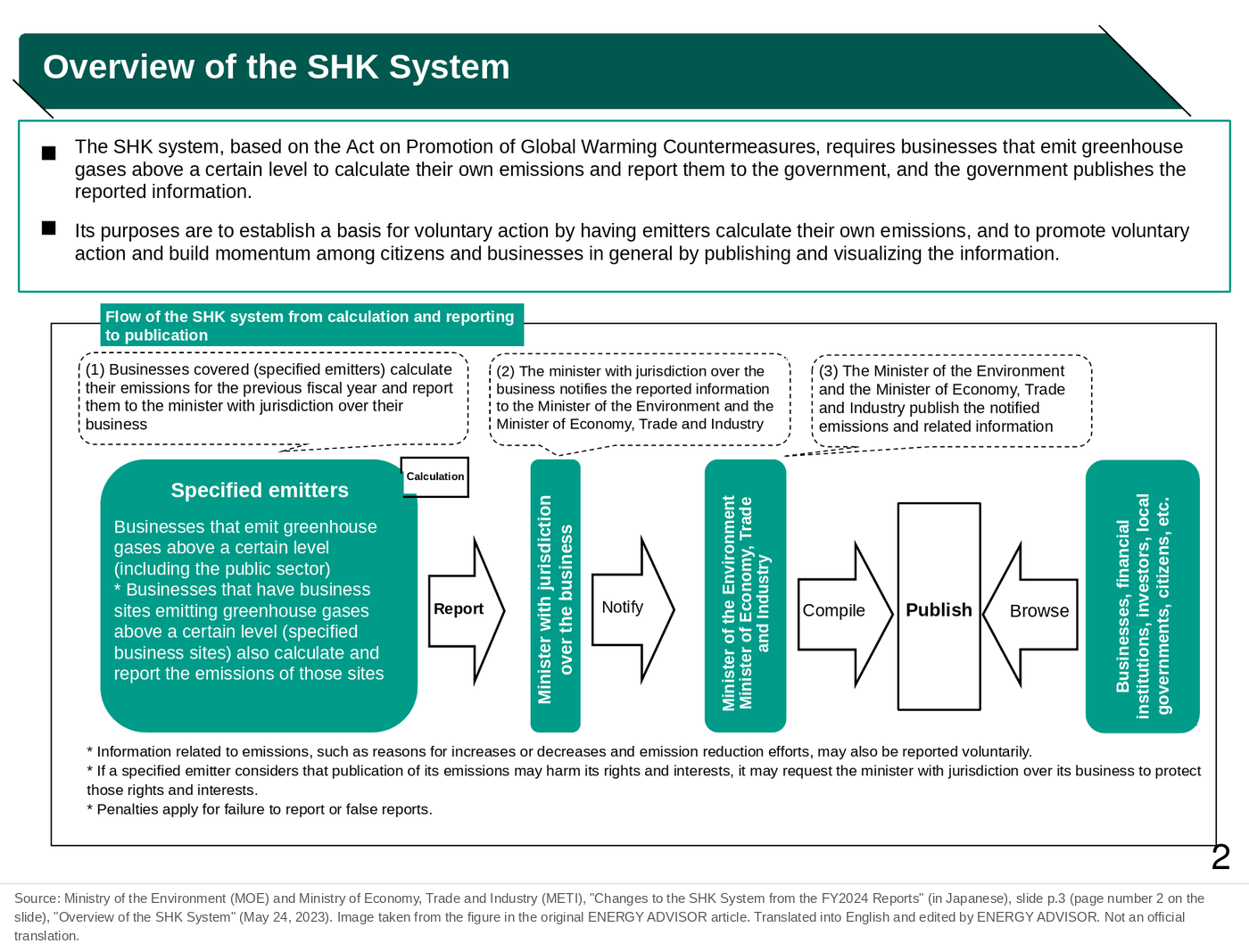
For most SMEs, it is not a direct legal obligation. The reporting obligations under the Mandatory Greenhouse Gas Accounting and Reporting System (the SHK system), based on the Act on Promotion of Global Warming Countermeasures, and under the Energy Conservation Act cover businesses above a certain size, such as those using 1,500 kL/year or more of energy (crude oil equivalent), and most SMEs do not reach this threshold. Many of the calculation and reporting requests that reach SMEs arise through voluntary frameworks such as SBT and CDP, or as customers’ own requests. In other words, it is less a matter of “we must respond because it is the law” and more a matter of “deciding whether to respond within our relationship with the customer.”
For details, see Part 3.
Q3. In the end, how much does decarbonization cost?
It varies greatly by type of measure. Operational improvements, such as reviewing air conditioning set temperatures and demand management, can be started for almost ¥0, and reviewing contracts and tariff plans usually involves no additional capital investment. On the other hand, capital investment such as solar PV or upgrading to high-efficiency equipment requires a substantial upfront cost, but the burden can sometimes be reduced by combining it with subsidies and tax incentives. In other words, the reality is that “how much it costs” depends on how far you take your response.
For details, see Part 7.
Q4. We are a small company with a few dozen employees. Does decarbonization really concern us?
Regardless of size, if your customers include large or listed companies, it may concern you. This is because when a customer tries to understand emissions across its whole supply chain, small suppliers are not necessarily excluded. The share of SMEs actually receiving requests rose from 8.5% in 2023 to 12.0% in 2024 (Q1), and even if no request has come yet, you can prepare with the possibility of one arriving in the future in mind.
For details, see Part 1.
Calculation
Q5. How do we calculate CO2 emissions? Can we do it without specialist knowledge?
Emissions from electricity use (Scope 2) can be calculated by a single multiplication, “electricity consumption (kWh) × emission factor (t-CO2/kWh)”: electricity consumption can be found on your monthly bill, and the emission factor in the list published by MOE and METI. Emissions from fuel use (Scope 1) can also be calculated simply by multiplying fuel use by a precalculated emission factor. It is work you can start with spreadsheet software and 12 months of past bills, without installing any special system.
For details, see Part 4 and Part 6.
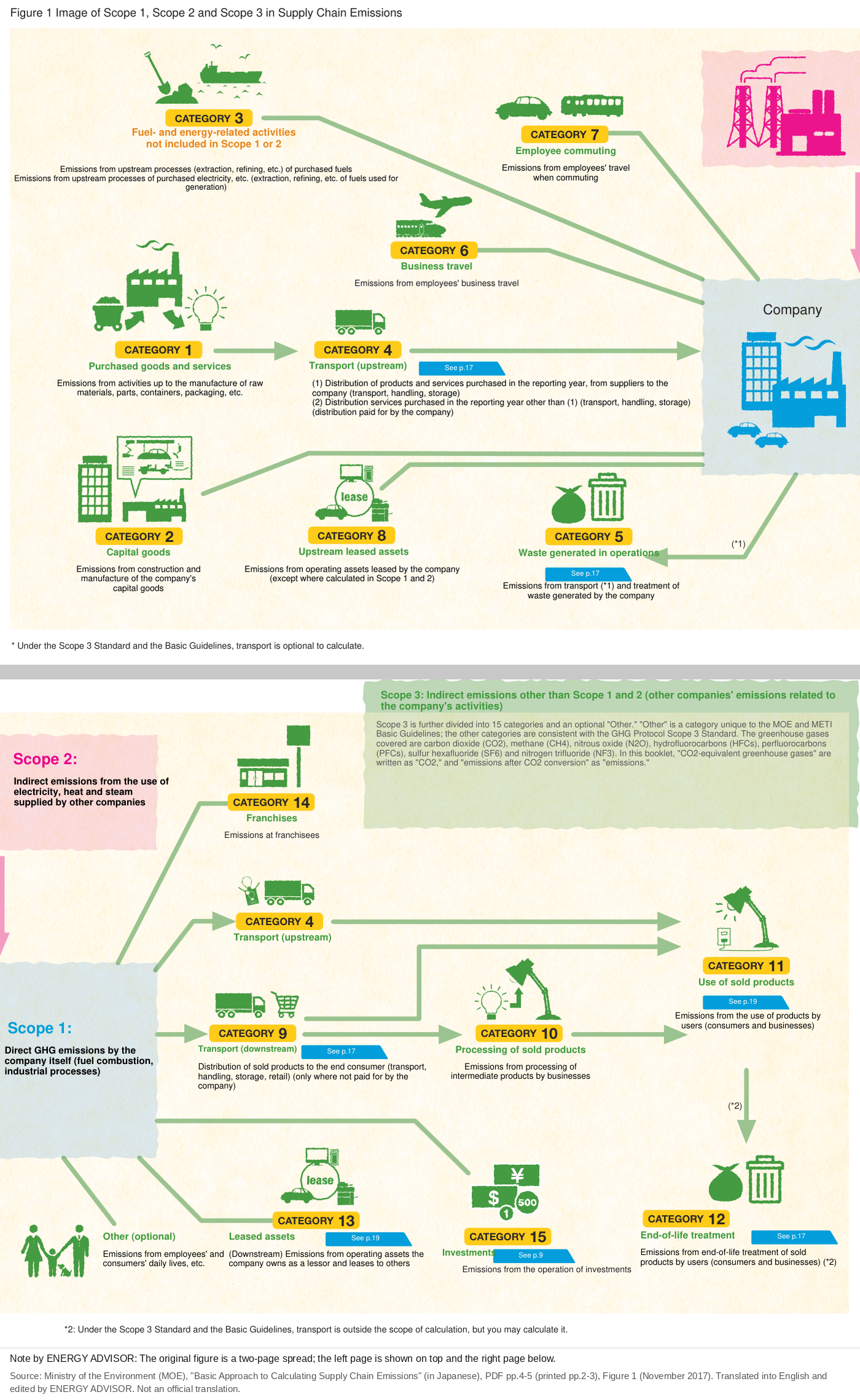
Q6. I don’t really understand the difference between Scope 1, Scope 2 and Scope 3.
Scope 1 refers to direct emissions, such as from burning fuel at your company; Scope 2 to indirect emissions from using purchased electricity and heat; and Scope 3 to emissions of other companies related to your business activities (such as suppliers and transport companies). The work needed also differs completely depending on whether a customer’s request asks for “emissions of the company as a whole” or “emissions per product (carbon footprint of products, CFP),” so the first step is to identify what the request is asking for.
For details, see Part 2.
Q7. What is an emission factor? Where can we look it up?
An emission factor is a value showing how much CO2 emission accompanies one unit of electricity or fuel use. For electricity, MOE and METI publish “supplier-specific emission factors” every fiscal year for each electricity supplier you may contract with, and even the same supplier may have different factors for different tariff plans. Because the factors are updated every fiscal year, each time you calculate you need to check the latest published value for the supplier and plan you contract with.
For details, see Part 5.
Q8. We are not confident about calculating it ourselves. Are there places where we can get advice for free or at low cost?
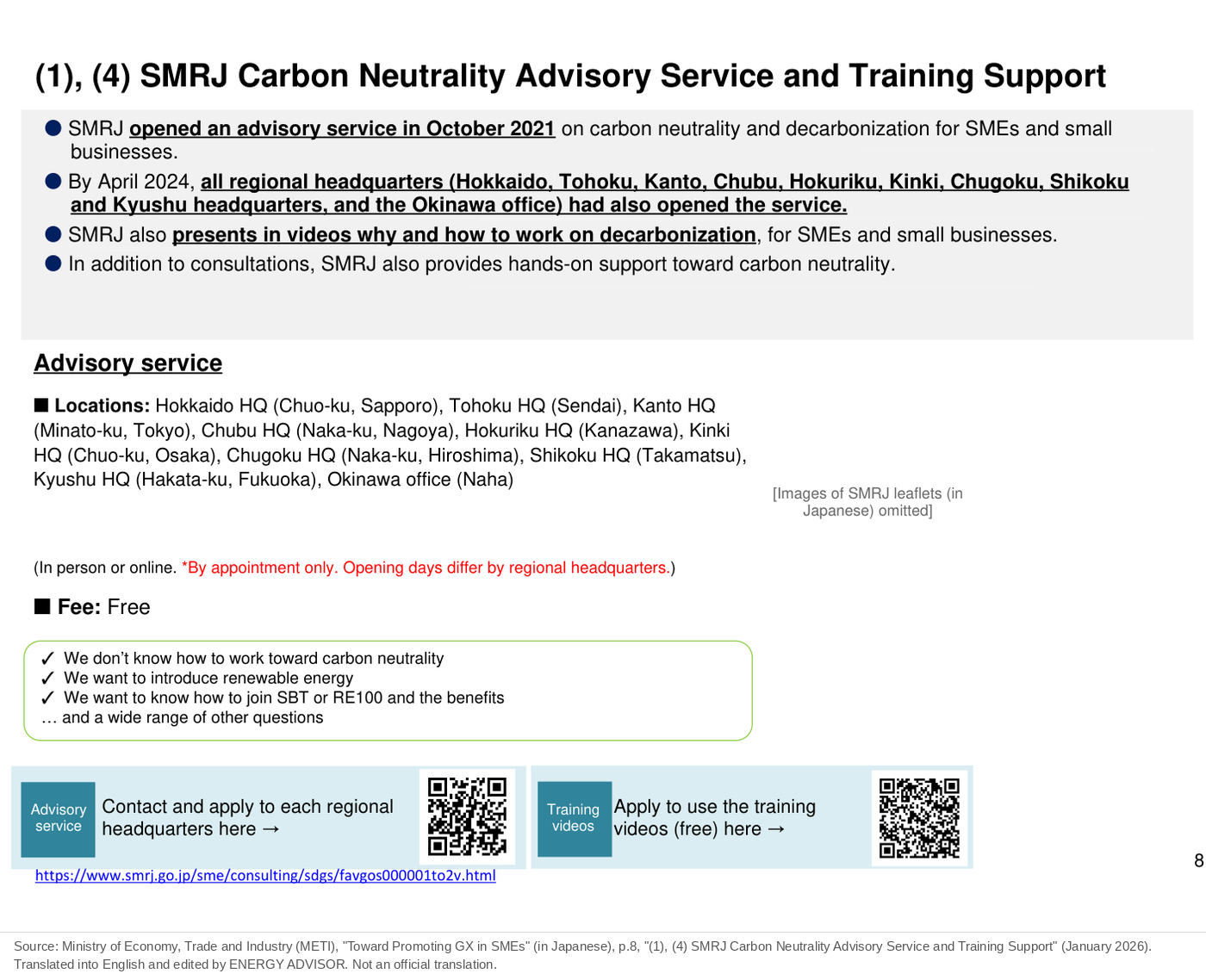
Yes. The Organization for Small & Medium Enterprises and Regional Innovation, JAPAN (SMRJ), an incorporated administrative agency, has set up free consultation desks on carbon neutrality at its regional headquarters across the country. In addition, there are low-cost options such as Shoene Otasuke-tai (local organizations that provide low-cost energy-saving support to SMEs) and the energy-saving optimization audit of The Energy Conservation Center, Japan (ECCJ), and some local governments offer energy audits completely free of charge. A reasonable order is to start by consulting a free desk about the overall picture and then move on to a paid audit if needed.
For details, see Part 6.
Reduction
Q9. Where should we start to reduce CO2 emissions?
The basic idea is to consider measures in order, starting with those that cost nothing. Specifically, they can be sorted into three stages: “operational improvements (reviewing air conditioning settings, demand management, etc., almost ¥0) → review of electricity contracts (reviewing electricity contracts and tariff plans) → capital investment in equipment (high-efficiency equipment, solar PV, etc.).” There is no need to judge a large capital investment straight away; you can start with familiar operational improvements.
For details, see Part 7.
Q10. Is it enough just to switch to renewable electricity?
Switching to a renewable tariff plan is one effective way to lower Scope 2 emissions, but it will not necessarily meet all of a customer’s requests by itself. The level of response needed differs depending on whether the request is at the stage of understanding and reporting emissions, or whether you are being asked to reach a specific renewable energy share or reduction target. Renewable tariff plans may also cost extra, so the decision is made after checking the balance with cost.
For details, see Part 8 and Part 9.
Q11. Will installing solar PV pay for itself?
It cannot be said in general terms. A guide to the payback period can be calculated from your own actual figures by finding “annual generation × self-consumption ratio × electricity unit price = annual savings” and dividing the initial investment by these annual savings. The number of years changes greatly with the self-consumption ratio, the electricity unit price and the quoted price of the equipment, and note that this is an estimate based on past results or general benchmarks and does not guarantee future generation or electricity price levels.
For details, see Part 10.
Q12. Can we not reduce emissions without replacing equipment with energy-saving models?
Not necessarily. There are audit cases in which a certain effect was confirmed from operational improvements alone that can be done with existing equipment, such as cleaning air conditioning filters, relaxing set temperatures, switching off lights at unneeded times and demand management. Capital investment is, so to speak, an option for a later stage, to be considered when operational improvements and contract review still fall short of the reduction target.
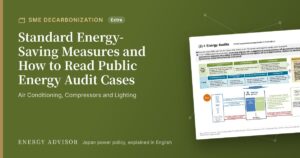
For details, see Part 7 and the extra article “Standard Energy-Saving Measures and How to Read Public Energy Audit Cases” (in Japanese).
Money
Q13. Can anyone get a subsidy?
Applying does not guarantee selection. Each subsidy has eligibility conditions and a budget limit, and whether an application is selected is decided after screening. The detailed eligibility conditions differ by program and may change in the application guidelines of a given fiscal year even for the same program. Whether you meet the requirements needs to be checked in that fiscal year’s application guidelines for the program you actually apply to.
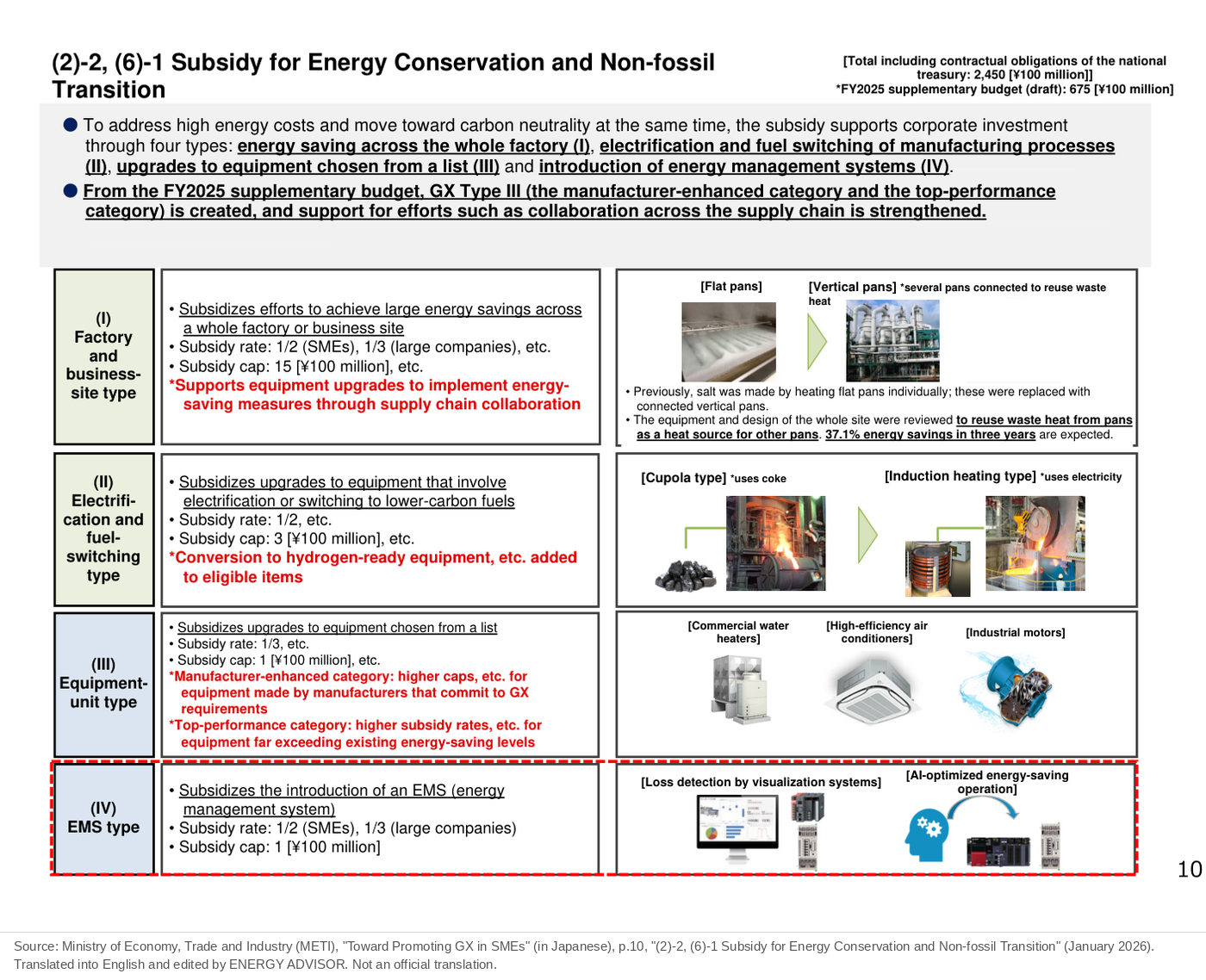
For details, see Part 11 and the extra article “Storage Parity Project” (in Japanese).
Q14. Can we apply for a subsidy ourselves? Do we need to ask a professional?
The business can prepare the application documents itself. However, preparing documents to be submitted to government agencies upon request of another person and for remuneration is considered the exclusive practice of a Certified Administrative Procedures Legal Specialist (gyoseishoshi), a licensed professional who prepares documents submitted to government agencies, and an unqualified person is not allowed to do this on someone’s behalf. On the other hand, “consultation,” such as researching a program’s requirements or receiving general advice, can be done without the qualification.
Source: e-Gov Laws and Regulations Search, “Gyoseishoshi Act” (Act No. 4 of 1951) (in Japanese)
For details, see the extra article “Subsidy Applications and the Gyoseishoshi Act” (in Japanese).
Q15. Are there subsidies we can use when installing solar PV and batteries?
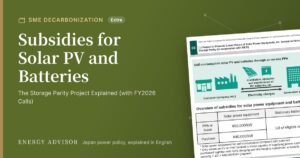
A representative one is MOE’s “Project to Promote Lower Prices of Solar Power Equipment, etc. toward Achieving Storage Parity.” It is a program that grants, with standard amounts of a flat ¥40,000 per kW for solar PV (¥50,000 for a PPA or lease under third-party ownership) and a flat ¥39,000 per kWh for commercial and industrial batteries, up to a total of ¥60 million per business. (This is the content of the calls under the FY2026 initial budget; FY2026 is April 2026–March 2027. In FY2026 two calls, the first and the second, were held, and the standard amounts and cap were the same in the second.) Application periods and requirements change by fiscal year, so always check the latest application guidelines before applying.
Sources: MOE and EIC, “Project to Promote Lower Prices of Solar Power Equipment, etc. toward Achieving Storage Parity, FY2026 Initial Budget: Application Guidelines” (in Japanese); same (revised August 27, 2026) (in Japanese)
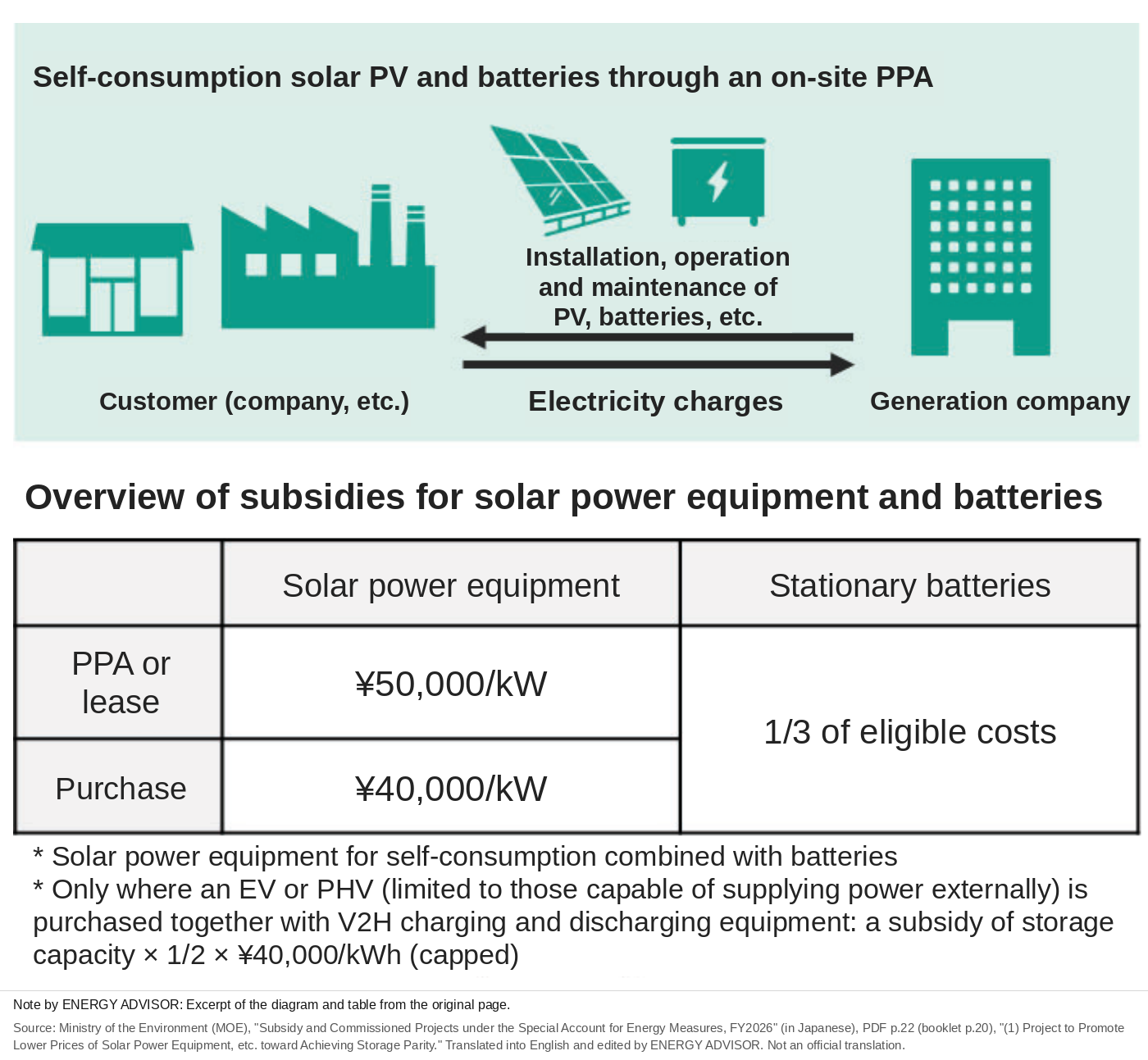
For details, see the extra article “Storage Parity Project” (in Japanese).
Q16. Besides subsidies, are there tax incentives we can use?
Yes. There is the “SME Management Reinforcement Tax Incentive,” under which, in principle after having a Business Enhancement Plan certified before acquiring the eligible equipment, you can choose immediate depreciation or a tax credit of 10% of the acquisition cost (7% for corporations with capital over ¥30 million); it is a measure in place until March 31, 2027. As for the solar PV in Q15, equipment intended to sell all of its output is not eligible, and even when combined with self-consumption it may be ineligible depending on the share of electricity expected to be sold, so eligibility needs to be checked case by case. Subsidies involve screening and applications may be rejected, whereas the tax incentive applies if the requirements are met, so it is worth considering as well. Note that the subsidy itself is subject to corporate tax or income tax, and when it is used to acquire fixed assets, taxation may be deferred to the future through reduction entry (tax deferral for subsidized assets).
Sources: Small and Medium Enterprise Agency, “SME Management Reinforcement Tax Incentive” (in Japanese); Small and Medium Enterprise Agency, “Q&A on the SME Management Reinforcement Tax Incentive” (in Japanese); National Tax Agency, Tax Answer No. 2202, “When You Receive National Subsidies” (in Japanese)
For details, see Part 10 and Part 11.
Responding to Customers
Q17. What happens if we ignore a customer’s questionnaire?
Answering a questionnaire is, in most cases, not a legal obligation but an individual exchange with the customer. Therefore, it cannot be stated definitively what will happen across the board if you do not answer. However, since the customer needs this data to understand emissions across its whole supply chain, leaving it unanswered may have some effect on future dealings. Answering at least what you know, and saying that your calculation is still in progress, is a more realistic response than leaving it unanswered.
For details, see Part 12.
Q18. A customer sent us a questionnaire like CDP’s. What should we write?
CDP is an international organization that asks companies to disclose information on climate change and other issues, or its questionnaire, and there is a mechanism through which requesting member companies ask their suppliers to disclose via the Supply Chain program. Such questionnaires can often be broadly sorted into items such as emissions results, reduction targets, renewable energy share and governance structure, and briefly showing the figures already calculated, the calculation method and future plans gives your answer a proper form.
Source: CDP, “CDP Supply Chain Membership” (in Japanese)
For details, see the extra article “CDP Questionnaire Basics” (in Japanese).
Q19. We were asked about reduction targets, but we have not decided anything yet. How should we answer?
If no target has been set, it is enough to say so and that it is currently under consideration. Rather than forcing a polished appearance, answering by separating what has been decided from what has not is the more realistic response.
For details, see Part 12.
Q20. To make our figures look better, may we report emissions lower than they really are?
We cannot recommend it. The electricity consumption and emission factors used in the calculation are based on information that can be checked later, such as bills and documents published by public bodies. If you report figures that differ from reality, the inconsistency may come to light at the stage of later checks or more detailed calculations. You can report your current figures as they are, and, if your calculation boundary or structure is still developing, say so as well.
For details, see Part 4 and Part 12.
Summary
This extra article organized the questions often raised about this series into a Q&A of 20 questions in five categories: “Basics,” “Calculation,” “Reduction,” “Money” and “Responding to customers.” The common thread across the categories is as follows: most customer requests are not legal obligations but individual exchanges with customers; CO2 calculation can be started in-house with bills and published materials; reductions can proceed step by step from measures that cost nothing; subsidies and tax incentives come with conditions and procedures; and the basic form of an answer to a customer is to show the figures already calculated and future plans. If you want to know more about a particular question, see the parts linked in the text.
Related Articles
- Part 1: What Is Supply Chain Decarbonization? How Customers Come to Ask for CO2 Emission Reports (in Japanese)
- Part 7: The Order of Reduction Measures: Operational Improvements, Contract Review and Capital Investment (in Japanese)
- Part 11: A Map of Energy and Decarbonization Subsidies for SMEs (FY2026 Edition) (in Japanese)
- Part 12: The Annual Cycle of Decarbonization Work: Calculation, Reporting, Customer Questionnaires and Subsidy Calls (in Japanese)
The information in this article is current as of the time of posting and may have changed by the time you read it.
This article is based on published materials from the Ministry of Economy, Trade and Industry and its Agency for Natural Resources and Energy, the Electricity and Gas Market Surveillance Commission, the Organization for Cross-regional Coordination of Transmission Operators (OCCTO) and other sources. The English translations of figures are by ENERGY ADVISOR and are not official translations. When using this information for decisions, please check the original sources. When we find an error, we correct the article and note the date of the correction.
Sources
- METI, “Toward Promoting GX in SMEs” (January 2026) (in Japanese). https://www.meti.go.jp/policy/energy_environment/global_warming/SME/pamphlet/gx_gaiyou.pdf
- MOE, Green Value Chain Platform, “What Are Scope 3 Emissions?” (in Japanese). https://www.env.go.jp/earth/ondanka/supply_chain/gvc/estimate_03.html
- MOE and METI, “GHG Emissions Calculation and Reporting Manual, Ver. 6.1” (in Japanese). https://policies.env.go.jp/earth/ghg-santeikohyo/files/manual/chpt2_6-1.pdf
- MOE and METI, “Calculation Methods and List of Emission Factors” (in Japanese). https://policies.env.go.jp/earth/ghg-santeikohyo/calc.html
- SMRJ, “Support for Carbon Neutrality” (in Japanese). https://www.smrj.go.jp/sme/sdgs/favgos000001to2v.html
- CDP, “CDP Supply Chain Membership” (in Japanese). https://www.cdp.net/ja/supply-chain
- MOE and EIC, “Project to Promote Lower Prices of Solar Power Equipment, etc. toward Achieving Storage Parity, FY2026 Initial Budget: Application Guidelines” (in Japanese). https://www.eic.or.jp/eic/topics/2026/st_r08/1st/files/SP_R8_ky.pdf
- Small and Medium Enterprise Agency, “SME Management Reinforcement Tax Incentive” (in Japanese). https://www.chusho.meti.go.jp/keiei/kyoka/kyoka_zeisei.html
- Small and Medium Enterprise Agency, “Q&A on the SME Management Reinforcement Tax Incentive” (in Japanese). https://www.chusho.meti.go.jp/keiei/kyoka/pdf/kyokaqanda.pdf
- National Tax Agency, Tax Answer No. 2202, “When You Receive National Subsidies” (in Japanese). https://www.nta.go.jp/taxes/shiraberu/taxanswer/shotoku/2202.htm
- e-Gov Laws and Regulations Search, “Gyoseishoshi Act” (Act No. 4 of 1951) (in Japanese). https://laws.e-gov.go.jp/law/326AC1000000004
- MOE and EIC, “Storage Parity Project, FY2026 Initial Budget: Application Guidelines” (revised August 27, 2026) (in Japanese). https://www.eic.or.jp/eic/topics/2026/st_r08/1st/files/SP_R8_ky_v2.pdf
- MOE, “Basic Guide to Calculating Supply Chain Emissions” (November 2017) (in Japanese). https://www.env.go.jp/earth/ondanka/supply_chain/gvc/files/tools/supply_chain_201711_all.pdf
- MOE and METI, “Changes to the Mandatory Greenhouse Gas Accounting and Reporting System (SHK System) under the Act on Promotion of Global Warming Countermeasures from the FY2024 Reports” (May 24, 2023) (in Japanese). https://www.kansai.meti.go.jp/3-9enetai/energypolicy/details/save_ene/R5setumeikai_shk.pdf
- MOE, “Subsidy and Commissioned Projects under the Special Account for Energy Measures, FY2026” (in Japanese). https://www.env.go.jp/content/000397154.pdf