As you read the series “SMEs and Decarbonization,” specialist terms such as Scope 1, 2 and 3, emission factors, non-fossil certificates and corporate PPAs appear one after another. Each part explained them one by one in the form “X is Y,” but when you go back and reread, finding “which part explained this word” takes time. As an extra article in this series, this piece explains the key terms that appeared in Parts 1 to 12, organized by theme rather than in alphabetical order.
Key points
- 1The terms are organized into four themes: “(1) Emissions and calculation,” “(2) Systems and initiatives,” “(3) Renewables and electricity” and “(4) Subsidies and support.”
- 2Instead of alphabetical order, it uses an arrangement by theme, in which related terms are grouped together and easier to understand.
- 3The definition of each term matches the explanation actually used in the text of Parts 1 to 12 of this series.
- 4The meanings can be understood by reading this glossary alone, but for how to actually carry out the work, such as the calculation procedure and the flow of a subsidy application, we recommend checking the text of each part.
From Part 1 to Part 12, this series looked in order at how customers come to ask for CO2 emission reports and reductions, how to count your own emissions, how to proceed with reductions, and the subsidies available to small and medium-sized enterprises (SMEs). This extra article looks back at the specialist terms that appeared in those parts, grouped by theme.
You do not need to read this glossary from beginning to end. It is meant to be used by opening the relevant theme on this page when you come across an unfamiliar word in the article you are reading.
(1) Emissions and Calculation
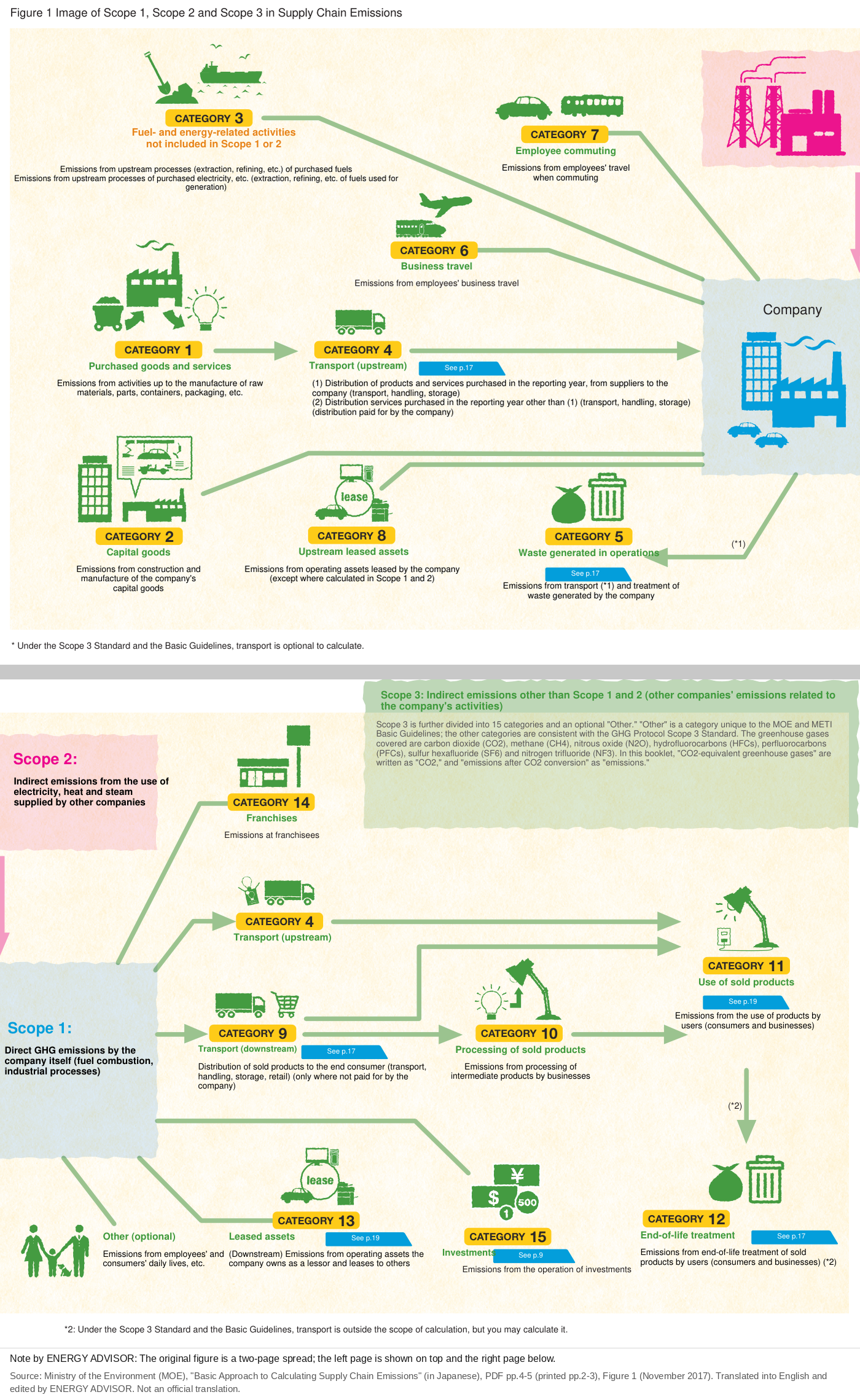
Scope 1 refers to direct greenhouse gas emissions by the business itself. These come from fuel combustion and industrial processes; typical examples are burning city gas or heavy oil in factory boilers and heating and cooling equipment, and using diesel or gasoline in company vehicles. The calculation formula is “fuel use × calorific value per unit × carbon emission factor × 44/12,” set out in the GHG Emissions Calculation and Reporting Manual of the Ministry of the Environment (MOE) and the Ministry of Economy, Trade and Industry (METI).
Scope 2 refers to indirect emissions from the use of electricity, heat and steam supplied by other companies. The calculation formula is a multiplication, “electricity consumption (kWh) × emission factor (t-CO2/kWh),” and electricity consumption can be found in the “electricity consumption” field of the monthly electricity bill.
Scope 3 refers to indirect emissions other than Scope 1 and Scope 2, that is, emissions of “other companies” related to your business activities. It covers emissions connected across the whole supply chain, such as raw material suppliers, logistics companies, customers using products and businesses handling disposal, and the GHG Protocol’s Scope 3 Standard classifies them into 15 categories.
GHG Protocol refers to the international standards for calculating and reporting greenhouse gas emissions developed by the World Resources Institute (WRI) and the World Business Council for Sustainable Development (WBCSD). It is the basis of the idea of viewing corporate emissions in three categories, Scope 1, 2 and 3, and the guidelines of Japan’s MOE and METI also follow these standards.
Scope 3 Category 1 refers to the category defined in the GHG Protocol’s Scope 3 Standard as “purchased goods and services.” It includes procurement of raw materials, outsourcing of packaging and procurement of consumables. When a large company tries to calculate its own Category 1 emissions, it needs emissions data from the SMEs that are its suppliers. Customers’ reporting requests to SMEs arise from this calculation structure.
Carbon footprint of products (CFP) refers to the GHG emissions over the whole life cycle of a product or service, from raw material procurement to disposal and recycling, converted into CO2 emissions, either as a value displayed on the product or as the system for displaying it. Unlike Scope 1, 2 and 3, which add up a company’s emissions over one year, CFP is calculated per product, and both the calculation approach and the scope covered are completely different.
ISO 14067 / JIS Q 14067 refers to the international standard setting out how to calculate CFP (ISO 14067) and the corresponding Japanese Industrial Standard (JIS Q 14067). The guidelines of METI and MOE position ISO 14067 as the main reference standard for CFP calculation.
Emission factor refers to a value showing how much CO2 emission accompanies each kWh of electricity supplied by an electricity supplier. MOE and METI publish these every fiscal year for each retail electricity supplier (and for each tariff plan, for suppliers that publish factors by plan) as part of the Mandatory Greenhouse Gas Accounting and Reporting System (the SHK system) under the Act on Promotion of Global Warming Countermeasures.
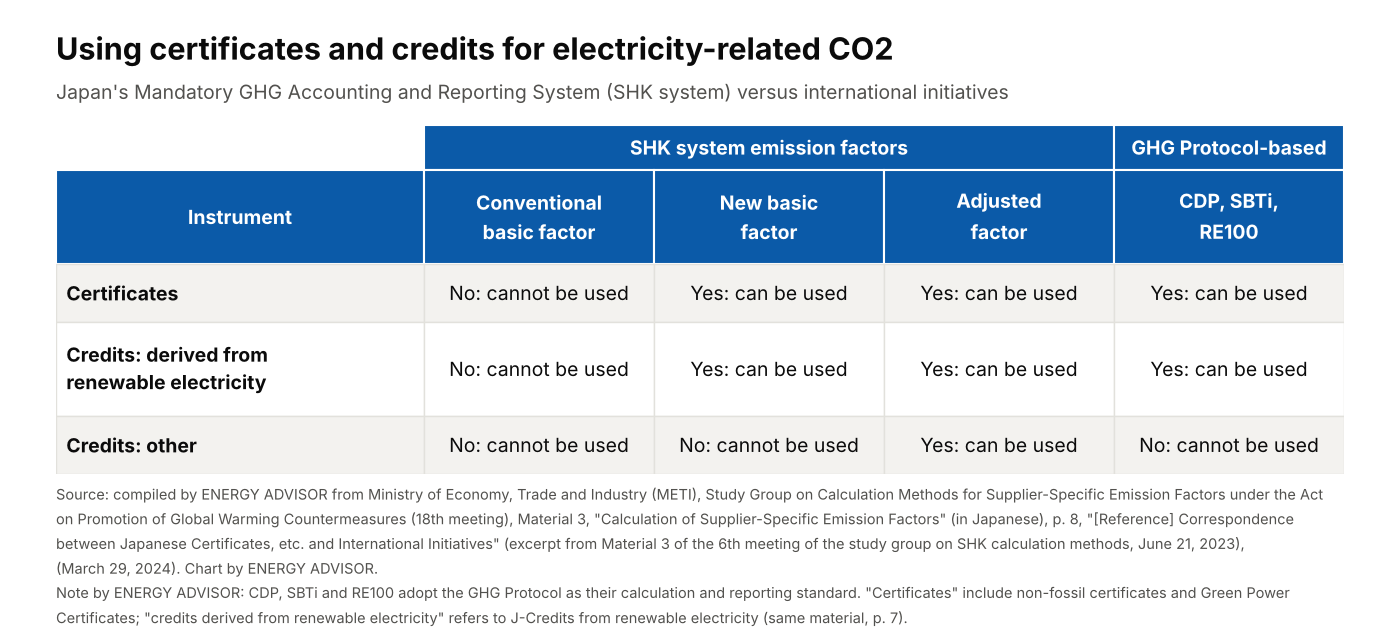
Basic emission factor (adjusted for non-fossil sources) refers to an emission factor that reflects transactions in non-fossil certificates (both FIT and non-FIT) regardless of the type of power source, and, for domestic credits and certifications such as the J-Credit Scheme and certification schemes equivalent to Green Power Certificates, only the transactions derived from renewable electricity. The name “adjusted for non-fossil sources” has been used since the figures published in March 2025. Transactions in domestic credits based on non-renewable sources, such as nuclear, are not reflected.
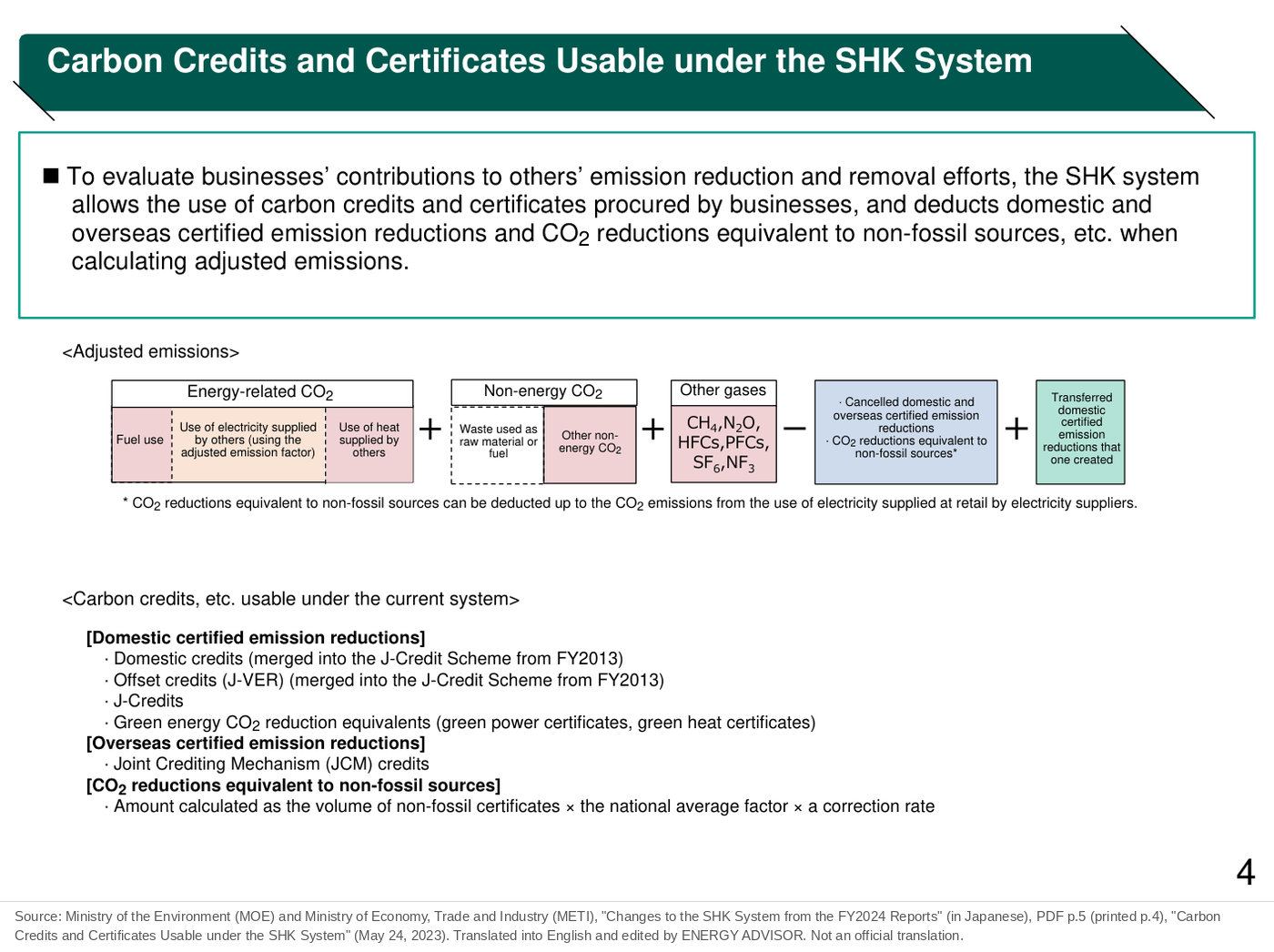
Adjusted emission factor refers to an emission factor that reflects transactions in all non-fossil certificates, etc., whether or not they derive from renewable sources, as well as certified emission reductions from overseas. The calculation and reporting manual sets out, as its basic method, that it is used when calculating “adjusted CO2 emissions” from electricity use under the SHK system.
Unadjusted emission factor refers to the value at the first stage of emission factor calculation, with no adjustment for certificates, etc. Adding adjustments such as those for the Feed-in Tariff (FIT) scheme to this value gives the basic emission factor, and further subtracting certified emission reductions from overseas gives the adjusted emission factor. The publicly available list shows only two columns, basic and adjusted, and does not include a column for the unadjusted emission factor.
Menu-specific emission factor refers to the different emission factors that an electricity supplier publishes for each tariff plan. Plans that preferentially combine non-fossil certificates, etc. have lower factors, while other plans have relatively higher ones, so you need to find the row in the list that matches the name of the plan you contract for.
Residual factor (similar to a residual mix) refers to the factor applied to electricity supplied to other customers as a result of an electricity supplier preferentially combining environmental attributes with particular tariff plans. It functions similarly to the “residual mix” in the international GHG Protocol, but the calculation rules, such as the treatment of FIT electricity, are not the same, and Japan’s ministerial notice does not use the term “residual mix” itself.
As a starting point for choosing among basic, adjusted and residual factors, the basic rule is to use the adjusted emission factor according to the purpose (reporting to customers or statutory reporting).
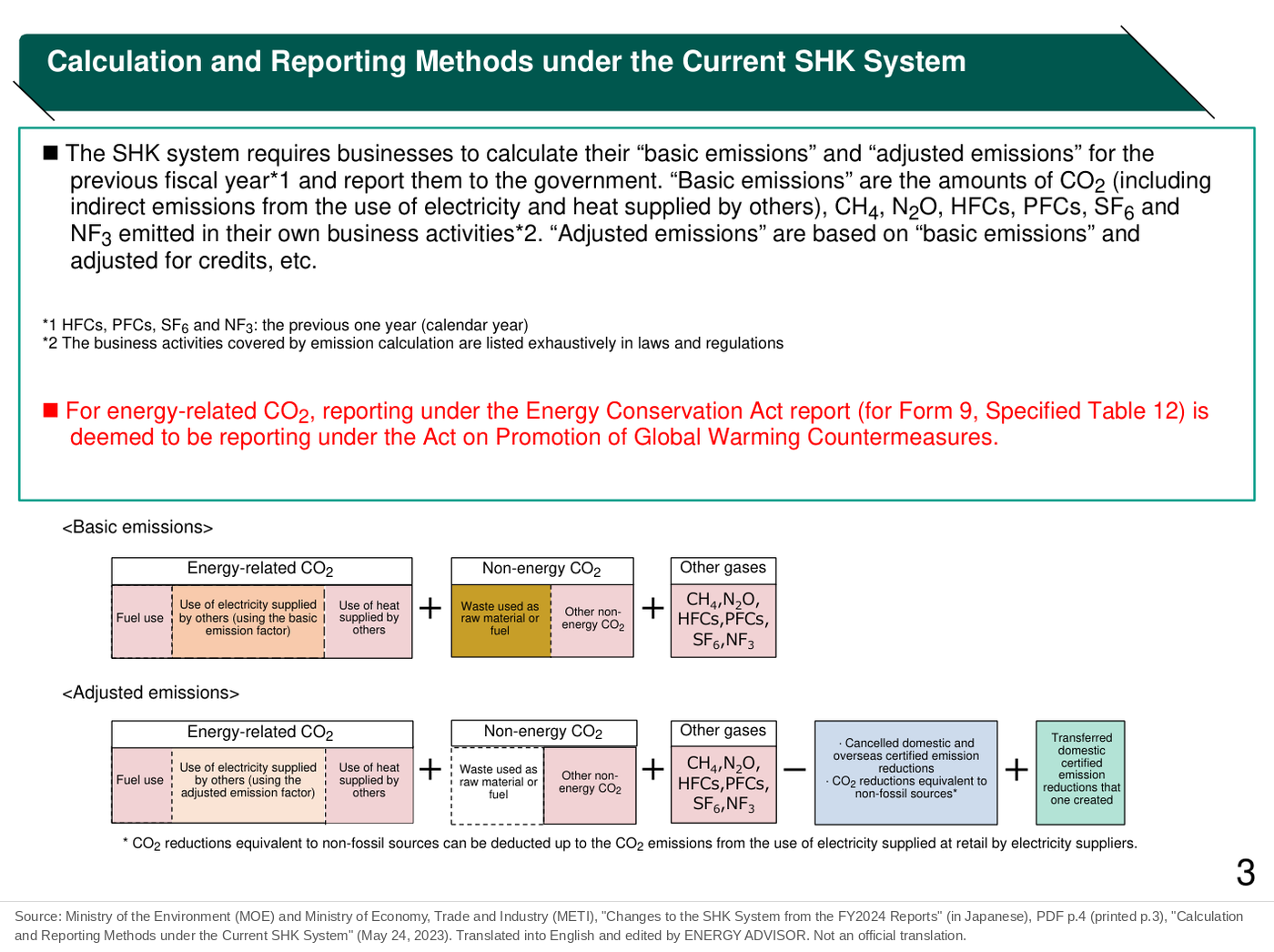
SHK system is the short name for the Mandatory Greenhouse Gas Accounting and Reporting System based on the Act on Promotion of Global Warming Countermeasures. It requires businesses above a certain size (for energy-related CO2 emitters, those using 1,500 kL/year or more in crude oil equivalent, etc.) to calculate their emissions every fiscal year and report them to the government; for specified business-site emitters, the reporting deadline is the end of July every year.
30-minute demand (demand value) refers to the highest value, within the metering period, of the average power use measured every 30 minutes. Under high-voltage supply contracts using the actual-demand method, the highest demand value over the past 12 months, including the current month, becomes the contract demand, so once demand spikes, the higher demand charge continues for the next 12 months.
Energy visualization refers to capturing electricity and energy use as data so that it can be analyzed by time of day and by equipment. It is positioned as one of the typical “operational improvements” that do not involve additional capital investment.
(2) Systems and Initiatives
Science Based Targets (SBT) refers to a mechanism in which a company sets reduction targets consistent with the level required by the Paris Agreement and is validated after review by a private validation body, the SBTi (Science Based Targets initiative). It is a voluntary framework, not a system based on law. According to MOE materials, the number of participating Japanese companies (including those with commitments) was a cumulative 1,563 as of March 31, 2025, of which 1,479 had obtained validation.
SBTi refers to the international initiative jointly run by CDP, the UN Global Compact, the World Resources Institute (WRI) and the World Wide Fund for Nature (WWF), which reviews and validates SBTs.
SBTi SME target-setting route (SBT for SMEs) refers to the SBT validation category in which companies that meet all four mandatory requirements, such as combined Scope 1 and 2 emissions of less than 10,000 tCO2e, and at least three of four additional requirements, such as fewer than 250 employees, can be validated through a simplified procedure. As with the standard route, the target year can be chosen within 5 to 10 years from submission (previously it was fixed at 2030).
CDP refers to an international non-profit organization that asks companies to disclose information on environmental issues such as climate change, water security and forests, or to the questionnaire the organization sends. At the request of institutional investors and others, it sends companies questionnaires in a standardized format, scores the responses and discloses them to those who made the request.
CDP Supply Chain program refers to the mechanism through which requesting member companies (large companies) that become CDP members can ask their suppliers to disclose. CDP’s page says that more than 200 requesting member companies use this mechanism and that in 2025 more than 45,000 suppliers received disclosure requests; most CDP-related requests that reach SMEs come through this mechanism.
GX Emissions Trading System (GX-ETS) refers to the statutory system, based on the Act on the Promotion of a Smooth Transition to a Decarbonized Growth-Oriented Economic Structure (GX Promotion Act), that obliges CO2 emitters above a certain size to hold emission allowances. In Phase 2, which began in FY2026 (April 2026), participation of covered businesses became mandatory under the amended GX Promotion Act. The threshold is direct CO2 emissions of 100,000 t or more on a three-fiscal-year average up to the previous fiscal year (at the system design stage [July 2025], about 300 to 400 businesses were expected), and most SMEs are not directly covered. The system is under the jurisdiction of METI, and the GX Acceleration Agency runs the portal site for the emissions trading system.
GX Promotion Act is the short name for the Act on the Promotion of a Smooth Transition to a Decarbonized Growth-Oriented Economic Structure, the law that provides the legal basis for the GX-ETS.
GX League refers to the voluntary framework in which participating companies voluntarily set and reported reduction targets in Phase 1 of the GX-ETS, from FY2023.
RE100 refers to the international initiative joined by companies aiming to meet 100% of the electricity used in their business activities with renewable energy. It is a voluntary framework. Under the revision of its technical criteria published on March 24, 2025, in countries and regions where certificate systems (certificates showing the environmental attributes of renewable energy) are widely used, renewable energy procured through the power grid (PPAs and contracts with power companies) must be backed by certificates retired (cancelled) on behalf of the member company. It applies from the 2027 CDP disclosure cycle.
Act on Promotion of Global Warming Countermeasures refers to the law that provides the legal basis for the SHK system. It obliges businesses above a certain size to calculate and report their emissions, but most SMEs do not meet the threshold and have no direct legal reporting obligation.
Energy Conservation Act is the short name for the Act on Rationalization of Energy Use and Shift to Non-fossil Energy, a law that designates businesses using 1,500 kL/fiscal year or more of energy (crude oil equivalent) as “specified business operators” and requires them to submit periodic reports.
Green Value Chain Platform refers to the website run by MOE that publishes how to calculate supply chain emissions and the definitions of Scope 1, 2 and 3. It is the primary source for this series’ approach to calculation, including the point that Scope 1 and 2 calculation covers only “electricity, heat and steam purchased and used by the company itself.”
(3) Renewables and Electricity
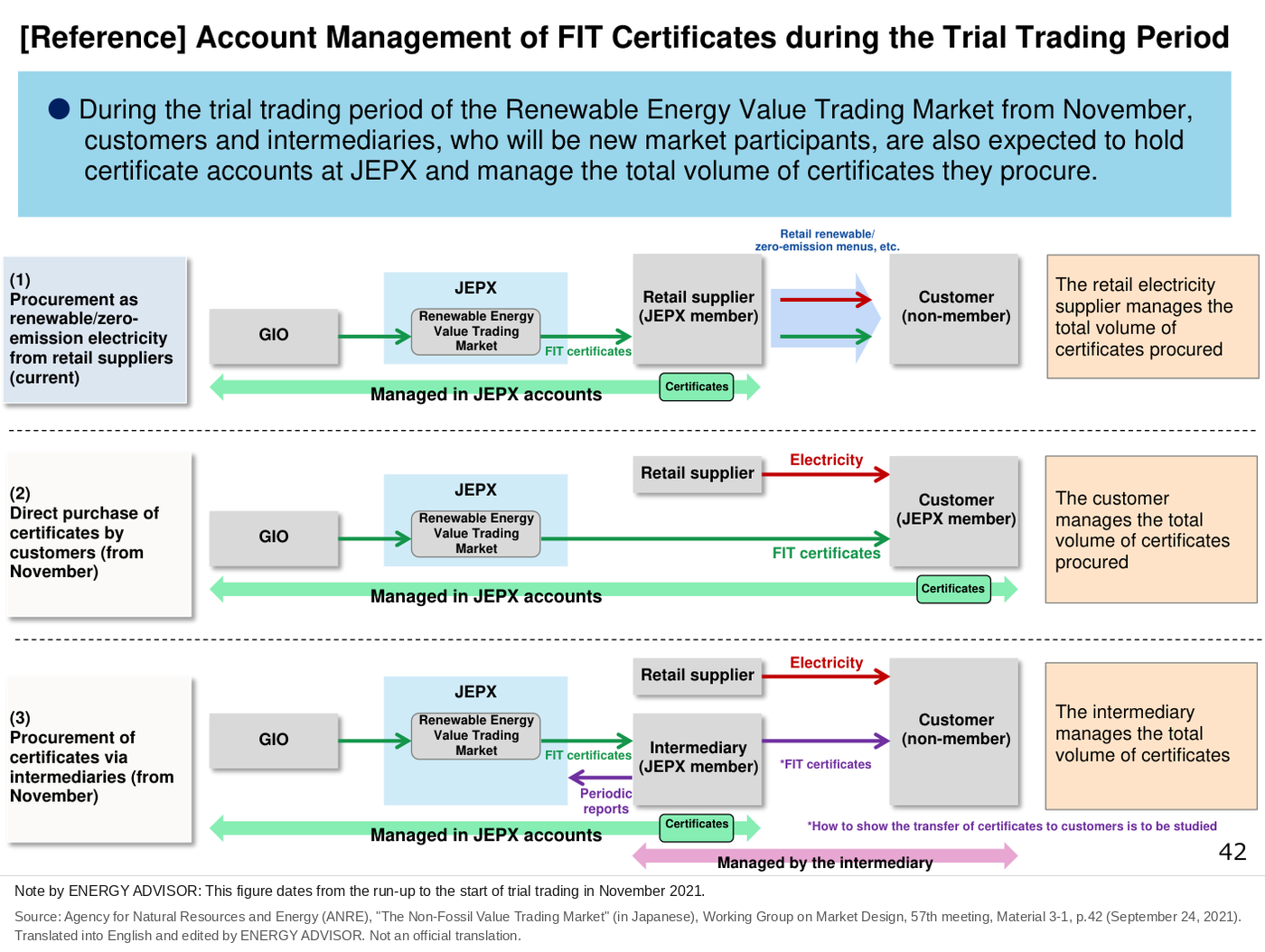
Non-fossil certificate refers to a certificate of the environmental attribute of “not emitting CO2” held by electricity generated from non-fossil sources (sources that do not use fossil fuels, such as renewables and nuclear), separated from the electricity itself. In principle, retail electricity suppliers procure them and build them into their tariff plans, but customers can also take part in the market directly and buy FIT non-fossil certificates, while customers can obtain non-FIT non-fossil certificates directly from generators only when certain conditions are met. Under the SHK system, certificates a customer has procured itself can be deducted, by the method in the calculation and reporting manual (certificate volume × national average factor × correction rate), up to the emissions from purchased electricity.
FIT / non-FIT non-fossil certificates: certificates derived from renewable electricity under the Feed-in Tariff (FIT) scheme are FIT non-fossil certificates, and certificates derived from other, non-FIT non-fossil sources are non-FIT non-fossil certificates. As of FY2025, the system sets price ranges of a cap of ¥4.0/kWh and a floor of ¥0.4/kWh for FIT non-fossil certificates, and a cap of ¥1.3/kWh and a floor of ¥0.6/kWh for non-FIT non-fossil certificates.
Tracking refers to the mechanism that attaches attribute information, such as the location of the generating facility a certificate comes from, to the certificate so that it can be identified. Full tracking has been carried out since FY2021 on the Renewable Energy Value Trading Market, which covers FIT sources, and since FY2024 on the Sophisticated Methods Act Compliance Market, which covers non-FIT sources, and it is a requirement for using certificates in international frameworks such as RE100.
Corporate power purchase agreement (PPA) refers to a mechanism in which a company (customer) and a generator directly conclude a long-term contract to buy and sell renewable electricity. PPAs are classified along two axes: “on-site / off-site,” by where the generating facility is located, and “physical / virtual,” by how the electricity is delivered.
On-site PPA / off-site PPA: a contract in which the generating facility is installed on the customer’s premises is an on-site PPA, and a contract in which electricity is procured from a generating facility installed off the premises is an off-site PPA.
Physical PPA / virtual PPA: a contract in which the generated electricity is actually supplied to the customer through the power grid and the environmental attributes are transferred together with the electricity is a physical PPA; a contract in which the generated electricity itself is sold to the market or other businesses and only the environmental attributes are transferred to the customer is a virtual PPA. For Scope 2 accounting, a physical PPA is treated as replacing purchased electricity, and a virtual PPA is treated similarly to non-fossil certificates.
Self-consumption solar PV refers to an installation approach in which electricity generated by solar PV equipment is not sold to the grid, or sales are kept to a minimum, and is mainly used within the facility where it is generated. Self-consumed electricity is not “purchased electricity,” so the electricity consumption covered by the Scope 2 calculation itself decreases.
Self-consumption ratio refers to the share of electricity generated by solar PV equipment that the company actually uses itself. For low-voltage solar of 10 kW to under 50 kW, at least 30% self-consumption is required as a condition of FIT certification, but the actual self-consumption ratio varies greatly with how the facility’s operating hours overlap with solar generation hours, and it is the starting point for calculating the economics.
Demand control (peak shaving / peak shifting) refers to measures that stop equipment or reduce its output when, while forecasting power use, it looks likely to exceed the contract demand. Peak shaving, which reduces power use itself, directly cuts both the demand charge and CO2 emissions, while peak shifting, which only moves the timing of use, may have little effect on Scope 2 emissions because total monthly electricity consumption hardly changes.
Contract demand (kW) refers to the value (kW) set in the contract with the power company as the guideline for the maximum power the site can use. The demand charge is calculated as “contract demand (kW) × demand charge unit price.”
Actual-demand method refers to the method applied to many customers with contract demand of less than 500 kW, in which the largest of the monthly maximum demands (30-minute demand) over the past 12 months, including the current month, becomes the contract demand for that month. Customers of 500 kW or more decide their contract demand through negotiation with the power company instead of this actual-demand method.
Demand charge / energy charge: the demand charge is determined by the size of the contract demand, and the energy charge by the amount of electricity actually used. Many high-voltage and extra-high-voltage electricity bills are calculated by adding these two together.
Power conditioner (inverter) refers to the device that converts the direct current generated by solar panels into alternating current that can be used in the facility. Its capacity is not necessarily designed to match the total output of the panels.
Stationary battery refers to equipment installed together with solar PV to store electricity. Its installation is considered for three reasons: raising the self-consumption ratio, managing demand, and its value as equipment that allows electricity to be used during an outage.
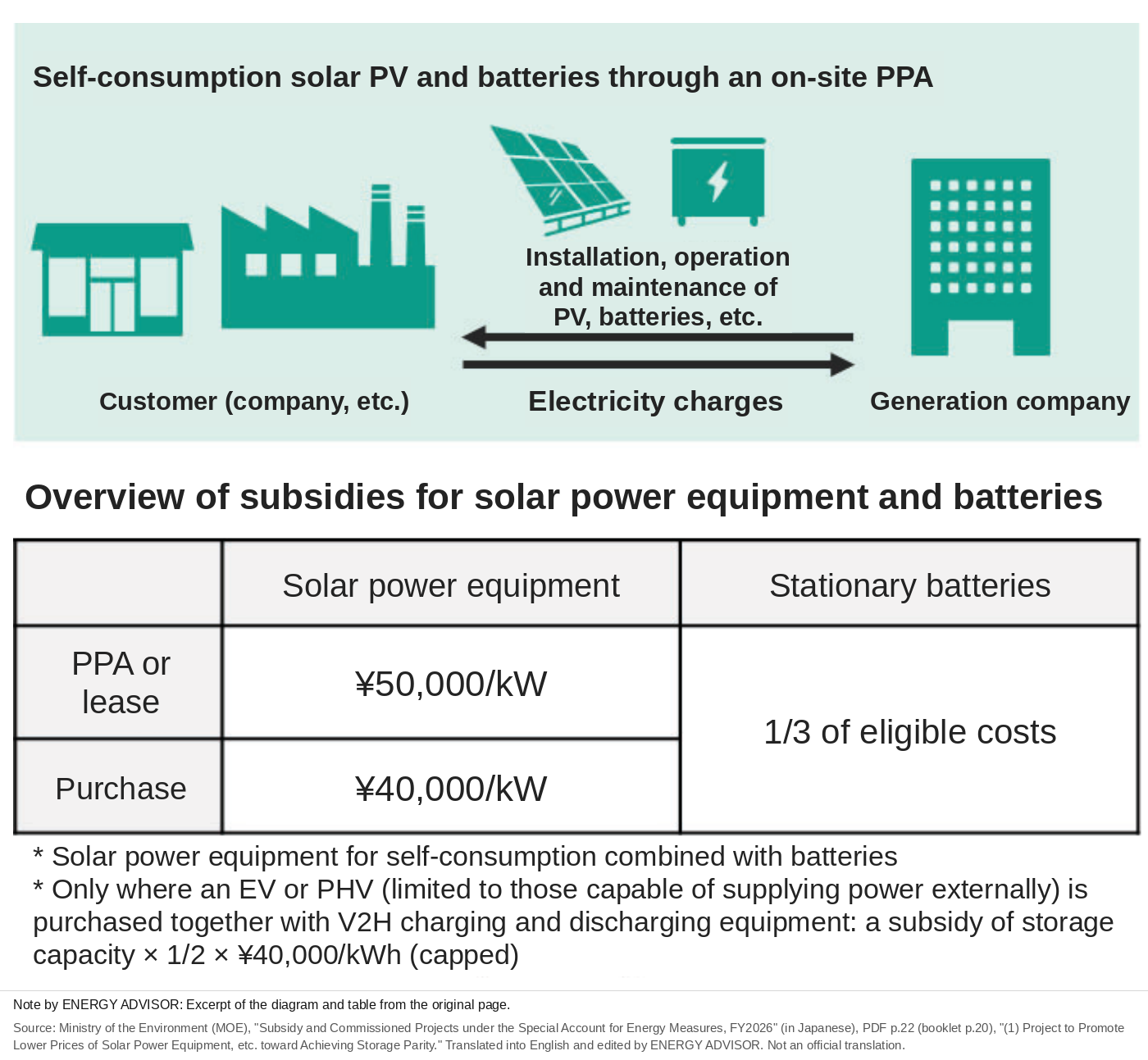
Third-party ownership (PPA / lease) refers to a mechanism in which a third party, such as a solar developer, installs and owns generating equipment on the customer’s premises and supplies the generated electricity to the customer. There are “on-site PPAs,” in which the customer pays according to the electricity it uses, and “leases,” in which it pays a fixed equipment usage fee; in both cases the customer in principle needs no upfront investment.
Last-resort supply refers to the system in which a general transmission and distribution company (GT&D company) temporarily supplies electricity to high-voltage and extra-high-voltage customers that can no longer receive electricity from the retail electricity supplier they contracted with. Even if the supplier exits the market or goes bankrupt, the supply of electricity itself does not stop, but it is meant only as a temporary safety net, and its price level tends to fluctuate.
(4) Subsidies and Support
SII (Sustainable open Innovation Initiative) refers to a general incorporated association that serves as the implementing organization for several energy-related subsidies under METI’s jurisdiction. For the Subsidy for Energy Conservation and Non-fossil Transition, it handles the practical work of running calls, screening, grant decisions and receiving completion reports.
Subsidy for Energy Conservation and Non-fossil Transition refers to a subsidy in which SII implements METI’s budget. It is divided into four project types, (I) the factory and business-site type, (II) the electrification and fuel-switching type, (III) the equipment-unit type and (IV) the energy demand optimization type, and eligible equipment, subsidy rates and caps differ by type.
Storage Parity Project is the common name for the “Project to Promote Lower Prices of Solar Power Equipment, etc. toward Achieving Storage Parity,” funded from MOE’s budget. For projects that install self-consumption solar PV and batteries together, it grants up to ¥60 million per project, with standard amounts of a flat ¥40,000 per kW for solar (¥50,000 for an on-site PPA or lease under third-party ownership) and a flat ¥39,000 per kWh for commercial and industrial stationary batteries.
SHIFT program is the short name for MOE’s “Project to Accelerate CO2 Reduction at Factories and Business Sites through Decarbonization Technologies.” As of FY2026, it consists of two menus: the “DX-based” menu, which supports drawing up CO2 reduction plans, and “retrofit support for low-CO2 systems,” which supports equipment upgrades.
DX-based CO2 reduction implementation support refers to one of the SHIFT program’s menus, which supports CO2 reduction audits and implementation plans, including examination of operational improvements involving measurement by a DX system. It is limited to SMEs, etc., and is designed with a subsidy rate of 3/4 and a cap of ¥2 million.
Reimbursement after completion (payment after the fact) refers to the mechanism in which a subsidy is paid only after the equipment has been installed and paid for and the completion report and review have been done. Costs ordered, contracted or paid before the grant decision are ineligible, so ordering equipment first and then looking for a subsidy does not work.
Completion report refers to the report a business submits after a subsidized project is completed. A subsidy is not finished when you receive the grant decision; it is paid only after you submit this completion report following installation of the equipment and go through a final inspection.
Grant decision refers to the decision, received after a business is selected through application and screening and then submits a grant application, that formally recognizes the project as a subsidized project. Ordering, contracting and paying for equipment are possible only on or after the date of this grant decision.
Payback period refers to an indicator showing how many years it takes to recover the initial cost of a capital investment from the annual effect obtained from the equipment (such as savings on the electricity bill). When considering the economics of solar PV, you can calculate it yourself as “initial investment ÷ annual savings,” and some subsidies use it in screening.
Exclusive practice of gyoseishoshi refers to the work of preparing documents to be submitted to government agencies upon request of another person and for remuneration, which the Gyoseishoshi Act prohibits anyone other than a Certified Administrative Procedures Legal Specialist (gyoseishoshi) from doing. Preparing subsidy application documents on behalf of others for a fee is also, in principle, considered to fall under this exclusive practice (for how this applies when the implementing organization is a private body, see the extra article on the Gyoseishoshi Act).
SME Management Reinforcement Tax Incentive refers to a tax incentive under which SMEs with a certified Business Enhancement Plan can choose immediate depreciation or a tax credit of 10% of the acquisition cost (7% for corporations with capital over ¥30 million) when they acquire eligible equipment. It is set to apply until March 31, 2027.
Shoene Otasuke-tai / ECCJ energy-saving optimization audit refers to low-cost energy audits for SMEs. Shoene Otasuke-tai provides walk-through audits by local energy audit organizations, and the energy-saving optimization audit of The Energy Conservation Center, Japan (ECCJ), a general incorporated foundation, has categories such as the quick audit; in both cases, experts check the energy use of the whole factory or building for a low fee.
Mirasapo plus refers to the website run by the Small and Medium Enterprise Agency where subsidies and support measures can be searched across programs. Because the names, subsidy rates and application periods of individual programs change every fiscal year, it is the entry point for checking the latest information yourself.
SII is not a private subsidy broker but an organization that implements METI’s subsidies. Knowing the names of such implementing organizations makes it easier to find application guidelines.
Summary
This glossary organized the key terms that appeared in Parts 1 to 12 of this series by theme: “(1) Emissions and calculation,” “(2) Systems and initiatives,” “(3) Renewables and electricity” and “(4) Subsidies and support.” From Scope 1, 2 and 3 and the types of emission factors, through the differences among systems such as SBT, CDP and GX-ETS, and renewable procurement mechanisms such as non-fossil certificates and corporate PPAs, to subsidy implementing organizations and program names such as SII and the SHIFT program, the definition of each term matches the text of the relevant part of this series. When you come across an unfamiliar word, we recommend checking the relevant theme on this page and, if you want to know more, rereading the relevant part (Parts 1 to 12, or the extra articles).
Related Articles
- Part 1: What Is Supply Chain Decarbonization? How Customers Come to Ask for CO2 Emission Reports (in Japanese)
- Part 2: Scope 1, 2 and 3 and the Carbon Footprint of Products (CFP): “CO2 for the Whole Company” and “CO2 per Product” (in Japanese)
- Part 5: Understanding the Emission Factor System: Basic, Adjusted and Menu-Specific Emission Factors and the Residual Mix (in Japanese)
- Part 11: A Map of Energy and Decarbonization Subsidies for SMEs (FY2026 Edition) (in Japanese)
The information in this article is current as of the time of posting and may have changed by the time you read it.
This article is based on published materials from the Ministry of Economy, Trade and Industry and its Agency for Natural Resources and Energy, the Electricity and Gas Market Surveillance Commission, the Organization for Cross-regional Coordination of Transmission Operators (OCCTO) and other sources. The English translations of figures are by ENERGY ADVISOR and are not official translations. When using this information for decisions, please check the original sources. When we find an error, we correct the article and note the date of the correction.
Sources
- MOE, Green Value Chain Platform, “What Are Scope 1 and 2 Emissions?” (in Japanese). https://www.env.go.jp/earth/ondanka/supply_chain/gvc/estimate_02.html
- MOE, Green Value Chain Platform, “What Are Scope 3 Emissions?” (in Japanese). https://www.env.go.jp/earth/ondanka/supply_chain/gvc/estimate_03.html
- MOE and METI, “Basic Guide to Calculating Supply Chain Emissions” (in Japanese). https://www.env.go.jp/earth/ondanka/supply_chain/gvc/files/tools/supply_chain_201711_all.pdf
- METI and MOE, “Carbon Footprint Guidelines” (May 2023) (in Japanese). https://www.meti.go.jp/shingikai/energy_environment/carbon_footprint/pdf/20230526_3.pdf
- MOE and METI, “Carbon Footprint Labeling Guide” (February 2025) (in Japanese). https://www.env.go.jp/content/000286660.pdf
- MOE and METI, “GHG Emissions Calculation and Reporting Manual, Ver. 6.1” (in Japanese). https://policies.env.go.jp/earth/ghg-santeikohyo/files/manual/chpt2_6-1.pdf
- MOE and METI, “Calculation Methods and List of Emission Factors” (in Japanese). https://policies.env.go.jp/earth/ghg-santeikohyo/calc.html
- MOE, “Publication of FY2024 Basic Emission Factors (Adjusted for Non-fossil Sources), Adjusted Emission Factors, etc. for Each Electricity Supplier” (in Japanese). https://www.env.go.jp/press/press_02235.html
- METI, Agency for Natural Resources and Energy (ANRE) and MOE, “Calculation and Publication of Unadjusted, Basic and Adjusted Emission Factors for Each Electricity Supplier” (ministerial notice of November 25, 2024) (in Japanese). https://www.enecho.meti.go.jp/category/electricity_and_gas/electric/gwc/pdf/241125tsutatsumerged.pdf
- MOE, “Publication of FY2023 Basic Emission Factors (Adjusted for Non-fossil Sources), Adjusted Emission Factors, etc. for Each Electricity Supplier (Partial Additions and Updates)” (March 18, 2025) (in Japanese). https://www.env.go.jp/press/press_04629.html
- METI, Study Group on Calculation Methods for Supplier-Specific Emission Factors under the Act on Promotion of Global Warming Countermeasures (18th meeting), Material 3, “Calculation of Supplier-Specific Emission Factors” (in Japanese). https://www.meti.go.jp/shingikai/energy_environment/ontaiho_haisyutsu/pdf/018_03_00.pdf
- ANRE, Working Group on Market Design (September 24, 2021), Material 3-1, “The Non-Fossil Value Trading Market” (in Japanese). https://www.meti.go.jp/shingikai/enecho/denryoku_gas/denryoku_gas/seido_kento/pdf/057_03_01.pdf
- MOE, “Mandatory Greenhouse Gas Accounting and Reporting System”: Overview (in Japanese). https://policies.env.go.jp/earth/ghg-santeikohyo/about.html
- ANRE, “Categories of Businesses and Their Obligations” (in Japanese). https://www.enecho.meti.go.jp/category/saving_and_new/saving/enterprise/factory/classification/
- MOE, “Decarbonization Management Handbook for SMEs” (in Japanese). https://www.env.go.jp/earth/SMEs_handbook.pdf
- MOE, “About Science Based Targets (SBT)” (November 30, 2025 edition) (in Japanese). https://www.env.go.jp/earth/ondanka/supply_chain/gvc/files/SBT_syousai_all_20251130.pdf
- MOE, “About Science Based Targets (SBT), Reference 1: SBT for SMEs” (in Japanese). https://www.env.go.jp/earth/ondanka/supply_chain/gvc/files/SBT_syousai_Option1_20250131.pdf
- CDP, “CDP Supply Chain Membership” (in Japanese). https://www.cdp.net/ja/supply-chain
- CDP, “CDP Questionnaires” (in Japanese). https://www.cdp.net/ja/disclose/question-bank
- METI, Industrial Structure Council, Subcommittee on Emissions Trading System, “Policy for Examining the Detailed Design of the Emissions Trading System” (in Japanese). https://www.meti.go.jp/shingikai/sankoshin/sangyo_gijutsu/emissions_trading/pdf/001_03_00.pdf
- RE100 (The Climate Group), “Results of public consultation on proposed changes to the RE100 technical criteria” (published March 24, 2025; p.5, mandatory certificates and application from the 2027 CDP disclosure cycle; p.6, retirement requirements). https://www.theclimategroup.org/hubfs/RE100/PDFs/Response%20from%20RE100%2020%20March%202025.pdf?hsLang=en
- MOE and METI, “Changes to the SHK System from the FY2024 Reports” (May 24, 2023) (in Japanese). https://www.kansai.meti.go.jp/3-9enetai/energypolicy/details/save_ene/R5setumeikai_shk.pdf
- MOE, “Subsidy and Commissioned Projects under the Special Account for Energy Measures, FY2026” (in Japanese). https://www.env.go.jp/content/000397154.pdf
- ANRE, Working Group on Market Design (March 4, 2026), Material 6, “Non-fossil Value Trading” (in Japanese). https://www.meti.go.jp/shingikai/enecho/denryoku_gas/jisedai_kiban/system_review/pdf/112_06_00.pdf
- ANRE, Advisory Committee for Natural Resources and Energy, Subcommittee on Mass Introduction of Renewable Energy and Next-Generation Electricity Networks (September 30, 2025), Material 1, “Creating an Environment in Which Renewable Energy Value Is Properly Evaluated” (in Japanese). https://www.meti.go.jp/shingikai/enecho/denryoku_gas/saisei_kano/pdf/076_01_00.pdf
- MOE and Mizuho Research & Technologies, “About Off-site Corporate PPAs” (in Japanese). https://www.env.go.jp/content/000392101.pdf
- ANRE, “Local Use Requirements under the FIT Scheme” (in Japanese). https://www.enecho.meti.go.jp/category/saving_and_new/saiene/community/dl/20220316_fit.pdf
- MOE, “Guide to Installing Solar PV Equipment through Third-Party Ownership such as PPAs” (in Japanese). https://www.env.go.jp/content/000118595.pdf
- TEPCO Energy Partner, “FY2026 Electricity Rate Table (Extra-High Voltage and High Voltage)” (in Japanese). https://www.tepco.co.jp/ep/corporate/plan_h/pdf/2026minaoshisiryou.pdf
- TEPCO Energy Partner, “How Contract Demand Is Determined (Actual-Demand Method)” (in Japanese). https://www.tepco.co.jp/ep/corporate/charge_c2/decision03.html
- TEPCO Power Grid, “About Last-Resort Supply Contracts” (in Japanese). https://www.tepco.co.jp/pg/consignment/lr/index.html
- MOE, Decarbonization Promotion Program (SHIFT Program) Navi, “Introducing Demand Control” (in Japanese). https://shift.env.go.jp/files/navi/measure/220231.pdf
- SII, “Subsidy for Energy Conservation and Non-fossil Transition (Equipment-Unit Type), FY2025 Supplementary Budget: Application Guidelines (for the 2nd call)” (in Japanese). https://sii.or.jp/setsubi07r/uploads/r7h_st_01_kouboyouryou_2.pdf
- SII, “Subsidy for Energy Conservation and Non-fossil Transition (Factory and Business-Site Type), FY2025 Supplementary Budget: Application Guidelines (for the 2nd call)” (in Japanese). https://sii.or.jp/koujou07r/uploads/r7h_kj_01_kouboyouryou_2.pdf
- MOE and Environmental Innovation Information Organization (EIC), “Project to Promote Lower Prices of Solar Power Equipment, etc. toward Achieving Storage Parity, FY2026 Initial Budget: Application Guidelines” (in Japanese). https://www.eic.or.jp/eic/topics/2026/st_r08/1st/files/SP_R8_ky.pdf
- MOE, “Start of the Call for Applications for the FY2026 Project to Accelerate CO2 Reduction at Factories and Business Sites through Decarbonization Technologies (SHIFT Program)” (in Japanese). https://www.env.go.jp/press/press_04967.html
- Greenhouse Gas Assurance Association of Japan (GAJ), “FY2026 SHIFT Program, DX-based CO2 Reduction Implementation Support: Application Guidelines” (in Japanese). https://www.gaj.or.jp/eie/shift/koubo/document/R8/A/sf08a1.pdf
- e-Gov Laws and Regulations Search, “Gyoseishoshi Act” (in Japanese). https://laws.e-gov.go.jp/law/326AC1000000004
- Director-General of the Local Administration Bureau, Ministry of Internal Affairs and Communications (MIC), “Promulgation of the Act Partially Amending the Gyoseishoshi Act (Notice)” (June 13, 2025) (in Japanese). https://www.soumu.go.jp/main_content/001014708.pdf
- Small and Medium Enterprise Agency, “SME Management Reinforcement Tax Incentive” (in Japanese). https://www.chusho.meti.go.jp/keiei/kyoka/kyoka_zeisei.html
- SII, “Energy Audit” (Shoene Otasuke-tai and registered audit organizations) (in Japanese). https://shoeneshindan.jp/
- ECCJ, “Energy-Saving Optimization Audit” (in Japanese). https://www.eccj.or.jp/shindan/
- Small and Medium Enterprise Agency, “Mirasapo plus: Subsidy and Comprehensive Support Site for SMEs” (in Japanese). https://mirasapo-plus.go.jp/