When a company tries to install self-consumption solar PV and batteries, one subsidy always comes up as a candidate: the Ministry of the Environment’s “Storage Parity Project.” However, searching by this name alone often leads to information from older fiscal years or to secondary explanations that leave out key points. As an extra article in this series, this piece sets out the subsidy’s official name, eligible applicants, subsidy unit rates, main requirements, status of calls as of FY2026 and application process, based on primary sources such as the application guidelines published by the Ministry of the Environment and the implementing organization.
Key points
- 1The official name is the “Project to Promote Lower Prices of Solar Power Equipment, etc. toward Achieving Storage Parity.” It is a budget program of the Ministry of the Environment, run by an implementing organization. Private companies and others, including small and medium-sized enterprises (SMEs), are eligible, and no one is excluded because of company size.
- 2The subsidy unit rates are a flat ¥40,000 per kW for solar PV (¥50,000 for an on-site PPA or lease under third-party ownership) and a flat ¥39,000 per kWh for commercial and industrial stationary batteries. The grant cap per business is ¥20 million for solar plus ¥40 million for batteries, etc., for a total of ¥60 million.
- 3Applications to install batteries alone are in principle not accepted; installing them together with solar PV is a condition. Solar PV on its own is also subject to a “cost-effectiveness of ¥40,000 per t-CO2 or less” requirement.
- 4Two calls were held under the FY2026 initial budget, the first (July 9–July 31, 2026, noon) and the second (August 27–October 2, 2026, noon), and both had closed as of October 22, 2026.
- 5The subsidy is in principle paid after the fact (reimbursement after completion), and orders or contracts placed before the date of the grant decision are not allowed. Preparing application documents on behalf of others for a fee is, in principle, considered the exclusive practice of a Certified Administrative Procedures Legal Specialist (gyoseishoshi). (For how this applies when the implementing organization is a private body, see the extra article on the Gyoseishoshi Act. Doing it free of charge does not fall under this.)
In this series, Part 10 covered how to calculate the economics of self-consumption solar PV and batteries, and Part 11 placed this program within the overall map of subsidies and tax incentives. This extra article digs into the details of the program itself, following primary sources.
Official Name and Purpose of the Program
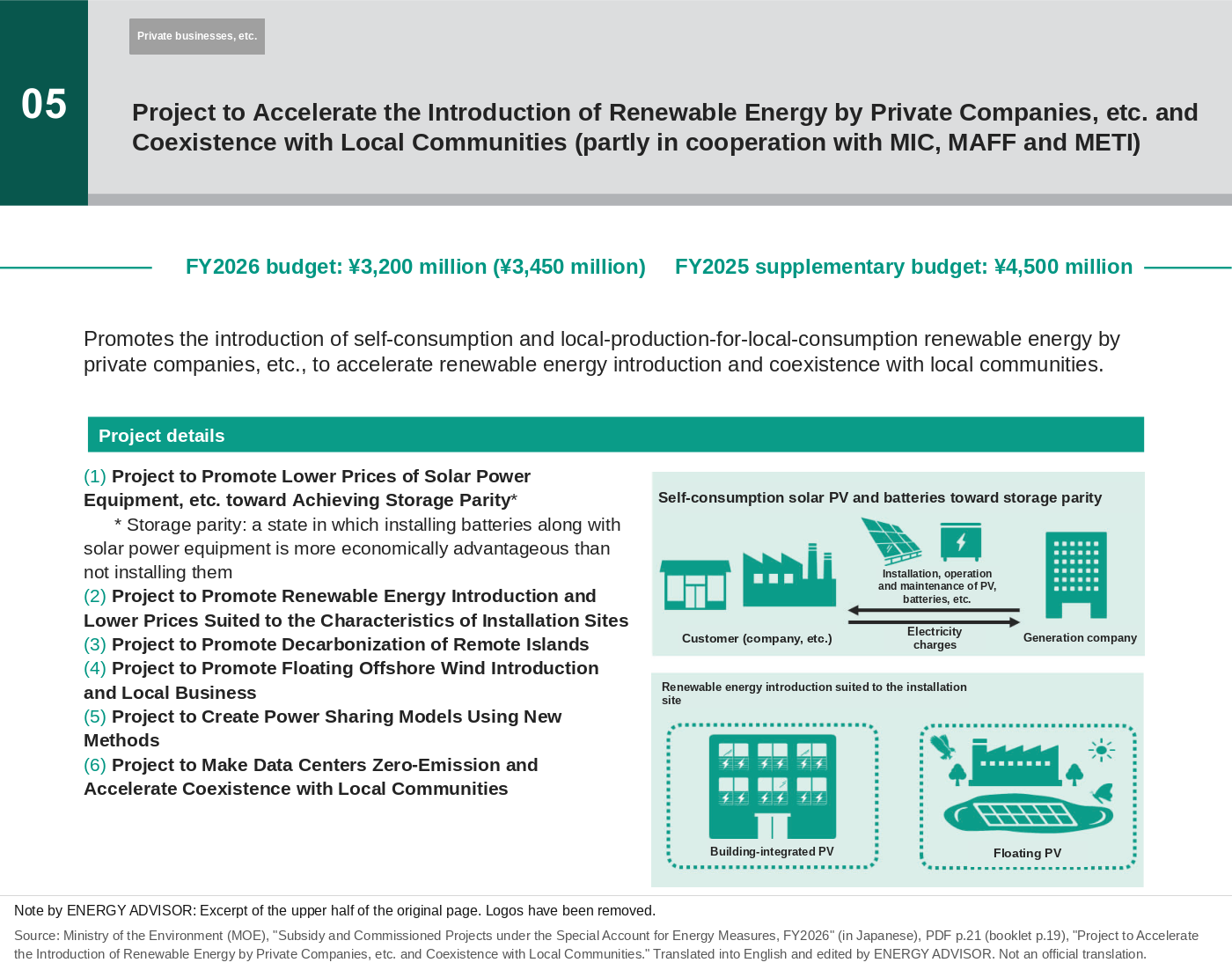
The official name of this subsidy is the “Project to Promote Lower Prices of Solar Power Equipment, etc. toward Achieving Storage Parity,” one of the projects under the “FY2026 Subsidy for Carbon Dioxide Emission Control Measures, etc. (Project to Accelerate the Introduction of Renewable Energy by Private Companies, etc. and Coexistence with Local Communities).” The Ministry of the Environment (MOE) provides the budget, and the Environmental Innovation Information Organization (EIC), as the implementing organization, handles the practical work of selection, grant decisions and payment of the subsidy. In this article, the program is referred to by its common name, the “Storage Parity Project.” “Reiwa 8” in Japanese material names means FY2026 (April 2026–March 2027).
According to the application guidelines, the purpose of this subsidized project is to contribute to achieving carbon neutrality by 2050 by supporting the installation of self-consumption solar PV equipment that coexists with local communities, and of batteries and other accessory equipment, to promote the spread of renewable energy. The project’s name comes from its particular emphasis on achieving “storage parity,” a state in which the economic benefits of installing batteries exceed the cost of installing them.
In short, it is “a subsidy that supports a state in which installing batteries pays off.”
Eligible Applicants: Private Companies, etc., Including SMEs
Eligible applicants are set broadly and include private companies doing business in Japan (of any corporate form, such as kabushiki kaisha or godo kaisha), sole proprietors (blue-form tax filers), incorporated administrative agencies, school corporations, medical corporations and cooperatives. There is no restriction by company size. In other words, SMEs can apply for this program.
Separately from company size, however, there are financial continuity requirements. Specifically, all three of the following must be met: at least one of the last three fiscal periods was profitable; net assets at the end of the latest fiscal period are ¥0 or more (not insolvent); and either the equity ratio is 10% or more or the current ratio is 100% or more. These requirements apply not only to the lead applicant but also to joint applicants and to the customers in a PPA or lease. SMEs with a small financial base need to check in advance, using their own financial statements, whether they can meet these requirements.
Local governments and individuals (other than sole proprietors who file blue-form tax returns) cannot be subsidized businesses under the “self-owned model,” in which the applicant owns the equipment. In that case, a PPA provider or leasing company owns the equipment and they take part as the customer. Projects that sell generated electricity to a power company (“sale of surplus electricity”), and projects with a solar output of less than 10 kW (for facilities other than detached houses), are also ineligible.
Subsidy Unit Rates and Grant Caps
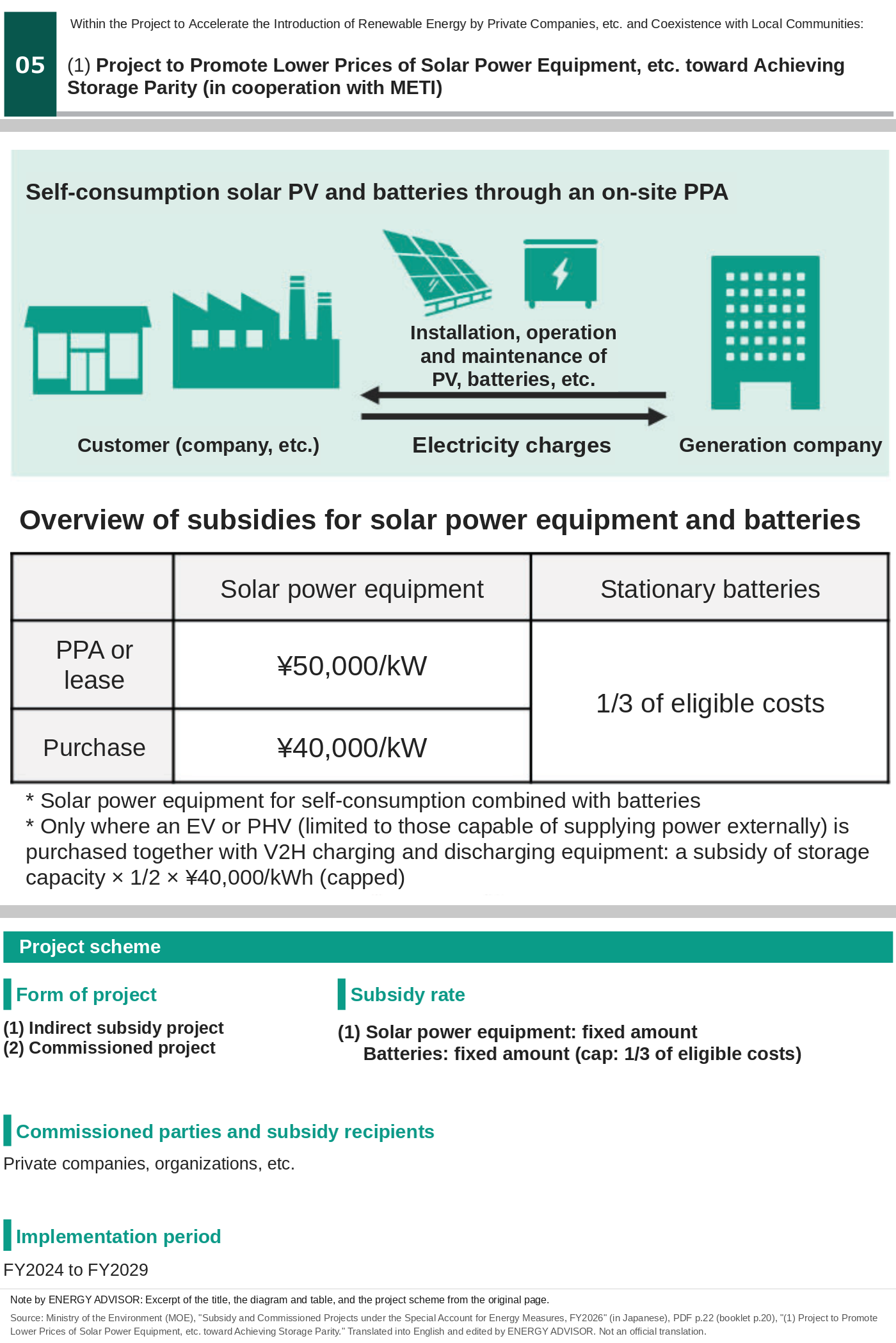
The subsidy unit rates are divided in detail by type of equipment and method of installation. For solar PV, the rate is a flat ¥40,000 per kW when the company owns the equipment itself (“self-owned”), or for a PPA or lease by a provider that has a capital relationship with the customer (“other PPA/lease models”). For an on-site PPA or lease by an unrelated third party (a scheme in which the customer does not own the equipment and installs it with no upfront cost), the rate is set higher, at ¥50,000 per kW. (Detached houses get ¥70,000/kW, but this is not one of the main categories for companies.) For stationary batteries, the rate is a flat ¥39,000 per kWh for commercial and industrial systems (over 20 kWh) and ¥38,000 for household systems (20 kWh or less). Charge-discharge equipment (V2H), which uses the batteries of electric vehicles, is also eligible. However, it is not calculated from a flat unit-rate table. Instead, the cap is the “subsidy amount for each model” under the Ministry of Economy, Trade and Industry (METI)’s Clean Energy Vehicle (CEV) subsidy, and it must be installed together with an on-board battery (applications for charge-discharge equipment alone are not accepted).
The grant cap per project is ¥20 million for solar PV and ¥40 million in total for stationary batteries, on-board batteries and charge-discharge equipment, for a combined cap of ¥60 million per project. The actual grant is the lower of the amount calculated from these standard rates and the amount calculated from the eligible costs actually incurred. In principle, quotations must be obtained from three or more vendors.
Main Requirements: No Batteries Alone, Cost-Effectiveness and More
Eligible equipment is subject to several common requirements. First, as a basic condition, a stationary or on-board battery must be installed together with solar PV, and applications to install batteries alone are not accepted. (There is an exception allowing battery-only applications only when used together with a separate subsidy project for perovskite solar cells.) Second, the solar PV or batteries installed must be able to supply the minimum electricity needed at the facility during an outage. Third, the “cost-effectiveness” of the eligible costs for the solar PV alone (excluding batteries, etc.), that is, the cost needed to reduce one tonne of CO2, must be ¥40,000 per t-CO2 or less. Other rules include that the equipment must be new; that solar modules and power conditioners (inverters) must be firmly fixed by methods conforming to Japanese Industrial Standards (JIS); and that certification under the Feed-in Tariff (FIT) scheme or the Feed-in Premium (FIP) scheme must not be obtained (the other side of the ban on selling surplus electricity). In addition, using other national (MOE, METI, etc.) subsidies or grants for the same equipment is prohibited, and violating this ban on double receipt can lead to rejection or cancellation of the grant decision.
Of these requirements, whether the cost-effectiveness criterion is met can be estimated in-house from the quoted price of the solar PV and its expected generation. It is a good idea to make a rough estimate from the vendor’s quotation before applying.
FY2026 Calls for Applications (First and Second)
Two calls were held in FY2026 under the FY2026 initial budget.
| Round | Application period | As of October 22, 2026 |
|---|---|---|
| First call | July 9 (Thu.)–July 31 (Fri.), 2026, noon (must arrive by then) | Closed |
| Second call | August 27 (Thu.)–October 2 (Fri.), 2026, noon (must arrive by then) | Closed |
Like the first call, the second call covered projects installing solar PV and batteries (stationary or on-board) together. The application guidelines were revised on August 27, 2026 for the second call, but the revision only added notes on the application period of the second call and the implementation deadline of the subsidized project; the subsidy unit rates, grant caps and requirements are the same as in the first call. As for a third call, as of October 22, 2026 there has been no announcement either on the implementing organization’s page or in MOE’s list of press releases (from September 24, 2026 onward). Late applications are not accepted, so even if you wait for the next call, you need to prepare early.
Sources: MOE, “Call for Applications for the Project to Promote Lower Prices of Solar Power Equipment, etc. toward Achieving Storage Parity, FY2026 Budget (Second Call)” (August 27, 2026) (in Japanese); EIC, “Storage Parity Project, FY2026 Initial Budget” call page (viewed October 22, 2026) (in Japanese); MOE, “List of Press Releases” (viewed October 22, 2026) (in Japanese); same, Application Guidelines (KY) (revised August 27, 2026), p.12 and revision history (in Japanese)
Applications are made through the electronic application system “jGrants,” which requires a separate “gBizID Prime” account. Obtaining gBizID Prime is said to take several business days even when issued online using an Individual Number (My Number) card, and about one to two weeks when a seal registration certificate is mailed. If you start the procedure only just before the deadline, obtaining the account alone may make you miss it, so if you are considering applying, check the status of your gBizID Prime account as early as possible.
This project runs on a single-year budget, and applications for projects spanning several fiscal years are not accepted. In the calls under the FY2026 initial budget, the implementation deadline of the subsidized project is January 29, 2027, whether the project was selected in the first or the second call. The earlier calls under the FY2025 supplementary budget have already closed.
Application Process and Points to Note: Implementing Organization, Payment After the Fact and Completion Reports
The application process falls broadly into four stages. Stage 1 is “application to grant decision”: you submit your application documents, are selected after screening by the implementing organization, then submit a grant application and receive a grant decision. Ordering, contracting and paying for equipment are possible only from the date of this grant decision. Stage 2 is “implementing the subsidized project”: you start the project after the grant decision, always report any changes to the implementing organization in advance, and complete the project by the deadline. Stage 3 is “completion report to payment”: you submit a completion report, which is reviewed, and after the grant amount is finalized you submit a request for payment, after which the subsidy is finally paid. Stage 4 is “post-completion management”: you must, for example, submit project reports for three years starting from the second fiscal year after the year of completion, and manage and operate the equipment properly until its statutory useful life has passed.
In other words, this subsidy is in principle paid after the fact (reimbursement after completion). The subsidy is paid only after you install the equipment, complete payment, and go through the completion report and review, and costs ordered, contracted or paid before the grant decision are ineligible. Ordering equipment first and then looking for a subsidy does not work.
The application documents also span several materials, such as the application guidelines, a separate volume of the guidelines and a full set of forms, with many items to fill in. Preparing such subsidy application documents on behalf of others for a fee is, in principle, considered the exclusive practice of a gyoseishoshi. (For how this applies when the implementing organization is a private body, see the extra article on the Gyoseishoshi Act. Doing it free of charge does not fall under this.) The detailed background (including the January 2026 amendment of the Gyoseishoshi Act) is covered in a separate extra article.
Summary
The Storage Parity Project, officially the “Project to Promote Lower Prices of Solar Power Equipment, etc. toward Achieving Storage Parity,” is a subsidy budgeted by MOE and implemented by EIC, for which private companies and others, including SMEs, are eligible. The subsidy unit rates are ¥40,000 per kW for solar PV (¥50,000 for an on-site PPA or lease) and ¥39,000 per kWh for commercial and industrial stationary batteries, with a total grant cap of ¥60 million. Installing batteries alone is in principle not allowed, and solar PV on its own must meet a cost-effectiveness requirement of ¥40,000 per t-CO2 or less. Two calls under the FY2026 initial budget were held in FY2026, the first (July) and the second (August to October), and both have closed. The subsidy is paid after the fact, and you cannot order before the grant decision. However, subsidy rates, unit rates, requirements and call timing are reviewed each fiscal year, so when actually considering an application, use this article as a starting point but always check the latest application guidelines published by the implementing organization and MOE yourself.
Related Articles
- Part 10: Self-consumption Solar PV and Batteries: How to Calculate the Economics and the Value as an Outage Measure (in Japanese)
- Part 11: A Map of Energy and Decarbonization Subsidies for SMEs (FY2026 Edition) (in Japanese)
The information in this article is current as of the time of posting and may have changed by the time you read it.
This article is based on published materials from the Ministry of Economy, Trade and Industry and its Agency for Natural Resources and Energy, the Electricity and Gas Market Surveillance Commission, the Organization for Cross-regional Coordination of Transmission Operators (OCCTO) and other sources. The English translations of figures are by ENERGY ADVISOR and are not official translations. When using this information for decisions, please check the original sources. When we find an error, we correct the article and note the date of the correction.
Sources
- MOE, “Call for Applications for the Project to Promote Lower Prices of Solar Power Equipment, etc. toward Achieving Storage Parity, FY2026 Budget” (in Japanese). https://www.env.go.jp/press/press_05272.html
- MOE and EIC, “Project to Promote Lower Prices of Solar Power Equipment, etc. toward Achieving Storage Parity, FY2026 Initial Budget: Application Guidelines (KY)” (in Japanese). https://www.eic.or.jp/eic/topics/2026/st_r08/1st/files/SP_R8_ky.pdf
- EIC, “Storage Parity Project, FY2026 Initial Budget, First Call” page (in Japanese). https://www.eic.or.jp/eic/topics/2026/st_r08/1st/
- Ministry of Internal Affairs and Communications (MIC), “Enforcement of the Act Partially Amending the Gyoseishoshi Act” (in Japanese). https://www.soumu.go.jp/main_content/001014708.pdf
- MOE, “Call for Applications for the Project to Promote Lower Prices of Solar Power Equipment, etc. toward Achieving Storage Parity, FY2026 Budget (Second Call)” (August 27, 2026) (in Japanese). https://www.env.go.jp/press/press_05472.html
- MOE and EIC, “Storage Parity Project, FY2026 Initial Budget: Application Guidelines (KY)” (revised August 27, 2026; the period of the second call and the implementation deadline were added to Section 2.1 and Table 2-2) (in Japanese). https://www.eic.or.jp/eic/topics/2026/st_r08/1st/files/SP_R8_ky_v2.pdf
- MOE, “List of Press Releases” (no announcement of a third call for the Storage Parity Project between September 24 and October 22, 2026; viewed October 22, 2026) (in Japanese). https://www.env.go.jp/press/index.html
- MOE, “Subsidy and Commissioned Projects under the Special Account for Energy Measures, FY2026” (in Japanese). https://www.env.go.jp/content/000397154.pdf