Calculating emissions and answering customers is not something you do once and finish. CO2 calculation, exchanges with customers and calls for applications for usable subsidies often move at roughly fixed times every year. In this final part of the series, we lay out in calendar form what happens when over the year, and also look at how to deal with the questionnaires that arrive from customers.
Key points
- 1Decarbonization work is not done once and finished. Calculation, reporting, responding to customers’ requests and subsidy calls each have periods that recur every year.
- 2Supplier-specific emission factors for electricity are usually published from late December to early January, and some additions and updates continue afterward. Reporting deadlines under the SHK system come every year only for companies covered by it (the deadline differs by category: the end of July for specified business-site emitters and the end of June for specified transport emitters).
- 3The main subsidy calls begin in spring and summer, and additional calls may follow into the autumn. Timing and content vary by fiscal year.
- 4Questionnaires from customers tend to arrive at times that overlap with the CDP disclosure cycle, and frequently asked items follow common patterns.
- 5The basic form of an answer to a customer is to show, briefly, the figures already calculated, the calculation method and future plans. For items not yet started, simply state that they have not been started.
In this series, “SMEs and Decarbonization,” up to the previous part (Part 11), we have covered why customers ask for decarbonization efforts (Part 1), how to count emissions as Scope 1, 2 and 3 and how to calculate them in practice (Parts 2 to 6), how to proceed with reductions and the options for electricity contracts and renewable procurement (Parts 7 to 10), and the overall picture of subsidies available to small and medium-sized enterprises (SMEs) (Part 11). In this final part, we organize how to position these tasks within a one-year cycle and repeat them. An overview of the whole series is also available in Part 1.
Decarbonization Work Is Not “Done Once and Finished”
In the previous parts, we covered emission calculation methods, how to proceed with reductions, and subsidy programs. However, none of these is complete after one round. There are three main reasons. First, the supplier-specific emission factors used in calculation are updated every fiscal year, so even with the same electricity use as the previous year, the result changes when the factor you refer to changes. Second, companies covered by the Act on Promotion of Global Warming Countermeasures have a legal reporting obligation under it, and this recurs every fiscal year. Third, customer questionnaires and subsidy calls both come around once a year at fixed times.
In fact, the legal reporting scheme itself, the Mandatory Greenhouse Gas Accounting and Reporting System (the SHK system), is designed to repeat a sequence every fiscal year: calculation and reporting by companies, compilation by the government, and publication.
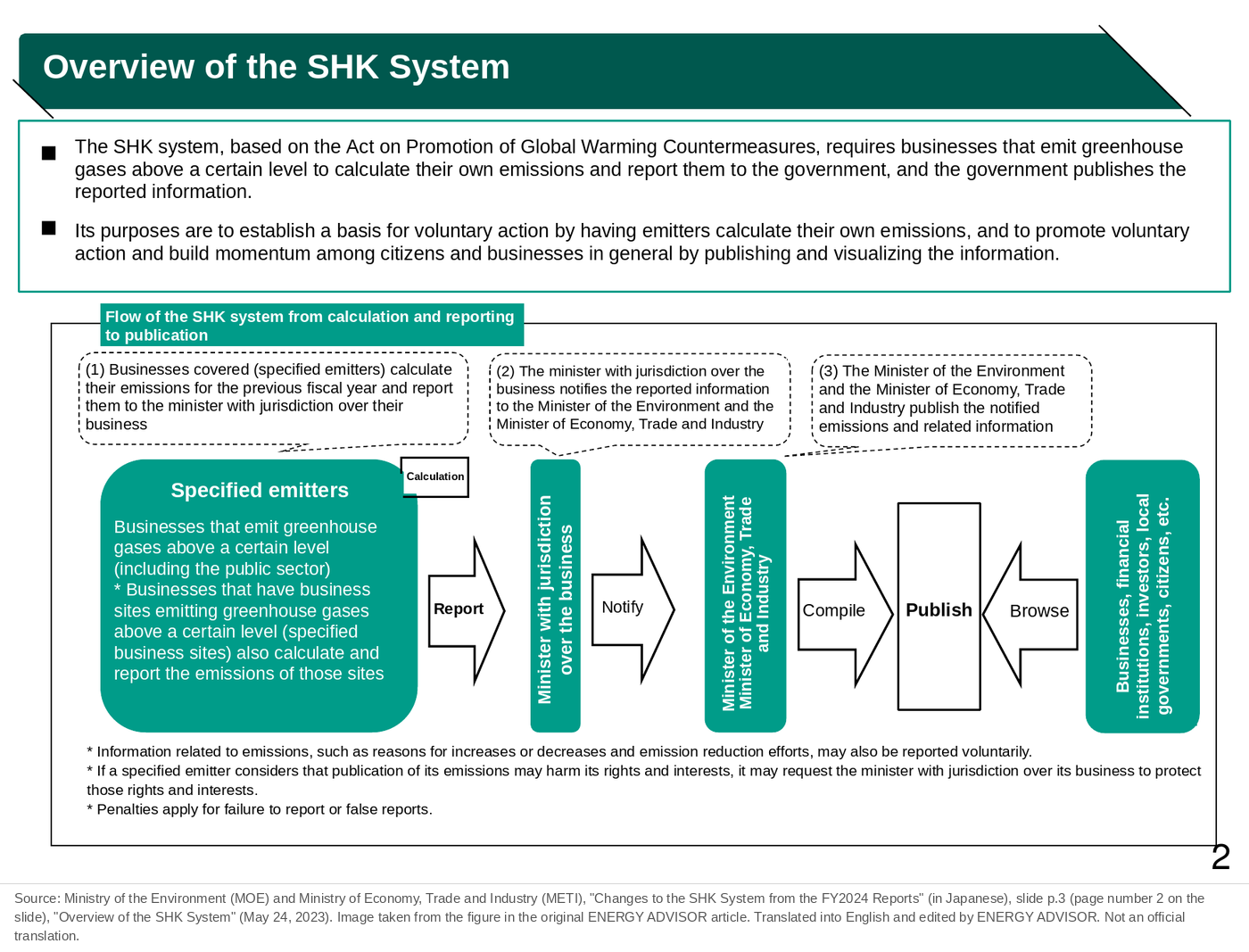
Even a company with no legal reporting obligation needs to revisit its calculation once a year, because the supplier-specific emission factors are updated every year.
Annual Calendar: Events by Period
Some items concern all SMEs, while others concern only covered companies, so the table below sorts them out. Japan’s fiscal year runs from April to March; FY2026 is April 2026–March 2027.
| Period | Main events | Who is affected / notes |
|---|---|---|
| January–March | For the supplier-specific emission factors published from late December of the previous year to early January, additional and updated versions for some suppliers are published (e.g., the FY2024 results were published on January 9, 2026 and updated on February 25) | Values used for the next fiscal year’s calculation. Timing varies by year |
| March–May | After the financial year closes, update your company’s CO2 emission calculation for the full year based on the finalized annual electricity and fuel use | All companies (timing varies with the closing month) |
| March–October | Examples of when the main subsidy calls are held (FY2026 results. Subsidy for Energy Conservation and Non-fossil Transition: 1st March 30–April 27, 2nd June 1–July 9, 3rd August 20–September 28, 4th October 5–October 30; SHIFT program: call opened June 12 (deadlines July 15 and August 26), third call opened September 11 (deadlines October 1 and October 15); Storage Parity Project (FY2026 initial budget): first July 9–July 31, noon, second August 27–October 2, noon) | Only companies with relevant capital investment or initiatives. Timing and content of calls vary by fiscal year |
| April–October | The CDP disclosure cycle is under way (in 2026, the questionnaire was released on April 20, the response window opened in June, and the final response submission deadline is October 28) | When your company answers CDP directly, or when a customer that answers CDP sends you a questionnaire |
| End of June | Reporting deadline under the SHK system (Act on Promotion of Global Warming Countermeasures) for specified transport emitters | Only covered companies, such as businesses of at least a set size that transport freight or passengers as a business. Note that the deadline differs from that of specified business-site emitters |
| Around July | Publication of supplier-specific emission factors for electricity suppliers that began retail sales in the previous fiscal year (factors for new entrants), and some additions and updates to the previous fiscal year’s factors (in 2026, July 23 and August 3; some updates also on June 4) | Values used for the next fiscal year’s calculation |
| End of July | Reporting deadline under the SHK system (Act on Promotion of Global Warming Countermeasures) for specified business-site emitters | Only covered companies, such as those using 1,500 kL/year or more of energy (crude oil equivalent) |
| Late December–early January | MOE and METI publish supplier-specific emission factors (factors for existing suppliers) (the FY2024 results were published on January 9, 2026) | Values used for the next fiscal year’s calculation and reporting |
Sources: MOE, “Mandatory Greenhouse Gas Accounting and Reporting System”: Overview (in Japanese); MOE, “Call for Applications for the Project to Promote Lower Prices of Solar Power Equipment, etc. toward Achieving Storage Parity, FY2026 Budget” (in Japanese); Sustainable open Innovation Initiative (SII), “Subsidy for Energy Conservation and Non-fossil Transition 2026”: Call Information (in Japanese); MOE, “Start of the Call for Applications for the SHIFT Program” (June 12, 2026) (in Japanese); MOE, “Third Call for Applications for the SHIFT Program” (September 11, 2026) (in Japanese); MOE, “Call for Applications for the Storage Parity Project (Second Call)” (August 27, 2026) (in Japanese); MOE and METI, “Calculation Methods and List of Emission Factors” (in Japanese); CDP, “Corporate Questionnaire Setup Preview 2026”; CDP FAQs; CDP, “Disclosure through CDP in 2026” (in Japanese)
The timing of subsidy calls shifts with when the fiscal year’s budget is passed and how ready the implementing organization is. The dates in the table above are FY2026 results, and note that they will not necessarily fall in the same months in later fiscal years. In FY2026, after the first calls that began in spring and summer, three programs held additional calls between August and October. Even if you miss the first deadline, another call may come out within the same fiscal year.
For supplier-specific emission factors, too, a METI study group’s materials show a schedule in which the factors for new entrants are published around mid-July and those for existing suppliers around late December, followed by checks and additional publications that continue until around March of the following year.
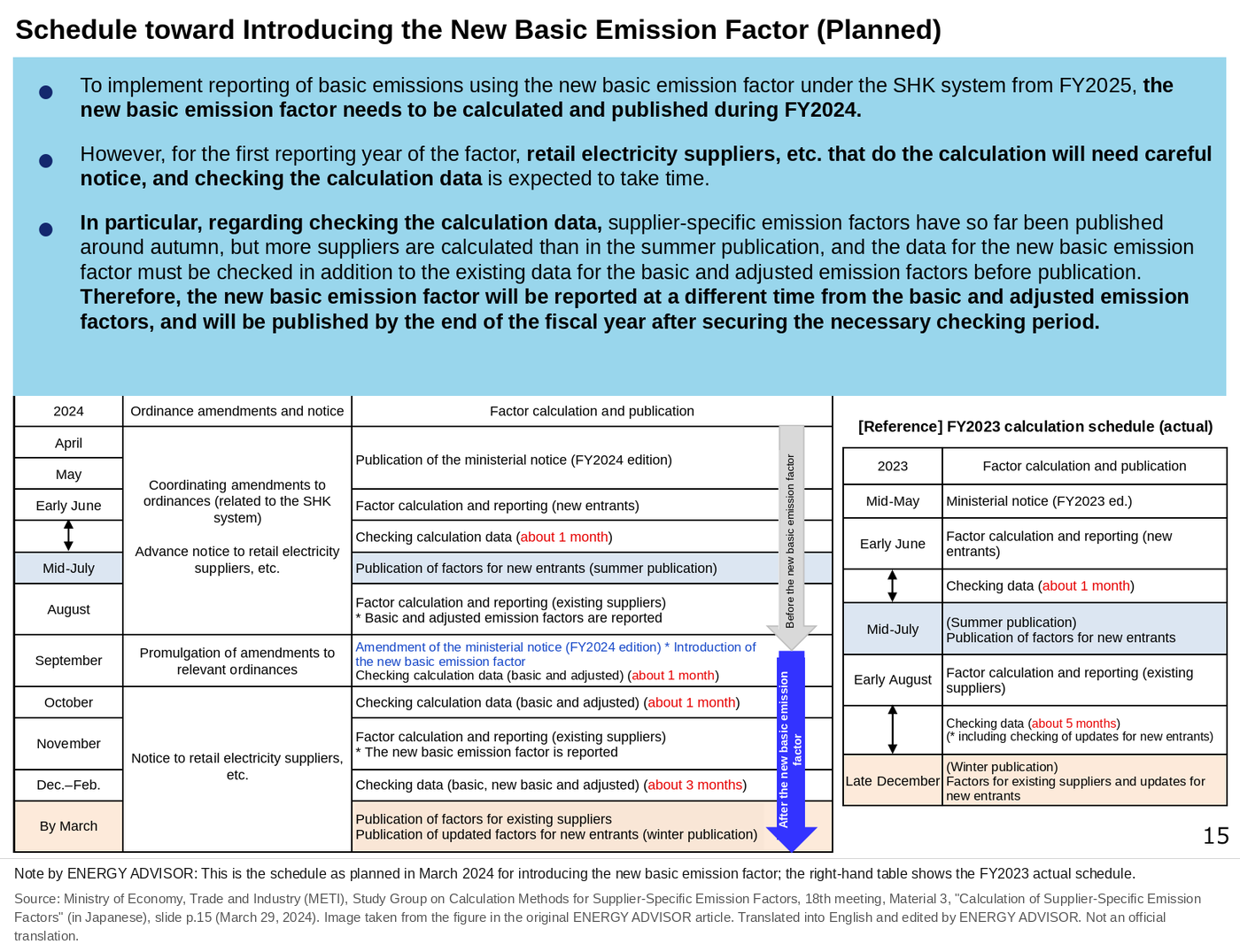
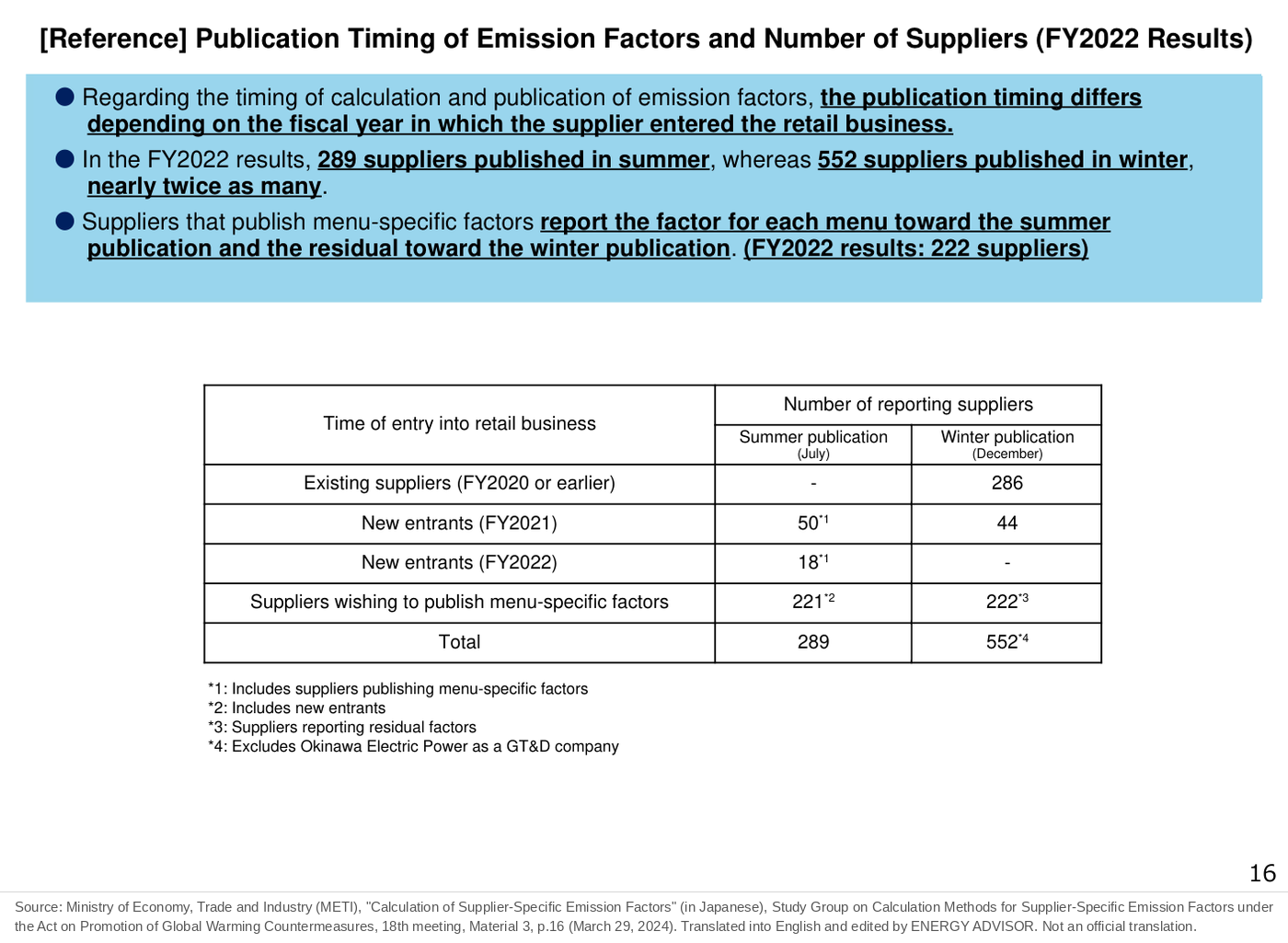
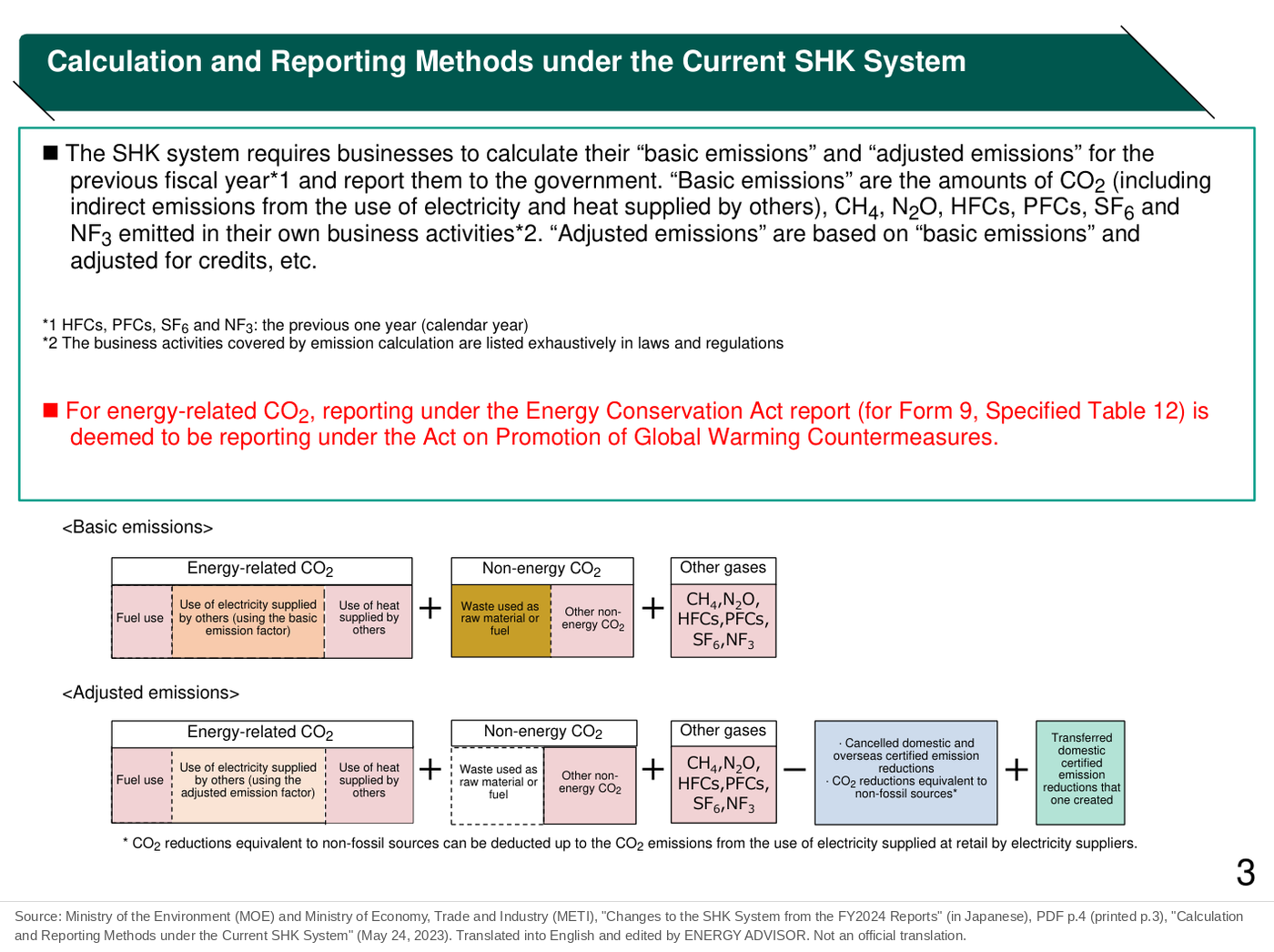
The list of basic emission factors and adjusted emission factors covered in Part 5 is updated every year on this schedule. Whenever you update your calculation, always recheck the latest version of the list.
Subsidy calls and the CDP response window both tend to overlap from spring to autumn. If you finish your own calculation first after the financial year closes, you can handle what follows together.
Customer Questionnaires: Patterns of Frequent Items
As covered in Part 1, questionnaires from customers arrive as surveys from purchasing or procurement departments, or as environmental items added to existing surveys. METI’s materials list what SMEs are actually being asked for by customers, including understanding and calculating GHG emissions, setting specific reduction targets and reporting progress, and obtaining environmental certifications.
Source: METI, “Toward Promoting GX in SMEs” (January 2026), p.3 (in Japanese)
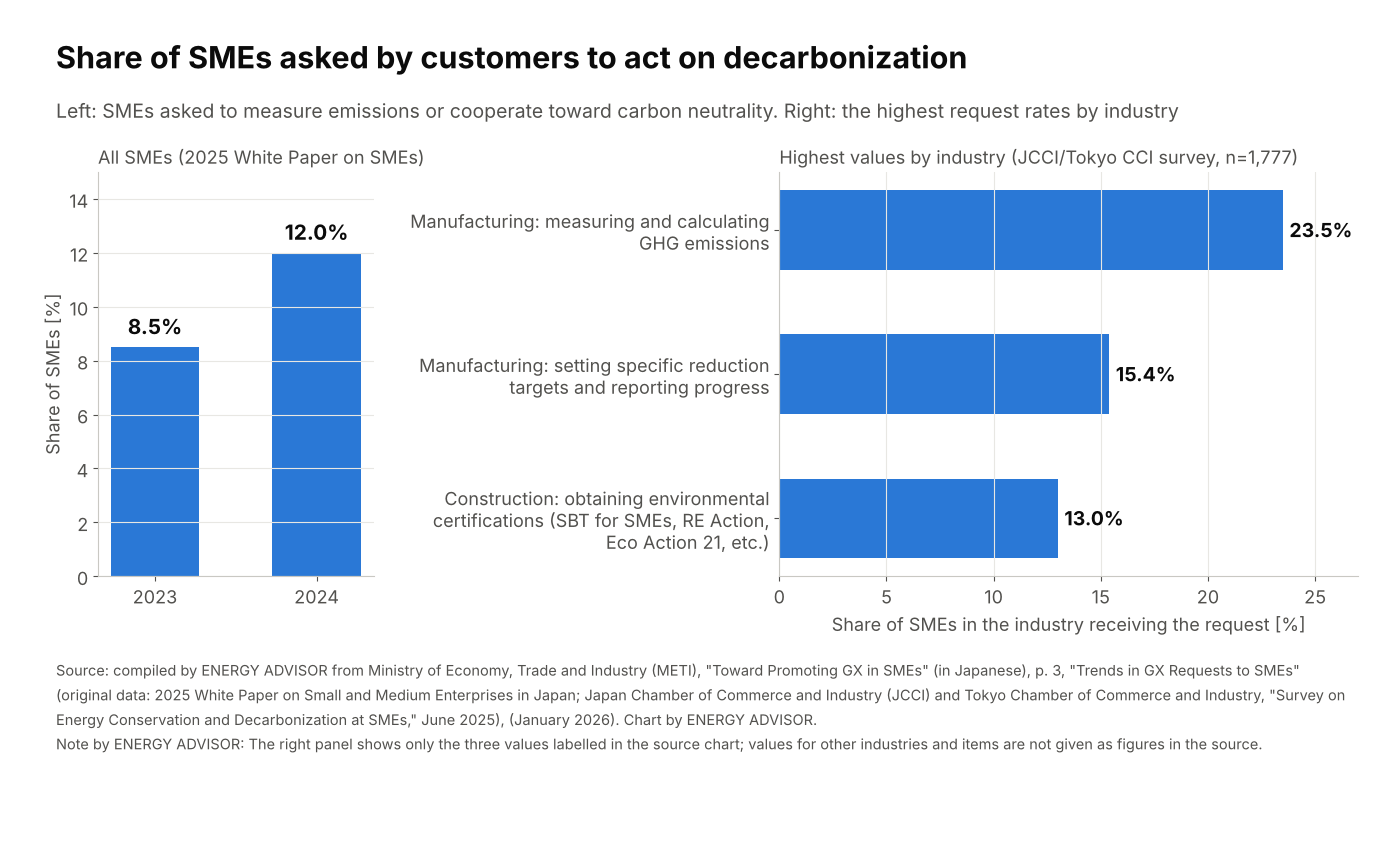
Broadly sorted, the items in such questionnaires fall roughly into four types.
- Emissions results: Whether your company’s Scope 1 and 2 emissions (in some cases part of Scope 3) have been calculated, and the figures. The calculation methods covered in Part 2, Part 4 and Part 6 apply directly.
- Reduction targets: Whether you have set medium- to long-term reduction targets and, if so, what they are. You may also be asked whether they follow a framework such as the Science Based Targets (SBT) covered in Part 3.
- Renewable energy share: The share of the electricity you use that is regarded as coming from renewable sources. Your use of the renewable procurement options covered in Part 9 is relevant.
- Governance: Items on your structure, such as how climate change response is positioned at the management level and who is responsible for driving it.
Note that the text of the questions in widely used international questionnaires such as CDP’s cannot be reproduced in this article for copyright reasons. The four types shown here are a summary based on published program materials and general tendencies, and do not quote item names or wording from any particular questionnaire.
The Form of an Answer: State the Current Situation Honestly, Even If It Is Not Perfect
The basic form of an answer is to show three things briefly: “the figures already calculated,” “the calculation method” and “future plans.” For emissions results, for example, as covered in Part 4 and Part 5, state the figure calculated by multiplying electricity use by an emission factor, and which emission factor you used (basic or adjusted, and for which fiscal year). For targets and governance items, too, simply separating what has been decided from what has not gives the answer a proper form.
The point to keep in mind is that you do not need a perfect reduction plan or structure in order to answer. If you only started calculating this fiscal year, you can say so and state that you plan to widen the calculation boundary. If you have not set a reduction target, it is enough to say that it is under consideration. Writing figures that differ from reality risks inconsistencies coming to light in later checks.
With figures already calculated and future plans, you can answer even without a fully developed structure. As with the order of reductions covered in Part 7, proceed one step at a time from what you can do.
Summary
Decarbonization work is not done once and finished. It sits within cycles that repeat every year: the yearly update of supplier-specific emission factors, the yearly reporting obligation under the SHK system, customer questionnaires and subsidy calls. Supplier-specific emission factors are usually published from late December to early January, and some additions and updates continue afterward. Reporting deadlines under the SHK system come every year only for covered companies (the end of July for specified business-site emitters and the end of June for specified transport emitters). The main subsidy calls begin in spring and summer, additional calls may follow into the autumn, and timing varies by fiscal year. Customer questionnaires often follow the common pattern of emissions results, reduction targets, renewable energy share and governance, and it is enough to answer by showing, briefly, the figures already calculated, the calculation method and future plans. Even without a fully developed structure, you can answer by stating the scope you have calculated and your future plans.
Looking Back on the Series: All 12 Parts
In this series, “SMEs and Decarbonization,” we wrote for managers and staff of SMEs who have begun to be asked by customers to report or reduce CO2 emissions, and explained Parts 1 to 12 on the premise that readers can follow them without specialist knowledge of electricity or the environment. Part 1 looked at how the mechanism of emissions across the whole supply chain has spread; Parts 2 to 6 covered how to count your own emissions (Scope 1, 2 and 3, calculation in practice, and the emission factor system); Parts 7 to 10 covered how to proceed with reductions (operational improvements, contract review and capital investment, reviewing electricity contracts, renewable procurement, and self-consumption solar PV and batteries); Part 11 covered the overall picture of usable subsidies; and this part covered the practical work of running all this within a one-year cycle. Links to all 12 parts are listed below.
- Part 1: What Is Supply Chain Decarbonization? How Customers Come to Ask for CO2 Emission Reports (in Japanese)
- Part 2: Scope 1, 2 and 3 and the Carbon Footprint of Products (CFP): “CO2 for the Whole Company” and “CO2 per Product” (in Japanese)
- Part 3: The Systems behind the Requests: SBT, CDP and GX-ETS, and How They Differ from Legal Reporting Obligations (in Japanese)
- Part 4: Scope 2 Calculation in Practice: Calculating CO2 Emissions from Electricity Use (in Japanese)
- Part 5: Understanding the Emission Factor System: Basic, Adjusted and Menu-Specific Emission Factors and the Residual Mix (in Japanese)
- Part 6: Calculating Scope 1, and How Far You Can Go for Free (in Japanese)
- Part 7: The Order of Reduction Measures: Operational Improvements, Contract Review and Capital Investment (in Japanese)
- Part 8: Electricity Contracts and CO2: How Reviewing Contracts and Tariff Plans Affects Emissions and Costs (in Japanese)
- Part 9: Four Ways to Procure Renewable Energy: Tariff Plans, Non-fossil Certificates, PPAs and Self-consumption (in Japanese)
- Part 10: Self-consumption Solar PV and Batteries: Calculating the Economics and the Value for Outages (in Japanese)
- Part 11: A Map of Energy and Decarbonization Subsidies for SMEs (FY2026 Edition) (in Japanese)
- Part 12 (this article): The Annual Cycle of Decarbonization Work: Calculation, Reporting, Customer Questionnaires and Subsidy Calls
Detailed explanations of individual subsidy programs, the basics of the CDP questionnaire, frequently asked questions and a glossary, which this series could not fully cover, are taken up separately in extra articles.
Related Articles
- Part 4: Scope 2 Calculation in Practice: Calculating CO2 Emissions from Electricity Use (in Japanese)
- Part 5: Understanding the Emission Factor System: Basic, Adjusted and Menu-Specific Emission Factors and the Residual Mix (in Japanese)
- Part 7: The Order of Reduction Measures: Operational Improvements, Contract Review and Capital Investment (in Japanese)
- Part 11: A Map of Energy and Decarbonization Subsidies for SMEs (FY2026 Edition) (in Japanese)
The information in this article is current as of the time of posting and may have changed by the time you read it.
This article is based on published materials from the Ministry of Economy, Trade and Industry and its Agency for Natural Resources and Energy, the Electricity and Gas Market Surveillance Commission, the Organization for Cross-regional Coordination of Transmission Operators (OCCTO) and other sources. The English translations of figures are by ENERGY ADVISOR and are not official translations. When using this information for decisions, please check the original sources. When we find an error, we correct the article and note the date of the correction.
Sources
- MOE, “Mandatory Greenhouse Gas Accounting and Reporting System”: Overview (in Japanese). https://policies.env.go.jp/earth/ghg-santeikohyo/about.html
- MOE and METI, “Changes to the Mandatory Greenhouse Gas Accounting and Reporting System (SHK System) under the Act on Promotion of Global Warming Countermeasures from the FY2024 Reports” (May 24, 2023) (in Japanese). https://www.kansai.meti.go.jp/3-9enetai/energypolicy/details/save_ene/R5setumeikai_shk.pdf
- METI, Study Group on Calculation Methods for Supplier-Specific Emission Factors under the Act on Promotion of Global Warming Countermeasures (18th meeting), Material 3, “Calculation of Supplier-Specific Emission Factors” (March 29, 2024) (in Japanese). https://www.meti.go.jp/shingikai/energy_environment/ontaiho_haisyutsu/pdf/018_03_00.pdf
- Agency for Natural Resources and Energy (ANRE), “Calculation and Publication of Basic and Adjusted Emission Factors for Each Electricity Supplier” (publication schedule page) (in Japanese). https://www.enecho.meti.go.jp/category/electricity_and_gas/electric/gwc/gwc_005.html
- MOE, “Call for Applications for the Project to Promote Lower Prices of Solar Power Equipment, etc. toward Achieving Storage Parity, FY2026 Budget” (in Japanese). https://www.env.go.jp/press/press_05272.html
- SII, “Subsidy for Energy Conservation and Non-fossil Transition 2026 Special Website”: Call Information (in Japanese). https://syouenehojyokin.sii.or.jp/information.html
- MOE, “Start of the Call for Applications for the FY2026 Project to Accelerate CO2 Reduction at Factories and Business Sites through Decarbonization Technologies (SHIFT Program)” (June 12, 2026) (in Japanese). https://www.env.go.jp/press/press_04967.html
- METI, “Toward Promoting GX in SMEs” (January 2026) (in Japanese). https://www.meti.go.jp/policy/energy_environment/global_warming/SME/pamphlet/gx_gaiyou.pdf
- CDP, “Corporate Questionnaire Setup Preview 2026.” https://assets.ctfassets.net/v7uy4j80khf8/2qFFBStRlvdvUVZsbBpFga/f1371dc72428efc812cd8a9de927ffce/CDP_Corporate_Questionnaire_Setup_Preview_2026.pdf
- CDP FAQs. https://www.cdp.net/en/faqs
- CDP, “Disclosure through CDP in 2026” (final response submission deadline October 28, 2026; viewed October 22, 2026) (in Japanese). https://www.cdp.net/ja/disclosure-2026
- CDP, “Enhance Your Internal Expertise as You Prepare for the 2026 Response Window.” https://www.cdp.net/en/insights/enhance-your-internal-expertise-for-the-2026-response-window
- MOE, “Call for Applications for the Storage Parity Project (Second Call)” (August 27, 2026) (in Japanese). https://www.env.go.jp/press/press_05472.html
- MOE, “Third Call for Applications for the SHIFT Program” (September 11, 2026) (in Japanese). https://www.env.go.jp/press/press_05521.html
- MOE and METI, “Calculation Methods and List of Emission Factors” (viewed October 22, 2026) (in Japanese). https://policies.env.go.jp/earth/ghg-santeikohyo/calc.html