We often hear from small and medium-sized enterprises (SMEs) that a request containing the word “CDP” has arrived from a customer and they do not know what to write or how far to go. Part 3 of this series sorted out the differences among three systems, SBT, CDP and GX-ETS, in terms of who runs them and whom they cover. For staff who have actually received a CDP questionnaire through a customer, however, more concrete questions remain: how CDP itself works as an organization, what kinds of questions there are, and how much is enough for a first response. This article explains these basics in an accessible way, based on published program materials, without reproducing the text of CDP’s questionnaire itself.
Key points
- 1CDP is an international non-profit organization headquartered in the United Kingdom that sends questionnaires on behalf of institutional investors and others and scores the responses. Since 2024, an integrated questionnaire combining climate change, water security and forests has been used.
- 2CDP’s “Supply Chain program” is a mechanism in which large companies (requesting member companies) submit lists of their suppliers to CDP, and CDP asks the companies concerned to respond. According to CDP’s page, more than 200 requesting member companies use this mechanism, and in 2025 more than 45,000 suppliers were asked to disclose.
- 3The original text of the questions sent to SMEs cannot be shown as is, but they can be broadly sorted into five types: “emissions results,” “whether there are reduction targets,” “renewable energy use,” “governance structure” and “risk awareness.”
- 4CDP scores are divided into four levels, Disclosure, Awareness, Management and Leadership, and what is required first is not a fully developed structure but an honest statement of the scope already calculated and future plans.
- 5The Scope 1 and 2 calculations covered in Parts 4 and 6 can be used directly as material for the response, and the same preparation also serves for companies’ own questionnaires other than CDP.
Part 3 of this series, “SMEs and Decarbonization,” sorted out the differences in who runs and whom they cover among three systems, SBT, CDP and GX-ETS, and positioned CDP as “a voluntary questionnaire that acts on behalf of requests from investors and others.” Part 12 also touched on the key points of how to deal with customer questionnaires within the annual cycle. This extra article digs one level deeper into CDP itself and checks the patterns common to questionnaires and a realistic level for responses.
Who Runs CDP, Types of Questionnaires and How Scoring Works
First, we check what kind of organization CDP is. CDP is an international non-profit organization (a registered charity in the UK) headquartered in the United Kingdom, with offices in several countries. CDP does not make investment decisions itself. It is an organization specialized in acting as an intermediary and evaluator of disclosure: on behalf of institutional investors and others with capital (whom CDP calls “capital markets signatories”), it sends companies questionnaires asking them to disclose environmental information, compiles and analyzes the responses, scores them and provides them to those who made the request.
Source: CDP, “About Us”
The questionnaires cover three environmental issues: climate change, water security and forests. Separate questionnaires used to be used for each theme, but in 2024 CDP combined them into one integrated questionnaire. Currently, there are the “full corporate questionnaire,” mainly for listed companies, a simplified “corporate SME questionnaire” (CDP SME questionnaire) for unlisted SMEs and others, and a “cities questionnaire” for local governments.
Source: CDP, “Disclose” (in Japanese) (English page: CDP, “Disclose”)
Another thing essential to understanding CDP is scoring. CDP evaluates responses on four levels: “Disclosure,” which evaluates the completeness of reporting; “Awareness,” which evaluates understanding of environmental issues; “Management,” which evaluates the status of action taken; and “Leadership,” which evaluates exemplary initiatives. Each level is further divided into two (e.g., A/A-). If a company does not submit a response, or lacks the information needed for evaluation, it is treated as “Did not disclose” and is not evaluated at all. In the SME questionnaire, only the climate change part is scored. The 2026 response window opened in the week of June 15. The final response submission deadline is October 28, 2026.
Sources: CDP Help Center, “For Disclosing Companies: Understanding Your Score” (in Japanese); CDP, “Enhance Your Internal Expertise as You Prepare for the 2026 Response Window” (May 20, 2026)
A CDP request is not just a survey from a research firm; it comes from an organization that acts as an intermediary and evaluator of disclosure on behalf of investors and others. This position is why similar requests arrive every year in a standardized format.
How the Supply Chain Program Works: Large Companies Asking Their Suppliers to Respond
Many of the CDP-related requests that reach SMEs are not sent directly by CDP but come through a mechanism called the “Supply Chain program.” In this mechanism, requesting member companies (large companies) that have become CDP members submit lists of their suppliers to CDP, and CDP compiles the lists and sends response requests to the companies concerned. According to CDP’s page (as worded when viewed on October 22, 2026), more than 200 requesting member companies use this program, and in 2025 more than 45,000 suppliers received disclosure requests.
Source: CDP, “CDP Supply Chain Membership” (in Japanese) (English page: CDP, “Supply Chain”)
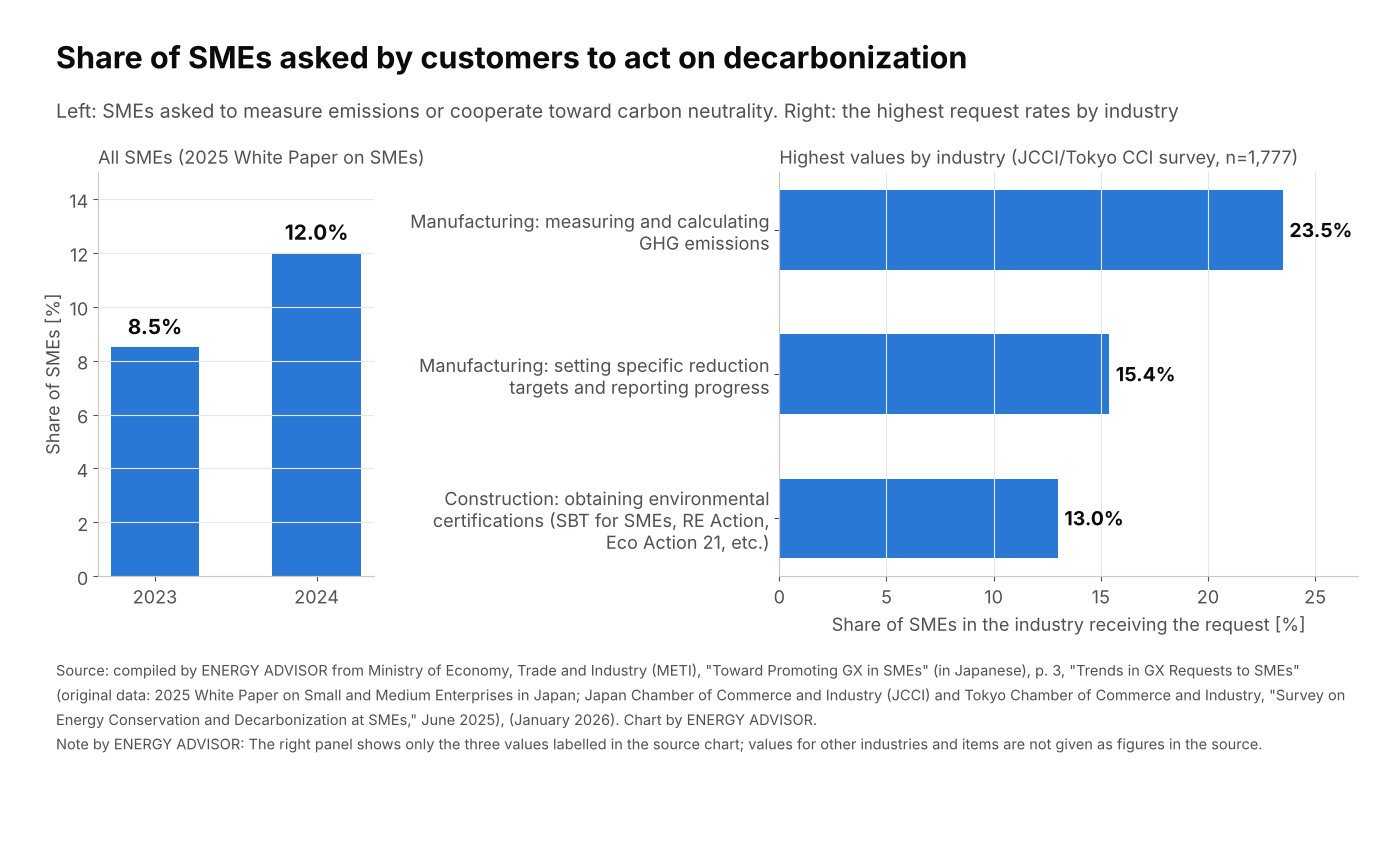
When suppliers that received requests submit their responses, CDP compiles and analyzes the data, and provides the requesting member companies with reports summarizing trends across their suppliers, and the suppliers themselves with feedback such as scores. In other words, the questionnaire an SME receives is not a format the requesting company created on its own, but arrives as part of a common mechanism run by a third party, CDP.
In 2025, the requests reached more than 45,000 suppliers through the same mechanism; they are not aimed only at particular companies.
Patterns in the Questions Sent to SMEs: Understanding by Type
The wording of the questions in CDP’s questionnaire is CDP’s copyrighted work, so this article does not reproduce the original text. However, the structure of the guidance materials CDP publishes shows what broad categories the questions fall into. Broadly sorted, the questions sent to SMEs fall roughly into the following five types.
- Emissions results: Whether your company’s CO2 emissions have been calculated, and the figures and the calculation boundary.
- Whether there are reduction targets: Whether you have set medium- to long-term reduction targets and, if so, their content and target year.
- Renewable energy use: The share of the electricity you use that is regarded as coming from renewable sources, and how it is procured.
- Governance structure: How climate change response is positioned at the management level and who is responsible for driving it.
- Risk awareness: What risks and opportunities you see climate change posing for your business.
Source: CDP, “Climate Change Questionnaire Scoring Methodology” guidance (in Japanese)
The five types shown here are a summary based on the chapter structure (module structure) of the published guidance materials, and do not directly quote the wording of questions or answer options from any particular questionnaire. Checking the actual question wording and responding must be done based on the guidance from customers or CDP and CDP’s official portal.
A Realistic Level for a First Response: It Does Not Have to Be Perfect
Once you know the types, the next question is how much to actually write. The four scoring levels checked earlier provide a clue. The first level, “Disclosure,” evaluates not how complete your action is, but the completeness of reporting, that is, how fully you have covered the scope without omissions. Conversely, even if reduction targets and a structure are not in place, simply writing, without omissions, the emissions already calculated, the calculation method and future plans is enough for an evaluation at this level.
Source: CDP Help Center, “For Disclosing Companies: Understanding Your Score” (in Japanese)
On the other hand, if you do not submit a response, or the information needed for evaluation is seriously lacking, you are treated as “Did not disclose,” which does not even reach the “Disclosure” level. In other words, the scoring system itself can be understood as designed to give meaning, first of all, to responding at all, rather than to how complete your structure is.
Even if a reduction target has not been set, if you state that it has not been set and submit your response, you will at least not be treated as “Did not disclose.”
The Series’ Calculations Can Be Used Directly to Prepare a Response
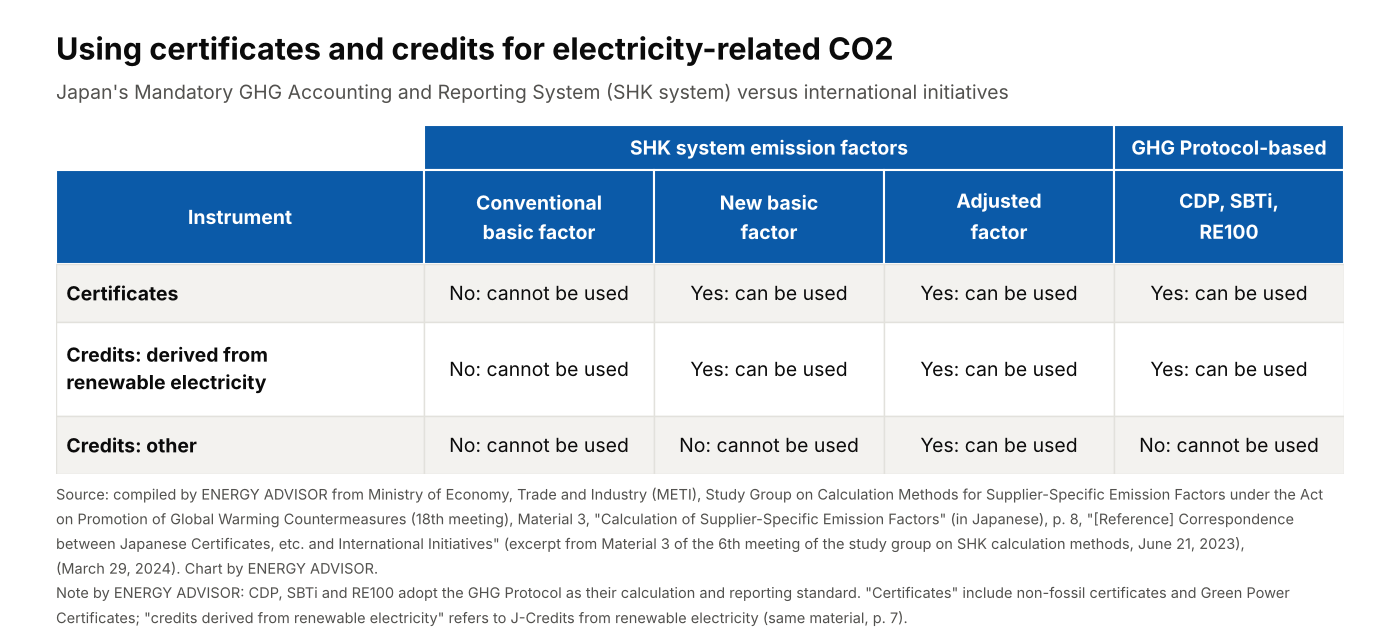
For each type of question in a questionnaire, what this series has covered can be used directly. In the “emissions results” fields, you can enter the results of the Scope 2 calculation (electricity use × emission factor) covered in Part 4 and the Scope 1 calculation (fuel use × calorific value per unit × emission factor × 44/12) covered in Part 6. In the “whether there are reduction targets” fields, you may be asked whether you follow a framework such as the Science Based Targets (SBT) covered in Part 3. In the “renewable energy use” fields, you enter the status of your electricity contract and use of renewable tariff plans. In other words, readers who have followed this series in order already have much of the material for a response at hand when a questionnaire arrives.
Companies’ Own Questionnaires Other Than CDP: Similar Patterns
Questionnaires from customers do not only come through CDP. Large companies sometimes ask about emissions and governance structure in survey formats of their own. Because such questionnaires are not in an internationally standardized format like CDP’s, the details of the items and the format differ by customer. In practice, however, there is a tendency for the broad types themselves, such as emissions results, reduction targets, renewable energy use, governance structure and risk awareness, to overlap largely with the CDP questionnaire. The calculation results you have organized in preparation for the CDP questionnaire can also be used for items of the same type in companies’ own questionnaires.
Summary
CDP is an international non-profit organization headquartered in the United Kingdom that sends questionnaires on behalf of institutional investors and others and scores the responses. Since 2024, the questionnaire has been a single integrated format covering climate change, water security and forests, and through the Supply Chain program, disclosure requests from more than 200 requesting member companies reached more than 45,000 suppliers in 2025. The original text of the questions sent to SMEs cannot be reproduced, but they can be broadly sorted into five types, emissions results, reduction targets, renewable energy use, governance structure and risk awareness, and the scoring system itself is designed to give meaning, first of all, to responding and to honestly stating the scope already calculated. The calculations covered in Parts 4 and 6 can be used directly in the response, and the same preparation also serves for companies’ own questionnaires other than CDP.
Related Articles
- Part 3: The Systems behind the Requests: SBT, CDP and GX-ETS, and How They Differ from Legal Reporting Obligations (in Japanese)
- Part 4: Scope 2 Calculation in Practice: Calculating CO2 Emissions from Electricity Use (in Japanese)
- Part 12: The Annual Cycle of Decarbonization Work: Calculation, Reporting, Customer Questionnaires and Subsidy Calls (in Japanese)
The information in this article is current as of the time of posting and may have changed by the time you read it.
This article is based on published materials from the Ministry of Economy, Trade and Industry and its Agency for Natural Resources and Energy, the Electricity and Gas Market Surveillance Commission, the Organization for Cross-regional Coordination of Transmission Operators (OCCTO) and other sources. The English translations of figures are by ENERGY ADVISOR and are not official translations. When using this information for decisions, please check the original sources. When we find an error, we correct the article and note the date of the correction.
Sources
- CDP, “About Us.” https://www.cdp.net/en/about
- CDP, “Disclose” (in Japanese). https://www.cdp.net/ja/disclose (English page: https://www.cdp.net/en/disclose)
- CDP, “CDP Supply Chain Membership” (“200+” and “45,000+ suppliers requested to disclose in 2025”; the year of the member count is not stated; as worded when viewed on October 22, 2026) (in Japanese). https://www.cdp.net/ja/supply-chain (English page: https://www.cdp.net/en/supply-chain)
- CDP, “Disclosure through CDP in 2026” (final response submission deadline October 28, 2026; viewed October 22, 2026) (in Japanese). https://www.cdp.net/ja/disclosure-2026
- Ministry of Economy, Trade and Industry (METI), “Toward Promoting GX in SMEs” (January 2026) (in Japanese). https://www.meti.go.jp/policy/energy_environment/global_warming/SME/pamphlet/gx_gaiyou.pdf
- METI, Study Group on Calculation Methods for Supplier-Specific Emission Factors under the Act on Promotion of Global Warming Countermeasures (18th meeting, March 29, 2024), Material 3, “Calculation of Supplier-Specific Emission Factors” (in Japanese). https://www.meti.go.jp/shingikai/energy_environment/ontaiho_haisyutsu/pdf/018_03_00.pdf
- CDP, “CDP Questionnaires” (in Japanese). https://www.cdp.net/ja/disclose/question-bank
- CDP Help Center, “For Disclosing Companies: Understanding Your Score” (in Japanese). https://help.cdp.net/ja-jp/knowledgebase/article/KA-01160
- CDP, “Climate Change Questionnaire Scoring Methodology” guidance (in Japanese). https://guidance.cdp.net/ja/guidance?cid=18&ctype=theme&idtype=ThemeID&incchild=1µsite=0&otype=ScoringMethodology&page=1&tags=TAG-605%2CTAG-593
- CDP Worldwide Japan, “The CDP Supply Chain Scheme and an Introduction to Accredited Partners” (August 29, 2023) (in Japanese). https://cdn.cdp.net/cdp-production/comfy/cms/files/files/000/008/322/original/JP_Net_Zero_webinar_3.pdf