In Part 4, we confirmed that Scope 2 emissions from electricity use can be calculated simply by multiplying the electricity consumption on the bill by an emission factor. Another category that can be completed with your own company’s activities alone is Scope 1, the emissions from burning fuel at your company. This article uses concrete examples to show where to look up the factors needed for each fuel (city gas, LPG, heavy fuel oil, kerosene, diesel and gasoline) and how to calculate. It also covers public support that helps with the calculation work itself, free of charge or at low cost.
Key points
- 1Scope 1 can be calculated on the same principle as Scope 2, with the formula “fuel consumption × calorific value per unit × emission factor × 44/12.” The factors can be looked up in the appended tables of the calculation and reporting manual of the Ministry of the Environment (MOE) and the Ministry of Economy, Trade and Industry (METI).
- 2City gas, LPG, heavy fuel oil, kerosene, diesel and gasoline each have their own calorific value per unit and emission factor. You can start calculating once you collect 12 months of consumption from bills and refueling records.
- 3City gas differs from the other fuels in that, like electricity, you use “factors published for each gas supplier you have a contract with.”
- 4If you are unsure about doing the calculation yourself, there are low-cost public services such as Shoene Otasuke-tai and the ECCJ energy-saving optimization audit, free audits by local governments, and the free advisory service of SMRJ.
- 5Private cloud-based calculation services are another option, but you can complete the visualization of Scope 1 and 2 first by combining your own calculations with public support.
In this series, “SMEs and Decarbonization,” we have looked so far (up to Part 5) at how to calculate Scope 2 emissions from electricity use (Part 4, in Japanese) and at the types of emission factors, namely basic, adjusted and menu-specific factors and the residual mix (Part 5, in Japanese). This time, we look at how to calculate Scope 1, the emissions from burning fuel at your company, and give an overview of free and low-cost public support for the calculation.
What Scope 1 Covers: Fuels Your Company Burns
As confirmed in Part 2, Scope 1 is the direct emissions of greenhouse gases by the company itself, from fuel combustion and industrial processes. At SMEs, the easiest examples to picture are burning city gas, LPG, heavy fuel oil or kerosene in factory boilers and heating and cooling equipment, and using diesel or gasoline in company vehicles. As with electricity in Scope 2, consumption in this category can be determined from your company’s own bills and records alone, without external data.
What Scope 1 covers can be identified by listing “the places where your company uses fire.” Typical examples are boilers, water heaters, forklifts and company vehicles.
The Basic Formula: Fuel Consumption × Calorific Value per Unit × Emission Factor
The calculation and reporting manual of MOE and METI states that CO2 emissions from fuel use are calculated with the following formula:
CO2 emissions (tCO2) = (for each type of fuel) fuel consumption (t, kL, thousand m³) × calorific value per unit (GJ/t, GJ/kL, GJ/thousand m³) × carbon emission factor (tC/GJ) × 44/12
Whereas electricity in Scope 2 was a one-step multiplication, “consumption × emission factor,” fuel in Scope 1 uses a multi-step formula: “consumption × calorific value × carbon emission factor × 44/12.” However, as explained below, a table of “CO2 emissions per kL (or per t, or per thousand m³),” in which the calorific value and carbon emission factor for each fuel are already multiplied together, has been published. In practice, you only need to multiply consumption by that value.
Looking Up the Calorific Value per Unit and Emission Factor for Each Fuel
MOE and METI publish the calorific value per unit and carbon emission factor for each fuel, as well as the CO2 emission factors calculated from them, in the “List of Calculation Methods and Emission Factors.” The fuels SMEs often use are summarized below.
| Fuel | Calorific value per unit | CO2 emission factor (reference value) |
|---|---|---|
| City gas | 40.0 GJ/thousand m³ | Use the factor published for your gas supplier (e.g., 2.09 t-CO2/thousand m³) |
| LPG (liquefied petroleum gas) | 50.1 GJ/t | 2.99 t-CO2/t |
| Heavy fuel oil A | 38.9 GJ/kL | 2.75 t-CO2/kL |
| Heavy fuel oil B and C | 41.8 GJ/kL | 3.10 t-CO2/kL |
| Kerosene | 36.5 GJ/kL | 2.50 t-CO2/kL |
| Diesel | 38.0 GJ/kL | 2.62 t-CO2/kL |
| Gasoline | 33.4 GJ/kL | 2.29 t-CO2/kL |
Simply multiplying consumption by the “emission factor (reference value)” column in the table gives CO2 emissions, including the 44/12 conversion. City gas, however, is treated differently. The manual provides that, when a company uses city gas supplied by a gas supplier, emissions from city gas use are calculated with the “factor for each gas supplier” published by the Minister of the Environment and the Minister of Economy, Trade and Industry. This is the same mechanism by which electricity emission factors differ by electricity supplier, and it was introduced for city gas starting with the FY2024 (April 2024–March 2025) reports. Many gas suppliers’ factors cluster around 2.09 t-CO2/thousand m³, but the value differs by supplier and plan, so you need to check the latest published value each time you calculate.
City gas alone is treated differently because, as with electricity, what lies behind production differs by supplier. The way to look it up is the same as for electricity: use the value published for your supplier.
Calculation Examples: City Gas, Heavy Fuel Oil A and Gasoline
Let us calculate with typical fuels. In each case, we also check the result to make sure the numbers agree.
City gas (boiler, annual consumption 10,000 m³ = 10 thousand m³)
Assuming the factor of your gas supplier is 2.09 t-CO2/thousand m³, the calculation is as follows:
10 thousand m³ × 2.09 t-CO2/thousand m³ = 20.9 t-CO2
As a check, applying the carbon emission factor of natural gas (0.0139 tC/GJ), which has similar properties, to the calorific value per unit of city gas (40.0 GJ/thousand m³) gives an approximate value of 40.0 × 0.0139 × 44/12 ≈ 2.04 t-CO2/thousand m³. This confirms that it is broadly close to the actually published factor (e.g., 2.09 t-CO2/thousand m³). For a formal calculation, however, you must always use the value published for the gas supplier your company has a contract with.
Heavy fuel oil A (boiler, annual consumption 8 kL)
8 kL × 2.75 t-CO2/kL = 22.0 t-CO2
As a check, going back to the basic formula: 8 kL × 38.9 GJ/kL = 311.2 GJ; 311.2 GJ × 0.0193 tC/GJ = about 6.01 tC; 6.01 tC × 44/12 ≈ 22.0 t-CO2. The results match.
Gasoline (company vehicles, annual consumption 1,500 L = 1.5 kL)
1.5 kL × 2.29 t-CO2/kL = 3.4 t-CO2
As a check, going back to the basic formula: 1.5 kL × 33.4 GJ/kL = 50.1 GJ; 50.1 GJ × 0.0187 tC/GJ ≈ 0.94 tC; 0.94 tC × 44/12 ≈ 3.4 t-CO2. The results match.
For every fuel, the calculation is complete once you multiply the consumption from your bills or refueling records by the emission factor (reference value) in the table.
Taking Stock of Fuels: Collecting 12 Months of Bills and Refueling Records
The consumption data needed for the calculation can be found in the following documents for each type of fuel:
- City gas and LPG: bills from the gas company or LPG dealer (consumption field; the unit may be m³ or kg, so convert it to the unit in the table, thousand m³ or t)
- Heavy fuel oil and kerosene: delivery slips from the fuel dealer (issued with each delivery, so total 12 months of slips and convert the unit from L to kL)
- Diesel and gasoline: statements for fuel cards, or refueling records for each vehicle (if you have several vehicles or sites, add up the totals for the whole company)
As with Scope 2, create columns in Excel or similar software for month, fuel type, consumption, factor applied and CO2 emissions, and add up 12 months to see annual emissions by fuel. If you have several sites or vehicles, adding columns for site and vehicle names makes it easier to continue recording in later years and to answer customers.
Overview of Free and Low-Cost Public Support
If you are unsure about doing the calculation yourself or about planning energy-saving measures beyond it, several public services are available free of charge or at low cost.
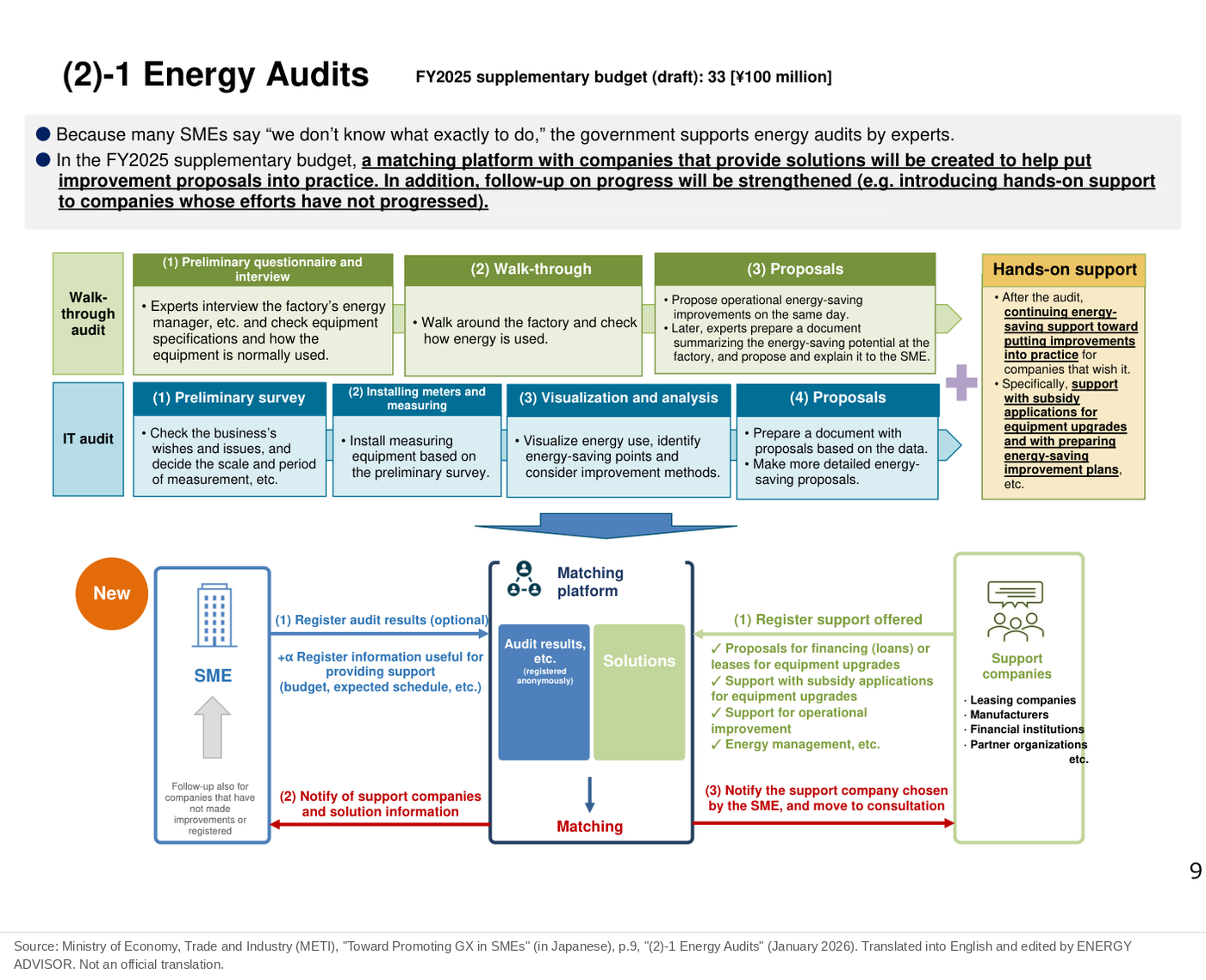
Shoene Otasuke-tai (local energy-saving support teams) provides audits conducted by local energy audit organizations (networks of energy-saving consulting companies, regional financial institutions, chambers of commerce and others) under the “Program for Optimizing Regional Energy Use and Expanding Energy Audits” of METI’s Agency for Natural Resources and Energy (ANRE). It is not free but low-cost: a walk-through audit of a single piece of equipment costs ¥6,006 per item, and a walk-through audit of a whole factory or business site costs ¥16,016 to ¥51,051 (depending on size, tax included). These are the fees under the program funded by the FY2025 supplementary budget. The program began accepting audit applications on March 30, 2026, and these are the Shoene Otasuke-tai audits available in FY2026 (April 2026–March 2027). The fees change with each year’s program.
Source: Sustainable open Innovation Initiative (SII), “Energy Audits” (Shoene Otasuke-tai) (in Japanese)
The ECCJ energy-saving optimization audit is an audit of a whole factory or building conducted by The Energy Conservation Center, Japan (ECCJ). It is also paid but low-cost. In FY2026, the audit fee is ¥9,460 to ¥30,470 (tax included), depending on the site’s annual energy use and other factors. For example, a Quick audit for sites using less than 100 kL in crude oil equivalent costs ¥9,460, and a Basic large-scale audit for sites using 1,500 kL or more costs ¥30,470.
Sources: ECCJ, “Energy-Saving Optimization Audit: Service Details” (FY2026 fee table) (in Japanese); ECCJ, “Energy-Saving Optimization Audit” (in Japanese); Energy Conservation and Power Saving Portal Site, “Energy Audit Flowchart” (in Japanese)
Free audits by local governments are also available in some areas. In Tokyo, for example, Cool Net Tokyo (the Tokyo Metropolitan Center for Climate Change Actions) provides energy audits completely free of charge, with specialists visiting small and medium-sized business sites (as a guide, sites using less than 1,500 kL/year of energy in crude oil equivalent). An audit takes about 90 minutes and includes an on-site survey and improvement proposals. Whether free audits are available and what they include differ by local government.
Source: Cool Net Tokyo, “Energy Audits for Small and Medium-Sized Business Sites” (in Japanese)
The SMRJ carbon neutrality advisory service is a completely free advisory service provided by the Organization for Small & Medium Enterprises and Regional Innovation, JAPAN (SMRJ), an independent administrative agency, at its regional headquarters across Japan. In person or online (Zoom or Microsoft Teams), you can consult on topics such as how to survey your CO2 emissions and how to explain things to customers, in one-hour sessions by appointment.
Source: SMRJ, “Support for Carbon Neutrality” (in Japanese)
If you want to proceed with advice, you can start with the free SMRJ service and then move on to a Shoene Otasuke-tai or ECCJ audit when you reach the stage of checking figures on site.
Cloud-Based Calculation Services as an Option
If you have many sites or fuel types and totaling them yourself becomes cumbersome, another option is a cloud-based calculation service that automatically calculates Scope 1 and 2 emissions when you enter bill data or consumption. Specific providers and prices are not listed here. A realistic order is to first try the do-it-yourself calculation method introduced in this article, and then consider such a service once the number of sites or the scope of calculation grows.
Summary
Scope 1, that is, CO2 emissions from burning fuel at your company, can be calculated with the formula “fuel consumption × calorific value per unit × carbon emission factor × 44/12.” Using the “List of Calculation Methods and Emission Factors” published by MOE and METI, you only need to multiply consumption by a factor. Note that for city gas alone, as with electricity, you use the factor published for the gas supplier you have a contract with. Once you collect 12 months of bills, delivery slips and refueling records, you can start calculating Scope 1 today. If you are unsure about calculating yourself or planning measures, low-cost services such as Shoene Otasuke-tai and the ECCJ energy-saving optimization audit, free audits by local governments and the free SMRJ advisory service can help. By combining your own calculations with this public support, you can complete the visualization of Scope 1 and Scope 2 without relying on outside consultants.
Related Articles
- Part 2: Scope 1, 2 and 3 and the Carbon Footprint of Products (CFP) — Company-Wide vs. per Product
- Part 4: Calculating Scope 2 in Practice — CO2 Emissions from Electricity Consumption
- Part 5: The Emission Factor System — Basic, Adjusted, Menu-Specific and Residual Mix
Note: The information in this article is current as of the time of posting and may have changed by the time you read it.

This article is based on published materials from the Ministry of Economy, Trade and Industry and its Agency for Natural Resources and Energy, the Electricity and Gas Market Surveillance Commission, the Organization for Cross-regional Coordination of Transmission Operators (OCCTO) and other sources. The English translations of figures are by ENERGY ADVISOR and are not official translations. When using this information for decisions, please check the original sources. When we find an error, we correct the article and note the date of the correction.
Sources
- MOE and METI, “GHG Emissions Calculation and Reporting Manual, Ver. 6.1,” Part II, 3.1.1 “Use of Fuels” (in Japanese). https://policies.env.go.jp/earth/ghg-santeikohyo/files/manual/chpt2_6-1.pdf
- MOE and METI, “List of Calculation Methods and Emission Factors” (in Japanese). https://policies.env.go.jp/earth/ghg-santeikohyo/files/calc/ichiran_2025r.pdf
- MOE and METI, “Gas Supplier-Specific Emission Factors (for Calculating GHG Emissions of Specified Emitters): FY2025 Supply Results” (published June 30, 2026) (in Japanese). https://policies.env.go.jp/earth/ghg-santeikohyo/files/calc/r08_gas_coefficient.pdf
- MOE and METI, “Calculation Methods and List of Emission Factors,” top page (in Japanese). https://policies.env.go.jp/earth/ghg-santeikohyo/calc.html
- Sustainable open Innovation Initiative (SII), “Energy Audits” (Shoene Otasuke-tai and registered audit organizations) (in Japanese). https://shoeneshindan.jp/
- Energy Conservation and Power Saving Portal Site, “Comparison of Energy Audit Menus” and “Energy Audit Flowchart” (in Japanese). https://shoeneshindan.jp/assets/docs/r7h_shoeneshindanhikakuhyo.pdf, https://shoeneshindan.jp/assets/docs/r7h_shoeneshindanfurochato.pdf
- The Energy Conservation Center, Japan (ECCJ), “Energy-Saving Optimization Audit” (in Japanese). https://www.eccj.or.jp/shindan/
- Cool Net Tokyo (Tokyo Metropolitan Center for Climate Change Actions), “Energy Audits for Small and Medium-Sized Business Sites” (in Japanese). https://www.tokyo-co2down.jp/learn/diagnosis-office
- Organization for Small & Medium Enterprises and Regional Innovation, JAPAN (SMRJ), “Support for Carbon Neutrality” (in Japanese). https://www.smrj.go.jp/sme/sdgs/favgos000001to2v.html